Citroen Nemo Dag (2008 year). Manual - part 6
 

  Index      Citroen     Citroen Nemo Dag - service manual 2008 year in english


Search            


Content   ..  4  5  6  7   ..


Citroen Nemo Dag (2008 year). Manual - part 6


7

5

4

ER

G

O

N

O

MI

C

a

n

d

 C

O

MF

O

R

T

   Practical information   

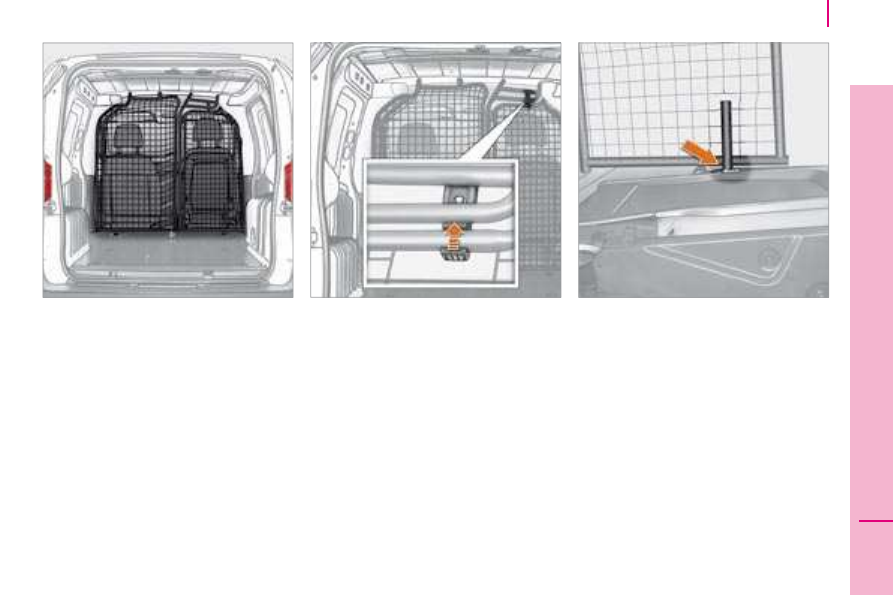
  Modular vertical grille 

 You can obtain a two-part partition grille. 
 Associated with the retractable seat, the 
grille increases the driver’s safety by 
isolating him from the front load. 

 Operations: 
1.   Place the passenger seat in the fully 

folded position.

2.   Pull the catch, located at the lower part of 

the grille.

3.   Pull the catch, located at the upper part 

of the grille.

4.   Pivot the grille and insert the catch in the 

space provided on the backrest of the 
passenger seat.

7

6

Practical information

 LOAD SPACE LAYOUT (COMBI) 

  Stowing rings 

 There are 4 stowing rings on the rear floor to 
secure your loads.  

      Luggage retaining net  

 Attached to the stowing rings, this allows 
you to secure your loads.  

  Rear shelf  

 Deployed, to hide the contents of the boot 
from the exterior.
Folded up, for easier access to the contents 
of the boot.
Stored behind the rear benchseat, for the 
vertical loading of bulky items.   

  Removing the shelf 

 Fold the shelf up.
Tilt the shelf to approximately 60°.
Unclip the side fixings of the shelf from their 
brackets.
Remove the shelf.
Store the shelf folded up in the storage area 
behind the rear benchseat.
To put it back in place, perform these 
operations in the opposite order.   

7

7

4

ER

G

O

N

O

MI

C

a

n

d

 C

O

MF

O

R

T

   Practical information   

 INTERIOR LIGHTING 

  Front courtesy light 

 This is located in the centre of the roof. 
 It can be activated by: 
   -   tilting the lens, 

  -   opening or closing a door, 

  -   locking or unlocking the vehicle.  

 It switches off automatically, after a few 
minutes, if the doors remain open, or when 
the ignition is switched on. 
 The courtesy light may be fitted with an 
alarm sensor, a microphone for the hands-
free kit and reading lights. 
 The reading lights have right-hand and left-
hand switches.  

  Rear courtesy light  

 This is located on the upper part of the rear 
right side. 
 Press the courtesy light lens to switch it on 
or off. 
 It comes on automatically when a door is 
opened.  

  Good practice 

 It switches off automatically: 
   -   if the switch is not pressed down, 

  -   in all cases within approximately 

15 minutes if the doors remain open, 

  -   when the ignition is switched on.   

7

8

Driving safety

 PARKING BRAKE 

  Applying 

 Pull the parking brake to immobilise your 
vehicle. 
 Check that the parking brake is applied 
firmly before leaving the vehicle. 

 If the parking brake is still on or has 
not been released properly, this is 
indicated by this warning light which 
comes on on the instrument panel. 

 When parking on a slope, direct your wheels 
towards the pavement and pull the parking 
brake.   There is no advantage in engaging a 
gear after parking the vehicle, particularly if 
the vehicle is loaded.  

  Releasing 

 Pull the handle and press the button to lower 
the parking brake.   

 HAZARD WARNING LIGHTS 

 Press this button, the two direction 
indicators flash. 
 They operate with the ignition off.  
 When the hazard warning lights are switched 
on, the change of direction function, via the 
right-hand or left-hand direction indicator, is 
deactivated. 

7

9

5

SA

F

ET

Y

 Driving safety 

 HORN 

 Press the centre of the steering wheel.  

 ABS ANTI-LOCK BRAKING SYSTEM 

 The ABS system improves vehicle stability 
and handling during braking, particularly on 
surfaces with poor adhesion (e.g. damaged 
or slippery road surfaces).
Note : when changing a wheel (tyres 
and rims), ensure that they meet the 
manufacturer’s requirements.
The anti-locking system automatically 
intervenes when there is a risk of the wheels 
locking.
The normal functioning of the ABS system 
may be indicated by light vibrations on the 
brake pedal.
When braking in an emergency, press 
hard on the brake pedal without releasing 
the force.

If the ABS warning lamp lights 
up on the instrument panel, this 
indicates a malfunction of the ABS 
system, which could lead to a loss 

of control of the vehicle when braking.
You must stop.
Contact a CITROËN dealer.

   Good practice  
 The anti-lock braking system comes into 
operation automatically when there is a risk 
of wheel lock. It does not permit shorter 
braking. On very slippery road surfaces 
(ice, oil, etc.) the ABS may lengthen the 
braking distances. In emergency braking, 
do not hesitate to press the brake pedal 
firmly, without releasing the pressure, even 
on slippery roads, you will then be able to 
continue to manoeuvre the vehicle to avoid 
an obstacle. 

8

0

Seat belts

 CAB SEAT BELTS 

 The front seats are fitted with pre-tensioners 
and force limiters. 

  Fastening 

 Pull the strap, then insert the tongue into the 
buckle. 
 Check that the seat belt is fastened correctly 
by pulling the strap. 
 The lap belt must be positioned as low as 
possible on the pelvis. The chest belt must 
pass over the hollow of the shoulder. 
 Check that the seat belt is fastened correctly 
by pulling the strap.  

  Inertia reel seat belts 

 These are fitted with a device which locks 
automatically in the event of a collision or 
emergency braking. 
 Safety in the event of a front impact has 
been improved by the introduction of 
pretensioning and force limiting seat belts. 
Depending on the seriousness of the 
impact, the pretensioning system instantly 
tightens the seat belt against the body of the 
occupant. 
 The pretensioning seat belts are active when 
the ignition is on. 
 The force limiter reduces the pressure of the 
seat belt against the body of the occupant in 
the event of an accident.  

  Driver’s seat belt not fastened warning 
light 

 When the vehicle is started, this 
warning light comes on if the 
driver has not fastened his seat 
belt.  

 REAR SEAT BELTS (COMBI) 

 The 3-seater benchseat is fitted with 3-point 
seat belts with force limiting reels. 
The centre seat has a guide and a reel, 
connected to the seat backrest.

When a seat belt is not in use, you 
can store its buckle in the storage 

space provided in the seat cushion of the 
benchseat.   

8

1

5

SA

F

ET

Y

   Seat belts   

  Good practice 

 Wherever you are seated in the vehicle, 
always fasten your seat belt, even for short 
journeys. 
 The seat belts are fitted with an inertia reel 
which automatically adjusts the length of the 
strap to your size. The seat belt is rolled up 
automatically when not in use. 
 Ensure that the seat belt is rolled up 
correctly after use. 
 After folding or moving a seat, ensure that 
the seat belt is rolled up correctly in its 
compartment and that the buckle is ready to 
accommodate the tongue. 

 The inertia reels are fitted with a device 
which automatically locks the strap in the 
event of a collision or emergency braking or 
if the vehicle rolls over.   

 The air bag warning light comes 
on if the pretensioners are 
triggered.  Consult a CITROËN 
dealer . 

 Depending on the nature and seriousness 
of any impact, the pretensioning device may 
be triggered before and independently of 
inflation of the air bags. It instantly tightens 
the seat belts against the body of the 
occupants. 
 The force limiter reduces the pressure of the 
seat belt against the body of the occupants. 
The equipment fitted to these seat belts is 
operational when the ignition is switched on. 

 In order to be effective, a seat belt must: 
   -   restrain one person only, 

  -   must not be twisted, check by pulling in 

front of you with an even movement, 

  -   be tightened as close to the body as 

possible.  

 The upper part of the seat belt should be 
positioned in the hollow of the shoulder. 
 The lap part should be placed as low as 
possible on the pelvis. 
 Do not invert the seat belt buckles as they 
will not fulfil their role completely. If the 
seats are fitted with armrests, the lap part of 
the seat belt should always pass under the 
armrest. 
 Check that the seat belt is fastened correctly 
by pulling the strap firmly. 

  Recommendations for children: 

   -   use a suitable child seat if the passenger 

is less than 12 years old or shorter than 
one metre fifty, 

  -   never allow a child to travel on your lap, 

even with the seat belt fastened.  

 For further information regarding child 
seats, refer to the “Child safety” section 

of chapter 5. 

 In accordance with current safety 
regulations, your  CITROËN dealer  
guarantees all work or any checks, from 
testing to maintenance, on your seat belt 
equipment. 
 Have the seat belts checked regularly 
(even after a minor impact) by a  CITROËN 
dealer : they must not show any signs of 
wear, cutting or fraying and they must not be 
transformed or modified. 

 Clean the seat belt straps with soapy 
water or a textile cleaning product, sold 

by a  CITROËN dealer .   

8

2

Air bags   

 AIR BAGS 

 The air bags have been designed to 
maximise the safety of the occupants in the 
event of a serious collision; they work in 
conjunction with the force limiting seat belts. 
 In the event of a serious collision, the 
electronic detectors record and analyse the 
front and side impacts suffered in the impact 
detection zones:  
   -   in the event of a serious impact, the air 

bags inflate instantly and protect the 
occupants of the vehicle. Immediately 
after the impact, the air bags deflate 
rapidly, so that they do not hinder the 
visibility of the occupants nor their 
possible exit from the vehicle. 

  -   in the event of a minor or rear impact 

and in certain roll-over conditions, the air 
bags will not be deployed; the seat belt 
alone is sufficient to provide maximum 
protection in these situations.  

 The seriousness of the collision depends on 
the nature of the obstacle and the speed of 
the vehicle at the moment of impact. 

  Air bags only operate when the 
ignition is switched on.
  

 This equipment only operates once. If a 
second impact occurs (during the same or 
a subsequent accident), the air bag will not 
operate. 
 The triggering of an air bag or air bags 
is accompanied by a slight discharge of 
harmless smoke and a noise, due to the 
activation of the pyrotechnic cartridge 
incorporated in the system. 
 This smoke is not harmful, but sensitive 
individuals may experience some irritation. 
 The noise of the detonation may result in a 
slight loss of hearing for a short time. 

 It is imperative that the passenger 
air bag is disarmed if a child seat is 

installed facing rearwards. Refer to the 
“Child safety” section of chapter 5. 

8

3

5

SA

F

ET

Y

   Air bags   

  SIDE AIR BAGS  

  Activation 

 It is triggered   unilaterally in the event of a 
serious side impact, perpendicular to the 
longitudinal centreline of the vehicle on 
a horizontal plane and directed from the 
outside towards the inside of the vehicle. 
 The side air bag inflates between the 
front occupant of the vehicle and the 
corresponding door trim pad.  

    In the event of a minor impact or bump 
on the side of the vehicle or if the 

vehicle rolls over, the air bag may not be 
triggered.  

  Operating fault 

 If this warning light comes on on 
the instrument panel,  consult a 
CITROËN dealer  without delay to 
have the system checked. The air 
bags may no longer be triggered 
in the event of a serious impact. 

8

5

5

SA

F

ET

Y

   Air bags   

   For the air bags to be fully effective, 
observe the following safety rules: 

 Sit in a normal upright position. 
 Wear a correctly adjusted seat belt. 
 Do not leave anything between the 
occupants and the air bags (a child, pet, 
object...). This could hamper the operation 
of the air bags or injure the occupants. 
 After an accident or if the vehicle has been 
stolen or broken into, have the air bag 
systems checked. 
 All work on the air bag systems is strictly 
forbidden unless it is carried out by the 
qualified personnel of a  CITROËN dealer . 
 Even if all of the precautions mentioned are 
observed, a risk of injury or of slight burns 
to the head, chest or arms when an air bag 
is triggered cannot be ruled out. In fact, 
the bag inflates almost instantly (within a 
few milliseconds) then deflates within the 
same time, discharging the hot gas through 
openings provided for this purpose.  

  Front air bags 

 Do not drive holding the steering wheel 
by its spokes or resting your hands on the 
centre part of the wheel. 
 Passengers must not place their feet on the 
fascia. 
 Smoke as little as possible as deployment of 
the air bags can cause burns or the risk of 
injury from a cigarette or pipe. 
 Never remove or pierce the steering wheel 
or hit it violently.  

  Side air bags  

 Only put approved covers on the seats. 
These will not hinder the triggering of the 
side air bags.  Consult a CITROËN dealer . 
 Do not fix or glue anything to the seat backs. 
This could cause injury to the chest or arms 
when the side air bag inflates. 
 Do not sit with the upper part of the body 
any nearer to the door than necessary.   

8

2

Air bags   

 AIR BAGS 

 The air bags have been designed to 
maximise the safety of the occupants in the 
event of a serious collision; they work in 
conjunction with the force limiting seat belts. 
 In the event of a serious collision, the 
electronic detectors record and analyse the 
front and side impacts suffered in the impact 
detection zones:  
   -   in the event of a serious impact, the air 

bags inflate instantly and protect the 
occupants of the vehicle. Immediately 
after the impact, the air bags deflate 
rapidly, so that they do not hinder the 
visibility of the occupants nor their 
possible exit from the vehicle. 

  -   in the event of a minor or rear impact 

and in certain roll-over conditions, the air 
bags will not be deployed; the seat belt 
alone is sufficient to provide maximum 
protection in these situations.  

 The seriousness of the collision depends on 
the nature of the obstacle and the speed of 
the vehicle at the moment of impact. 

  Air bags only operate when the 
ignition is switched on.
  

 This equipment only operates once. If a 
second impact occurs (during the same or 
a subsequent accident), the air bag will not 
operate. 
 The triggering of an air bag or air bags 
is accompanied by a slight discharge of 
harmless smoke and a noise, due to the 
activation of the pyrotechnic cartridge 
incorporated in the system. 
 This smoke is not harmful, but sensitive 
individuals may experience some irritation. 
 The noise of the detonation may result in a 
slight loss of hearing for a short time. 

 It is imperative that the passenger 
air bag is disarmed if a child seat is 

installed facing rearwards. Refer to the 
“Child safety” section of chapter 5. 

8

4

Air bags   

  FRONT AIR BAGS 

 The front air bags are incorporated in the 
centre of the steering wheel for the driver 
and in the fascia for the front passenger. 

  Activation 

 They are deployed simultaneously, unless 
the passenger’s front air bag has been 
disarmed, in the event of a serious front 
impact. 
 The front air bag inflates between the front 
occupant of the vehicle and the fascia to 
cushion his forward movement.  

  Disarming  

 The passenger’s front air bag alone can be 
disarmed. The air bag is disarmed from the 
trip computer. 

 The air bag warning light on the 
instrument panel is lit throughout 
the period of disarming. 

 To ensure the safety of your child, it 
is essential to disarm the passenger 

air bag when you install a rear-facing child 
seat on the front passenger seat. Otherwise, 
the child would risk being killed or seriously 
injured if the air bag were to inflate.  

 Refer to the “MENU” section of chapter 
3, then select  OFF  on the “Passenger 

air bag” menu. 

  Operating fault 

  If the two air bag warning lights are lit 
continuously, do not install a rear-facing 
child seat.  Consult a CITROËN dealer .   

 If this warning light comes 
on on the instrument panel, 
accompanied by an audible signal 
and a message on the display, 

 consult a CITROËN dealer  without delay 
to have the system checked. The air bags 
may no longer be triggered in the event of a 
serious impact.    

8

5

5

SA

F

ET

Y

   Air bags   

   For the air bags to be fully effective, 
observe the following safety rules: 

 Sit in a normal upright position. 
 Wear a correctly adjusted seat belt. 
 Do not leave anything between the 
occupants and the air bags (a child, pet, 
object...). This could hamper the operation 
of the air bags or injure the occupants. 
 After an accident or if the vehicle has been 
stolen or broken into, have the air bag 
systems checked. 
 All work on the air bag systems is strictly 
forbidden unless it is carried out by the 
qualified personnel of a  CITROËN dealer . 
 Even if all of the precautions mentioned are 
observed, a risk of injury or of slight burns 
to the head, chest or arms when an air bag 
is triggered cannot be ruled out. In fact, 
the bag inflates almost instantly (within a 
few milliseconds) then deflates within the 
same time, discharging the hot gas through 
openings provided for this purpose.  

  Front air bags 

 Do not drive holding the steering wheel 
by its spokes or resting your hands on the 
centre part of the wheel. 
 Passengers must not place their feet on the 
fascia. 
 Smoke as little as possible as deployment of 
the air bags can cause burns or the risk of 
injury from a cigarette or pipe. 
 Never remove or pierce the steering wheel 
or hit it violently.  

  Side air bags  

 Only put approved covers on the seats. 
These will not hinder the triggering of the 
side air bags.  Consult a CITROËN dealer . 
 Do not fix or glue anything to the seat backs. 
This could cause injury to the chest or arms 
when the side air bag inflates. 
 Do not sit with the upper part of the body 
any nearer to the door than necessary.   

8

6

 Child safety 

   GENERAL POINTS RELATING TO CHILD 
SEATS 

 Although one of  CITROËN ’s main criteria 
when designing your vehicle, the safety of 
your children also depends on you. 
 For maximum safety, please follow these 
precautions: 
   -   in accordance with Directive 2003/20,  all 

children under the age of 12 or less 
than one metre fifty tall must travel in 
approved child seats suited to their 
weight
 , on seats fitted with a seat belt or 
ISOFIX mountings. 

  -    statistically, the safest seat positions 

for carrying children are the rear seats 
of the vehicle,

-  a child weighing under 9 kg must 

always be carried in the “rearwards-
facing” position whether in the front or 
the back of the vehicle.
  

 CITROËN  recommends  that children are 
carried in the rear seats of your vehicle : 
   -    “rearwards-facing” up to the age of 2,

-  “forwards-facing” over the age of 2.       

  INSTALLING A CHILD SEAT USING A THREE POINT SEAT BELT  

  “Rearwards-facing” 

   Do not forget to disarm the air 
bag before installing the child. 
 When a “rearwards-facing” child 
seat is installed on the  front 

passenger seat , it is essential that the 
passenger air bag is disarmed. Otherwise, 
 the child would risk being seriously 
injured or killed if the air bag were to 
inflate
 . 

  “Forwards-facing” 


 When a “forwards-facing” child 
seat is installed on the  front 
passenger seat
 , leave the 
passenger air bag armed. 


 The rules for transporting children are 
specific to each country. Consult the 

current legislation in your country. 
 Please consult the list of seats approved 
in your country. The isofix mountings, the 
rear seats, the passenger air bag and the 
disarming of this air bag depend on the 
version sold. 


8

7

5

SA

F

ET

Y

 Child safety 

 To deactivate or activate the passenger 
airbag, refer to Chapter 3, section 

“MENU”. 

  CHILD SEATS RECOMMENDED BY CITROËN 

  CITROËN  offers a complete range of recommended child seats which are  secured using a 
three point seat belt
 : 

 The child seats function is shared by 
the entire  CITROËN  range. However, 

each individual model has its own special 
features. 
 If your vehicle is fitted with this function, the 
passenger air bag must be disarmed using 
the trip computer MENU button. 
 If your vehicle is not fitted with the 
passenger air bag disarming function, the 
installation of a “rear-facing” child seat on 
the vehicle’s front seat is strictly prohibited. 
 The passenger must not travel with a child 
on his lap. 

   Group 0: from birth to 10kg  
Group 0+: from birth to 13 kg


   L1   
“ROMER Baby-Safe Plus”  
Installed in the rear-facing position 
       

   Groups 1, 2 and 3: from 9 to 36 kg   


   L2    
“KIDDY Life”  
For the safety of young children (from 9 to 
18 kg),  CITROËN  recommends use of the 
restraining cushion.  

   Groups 2 and 3: from 15 to 36 kg   


   L3   
“RECARO Start’’  


   L4    
“KLIPPAN Optima”  
From the age of 6 
years (approximately 
22 kg), the booster 
is used on its own.  

8

7

5

SA

F

ET

Y

 Child safety 

 To deactivate or activate the passenger 
airbag, refer to Chapter 3, section 

“MENU”. 

  CHILD SEATS RECOMMENDED BY CITROËN 

  CITROËN  offers a complete range of recommended child seats which are  secured using a 
three point seat belt
 : 

 The child seats function is shared by 
the entire  CITROËN  range. However, 

each individual model has its own special 
features. 
 If your vehicle is fitted with this function, the 
passenger air bag must be disarmed using 
the trip computer MENU button. 
 If your vehicle is not fitted with the 
passenger air bag disarming function, the 
installation of a “rear-facing” child seat on 
the vehicle’s front seat is strictly prohibited. 
 The passenger must not travel with a child 
on his lap. 

   Group 0: from birth to 10kg  
Group 0+: from birth to 13 kg


   L1   
“ROMER Baby-Safe Plus”  
Installed in the rear-facing position 
       

   Groups 1, 2 and 3: from 9 to 36 kg   


   L2    
“KIDDY Life”  
For the safety of young children (from 9 to 
18 kg),  CITROËN  recommends use of the 
restraining cushion.  

   Groups 2 and 3: from 15 to 36 kg   


   L3   
“RECARO Start’’  


   L4    
“KLIPPAN Optima”  
From the age of 6 
years (approximately 
22 kg), the booster 
is used on its own.  


Content   ..  4  5  6  7   ..