Dodge 2500 Diesel (2008 year). Instruction - part 23
 

  Index      Dodge     Dodge 2500 Diesel (2008 year) - instruction in english


Search            copyright infringement  


Content      ..     21      22      23      24     ..


Dodge 2500 Diesel (2008 year). Instruction - part 23


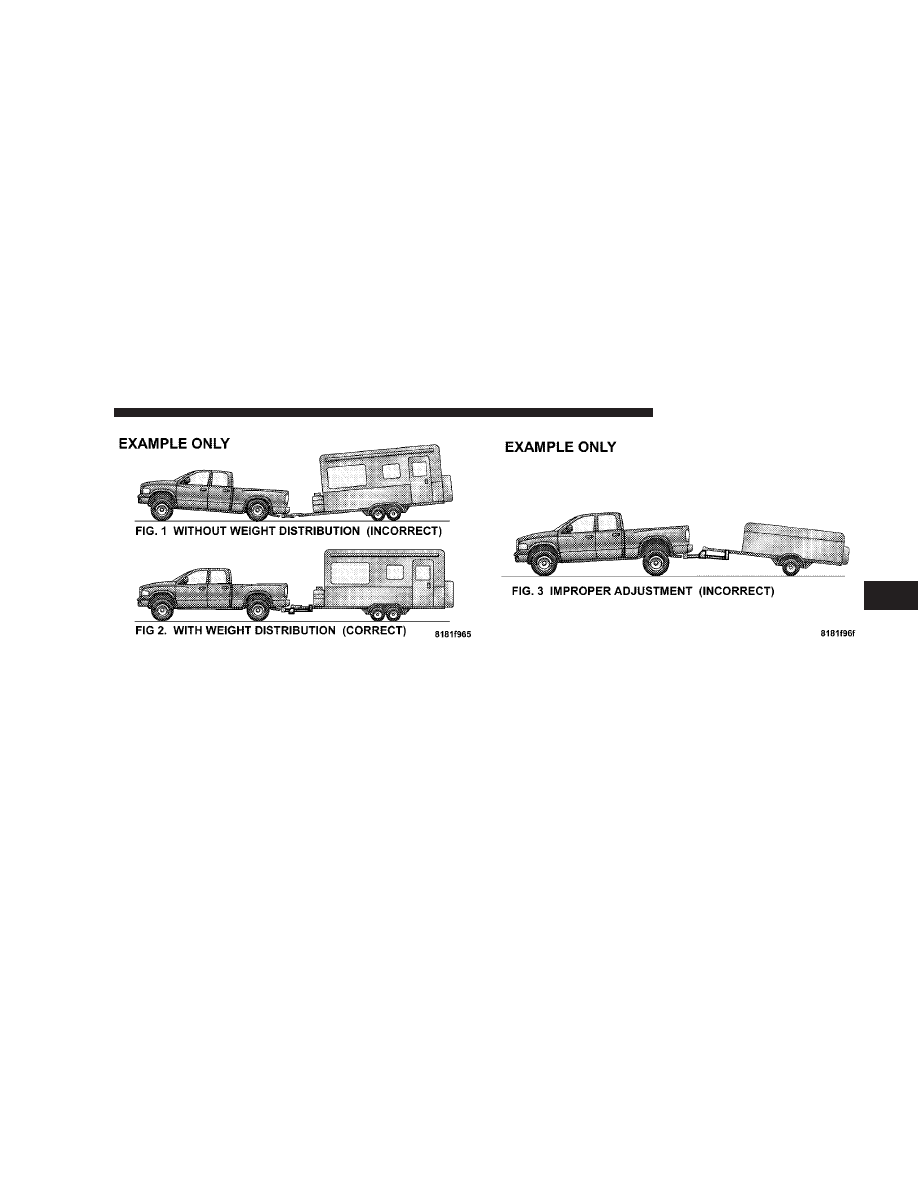
Weight-Distributing Hitch System

Improper Adjustment Of Weight-Distributing System

STARTING AND OPERATING

359

5

-------------------------------------------------------------------------------------------------------------------------------------------------------------

Fifth-Wheel Hitch
A special high platform with a coupling that mounts over
the rear axle of the tow vehicle in the truck bed. Connects
a vehicle and fifth-wheel trailer with a coupling king pin.

Gooseneck Hitch
The gooseneck hitch employs a pivoted coupling arm
which attaches to a ball mounted in the bed of a pickup
truck. The coupling arm connects to the hitch mounted
over the rear axle in the truck bed.

Trailer Hitch Classification

The rear bumper is intended to tow trailers up to 2,000
lbs (907 kg) without added equipment or alterations to
the standard equipment. Your vehicle may be factory
equipped for safe towing of trailers weighing over 2,000
lbs (907 kg) with the optional Trailer Tow Prep Package.
See your dealer for package content.

The following chart provides the industry standard for
the maximum trailer weight a given trailer hitch class can

tow and should be used to assist you in selecting the
correct trailer hitch for your intended towing condition.
Refer to “Trailer Towing Weights (Maximum Trailer
Weight Ratings)” for the website address that contains
the necessary information for your specific drivetrain.

Trailer Hitch Classification

Class

Max. GTW

(Gross Trailer Wt.)

Class I - Light Duty

2,000 lbs (907 kg)

Class II - Medium
Duty

3,500 lbs (1587 kg)

Class III - Heavy Duty

5,000 lbs (2268 kg)

Class IV - Extra
Heavy Duty

10,000 lbs (4540 kg)

Fifth Wheel/
Gooseneck

Greater than 10,000 lbs

(4540 kg)

All trailer hitches should be professionally installed on
your vehicle.

360

STARTING AND OPERATING

-------------------------------------------------------------------------------------------------------------------------------------------------------------

Trailer Towing Weights (Maximum Trailer Weight
Ratings)

NOTE:

For additional trailer towing information (maxi-

mum trailer weight ratings) refer to the following website
addresses:

• http:// www.dodge.com/towing.
• http:// www.dodge.ca (Canada).

Trailer and Tongue Weight

Always load a trailer with 60% to 65% of the weight in
the front of the trailer. This places 10% to 15% of the
Gross Trailer Weight (GTW) on the tow hitch of your
vehicle. Loads balanced over the wheels or heavier in the
rear can cause the trailer to sway severely side to side
which will cause loss of control of vehicle and trailer.
Failure to load trailers heavier in front is the cause of
many trailer accidents.

Never exceed the maximum tongue weight stamped on
your bumper or trailer hitch.

Consider the following items when computing the
weight on the rear axle of the vehicle:

• The tongue weight of the trailer.

STARTING AND OPERATING

361

5

-------------------------------------------------------------------------------------------------------------------------------------------------------------

• The weight of any other type of cargo or equipment

put in or on your vehicle.

• The weight of the driver and all passengers.

NOTE:

Remember that everything put into or on the

trailer adds to the load on your vehicle. Also, additional
factory-installed options, or dealer-installed options,
must be considered as part of the total load on your
vehicle. Refer to the Tire and Loading Information plac-
ard in the Tire Safety Information Section of this instruction.

Towing Requirements

To promote proper break-in of your new vehicle driv-
etrain components the following guidelines are recom-
mended:

CAUTION!

• Avoid towing a trailer for the first 500 miles (805

km) of vehicle operation. Doing so may damage
your vehicle.

• During the first 500 miles (805 km) of trailer

towing, limit your speed to 50 mph (80 km/h).

WARNING!

Your vehicle may require special axle lubricant.
Please refer to the fluids section of this instruction.

Perform the maintenance listed in Section 8 of this
instruction. When towing a trailer, never exceed the GAWR,
or GCWR, ratings.

362

STARTING AND OPERATING

-------------------------------------------------------------------------------------------------------------------------------------------------------------

WARNING!

Improper towing can lead to an injury accident.
Follow these guidelines to make your trailer towing
as safe as possible:

Make certain that the load is secured in the trailer
and will not shift during travel. When trailering
cargo that is not fully secured, dynamic load shifts
can occur that may be difficult for the driver to
control. You could lose control of your vehicle and
have an accident.

• When hauling cargo or towing a trailer, do not over-

load your vehicle or trailer. Overloading can cause a
loss of control, poor performance or damage to brakes,
axle, engine, transmission, steering, suspension, chas-
sis structure or tires.

• Safety chains must always be used between your

vehicle and trailer. Always connect the chains to the
frame or hook retainers of the vehicle hitch. Cross the
chains under the trailer tongue and allow enough
slack for turning corners.

• Vehicles with trailers should not be parked on a grade.

When parking, apply the parking brake on the tow
vehicle. Put the tow vehicle automatic transmission in
P for Park. With a instruction transmission, shift the
transmission into reverse. And with four-wheel-drive
vehicles, make sure the transfer case is not in neutral.
Always, block or

9chock9 the trailer wheels.

• GCWR must not be exceeded.
• Total weight must be distributed between the tow

vehicle and the trailer such that the following four
ratings are not exceeded:

1. GVWR

STARTING AND OPERATING

363

5

-------------------------------------------------------------------------------------------------------------------------------------------------------------

2. GTW

3. GAWR

4. Tongue weight rating for the trailer hitch utilized
(This requirement may limit the ability to always
achieve the 10% to 15% range of tongue weight as a
percentage of total trailer weight).

Towing Requirements — Tires

− Do not attempt to tow a trailer while using a compact

spare tire.

− Proper tire inflation pressures are essential to the safe

and satisfactory operation of your vehicle. Refer to the
Tires–General Information section of this instruction on
Tire Pressures for proper tire inflation procedures.

− Also, check the trailer tires for proper tire inflation

pressures before trailer usage.

− Check for signs of tire wear or visible tire damage

before towing a trailer. Refer to the Tires–General
Information section of this instruction on Tread Wear
Indicators for the proper inspection procedure.

− When replacing tires refer to the Tires–General Infor-

mation section of this instruction on Replacement Tires for
proper tire replacement procedures. Replacing tires
with a higher load carrying capacity will not increase
the vehicle’s GVWR and GAWR limits.

Towing Requirements — Trailer Brakes

− Do not interconnect the hydraulic brake system or

vacuum system of your vehicle with that of the trailer.
This could cause inadequate braking and possible
personal injury.

364

STARTING AND OPERATING

-------------------------------------------------------------------------------------------------------------------------------------------------------------

− An electronically actuated trailer brake controller is

required when towing a trailer with electronically
actuated brakes. When towing a trailer equipped with
a hydraulic surge actuated brake system, an electronic
brake controller is not required.

− Trailer brakes are recommended for trailers over 1,000

lbs (454 kg) and required for trailers in excess of 2,000
lbs (907 kg).

CAUTION!

If the trailer weighs more than 1,000 lbs (454 kg)
loaded, it should have its own brakes and they
should be of adequate capacity. Failure to do this
could lead to accelerated brake lining wear, higher
brake pedal effort, and longer stopping distances.

WARNING!

Do not connect trailer brakes to your vehicle’s hy-
draulic brake lines. It can overload your brake sys-
tem and cause it to fail. You might not have brakes
when you need them and could have an accident.

Towing any trailer will increase your stopping dis-
tance. When towing you should allow for additional
space between your vehicle and the vehicle in front
of you. Failure to do so could result in an accident.

Towing Requirements — Trailer Lights & Wiring
Whenever you pull a trailer, regardless of the trailer size,
stop lights and turn signals on the trailer are required for
motoring safety.

STARTING AND OPERATING

365

5

-------------------------------------------------------------------------------------------------------------------------------------------------------------

The Trailer Tow Package may include a 4 and 7 pin
wiring harness. Use a factory approved trailer harness
and connector.

NOTE:

Do not cut or splice wiring into the vehicles

wiring harness.

The electrical connections are all complete to the vehicle
but you must mate the harness to a trailer connector.
Refer to the following illustrations.

4-Pin Connector

366

STARTING AND OPERATING

-------------------------------------------------------------------------------------------------------------------------------------------------------------

WARNING!

Any work done to the vehicles electrical system, or
wiring, should be performed by a qualified automo-
tive technician, if done improperly it may cause
damage to the electrical system wiring and could
result in serious or fatal injury.

The following chart identifies the maximum electrical
loads that the trailer tow output circuits are capable of
supporting.

7-Pin Connector

STARTING AND OPERATING

367

5

-------------------------------------------------------------------------------------------------------------------------------------------------------------

Trailer Tow Additional Lamp Loads

Output

Functions

Maximum

Current

Additional Bulbs

Allowed Example

Only. Other bulb

combinations can

be used as long

as maximum cur-

rent is not ex-

ceeded.

Stop/Turn Left

16A

2 #3157 bulbs for
stop/turn

Stop/Turn
Right

16A

2 #3157 bulbs for
stop/turn

Trailer Park
Lamps

14A

2 #1157 bulbs
(two filament

park/stop/turn)

plus up to 24

#168 or #194 pea-

nut bulbs.

Towing Tips

Before setting out on a trip, practice turning, stopping
and backing the trailer in an area away from heavy
traffic.

If using a instruction transmission vehicle for trailer towing,
all starts must be in FIRST gear to avoid excessive clutch
slippage.

Towing Tips — Automatic Transmission
The “D” range can be selected when towing. However, if
frequent shifting occurs while in this range, select

9TOW/

HAUL

9 mode or select a lower gear using the Auto-6

(ERS) switch.

NOTE:

Using the “TOW HAUL” range while operating

the vehicle under heavy operating conditions will im-
prove performance and extend transmission life by re-
ducing excessive shifting and heat build up. This action
will also provide better engine braking.

368

STARTING AND OPERATING

-------------------------------------------------------------------------------------------------------------------------------------------------------------

The automatic transmission fluid and filter should be
changed if you REGULARLY tow a trailer for more than
45 minutes of continuous operation. See Maintenance
Schedule in section 8 of this instruction for transmission
fluid change intervals.

NOTE:

Check the automatic transmission fluid level

before towing.

Towing Tips — Tow/Haul (If Equipped)
To reduce potential for automatic transmission overheat-
ing, turn the “TOW HAUL” feature ON when driving in
hilly areas or downshift the transmission (using the
Auto-6 [ERS] switch).

Towing Tips — Electronic Speed Control (If
Equipped)

− Don’t use in hilly terrain or with heavy loads.

− When using the speed control, if you experience speed

drops greater than 10 mph (16 km/h), disengage until
you can get back to cruising speed.

− Use speed control in flat terrain and with light loads to

maximize fuel efficiency.

Towing Tips — Cooling System
To reduce potential for engine and transmission over-
heating, take the following actions:

− City Driving
When stopped for short periods of time, put transmission
in neutral and increase engine idle speed.

− Highway Driving
Reduce speed.

− Air Conditioning
Turn off temporarily.

STARTING AND OPERATING

369

5

-------------------------------------------------------------------------------------------------------------------------------------------------------------

− refer to Cooling System Operating information in the

Maintenance section of this instruction for more informa-
tion.

Trailer Towing Mirrors — If Equipped

These mirrors are designed with an adjustable mirror
head to provide a greater vision range when towing
extra-wide loads. To change position inboard or out-
board, the mirror head should be rotated (flipped Out or
In). A small blindspot mirror is integrated onto the main
mirror surface.

NOTE:

Fold the 7 x 10 inch trailer towing mirrors

rearward prior to entering an automated car wash.

Blindspot Mirror

370

STARTING AND OPERATING

-------------------------------------------------------------------------------------------------------------------------------------------------------------

SNOWPLOW

Snowplow Prep Packages are available as a factory
installed option. These packages include components
necessary to equip your vehicle with a snowplow.

NOTE:

Before installation of a snowplow it is highly

recommended that the owner / installer obtain and

follow the recommendations contained within the cur-
rent Dodge BODY BUILDER’S GUIDE. See your dealer,
installer or snowplow manufacture for this information.
There are unique electrical systems that must be con-
nected to properly assure operator safety and prevent
overloading vehicle systems.

WARNING!

Attaching a snowplow to this vehicle could adversely
affect performance of the airbag system in an acci-
dent. Do not expect that the airbag will perform as
described earlier in this instruction

CAUTION!

The “Lamp Out” indicator could illuminate if exte-
rior lamps are not properly installed.

Trailer Towing Position

STARTING AND OPERATING

371

5

-------------------------------------------------------------------------------------------------------------------------------------------------------------

Before plowing

• Check the hydraulic system for leaks and proper fluid

level.

• Check the mounting bolts and nuts for proper tight-

ness.

• Check the runners and cutting edge for excessive wear.

The cutting edge should be 1/4 to 1/2 inch above
ground in snow plowing position.

• Check that snowplow lighting is connected and func-

tioning properly.

Snowplow Prep Package Model Availability

For Information about snowplow applications visit
www.dodge.com or refer to the current Dodge Body
Builders Guide.

1. The maximum number of occupants in the truck
should not exceed two.

2. The total GVWR or the Front GAWR or the Rear
GAWR should never be exceeded.

3. The snowplow prep packages are not available with
the Sport Package.

4. Cargo capacity will be reduced by the addition of
options or passengers, etc.

The loaded vehicle weight, including the snowplow
system, all aftermarket accessories, driver, passengers,
options, and cargo, must not exceed either the Gross
Vehicle Weight (GVWR) or Gross Axle Weight (GAWR)
ratings. These weights are specified on the Safety Com-
pliance Certification Label on the driver’s side door
opening.

NOTE:

Detach the snowplow when transporting pas-

sengers.

Vehicle front end wheel alignment was set to specifica-
tions at the factory without consideration for the weight

372

STARTING AND OPERATING

-------------------------------------------------------------------------------------------------------------------------------------------------------------

of the plow. Front end tow-in should be checked and
reset if necessary at the beginning and end of the
snowplow season. This will help prevent uneven tire
wear.

The blade should be lowered whenever the vehicle is
parked.

Maintain and operate your vehicle and snowplow equip-
ment following the recommendations provided by the
specific snowplow manufacturer.

Over the Road Operation With Snowplow
Attached

The blade restricts air flow to the radiator and causes the
engine to operate at higher than normal temperatures.
Therefore, when transporting the plow, angle the blade
completely and position it as low as road or surface
conditions permit. Do not exceed 40 mph (64 km/h). The
operator should always maintain a safe stopping distance
and allow adequate passing clearance.

Methods For Removing Snow

Operating Tips

Under ideal snow plowing conditions, 20 mph (32 km/h)
should be maximum operating speed. The operator
should be familiar with the area and surface to be
cleaned. Reduce speed and use extreme caution when
plowing unfamiliar areas or under poor visibility.

STARTING AND OPERATING

373

5

-------------------------------------------------------------------------------------------------------------------------------------------------------------

NOTE:

During snowplow usage on vehicles equipped

with an overhead console module, the outside tempera-
ture display will show higher temperatures than the
outside ambient temperature. The higher displayed tem-
perature is due to blocked or reduced airflow to the
underhood ambient temperature sensor by the snow-
plow. This is common and outside temperature display
operation will return to normal when the snowplow is
removed.

General Maintenance

Snowplows should be maintained in accordance with the
plow manufacturer’s instructions.

Keep all snowplow electrical connections and battery
terminals clean and free of corrosion.

When plowing snow, to avoid transmission and driv-
etrain damage, the following precautions should be ob-
served.

• Operate with transfer case in 4L when plowing small

or congested areas where speeds are not likely to
exceed 15 mph (24 km/h). At higher speeds operate in
4H.

• Vehicles with 68RFE transmissions should use 4L

range when plowing deep or heavy snow for extended
periods of time to avoid transmission overheating.

• Do not shift the transmission unless the engine has

returned to idle and wheels have stopped. Make a
practice of stepping on the brake pedal before shifting
the transmission.

374

STARTING AND OPERATING

-------------------------------------------------------------------------------------------------------------------------------------------------------------


Content      ..     21      22      23      24     ..