Westfalia. Testing repair electrical manual - part 63
 

  Index      Westfalia     Westfalia (903.662) testing repair electrical manual in english


Search            copyright infringement  


Content   ..  61  62  63  64   ..


Westfalia. Testing repair electrical manual - part 63


AS00.00-Z-0017-
01B

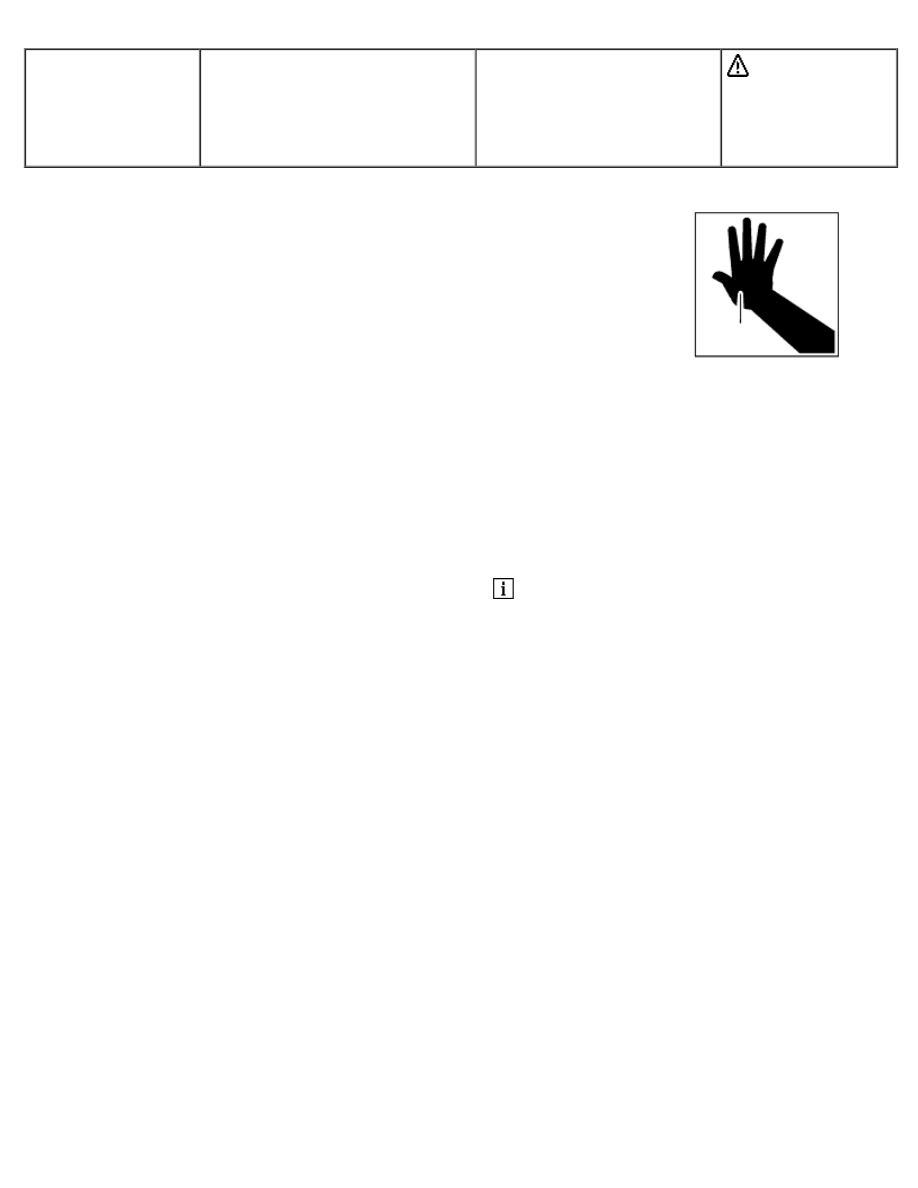
Risk of injury caused by
scraping or cutting body parts on
sharp vehicle parts

Always wear protective
gloves when working on or
near sharp and non-
deburred vehicle parts. 
Deburr repair panels.

 Danger!

Potential risks 

Risk of injury 
When performing work on body parts, major assembly parts and
suspension parts that, due to their manufacturing process or their
finishing stage, have not yet been deburred, there is the risk of cutting,
ripping and scraping body parts on non-deburred edges.


D00.00-1126-01

Safety precautions/instructions 
- Wear protective gloves. 
- Deburr repair panels and edges that have been
cut. 
- Avoid applying too much pressure when working,
otherwise there is the danger of slipping.


First aid measures: 
Move the victim out of the hazard area. 
Treat the wound to stop the bleeding. If any
arteries have been cut, the flow of blood to that
area must be stopped (by applying a tourniquet
above the injured area). 

 Consult a physician immediately in the case of

serious injuries (heavy bleeding, severed limbs,
etc.), sings of blood poisoning or if victim is
unconscious.

AS54.10-Z-0001-
01A

Risk of explosion from gas. Risk
of poisoning and burns from
swallowing battery electrolyte.
Risk of injury to eyes and skin as
result of caustic burns from
battery electrolyte or from
handling damaged lead-acid
batteries.

No fire, sparks, naked flames
or smoking. Wear acid-
resistant gloves, clothing and
eye protection. Pour battery
electrolyte only into suitable
and appropriately marked
containers.

 Danger!

Possible hazards 

Risk of explosion 
A highly explosive gas mixture is produced when
charging lead-acid batteries. 

Risk of poisoning 
If battery electrolyte is swallowed, this can result
in manifestations of poisoning such as headaches,
dizziness, stomach pain, respiratory paralysis,
unconsciousness, vomiting and cramps. 
Battery electrolyte mist causes caustic burns to
the eyes. 
If swallowed, this can result in caustic burns to the
mucous membranes and respiratory passages. 
The absorption of lead in the body can cause
damage to blood, nerves and kidneys; in addition,
lead compounds are considered to represent a
reproductive hazard. 


Injury hazard 
Battery electrolyte contains sulfuric acid which can
cause severe caustic burns to skin and eyes. Strict
caution is required when handling damaged lead-
acid batteries (removing from vehicle damaged in
accident) because of the sharp edges on the
fractured housing and direct contact with the lead
plates. 

Protective measures/rules of conduct 
- Charge lead-acid batteries only in well ventilated
areas. 
- No fire, sparks, naked flames or smoking. 
- Do not place any tool or other conducting objects
onto the lead-acid battery (risk of short-circuit). 
- Disconnect and remove lead-acid batteries for
charging. 
- Always disconnect negative terminal first of all;
always connect positive terminal first of all. 
- Do not switch on the charger until after it has
been connected to the terminals; switch it off before
disconnecting. 

- Keep lead-acid batteries and battery electrolyte
away from unauthorized persons. 
Pour battery electrolyte only into suitable and
appropriately marked containers. 
- Always store lead-acid batteries horizontally. 
- Ensure the gassing line is properly connected. 
- Ensure the gassing line does not have any kinks
and is not blocked at any point. 
- Pay attention to instructions for use of the
particular lead-acid battery and the operating
instructions of the vehicle. 
- Wear acid-resistant clothing and eye protection
with side guards.


First-aid measures 
Eye contact 

 Rinse out eyes immediately with plenty of water. 

Skin contact 

 Take off moistened clothing. 
 Immediately neutralize acid splashes on skin or

clothing with acid converter or soap suds and rinse
off with plenty of water. 
Inhaling battery electrolyte mist 

 Take the affected person out into the fresh air. 

Swallowing battery electrolyte 

 Have the person affected drink plenty of water

with the addition of activated charcoal. 

As a general rule, the person affected should
consult a medical service or doctor after first-

aid has been rendered. 

Fire protection measures 
Suitable extinguishing agents 
- CO2 and dry extinguishing agent

P54.10-0270-08

Warning instructions for lead-
acid batteries
 

1 No fire, sparks, naked flames or
smoking
 
2 Risk of explosion


3 Pay attention to operating
instructions
 
4 Risk of caustic burns 
5 Wear eye protection


6 Keep away from children 
7 First-aid

AH54.10-P-0001-
01A

Notes on battery

All models


 Do not store lead-acid batteries for longer

periods of time in direct sunlight. 

 Always store lead lead-acid batteries horizontally

to prevent acid leaking out and do not tilt during
transportation. 

 Flat or defective acid lead batteries may freeze,

therefore store away from frost. 

 Keep tools and other conductive objects away

from batteries (risk of short-circuit). 

 Avoid polarity reversal and short-circuits. 
 To prevent unintentional sparking, turn off all

switchable current consumers and the engine
before removing and installing lead-acid batteries. 

 Always disconnect the negative terminal first;

always connect the positive terminal first. 


 Switch on the charging equipment only after

connecting to the terminals; switch off the charging
equipment before disconnecting from the terminals.

 Only charge lead-acid batteries with direct

current (DC). The recommended charging current
for slow charging is 10 % capacity and 50 %
capacity for fast charging. 

 When fast charging, ensure that the housing of

the lead-acid battery does not heat up too much (<
55 °C). 

 Whenever possible, lead-acid batteries should be

stored in a clean and dry place. 

 We recommend greasing the terminals slightly

with battery-terminal grease. 

 Lead-acid batteries should not be stored for

longer periods of time without recharging. 

 The negative terminal should be disconnected if

the lead-acid battery remains in a parked or
unused vehicle for a longer period of time. 

AS00.00-Z-0027-
01A

Risk of death caused by coming
into contact with electrical parts
of the 110 V system.Risk of
injury
 caused by burns, which
can be produced by electrical
shocks or by body parts coming
in direct contact with electrical
currents.

Do not touch any conductive
parts of the 110 V system.

 Danger!

Potential risks 

Risk of death caused by electric shock 
Risk of death caused by coming into contact with electrical parts of the
110 V system. Electric shocks can cause fibrillation of the heart or even
cardiac arrest. The effects of an electric shock may sometimes first
appear after several minutes; for this reason always consult a physician.

Risk of injury caused by burns 
Electric shock or direct body contact with a power source can lead to
burns or scalding.


D00.00-1129-01

Safety precautions/instructions 
The 110 V power supply should not be hooked up
to an outside socket during any repair work. 

Do not touch any conductive parts of the 110 V
system. 

Before starting any work, the 110 V system must: 
- be disconnected 
- be secured from being turned on again 
- be tested for no voltage. 

Before starting any work on the 110 V system,
parts 
which are to be worked on, should be grounded
and short circuited. 

All work involving assembly and disassembly and
all function tests may only be performed by
authorized personnel. 


Workshop personnel must demonstrate their
knowledge in accordance with the OSHA
requirements (Occupational Safety and Health
Administration) and be able to act accordingly. 

All work involving assembly and disassembly and
all function tests must be performed as per the
relevant regulations and requirements of the ANSI,
NEMA, NFPA and UL standards. 

Persons who have electronic implants (e.g. heart
pacemakers) must not perform any work on
conductive parts of the 110V system. 

When performing any repair work on the 110 V
system, proper insulated protective clothing must
be worn and insulated tools and protective devices
must be used as per the safety regulations. 

First aid measures 
- Separate the victim from the source of electricity.
Use protective gloves, a wooden board or a
wooden ladder to push or pull the victim out of the
danger zone. 


- Treat burns by placing the affected area under
cold running water for at least 15 min. Cover the
affected area with a sterile Metalline burn
compress. Apply the Metalline coated side to the
burn and wrap loosely with a gauze bandage or a
triangular bandage. The burn compress will not

 First attempt to turn off the power. 

- Check for breathing. If there is no breathing or
insufficient breathing, the preferable action is to
perform mouth-to-mouth resuscitation. If
necessary, carry out CPR. 
- If victim is unconscious, but breathing, place
victim in the recovery position.

stick to the wound, is heat insulating and protects
the wound from contamination. 

 If any of these symptoms occur, consult a

physician immediately.

AR86.60-D-0050-
01A

Remove/install floor in cabinet


 Danger!

Risk of injury caused by body
parts becoming jammed, pinched
or severed by doors, covers,
flaps or by loose components

Keep body parts well clear
when moving doors, covers,
flaps and components. Wear
protective gloves and
protective shoes.

AS00.00-Z-0025-
01A


110 589 03 59 00


Mounting wedge


1 Open roller blind. 

2 Remove floor carrier (1) from
corresponding stowage floor 

3 Remove stowage floor (2) to be
taken out from hanging cabinet in
longitudinal direction 

4 Install in reverse sequence.


D86.60-0047-06

AR86.60-D-0051-
01A

Remove/install cover panel from
hanging cabinet


1 Open stowage compartment
flap on lateral hanging cabinet (3).

2 Unscrew bolts (1). 

3 Remove cover panel (2). 

4 Install in the reverse order. 

 When tightening bolts (1)

ensure that no electrical lines are
pinched below the cover panel to
prevent damaging the leads and
avoiding malfunctions of the
components.


D86.60-0031-06


Content   ..  61  62  63  64   ..