Asylum Report 2023 - page 1
Asylum Report 2023
Annual Report on the Situation of Asylum in
the European Union
July 2023
ASYLUM REPORT 2023
Foreword
International and temporary protection remained at the
forefront of policy discussions throughout 2022, with a
combined figure of 5 million people seeking protection
arriving into Europe. The total includes the number of
asylum applications which soared to almost 1 million, in
addition to over 4 million registrations for temporary
protection by people fleeing the war in Ukraine.
Naturally, the magnitude of the inflow tested national
asylum and reception systems to new highs, and
EU+ countries were faced with finding rapid, yet viable,
solutions.
Developments in international protection in 2022 highlighted the importance of having in
place an effective protection architecture with multi-stakeholder participation. As presented in
this report, EU institutions continued their efforts to advance the reform of the Common
European Asylum System (CEAS) and further foster practical cooperation among
EU+ countries on the basis of solidarity and responsibility. They also played a leading role in
the development of an orchestrated European response to the needs of displaced persons
from Ukraine.
To cope with existing and emerging needs, EU+ countries responded by adjusting policies
and practices, allocating additional resources and enacting changes to legislation. The many
positive developments are to be appreciated and celebrated. But in a world of quickly-shifting
patterns in migration and asylum, there is no time for complacency and the lessons learned in
2022 should serve as a catalyst for further refinement. The quick activation and extension of
temporary protection indicated that effective legislation and contingency planning, coupled
with broad political will, can lead to swift responses to humanitarian crises; provide
predictability and stability to beneficiaries; and foster convergence in practices across several
countries. Importantly, the EU response in protecting displaced persons from Ukraine can
pave the way in guiding the EU’s asylum system as a whole through similar expressions of
solidarity and shared responsibility.
After a full year of functioning with an enhanced mandate, the European Union Agency for
Asylum (EUAA) closed 2022 with an unprecedented number of operating plans to provide
operational and technical assistance primarily to Member States experiencing
disproportionate pressure on their asylum and reception systems. As stipulated in the EUAA
Regulation, the new work programme of the Agency will continue to evolve over the coming
year. The newly-appointed EUAA Fundamental Rights Officer will ensure that the Agency’s
operations continue to fully adhere to fundamental rights, Liaison Officers in Member States
will further calibrate the cooperation with national authorities and a Monitoring Mechanism will
begin in early 2024 to help harmonise practices across the EU. Living up to its status as the
centre of expertise on asylum, the Agency will continue to play a key role in the European
effort to provide protection to those in need.
Nina Gregori
Executive Director
European Union Agency for Asylum
3
ASYLUM REPORT 2023
Acknowledgements
We would like to thank a number of organisations and institutions which
actively contributed to this year’s edition of the Asylum Report through direct
contributions, consultations or feedback during the drafting process.
In particular, we express our gratitude to asylum and reception authorities in
EU+ countries for the continuous exchange of information throughout the year.
From January to March 2023, the EUAA conducted a series of bilateral calls with experts from
national authorities who form part of the EUAA Information and Documentation System (IDS)
Advisory Group to confirm primary facts and information on legislative, policy, practical and
jurisprudential developments in asylum and reception which occurred during 2022. The
contributions of national experts involved in the EUAA’s thematic networks are invaluable in
helping the Agency maintain an accurate and up-to-date overview of asylum-related
developments in Europe and beyond. The report was complemented by information collected
from EU+ countries by the European Migration Network (EMN).
We are grateful to the European Commission for its continued support and feedback during
the drafting process. Experts from the United Nations High Commissioner for Refugees
(UNHCR) also provided valuable input.
Through various channels, civil society organisations, academia and research institutions
provided the EUAA with research findings and information from the ground. To present the
full picture of asylum in 2022 and take account of all perspectives, contributions from these
institutions and organisations were included in this report. To this end, the EUAA would like to
acknowledge the following contributors:
Accem
Centre of Migration Research, University of
Aditus foundation
Warsaw and SGH Warsaw School of
AIDROM-Ecumenical Association of
Economics
Church in Romania
Centro Astalli - ODV
Arca di Noè Società Cooperativa Sociale
Churches' Commission for Migrants in
Association for Legal Intervention
Europe
(Stowarzyszenie Interwencji Prawnej)
Comisión Española de Ayuda al
Association Foyer Notre Dame
Refugiado - CEAR (Spanish Commission
AsyLex
for Refugees)
Asylos
Conselho Português para os Refugiados
Asylrättscentrum - Swedish Refugee Law
(CPR) (Portuguese Refugee Council)
Center
Convive - Fundación Cepaim
Asylum Protection Center
Danish Institute for Human Rights)
Asylum Research Centre (ARC) Foundation
Danish Refugee Council - DRC
Border Violence Monitoring Network
Deutscher Anwaltverein - DAV
Bulgarian Helsinki Committee - Refugees
DRC Greece
and Migrants
Dutch Advisory Council on Migration
Centre for Migration Law, Radboud
European Council on Refugees and Exiles
University
(ECRE)
Centre for Migration, Refugees and
European Network of Migrant Women
Belonging, University of East London (UK)
(ENoMW)
5
EUROPEAN UNION AGENCY FOR ASYLUM
European Network of National Human
Nansen, the Belgian Refugee Council
Rights Institutions (ENNHRI)
Network for Children’s Rights
European Network on Statelessness
New Women Connectors
European Trade Union Committee for
Norwegian Organisation for Asylum
Education
Seekers (NOAS)
Flyktinggruppernas riksråd (FARR)
Organisation for Aid to Refugees (OPU)
Forum Réfugiés Cosi
Organisation Intersex International
France terre d'asile (FTDA)
Europe (OII Europe)
Fundacja Polskie Forum Migracyjne | Polish
Österreichischer
Migration Forum)
Rechtsanwaltskammertag (ÖRAK)
Greek Council for Refugees
Platform for International Cooperation on
Grupa Granica | Border Group
Undocumented Migrants (PICUM)
Helsinki Foundation for Human Rights
Progestion
Hungarian Helsinki Committee
Queer Base -
Welcome and Support for
I Have Rights
LGBTIQ Refugees
Irish Refugee Council
Queerstion media
Jesuit Refugee Service Luxembourg
Servicio Jesuita a Migrantes - España
Jesuit Refugee Service Serbia
(SJM)
L'Auberge des Migrants - Human Rights
Slovak Humanitarian Council
Observers
Stichting Gave
Lithuanian Red Cross Society
Stichting Nidos
Ludwig Boltzmann Institute of Fundamental
Swiss Refugee Council (SFH | OSAR)
and Human Rights
The Rule of Law Institute
Malta Refugee Council
United Nations Children's Fund (UNICEF)
Migrant Integration Center - Brasov
Vluchtelingenwerk Vlaanderen
Migrant Offshore Aid Station (MOAS)
Volontariato Internazionale per lo Sviluppo
Migration Policy Group
(VIS), joint submission with Comitato per la
Mobile Info Team
promozione e protezione dei diritti umani,
Multiculturalism and Migration
Associazione Don Bosco 2000, Salesiani
Observatory - Cracow University of
per il Sociale, Forum per cambiare l’ordine
Economics
delle cose
6
ASYLUM REPORT 2023
Acronyms and abbreviations
AIDA
Asylum Information Database
AMIF
Asylum, Migration and Integration Fund
ASGI
Association for Juridical Studies on Immigration (Italy)
AWAS
Agency for the Welfare of Asylum Seekers
BAMF
Federal Office for Migration and Refugees (Germany)
BBU
Federal Agency for Reception and Support Services (Austria)
BMS
Bilateral Mentoring Scheme
BVwG
Federal Administrative Court (Austria)
CALL
Council for Alien Law Litigation (Belgium)
CCAC
Closed Controlled Access Centres (Greece)
CCBE
Council of Bars and Law Societies of Europe
CEAS
Common European Asylum System
CGRS
Office of the Commissioner General for Refugees and Stateless
Persons (Belgium)
CJEU
Court of Justice of the EU
CNDA
National Court of Asylum (France)
COA
Central Agency for the Reception of Asylum Seekers (Centraal Orgaan
opvang asielzoekers) (Netherlands)
COI
country of origin information
CPT
Council of Europe’s Committee for the Prevention of Torture
CRA
administrative detention centre (France)
DT&V
Repatriation and Departure Service (Netherlands)
EASO
European Asylum Support Office
ECRE
European Council on Refugees and Exiles
ECHR
European Charter of Human Rights
ECtHR
European Court of Human Rights
EEAS
European External Action Service
EIGE
European Institute for Gender Equality
EMN
European Migration Network
ENS
European Network on Statelessness
EPS
EUAA’s Early Warning and Preparedness System
ESTIA
Emergency Support to Integration and Accommodation
EU+
European Union Member States, Iceland, Liechtenstein, Norway and
Switzerland
EUAA
European Union Agency for Asylum
eu-LISA
European Union Agency for the Operational Management of Large-
Scale IT Systems in the Area of Freedom, Security and Justice
FAC
Federal Administrative Court (Switzerland)
FGM/C
Female genital mutilation/cutting
FRA
European Union Agency for Fundamental Rights
Frontex
European Border and Coast Guard Agency
GDP
gross domestic product
GRETA
Council of Europe’s Group of Experts on Action against Trafficking in
Human Beings
GUDA
single desks at the prefectures (France)
IBC
illegal border-crossing
ICAM
Individual Case Management
7
EUROPEAN UNION AGENCY FOR ASYLUM
ICMPD
International Centre for Migration Policy Development
IDS
Information and Documentation System
IND
Immigration and Naturalisation Service (Netherlands)
IPAC
Administrative Court for International Protection (Cyprus)
IPAT
International Protection Appeals Tribunal (Ireland)
IPO
International Protection Office (Ireland)
IOM
International Organization for Migration
JHA
Justice and Home Affairs
LGBTIQ
Lesbian, gay, bisexual, trans-gender, intersex and queer
MENA
Middle East and North Africa
MIPROF
Interdepartmental Mission on Human Trafficking
MOCADEM
Operational Coordination Mechanism for the External Dimension of
Migration
NDICI
Neighbourhood, Development and International Cooperation
Instrument
NGO
Non-governmental organisation
NHRI
National Human Rights Institution
NOAS
Norwegian Organisation of Asylum Seekers
OFII
Office of Immigration and Integration (Office Français de l’Immigration
et de l’Intégration) (France)
OFPRA
Office for the Protection of Refugees and Stateless Persons (Office
Français de Protection des Réfugiés et Apatrides) (France)
ONA
National Reception Office (Luxembourg)
OPU
Organization for Aid to Refugees (Czechia)
PBGB
Police and Border Guard Board (Estonia)
PIC
Legal-Informational Centre for NGOs (Slovenia)
PKK
Kurdistan Workers' Party
PMM
Presidency for Migration Management
PTSD
post-traumatic stress disorder
QD
Qualification Directive (recast)
RAO
Regional Asylum Office (Greece)
RIC
Reception and Identification Centre (Greece)
SAR
search and rescue
SEF
Immigration and Border Service (Portugal)
SEM
State Secretariat for Migration (Switzerland)
SMA
Swedish Migration Agency (Sweden)
SOGIESC
Sexual orientation, gender identity or expression, and sex
characteristics
UCPM
Union Civil Protection Mechanism
UDI
Directorate for Immigration (Norway)
UNCAT
UN Committee Against Torture
UNCRC
United Nations Committee on the Rights of the Child
UNHCR
United Nations High Commissioner for Refugees
UNHRC
UN Human Rights Committee
UNICEF
United Nations Children’s Emergency Fund
UNRWA
United Nations Relief and Works Agency for Palestine Refugees in the
Near East
WHO
World Health Organization
8
ASYLUM REPORT 2023
Contents
Foreword
3
Acknowledgements
5
Acronyms and abbreviations
7
Contents
9
Introduction
16
Section 1. Global developments in the field of asylum in 2022
20
1.1. Focus on children and unaccompanied minors
24
1.2. Women and girls in the context of displacement
25
1.3. Physical and mental health as a daily concern
26
1.4. Climate-induced displacement
27
1.5. Global developments on statelessness
28
Section 2. Major developments in asylum in the European Union in 2022
30
2.1. Reforming the Common European Asylum System: An ongoing process
31
2.2. Responding to the arrival of persons fleeing the war in Ukraine
33
2.3. Key developments in policies and practices at the EU level
35
2.4. EU’s external borders and migration routes: Support to frontline
Member States
38
2.4.1. Action plans for the Central Mediterranean and Western
Balkan routes
40
2.4.2. Search and rescue activities
41
2.4.3. Voluntary solidarity mechanism
42
2.5. External dimension of the EU’s asylum policy
43
2.6. Jurisprudence of the Court of Justice of the EU
48
Section 3. EUAA support in 2022
55
3.1. Asylum knowledge
57
3.2. Training and professional development
59
3.3. Operational and technical assistance
60
3.3.1. Assessment of EUAA operational support in 2022
63
3.4. Cooperation with third countries
64
3.4.1. Assessment of EUAA support to third countries in 2022
65
3.5. Consultative forum and civil society organisations
66
3.6. Protection of fundamental rights
67
3.7. EUAA Presidency of the JHA Agencies Network 2023
68
Section 4 Functioning of the Common European Asylum System
70
Section 4.1. Access to procedures
72
4.1.1. Access to territory
74
4.1.2. Access to the asylum procedure
78
4.1.2.1. Access to the asylum procedure in a state of emergency
78
4.1.2.2. Impact of increasing number of applications for international
protection
80
9
EUROPEAN UNION AGENCY FOR ASYLUM
4.1.3. Data on applications for international protection
82
4.1.3.1. Applications for asylum and detected illegal border-crossings
86
4.1.3.2. Data on socioeconomic indicators to analyse trends in asylum
in Europe
90
Section 4.2. The Dublin procedure
92
4.2.1. Institutional and staff changes to manage the Dublin procedure
94
4.2.2. Policy changes for a more efficient implementation of the Dublin procedure
94
4.2.3. Practical implementation of Dublin transfers
96
4.2.4. Decisions on outgoing Dublin requests
100
4.2.4.1. Citizenship of applicants in the Dublin procedure
102
4.2.4.2. Acceptance rate for Dublin requests
103
4.2.4.3. Decisions on take back and take charge requests
103
4.2.5. Use of the discretionary clause
104
4.2.6. Assessing transfers to specific countries
104
4.2.7. Implementing Dublin transfers
111
Section 4.3. Special procedures to assess protection needs
115
4.3.1. Border procedures
116
4.3.2. Safe country concepts
117
4.3.2.1. Recent changes in national lists of safe countries
118
4.3.3. Admissibility procedures
121
4.3.4. Accelerated procedures
122
4.3.5. Subsequent applications
123
4.3.5.1. Data on subsequent applications
125
Section 4.4. Processing asylum applications at first instance
127
4.4.1. Reorganisation and future restructuring
128
4.4.2. Legislation and policy changes
129
4.4.3. Case load management and prioritisation policies
131
4.4.4. New general guidelines to assess applications
133
4.4.5. National policies on cases lodged by specific profiles and nationalities
135
4.4.6. Personal interviews
141
4.4.7. Decisions issued on first instance asylum applications
142
4.4.8. Withdrawn applications
147
4.4.9. Quality assessment of first instance decisions
150
4.4.10. Length of the asylum procedure before the determining authorities
151
4.4.11. Penalty payments for exceeding the time limit in first instance
decision-making
152
4.4.12. Digitalisation
152
4.4.13. Staff training and well-being
154
Section 4.5. Processing asylum applications at second or higher instances
155
4.5.1. Access to the appeals procedure
156
4.5.1.1. Right to a hearing
157
4.5.2. Data on decisions issued on asylum applications at second or higher
instances
158
4.5.3. Scope of an appeal in international protection cases
161
4.5.4. Effectiveness of specific remedies
162
4.5.5. Suspensive effect of an appeal
163
4.5.6. Reorganisation of appeal panels
164
10
ASYLUM REPORT 2023
4.5.7. Length of the procedure
165
4.5.8. Appeals by specific profiles of applicants
166
4.5.9. Digitalisation of procedures
167
Section 4.6. Pending cases
168
Section 4.7. Reception of applicants for international protection
173
4.7.1. Entitlement to material reception conditions
174
4.7.2. Organisation and functioning of reception systems
176
4.7.2.1. Adjusting reception capacity and impact on reception conditions .. 176
4.7.2.2. Adapting reception systems
182
4.7.2.3. Working together with other stakeholders
183
4.7.2.4. Reception conditions
184
4.7.3. Applicants’ daily life
186
4.7.3.1. House rules and measures for disruptive applicants
186
4.7.3.2. Freedom of movement
187
4.7.3.3. Use of pre-paid cards for material reception conditions in cash
187
4.7.3.4. Employment
188
4.7.3.5. Education and orientation
189
4.7.3.6. Health
189
Section 4.8. Aspects of detention involving asylum applicants and former applicants .. 191
4.8.1. Institutional and legislative changes
192
4.8.1.1. Legislative reforms
192
4.8.1.2. Detention capacity
194
4.8.2. Recourse to detention
195
4.8.3. Detention conditions
198
4.8.4. Alternatives to detaining applicants
199
Section 4.9. Access to information
201
4.9.1. Information on the asylum procedure
202
4.9.1.1. New initiatives by national authorities
202
4.9.1.2. New initiatives by civil society organisations
204
4.9.1.3. Concerns raised on providing access to information
204
4.9.2. Information for specific nationalities
205
4.9.3. Information on everyday life, rights and obligations
206
4.9.3.1. Information provided by national authorities
206
4.9.3.2. Information provided in reception centres
207
4.9.3.3. Information provided by organisations and public authorities
207
Section 4.10. Legal assistance and representation
209
4.10.1. Legal information and access to legal aid as prerequisites for an effective asylum
procedure
211
4.10.2. The right of the representative to access files and the premises
213
4.10.3. Legal aid in the appeal procedure
214
4.10.4. New projects in the provision of legal aid
216
4.10.5. Quality assurance by investing in the work of lawyers
217
4.10.6. Legal aid provision at the border and in detention
219
4.10.6.1. Legislative amendments and proposals
220
4.10.6.2. Legal aid as a component of the right to an effective remedy
220
11
EUROPEAN UNION AGENCY FOR ASYLUM
Section 4.11. Interpretation services
222
4.11.1. Legislative and policy updates
223
4.11.2. New initiatives
226
4.11.3. Interpretation at the borders
226
4.11.4. Interpretation in the health care system
227
Section 4.12. Country of origin information
228
4.12.1. Enhancing capacity and improving methodologies
229
4.12.2. Collaborating on producing accurate information
230
4.12.3. The focus of COI reports
230
Section 4.13. Statelessness in the context of asylum
234
4.13.1. Identifying stateless persons and their rights
235
4.13.1.1. Stateless Palestinians
236
4.13.1.2. Stateless children of asylum seekers and refugee parents
237
4.13.2. Statelessness in the context of Russia’s invasion of Ukraine
238
4.13.3. Changing legislation
239
4.13.4. Improving the situation of stateless persons
241
Section 4.14. Content of protection
242
4.14.1. Granting international protection: Recognition rates
243
4.14.1.1. Recognition rates at first instance
243
4.14.1.2. Recognition rates at second or higher instances
247
4.14.2. Building perspectives: Legal status and family reunification
251
4.14.2.1. National forms of protection and regularisation measures
251
4.14.2.2. Review, cessation and revocation of international protection
253
4.14.2.3. Residence permits and travel documents
256
4.14.2.4. Family reunification
258
4.14.3. Developing policies: Integration plans and their evaluation
263
4.14.3.1. Developing and updating integration strategies
263
4.14.3.2. Revising legislation on integration
264
4.14.3.3. Fostering cooperation among stakeholders
265
4.14.3.4. Evaluating integration plans and support
267
4.14.4. Support for integration
269
4.14.4.1. Social orientation and daily administration
269
4.14.4.2. Children’s education
270
4.14.4.3. Employment
271
4.14.4.4. Health
274
4.14.4.5. Welfare
274
4.14.4.6. Housing
275
Section 4.15. Resettlement and humanitarian admissions
277
4.15.1. Pledges for resettlement and humanitarian admissions
278
4.15.1.1. Annual pledging exercise
278
4.15.1.2. Implementing pledges
279
4.15.2. Complementary pathways for admission
281
4.15.2.1. Humanitarian admission programmes
281
4.15.2.2. Community sponsorship programmes
282
Box 10. Return of former applicants
283
12
ASYLUM REPORT 2023
Section 5. Children and people with special needs in the asylum procedure
285
5.1. Comprehensive approaches to identify and support children and
applicants with special needs
288
5.2. Protecting women and girls
290
5.3. Applicants with disabilities and special health needs
294
5.4. Seeking protection and receiving support in reception for applicants with
diverse SOGIESC
295
5.5. Identifying and supporting survivors of human trafficking
297
5.5.1. Policy, legislative and judicial developments at the national level
298
5.5.2. Practical tools and awareness-raising campaigns
299
5.6. Children going through the asylum procedure
300
5.6.1. Data on unaccompanied minors
300
5.6.2. Legal representation for asylum-seeking children
309
5.6.3. Assessing the age of an applicant claiming to be a child
310
5.6.4. Rights of the child during the asylum procedure
311
5.6.5. Children in the reception system
314
5.6.6. Future perspectives for applicant children
319
Concluding remarks
321
References
323
Reader’s guide
409
Legal basis
409
Qualitative information
409
Quantitative information
410
Products related to the Asylum Report 2023
413
Statistical tables
414
Table 1: Asylum applicants in EU+ countries by reporting country and main citizenship,
2018-2022
414
Table 2: First-time asylum applicants in EU+ countries by reporting country and main
citizenship, 2018-2022
415
Table 3: Pending cases at the end of the year in EU+ countries by reporting country
and main citizenship, 2018-2022
416
Table 4: Withdrawn applications in EU+ countries by reporting country and main
citizenship, 2018-2022
417
Table 5: Unaccompanied minors in EU+ countries by reporting country and main
citizenship, 2018-2022
418
Table 6: Refugee status at first instance in EU+ countries by reporting country and main
citizenship, 2018-2022
419
Table 7: Subsidiary protection status at first instance in EU+ countries by reporting
country and main citizenship, 2018-2022
420
Table 8: Humanitarian protection at first instance in EU+ countries by reporting country
and main citizenship, 2018-2022
421
Table 9: Rejections at first instance in EU+ countries by reporting country and main
citizenship, 2018-2022
422
Table 10: Decisions at first instance in EU+ countries by reporting country and main
citizenship, 2018-2022
423
Table 11: Refugee status at second or higher instances in EU+ countries by reporting
country and main citizenship, 2018-2022
424
13
EUROPEAN UNION AGENCY FOR ASYLUM
Table 12: Subsidiary protection status at second or higher instances in EU+ countries
by reporting country and main citizenship, 2018-2022
425
Table 13: Humanitarian protection at second or higher instances in EU+ countries by
reporting country and main citizenship, 2018-2022
426
Table 14: Rejections at second or higher instances in EU+ countries by reporting
country and main citizenship, 2018-2022
427
Table 15: Decisions at second or higher instances in EU+ countries by reporting
country and main citizenship, 2018-2022
428
List of figures
Figure 1.
Applications for international protection by EU+ country, 2022
83
Figure 2.
Applications for international protection by top countries of origin, 2022
85
Figure 3.
Monthly asylum applications and detections of IBCs in EU+ countries, 2018-2022
86
Figure 4.
Monthly asylum applications and detections of IBCs along the Western Balkan
route, 2022
87
Figure 5.
Monthly asylum applications and detections of IBCs along the Central Mediterranean
route (left) and the Eastern Mediterranean route (right), 2022
89
Figure 6.
Applications for international protection relative to GDP, population and country
size, 2022
91
Figure 7.
Decisions on outgoing Dublin requests by selected countries receiving a
decision (left) and responding to a request (right), 2022
101
Figure 8.
Top 10 nationalities receiving decisions on Dublin requests, 2022 compared to 2021
102
Figure 9.
Number of outgoing Dublin transfers implemented in EU+ countries by month,
January 2019-December 2022
111
Figure 10.
Number of outgoing Dublin transfers implemented by sending (left) and receiving
country (right) for selected countries, 2022 compared to 2021
112
Figure 11.
Transferees in the Dublin procedure by age group and sex, 2022
113
Figure 12.
Receiving countries (left) and countries of origin (right) with the most subsequent
applications, 2022 compared to 2021
126
Figure 13.
Applications for international protection and first instance decisions in EU+ countries,
Q1 2021-Q4 2022
143
Figure 14.
First instance decisions by Top 10 EU+ countries in issuing decisions, 2022 compared
to 2021
145
Figure 15.
First instance decisions in EU+ countries by Top 10 countries of origin receiving
decisions, 2022 compared to 2021
146
Figure 16.
EU+ countries with the most withdrawals, 2022 compared to 2021
148
Figure 17.
Citizenships with the most withdrawn applications by EU+ countries recording the
most withdrawals, 2022 (bubbles) compared to 2021 (legend)
149
Figure 18.
Number of decisions at first and second or higher instances, 2014-2022
159
Figure 19.
Top countries issuing decisions at second or higher instances in 2022 and trendlines
for 2008-2022
159
Figure 20.
Number of decisions on appeal by top nationalities, 2014-2022
160
Figure 21.
Pending cases in EU+ countries at the end of each year, 2014-2022
169
Figure 22.
Pending cases in EU+ countries at the end of 2022 compared to the end of 2021
170
Figure 23.
Pending cases in EU+ countries at the end of 2022 compared to the end of 2021 by
Top 10 countries of origin of applicants for international protection
171
Figure 24.
First instance recognition rates for the Top 20 nationalities with the most decisions
issued in EU+ countries, by nationality and status granted, 2022
245
Figure 25.
Recognition rates for nationalities receiving the most decisions at first instance, by
receiving country, 2022
247
14
ASYLUM REPORT 2023
Figure 26. Outcomes of decisions on asylum applications at second or higher instances in
EU+ countries (bars), and recognition rates at first instance (yellow line) and
recognition rates at second or higher instances (red line), 2016-2022
248
Figure 27. Outcomes of decisions on asylum applications at first instance compared to second
or higher instances in EU+ countries, 2022
249
Figure 28. Recognition rates for the Top 20 nationalities with the most decisions issued in
EU+ countries, 2022
250
Figure 29. Asylum applicants considered to be unaccompanied minors by main country of origin,
2015-2022
301
Figure 30. Top 10 EU+ countries receiving applications by unaccompanied minors, 2022
302
Figure 31. First instance decisions issued to unaccompanied minors and respective recognition
rates by Top 10 nationalities, 2022
303
Figure 32. Outcome of first instance decisions issued to unaccompanied minors by Top 5
EU+ country, 2022
304
Figure 33. EU+ countries with the most withdrawals by citizenship of the unaccompanied minor
applicant, 2022 compared to 2021
306
Figure 34. Applications by unaccompanied minors: lodged, withdrawn at any instance and
closed with a decision at first and second or higher instance, 2022 compared to 2021 .. 307
Figure 35. Unaccompanied minors with an asylum application pending at the end of
December 2022 by EU+ country
308
15
EUROPEAN UNION AGENCY FOR ASYLUM
EU+ countries were faced with an
Introduction
exceptional number of people in need
of protection in 2022 as a result of
As the go-to source of information on
sharply increasing asylum
international protection in Europe, the
applications lodged in Europe,
annual EUAA Asylum Report provides
coupled with the forced displacement
a comprehensive overview of key
of millions of people from Ukraine
developments in asylum in Member
following the Russian invasion. In light
States of the European Union,
of these developments, the EU and its
Iceland, Liechtenstein, Norway and
Member States mobilised an
Switzerland (EU+ countries).
unprecedented amount of resources
to address growing protection needs.
All aspects of the Common European
To manage the situation, some
Asylum System (CEAS) are covered
countries called a state of emergency,
by summarising changes to
many reorganised the registration
legislation, policy and practices at the
process and all countries needed to
European and national levels. The
adjust reception capacity.
report presents selected case law
which has shaped the interpretation
of European and national laws, as well
as key statistical indicators for the
2022 reference year, which highlight
emerging trends and the
effectiveness of asylum systems.
16
ASYLUM REPORT 2023
To set the scene, Section 1 presents an overview of forced displacement globally and
addresses the international community’s response to large refugee movements. The section
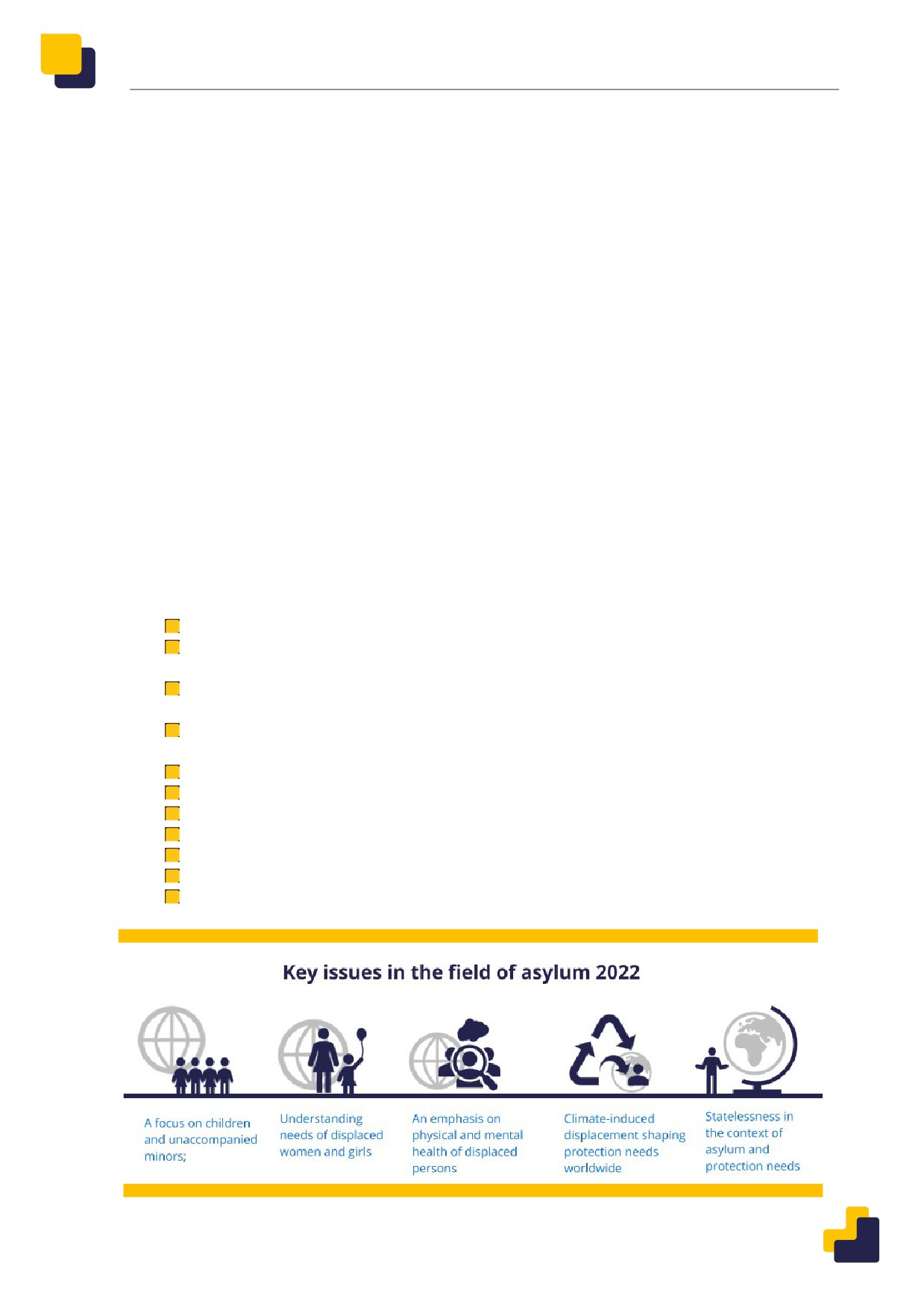
zooms in on key topics which were discussed at the global level: children seeking protection,
displaced women and girls, physical and mental health of asylum applicants, climate-induced
displacement and developments concerning stateless populations.
Section 2 zooms in on the context in the European Union, presenting the latest legislative and
policy developments in the evolution of CEAS. Starting with the activation of the Temporary
Protection Directive, it highlights the EU response in providing protection to displaced persons
from Ukraine, while managing the ever-increasing number of asylum applications. Cases
addressed by the Court of Justice of the EU are also summarised to clarify the interpretation
of law in often complex situations.
The support provided by the EUAA to countries during 2022 is outlined in Section 3. It details
the Agency’s work programme, work with third countries, and operational and technical
assistance which was provided over the course of the year. It also presents an evaluation of
these activities, when applicable.
Section 4 analyses developments at the national level at each stage of the asylum procedure,
including access to the asylum procedure and to information, legal assistance, interpretation
services, procedures at first and second instances, special procedures, the Dublin procedure,
reception conditions, detention during the asylum procedure, country of origin information, the
content of protection and resettlement. The key indicators which are presented help to
identify and monitor trends in receiving countries, as well as with the main nationalities of
applicants.
The situation of children and applicants with special needs are described in Section 5. The
section combines quantitative, qualitative and legal information to provide an overview of the
situation for minors, women, victims of violence and human trafficking, and lesbian, gay,
bisexual, trans-gender, intersex and queer (LGBTIQ) asylum applicants. The section focuses in
particular on unaccompanied minors, reviewing changes to legal representation, age
assessments and reception conditions.
To include diverse perspectives, observations by civil society organisations and other
stakeholders are presented throughout the report by topic. In 2022, concerns often centred
around access to the asylum procedure, reception conditions and applicants with special
needs.
The report serves as a main reference for developments in asylum in EU+ countries. It collates
a wide range of sources to provide accurate information to policymakers, national asylum
authorities, researchers and practitioners involved in the field of asylum.
17
EUROPEAN UNION AGENCY FOR ASYLUM
A Year in Review
Protection needs in Europe
reached a new high, testing
asylum and reception systems
42,000
applications by unaccompanied minors
lodged in 2022
18,000
applications by unaccompanied minors were
Sharp rise in unaccompanied
withdrawn, twice as many as in 2021
minors seeking protection in
Europe as asylum applications
of all unaccompanied minor
continue to grow
applicants were from Syria
2/3
and Afghanistan
The expanding role of the EUAA to further harmonise and
improve the Common European Asylum System
Faster
Reserve pool
Enhanced
Technical
Fundamental
deployments
500 experts
training
tools
Rights Officer
18
ASYLUM REPORT 2023
2022
Applications for international protection by
Nearly
top countries of origin, 2022
1 million
applications lodged
across EU+ countries
71%
of applicants
for international protection
were male
Growth in asylum applications by
unaccompanied minors in EU+ countries
2021
2022
Applications by
unaccompanied minors
increased by 3/5 compared
to the previous year
Greater
Enhanced suppo
Complaints
Monitoring
EUAA liaison
collaboration wit
to third countrie
Mechanism
Mechanism
officers
civil society
19
EUROPEAN UNION AGENCY FOR ASYLUM
Section 1.
Global developments
in the field of asylum
in 2022
To set the broader context within
Section 1 presents an overview of
which asylum-related trends in Europe
forced displacement globally and
emerged, this section provides an
addresses the international
overview of key themes in forced
community’s response to large
displacement at the global level. A
refugee movements. The section
combination of crises, including new
zooms in on key topics which were
and ongoing conflicts, climate shocks,
discussed at the global level:
geopolitical unrest, violence and
children seeking protection,
persecution, led millions of people to
displaced women and girls, physical
flee their homes in 2022.1 The Russian
and mental health of asylum
invasion of Ukraine caused the fastest
applicants, climate-induced
and one of the largest forced
displacement and developments
displacement crises since World War
concerning stateless populations.
II.2 Other pre-existing, profound
situations of displacement around the
world persisted or grew, pushing the
number of people displaced globally
to historic highs in 2022, reaching
approximately 103 million.3
20
ASYLUM REPORT 2023
Millions of people across the world experience forced displacement as a result of violent
conflict, persecution, abuse of human rights, natural disasters and deteriorating ecosystems.
Recurrent cycles of displacement are frequently explained by the intricate interaction of
several underlying causes. Displaced persons may seek refuge for themselves and their
families within their home country (internally displaced persons) or by crossing international
borders (refugees).
Box 1. Definitions of displaced persons
Refugee: An individual who has fled a country due to a well-founded fear of
being persecuted for reasons of race, religion, nationality, membership of a
particular social group or political opinion.4
Internally displaced persons (IDPs): Persons or groups of persons who have
been forced or obliged to flee or to leave their homes or places of habitual
residence, in particular as a result of or in order to avoid the effects of armed conflict, situations
of generalised violence, violations of human rights or natural or human-made disasters, and
who have not crossed an internationally-recognised state border.5
Increased levels of conflict and human rights violations continued in 2022. Local and
internationalised conflicts, political instability, intercommunal disputes over land and access to
resources - compounded by the effects of climate change - persisted in several parts of the
world. Grave effects on civilian populations were seen in Afghanistan, Burkina Faso, the
Central African Republic, the Democratic Republic of Congo, Ethiopia, Mozambique, Myanmar,
Nicaragua, the Northern Triangle of Central America (Guatemala, El Salvador and Honduras),
the Sahel region, Syria and Venezuela.6, 7, 8, 9, 10 11, 12, 13, 14 In addition, in February 2022, the
Russian invasion of Ukraine forced millions to flee the country and seek refuge in European
countries.15
21
EUROPEAN UNION AGENCY FOR ASYLUM
According to the United Nations High Commissioner for Refugees (UNHCR), just six countries
accounted for 76% of all refugees and other people in need of protection in 2022: Syria,
Venezuela, Ukraine, Afghanistan, South Sudan and Myanmar (in descending order).16 The
majority of people who are displaced globally continued to be hosted in low-income and
middle-income countries, which bear a disproportionate share of the burden considering the
resources they have at their disposal.17
In 2022, refugees and host communities across the world continued to feel the after-effect of
the COVID-19 pandemic as the cost-of-living crisis struck. Many refugees and internally
displaced people struggled to meet their daily needs due to inflated prices and limited
humanitarian assistance, precipitated by disrupted supply chains.18 Nevertheless, the number
of people attempting perilous crossings in search of safety, exposing themselves to grave
risks, increased dramatically in 2022. 19, 20, 21, 22
Against this background, the international community continued efforts in developing
solutions for people in need of protection. Through multi-stakeholder cooperation, effective
protection responses were provided to persons fleeing Ukraine within short timeframes. With
regard to international protection, under the framework of the Global Compact on Refugees,
the international community continued to design and implement initiatives toward: i) easing
the pressure on host countries; ii) enhancing refugee self-reliance; iii) expanding access to
solutions in third countries; and iv) supporting conditions in countries of origin for safe and
dignified returns. Initiatives in the frames of the compact focused on a range of protection-
related areas, including:
child protection in humanitarian contexts;
increasing capacity of national asylum systems through the Asylum Capacity Support
Group;
ensuring that settlements of forcibly displaced people have access to affordable,
modern and clean energy
offering sustainable resettlement and complementary pathways, including through
education;
inclusive, quality education for refugee and host community children and youth;
synergistic research on forced displacement and statelessness;
efforts toward ending statelessness;
initiatives focused on family reunification in the context of forced displacement;
providing pro bono legal assistance to displaced people;
alleviating poverty and fostering the financial independence of refugees; and
enhancing the meaningful participation of displaced people in peace-building
efforts.23
22
ASYLUM REPORT 2023
Three regional support platforms, focusing on Afghanistan (SSAR), Central America and
Mexico (MIRPS), and East Africa (IGAD), provide the fora for situation-specific support from the
international community. They aim to ensure comprehensive responses to specific refugee
situations.24
The Three-Year Strategy on Resettlement and Complementary Pathways 2019-2022, meant to
increase durable solutions for refugees in third countries, managed to achieve significant
foundation-laying work amidst challenging circumstances. The objectives for growth in
UNHCR-referred resettlement for those most at risk were met in 2019, but not in 2020 and
2021. While the COVID-19 pandemic, which significantly inhibited mobility, was the primary
reason for the shortfall, insufficient resettlement pledges by resettlement countries also
played a role. Innovative solutions in processing modalities allowed for an increase in
resettlement numbers in 2021 compared to the year before, while the positive dynamic
seemed to persist in 2022.25 To assist asylum authorities, UNHCR published a paper in
March 2022 with an overview of national practices to increase productivity in processing
asylum applications. It also proposed systematic changes and the building of resilience to the
benefit of both countries of asylum and individuals in need of international protection.26
Comparable data play a key role in understanding displacement and informing sound
policymaking. Data gaps in a range of areas related to displacement (for example on gender-
based violence, refugee health and statelessness) are common challenges that have been
highlighted by researchers, professionals and policymakers alike.27,28, 29, 30, 31 To improve the
reliability, comparability and validity of assessments, the Internal Displacement Monitoring
Centre (IDMC) developed a revised, predominantly qualitative, methodology using a
combination of expertise and desk research. The methodology includes 18 questions grouped
into four categories: safety and security; standards of living; basic services; and civic and
social rights. The questions are phrased in a way that, in the absence of quantitative
information, qualitative information could be used and grouped into five standardised
response options.32 In addition, in December 2022, UNHCR published the second edition of
the Global Compact on Refugees Indicator Framework, which includes technical refinements
based on collaboration and extensive consultations with multiple stakeholders.33
The second Global Refugee Forum, which will be organised in 2023, will review the progress
made on initiatives that were announced in the first forum of 2019. Participating governments
and other stakeholders will announce new initiatives, share good practices and take stock of
the challenges and opportunities ahead.34 A common theme among stakeholders has been
the meaningful participation of refugees in decision-making procedures that concern them
directly and in the development of protection solutions. This has been one of the overarching
principles of the Global Compact on Refugees, that is, to develop actions underpinned by a
strong partnership and participatory approach, involving refugees and host communities, as
well as incorporating age, gender and diversity considerations.35 The fundamental premise
informing this approach is that protection responses are more likely to be effective when there
is meaningful engagement from those that such responses are intended to protect and assist.
To improve the theorisation of 'meaningful refugee participation' in decision-making
processes that affect their lives, in March 2022, the Global Refugee-Led Network, the
European Coalition of Migrants and Refugees, and the New Women Connectors published a
reflection paper unpacking the most essential components of meaningful participation by
refugee leaders. Placing an emphasis on the elements of agency and empowerment, the
paper analyses the ‘layered’ experiences and reflections of refugee advocates and refugee-
23
EUROPEAN UNION AGENCY FOR ASYLUM
led organisations on meaningful refugee participation and concludes with a set of actionable
recommendations for improving practices on refugee governance.36
To the same end, in January 2023, the second edition of the European Summit of Refugees
and Migrants took place with the participation of advocates, practitioners and activists of
refugee and migrant backgrounds from European countries. The objective of the summit was
to start building alliances and coordinate activities for refugee-led and migrant-led advocacy,
thus strengthening capacity to influence the European agenda and policies on asylum and
migration. The event also served as a platform for participants to share experiences, concerns
and interests.37
As the international community continues to address complex aspects of ever-changing
patterns of displacement, the discourse and praxis of international protection evolve to
accommodate emerging needs. This section provides a brief overview of key issues that
remained at the centre of attention in the area of asylum over the past year.
1.1. Focus on children and unaccompanied minors
Deteriorating socio-economic conditions, conflicts and humanitarian funding
shortfalls increase the risk of displaced children suffering direct or extreme
forms of structural violence, including forced military recruitment. The journey
from the country of origin to the country of asylum is typically a traumatic
experience, with a heightened risk that children may be subjected to physical
and sexual violence, forced labour and exploitation by smuggling networks
along the route.38 It is estimated that, in certain cases, as many as one-third
of displaced children have developed trauma and a persistent fear for their safety.39
The physical and mental health of children in the context of forced displacement remained a
key concern of the international community in 2022. A progress report on the Global Strategy
for Women’s, Children’s and Adolescents’ Health, published by the World Health
Organization (WHO) and the United Nations Children’s Emergency Fund (UNICEF) in 2022,
showed a critical regression of childhood well-being and highlighted that children’s prospects
of having a healthy and productive life declined sharply.40 Displaced children who often live in
overcrowded conditions face the risk of malnutrition and viral diseases, while access to health
services may be limited. Their education is often disrupted, which may have an adverse long-
term impact on their personal and social development.41, 42
Multistakeholder cooperation has focused on providing psychological support, creating or
improving school infrastructure, including teacher training, and facilitating family reunification
in the context of displacement. In March 2022, the UN Human Rights Council held a panel
discussion on the rights of the child and family reunification. The Special Rapporteur on the
Human Rights of Migrants observed how separation from families may have detrimental
effects on children’s mental and physical health and called national authorities in host
countries to integrate unaccompanied migrant children into national child protection systems
without discrimination.43 The High Commissioner for Human Rights presented the findings of
his report on the risks children may face, especially in the context of migration, and offered a
series of recommendations to prevent separation and better support family reunification.44
24
ASYLUM REPORT 2023
1.2. Women and girls in the context of displacement
Women and girls throughout the world may be subjected to intense forms of
cultural, structural and direct violence. Gender-based violence may include -
but is by no means limited to - sexual abuse and exploitation, rape, female
genital mutilation/cutting (FGM/C), human trafficking, harassment and
domestic violence, as well as social stigmatisation and marginalisation.
Gender-based violence may be the key reason for having to flee the country
of origin but may also be experienced during the journey through transit
countries in the pursuit of safety. Accordingly, such experiences need to be included in the
development of protection solutions in receiving countries to sufficiently cater to the needs of
survivors of gender-based violence.
In 2022, a number of reports highlighted how women and girls are disproportionally affected
in displacement situations. Relevant initiatives were launched by various stakeholders to
increase understanding of the gender dimension in the context of displacement and enhance
capacity to address gender-related considerations in international protection processes.
In the context of South America, Amnesty International reported on the daily discrimination
and direct violence that Venezuelan refugee women and girls faced in public and private
spaces in the host country - including within their families and workplaces - due to their
gender and nationality. The report indicates that Colombia and Peru fell short of ensuring
protection to these women, without effective access to the asylum procedure and to justice
and health systems for survivors of gender-based violence.45
The International Rescue Committee analysed that the extreme drought in east Africa led to
increased violence against women and girls, including in refugee camps. Combined with the
economic downturn resulting from the COVID-19 pandemic, the drought forced women, who
are in charge of providing food and water to their families, to travel further from home in
search of provisions, thus being exposed to higher risks. As families migrate in search of
resources, children - especially girls - are dropping out of school and in unfamiliar and risky
territories.46
CARE published a brief on the link between food insecurity and gender-based violence, which
is also catalysed by other parameters, such as discriminatory social norms, environmental
degradation and a lack of income opportunities. Examples were given of cases in Afghanistan,
Bangladesh, Burundi, the Central African Republic, Ethiopia, Rwanda and Somalia.47 In
Somalia, CARE’s research indicated a staggering 200% increase in violence against women
and girls between 2021 and 2022, particularly intimate partner violence and rape.48
It is fundamental that gender considerations are integrated into the asylum procedure, even
when a specific asylum claim is not clearly gender-related per se. A number of regional and
national legal instruments are in place to safeguard the rights of women and girls, and prohibit
social, cultural and religious practices that may be harmful to them.
Apart from gendered analysis for a better understanding of the gender dimension in the
provision of protection solutions, key recommendations and guidance produced in 2022
stressed the importance of including a gender perspective in asylum procedures. In May
2022, the Committee of Ministers of the Council of Europe adopted a new recommendation
on the protection of rights for migrant, refugee and asylum-seeking women and girls. The
25
EUROPEAN UNION AGENCY FOR ASYLUM
recommendations define measures to better respond to their needs and the challenges faced
by them.49
To foster integration prospects in host societies, the ‘WorldPlaces’ project developed a toolkit
for the meaningful engagement of migrant, asylum-seeking and refugee women at the
workplace.50 The project involves national partners from a number of countries and European-
wide organisations, such as the European Network of Migrant Women.
1.3. Physical and mental health as a daily concern
The experience of displacement may have serious implications for one’s
physical and mental well-being, and health considerations factor in
throughout the displacement cycle. Even after reaching the country of
asylum, refugees are still in a precarious situation, having inhibited access to
resources that constitute physical and mental health determinants, such as
food, work and income, housing, education and public services.51
Despite limitations in the availability of comparable data across the world, WHO, through a
comprehensive review of available literature, reached a number of compelling conclusions at
the regional and global levels related to the health of refugees and migrants. The WHO study,
published in July 2022, indicates that refugees and migrants face poorer health outcomes
than host populations, including higher occupational health risks; low awareness of issues
related to sexual and reproductive health’; frequent occurrences of gender-based violence;
lower levels of maternal and child health; lower level of diagnosis of non-communicable
diseases (such as cancer, cardiovascular diseases, diabetes and hypertension) and an
increased likelihood of substance abuse due to stressful conditions.52
In general, refugees and migrants are at an increased risk of communicable diseases due to
their living and working conditions. Overall, the health condition of refugees and migrants is
influenced by additional health determinants, such as a precarious legal status; discrimination;
social, cultural, linguistic, administrative and financial barriers; a lack of information about
health entitlements; low health literacy; and a fear of detention and deportation.53
In 2022, UNHCR recorded serious nutrition concerns, including acute malnutrition, stunting
and anaemia, among refugee populations in Algeria, Bangladesh, Cameroon, Chad, Congo,
Ethiopia, Kenya, Sudan, South Sudan, Niger, Tanzania, Uganda and Zambia.54, 55 Across
eastern and western Africa, as well as across the Americas, forcibly displaced populations
were often unable to meet basic needs or secure a sufficient quantity and quality of food. In
Syria, more than 1.8 million people residing in camps were severely food insecure, as well as
in Lebanon, where 9 in 10 Syrian refugees were unable to afford essential food and services.
56
Mental health among displaced populations is also a particular concern. Refugees are
exposed to stress at every stage of their displacement, such as stress linked to separation
from families, a lack of livelihood opportunities, perilous journeys and exposure to conflict,
persecution and xenophobia in their new countries.57 WHO indicated that conflict- and war-
affected refugees and migrants may exhibit higher levels of post-traumatic stress
disorder (PTSD) and other mental health issues, particularly among young people and
adolescents.58
26
ASYLUM REPORT 2023
Addressing health-related needs of refugees requires culturally-sensitive and effective care
that takes into account both the impact of displacement on mental and physical health and the
possible barriers affecting the availability, accessibility, acceptability and affordability of health
services for displaced populations.59 While gains have been made over the past years in the
inclusion of refugees into national health systems and policies, there is still a need for better
health support, especially in mental health and psychosocial support, which needs to be
systematically included in the design and implementation of protection solutions.60
1.4. Climate-induced displacement
Climate crises disproportionately affect communities that may already be
vulnerable, many of which are located in ’hotspots’ of climatic change and
often lack the means to cope with an increasingly hostile environment.
Depletion of natural resources which are used for subsistence or income
generation may lead to antagonism between different communities and often
exacerbate pre-existing tensions across communal identity lines, leading to
violent conflict. This creates a complex and dynamic interplay between climate change and
other root causes of displacement.
Indeed, over 70% of refugees and displaced people worldwide come from the most climate-
vulnerable countries, including Afghanistan, the Democratic Republic of the Congo, Syria and
Yemen.61 Climate-induced displacement often takes place within countries but also causes
displaced populations to cross borders in pursuit of a liveable environment. Such cross-border
mobility places the issue of providing protection into an international context.
In 2022, millions of people were forced to flee their homes due to drought and the threat of
famine in Somalia, drought in Central America’s “Dry Corridor”,i cyclones in Mozambique,
hurricanes in Honduras, and floods in Afghanistan, Burkina Faso, Cameroon, Chad, Mali,
Niger, Nigeria, Pakistan, South Sudan and Sudan.62
Acknowledging climate change as a real and existing challenge, as well as its role in shaping
protection needs worldwide, the international community has intensified efforts over the past
years to develop effective responses. Through the Strategic Framework for Climate Action,
UNHCR works together with affected communities, host governments, UN country teams,
international organisations, financial institutions, the private sector and academia to increase
resilience among displaced populations in the face of climate change.63
In March 2022, the UN Human Rights Council appointed the first Special Rapporteur on the
promotion and protection of human rights in the context of climate change. The rapporteur’s
overall mandate is to contribute towards ongoing efforts to address the adverse impact of
climate change on the enjoyment of human rights, including people displaced by climate-
related reasons.64 A challenge in providing protection solutions to these populations is that no
legal definition exists for persons displaced due to environmental reasons and, derivatively,
what the criteria are for one to qualify.
i An area in Central America extending from the Chiapas region in Mexico through Guatemala, El Salvador,
Honduras, Nicaragua, Costa Rica and Panama.
27
EUROPEAN UNION AGENCY FOR ASYLUM
In November 2022, the 27th UN Climate Change Conference of Parties (COP27) highlighted
the need to include refugees and displaced persons from the most climate-vulnerable
countries in the debate. Refugees and displaced persons from countries affected by climate-
induced displacement addressed the audience for the first time in the history of the
conference, warning that current attempts to adapt to the changing environment were
outpaced by the speed of climate change.65 As highlighted by UNHCR, there is a need to
scale-up financing for the countries at the frontlines of climate emergencies, but also to
ensure that resources reach not only climate-vulnerable countries but displaced people and
host communities as well.66
1.5. Global developments on statelessness
Issues surrounding statelessness remained a key theme in the asylum
discourse in 2022. A stateless person is someone “who is not considered as
a national by any state under operation of its law”.67 Whether born stateless
or having become stateless later in life, a stateless person does not have the
nationality of any country, which impedes their access to basic rights, such as
education, health care, housing, employment, social welfare and
documentation.68
Data by UNHCR reported for 95 countries indicate a total of 4.3 million stateless people
around the world.69 The figure is likely much higher, as approximately one-half of countries in
the world, including countries with known stateless populations, do not report statistics on
statelessness.70
A 10-year Global Action Plan to End Statelessness was set up in 2014 under the coordination
of UNHCR and with the participation of other UN and international agencies, regional
organisations, civil society and stateless people.71 The plan aims to address existing situations
of statelessness, prevent the emergence of new cases and enhance the identification and
protection of stateless people. In its eighth year of implementation, in 2022 a number of
countries across the world introduced initiatives for the prevention and elimination of
statelessness, such as:
acceding to relevant international legal instruments,72 establishing statelessness
determination procedures or laying the groundwork to prepare national legislation to
this end;73, 74
facilitating access to protection services;75, 76
organising information provision and campaigns to increase awareness on how
stateless people can access protection solutions;77 and
facilitating birth registration for new-born children at heightened risk of statelessness,
as well as access to naturalisation procedures.78
Overall, since the beginning of the campaign and up to November 2022, almost
450,000 stateless people had acquired or had their nationality confirmed and tens of
thousands worldwide have a pathway to citizenship.79 Despite this progress, taking into
consideration the total population of stateless people worldwide, stronger efforts are needed
to step up action and eliminate legal and policy gaps that perpetuate or increase the risk of
statelessness.80
28
ASYLUM REPORT 2023
Climatic statelessness has been attracting increasing attention over the past years, that is,
combining elements of statelessness and climate-induced displacement.81 It refers to
statelessness not due to the degradation of a specific ecosystem, but due to the overall
disappearance of habitats, as is the case of certain small island states that are likely to
disappear in the coming decades as sea levels rise. The novelty of this occurrence is that it
cannot be effectively addressed by existing legislation, since current legislation centres on
rights of individuals and duties of states vis-à-vis those individuals. A question, for example,
that is not addressed by current legislation relates to the binary between statelessness as the
undesirable state and citizenship (of the host country) as the desirable state, not covering the
imminent possibility of affected populations wanting to keep their nationality even after their
country disappears.82
Another open question that sheds light to the legal complexity - apart from the social, cultural
and spiritual aspects - is what will happen to people who leave the country before the
complete loss of the country’s territory occurs.83 In the absence of relevant provisions, existing
legal instruments need to be strengthened to protect populations at risk of permanently losing
their homes and becoming stateless.84
29
EUROPEAN UNION AGENCY FOR ASYLUM
The Russian invasion of Ukraine caused
forced displacement of unprecedented
levels in recent decades in Europe and
added pressure on already-saturated
reception systems. Displaced persons
Section 2.
from Ukraine and the activation of the
Temporary Protection Directive were at
Major developments
the heart of policy debates and
discussions on practices in asylum and
in asylum in
migration in 2022.
the European Union
The effective management of external
borders and the associated impact on
in 2022
the proper functioning of the Schengen
system were also key topics among
European policymakers. Efforts were
made to strengthen cooperation with
Section 2 presents an overview of CEAS
countries of origin and transit to address
and the latest legislative and policy
developments shaping its evolution at
irregular migration.
the EU level, set against the backdrop of
Under the French and Czech
key developments in 2022 and early
Presidencies of the Council of the EU,
2023.
advancements were made toward the
adoption of instruments included in the
This section also provides an overview
of jurisprudence by the Court of Justice
Pact on Migration and Asylum. These
efforts culminated into political
of the EU (CJEU), which in 2022 issued
agreement on a joint roadmap for
more than 20 judgments in the area of
international protection and related
negotiations between the co-legislators,
aiming to adopt the legislative proposals
topics.
before the end of the 2019-2024
legislative period.
30
ASYLUM REPORT 2023
2.1. Reforming the Common European Asylum System:
An ongoing process
CEAS is a legal and policy framework developed to guarantee harmonised and
uniform standards for people seeking international protection in the EU. It
emphasises a shared responsibility to process applications for international
protection in a dignified manner and with fair treatment.85 Since its inception,
the approaches and instruments which regulate CEAS have been periodically
reformed to respond to the changing landscape of migration and asylum.
Amendments to the system take into account the varied experiences of European countries
and mixed migration flows.ii
Building on previous progress, in September 2020 the European Commission presented a
new Pact on Migration and Asylum, based on in-depth consultations with a multiplicity of state
and non-state stakeholders.86 Some aspects of the pact are still under negotiations. In parallel,
new discussions emerged following developments; for example, the European Commission
proposed a regulation in December 2021 which addresses situations of instrumentalisation in
the field of migration and asylum, in response to state-sponsored smuggling of migrants by
the Belarusian regime in the EU’s eastern land borders.87
The regulation, which complemented the other proposals toward a comprehensive approach,
aims to set a framework for managing such situations - instead of resorting to ad hoc
measures at the national level - in full respect of fundamental rights and international
obligations. The proposal was accompanied by a regulation to amend the Schengen Borders
Code,88 which aims to improve the Schengen system's resilience to serious threats and to
adapt it to new challenges. The amended code would:
i)
provide new tools to combat the instrumentalisation of migrant flows;
ii)
establish a new legal framework and coordination mechanism for external border
measures in the event of a health crisis, drawing on the lessons learned from the
COVID-19 pandemic;
iii)
update the legal framework to reintroduce internal border controls in order to
safeguard the principle of free movement while responding to persistent threats; and
iv)
introduce alternative measures to these controls, such as a safeguard mechanism for
a common response at the internal borders in situations of threats affecting Member
States.89
In June 2022, the Council adopted its general approach on the proposal for the revision of the
Schengen Border Code.90, 91 The discussion at the Council was informed by the European
Commission’s report on the State of Schengen.92 Following the presentation of the Schengen
Strategy in 2021, the report came as part of the European Commission’s initiative to reinforce
ii
“Complex migratory population movement including refugees, asylum seekers, economic migrants and other
types of migrants as opposed to migratory population movements that consist entirely of one category of
migrants.” Definition provided in the EMN Glossary: https://ec.europa.eu/home-affairs/what-we-
do/networks/european_migration_network/glossary_search/mixed-migration-flow_en
31
EUROPEAN UNION AGENCY FOR ASYLUM
the functioning of Schengen through yearly reporting, identifying priorities for the year ahead
and monitoring progress. The report set a list of priority actions for 2022-2023 at the national
and European levels, including:
implementing the new IT architecture and interoperability for border management;
making full use of cross-border cooperation tools;
ensuring systematic checks of all travellers at the external borders;
ensuring that the European Border and Coast Guard Agency (Frontex) reaches the full
potential of its mandate;
lifting all long-lasting internal border controls; and
adopting the revised Schengen Borders Code.93
Together with the State of Schengen Report, the European Commission presented a policy
document to launch a multiannual strategy for integrated border management,94 that is,
coordinated efforts at the national and international levels among authorities and agencies
responsible for border management at the EU’s external borders. The document addresses
border control; search and rescue; risk analysis; inter-agency, EU and international
cooperation; the return of illegally-staying third-country nationals; fundamental rights; research
and innovation; and education and training. Consultations on the content between the
European Commission, the European Parliament and the Council will result in a Commission
Communication establishing the Multiannual Strategic Policy for European Integrated Border
Management.95
A number of stakeholders have issued commentaries on the European Commission's
proposals for the regulations on instrumentalisation in the field of migration and the Schengen
Borders Code, expressing concern that they would create a parallel system of managing
borders, based on derogations from standards of the EU asylum acquis, whereas the current
framework already provides sufficient flexibility to Member States.96, 97, 98 Relevant
commentaries analysed how the provisions of the regulations could possibly affect the
fundamental rights of persons who have been subject to instrumentalisation by third-country
governments.99, 100 As a result, concerns were expressed regarding the necessity and
proportionality of the measures included in the proposal.101, 102, 103 To address these concerns,
the European Commission stressed that the proposed measures safeguard fundamental rights
by ensuring that all arrivals at the EU's external border in a Member State which is faced with
instrumentalisation have genuine and effective access to the asylum procedure.104
Commentaries have been issued on the Screening Regulation too, especially in regard to the
premise that third-country nationals are not considered to have officially entered the territory
of a Member State if they arrive through irregular routes. Critical voices argue that this may
exclude migrants from effectively accessing rights and procedures.105 To ensure respect for
fundamental rights, the regulation also foresees a fundamental rights border monitoring
mechanism to be set up by individual Member States. In October 2022, at the European
Commission’s request, the EU Agency for Fundamental Rights (FRA) issued guidance to
EU Member States in setting up national independent mechanisms to monitor fundamental
rights compliance at the EU’s external borders, in line with the proposed screening
regulation.106
With the active work of the French and the Czech Presidencies of the Council of the EU and
under the coordination of the European Commission, considerable progress was made in
2022 toward advancing the reform package. In the first semester of 2022, the French
Presidency advocated for a gradual approach to adopt the reform package, with cumulative
increments of commitment by Member States in both areas of solidarity and responsibility. As
32
ASYLUM REPORT 2023
a result, in June 2022, the Council adopted negotiating mandates on the Screening and
Eurodac Regulations.107
Agreement was also reached by 21 countries on the implementation of the Voluntary
Solidarity Mechanism, paving the way for further progress on the Asylum and Migration
Management Regulation. The mechanism, which is voluntary and spans 1 year, provides for
expressions of solidarity to Member States experiencing particular pressure in their asylum
and reception systems through relocations, financial contributions and other measures of
support (read more in Section 2.4).108
At the level of the European Parliament, in 2022 the rapporteurs presented draft reports on all
legislative proposals included in the Pact on Migration and Asylum and on the recast Return
Directive.109 With the pact being one of the top priorities, in September 2022 the European
Parliament and the rotating Presidencies of the Council of the EU reached political agreement
on a joint roadmap for negotiations between co-legislators in order to adopt the legislative
proposals before the end of the 2019-2024 legislative period, that is, by February 2024.110
The roadmap provides the framework for negotiations on the Eurodac, the Screening, the
Asylum and Migration Management, Crisis and Force Majeure and the Asylum Procedures
Regulations and for finalising the Union Resettlement Framework, the recast Reception
Conditions Directive (RCD) and the recast Qualification Directive (QD), for which provisional
agreements have been previously reached between the European Parliament and the
Council. The roadmap also provides new impetus for reaching an agreement on the proposal
for a recast Return Directive.iii Following agreement on the roadmap, in December 2022 the
European Parliament and the Council reached an agreement on reception conditions for
applicants for international protection, thus endorsing the outcome of negotiations reached in
2018.
2.2. Responding to the arrival of persons fleeing the
war in Ukraine
The Russian invasion of Ukraine in February 2022 spurred waves of
outward mobility by people seeking refuge in neighbouring countries.
Within a few weeks, millions of people fleeing Ukraine arrived in the
EU through Hungary, Poland, Romania and Slovakia. The impact of the war
had a profound effect in shaping migration and asylum and naturally
occupied a central place in protection-related policymaking at national and EU levels
throughout the year.
In response to pressing protection needs, EU+ countries and EU institutions needed to
provide quick, yet systematic, solutions. In the immediate aftermath of the invasion,
EU+ countries - especially countries at the external border - implemented a number of
measures rapidly: they activated emergency situation protocols and preparedness plans;
simplified entry procedures; established task forces and coordination mechanisms to provide
emergency accommodation and aid; introduced temporary protection schemes; provided
tailored information through information points, dedicated phone lines, leaflets and websites;
iii For a detailed overview of the state-of-play of the proposals included in the Pact on Migration and Asylum, as of
December 2022, see: European Parliament. (December 2022). EU pact on migration and asylum: State of play.
33
EUROPEAN UNION AGENCY FOR ASYLUM
provided specialised psychological counselling and support; extended the period of legal
stay/visas for special reasons; paused the processing of applications for international
protection by Ukrainian nationals, pending the activation of the Temporary Protection
Directive; suspended returns to Ukraine; and, when applicable, removed Ukraine from the list
of safe countries of origin.111
Reflecting the EU’s commitment to show full solidarity with Ukraine, on 4 March 2022 the
Justice and Home Affairs (JHA) Council unanimously adopted a Council implementing
decision to activate the Temporary Protection Directive and established temporary protection
for displaced people fleeing the war in Ukraine.112 Based on Article 3(2) of the Council
decision, the European Commission established the Solidarity Platform to accompany the
activation of the Temporary Protection Directive. It became the hub of coordinated EU
response, chaired by the European Commission and bringing together Member States,
Schengen Associated Countries, the European External Action Service (EEAS), the EUAA,
Frontex, Europol, the International Organization for Migration (IOM), UNHCR, and involving
Ukrainian and Moldovan authorities.113 The EU Migration Preparedness and Crisis Blueprint
Network114 was identified as the most appropriate means for administrative cooperation
among Member States and strengthened the foundation for a coherent EU response.115
To coordinate a strong, common European response in addressing the needs of people
fleeing the war, the European Commission developed a 10-point action plan with measures to
be taken by the European Commission, EU agencies and Member States.116 In addition, the
Union Civil Protection Mechanism (UCPM)117 was activated, through which Member States can
request resources to attend to the needs of the displaced persons fleeing Ukraine and receive
co-financing to deliver such assistance. The UCPM was used to channel assistance inside
Ukraine too, in what has been its largest operation to date.118 Financial support was provided
throughout the year from various EU sources, such as the Cohesion Policy Fund, the European
Social Fund, the European Regional Development Fund and Home Affairs Fund.119 EU
agencies, including the EUAA, Frontex and Europol, played a crucial role in providing
operational support and guidance directly to Member States.
Responding to the internal security risks resulting from the Russian invasion of Ukraine, the
EU and Moldovan authorities launched the Support Hub for Internal Security and Border
Management in Moldova120 to catalyse cooperation among EU agencies, Member States and
Moldova, including in the areas of firearm trafficking, drug trafficking and trafficking in human
beings.121 A key action in May 2022 was the development of a dedicated Common Anti-
Trafficking Plan to address the risks of trafficking in human beings and potential victims
among those fleeing Ukraine.122
Following the Council decision in March 2022, EU countries proceeded with the application of
the Council implementing decision by introducing relevant procedural and reception
arrangements, organising information campaigns and granting access to rights for persons
fleeing Ukraine. The activation of the Temporary Protection Directive allowed for a clear legal
status for persons fleeing the war in Ukraine and systematic access to associated rights,
including suitable accommodation or means to obtain housing, access to the education
system for persons under 18 years, social welfare and means of subsistance, medical care,
employed or self-emlpoyed activities, and educational opportunities for adults through
vocational training and practical workplace experience.123 As of February 2023, approximately
4 million people from Ukraine had received temporary protection in the EU.124 In line with the
provisions of the Temporary Protection Directive, temporary protection was extended for a
further year, until March 2024, thus providing stability and predictability to millions of people.
34
ASYLUM REPORT 2023
The UN launched a Humanitarian Flash Appeal for immediate funding to help people inside
Ukraine and those seeking protection abroad.125 A Regional Refugee Response Plan was also
launched to bring together the UN, NGOs and other relevant partners to support host country
governments in ensuring safe access to the territory for persons fleeing from Ukraine.126
Since the beginning of the war, UNHCR provided assistance by undertaking a variety of
actions, including delivering core relief items; scaling up of reception structures; providing
legal, psychological and information support at reception places; and launching a multi-
purpose cash assistance programme to support those who need it the most.127, 128, 129, 130
UNHCR also highlighted the increased protection-related risks that individuals with
vulnerabilities faced and called for measures to quickly identify, mitigate and respond to risks
of gender-based violence, exploitation, abuse and the trafficking of women and girls.131
Together with UNICEF, UNHCR urged all neighbouring and impacted countries to ensure the
immediate identification and registration of unaccompanied children, access to national child
protection systems and temporary foster or other forms of community-based care under the
critical protection of a government system.132
The orchestrated response to provide protection showed that such effectiveness is possible.
Thus, for example, UNHCR recommended that EU Member States build upon the experiences
and apply them in the asylum procedure to the benefit of other groups of third-country
nationals who are in need of protection.133
For a detailed overview of actions taken by EU+ countries in providing temporary
protection to people fleeing Ukraine, see the EUAA’s
Providing Temporary Protection to Displaced Persons from Ukraine:
A Year in Review.
2.3. Key developments in policies and practices at the
EU level
Amidst the war in Ukraine and with the Presidencies of the Council of the
European Union (EU) trying to push for a breakthrough in the CEAS reform,
migration and asylum remained high on the EU’s policy agenda. Drawing
inspiration from the European response in addressing the protection needs of
persons fleeing Ukraine, the President of the European Commission, Ursula
von der Leyen, made reference to asylum and migration in her State of the
Union address in September 2022,134 expressing the will to see such determination and
solidarity in the European migration debate. Viewing the EU actions as a blueprint, the
President of the Commission called for fair and quick migration and asylum procedures; a
system that is crisis-proof and quick to deploy; a permanent and legally-binding mechanism
that ensures solidarity; and effective controls of the EU’s external borders, in line with the
respect for fundamental rights.135
35
EUROPEAN UNION AGENCY FOR ASYLUM
Overall, key areas of focus in migration and asylum policy in Europe in 2022 centred on:
Advancing the adoption of the instruments included in the Pact on Migration and
Asylum through a gradual approach on the basis of a balance between solidarity and
responsibility;
Effective management of external borders, which has implications for the effective
internal functioning of the Schengen area;
Strengthening cooperation with countries of origin and transit to address irregular
migration, ensure effective returns and readmission; and
Protecting those who may be in a position of vulnerability, such as children and victims
of human trafficking.
Reflecting the importance accorded to migration, the 18-month programme of the presidential
trio presented in December 2021, prepared by the then-upcoming French, Czech and Swedish
Presidencies, included migration, the Schengen area, and police and judicial cooperation as
priority areas. An overarching aim of the trio programme was to strengthen the Schengen area
as an area of free movement without internal borders. Key components of this included the
effective management of external borders; a functional asylum and migration system based on
a balance of responsibility and solidarity; avoiding the loss of life and ensuring protection to
those who need it; and strengthened cooperation with countries of origin and transit to
address irregular migration and human trafficking and ensure the effective return of rejected
applicants.136
In January 2022, UNHCR offered its recommendations to the French and Czech Presidencies,
underlining that the reform of CEAS has scored only some progress and acknowledging the
significant agenda-setting power of the two presidencies toward achieving breakthroughs.
The recommendations went along two interlinked dimensions toward negotiating a
sustainable asylum reform based on the pact and its elements; and providing more support to
the countries and regions where most forcibly-displaced people live and addressing root
causes of forced displacement and irregular migration.137
In line with the orchestrated effort reflected in the trio programme, both Presidencies of the
Council of the EU included priorities related to migration and asylum in their programmes. The
French presidency (January-June 2022) aimed to further develop the external dimension of
migratory policies by strengthening cooperation with the main third countries of origin or
transit through action plans that set out clear objectives and concrete activities, which are
based on available instruments, such as visa policies and financial schemes.
The Presidency also proposed a gradual approach in advancing negotiations on proposed
instruments, ensuring that each step taken has a satisfactory balance of protecting the
external borders, responsibility and solidarity.138 Through this approach, which was adopted by
the JHA Council of 3 February 2022, progress was made toward the adoption of the Pact on
Migration and Asylum and significant steps were taken for the reform of the Schengen area.
Importantly, the Presidency facilitated a quick and protection-oriented EU response to address
the needs of millions of people fleeing Ukraine, offering protection, immediate access to
rights, as well as humanitarian and financial assistance.139
The Czech Presidency in the second semester of 2022 also included migration and asylum
among its priority areas, focusing on the management of the crisis linked to the arrival of
displaced persons from Ukraine and addressing new potential security risks.140, 141 The
Presidency fostered a common response to the consequences of the Russian aggression,
36
ASYLUM REPORT 2023
including the launch of the EU Internal Security and Border Support Hub in Moldova for mutual
cooperation. One of the priorities of the Czech Presidency was the prolongation of temporary
protection until March 2024, while emphasis was placed on ensuring access to education,
health care and the labour market for beneficiaries of temporary protection to catalyse their
effective integration into the host country.
In view of developments in Ukraine and their impact on the external dimension of the
EU’s migration policy, the presidency focused primarily on cooperation with the Eastern
Partnership countries and the Western Balkans. It also addressed the functioning of the
Schengen Area, which includes Croatia as of January 2023, while the ground was also
prepared for the enlargement of the Schengen Area to include Bulgaria and Romania. Building
on the gradual approach put forth by the preceding French presidency, the Czech presidency
facilitated the resumption of negotiations that had been stalled for several years. In the JHA
Council in December 2022, broad support was shown for fostering solidarity and
responsibility in the field of asylum based on a system without mandatory quotas.142
A two-day ministerial conference was organised by the Czech Presidency in October 2022 in
the frames of the Prague Process, an intergovernmental dialogue on migration which was
established in 2009 by the first Czech Presidency of the Council of the EU. It brings together
representatives of almost 50 countries, the European Commission, the EUAA, Frontex,
UNHCR, the IOM, the Migration, Asylum, Refugees Regional Initiative (MARRI), the Joint
Coordination Platform (JCP) and the International Centre for Migration Policy
Development (ICMPD). The ministers and high-level officials from participating countries
discussed current migration challenges, including the impact of the war in Ukraine and the
dramatic increase of irregular migration along the Western Balkan route, which was the main
route for irregular migration to the EU in 2022. Confirming the will to strengthen cooperation
and partnerships, the ministers adopted a Joint Declaration and an Action Plan for 2023-2027.
In the Joint Declaration, parties expressed their grave concern over the impact of the Russian
aggression on the humanitarian situation in Ukraine and global security, health and
socioeconomic developments which had severe implications on migrants and mobility,
resulting in large-scale displacement. They emphasised the key role of regional processes on
migration in achieving shared objectives and acknowledged the necessity of a whole-of-route
approach. The parties also reaffirmed the importance of working together along six thematic
areas:
1.
Preventing and fighting irregular migration and migrant smuggling;
2. Strengthening capacities in the areas of asylum and international protection and
expanding protection capacities in the region;
3. Promoting readmission, voluntary return and sustainable reintegration;
4. Addressing legal migration and mobility with a special emphasis on labour migration;
5. Promoting the integration of legally-residing migrants into their host societies; and
6. Making migration and mobility positive forces for development.143
In the Action Plan, the parties identified 53 concrete actions to be taken throughout 2023-
2027 within each thematic area to achieve common goals in migration and asylum.144
In an effort to increase protection for the most vulnerable, in February 2022 the European
Commission earmarked EUR 7 million to support the fight against trafficking in human beings.
The funding was announced through two calls for proposals and support projects aimed at
breaking the business model of traffickers and improving the protection, support and
37
EUROPEAN UNION AGENCY FOR ASYLUM
empowerment of survivors. It is meant to materialise priorities set in the EU Strategy on
Combatting Trafficking in Human Beings (2021-2025).145
The protection of children was another area of focus in European policymaking in 2022. In
February 2022, the Council of Europe hosted a plenary session on the rights of children in
migration, with topics covering age assessments and guardianship for unaccompanied
minors.146 The Steering Committee for the Rights of the Child (CDENF) approved a draft
recommendation relating to human rights principles and guidelines on age assessments for
children and adopted a Draft Explanatory Memorandum of Recommendation (CM/Rec(2019)11)
on effective guardianship for unaccompanied and separated children in the context of
migration.147
Similarly, on 17 February 2022, the European Commission discussed guardianship for
unaccompanied minors in EU Member States, based on a report by FRA. Despite legislative
changes introduced over the past years in many Member States, the report indicates that
national guardianship systems continued to face challenges, such as long procedures to
appoint a guardian, limited local resources and conflicts of interest between reception and
guardianship services, which in some cases operate under the same authority.148
In April 2022, FRA published an updated version of the Handbook on European Law relating
to the Rights of the Child, which is a practical guide and introduction to European law for
lawyers, judges, prosecutors, social workers and non-governmental organisations (NGOs).149
Focusing on the protection of children’s rights, on 9 June 2022, the Council adopted
conclusions on the EU Strategy on the Rights of Child. As a result of the war in Ukraine, the
Council gave specific attention to the need to protect children from recruitment by armed
forces, illegal adoption, trafficking in human beings, sexual exploitation and family
separation.150
2.4. EU’s external borders and migration routes:
Support to frontline Member States
In 2022, the EU’s external borders continued experiencing increased pressure,
with arrivals sharply rising for a second year in a row. According to preliminary
data collected by Frontex, 330,000 irregular border crossings were detected at
the EU’s external border, representing an increase of 64% compared 2021 (with
approximately 200,000 detections).151 These numbers do not include persons
displaced from Ukraine, who are recorded separately.
The Western Balkan route was the most frequently used with 145,600 detections, accounting
for 45% of all irregular entries in 2022. The high flow on this route may be a result of
movements by migrants already present in the region, as well as people arriving to Serbia by
air due to visa-free arrangements.152
The number of detections also increased on the Central Mediterranean route (over 100,000),
rising by more than one-half compared to the year before. On the Eastern Mediterranean
route, the number of irregular entries almost doubled compared to 2021, yet remained lower
than one-half of the number in 2019, before the COVID-19 pandemic.
38
ASYLUM REPORT 2023
The Western Mediterranean route (14,582) and the Western African route (15,462)
experienced decreases in the number of detections of irregular border crossings compared to
the previous year.153 On the Eastern land borders, following the peak of the
instrumentalisation crisis in 2021, the situation appeared stable in 2022 with a significantly
lower number of irregular border crossings. This route appears to have shifted, with many
third-country nationals arriving in Belarus after travelling legally to Russia.154
To address the situation at the external borders, the European Commission continued to
provide support to frontline Member States by offering financial assistance and operational
responses in coordination with EU agencies, international organisations and other relevant
stakeholders. Assistance was provided in managing arrivals; setting up adequate reception
structures; implementing relocations; ensuring efficient asylum and return procedures;
improving border management; protecting unaccompanied minors and other groups with
vulnerabilities; and implementing integration policies for legally-residing, third-country
nationals.155 The Task Force on Migration Management, established originally to support
Greek authorities in improving reception conditions on the Greek islands, also provided
assistance to Cyprus, Italy, Malta, Spain and Member States bordering Belarus and Ukraine.
Greece
With assistance from the European Commission and EU agencies, more efficient
asylum procedures have been implemented in Greece, which led to the reduction of
the backlog of applications in 2022.156 Progress was made on the construction of new
reception facilities on the Greek islands, with centres established on Kos, Leros and Samos.
Support from the European Commission has catalysed the improvement of reception
conditions on the Greek islands and the mainland, including shelter, hygiene, access to health
and education for children. Through the voluntary relocation scheme, introduced in 2020,
more than 5,000 unaccompanied minors, vulnerable applicants and beneficiaries of
protection were relocated by October 2022 to 16 European countries which participate in the
scheme.157
Cyprus
With Cyprus currently receiving the highest number of applicants for protection per
capita, the European Commission and EU agencies have stepped in to provide direct
support. In February 2022, the European Commissioner for Home Affairs, Ylva Johansson, and
the Cypriot Minister of the Interior, Nicos Nouris, signed a memorandum of understanding and
a detailed action plan to enhance migration management in Cyprus.158 The specific objectives
of the action plan include: enhancing first reception capacities, improving the level of material
reception conditions for asylum applicants, supporting timely and effective asylum and return
procedures, and establishing and implementing an integration strategy.159 The implementation
of the action plan is supported by the EUAA, Frontex and Europol.
Funding for Cyprus under the 2021-2027 Home Affairs Funds is also channelled toward the
construction of a new open reception centre and pre-departure detention centre, with safe
zones for vulnerable people, recreational and common areas, and medical and quarantine
areas.160 The European Commission, Frontex and the Cypriot authorities have set up a
tripartite working group on the return of rejected applicants, resulting in a steady increase in
returns.161
39
EUROPEAN UNION AGENCY FOR ASYLUM
Italy
The European Commission, together with Italian authorities, coordinates the work of
EU agencies on the ground in Italy, including through the EU Regional Task Force in
Catania. The European Commission is also working with Italian authorities in addressing flows
from Libya and along the Central Mediterranean route.162
Spain
Support to Spain focuses on reforming the national reception system to increase
capacity in addressing migratory pressure. EU funding has also supported the reform
of the Spanish Asylum Office, which included recruiting additional case officers.163
As part of the overall support to Member States experiencing pressure, in August 2022, the
European Commission awarded EUR 171 million for projects to support the reception, asylum
and return systems in Cyprus, Spain, Greece, Italy and Poland, through a competitive call
under the Asylum, Migration and Integration Fund (AMIF). The support to Cyprus would fund
the construction of an accommodation and pre-departure centre in the Menoyia area in
Larnaka. Support for Spain would reinforce the capacity of the reception system in Ceuta and
on the Canary Islands. In Italy, the focus would be on strengthening the capacity of the
reception system from arrival to all phases of reception, and to protect and care for the most
vulnerable refugee children and women. For Greece, funding will be channelled to
international organisations working on improving the quality of assistance for asylum seekers
in the reception system, for vulnerable individuals in particular and school-aged refugee
children to access education. Funding for Poland was channelled to the IOM for projects
meant to foster a rights-based and protection-sensitive approach to the provision of direct
assistance and improving return procedures.164
2.4.1. Action plans for the Central Mediterranean and Western Balkan routes
At the end of 2022, the European Commission presented two action plans with
a series of operational measures to address immediate and ongoing challenges
along the Central Mediterranean and the Western Balkan routes.
The Action Plan for the Central Mediterranean includes 20 measures designed
to reduce irregular and unsafe migration, provide solutions to emerging challenges in the area
of search and rescue, and foster solidarity balanced against responsibility among Member
States. Work in the frames of the action plan would centre around three pillars:
Working with partner countries and international organisations to enhance capacities
in Egypt, Libya and Tunisia, ensure better border and migration management,
reinforce the fight against smuggling, enhance diplomatic cooperation on returns and
increase legal pathways to the EU.
A more coordinated approach on search and rescue activities through the re-launch
of the European Contact Group on Search and Rescue.
Reinforcing the implementation of the Voluntary Solidarity Mechanism agreed in the
Council in June 2022 to provide swift support to Member States receiving arrivals by
sea, enhancing flexibility, streamlining processes and financing alternative measures
of solidarity.165
40
ASYLUM REPORT 2023
The Action Plan for the Western Balkans also comprises 20 operational measures structured
along five pillars. The aim is to strengthen cooperation on migration and border management
between the EU and Western Balkan countries, which have a unique status as countries in the
EU accession process.166 The pillars of work include:
Strengthening border management along the route, including through the
deployment of Frontex personnel, joint operations in the region and new status
agreements.
Ensuring a swift asylum procedure and supporting reception capacity, including
through the development of contingency planning. Within the EU, it would be of
importance to implement the roadmap for Dublin transfers and Eurodac registrations
to address secondary movements.
Fighting migrant smuggling through the establishment of a Europol operational task
force and, pending advances in the proposal to sanction transport operators involved
in migrant smuggling, through the creation of an operational toolbox with measures
for transport operators.
Enhancing cooperation on readmission and returns, strengthening operational
capacities and convening joint readmission committees.
Achieving alignment in visa policies, which is essential for the proper functioning of
the visa-free regime of the Western Balkans with the EU.167
The effective management of external borders is also meant to allow for effective access to
the territory and the asylum procedure for those in need of protection. Still, throughout 2022,
EU institutions and agencies, UNHCR, and international and civil society organisations often
scrutinised policies and practices in European countries in this area, expressed concern and
called both national governments and the European Commission to ensure respect for
fundamental rights and adherence to the principle of non-refoulement.168, 169, 170, 171, 172
2.4.2. Search and rescue activities
In 2022, the EU and its Member States continued to render assistance through
search and rescue (SAR) operations to people and vessels in distress in the
Mediterranean Sea. These included migrants and refugees trying to reach
Europe, embarking on life-threatening journeys organised by smugglers who
used increasingly dangerous tactics to cross the Mediterranean Sea.173, 174, 175
Currently four EU operations are patrolling the Mediterranean Sea to rescue migrants at risk,
while securing the EU’s borders and targeting migrant smugglers: Operation Indalo, Operation
Themis, Operation Poseidon and Operation Sophia. NGOs also contribute to this effort by
operating private vessels for the purpose of SAR activities. In the period 2015-January 2023,
632,455 lives were saved on the Mediterranean and Western African routes. During the same
period, 25,595 fatalities were registered.176 Rescue operations and disembarkation to a place
of safety are complex and different stakeholders may have different obligations under
international law.177
SAR activities are not covered by a common EU legal framework. In accordance with the
relevant provisions of Regulation (EU) 2019/1896 and Regulation (EU) No 656/2014, all vessels
and other assets deployed in the operational activities of Frontex are at the disposal of the
41
EUROPEAN UNION AGENCY FOR ASYLUM
competent Maritime Rescue Coordination Centres which coordinate SAR interventions and
render assistance to any vessel in distress at sea. In the absence of an EU-wide, commonly-
accepted and predictable mechanism for SAR events, the limitations of current arrangements
and practices continued to be the target of criticism. For those voices, a lack of coordination in
SAR activities, solitary action by individual countries and the criminalisation of NGOs involved
in SAR activities in the Mediterranean Sea have often led to migrants being forced to stay for
several days on boats.178, 179, 180 EU Member States and EU agencies (Frontex) have also been
accused of pushbacks of migrants to the high seas and towards Libya and Türkiye.181 For such
critical voices, there seems to have been a shift toward prioritising enforcement against
migrants at sea and cooperation with third countries to intercept and return smugglers and
migrants.182, 183
FRA regularly collects data on the operations of NGO vessels involved in SAR activities in the
Mediterranean Sea, including information on legal proceedings against them and difficulties in
disembarking migrants in safe ports.184 In December 2022, UNHCR issued a note with legal
considerations on the roles and responsibilities of states in relation to rescues at sea, non-
refoulement and access to the asylum procedure. The note summarises key legal principles
and state obligations under different bodies of international law in situations affecting people
in distress at sea who seek or may be in need of protection.185
2.4.3. Voluntary solidarity mechanism
During the JHA Council in June 2022, ministers in charge of migration matters
in 18 Member States and three associated countries committed to implement a
Voluntary Solidarity Mechanism. In a well-defined and predictable way, needs-
based assistance would be provided to Member States most affected by
migratory flows in the Mediterranean area, including the Western Atlantic route,
through relocation and financial contributions.
The voluntary nature of the mechanism allows supporting states to determine the nature and
amount of their contributions, as well as the Member State to which their solidarity is provided.
However, a number of common criteria should be applied to ensure the predictability of the
mechanism:
Priority should be given to search and rescue operations in the Mediterranean and
Western Atlantic routes, in addition to other situations in Cyprus and the Greek
islands, for example;
Relocations should primarily apply to persons in need of international protection,
giving priority to the most vulnerable;
A total annual number of relocations should be set;
Each contributing Member State should present a pledge on the target number of
relocations, which is based on the population size and gross domestic product (GDP);
and
A Member State can withhold commitments temporarily in the case of
disproportionate pressure on its reception system due to secondary flows, taking into
account the state of cooperation under the Dublin system.186
Member States can also express solidarity through financial contributions or the
implementation of a project in a third country that may have a direct impact on the flows at the
external border.
42
ASYLUM REPORT 2023
To coordinate the implementation of the mechanism, the European Commission established a
Solidarity Platform on the Voluntary Solidarity Mechanism and coordinates the relocation
processes in close collaboration with participating countries and with the operational support
of EU Agencies. The EUAA plays a key role in the relocation process by providing additional
operational support to competent authorities of European countries. The first relocation
transfers under the Voluntary Solidarity Mechanism started in August 2022.187
The agreement on the Voluntary Solidarity Mechanism was a welcome breakthrough, since
the application of the principle of solidarity in practice - one of the core principles of the Pact
on Migration and Asylum - has often faced disagreement among Member States.
2.5. External dimension of the EU’s asylum policy
Apart from effective legislation, policies and practices, a well-functioning
migration and asylum system also requires systematic cooperation with
external partners, especially countries of origin and transit. Over the past
decades, the EU has been a leading actor in promoting protection-oriented
solutions across the world.
The Neighbourhood, Development and International Cooperation Instrument
(NDICI) is the main, albeit not the only, EU financing tool for external cooperation.188 Through
NDICI, the EU merged ten instruments under the previous budgetary cycle (2014-2020) into
one comprehensive instrument. With migration being one of the five priority areas of the
instrument, work in this area addresses the root causes of irregular migration and forced
displacement, migration management, durable solutions for refugees and legal pathways. The
basis of the EU’s overall financial assistance to third countries for the coming years are the
country and regional multiannual indicative programmes (MIPs).iv
Looking into funding from the EU’s internal affairs to support the external dimension of
migration, in November 2022, UNHCR and the European Council on Refugees and Exiles
(ECRE) published a study with an overview of how AMIF and Internal Security Fund-Borders
and Visa (ISF-BV) were used outside of the EU in the budget period 2014-2020. The study
also presents an analysis of the provisions for spending outside of the EU in the 2021-2027
Multi-Annual Financial Framework and provides recommendations to Member States, the
European Commission and the European Parliament on improving the effectiveness,
transparency and accountability of the use of internal affairs funding to support the external
dimension of migration.189
In January 2022, the Council of the EU released an Implementing Decision (EU) 220/40 on the
Operational Coordination Mechanism for the External Dimension of Migration (MOCADEM),
which operates under the direction of the Council Presidency. Building on previous
arrangements provided by the Council Implementing Decision (EU) 2018/1993,190 it created
new mechanisms to increase cooperation and build relations with third countries in the field of
migration. To maintain the coherence of the policies and actions carried out by the EU, the
Committee of the Permanent Representatives of the Governments of the Member States to
the EU (Coreper) ensures the strategic direction of the work of MOCADEM. This coordinating
mechanism, together with the functions of the External Migration Working Party and the
iv For a more comprehensive overview of the financing of the external dimension of the EU’s policies in asylum and
migration, see the Asylum Report 2022.
43
EUROPEAN UNION AGENCY FOR ASYLUM
coordination group on Migration under the NDICI, further calibrates a common approach in
the external dimension of the EU migration policy.
To further calibrate a synergistic approach, in its 2022-2023 Risk Mitigation Strategy and
2022 Appeal, UNHCR expressed its will to support the joint vision of Europe and Africa on
migration and mobility to address root causes in countries of origin and asylum; to enable
states to regulate asylum and protection in accordance with international law; to save lives; to
address grave and systematic violations of human rights of people on the move; and to enable
sustainable solutions.191
Addressing root causes of irregular migration
Preventing irregular migration requires orchestrated action to address the root
causes. EU engagement in this area gradually progressed from a short-term
humanitarian approach to a longer-term developmental approach, including
efforts to support good governance, prevent conflicts, promote respect for
fundamental rights, foster economic and social development, and take
proactive action towards climate change.192
Through the Global Getaway, the EU has provided major investments into infrastructure to
foster secure links in the digital, energy and transport sectors and strengthen health,
education and research systems across the world.193 Initiatives delivered as part of the Global
Gateway have targeted specific regions, such as the Southern Neighbourhood, Africa and
Latin America.194
Combating smuggling networks
To tackle migrant smuggling and safeguard the fundamental rights of migrants,
the EU has been working systematically with international partners over the
past years. The renewed Action Plan against Migrant Smuggling 2021-2025195
provides the overall framework to address smuggling as part of a
comprehensive migration management system and focuses on more targeted
cooperation with countries of origin and transit.
In July 2022, the European Commission, in cooperation with the EEAS, launched the first anti-
smuggling operational partnerships with Morocco and Niger, aiming to strengthen their legal,
policy, operational and strategic frameworks in addressing migrant smuggling. These
operational partnerships include support for border management, enhanced police
cooperation (including joint investigations), awareness-raising on the dangers of irregular
migration, and enhanced cooperation with EU agencies.196 Joint efforts under these
partnerships are set to achieve common objectives to save lives, disrupt the business model
used by criminal networks, prevent migrants from becoming victims of violence and
exploitation, and protect their fundamental rights.197
In December 2022, the EU and African partners launched two Team Europe Initiatives (TEI)
focused on the Atlantic/Western Mediterranean and the Central Mediterranean routes. The
projects are based on joint effort in addressing the upsurge of irregular flows and abuses by
smuggling networks.198
44
ASYLUM REPORT 2023
Facilitating returns, readmission and reintegration
Along with providing protection to those in need, effective returns and the
readmission of those who are not in need of protection are essential
components of a comprehensive, well-functioning migration and asylum
management system. In May 2022, the Return Coordinator took office at the
European Commission to promote a more coherent and effective approach to
returns. Through a high-level network, the coordinator fosters operational cooperation in the
management of returns, readmission and reintegration.199
Specifically in the area of readmission, increased EU cooperation with partner countries has
been fruitful in enhancing returns and has helped Member States most directly affected by
irregular migration flows, such as Cyprus, Greece and Malta.200 In this context, readmission is
an area where progress can be made on the basis of mutual interests, for example by linking
cooperation on readmission with the EU visa policy.201
In September 2022, the European Migration Network (EMN) published an inform evaluating
existing, legally-binding bilateral readmission agreements in EU Member States and Norway,
focusing on agreements concluded in the period 2014-2020. The inform found that the
number of bilateral agreements with third countries is proportional to the relevance of those
countries for the overall EU migration management, taking into consideration factors such as
the number of their nationals found irregularly in EU countries, their geographic proximity to
the EU’s external borders and their presence along key migratory routes to the EU. As to the
effectiveness of bilateral agreements, the inform showed that they indeed contributed to
higher numbers of returns and smoother operations, while enhancing overall cooperation with
third countries.202
Throughout 2022, the EU and Member States continued to promote and support the voluntary
return and reintegration of migrants on the basis of the EU Strategy on Voluntary Return and
Reintegration, which was launched in 2021 to increase the number of voluntary returns and
improve the quality of the support to returnees. In July 2022, the EMN published an inform on
the incentives and motives that Member States have developed to encourage voluntary
departures through Assisted Voluntary Return and Reintegration (AVRR) programmes,
following the issuance or in anticipation of a return decision. It explores factors that contribute
to an individual’s decision-making process and how all the elements are interconnected. The
inform finds that in-kind support, such as counselling, medical or psychological assistance,
logistical support to organise the return journey, legal assistance, and the provision of basic
needs prior to a return (such as accommodation, health care and food), may have a greater
impact than in-cash assistance. Factors which influence the decision include the situation in
the country of return, a lack of economic opportunities, lack of social circles, fear of rejection
upon arrival, or stigma associated with returning.203
Working with partner countries toward migration and border management
EU efforts to respond to a complex migratory reality include joint initiatives with
partner countries for effective border management. Status agreements between
Frontex and third countries aim to support border management, fight migrant
smuggling and reduce irregular migration. A status agreement with
North Macedonia was proposed by the European Commission in
September 2022,204 and negotiations have ensued for a status agreement with Bosnia and
Herzegovina.205 Frontex already has status agreements with Albania, Montenegro and Serbia,
45
EUROPEAN UNION AGENCY FOR ASYLUM
which enable the deployment of Frontex teams and equipment on the territory of these
countries.206 In light of the Russian invasion of Ukraine, a status agreement was signed with
Moldova. Mauritania and Senegal were the first African countries for which mandates to
negotiate status agreements were issued. To complement these efforts, working
arrangements have been completed or are currently negotiated with Niger, Libya and Ukraine,
while civilian missions have been undertaken in Iraq, Kosovo, Libya, Mali, Niger and Palestine,
which offer strategic advice and work with local authorities to promote peace, stability,
security and development.207
Looking through a critical stance at the possible impact of the EU’s migration policy vis-à-vis
Senegal on intra-African migration, in May 2022, ECRE published a working paper which
focuses on the conditions, readmission arrangements and the impact of Frontex presence.
The paper concluded that Frontex presence could possibly have serious implications on the
freedom of movement, while the unequal access to visas for Europe between different groups
of people in West African countries may lead to frustrations and the crystallisation of pre-
existing tensions.208
Migration, terrorism and organised crime were among the key issues discussed in the EU-
Western Balkans summit in December 2022. The EU adopted a new EUR 40 million
programme for countries in the region to enhance asylum and reception systems, strengthen
border protection, fight smuggling networks and organised crime groups, and step-up returns
from the Western Balkans to the countries of origin.209
An important effort in this area over the past years has been the EU cooperation with Türkiye,
for which the EU has mobilised EUR 9.5 billion for refugees and host communities since 2015.
This includes the EUR 6 billion Facility for Refugees in Turkey, which is a key component of
the 2016 EU-Turkey Statement. In December 2022, the EU adopted new programmes to
continue supporting refugees in Türkiye in addressing basic needs, assisting the most
vulnerable and providing socio-economic support. A dedicated package was also adopted to
improve border control at Türkiye's eastern border. The assistance package of over
EUR 1.2 billion comprises four programmes:
EUR 400 million to continue cash assistance to support refugees in meeting their daily
basic needs under the Emergency Social Safety Net (ESSN);
EUR 234 million for projects implementing Türkiye's Employment Strategy and
Sustainable Socioeconomic Programme for refugees;
EUR 381 million to continue the Complementary-ESSN programme focused on
providing cash support for the most vulnerable refugees (elderly, handicapped, etc.);
and
EUR 220 million to support more border control measures at Türkiye's eastern
border.210
EU support for protection worldwide
Supporting protection solutions across the world has been an important
component of the external dimension of the EU’s asylum and migration policy.
Both EU institutions and Member States are leading actors in the provision of
humanitarian support to refugees, asylum seekers, internally displaced people
and host communities around the world.
46
ASYLUM REPORT 2023
In 2022, the EU continued to support forcibly-displaced people in Syria, Lebanon, Jordan,
Türkiye and Iraq. The Sixth Brussels Conference on Supporting the Future of Syria and the
Region, held in May 2022, exceeded pledges made by donors in 2021, thus confirming
continued support to major host countries.211 Assistance was also provided to Venezuelans
hosted in Colombia, Ecuador and Peru, internally displaced people in Iraq, Ethiopia and
Sudan, displaced people in and from Myanmar, and Afghans hosted in Iran and Pakistan.212
The EU maintained the chairmanship of the Core Group for the Support Platform of the
Solutions Strategy for Afghan Refugees, through which support was provided to the over
5.9 million Afghans estimated to be internally displaced in Afghanistan, as well as to those
displaced in Iran and Pakistan.213 A Team Europe Initiative was created for Afghanistan,
focusing on strengthening policy dialogue on facilitating labour migration and visa procedures;
social inclusion and the sustainable integration of Afghans into host communities; the
provision of basic services; the creation of jobs and skills development; and enhancing overall
migration management, including fighting against the smuggling of migrants and trafficking in
human beings.214
The EU is also an active contributor to a number of regional platforms, such as the
Comprehensive Regional Protection and Solutions Framework (MIRPS) for Central America
and the Intergovernmental Authority on Development (IGAD) in Africa. Participating in these
platforms, the EU provides political and financial support through humanitarian assistance and
development cooperation.215
In February 2022, the sixth EU-African Union Summit took place in Brussels, with leaders from
European and African countries agreeing to continue cooperation on all aspects of migration
and mobility. The EU and the African Union agreed to continue to find durable solutions for
asylum seekers, refugees and vulnerable migrants in need of international protection and to
revitalise the work of the joint African Union-EU-UN Tripartite Task Force.216
Developing legal pathways to protection in Europe
Providing safe and legal pathways to persons in need of protection is a priority
for the EU, enabling the most vulnerable refugees to reach Europe without
becoming victims to smuggling networks or undertaking dangerous journeys. It
is also a demonstration of European solidarity to non-EU countries which host
large numbers of persons fleeing war or persecution.
Since 2015, ad hoc resettlement and humanitarian admissions schemes have assisted more
than 100,000 persons to find protection in the EU.217 The pledging exercise of 2021-2022
generated almost 65,000 pledges, and by June 2022, EU Member States had supported
more than 36,000 resettlements and humanitarian admissions combined.218 In
November 2022, Commissioner Johansson hosted a high-level forum on legal pathways to
protection and resettlement cooperation. The aim of the forum was to promote closer
cooperation with partner countries to expand safe and legal avenues to protection.
Participants in the forum included representatives from EU Member States, the United States,
the United Kingdom (UK), Canada, UNHCR, the IOM, civil society organisations, refugees and
businesses involved in complimentary pathways for labour, with discussions focusing on
building more resilient programmes and offering, in addition to resettlement, innovative
pathways linked to work.219 In total, 17 Member States pledged more than 29,000 places for
resettlement and humanitarian admissions combined, including more than 13,000 places for
Afghans at risk.220
47
EUROPEAN UNION AGENCY FOR ASYLUM
Civil society organisations expressed concern that more could have been done for Afghans
wishing to come to Europe, such as facilitating family reunification, establishing community
sponsorship schemes and opening education and labour pathways, particularly for women
whose education has been disrupted.221
Following the Russian invasion of Ukraine, a high level of community engagement was noted
with private individuals hosting persons fleeing the war. In July 2022, the European
Commission elaborated the safe homes guidance on the organisation of private housing
initiatives to support Member States, regional and local authorities, as well as civil society
organisations that organised private housing. The document consolidates the experience,
considerations, guidance and good practices of EU Member States, the EUAA, regions, cities,
civil society organisations, foundations, entrepreneurs and individuals involved in these
efforts.222
In June 2022, UNHCR offered its recommendations to the EU on resettlement needs,
complementary pathways and key priorities for 2023. UNHCR called the EU to maintain
ambitious targets for the resettlement of persons in need; prioritise resettlement from five
areas most in need (Syria, the Central Mediterranean, Venezuela, Afghanistan and areas
hosting Rohingya refugees); solidify resilience of resettlement in Europe by strengthening
processing and reception capacities, preserving the protection nature of resettlement, and
maintaining close collaboration with key actors in resettlement; enhance possibilities for family
reunification; and expand complementary pathways to protection, including through
community sponsorship programmes.223
2.6. Jurisprudence of the Court of Justice of the EU
As the guardian of EU law, the CJEU ensures that “in the interpretation
and application of the Treaties, the law is observed” (TEU, Article 19(1)).
As part of its mission, the CJEU ensures the correct interpretation and
application of primary and secondary EU laws; reviews the legality of
acts of EU institutions; and decides whether Member States have
fulfilled their obligations under primary and secondary laws. The CJEU
also provides interpretations of EU law when requested by national
judges. The court, thus, constitutes the judicial authority of the EU and,
in cooperation with the courts and tribunals of Member States, ensures
the uniform application and interpretation of EU law.224
In 2022, the CJEU issued more than 20 judgments interpreting
various provisions of CEAS. The judgments covered topics related
to:
effective access to the asylum procedure;
the Dublin procedure;
the concept of a subsequent application;
the admissibility of applications for international protection;
the right of access to an administrative file and the meaning of
communication of the decision ‘in writing’;
the withdrawal of material reception conditions;
48
ASYLUM REPORT 2023
the scope of detention and judicial review of the lawfulness of
detention;
family reunification involving minors; and
the withdrawal of international protection on grounds of national
security.
Effective access to the asylum procedure
In M.A. v State Border Protection Service at the Ministry of the Interior of the
Republic of Lithuania (C-72/22 PPU), the CJEU ruled under an urgent preliminary
ruling procedure that the recast Asylum Procedures Directive (APD) precludes
legislation that prevents access to the asylum procedure for illegally-staying,
third-country nationals or stateless persons in the event of a declared state of
war, a state of emergency or an emergency situation due to a mass influx of third-country
nationals. Focusing on the mass influx in particular, the CJEU noted that the assumption of
breaches of public policy or internal security does not justify such legislation. The court
observed that EU law precludes legislation under which an asylum applicant is detained on
the ground that he/she is staying illegally, because in principle, an applicant for international
protection cannot constitute a threat to national security or public order solely for staying
illegally.
Dublin procedure
In 2022, the CJEU continued to examine the effects of the COVID-19 pandemic
on asylum procedures. In Federal Republic of Germany v MA, PB, LE (C-245/21
and C-248/21), the CJEU clarified that the suspension of a Dublin transfer due to
the COVID-19 pandemic does not interrupt the 6-month time limit for the
transfer. The time limit can only be suspended when an applicant must be
authorised to remain in the Member State until a final decision on an appeal is pronounced.
The CJEU further noted that, under the Dublin III Regulation, the impossibility of implementing
a Dublin transfer decision should not be regarded as justifying the interruption or suspension
of the time limit for a transfer.
The CJEU clarified the conditions in which Dublin transfers of victims of human trafficking may
be enforced. In O.T.E. v State Secretary for Justice and Security (NL) (C-66/21), the court noted
that the concept of a removal order under Article 6(2) of Directive 2004/81/EC on the
residence permit issued to third-country nationals who are victims of trafficking in human
beings or who have been the subject of an action to facilitate illegal immigration, who
cooperate with the competent authorities covers Dublin transfers between Member States.
The CJEU confirmed that a Dublin transfer of a victim of human trafficking cannot be
implemented during the reflection period, the purpose of which is to allow the person to
recover and escape the influence of the perpetrators so that the person can take an informed
decision on whether to cooperate with the competent authorities. However, the court noted
that a Dublin transfer decision may be adopted and preparatory measures may be undertaken
during this reflection period.
Following a referral by the Dutch Court of The Hague, in I, S v State Secretary for Justice and
Security (NL), (C-19/21), the CJEU ruled that the Dublin III Regulation, read in conjunction with
the EU Charter, provides the unaccompanied minor the right to appeal against a decision to
take charge by a Member State in which relatives reside. The court highlighted that the
49
//////////////////////////////////////////