SANY Crawler Hydraulic Excavator SY115C9/135C/155H. Operation and Maintenance Manual - page 2
Safety
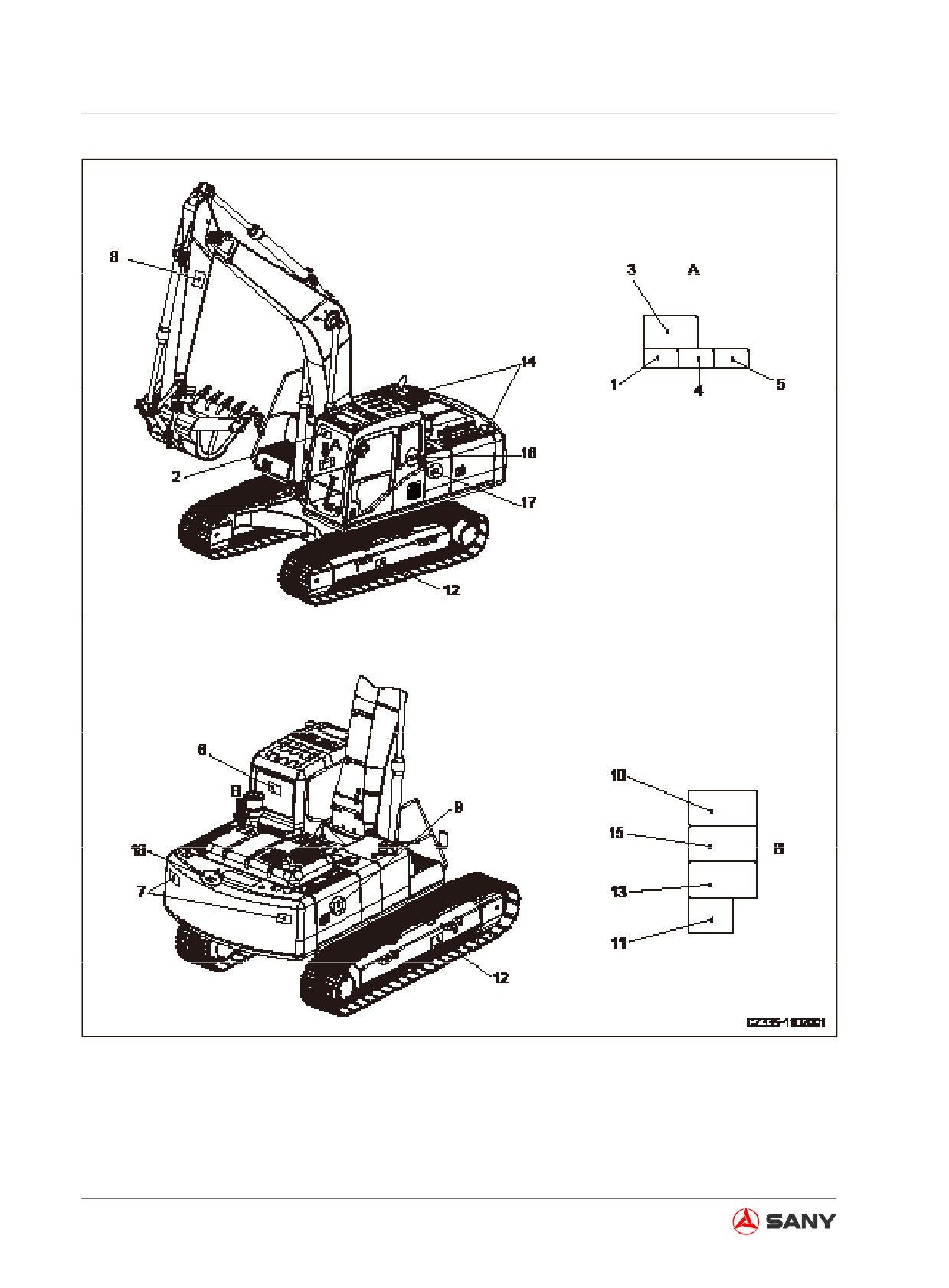
2.2.3.3 Safety decal locations
Sany cannot anticipate every possible circum-
stance that might involve a potential hazard.
The warnings in this manual and on the prod-
uct are, therefore, not all inclusive. If a tool,
procedure, work method or operating tech-
nique that is not specifically recommended by
Sany is used, you must be sure that it is safe
for you and for others.
Application or operation not specified in this
manual shall not be performed at any time.
The following safety decals are used on the
machine.
● Be sure to recognize the correct locations
and information on the decals.
● To ensure that the decals can be read
and understood easily, they have to be at-
tached to the right locations and always
kept clean. The use of organic solution or
gasoline to clean the decals is not allowed.
● There are also other decals besides those
for warning and safety. These messages
should be treated in the same way.
● A new decal should be used for replace-
ment if the old one is broken or missing,
or cannot be read. See the manual or the
message for part number of the decal. You
may order a new one from your Sany dis-
tributor.
2-11
Safety
Fig. 2-3
2-12
Safety
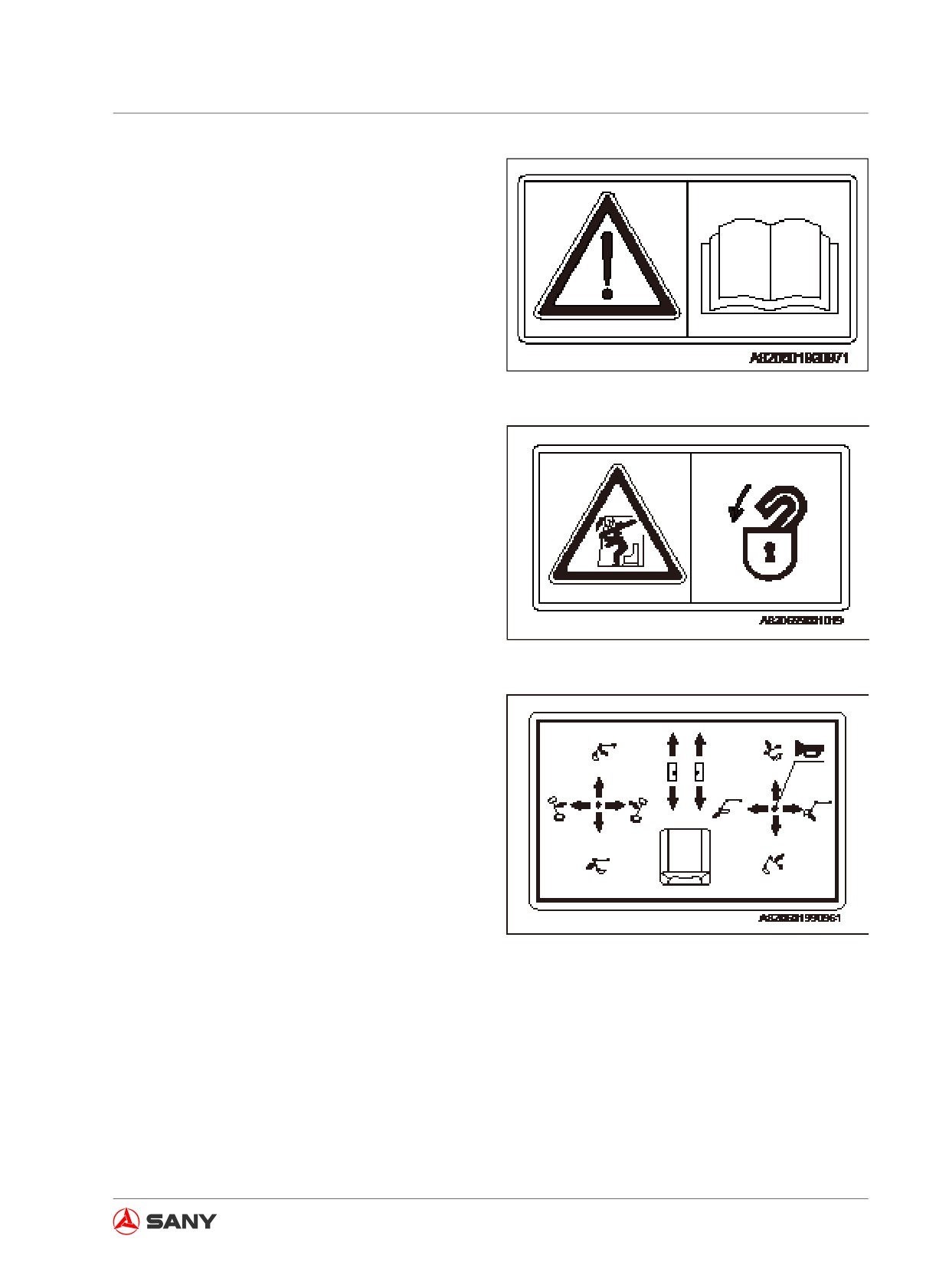
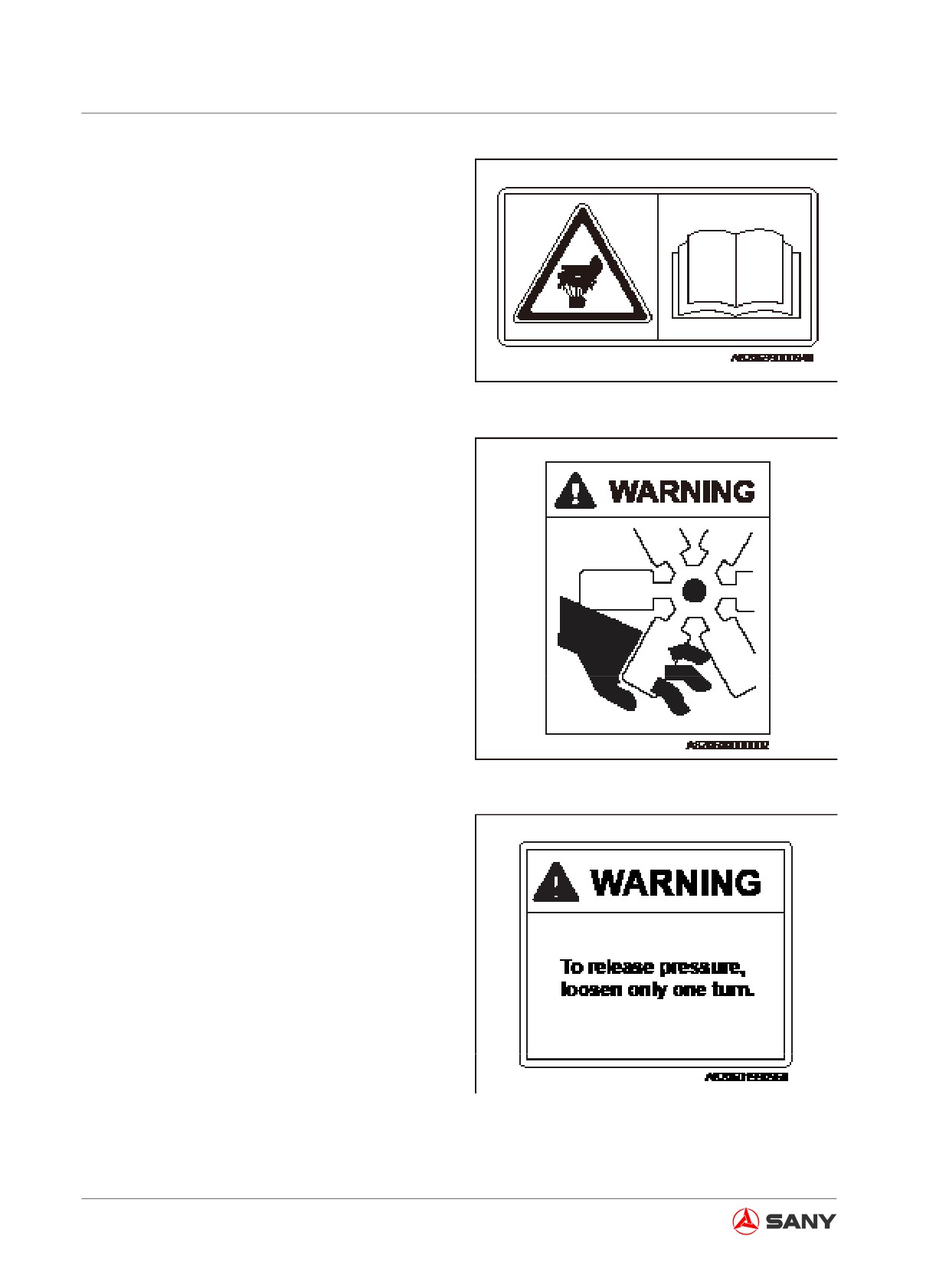
(1) Read the manual
● Warning!
● Read the Manual before operation, main-
tenance, disassembly, reassembly and
transportation of your machine.
Fig. 2-4
(2) Lock the front window
● Always lock the front window if it is open.
● If the front window is unlocked in the open
position, it may fall and personal injury
could result.
Fig. 2-5
(3) Excavator control pattern
● To prevent bodily injury or death, be aware
of the running condition and mode of your
machine. Pay attention to your surrounding
and operate your machine slowly.
Fig. 2-6
2-13
Safety
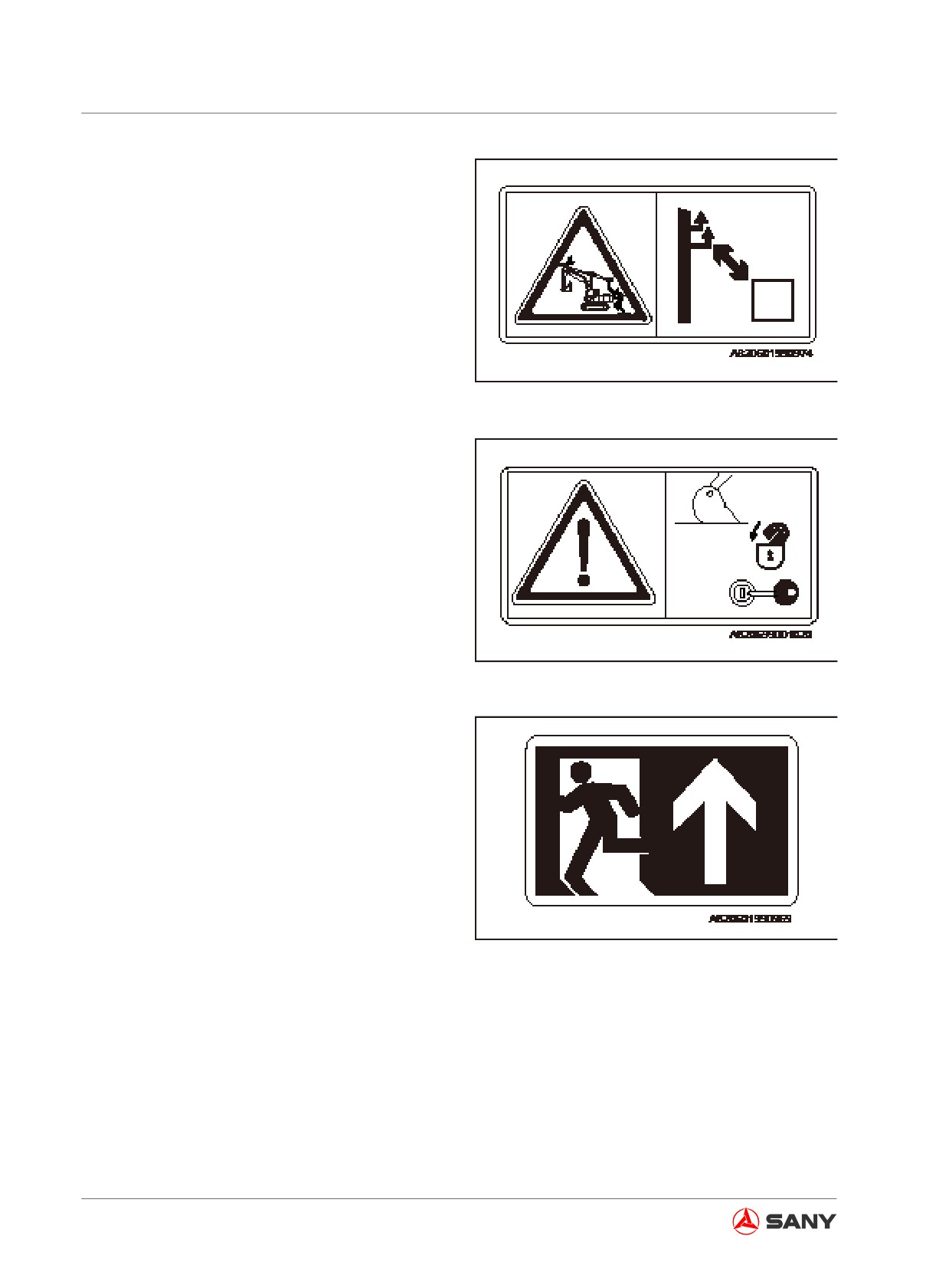
(4) High voltage
● Electrocution hazard.
● Keep a safe distance from power transmis-
sion lines.
Fig. 2-7
(5) Remove key after power-off
Before leaving your machine, lower the work
equipment to ground, engage the hydraulic
lockout control and remove the ignition key.
Fig. 2-8
(5) Alternate exit
Fig. 2-9
2-14
Safety
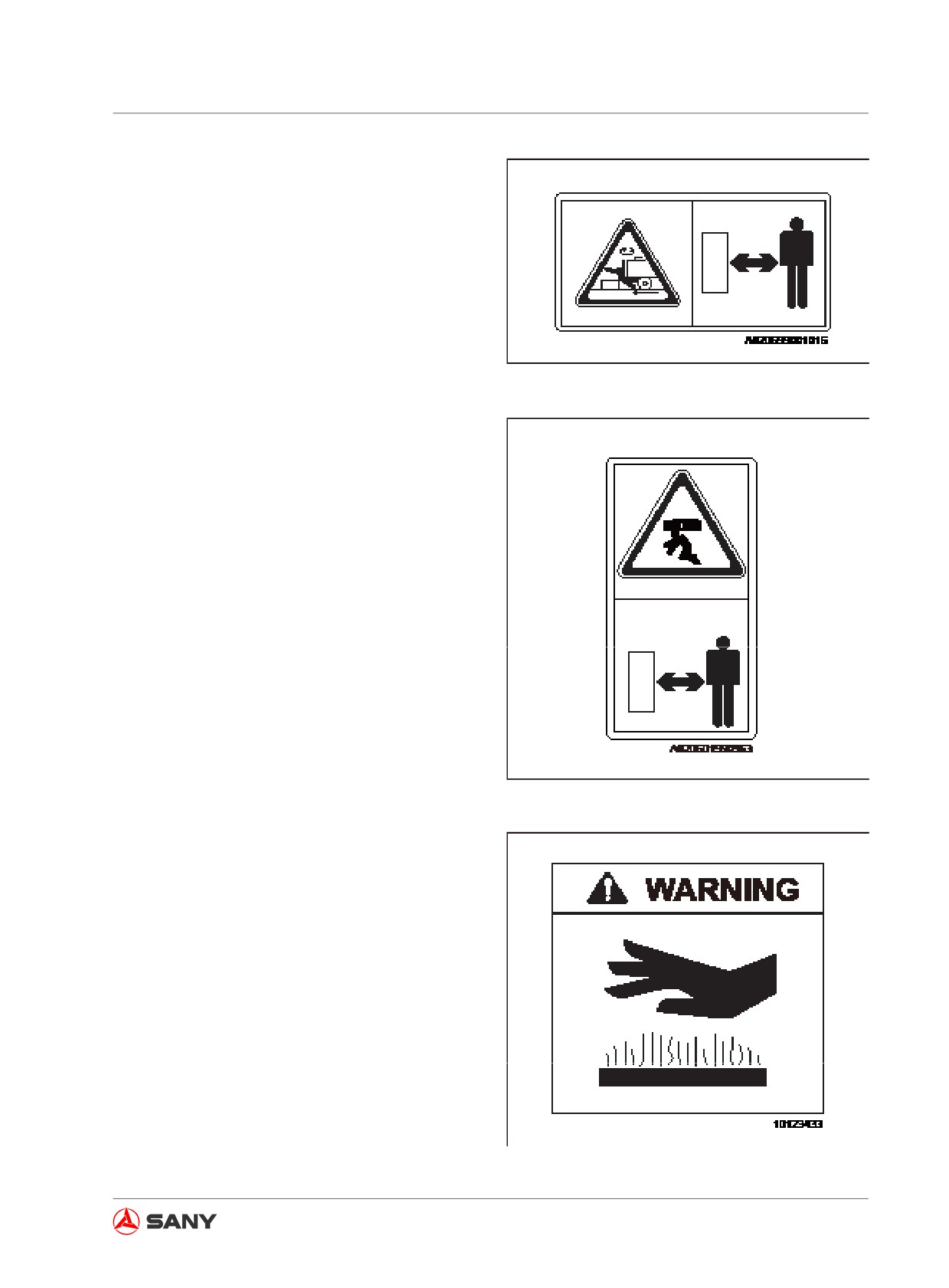
(7) Away from swinging range
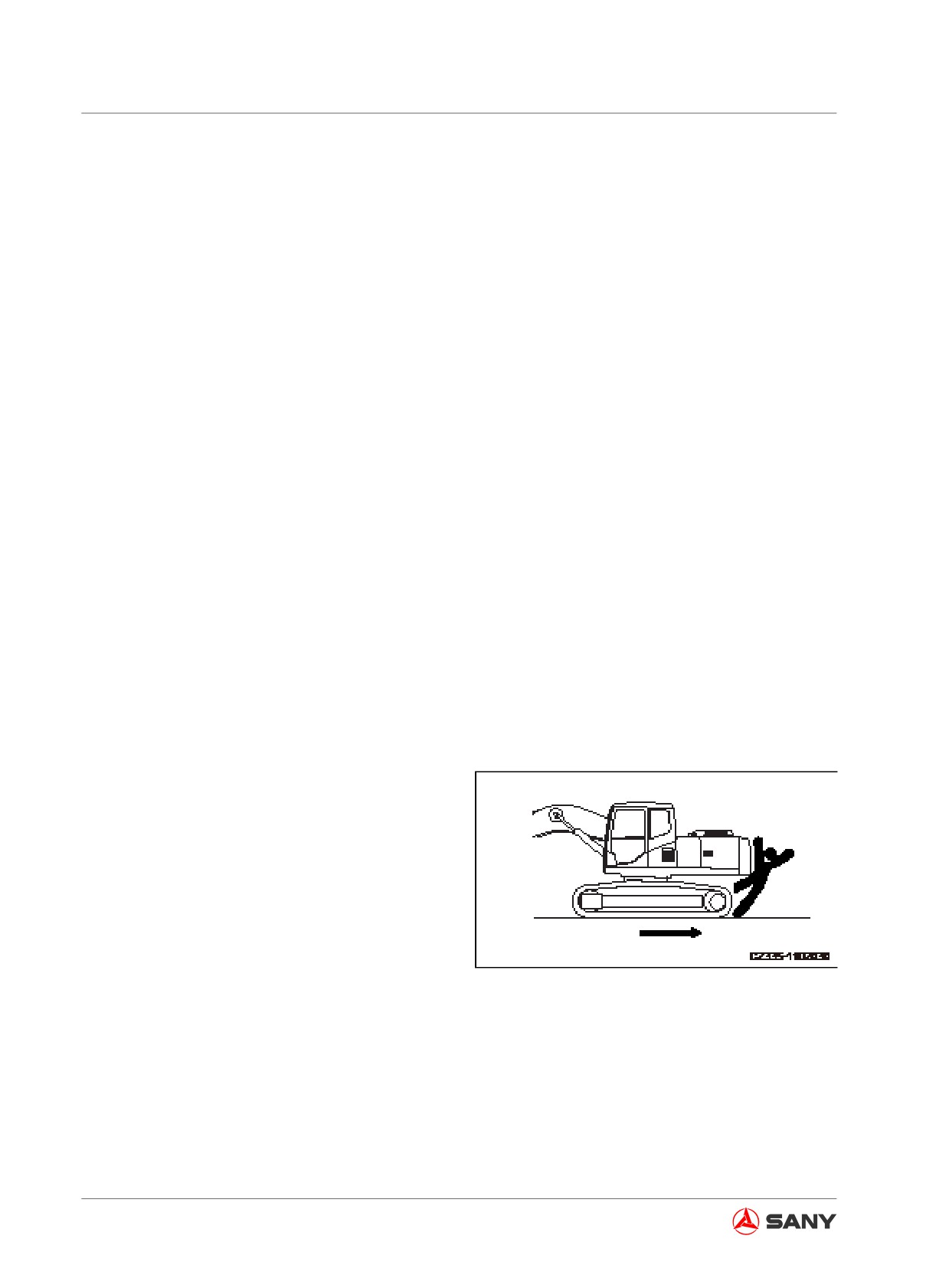
● This decal shows the possibility of being hit
by the machine. Be away from the swing-
ing range.
● Keep a safe distance from the machine
when it is working.
Fig. 2-10
(8) Watch out work equipment
● It is possible to be hurt by the work equip-
ment.
● Keep a safe distance from the machine
when it is working.
Fig. 2-11
(9) Hot surface
● Hot parts can cause burns. Never touch
any hot part.
Fig. 2-12
2-15
Safety
(10) Squirting hazard
● Read the instruction before removing the
cap of any pressure vessel. To prevent
squirting, turn the cap slowly to release in-
ternal pressure before removing it.
Fig. 2-13
(11) Fan cutting hazard
● A rotating part may cause injury. Keep a
safe distance from any rotating part.
Fig. 2-14
(12) Track tension adjustment warning
● The regulator valve under high pressure
may eject and cause bodily injury. Never
loosen it over one turn.
Fig. 2-15
2-16
Safety
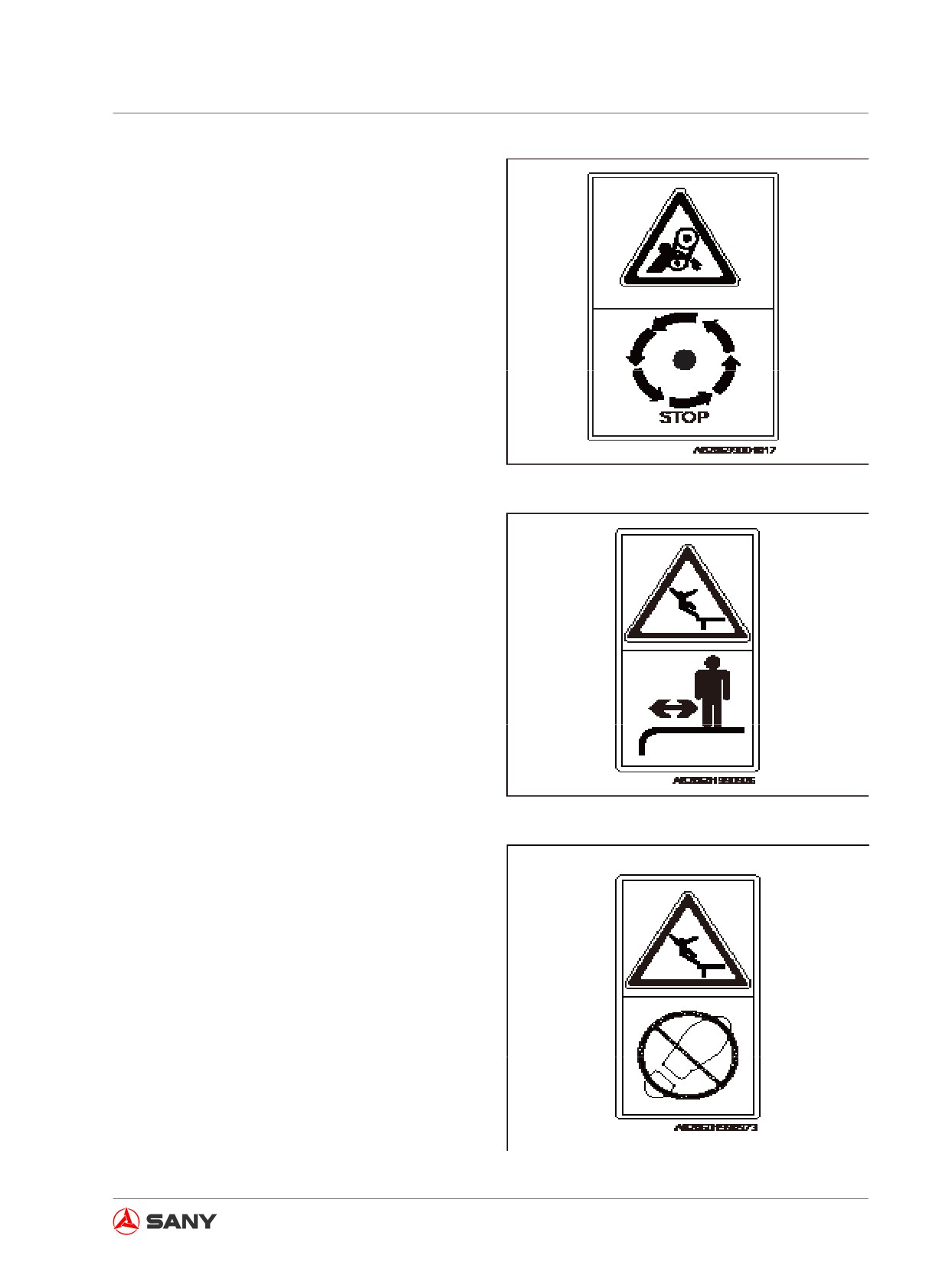
(13) Moving belt
● A rotating belt is dangerous.
● Stop the belt before maintenance.
Fig. 2-17
(14) Possible to fall
● It is possible to fall.
● Stay away from the edge.
Fig. 2-18
(15) Engine hood
● It is possible to fall.
● Never step here!
Fig. 2-16
2-17
Safety
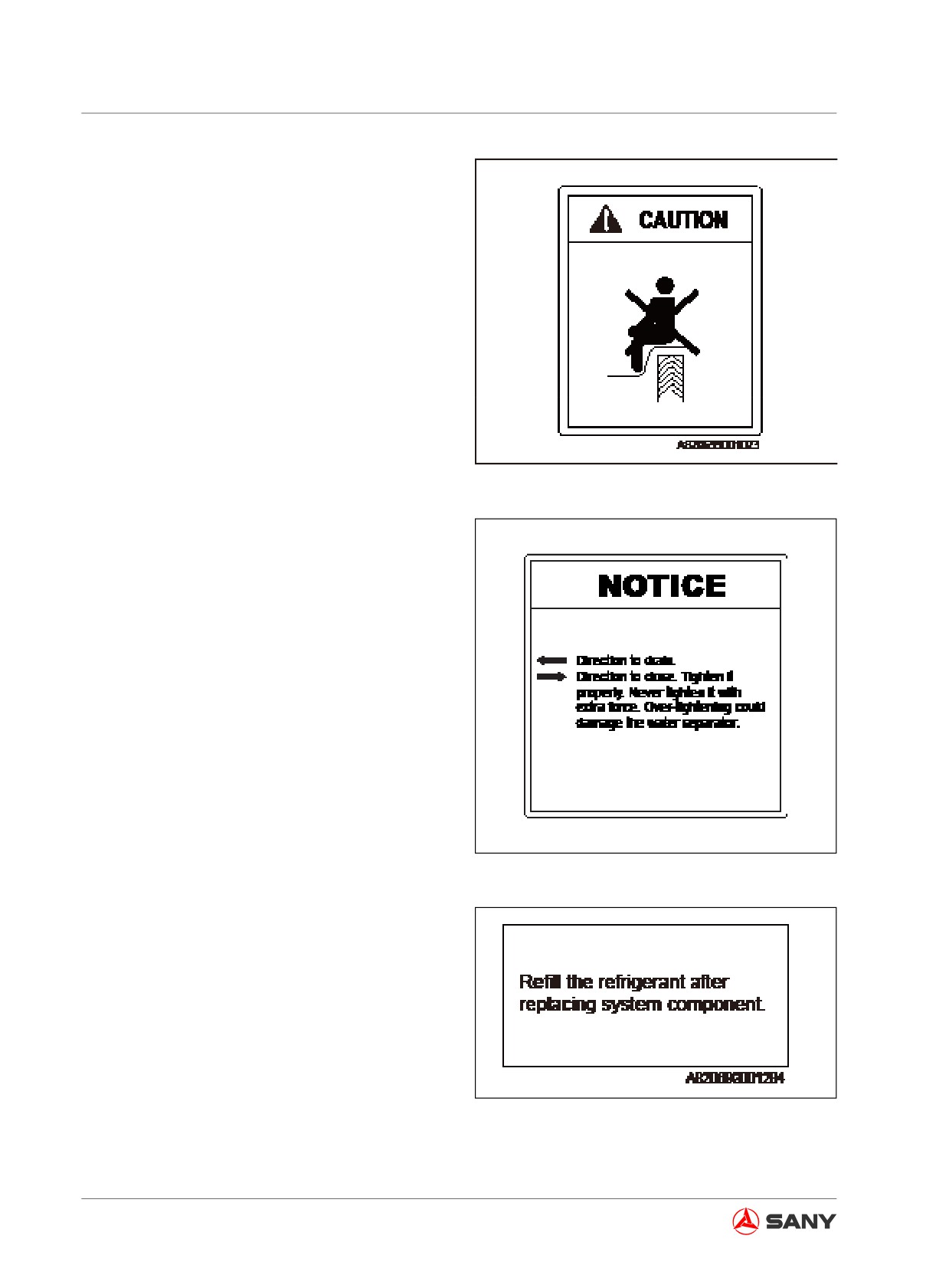
(16) Not seating
Fig. 2-19
(17) Water separator draining precautions
A820601990962
Fig. 2-20
(18) Refill refrigerant
Fig. 2-21
2-18
Safety
2.3 General Precautions
2.3.1 Safety rules
● Only trained personnel are allowed to op-
erate and service the machine.
● All safety rules, precautions and instruc-
tions must be followed when operating and
servicing the machine.
● Taking alcohol or drug could seriously im-
pair one's ability in operating or repairing
the machine, and it is hazardous for you
and other persons.
● When working with another operator or job
site traffic signalman, be sure to make all
people understand all hand signals to be
used.
2.3.2 Abnormalities
In case of any abnormalities found during
operation and maintenance, such as noise, vi-
bration, odor, incorrect gauge display, smoke,
or oil leakage, contact your Sany distributor
and take necessary measures. Never operate
the machine before the faults are corrected.
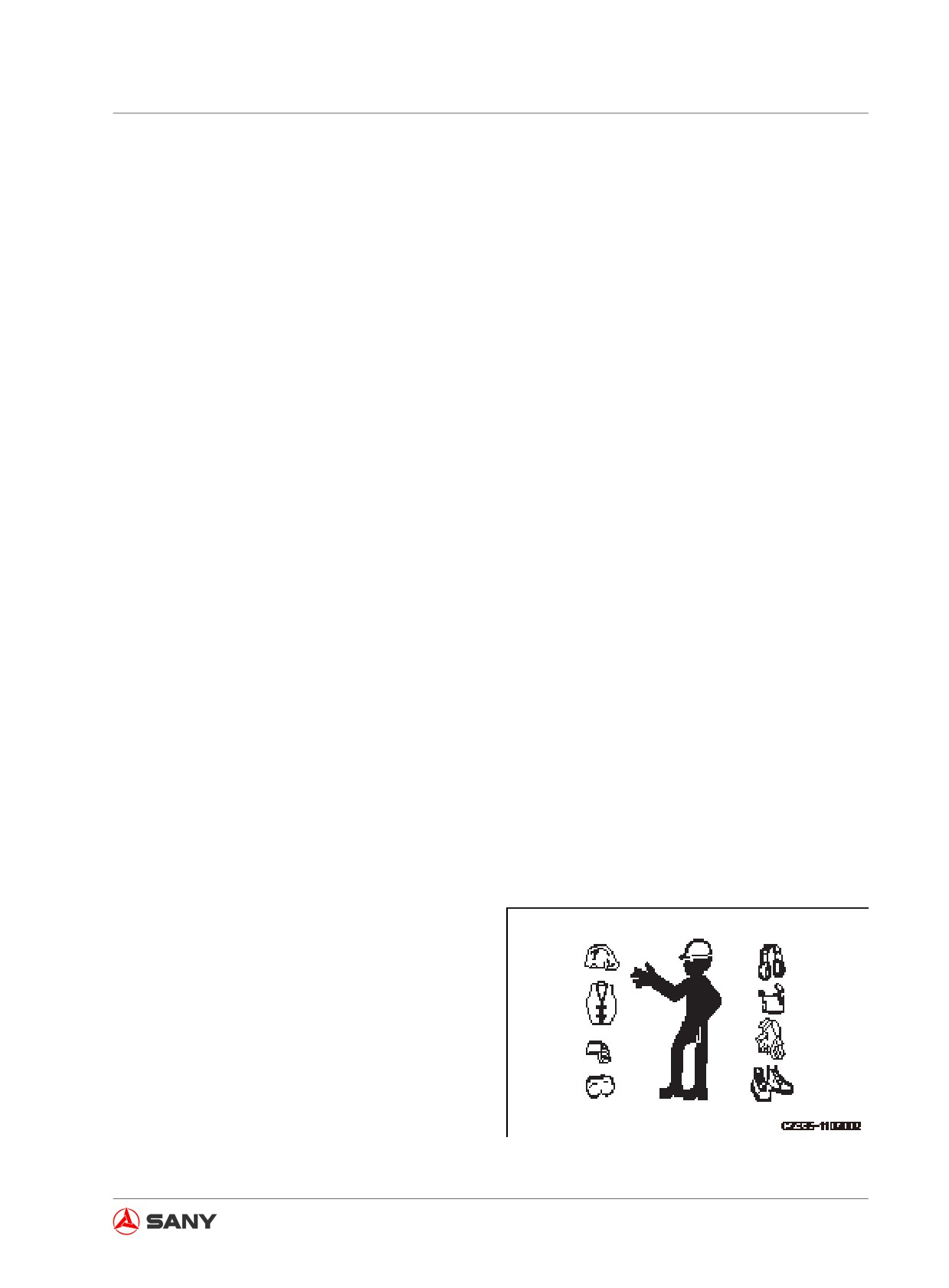
2.3.3 Personal protective equipment
Wear proper work clothes and personal pro-
tective equipment (PPE) suitable for the envi-
ronment of the job site. You may need:
● Hard hat
● Safety shoes
● Safety glasses, goggles or face shield
● Protective gloves
● Hearing protection
● Reflective protective clothing
Fig. 2-22
● Rain gear
2-19
Safety
● Dust mask
Wear all necessary PPEs as well as other
equipment required by your employer, local
government, and local laws and regulations.
Never take a risk.
WARNING
Observe the following items before per-
forming any operations. Failure to do so
could cause machine damage, personal
injury or death.
● Never wear slack clothing and jewelry,
which may get caught by control levers
or other machine parts.
● Long hair can be caught in moving
parts. Tie your hair if necessary to
avoid such hazard.
● Always have your hard hat and safety
shoes on. Wear safety goggles, face
masks, gloves, hearing protection and
safety belt if necessary.
● Make sure all PPEs are in good condi-
tion before use.
● Never listen to radio or music with ear
plugs on during operation.
2-20
Safety
2.3.4 Fire extinguisher and first aid kit
To prevent injury or fire, observe the following
precautions:
● First aid kit and fire extinguisher should be
available nearby.
● Read and understand the instruction at-
tached to fire extinguisher. Use fire extin-
guisher properly.
● Regular inspection and maintenance shall
Fig. 2-23
be done to ensure proper functioning of fire
extinguisher at any time.
● Check the first aid kit regularly and replen-
ish it when necessary.
● Make emergency scheme to deal with fire
and accidents.
2.3.5 Safety equipment
To protect you and others around you, your
machine may be equipped with the following
safety equipment. Make sure that they are se-
cured in place and in good condition.
● Falling object protective structure (FOPS)
● Front guard
● Lamps
● Safety signs
Fig.
2-24
● Horn
● Guards
● Travel alarm
● Mirrors
● Fire extinguisher
● First aid kit
● Windshield wipers
Make sure the above equipment are opera-
tional. Never remove or disconnect any safety
equipment.
2-21
Safety
WARNING
Observe the following items before per-
forming any operations. Failure to do so
could cause machine damage, personal
injury or death.
● Make sure all covers and caps are in
proper place. Repair or replace any of
them immediately once found dam-
aged.
● Know how to use these facilities and
use them correctly.
● Never remove the guard rail of the op-
erator cab (unless necessary) .
2.3.6 Cleaning your machine
● Clean the windshields, mirrors and lights.
Make sure that the operating area, steps
and handholds are free from oil, grass,
snow, ice or mud, which can cause you
to slip and fall. Remove the mud on your
soles before getting on the machine.
● If the machine is checked or serviced with
presence of mud or oil dirt, it may cause
you to slip or fall, or dirt may get into your
eyes. Keep the machine clean all the time.
Fig. 2-25
● If water has penetrated into the electri-
cal system, never rush to power on your
machine and start the engine, which can
cause machine failure or PC board dam-
age. Never flush the electrical system
(including sensors, connectors, etc.) with
water or steam.
2-22
Safety
2.3.7 Keeping the cab clean
● Clean the mud and oil on your soles when
getting into the cab. Mud or oil under your
shoes can cause your foot to slip on the
pedal during operation, and serious acci-
dent could result.
● Remove all loose personal items or other
objects from the operator's area. Secure
these items in the tool box or remove them
from the machine.
● Never use cellular phone when operating
or driving the machine.
● Never bring Hazardous articles, such as
flammable or explosive products, into the
cab.
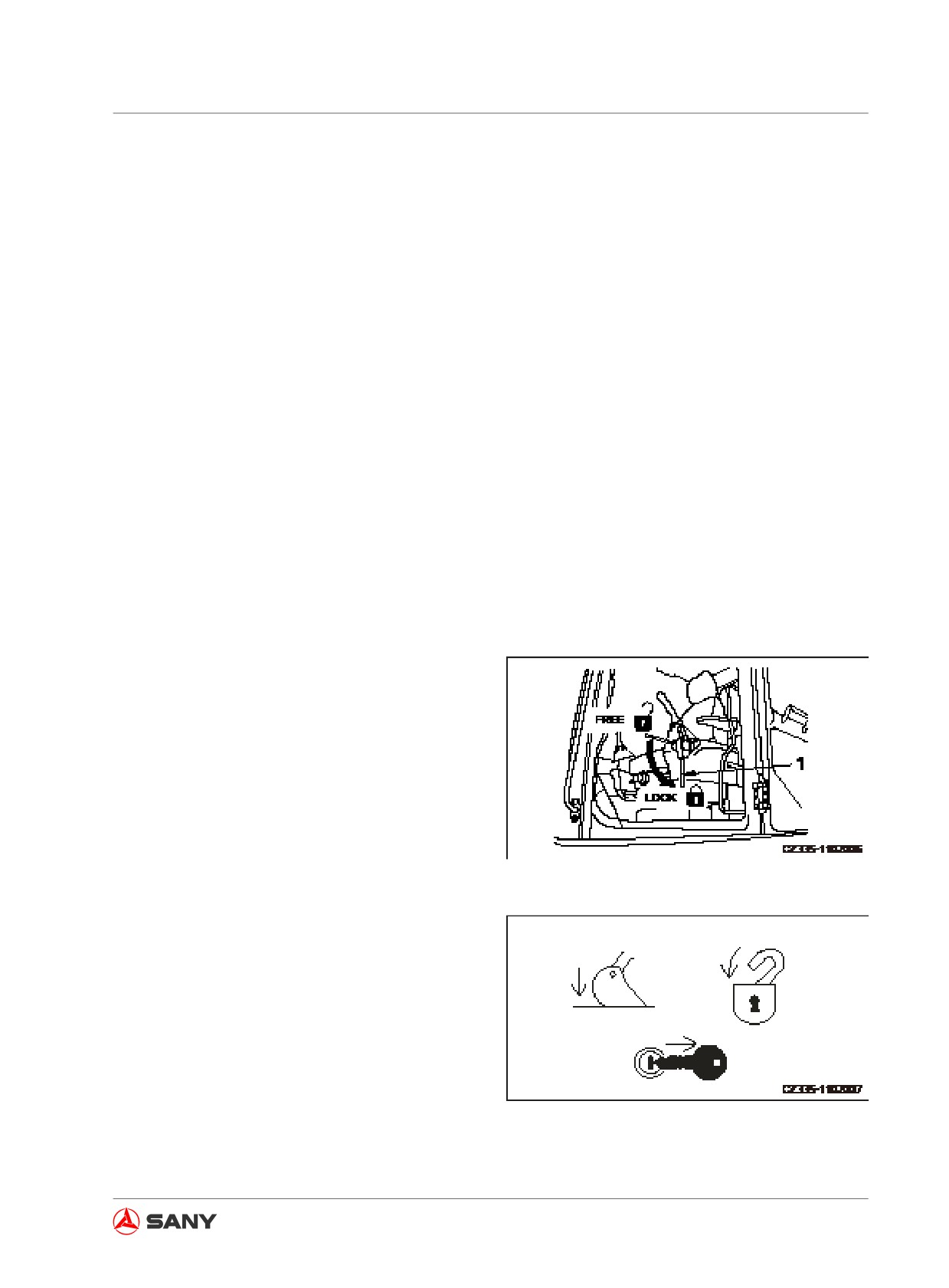
2.3.8 Engaging the hydraulic lockout
control
● Before you rise from the operator seat (e.g.
to open or close the front window or to
adjust the seat), lower work equipment to
ground, place hydraulic lockout control (1)
securely to the LOCK position, and then
stop the engine. If hydraulic lockout control
is FREE, accidental touching of control
levers can cause sudden machine move-
ment and serious injury, or machine dam-
age could result.
Fig. 2-26
● Before leaving your machine, always lower
work equipment to ground, place hydraulic
lockout control (1) to the LOCK position,
and then shut down the engine. Lock all
lockable components and remove ignition
key.
Fig. 2-27
2-23
Safety
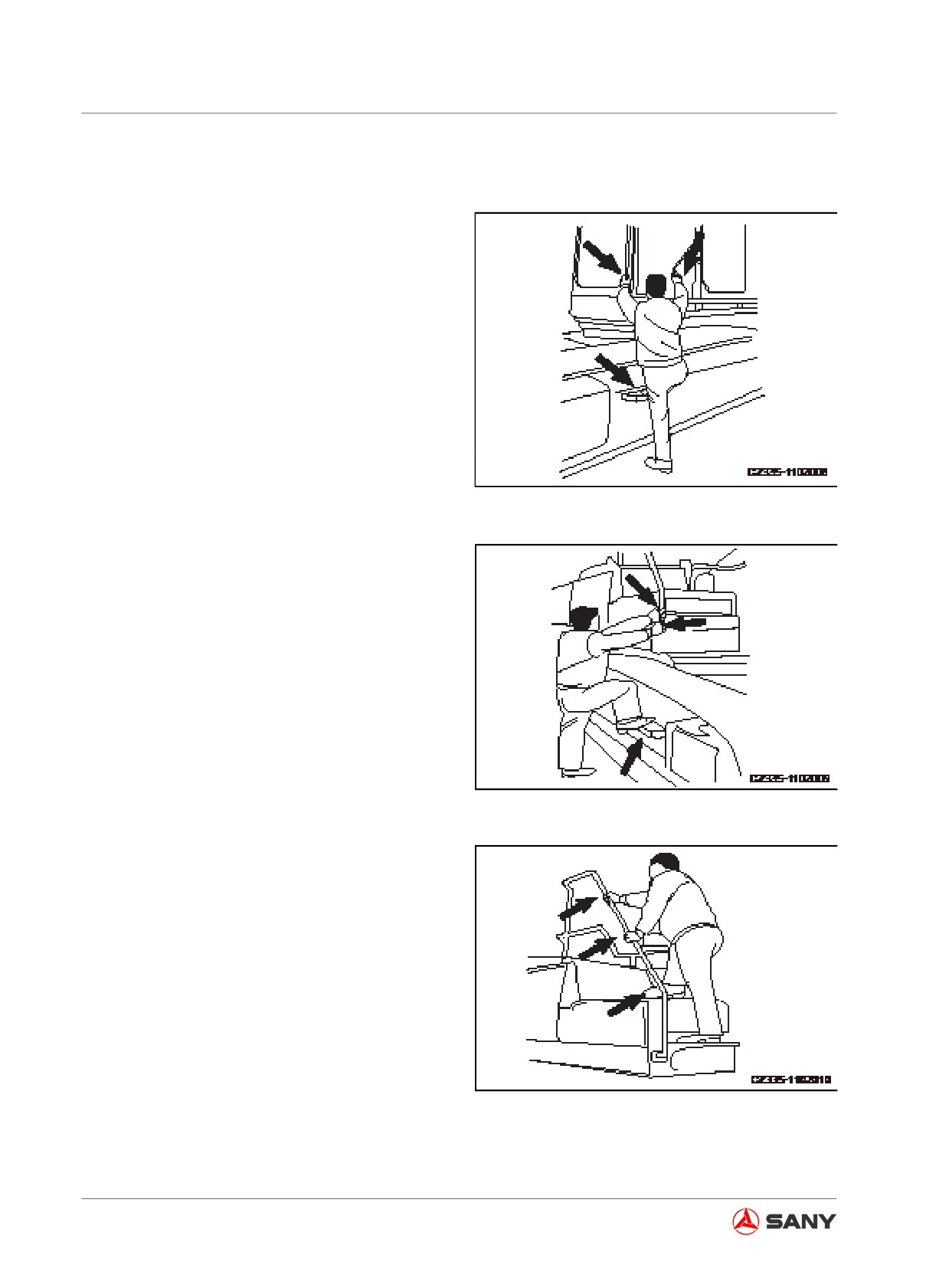
2.3.9 Handholds and steps
To avoid personal injury caused by slippery
handholds or steps, observe the following in-
structions:
●
Before mounting and dismounting, check
the handholds and steps (including tracks)
for oil, grease or mud. Always keep them
clean. Make necessary repairs and tighten
loose bolts if any.
●
When mounting and dismounting the
machine, use the handholds and steps
marked by the arrows.
●
Face the machine and maintain a 3-point
Fig.
2-28
contact with the handholds and steps (in-
cluding tracks) . A 3-point contact can be
both feet and one hand, or both hands and
one foot.
●
Never use any control lever as a handhold
when mounting or dismounting the ma-
chine.
●
Never carry tools when mounting or dis-
mounting the machine.
●
Never work on an engine hood or cover
with no non-slip mat on it.
●
Always face the machine when you mount
Fig.
2-29
or dismount the machine.
●
Never jump onto/off the machine. Never
mount a moving machine. Never jump onto
the machine and try to stop it.
●
When you enter and exit the operator cab,
make sure the cab is on the central line of
undercarriage.
Fig. 2-30
2-24
Safety
2.3.10 Overhead work
When working on a overhead place, use a lad-
der or other support to ensure your safety.
2.3.11 No sitting on attachment
To avoid falling hazard, no one is allowed to sit
on work equipment or other machine attach-
ments.
2.3.12 Articulated parts
The space around work equipment changes
with movement of linkages. Serious personal
injury could result if one is stuck in between.
Never stay close to rotating or retracting/ex-
tending components.
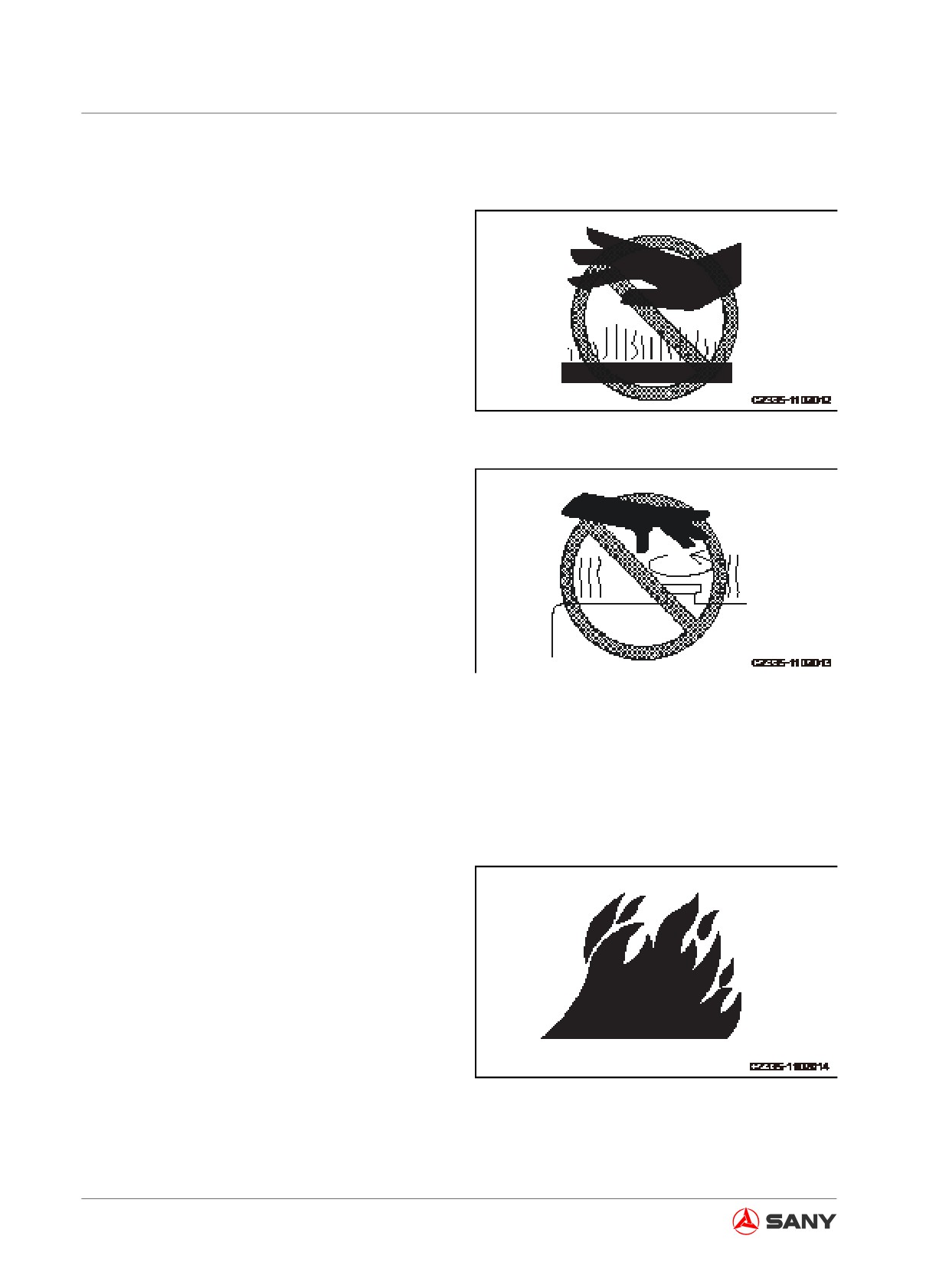
2.3.13 Preventing burns
2.3.13.1 Hot coolant
● To prevent burns caused by hot coolant or
steam when checking or discharging the
coolant, wait until the engine coolant is
cool enough before proceeding.
● Never open the cap of radiator before the
engine cools down. Loosen the cap of the
radiator slowly before removing it. Internal
pressure of radiator must be relieved to
avoid serious burns.
Fig. 2-31
2-25
Safety
2.3.13.2 Hot oil
To prevent scalds caused by hot oil when
checking or discharging the oil, always wait
for the engine oil to cool down before you pro-
ceed.
When the engine has cooled down, loosen the
cover or screw plug slowly to relieve internal
pressure.
Fig. 2-32
Fig. 2-33
2.3.14 Preventing fire and explosion
2.3.14.1 Fire caused by fuel or oils
● Engine oil and fuel must be stored in des-
ignated place, where unauthorized persons
cannot enter.
● Never smoke or use fire near fuel or en-
gine oil.
● Check for missing or loose pipe clamps,
twisted hoses, hoses rubbing against pipe-
line, damaged oil cooler, and loose bolts in
flange of oil cooler, so as to avoid oil leak-
age. Tighten, repair or replace any missing,
Fig. 2-34
loose or damaged pipe clamps, pipelines,
hoses, oil coolers or other flange bolts.
● Refuel or store oils in a place with good
ventilation.
2-26
Safety
●
Shut down the engine before refueling.
●
Never leave the machine when refilling the
fuel or engine oil.
●
Never let fuel overflow onto overheated
surface or electrical components.
●
Remove overflowed fuel or engine oil after
refilling.
Fig.
2-35
●
Store oily rags and any flammable materi-
als in protective containers in order to keep
the job site safe.
●
Screw on the caps of fuel tank and oil tank
tightly.
●
When oil is used to clean the parts, use
non-flammable oil. Never use diesel oil or
gasoline as they can easily catch on fire.
●
All flammable materials should be moved
to a safe place before carrying out grinding
or welding operation on the chassis.
●
Never weld or flame cut the lines contain-
ing flammable fluid.
2.3.14.2 Fire caused by flammable materi-
als
● Remove at any time dry leaves, wood
chips, paper pieces, dirt and other flamma-
ble materials built up or stuck on engine,
exhaust manifold, battery or interior of en-
gine hood to prevent fire.
2.3.14.3 Fire caused by electric lines
Short circuit of electrical system can cause
fire.
● Keep electric terminals clean and fastened.
● Check power cables and electric lines for
looseness, entanglement, hardening or
break each day after operating for 8-10
hours. Check the presence or damage of
wiring terminal cover.
2-27
Safety
● In case of slack or entangled power cables
or electric wires, tighten the connections
or wire clips, and repair or replace broken
wires.
2.3.14.4 Fire caused by hydraulic lines
● Check the clamps, guards and gaskets of
all hoses and pipes to see whether they
are tightened in position.
● In case of loosening, their vibration in op-
eration may lead to friction against other
components, resulting damage of hose,
ejection of high-pressure oil, disastrous fire
or serious injury.
2.3.14.5 Fire caused by illumination equip-
ment
● Anti-blast illumination equipment shall be
used to avoid explosion when fuel, oil,
electrolyte, window cleaning detergent or
cooling fluid is being checked.
● Instructions in this manual must be fol-
lowed when power outlet on the machine
is used for illumination.
2.3.14.6 Fire caused by heat shield
● Damage or missing of heat shield may
lead to fire.
● In case of any abnormality, heat shield
must be repaired or replaced before opera-
tion of machine.
2.3.15 In the event of fire
When a fire breaks out, leave the machine im-
mediately by the following steps.
● Turn start switch to the OFF position to
shut down the engine.
● Leave the machine with the help of hand-
2-28
Safety
holds and steps.
2.3.16 Windshield cleaning detergent
Use alcohol based detergent. Never use meth-
anol based detergent as it irritates eyes.
2.3.17 Preventing ejection of part
The grease in track tensioning device is under
high pressure. Improper handling may result in
serious injury, blindness or death. Observe the
following instructions.
● Never disassemble grease nozzle or valve
components. These parts may eject. Never
stay in front of the valve.
● Travel reducer is under pressure.
Fig. 2-36
● Gear oil is hot liquid. Wait for it to cool
down before loosening the plug to release
pressure. To avoid injury, never face the
plug during operation.
2-29
Safety
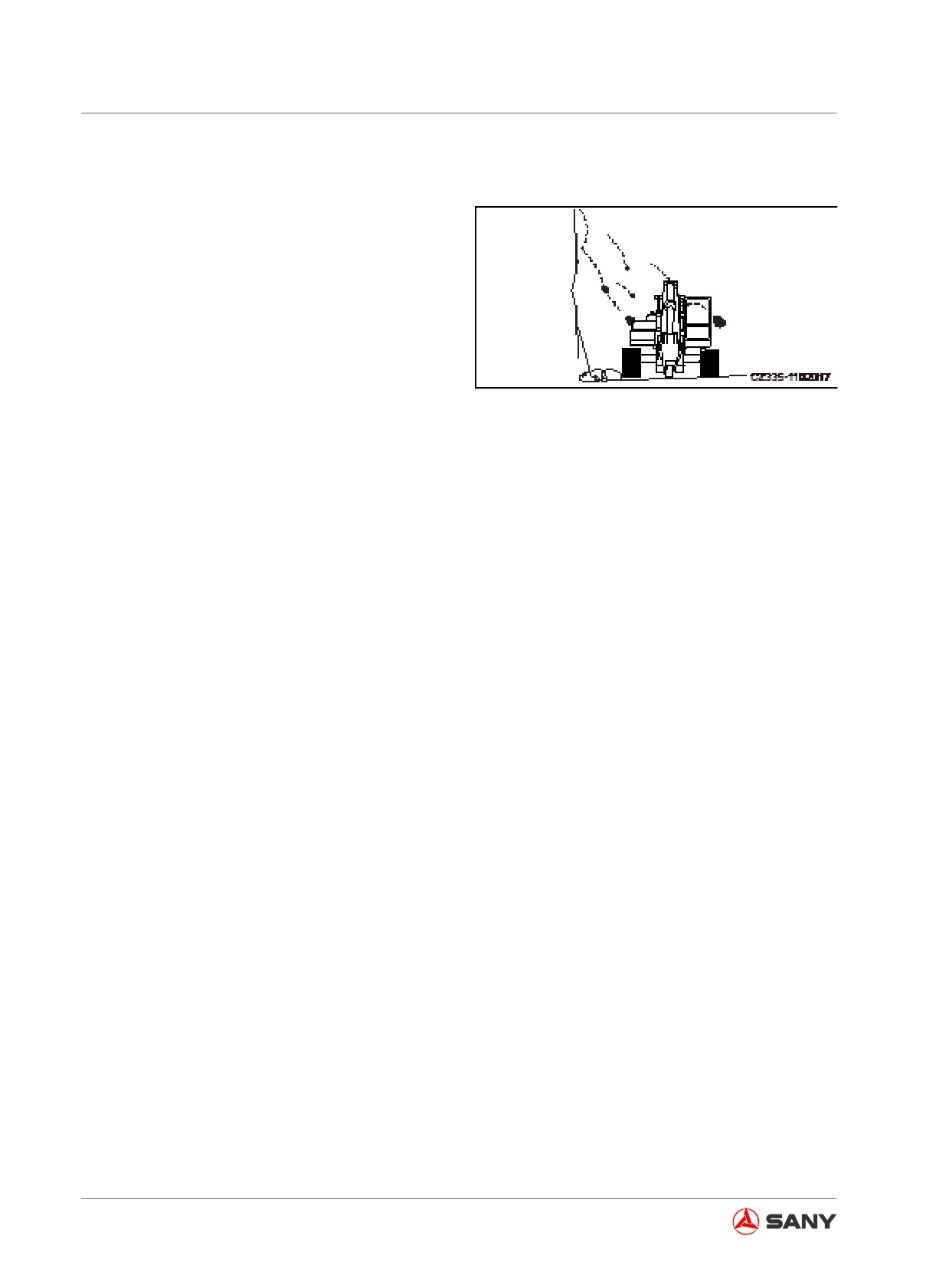
2.3.18 Falling object protection
●
When the machine is operated in places
where the cab is likely to be hit or invaded
by falling objects, scattered materials or
foreign bodies, protective structure shall be
used to protect the operator.
●
In demolishing or breaking operation, a
front guard is necessary. In addition, a
transparent glass film shall be applied to
the windshield.
Fig.
2-37
●
In a coal mine or a quarry where falling ob-
jects are present, install falling object pro-
tective structure (FOPS) and front guard,
and apply a transparent glass film to the
windshield. The operator shall wear a hard
hat and goggles.
●
Keep the windshield shut in such condi-
tions and make sure other people are kept
a safe distance away from the operating
area.
●
Other guards may be necessary according
to different working conditions. In this case,
contact Sany distributor in advance.
2.3.19 Attachment installation
● Installation of optional parts or attachments
may involve safety issues or be limited by
the law. In this case, contact your Sany
distributor in advance.
● Sany assumes no responsibility for the in-
jury, accidents and product failure caused
by the use of unauthorized attachments
and parts.
● Before installing and using machine attach-
ments, read related instructions regarding
the attachment and general precautions on
attachment in this manual.
2-30
Safety
2.3.20 Attachment combination
Different or combined work equipment may
collide with the cab or interfere with other
machine components. Before operating work
equipment you are not familiar with, check the
clearance between it and the machine and op-
erate it carefully.
2.3.21 Cab windows glasses
● Broken cab windows at the side of the
work equipment may expose the operator
in direct contact with the work equipment.
In this case, stop operation immediately
and replace the glasses.
● Broken or damaged window provides no
protection to the operator. When the roof
window is damaged, replace it immediately
with a new one.
2.3.22 Unauthorized modification
Any modification unauthorized by Sany may
lead to safety problems, personal injury or
death. Improper modification can affect ma-
chine's strength and operator's view. Contact
your Sany distributor before making any modi-
fication. Sany assumes no responsibility for
the accidents, failure or damage caused by
unauthorized modification.
2.3.23 Job site investigation
● Machine operation near flammable materi-
als (e.g. dry tree leaves) poses a fire haz-
ard. Be careful during operation.
● Check the terrain and ground condition and
use the safest operating method. Never
operate in areas with the risk of landslide
or falling stones.
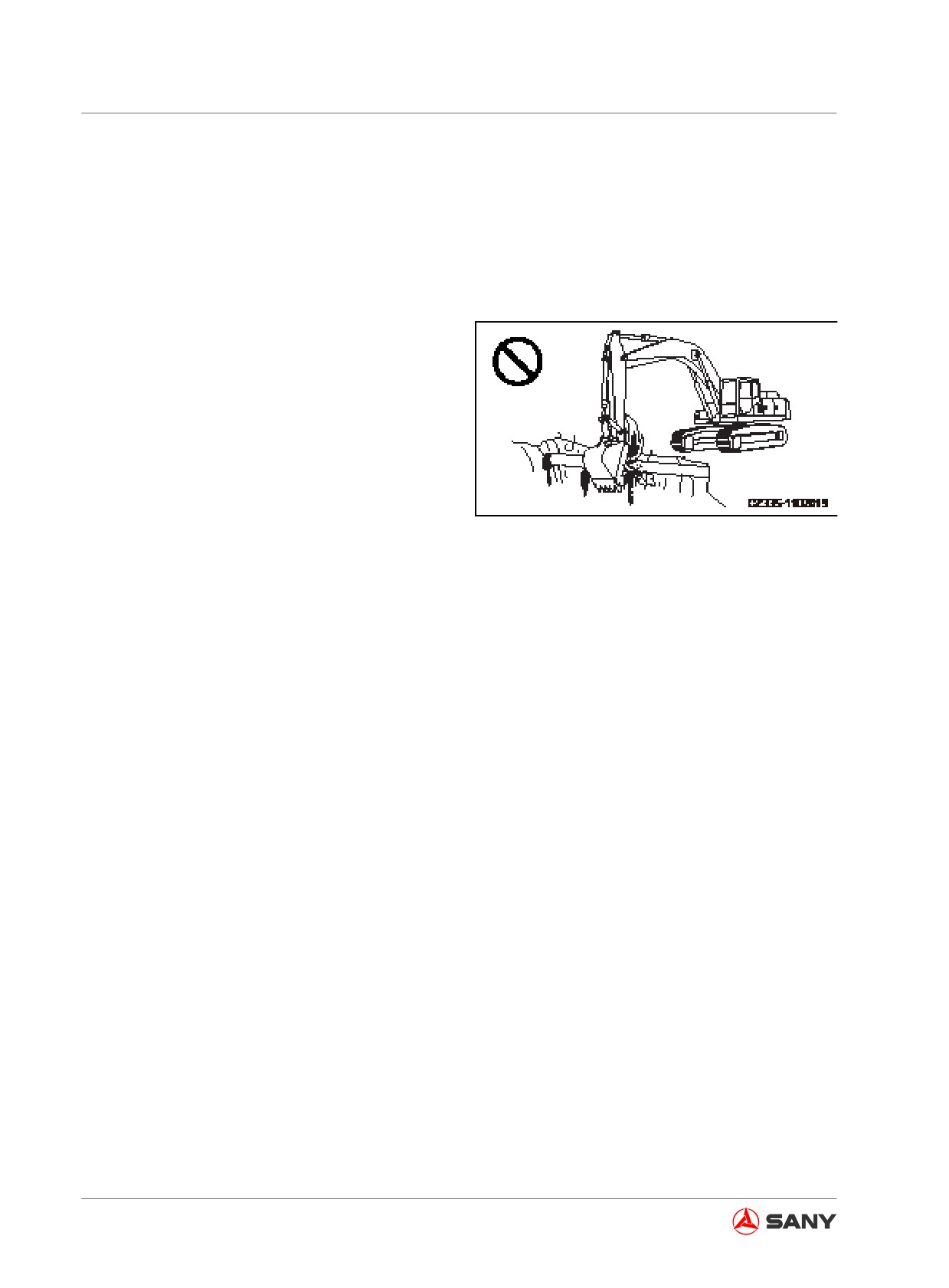
● Solidify the ground when operating beside
Fig. 2-38
2-31
Safety
a ditch or on road shoulders. Keep your
machine a safe distance away from the
ditch or road shoulder. Designate a signal
man, when necessary, to avoid accidental
injury.
●
When underground water mains, gas lines,
cables or high-voltage electric cables are
available on the job site, inform related
utilities providers and mark the area. Be
careful not to cut or damage any lines.
●
Prevent any unauthorized personnel from
entering the job site. Designate a signal
man and fence the job site when operating
your machine on a highway.
●
Be especially alert when operating on fro-
zen ground. Increase of ambient tempera-
Fig.
2-39
ture may result in soft and slippery ground.
●
When traveling or operating in shallow wa-
ter or soft ground, check the type and con-
dition of rock bed as well as the depth and
water flow before operation.
2.3.24 Operation on soft ground
● Avoid traveling or operating your machine
near cliffs, road shoulders or trenches. The
soft ground plus machine weight and vibra-
tion can cause your machine to sink or tip
over. The ground may become even softer
after heavy rain, explosion or earthquake.
● When operating on a dam or near an exca-
vated ditch, vibration and machine weight
may trigger a landslide. Before operation,
take protective measures to prevent your
machine from tipping over or falling.
2-32
Safety
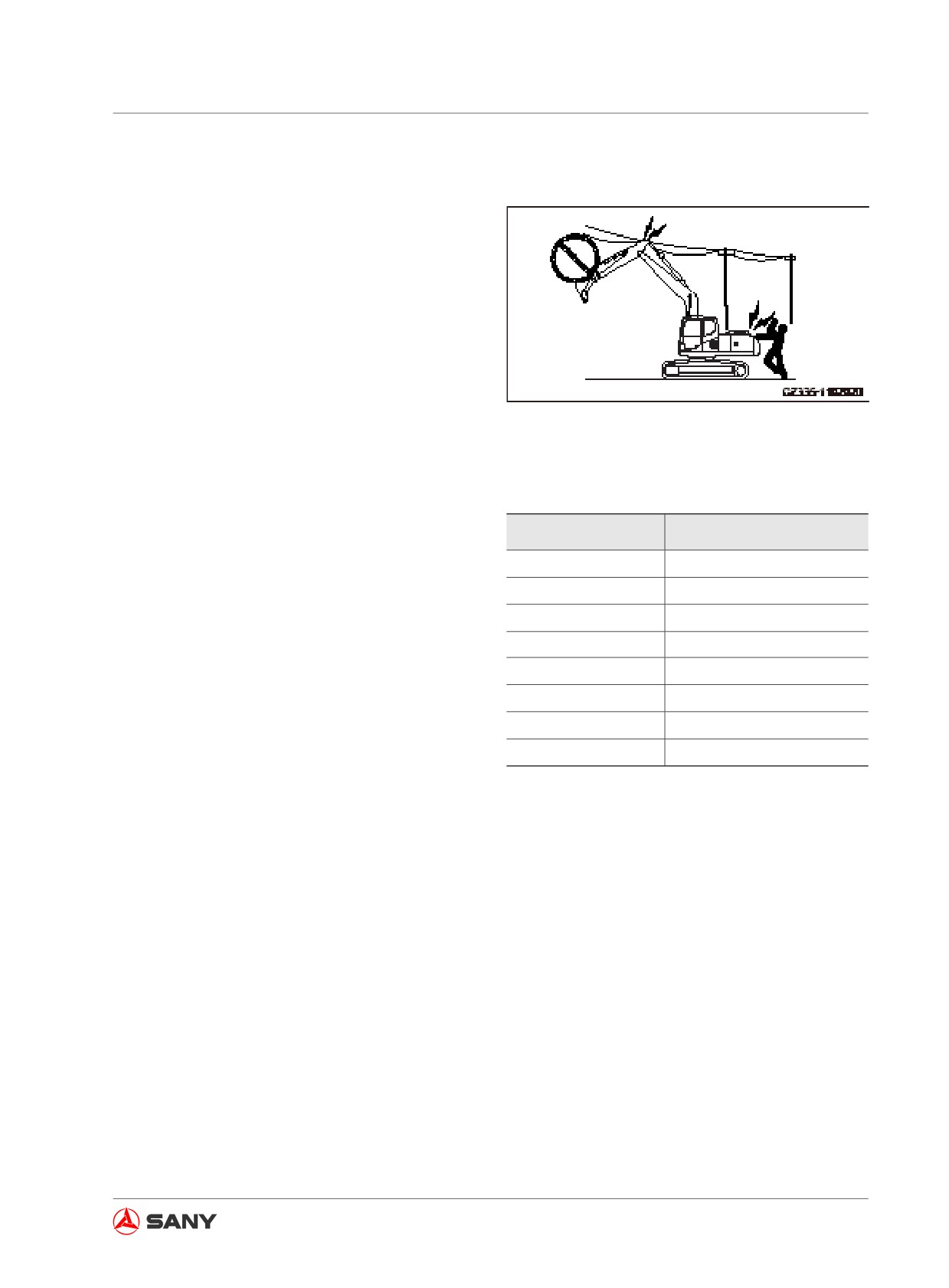
2.3.25 Overhead power cables
Never drive or operate your machine near
power cables, which may bring electrocution
hazard and cause machine damage, personal
injury or death. The following steps are to be
followed while working at where power cables
could be nearby.
●
Before operation in the vicinity of power
cables, inform local power company of the
coming operation and ask them to take
Fig. 2-40
necessary measures.
●
If your machine is too close to power
cable, electrocution is most likely to occur
and cause burns or death. A safe distance
must be kept between machine and power
Cable Voltage
Safe Distance
cable (See Table 2-1). Before operation,
100V-200V
2 m ( 7 ft) or above
communicate with local power company
6,600V
2 m ( 7 ft) or above
regarding safety measures.
22,000V
3 m ( 10 ft) or above
●
A signalman is to be designated to give
66,000V
4 m ( 14 ft) or above
signals if your machine is too close to pow-
154,000V
5 m ( 17 ft) or above
er cables.
187,000V
6 m ( 20 ft) or above
●
Nobody is allowed to approach the ma-
275,000V
7 m ( 23 ft) or above
chine when it is operated near high-voltage
cables.
500,000V
12 m ( 36 ft) or above
●
If your machine is too close to the cable
Table 2-1
or touches the cable, to prevent electrocu-
tion, operator shall not leave the cab until
machine power is surely cut off. In addi-
tion, Nobody is allowed to approach the
machine.
●
To prevent accidents, wear rubber shoes
and rubber gloves during operation. Cover
the operator’s seat with rubber sheet and
pay attention to exposed part of body that
should not touch the lower part of machine.
2-33
Safety
2.3.26 Ensuring a good visibility
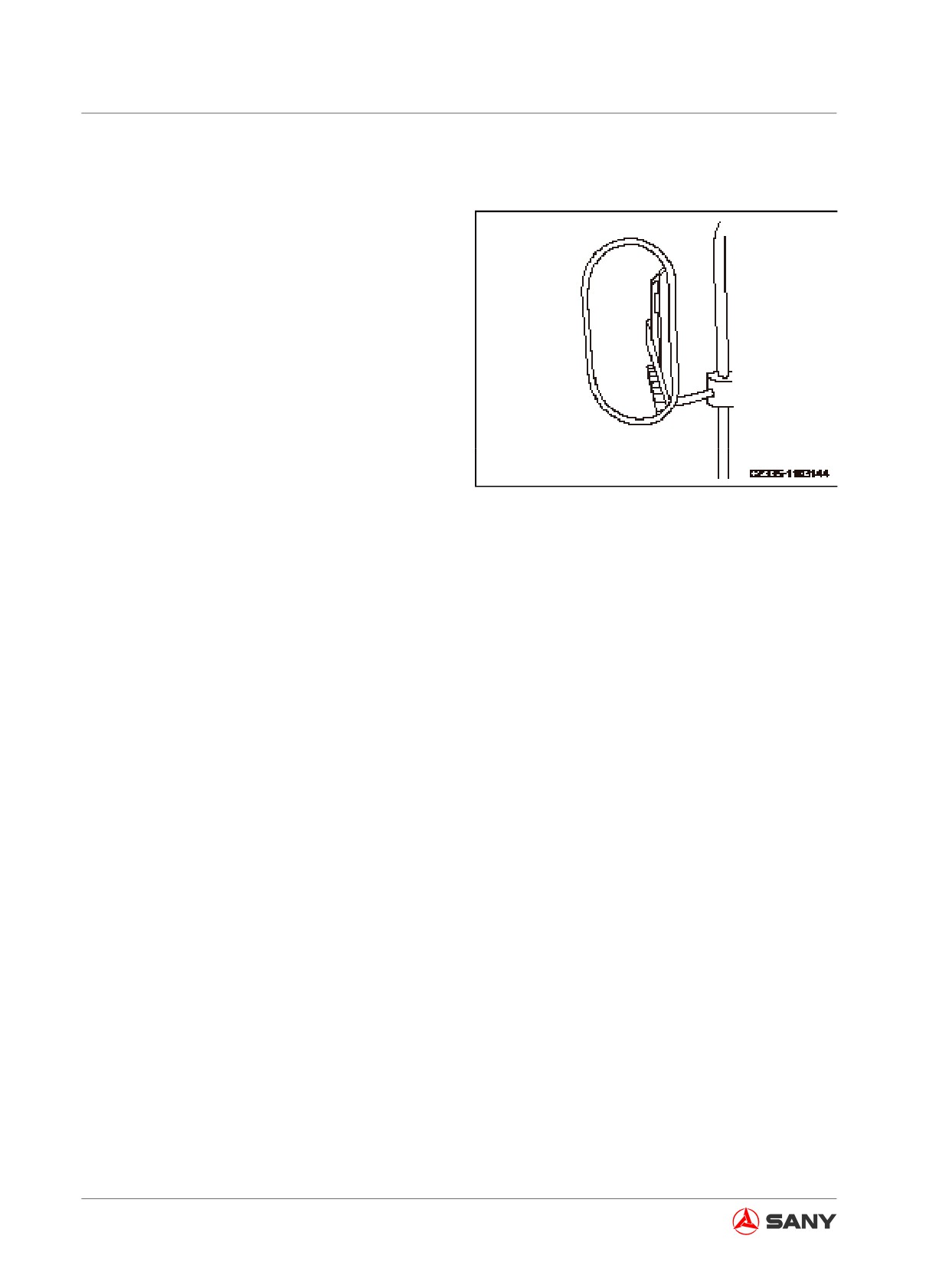
The machine is equipped with rearview mirrors
to improve the visibility of the operator. How-
ever, some areas cannot be seen from the
operator seat. When operating your machine
in a position that gives you poor visibility, un-
certainty of job site may cause machine dam-
age and personal injury. Observe the following
instructions when operating or driving your
machine in a place without a clear view.
● Check rear view mirrors on each workday.
Remove debris and adjust the view to en-
sure good visibility.
● Working in a darkened area requires turn-
Fig.
2-41
ing on work lamps and head lamps of the
machine. Set up auxiliary illumination on a
job site if necessary.
● Stop operation if you cannot have a clear
view in days with fog, snow, rain or sand
storm.
● Road shoulder or soft ground should be
marked. In case of bad vision, a signalman
should be available if necessary. Operator
shall especially pay attention to the marks
and follow the instruction of the signalman.
● Only one signalman is allowed to give sig-
nals.
● Make sure all workers understand all sig-
nals and gestures before operation.
2-34
Safety
WARNING
Exposure to hazardous chemicals or dusts
pose a serious danger if released or mis-
handled. Performing demolition work or
handling hazardous materials often release
substances that could pose a hazard. Seri-
ous injury or death may result unless prop-
er precautions are observed while working
with these materials. All workers involved
in demolition or handling of hazardous
materials should use approved personal
Fig. 2-42
protective equipment and follow all envi-
ronmental safety regulations.
2.3.27 Ventilating enclosed area
Engine exhaust gas can be fatal. If the engine
must be started, or if fuel, cleaning oil or paint
must be handled in an enclosed area, to pre-
vent gas poisoning, doors and windows shall
be opened to ensure sufficient ventilation.
2.3.28 Asbestos hazard
Inhalation of asbestos dust can cause lung
cancer. It is possible to inhale asbestos dust
when performing tear-down operation or han-
dling industrial wastes at job site. The follow-
ing rules must be followed.
● Use water, instead of compressed air, to
remove the dust.
● If the air contains asbestos dust, operate
the machine following the wind. All persons
shall wear acceptable filter mask.
● Nobody is allowed to approach the ma-
chine during operation.
● The regulations, rules and environment cri-
terion at job site shall be observed.
No asbestos is used in this machine. But after-
2-35
Safety
market parts could contain asbestos. There-
fore, use only the parts and components sup-
plied by Sany.
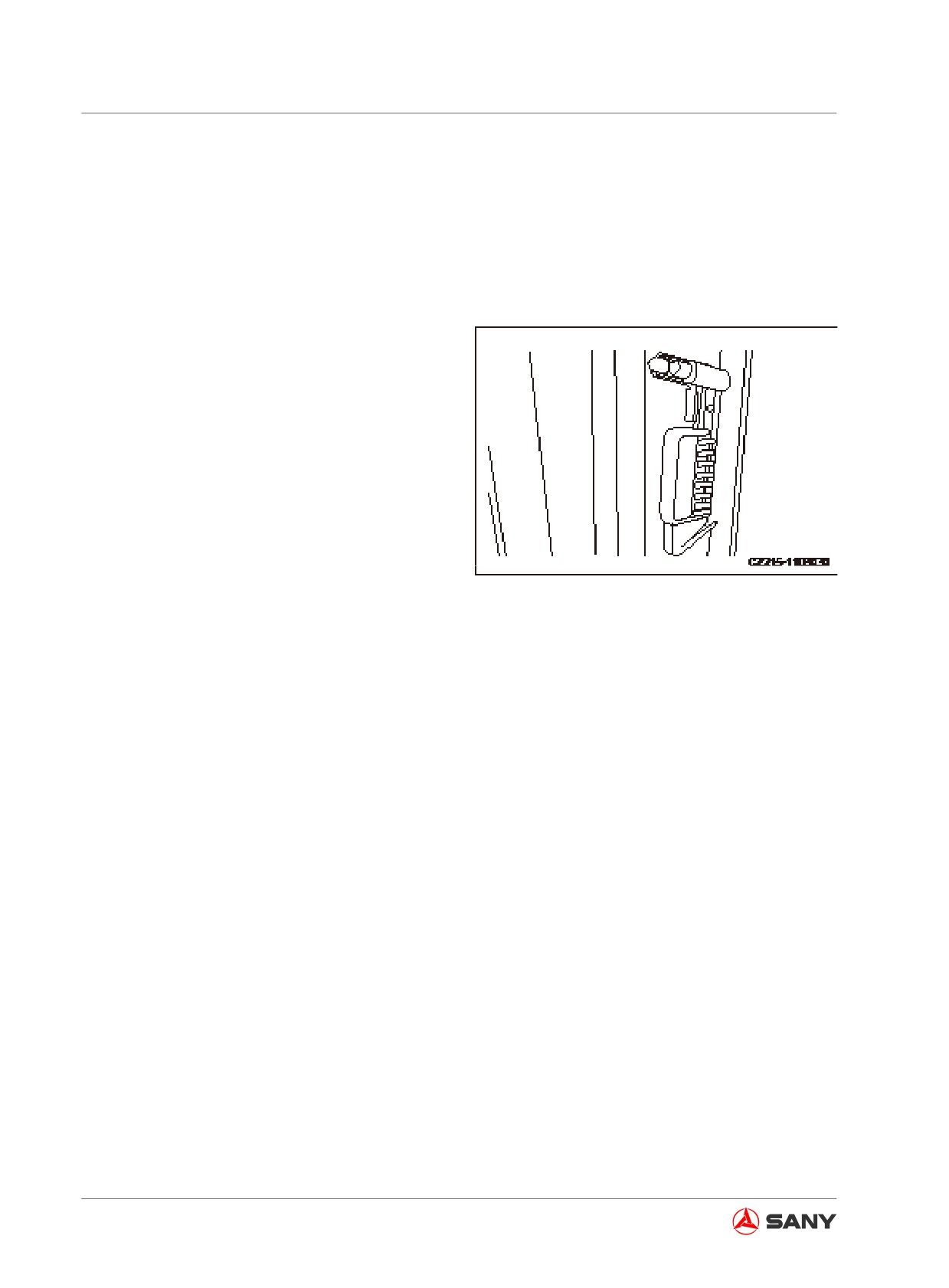
2.3.29 Alternate exit
● If you are unable to open the cab door in
case of emergency, use the safety hammer
to break the rear window to escape.
● Remove the pieces of glass from the win-
dow frame before escaping. Be careful not
to be cut by broken glass. Pay attention to
the broken glass on the ground, which may
cause you to slip and fall.
Fig. 2-43
2-36
Safety
2.4 Safe Operation Precautions
2.4.1 Safe starting
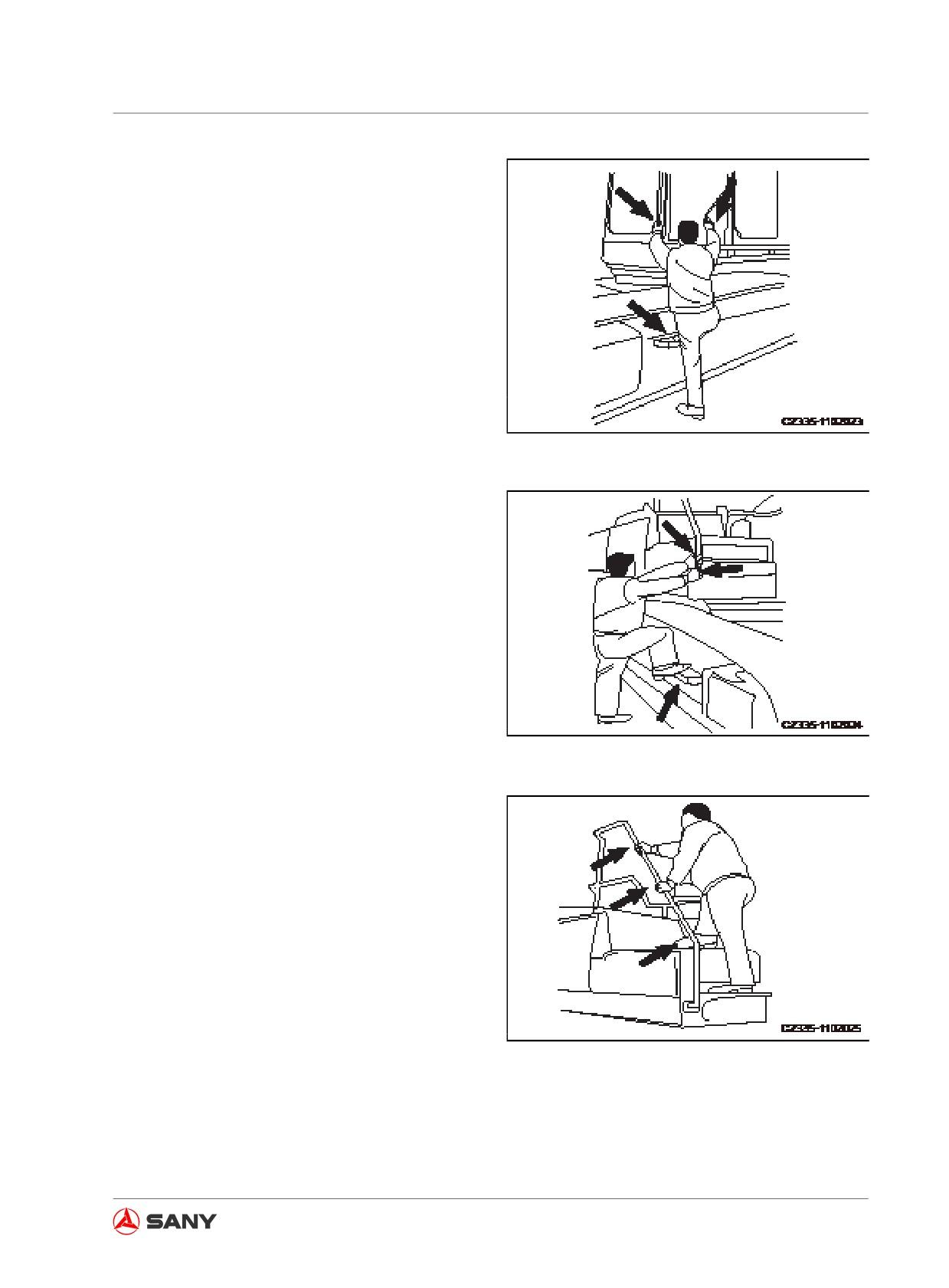
2.4.1.1 Safe mounting
When you mount or dismount the machine:
● Always face the machine and maintain a
three-point contact (one hand and two feet
or two hands and one foot).
Fig.
2-44
● Never jump on/off the machine. Never
mount a moving machine.
● Never use any control lever as handhold.
● Remove the mud, oil dirt and water from
the pedals, handholds and your soles at all
times.
● The cab must be aligned with the under-
carriage centerline before you enter or exit
the cab.
An unattended machine is dangerous.
Fig.
2-45
Fig. 2-46
2-37
Safety
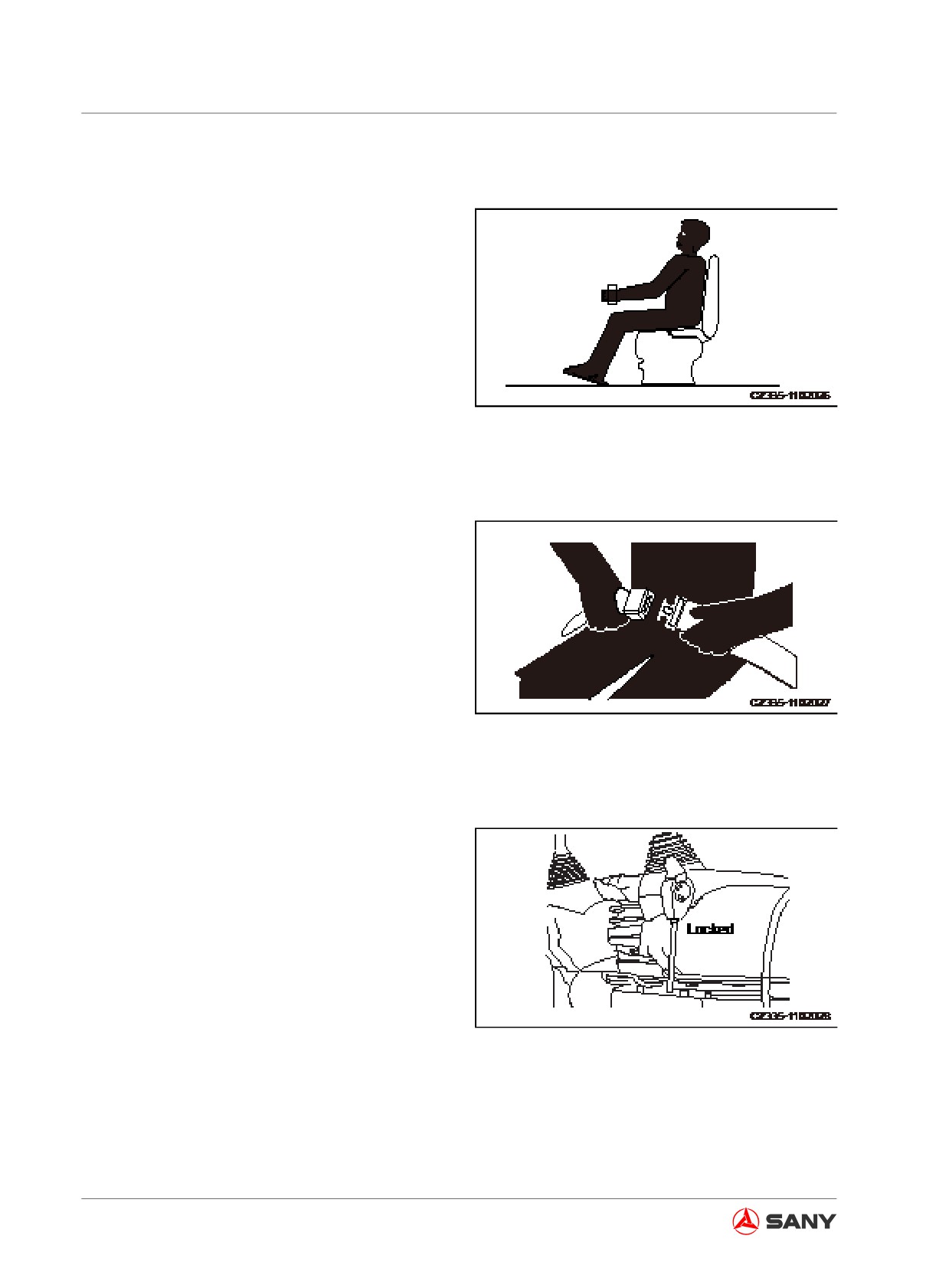
2.4.1.2 Seat adjustment
Uncomfortable seat position can easily lead to
operator fatigue and mistakes. The seat posi-
tion should be adjusted upon change of opera-
tor. Leaning against the back of seat, operator
shall be able to push the pedal to its limit with
his foot, and operate the control lever properly.
Otherwise, the seat should be readjusted by
moving it forward or backward.
Fig.
2-47
2.4.1.3 Seat belt
The operator may get seriously injured or
killed when the machine tips over. Before
operating the machine, check carefully your
seat belt, the buckles and the anchor point.
Replace the seat belt if damage or excessive
wear is observed. When the machine is being
operated, keep your seat belt buckled up.
The seat belt must be replaced every three
years regardless of its condition.
Fig.
2-48
2.4.1.4 Before starting the engine
Before starting your daily work, the following
items must be observed before starting the
engine.
● Clean the windows to ensure a good vis-
ibility.
● Clean the head lamps and work lamps,
and check if they are in good condition.
● Check coolant level, fuel level and engine
oil level.
Fig.
2-49
● Check for blocked air filter and damaged
electrical wires.
● Adjust the seat to a position easy for op-
eration; check seat belt and buckles for
damage and wear.
2-38
Safety
● Check the instrument panel. Check if the
control levers are all in neutral position.
● Check if the hydraulic lockout control is in
the LOCK position.
● Adjust the rear view mirrors so as to see
clearly from the operator seat what is hap-
pening behind the machine.
2.4.1.5 Engine starting rules
● Before starting the machine, make sure
nobody is on, under or around the ma-
chine. Sound the horn to warn people
around.
● Always start and operate the machine from
the operator seat.
● No one is allowed to stay on the machine
except the operator.
● Never start the engine by shorting the start
motor circuit, which is dangerous and may
cause machine damage.
2.4.1.6 Safe starting
WARNING
● Ample ventilation must be provided if
you have to start the engine or operate
the machine in an enclosed environ-
ment.
● Excessive inhalation of exhaust gas can
be fatal.
● If you do not know how to stop the ma-
chine, never start it.
2-39
Safety
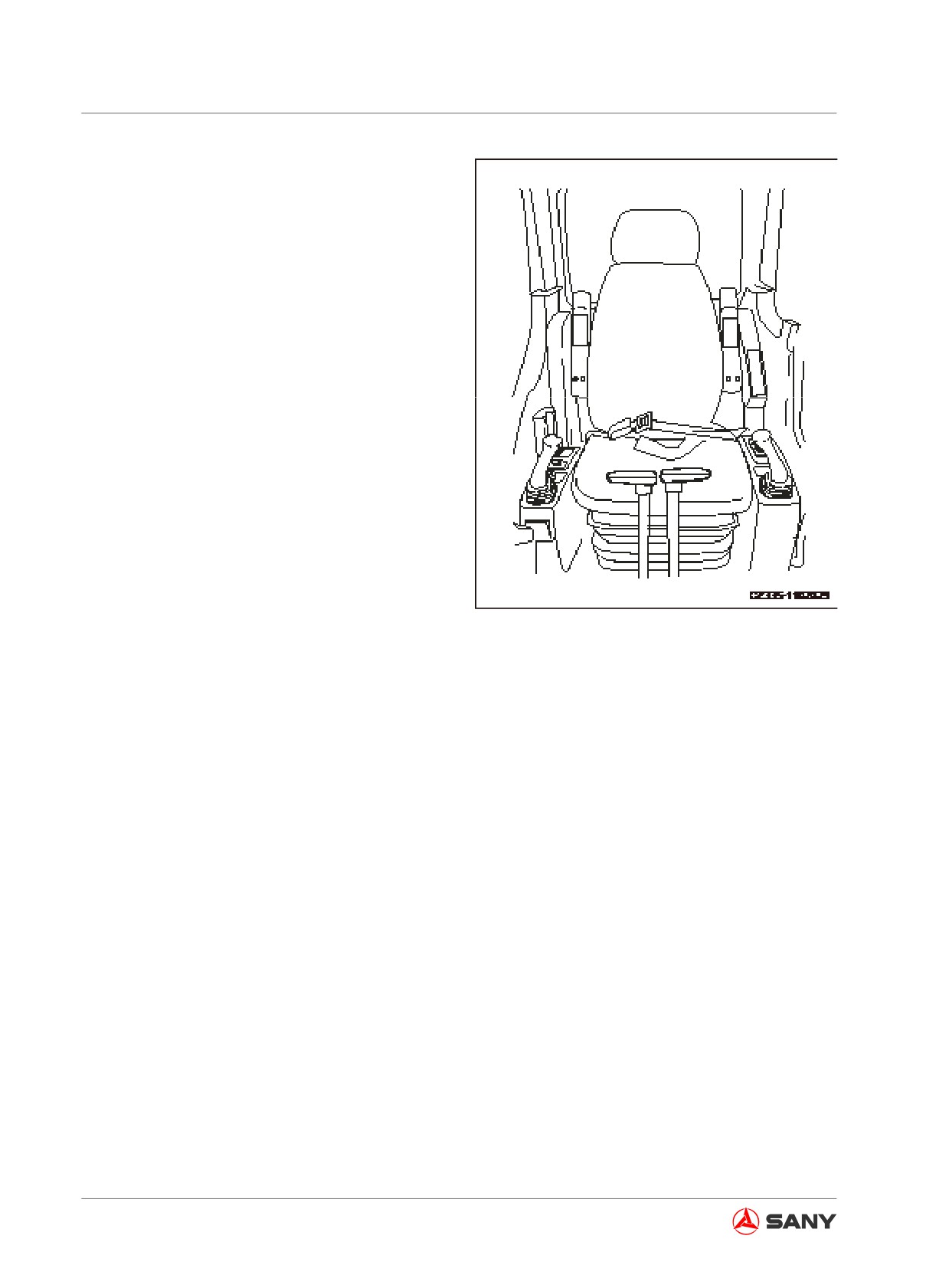
To understand proper starting steps of the ma-
chine, see “Engine Starting” on page 4-22.
● Being seated in the operator's position, ad-
just the seat so you can easily access all
controls from a seated position.
● Familiarize all warning devices, gauges
and operation controls.
● Place all controls to neutral/shutdown posi-
tion.
● Nobody is allowed to stay in the working
area.
● Start the engine as indicated in Operation
Section.
Fig.
2-50
2.4.1.7 Starting engine in cold season
● When ambient temperature is blow 10ºC,
pre-heat the engine before start it. For de-
tailed information, see “Engine Preheat-
ing” on page 4-25.
● When the machine is intended to work in
areas where temperature is always below
-15ºC, fuel heating system is recommend-
ed to improve engine startup performance.
● Sufficient warm-up operation is necessary.
Incomplete warming up may result in slow
reaction and accidents.
● Before starting, check the battery electro-
lyte. In case of frozen electrolyte, never
charge the battery or use alternative power
source to start the engine; instead, melt the
electrolyte first. Otherwise, fire may break
out on the battery.
2.4.1.8 Engine starting aid
Follow procedures in the Operation section
when using jumper cables to start the engine.
2-40
Safety
Improper handling may cause battery explo-
sion or loss of machine control, resulting in
personal injury and death. Never use jumper
cables to start the engine unless necessary.
Contact your Sany distributor before such an
attempt.
●
Using jumper cables to start the engine
needs two persons working together with
one seated in the operator seat and the
other handling the battery.
●
Wear goggles and rubber gloves before
starting the engine with jumper cables.
●
When connecting a normal machine with a
faulty machine with jumper cables, battery
voltage of the two machines shall be the
same. Be careful not to allow the two ma-
chines to contact with each other.
●
Turn both start switches to OFF position
when connecting the two machines. Oth-
erwise, the machine may move and cause
danger when it is powered on.
●
Start with the positive terminal when con-
necting the jumper cable. Start with the
ground or negative terminal when discon-
necting the jump cable.
●
When disconnecting the jumper cable, take
care not to allow the clips of jumper cable
to contact with each other or with the ma-
chine.
Ether is a liquid used for cold start, which is
extremely flammable and explosive. Read the
instructions on the ether container before ap-
plication.
Never use ether if the engine is equipped with
spark-plug preheater or other forms of pre-
heater.
2.4.1.9 After starting the engine
Run the engine at low idle for 3 to 5 minutes
after engine startup, and check the running
parameters and make sure they are normal
2-41
Safety
and all readings are within normal working
range.
2.4.2 Operation
2.4.2.1 Inspection before operation
● When conducting inspection, move the
machine to a spacious area without barri-
ers and operate slowly. Any other person is
not allowed to approach the machine.
● Be sure to buckle the seat belt.
● Check the gauges and machine operation
for abnormality; check the bucket, arm,
boom, travel system, swivel system and
steering system for abnormal operation.
● Check for abnormal noise, vibration, heat-
ing, odor or gauge reading; check oil or
fuel for leakage.
● When the travel control level is in neutral
position, test the engine's speed control
device; operate each control lever and
confirm they work properly. Understand the
control mode of work equipment.
● In case of any abnormality, stop operation
and take corrective measures immediately.
2.4.2.2 Prior-operation precautions
To prevent serious injury or death, follow the
items below before moving the machine.
● It is dangerous to stay in the working range
during machine operation. Sound the horn
to warn people within the working range
before operating your machine.
Fig. 2-51
● Nobody is allowed to stay on and near the
machine, or within the working range.
● To improve the visibility in the travel direc-
tion, you may turn the cab if necessary.
● Assign a signalman at where visibility is
poor.
2-42
Safety
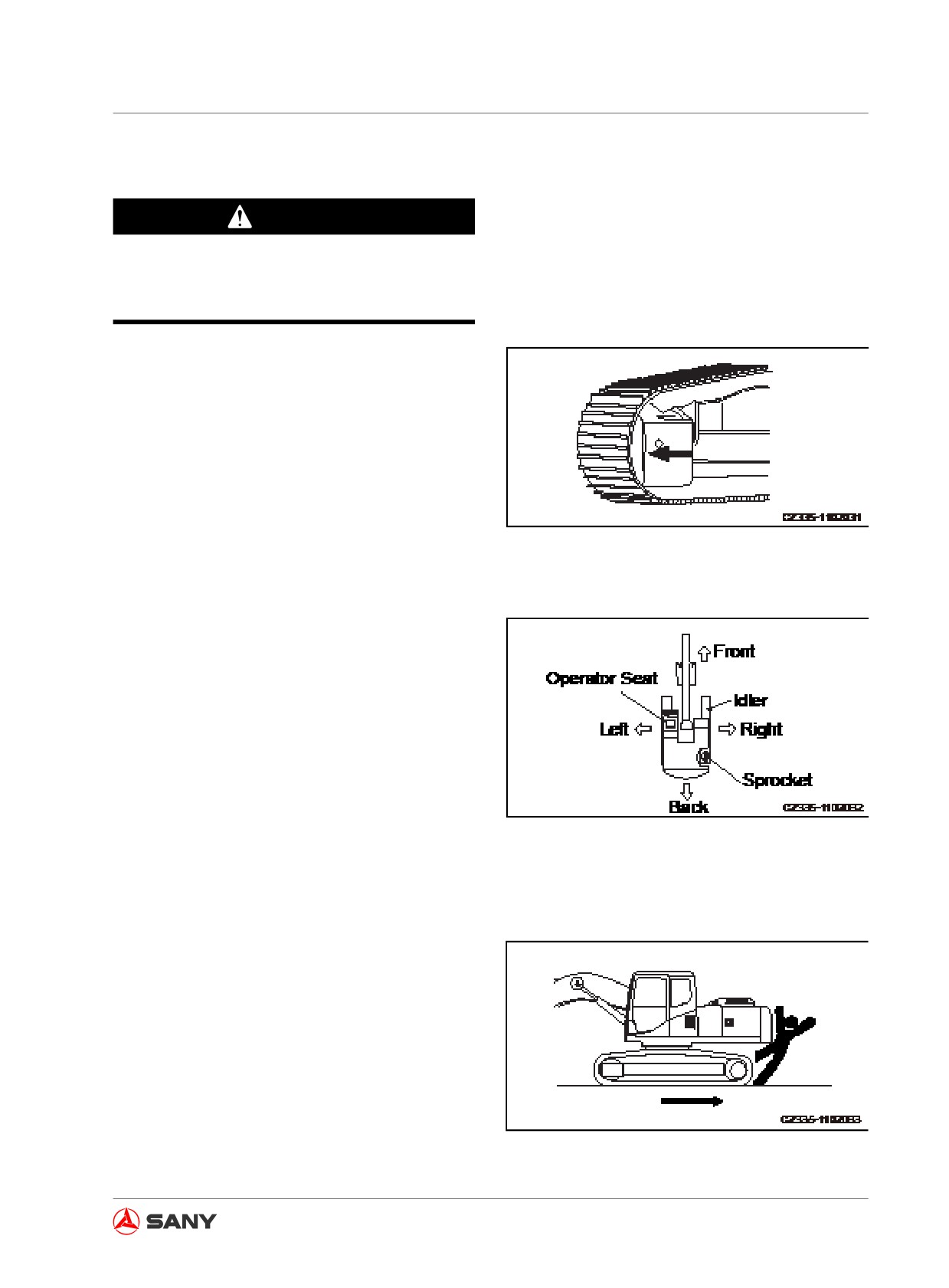
2.4.2.4 Travel directions
WARNING
Improper operation of travel control lever/
pedal can cause serious injury or death.
● Confirm the relative positions between the
undercarriage and operator before operat-
ing the machine.
● If the motor is under the cab, pushing the
control lever/pedal forward will move the
machine backward.
● If the guide roller is under the cab, push
the control lever/pedal to move machine
forward.
Fig.
2-52
● A sign for travel direction can be found on
internal side of undercarriage. When oper-
ator pushes control lever/pedal, the actual
travel direction is the direction indicated by
arrow.
Note:
In this manual, the forward, backward, left or
right direct is the direction seen from the cab
when the cab is straight forward and the driv-
ing wheels are in the rear.
Fig.
2-53
2.4.2.3 Rules for steering safety
● Always drive and operate the machine in a
seated position.
● Nobody is allowed in the cab except the
operator.
● Check if the travel alarm works.
● Always secure the cab door or windows,
either open or closed. At job site where fly-
ing objects may get into the cab, check if
the doors and windows are properly shut.
Fig. 2-54
● Assign a signalman if a blind area exists
2-43
Safety
at the rear of the machine. In turning or
swivel operation, be alert not to hit other
machines or personnel.
●
Sound the horn to warn personnel in the
area before traveling.
●
Check for the presence of personnel and/
or obstacles again in the machine sur-
roundings before traveling.
●
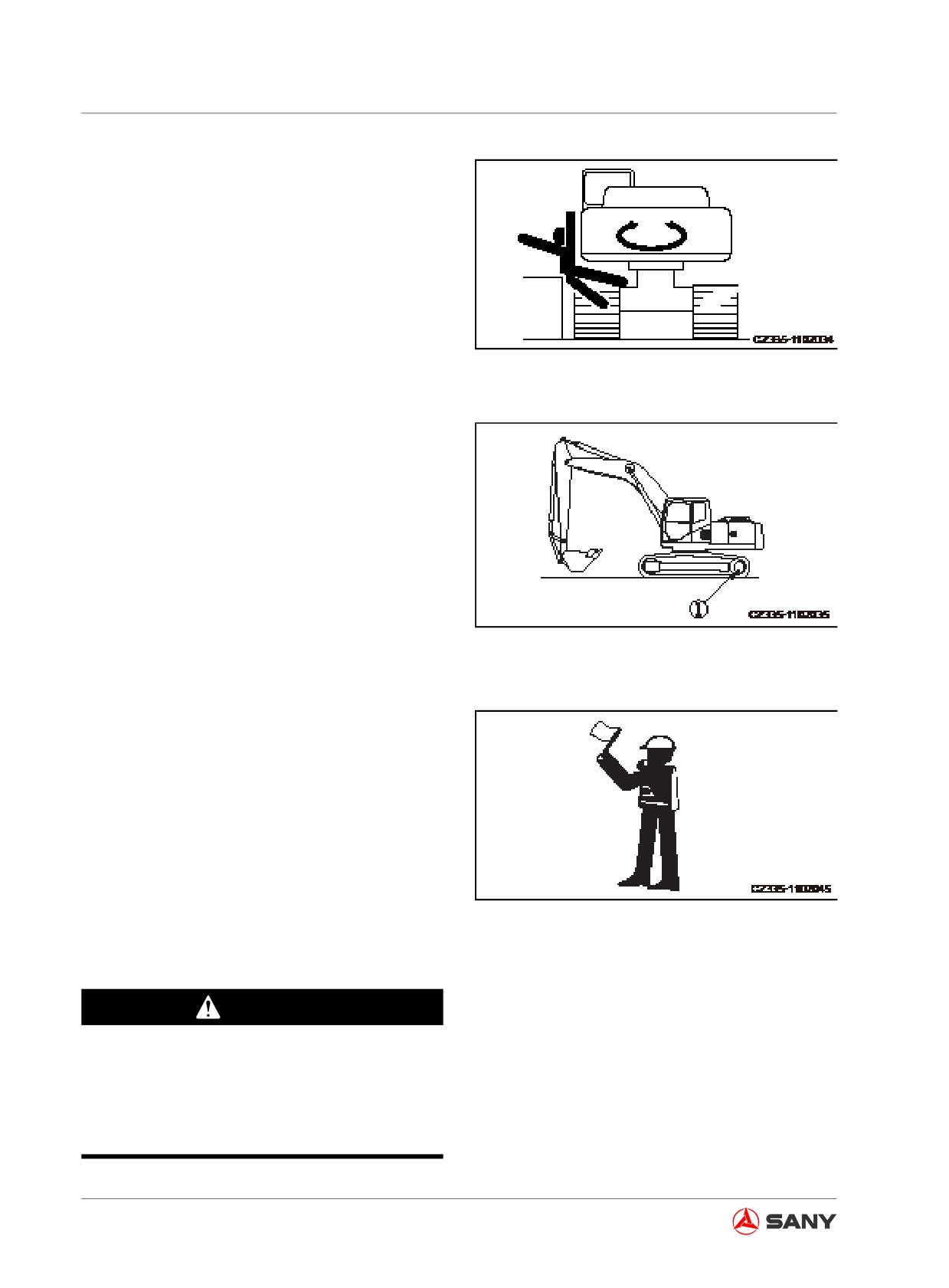
Before traveling, position the machine so
Fig. 2-55
that the sprocket (1) is behind the operator
cab. If the sprockets are in front of the cab,
the machine will move in a direction oppo-
site to the move direction of control levers.
Special attention must be paid to opera-
tions under such circumstances.
●
If your vision is limited during reverse trav-
el, assign a signalman and keep him within
the range of your vision.
●
When a signalman is necessary on some
occasions, use hand signals specified in
Fig. 2-56
local regulations.
●
The machine can only be moved when
both signalman and operator understand
the signals.
●
Understand all vocal, graphic and flag
signals used in work and decide who is to
give signals.
●
Keep the windows, rear view mirrors and
work lights clean and intact.
●
Dust, heavy rain and fog may reduce vis-
ibility. Drive slowly and use proper lights in
Fig. 2-57
case of low visibility.
WARNING
During reverse or swivel operation, people
around the machine may get hit by the
counterweight or work equipment, result-
ing in serious injury or even death.
2-44
Safety
2.4.2.5 Rules for traveling safety
●
To prevent machine breakdown and avoid
damage of work equipment, never operate
the machine beyond its maximum load or
rated capacity.
●
When driving or operating the machine,
keep the machine a safe distance away
from people, building or other machine so
as to avoid collision.
●
When traveling on a highway, contact re-
lated departments in advance and follow
their instructions.
●
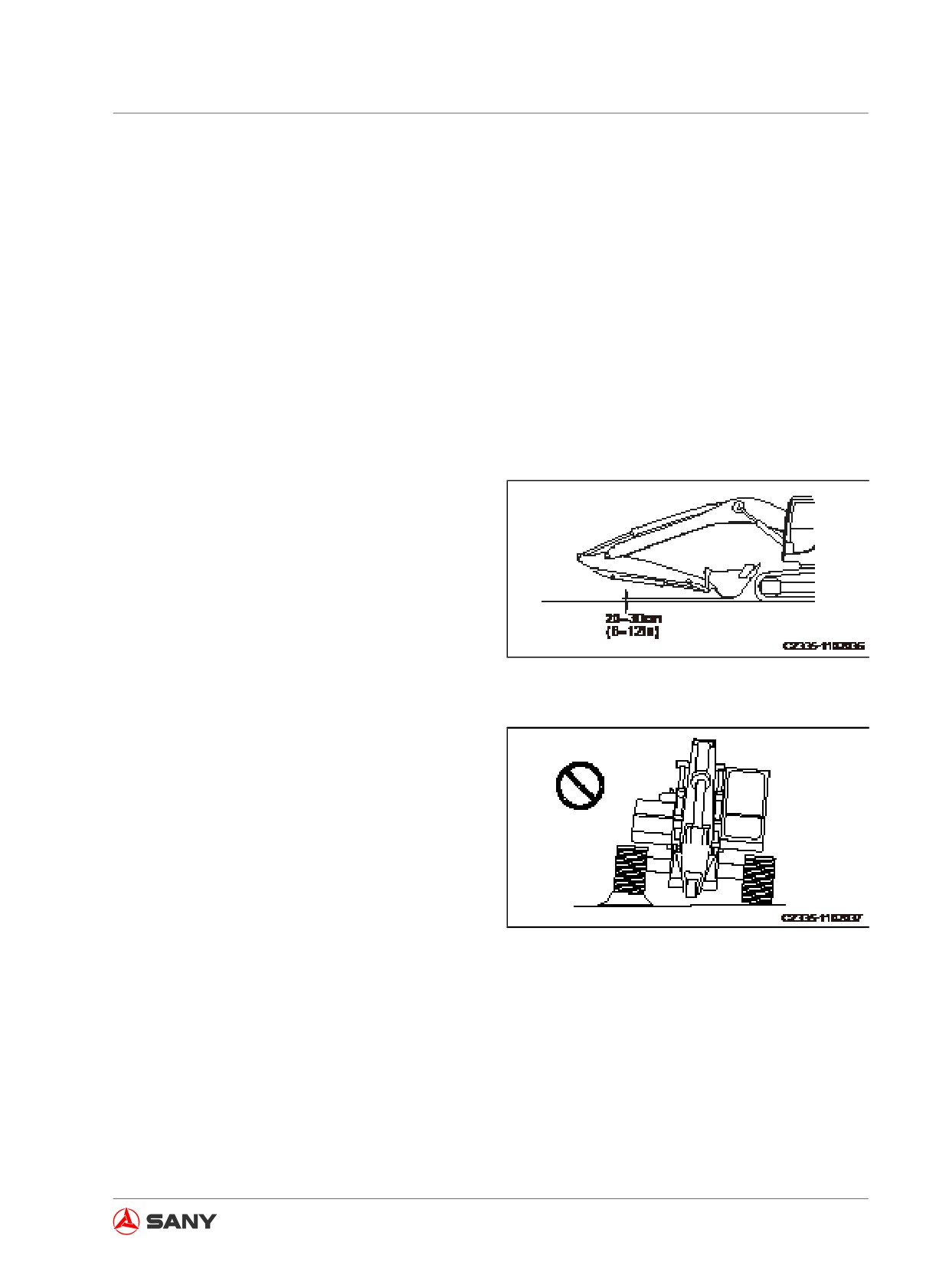
When traveling on flat ground, the work
equipment should be retracted and kept
20-30cm(8-12in) off the ground.
●
When traveling on rough ground, the ma-
chine shall move at a low speed and avoid
sudden change of direction, or the machine
may tumble down. If the work equipment
hits the ground, the machine will lose bal-
ance and get damaged.
Fig.
2-58
●
When traveling on rough ground or on a
steep slope, the auto-deceleration switch (if
equipped) shall be switched off. If the auto-
idle switch is on, engine speed and travel
speed may drop suddenly.
●
Avoid traveling over a barrier if possible. If
you have to do that, lower the work equip-
ment close to the ground and drive slowly.
Never let the machine travel on a barrier
that would make it tilt sharply.
●
Check first the structural strength of a
Fig.
2-59
bridge or a building before drive the ma-
chine on it.
●
Operate slowly when you are working in a
tunnel, under a bridge or power cables or
under where working height is limited. Take
care not to damage anything with work
equipment.
2-45
Safety
2.4.2.6 Safe traveling
● Check the travel direction of the machine
before driving it. Make sure you know how
to operate the control levers and pedals.
● Press the upper part of the control pedal or
push the control lever forward to move the
machine in the direction of the idlers.
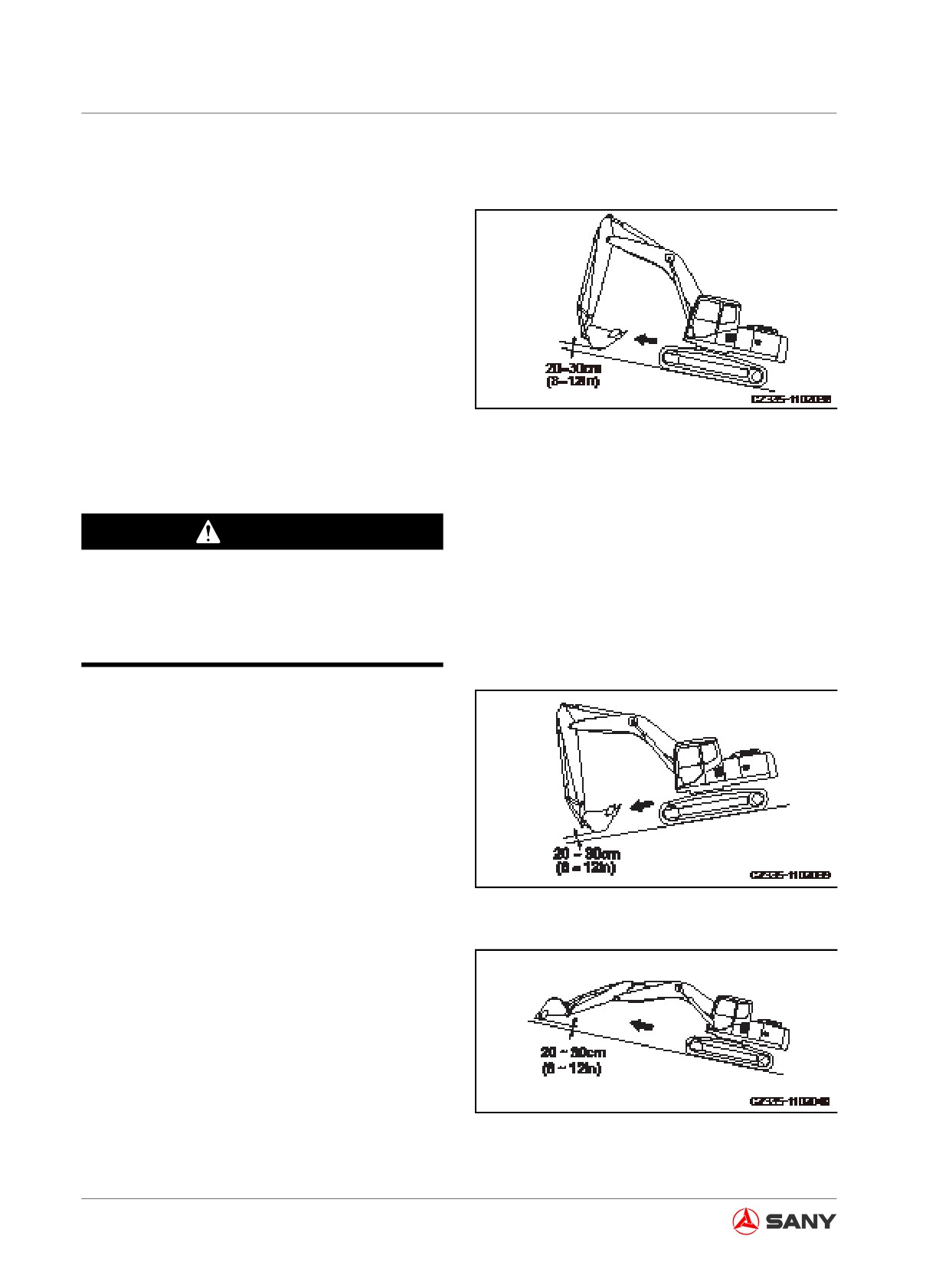
● Work equipment should be kept 20-30 cm
(8-12 in) off the ground when moving on a
slope. In case of an emergency, the work
equipment could be lowered to ground im-
Fig. 2-60
mediately to help stop the machine.
WARNING
Driving the machine on a slope may cause
it to slip or tumble down, resulting in seri-
ous injury or death.
● When driving the machine up a slope, face
the cab to the uphill direction; when driving
down a slope, face the cab to the downhill
direction.
● Before traveling, always check the hard-
ness of ground before your machine.
Fig. 2-61
● When driving the machine up a slope, ex-
tend the work equipment to keep balance.
Keep the work equipment 20-30 cm (8-
12in) off the ground and drive the machine
slowly.
● When driving down a slope, lower the en-
gine speed, keep the travel control levers
close to “neutral” position and drive
Fig. 2-62
slowly.
2-46
Safety
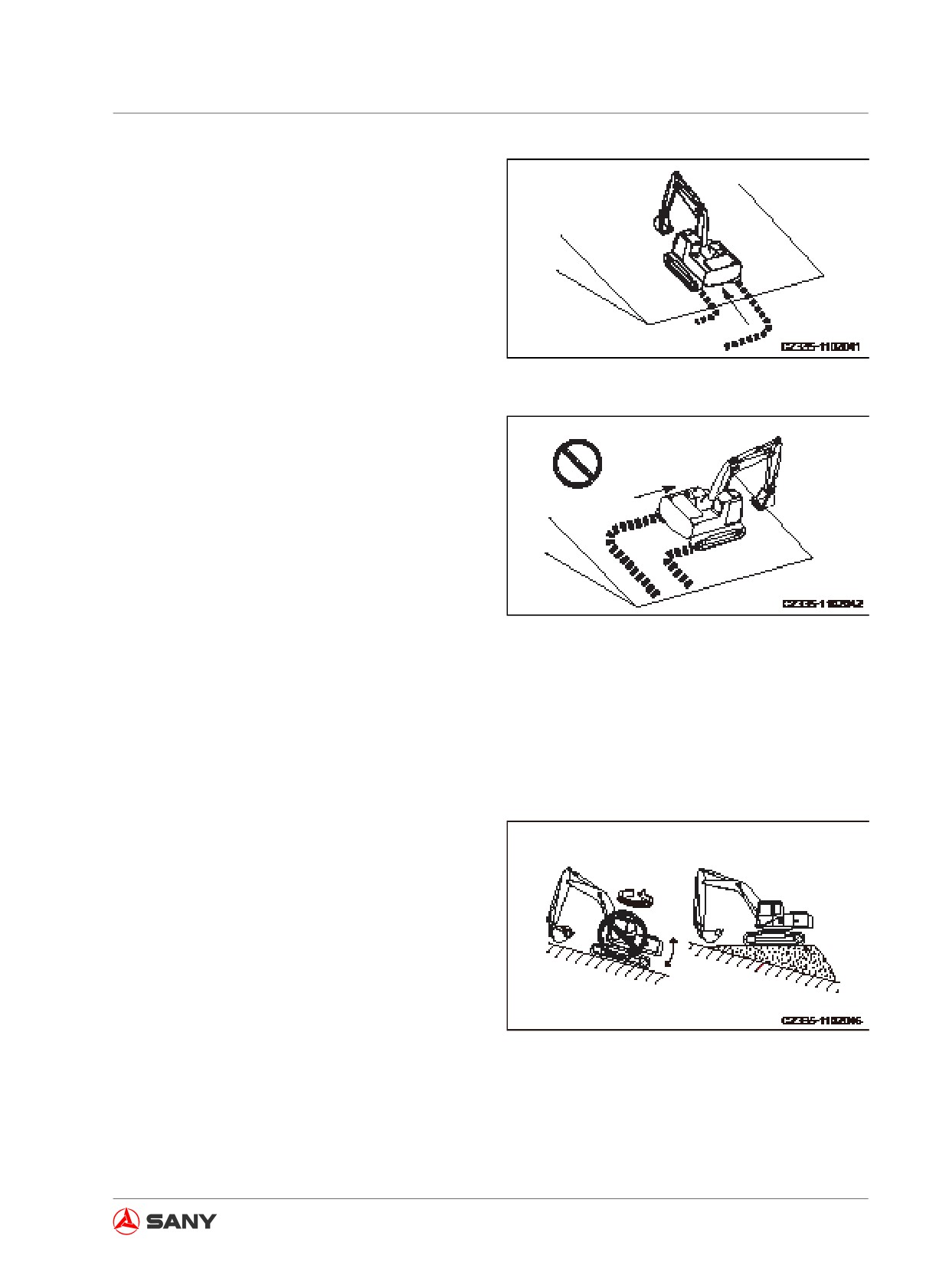
● Drive straight up and down a steep slope.
It is very dangerous to turn on or drive
across a slope.
Fig. 2-63
● To adjust the position of the machine on a
slope, drive it onto a flat surface, reposi-
tion it and driving the machine to the slope
again.
● Drive at low speed on meadow, fallen
leaves or wet steel plate because even a
small grade could cause the machine to
slip.
● If your engine stalls out when traveling on
Fig. 2-64
a slope, place the control levers to “neu-
tral” position immediately and restart the
engine.
2.4.2.7 Operation on an incline
If you swing upper structure or operate work
equipment on an incline, you machine could
loose balance and tip over, causing serious
injury or damage. Therefore, such operations
must be performed carefully on a flat platform.
● When the bucket is fully loaded, never turn
work equipment from uphill to downhill.
Such operation is dangerous and your ma-
chine could tip over.
● If you have to operate your machine on an
Fig. 2-65
incline, always build an earth platform so
that your machine can work on a level sur-
face.
2-47
Safety
2.4.2.8 Operation in snowy weather
● Snow-covered or frozen surfaces are slip-
pery. Never manipulate the control lever
suddenly when driving or operating the
machine. Extra attention should be paid to
operation on a slope because even small
inclination could cause the machine to slip.
● The machine may tip over on frozen sur-
face which may become soft upon increase
of ambient temperature.
● Avoid deep snow, which may cause your
machine to tip over or to be buried in
snow. Be noted that you shall never be
away from road shoulder and avoid being
trapped in snow.
● When cleaning the snow, it is hard to see
the snow-covered road shoulder and ob-
jects near the road. There is danger for
your machine to tip over or hit the covered
objects. Therefore, please operate with ex-
treme caution.
2.4.2.9 Restricted operations
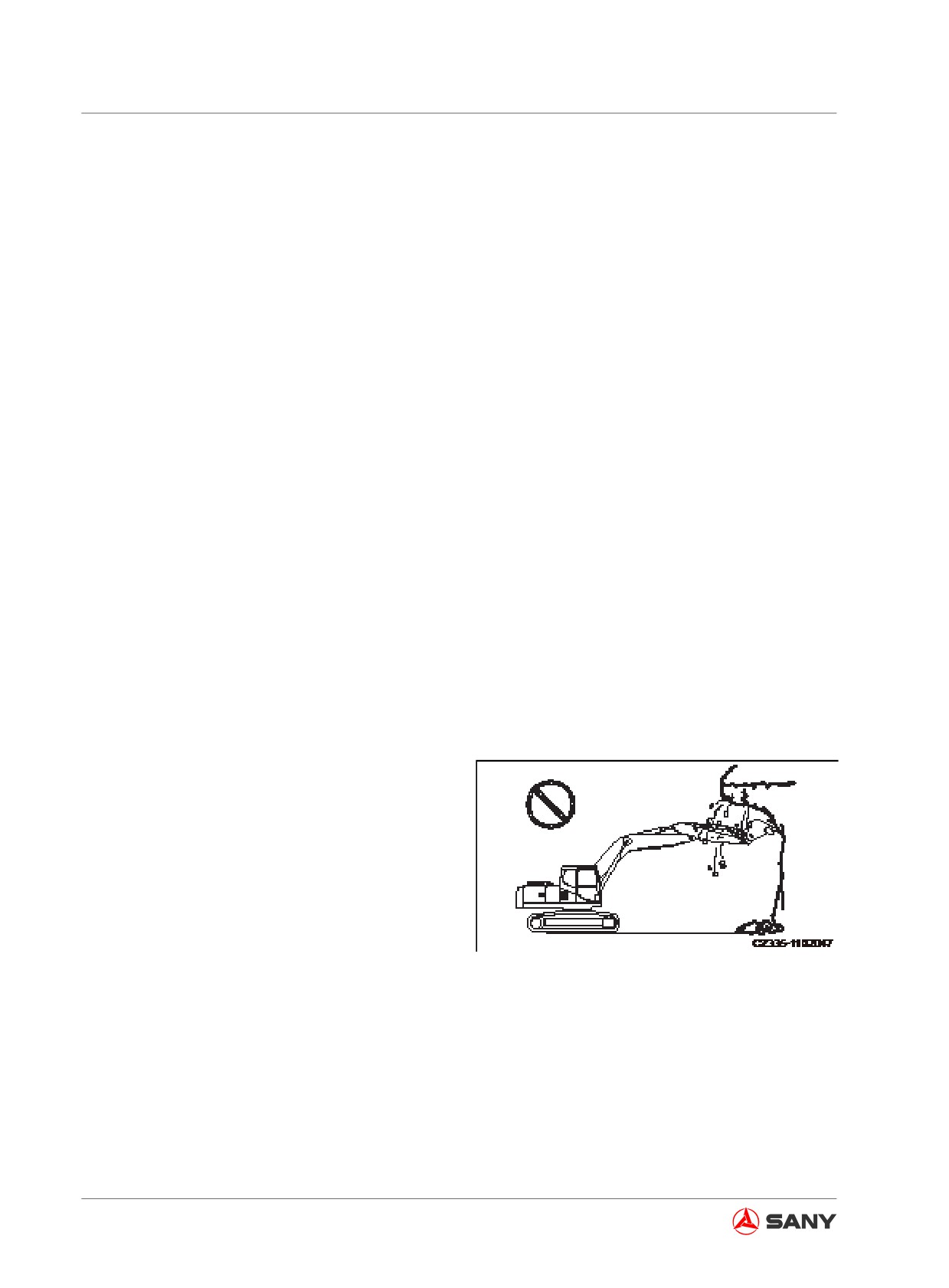
● Never dig under an overhang, which may
lead to falling stones, collapse of overhang,
and accidents.
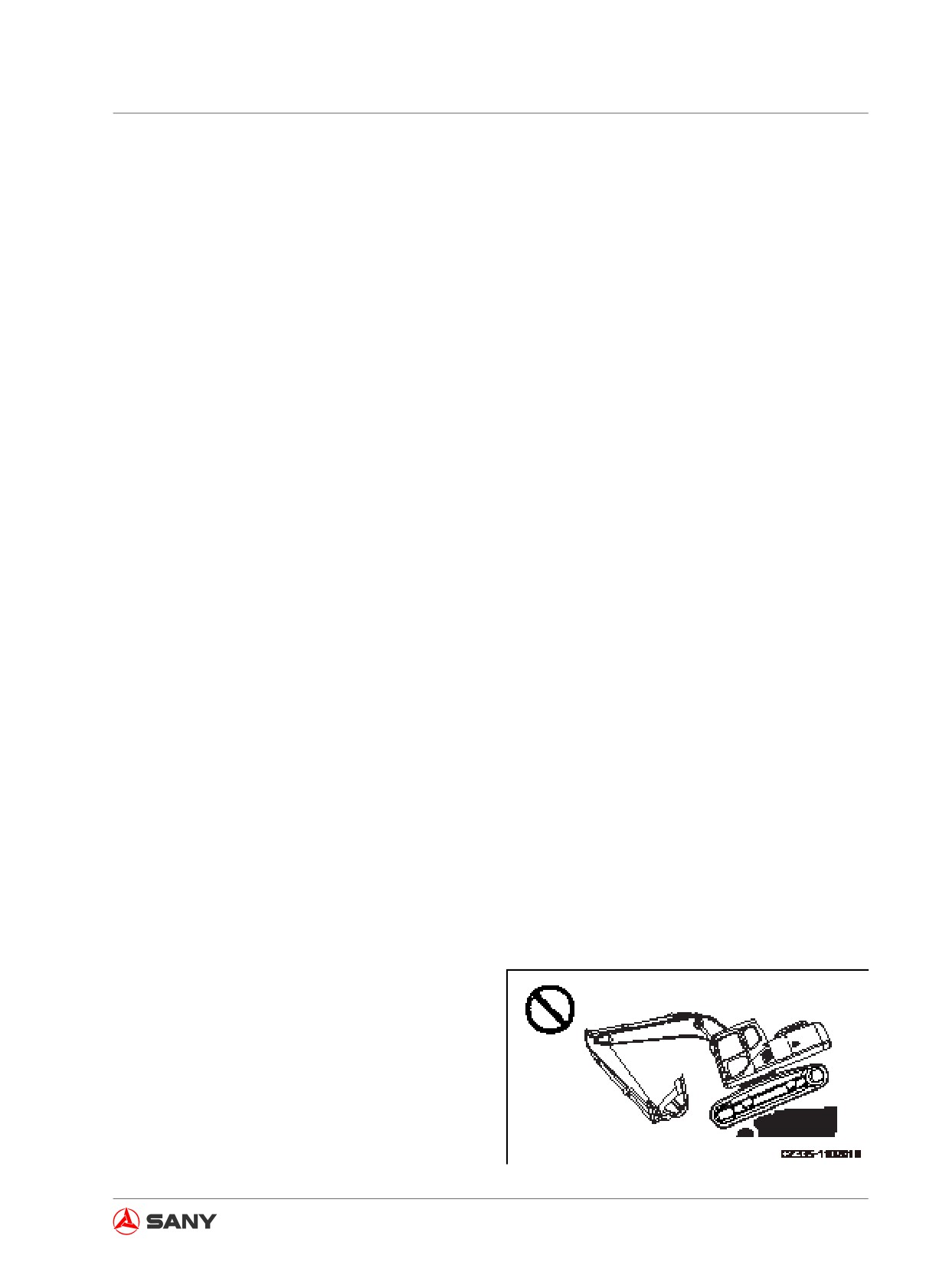
Fig. 2-66
2-48
Safety
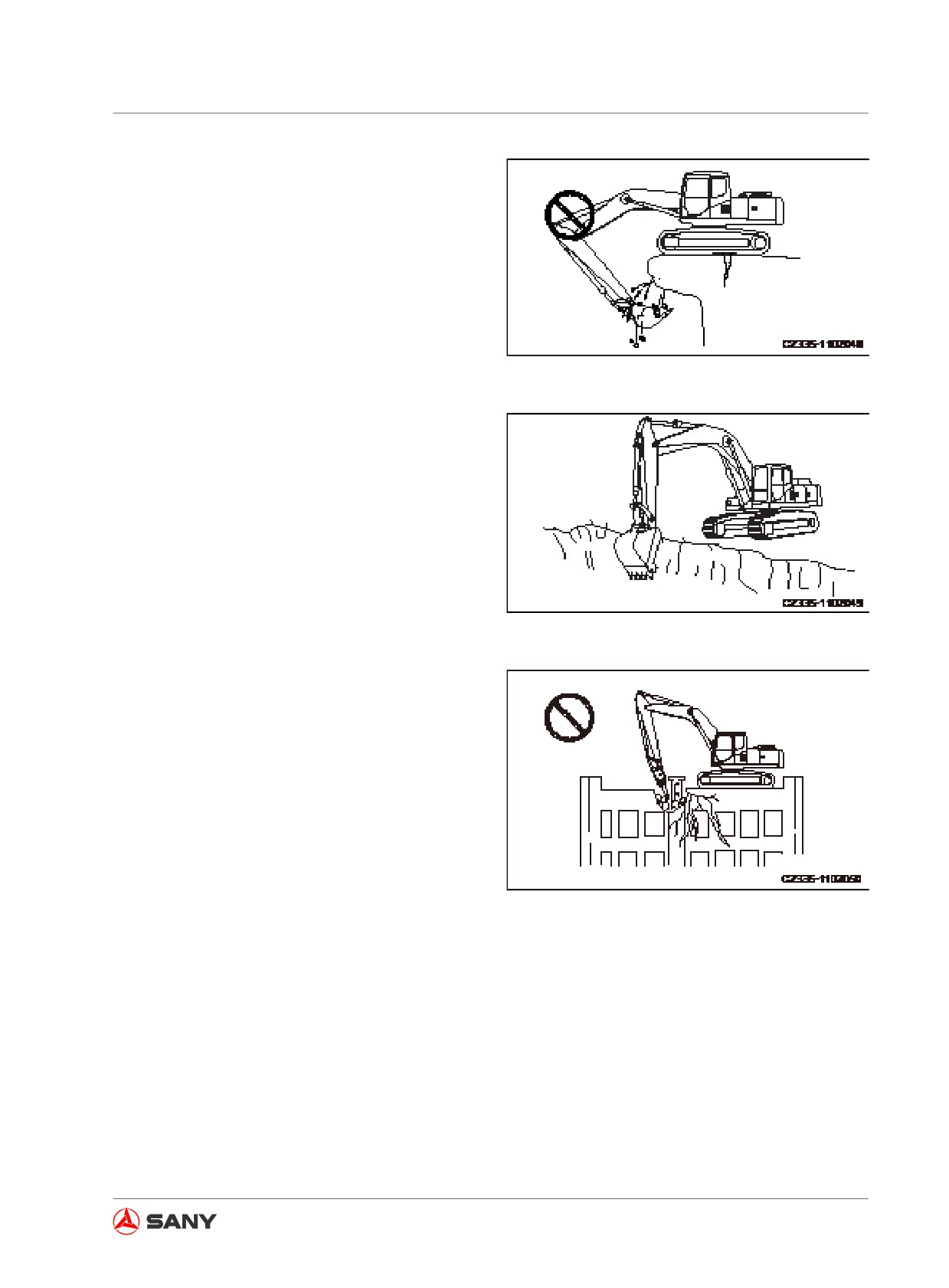
● Never dig too much under the machine,
which may cause the ground to collapse
due to cave-in, hence the accidents.
Fig. 2-67
● In excavating operation, the track should
be adjusted vertical to road shoulder or
cliff, with sprockets behind the cab, so that
the machine can retreat easily in case of
an emergency.
Fig. 2-68
● Never tear down under your machine,
which may cause your machine to destabi-
lize and roll over.
● When operating on building or other
structures, strength of structure must be
checked to avoid collapse of building, thus
resulting injury or death.
Fig. 2-69
2-49
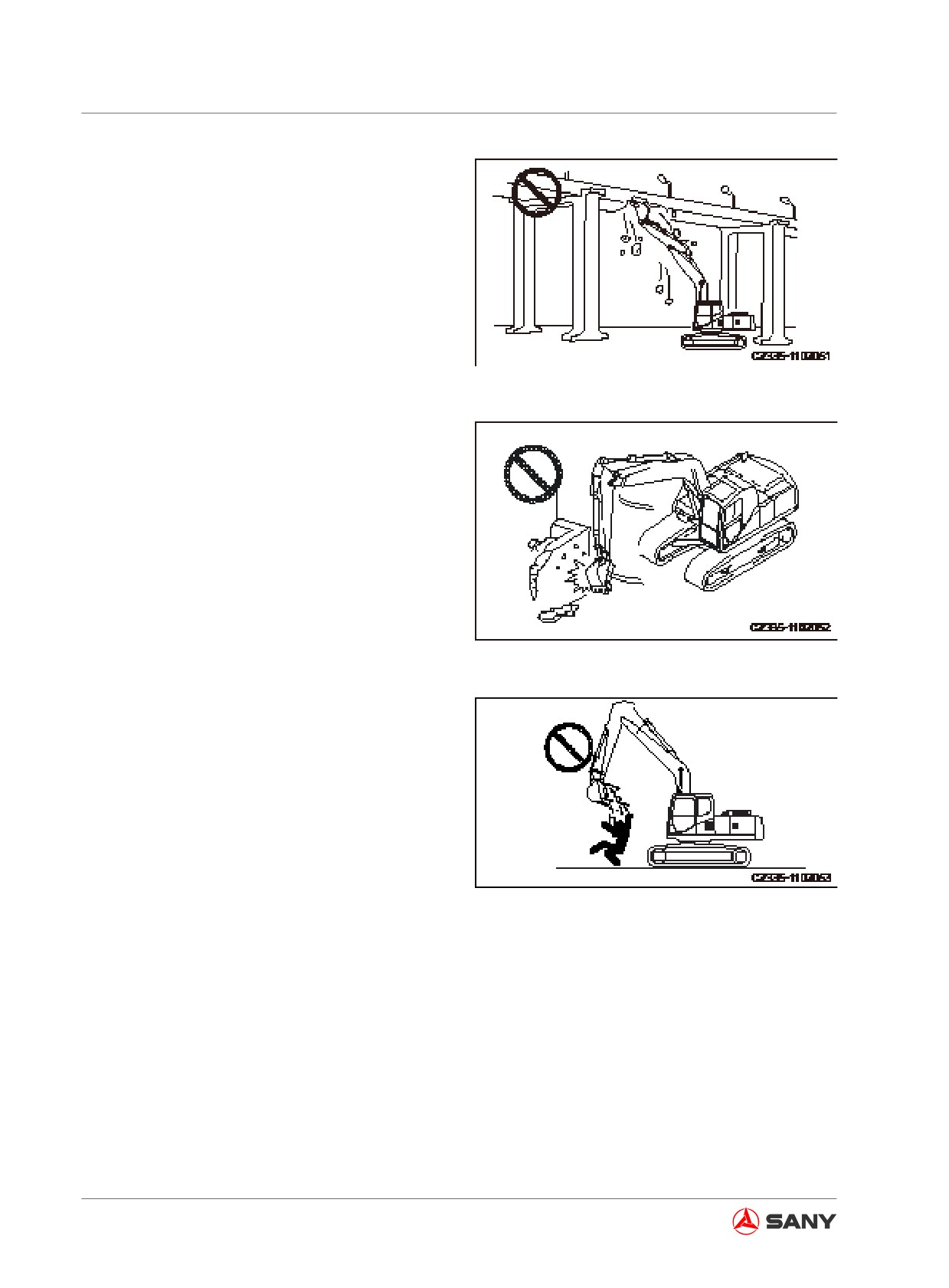
Safety
● Never tear down any structure over your
machine. The falling of broken objects or
collapse of building could damage your
machine and cause personal injury or
death.
Fig.
2-70
●
Never break anything with the impact force
of work equipment as broken pieces could
lead to personal injury, the work equipment
could be damaged, and the counter-action
of impact force could roll over your ma-
chine.
●
Generally speaking, it is easier to tip over
with the work equipment at one side than it
is positioned in the front or rear.
Fig.
2-71
●
Lifting, moving or swinging the bucket shall
never pass over anybody or a truck's cab.
The falling of substances from the bucket
or collision of buckets could result in per-
sonal injury or machine damage.
●
The use of crusher or other heavy working
unit could cause your machine to lose bal-
ance and tip over. When operating on a flat
surface or slope:
Fig.
2-72
Never lower, swing or stop the working unit
suddenly.
Never extend or retract the boom cylinder
suddenly as which may cause your ma-
chine to tip over due to impact.
2-50