Doosan DX255LC. Operation and Maintenance Manual (2006) - page 1
DX255LC
Operation and Maintenance Manual
K1016584E
Serial Number 5001 and Up
September 2006
DOOSAN reserves the right to improve our products in a continuing process to provide the best possible product
to the market place. These improvements can be implemented at any time with no obligation to change materials
on previously sold products. It is recommended that consumers periodically contact their distributors for recent
documentation on purchased equipment.
This documentation may include attachments and optional equipment that is not available in your machine's
package. Please call your distributor for additional items that you may require.
Illustrations used throughout this manual are used only as a representation of the actual piece of equipment, and
may vary from the actual item.
K1016584E Operation and Maintenance Manual
Table of Contents
Safety
1-1
To the Operator of a DOOSAN Daewoo Excavator
1-1
Location of Safety Labels
1-5
Summary of Safety Precautions for Lifting in Digging Mode
1-15
Unauthorized Modifications
1-16
General Hazard Information
1-16
Before Starting Engine
1-25
Machine Operation
1-29
Maintenance
1-36
Battery
1-45
Towing
1-47
Shipping and Transportation
1-48
Excavator Rated Lift Capacity Tables
1-49
Operating Controls
2-1
Component Locations
2-4
Operator's Area
2-6
Operational Controls and Panels
2-8
Instrument Panel
2-22
Multifunction Gauge and Graphic Information
2-29
Mode Selector Buttons
2-34
Setting Main Menu
2-36
Flow Control
2-45
Operation Selection Display
2-47
Heater and Air Conditioner Control Panel
2-49
Stereo
2-55
Miscellaneous Electrical Devices
2-57
Seat Adjustment
2-59
K1016584E
Table of Contents
I
Ceiling Cover
2-63
Front Windows
2-64
Door Side Latch
2-66
Cabin Storage Compartments
2-67
Ashtray
2-67
Sun Visor
2-68
Hanger
2-68
Cup Holder
2-69
Door Window Holder
2-69
Emergency Glass Breaking Tool
2-69
Miscellaneous Access Covers and Doors
2-70
Operation
3-1
To Handle a New Excavator
3-1
Starting and Stopping the Engine
3-2
Safety Lever
3-13
Travel
3-14
Operating Instructions
3-20
Operating Precautions
3-26
Parking Excavator
3-31
Towing Procedure
3-32
Hydraulic Breaker
3-33
Adjusting the Pump Flow
3-38
Operating Techniques
3-41
Operation Under Unusual Conditions
3-43
Inspection, Maintenance and Adjustment
4-1
Preventive Maintenance
4-1
Preliminary Work Machine Setup for Maintenance
4-4
Table of Recommended Lubricants
4-6
Fluid Capacities
4-8
Lubrication and Service Chart
4-8
Maintenance Intervals
4-12
K1016584E
Table of Contents
II
10 Hour / Daily Service
4-14
50 Hour / Weekly Service
4-25
250 Hour / Monthly Service
4-28
500 Hour / 3 Month Service
4-35
1,000 Hour / 6 Month Service
4-44
2,000 Hour / Yearly Service
4-51
4,000 Hour / Biennial Service
4-57
12,000 Hour / Six Year Service
4-58
Air-Conditioning System
4-59
Bolt and Nut Inspection
4-60
Bucket
4-68
Electrical System
4-71
Engine Cooling System
4-75
Fuel Transfer Pump (Option)
4-77
Handling of Accumulator
4-80
Track Tension
4-81
Venting and Priming Hydraulic System
4-83
Long Term Storage
4-85
Maintenance in Special Conditions
4-86
Transportation
5-1
Loading and Unloading
5-1
Lifting With Sling
5-5
Troubleshooting
6-1
Electrical System
6-1
Engine
6-2
Hydraulic System
6-3
Swing System
6-4
Travel System
6-5
Specification
7-1
Standard Specification
7-1
K1016584E
Table of Contents
III
Overall Dimensions
7-2
Working Range
7-3
Approximate Weight of Workload Materials
7-4
Index
8-1
Table of Contents
K1016584E
IV
OP000481
1Safety
TO THE OPERATOR OF A
DOOSAN DAEWOO
EXCAVATOR
DANGER!
Unsafe use of the excavator could lead to serious injury
or death. Operating procedures, maintenance and
equipment practices or traveling or shipping methods
that do not follow the safety guidelines on the following
pages could cause serious, potentially fatal injuries or
extensive damage to the machine or nearby property.
Please respect the importance of taking responsibility for
your own safety, and that of other people who may be
affected by your actions.
The safety information on the following pages is organized
into the following sections:
1.
“Location of Safety Labels” on page 1-5
2.
“Summary of Safety Precautions for Lifting in Digging
Mode” on page 1-15
3.
“Unauthorized Modifications” on page 1-16
4.
“General Hazard Information” on page 1-16
5.
“Before Starting Engine” on page 1-25
6.
“Machine Operation” on page 1-29
7.
“Maintenance” on page 1-36
8.
“Battery” on page 1-45
9.
“Towing” on page 1-47
10. “Shipping and Transportation” on page 1-48
11. “Excavator Rated Lift Capacity Tables” on page 1-49
OP000481
Safety
1-1
WARNING!
Improper operation and maintenance of this machine
can be hazardous and could result in serious injury or
death.
Operator and maintenance personnel should read this
manual thoroughly before beginning operation or
maintenance.
Keep this manual in the storage compartment to the
rear of the operator's seat, and have all personnel
involved in working on the machine read the manual
periodically.
Some actions involved in operation and maintenance of
the machine can cause a serious accident, if they are
not done in a manner described in this manual.
The procedures and precautions given in this manual
apply only to intended uses of the machine.
If you use your machine for any unintended uses that
are not specifically prohibited, you must be sure that it
is safe for any others. In no event should you or others
engage in prohibited uses or actions as described in
this manual.
DOOSAN delivers machines that comply with all
applicable regulations and standards of the country to
which it has been shipped. If this machine has been
purchased in another country or purchased from
someone in another country, it may lack certain safety
devices and specifications that are necessary for use in
your country. If there is any question about whether
your product complies with the applicable standards and
regulations of your country, consult DOOSAN or your
DOOSAN distributor before operating the machine.
Safety
OP000481
1-2
SAFETY ALERT SYMBOL
Be Prepared - Get to Know All Operating and Safety
Instructions.
This is the Safety Alert Symbol. Wherever it appears in
this manual or on safety signs on the machine you
should be alert to the potential for personal injury or
accidents. Always observe safety precautions and follow
recommended procedures.
Learn the Signal Words Used with the
Safety Alert Symbol
The words "CAUTION," "WARNING," and "DANGER" used
throughout this manual and on decals on the machine
indicate degree of risk of hazards or unsafe practices. All
three degrees of risk indicate that safety is involved.
Observe precautions indicated whenever you see the Safety
Alert "Triangle," no matter which signal word appears next to
the "Exclamation Point" symbol.
CAUTION!
This word is used on safety messages and safety labels
and indicates potential of a hazardous situation that, if
not avoided, could result in minor or moderate injury. It
may also be used to alert against a generally unsafe
practice.
WARNING!
This word is used on safety messages and safety labels
and indicates potential of a hazardous situation that, if
not avoided, could result in serious injury or death. It
may also be used to alert against a highly unsafe
practice.
DANGER!
This word is used on safety messages and safety labels
and indicates an imminent hazard of a situation that, if
not avoided, is very likely to cause death or extremely
serious injury. It may also be used to alert against
equipment that may explode or detonate if handled or
treated carelessly.
Safety
OP000481
1-3
Safety precautions are described in SAFETY from page 1-5
on.
DOOSAN cannot predict every circumstance that might
involve a potential hazard in operation and maintenance.
Therefore the safety messages in this manual and on the
machine may not include all possible safety precautions. If
any procedures or actions not specifically recommended or
allowed in this manual are used, you must be sure that you
and others can do such procedures and actions safely and
without damaging the machine. If you are unsure about the
safety of some procedures, contact a DOOSAN distributor.
Safety
OP000481
1-4
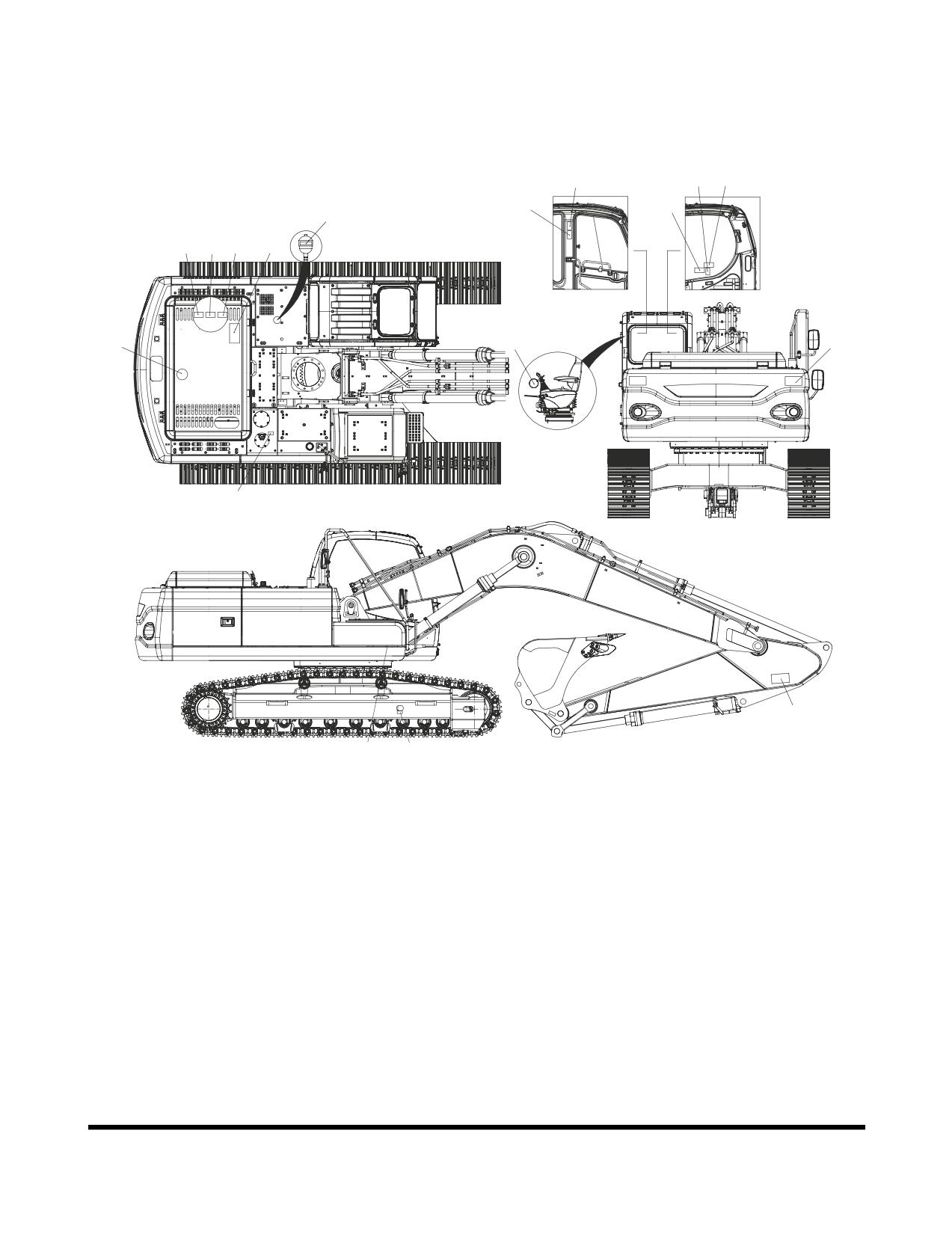
LOCATION OF SAFETY
LABELS
3
5
2
6
1
10
11
9
11
14
12
15
13
8
16
7
4
FG006900
Figure 1
There are several specific warning signs on this machine.
The exact location of hazards and the description of the
hazards are reviewed in this section.
Please become familiarized with all warning signs.
Make sure that all of the warning signs are legible. Clean
the warning signs or replace the warning signs if you cannot
read the words. Replace the illustrations if the illustrations
are not visible. When you clean the warning signs, use a
cloth, water and soap. Do not use solvent, gasoline, or other
harsh chemicals to clean the safety signs. Solvents,
gasoline, or other harsh chemicals could loosen the
adhesive that secures the warning sign. Loose adhesive will
allow the warning sign to fall off.
OP000481
Safety
1-5
Replace any safety sign that is damaged, or missing. If a
safety sign is attached to a part that is replaced, install a
safety sign on the replacement part.
Safety
OP000481
1-6
1. Warnings for Operation, Inspection
and Maintenance (190-00688,
190-00092)
AVOID DEATH OR SERIOUS INJURY. - READ AND UNDERSTAND
OPERATION MANUAL AND SAFETY LABELS prior to operating
this machine.
Never get in under the machine while it is being jacked up
with boom and arm.
Sound the horn to alert the people nearby before operating,
and make sure that all persons are clear of area.
190-00092
Controls may be changed for attachments or operator
preference. Try control pattern before operating.
190-00688
ARO1080L
2. Warnings for High Voltage
(190-00689, 190-00096)
DANGER
SERIOUS INJURY OR DEATH BY
ELECTROCTION can occur if
machine or attachments are
not a safe distance from electrical
power lines.
Line voltage
Safe Distance
6.6 kv
At least 3m(10ft)
66.6 kv
At least 5m(16ft)
190-00096
275.0 kv
At least 10m(33ft)
190-00689
ARO1090L
OP000481
Safety
1-7
3. Warnings When Opening a Front
Window (2190-3388, 190-00093)
When raising window,
lock it in place with lock
pins on both sides.
Falling window can cause
injury.
2190-3388
190-00093
FG000665
4. Warnings for a High-pressure
Cylinder (190-00122)
190-00122
ARO1110L
Safety
OP000481
1-8
5. Warnings When Adjusting Track
Tension (2190-3386A, 190-00521)
The track adjuster adjustment and handling
The spring in the track adjuster is loaded with great force
and the pressure in the cylinder is very high. For this
reason there is a possibility of an accident which
may involve injury to personnel. It is very dangerous
to make mistakes when performing such an adjustment
or disassembly.
Be sure to read the procedures described in the Operation
and Maintenance Manual carefully before adjusting the
track tension.
2190-3386A
190-00521
ARO1120L
6. Warnings for Leaving Operator's
Seat (190-00693, 190-00094)
Sudden and unwanted machine
movement can cause serious
injury or death.
Always make sure when leaving
operator's seat to :
Lower equipment to the ground.
Move safety lever to LOCK position.
Turn key switch OFF. Remove key
from switch.
190-00693
190-00094
ARO1140L
OP000481
Safety
1-9
7. Warnings for Batteries Maintenance
(2190-2533A, 190-00100)
Battery fumes can explode. Keep sparks and flames away
from batteries.
Always avoid storing metals like tools or flammable
materials around or on the batteries. Explosion or fire
can be caused by shortcircuiting batteries.
Surfuric acid in battery is poisonous. It is strong enough
burn skin, eat holes in clothing, and cause blindness
if splashed eyes.
If you spill acid on yourself;
1. Flush your skin with water.
2. Apply baking soda or lime to help neutralize the acid.
3. Flush your eyes with water for 10-15 minutes.
Get medical attention immediately.
2190-2533A
190-00100
ARO1150L
8. Warnings for High Temperature
Hydraulic Oil (190-00691, 190-00097)
HOT OIL CAN CAUSE INJURY OR
BLINDNESS.
To prevent hot oil from spurting out:
Turn engine off
Allow oil to cool
190-00097
Slowly loosen cap to relieve
pressure
190-00691
ARO1160L
Safety
OP000481
1-10
9. Warnings for Hot Coolant (190-00692,
190-00097)
HOT COOLANT CAN CAUSE INJURY
OR BLINDNESS.
Never loosen or open radiator cap
when coolant is hot and under
pressure.
To open cap, stop engine, wait until
radiator is cool. Then loosen cap
190-00097
slowly to relieve the pressure.
190-00692
ARO1170L
10. Warnings for Handling an
Accumulator (190-00703, 190-00099)
Keep away from flame.
Do not weld on, or drill
into the accumulator.
EXPLOSION HAZARD
190-00703
190-00099
ARO1180L
OP000481
Safety
1-11
11. Warnings for Rotating Parts
(190-00694, 190-00095, 190-00557)
190-00095
Rotating parts can cause
personal injury.
Keep away from fan and
belt when engine is run-
ning. Stop engine before
servicing.
190-00694
190-00557
ARO1190L
12. Warning Tag - Used When Inspection
and Maintenance (190-00695,
190-00098)
WARNING
DO NOT OPERATE
when performing inspection
or maintenance
190-00695
190-00098
ARO1200L
Safety
OP000481
1-12
13. Warning for a Hot Surface
(190-00648A)
190-00648
ARO1210L
14. Caution for Hood (190-00522)
190-00522
ARO1220L
OP000481
Safety
1-13
15. Keep Out of the Swing Area
(2190-3379, K1008571)
2190-3379
K1008571
FG000180
16. Warnings for Front Attachments
(190-00652)
190-00652
ARO1230L
Safety
OP000481
1-14
SUMMARY OF SAFETY
PRECAUTIONS FOR LIFTING IN
DIGGING MODE
DANGER!
Unsafe use of the excavator while making rated lifts
could cause serious, potentially fatal injuries or
extensive damage to the machine or nearby property.
Do not let anyone operate the machine unless they've
been properly trained and understand the information in
the Operation and Maintenance Manual.
To lift safely while in Digging Mode, the following items must
be evaluated by the operator and the work site crew.
•
Condition of ground support.
•
Excavator configuration and attachments.
•
Weight, lifting height and lifting radius.
•
Safe rigging of the load.
•
Proper handling of the suspended load.
Tag lines on opposite sides of the load can be very helpful
in keeping a suspended load secure, if they are anchored
safely to control points on the ground.
WARNING!
NEVER wrap a tag line around your hands or body.
NEVER rely on tag lines or make rated lifts when wind
gusts are more than 48.3 km/h (30 MPH). Be prepared
for any type of wind gust when working with loads that
have a large surface area.
Always engage the "Digging Mode" control on the Instrument
Panel before using the excavator for lifting work.
WARNING!
If you need more information or have any questions or
concerns about safe operating procedures or working
the excavator correctly in a particular application or in
the specific conditions of your individual operating
environment, please consult your local DOOSAN
representative.
OP000481
Safety
1-15
UNAUTHORIZED
MODIFICATIONS
Any modification made without authorization or written
approval from DOOSAN can create a safety hazard, for
which the machine owner must be held responsible.
For safety's sake, replace all OEM parts with the correct
authorized or genuine DOOSAN part. For example, not
taking the time to replace fasteners, bolts or nuts with the
correct replacement parts could lead to a condition in which
the safety of critical assemblies is dangerously compromised.
GENERAL HAZARD
INFORMATION
Safety Rules
Only trained and authorized personnel can operate and
maintain the machine.
Follow all safety rules, precautions and instructions when
operating or performing maintenance on the machine.
Do not operate the machine if you are not feeling well, if
you are taking medication that makes you feel sleepy, if you
have been drinking, or if you are suffering from emotional
problems. These problems will interfere with your sense of
judgement in emergencies and may cause accidents.
When working with another operator or with a person on
work site traffic duty, be sure that all personnel know the
nature of the work and understand all hand signals that are
to be used.
Always observe strictly any other rules related to safety.
Safety Features
Be sure that all guards and covers are installed in their
proper position. Have guards and covers repaired
immediately if damaged.
Be sure that you understand the method of use of safety
features such as safety lock lever and the seat belt, and
use them properly.
Never remove any safety features. Always keep them in
good operating condition.
Failure to use safety features according to the instructions in
the Operation and Maintenance Manual could result in
serious bodily injury.
Safety
OP000481
1-16
Inside Operator's Compartment
When entering the operator's compartment, always remove
all mud and oil from the soles of your shoes. If you operate
the travel pedal with mud or oil stuck to your shoes, your
foot may slip and this may cause a serious accident.
After using the ashtray, make sure that any matches or
cigarettes are properly extinguished, and be sure to close
the ashtray. If the ashtray is left open, there is danger of
fire.
Do not stick suction pads to the window glass. Suction pads
act as a lens and may cause fire.
Do not leave lighters laying around the operator's
compartment. If the temperature inside the operator's
compartment becomes high, there is danger that the lighter
may explode.
Do not use cellular telephones inside the operator's
compartment when driving or operating the machine.
There is danger that this may lead to an unexpected
accident.
Never bring any dangerous objects such as flammable or
explosive items into the operator's cabin.
To ensure safety, do not use the radio or music
headphones when operating the machine. There is danger
that this may lead to a serious accident.
When operating the machine, do not put your hands or
head out of the window.
When standing up from the operator's seat, always place
safety lock lever securely in the "LOCK" position. If you
accidentally touch the work equipment levers when they are
not locked, the machine may suddenly move and cause
serous injury or damage.
When leaving the machine, lower the work equipment
completely to the ground, set safety lock lever to the
"LOCK" position and shut down engine. Use the key to lock
all the equipment. Always remove the key and take it with
you.
Clothing and Personal Protective Items
Contain long hair, and avoid loose clothing and jewelry.
They can catch on controls or in protruding parts and cause
serious injury or death.
Do not wear oily clothes. They are highly flammable.
Full eye protection, a hard hat, safety shoes and gloves
may be required at the work site.
While working on the machine, never use inadequate tools.
They could break or slip, causing injury, or they may not
HAOA020L
adequately perform intended functions.
Figure 2
OP000481
Safety
1-17
Breathing Masks, Ear Protection May Be
Required
Do not forget that some risks to your health may not be
immediately apparent. Exhaust gases and noise pollution
may not be visible, but these hazards can cause disabling
or permanent injuries.
NOTE:
The equivalent continuous A-weighted sound
pressure level at the workstation for this machine is
71 dB(A).
Measurement is obtained on a dynamic machine
following the procedures and cabin conditions as
described in ISO 6396.
NOTE:
The guaranteed sound power level emitted by the
machinery for this machine is 103 dB(A).
Measurement is obtained on a dynamic machine with
the procedures as described in 2000/14/EC.
Vibration Level Information
Hands/Arms: The weighted root mean square acceleration to
which the hands/arms are subjected, is less than 2.5 m/s2.
Whole body: The weighted root mean square acceleration to
which the whole body is subjected, is less than 0.5 m/s2.
Measurements are obtained on a representative machine,
using measuring procedures as described in the following
standard: ISO 2631/1. ISO 5349, and SAE J1166.
Recommendations for Limiting
Vibrations
1.
Select the right machine, equipment and attachments
for a particular application.
2.
Replace any damaged seat by a DOOSAN genuine
part. Keep the seat maintained and adjusted.
•
Adjust the seat and suspension for the weight
and size of the operator.
•
Inspect and maintain the suspension and
adjustment mechanisms of the seat regularly.
3.
Check that the machine is properly maintained.
•
Tire pressure, brakes, steering, linkages, etc.
4.
Steer, brake, accelerate, shift gears, move the
attachments and load the attachments smoothly.
5.
Adjust the machine speed and travel path to reduce
the vibration level.
Safety
OP000481
1-18
•
Slow down if it is necessary when passing rough
terrain.
•
Drive around obstacles and excessive rough
terrain conditions.
6.
Keep the terrain on work sites where the machine is
working and traveling in good condition.
•
Remove any large rocks or obstacles.
•
Fill any ditches and holes.
•
Provide machines for and schedule time to
maintain the terrain conditions.
7.
Travel over longer distance (e.g. on public roads) at
adjusted (medium) speed.
•
Always adjust the speed for preventing bouncing.
Mounting and Dismounting
Before getting on or off the machine, if there is any oil,
grease, or mud on the handrails, steps, or track shoes, wipe
it off immediately. Always keep these parts clean. Repair
any damage and tighten any loose bolts.
Never jump on or off the machine. In particular, never get
on or off a moving machine. These actions may lead to
serious injury.
When getting on or off the machine, always face the
machine, and maintain three-point contact (both feet and
one hand or one foot and both hands) with the handrails,
steps, and track shoes to ensure that you support yourself
securely.
Never hold any control levers when getting on or off the
machine.
Apply the door lock securely. If you grip the handrail inside
the door when moving on top of the track shoes, and the
door lock is not applied securely, the door may move and
cause you to fall.
Use the points marked by arrows in the diagram when
getting on or off the machine.
FG006901
Figure 3
OP000481
Safety
1-19
Fuel, Oil and Hydraulic Fluid Fire
Hazards
Fuel, oil and antifreeze will catch fire if it is brought close to
a flame. Fuel is particularly flammable and can be
hazardous.
Always strictly observe the following.
Add fuel, oil, antifreeze and hydraulic fluid to the machine
only in a well ventilated area. The machine must be parked
with controls, lights and switches turned "OFF." The engine
must be "OFF" and any flames, glowing embers, auxiliary
heating units or spark causing equipment must be doused,
turned "OFF" and/or kept well clear of the machine.
Static electricity can produce dangerous sparks at the fuel
filling nozzle. In very cold, dry weather or other conditions
Figure 4
that could produce a static discharge, keep the tip of the
fuel nozzle in constant contact with the neck of the fuel
filling nozzle, to provide a ground.
Keep fuel and other fluid reservoir caps tight and do not
start the engine until caps have been secured.
Precautions When Handling Fluids at
High Temperature
Immediately after operations are stopped, the coolant,
engine oil, and hydraulic oil are at high temperature and the
radiator and hydraulic tank are still under pressure.
Attempting to remove the cap, drain the oil or coolant, or
replace the filters may lead to serious burns. Always wait for
the temperature to go down, and follow the specified
procedures when carrying out these operations.
HAOA050L
Figure 5
To prevent hot coolant from spurting out, shut down engine,
wait for the coolant to cool, then loosen the cap slowly to
relieve the pressure.
To prevent hot oil from spurting out, shut down engine, wait
for the oil to cool, then loosen the cap slowly to relieve the
pressure.
HAOA060L
Figure 6
Safety
OP000481
1-20
Asbestos Dust Hazard Prevention
Asbestos dust can be HAZARDOUS to your health if it is
inhaled. Materials containing asbestos fiber can be present on
work site. Breathing air that contains asbestos fiber can
ultimately cause serious or fatal lung damage. To prevent lung
damage from asbestos fiber, observe following precautions;
•
Use a respirator that is approved for use in an
asbestos-laden atmosphere.
•
Never use compressed air for cleaning.
ARO1770L
•
Use water for cleaning to keep down the dust.
Figure 7
•
Work on the machine or component with the wind
at your back whenever possible.
•
Always observe any rules and regulations related
to the work site and working environment.
Injury from Work Equipment
Do not enter or put your hand, arm or any other part of
your body between movable parts, such as between the
work equipment and cylinders, or between the machine and
work equipment.
If the control levers are operated, the clearance between the
machine and the work equipment will change and this may
lead to serious damage or personal injury.
If going between movable parts is necessary, always position
HDO1010L
and secure the work equipment so that it cannot move.
Figure 8
Fire Extinguisher and First Aid Kit
As a precaution if any injury or fire should occur, always do
the following.
•
Be sure that fire extinguishers have been provided
and read the labels to ensure that you know now
to use them. It is recommended that an
appropriately sized
(2.27 kg
[5 lb] or larger)
multipurpose "A/B/C" fire extinguisher be mounted
in the cabin. Check and service the fire extinguisher
at regular intervals and make sure that all work site
HDO1009L
crew members are adequately trained in its use.
Figure 9
•
Provide a first aid kit in the storage compartment
and keep another at the work site. Check the kit
periodically and make any additions if necessary.
•
Know what to do in case of injury from fire.
•
Keep emergency numbers for doctor, ambulance
service, hospital and fire department near your
telephone.
OP000481
Safety
1-21
If the machine catches fire, it may lead to serious personal
injury or death. If a fire occurs during operation, escape
from the machine as follows;
•
Turn the starter switch to the "O" (OFF) position
and shut down engine.
•
If there is time, use the fire extinguisher to
extinguish as much of the fire as possible.
•
Use the handrails and steps to escape from the
machine.
The above is the basic method for escaping from the
machine, but changing the method may be necessary
according to the conditions, so carry out practice drills at the
work site.
Protection from Falling or Flying Objects
On work sites where there is danger that falling objects or
flying objects may hit the operator's cabin select a guard to
match the operating conditions to protect the operator.
Working in mines, tunnels, deep pits or on loose or wet
surfaces could produce danger of falling rock or hazardous
flying objects. Additional protection for the operator's cabin
could be required in the form of a FOPS (Falling Object
Protective Structure) or window guards.
HAOA110L
Figure 10
Never attempt to alter or modify any type of protective
structure reinforcement system, by drilling holes, welding,
remounting or relocating fasteners. Any serious impact or
damage to the system requires a complete integrity
reevaluation. Reinstallation, recertification and/or replacement
of the system may be necessary.
Contact your DOOSAN distributor for available safety guards
and/or recommendations if there is any danger of getting hit
by objects that could strike the operator's cabin. Make sure
that all other work site crew members are kept well away
from the excavator and safe from possible hazards.
HAOA100L
Figure 11
For breaker operation, install a front guard and apply a
laminated coating sheet to the front glass. Contact your
DOOSAN distributor for recommendations.
When carrying out demolition or cutting operation, install a
front guard and top guard, and apply a laminated coating
sheet to the front glass.
When working in mines or quarries where there is danger of
falling rock, install FOPS (Falling Objects Protective
Structure) and apply a laminated coating sheet to the front
glass.
If any glass on the machine is broken, replace it with new
glass immediately.
Safety
OP000481
1-22
Attachment Precautions
Option kits are available through your dealer. Contact
DOOSAN for information on available one-way (single-acting)
and two-way (double-acting) piping
/ valving
/ auxiliary
control kits. Because DOOSAN cannot anticipate, identify or
test all of the attachments that owners may wish to install
on their machines, please contact DOOSAN for authorization
and approval of attachments, and their compatibility with
options kits.
Accumulator
The pilot control system is equipped with an accumulator.
For a brief period of time after the engine has been shut
down, the accumulator will store a pressure charge that may
enable hydraulic controls to be activated. Activation of any
controls may enable the selected function to operate under
force of gravity.
When performing maintenance on the pilot control system,
the hydraulic pressure in the system must be released as
describe in “Handling of Accumulator” on page 4-80.
The accumulator is charged with high-pressure nitrogen gas,
so it is extremely dangerous if it is handled in the wrong
way. Always observe the following precautions;
•
Do not drill or make any holes in the accumulator
or expose it any flame, fire or heat source.
•
Do not weld on the accumulator, or try attaching
anything to it.
•
When carrying out disassembly or maintenance of
the accumulator, or when disposing of the
accumulator, the charged gas must be properly
released. Contact your DOOSAN distributor.
•
Wear safety goggles and protective gloves when
working on an accumulator. Hydraulic oil under
pressure can penetrate the skin and cause
serious injuries.
Indoor Ventilation
Engine exhaust gases can cause fatal accidents, and
unconsciousness, loss of alertness, judgement and motor
control and serious injury.
Make sure there is adequate ventilation before starting the
engine in any enclosed area.
You should also be aware of open windows, doors or
ductwork into which exhaust may be carried, or blown by
the wind, exposing others to danger.
ARO1770L
Figure 12
OP000481
Safety
1-23
Emergency Exit
This machine is equipped with a glass breaking tool. It is
behind the operator seat in the upper right corner of the
cabin. This tool can be used in case of an emergency
situation that requires the breaking of glass to exit from the
operator's cabin. Grip the handle firmly and use the sharp
point to break the glass.
WARNING!
FG000178
Figure 13
Protect your eyes when breaking the glass.
Safety
OP000481
1-24
BEFORE STARTING ENGINE
Work Site Precautions
Before starting operations, thoroughly check the area for any
unusual conditions that could be dangerous.
Check the terrain and condition of the ground at the work
site, and determine the best and safest method of operation.
Make the ground surface as hard and horizontal as possible
before carrying out operations. If there is a lot of dust and
sand on the work site, spray water before starting operations.
If you need to operate on a street, protect pedestrians and
cars by designating a person for work site traffic duty or by
erecting fences and posting "No Entry" signs around the
work site.
Erect fences, post "No Entry" signs, and take other steps to
prevent people from coming close to or entering the work
site. If people come close to a moving machine, they may
be hit or caught by the machine, and this may lead to
serious personal injury or death.
DANGER
No Entry
Water lines, gas lines, phone lines and high voltage
FG000400
electrical lines may be buried under the work site. Contact
Figure 14
each utility and identify their locations. Be careful not to
damage or cut any of these lines.
Check the condition of the river bed, and the depth and flow
of the water before operating in water or crossing a river.
NEVER be in water that is in excess of the permissible
water depth.
Any type of object in the vicinity of the boom could
represent a potential hazard, or cause the operator to react
suddenly and cause an accident. Use a spotter or signal
person working near bridges, phone lines, work site
scaffolds, or other obstructions.
FG000363
Figure 15
Minimum levels of insurance coverage, work permits or
certification, physical barriers around the work site or
restricted hours of operation may be mandated by governing
authorities. There may also be regulations, guidelines,
standards or restrictions on equipment that may have to be
followed for local requirements. There may also be
regulations related to performing certain kinds of work. If
there is any question about whether your machine and work
site complies with the applicable standards and regulations
contact your local authorities and agencies.
Avoid entering soft ground. It will be difficult for the machine
FG000372
to escape.
Figure 16
OP000481
Safety
1-25
Avoid operating your machine to close to the edge of cliffs,
overhangs, and deep ditches. The ground may be weak in
such areas. If the ground should collapse, the machine
could fall or tip over and this could result in serious injury or
death.
Remember that the soil after heavy rain, blasting or after
earthquakes, is weakened in these areas.
Earth laid on the ground and the soil near ditches is loose.
It can collapse under the weight of vibration of your machine
and cause your machine to tip over.
Install the head guard (FOPS) if working in areas where
there is danger of falling rocks.
Checks Before Starting Engine
Every day before starting the engine for the first time, carry
out the following checks. If these checks are not carried out
properly, there is danger of serious injury.
Completely remove all wood chips, leaves, grass, paper and
other flammable materials accumulated in the engine
compartment and around the battery. They could cause a
fire. Remove any dirt from the window glass, mirrors,
handrails, and steps.
Do not leave tools or spare parts laying around in the
operator's compartment. The vibration of the machine when
traveling or during operations may cause them to fall and
damage or break the control levers or switches. They may
also get caught in the gap of the control levers and cause
the work equipment to malfunction or move dangerously.
This may lead to unexpected accidents.
Check the coolant level, fuel level, and hydraulic tank oil
level, and check for clogged air cleaner and damage to the
electrical wiring.
Adjust the operator's seat to a position where it is easy to
operate the machine, and check the seat belt and mounts
for damage and wear.
Check the operation of the gauges and the angle of the
mirrors, and check that the safety lever is in "LOCKED"
position.
If any abnormalities are found in the above checks, carry
out repairs immediately.
Engine Starting
Walk around your machine before getting in the operator's
cabin. Look for evidence of leaking fluid, loose fasteners,
misaligned assemblies or any other indications of possible
equipment hazard.
Safety
OP000481
1-26
All equipment covers and machinery safety guards must be
in place, to protect against injury while the machine is being
operated.
Look around the work site area for potential hazards, people
or properly that could be at risk while operation is in
progress.
NEVER start the engine if there is any indication that
maintenance or service work is in progress, or if a warning
tag is attached to controls in the cabin.
A machine that has not been used recently, or is being
operated in extremely cold temperatures, could require a
warm-up or maintenance service before start-up.
Check gauges and monitor displays for normal operation
before starting the engine. Listen for unusual noises and
remain alert for other potentially hazardous conditions at the
start of the work cycle.
Do not short circuit the starting motor to start the engine. This
is not only dangerous, but may also damage the machine.
When starting the engine, sound the horn as an alert.
Start and operate the machine only while seated.
Before Operating Machine
If checks are not carried out properly after starting the
engine, it may result in a delay in discovering abnormalities
in the machine, and this may lead to personal injury or
damage to the machine.
Carry out the checks in an open area where there are no
obstructions. Do not let anyone near the machine when
carrying out the checks.
•
Check the operating condition of the equipment,
and the actuation of the bucket, arm, boom,
travel, and swing systems.
•
Check the machine for any abnormal noise,
vibration, heat, smell, or abnormality with the
gauges. Check also for leakage of air, oil, and fuel.
•
If any abnormality is found, repair the problem
immediately. If the machine is used without
repairing the problems, it may lead to unexpected
injury or failure.
•
Clear all personnel from directly around machine
and from the area.
•
Clear all obstacles from the machine's path.
Beware of hazards.
•
Be sure that all windows are clean. Secure the
doors and the windows in the open position or in
the shut position.
OP000481
Safety
1-27
•
Adjust the rear view mirrors for best visibility close
to the machine. Make sure that the horn, the
travel alarm (if equipped), and all other warning
devices are working properly.
•
Fasten the seat belt securely.
•
Warm up the engine and hydraulic oil before
operating machine.
•
Before moving the machine, check the position of
undercarriage. The normal travel position is with
idler wheels to the front under the cabin and the
drive sprockets to the rear. When the
undercarriage is in the reversed position, the travel
controls must be operated in opposite directions.
Safety
OP000481
1-28
MACHINE OPERATION
When Swinging or Changing Direction
of Travel
Before operating the machine or the work equipment, always
observe the following precautions to prevent serious injury or
death.
•
Start and operate the machine only while seated.
•
When changing the direction of travel from
forward to reverse or from reverse to forward,
reduce speed early and stop the machine before
HAOA190L
changing the direction of travel.
Figure 17
•
Sound the horn to warn people in the area.
•
Check that there is no one in the area around the
machine. There are blind spots behind the
machine, so if necessary, swing the upper
structure to check that there is no one behind the
machine before traveling in reverse.
•
When operating in areas that may be hazardous
or have poor visibility, designate a person to
direct work site traffic.
•
Ensure that no unauthorized person can come
within the turning radius or direction of travel.
Be sure to observe the above precautions even if a travel
alarm or mirrors are installed.
OP000481
Safety
1-29
Travel Precautions
TRAVEL POSTURE
Never turn the starting switch to the "O" (OFF) position
when traveling. It is dangerous if the engine stops when the
machine is traveling. It will be impossible to operate the
steering.
Attachment control levers should not be operated while
traveling.
Do not change selected travel mode (FAST/SLOW) while
traveling.
40~50cm (16~20 in)
Fold in work equipment so that the outer end of the boom
is as close to the machine as possible, and is 40 - 50 cm
INCORRECT
(16 - 20 in) above ground.
Never travel over obstacles or slopes that will cause the
machine to tilt severely. Travel around any slope or obstacle
that causes the machine to tilt 10 degrees or more to the
right or left, or 30 degrees or more from front to rear.
Do not operate the steering suddenly. The work equipment
may hit the ground and cause the machine to lose its
balance, and this may damage the machine or structures in
FG006902
the area.
Figure 18
When traveling on rough ground, travel at low speed, and
avoid sudden changes in direction.
Always keep to the permissible water depth. Permissible
water depth is to the center line of the upper track rollers.
When traveling over bridges or structures on private land,
check first that the bridge or structure can withstand the
weight of the machine. When traveling on public roads,
check with the local authorities and follow their instructions.
Safety
OP000481
1-30
Traveling on Slopes
Never jump onto a machine that is running away to stop it.
There is danger of serious injury.
Traveling on slopes could result in the machine tipping over
or slipping.
On hills, banks or slopes, carry the bucket approximately 20
-
30 cm
(8
-
12 in) above the ground. In case of an
emergency, quickly lower the bucket to the ground to help
stop the machine.
Do not travel on grass, fallen leaves, or wet steel plates.
Even slight slopes may cause the machine to slip to the
side, so travel at low speed and make sure that the
machine is always traveling directly up or down the slope.
Avoid changing the direction of travel on a slope. This could
result in tipping or side slipping of the machine.
When possible, operate the machine up slopes and down
slopes. Avoid operating the machine across the slope, when
possible.
FG006903
Figure 19
Prohibited Operations
Do not dig the work face under an overhang. This may
cause the overhang to collapse and fall on top of the
machine.
FG006904
Figure 20
OP000481
Safety
1-31
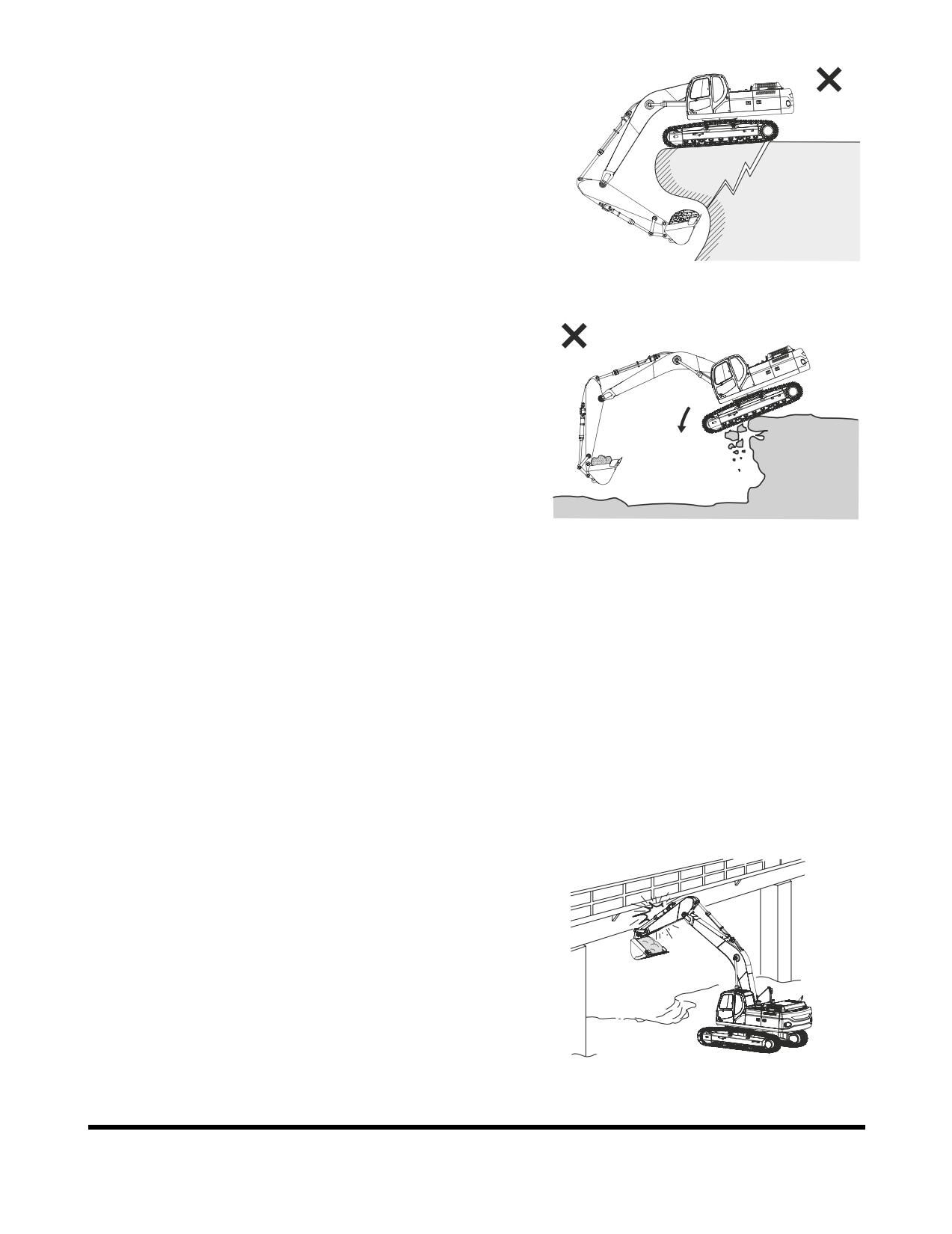
Do not carry out deep digging under the front of the
machine. The ground under the machine may collapse and
cause the machine to fall.
Working heavy loads over loose, soft ground or uneven,
broken terrain can cause dangerous side load conditions
and possible tipover and injury. Travel without a load or a
balanced load may also be hazardous.
Never relay on lift jacks or other inadequate supports when
work is being done. Block tracks fore and aft to prevent any
movement.
FG006905
Figure 21
When using the machine, to prevent accidents caused by
damage to the work equipment and overturning because of
an excessive load, do not use the machine in excess of its
ability (in terms of the maximum load and stability
determined by the structure of the machine).
When working at the edge of an excavation or on a road
shoulder, the machine could tip over, possibly resulting in
serious injury or death. Investigate the configuration and
ground conditions of the work site beforehand to prevent the
machine from falling and to prevent the ground, stockpiles,
or banks from collapsing.
FG006906
Figure 22
Precautions for Operation
Be careful not to go close to the edge of a cliff by mistake.
Use the machine only for its main purpose. Using it for
other purposes will cause failures.
To ensure an ample view, do as follows:
•
When working in dark areas, attach working lights
and front lights to the machine. If necessary, set
up lighting at the work site.
•
Stop operations when the visibility is poor, such
as in fog, mist, snow, and rain. Wait for the
visibility to improve to a level which causes no
problems for the operation.
To avoid hitting the work equipment, always do the following;
•
When working in tunnels, on bridges, under
electric wires, or when parking the machine or
carrying out other operations in places with limited
height, be extremely careful not to hit the bucket
or other parts.
•
To prevent collisions, operate the machine at a
safe speed when working in confined spaces,
indoors, or in crowded areas.
•
Do not pass the bucket over the heads of workers
FG000430
or over the operator's compartment of dump truck.
Figure 23
Safety
OP000481
1-32
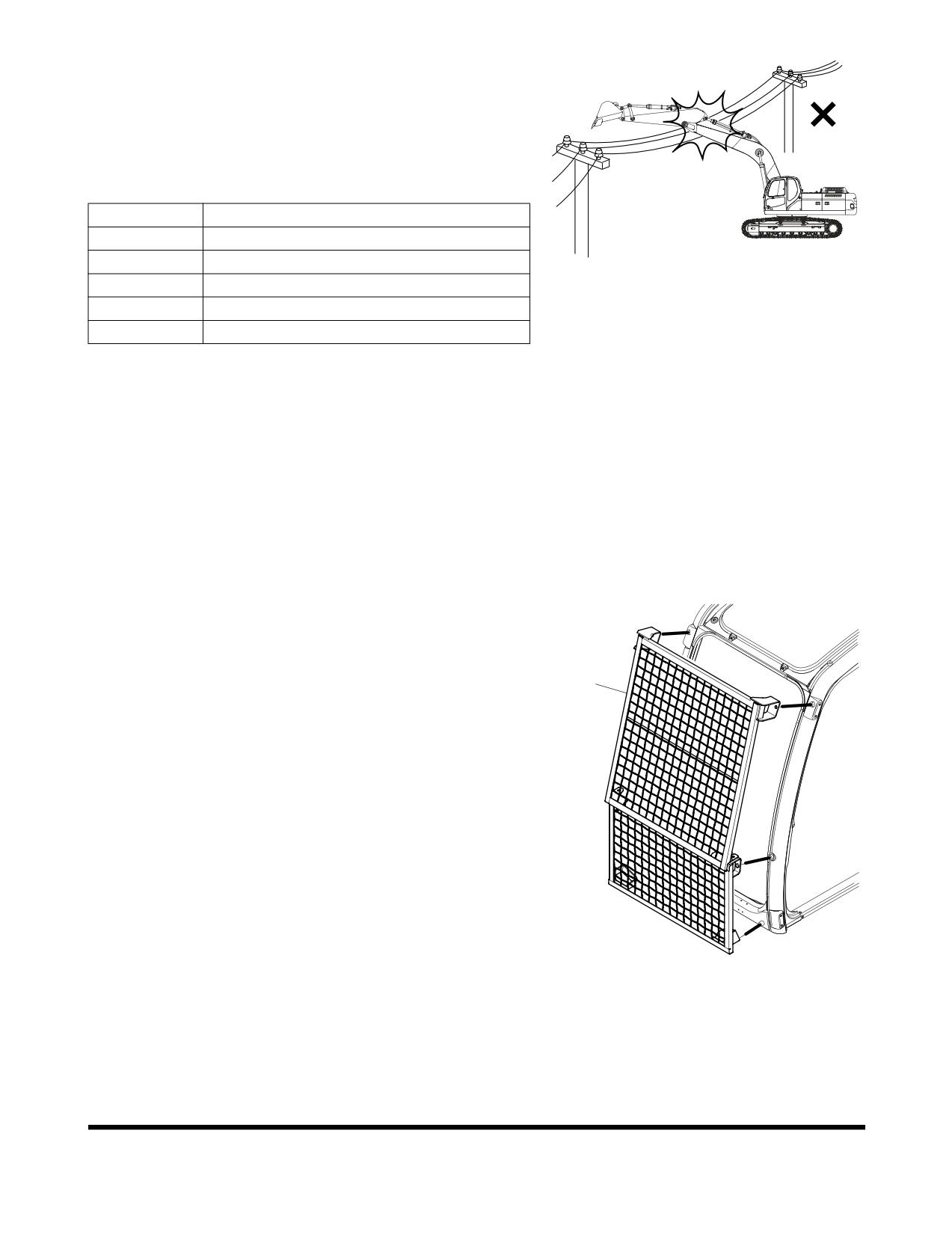
Avoid High Voltage Cables
Serious injury or death can result from contact or proximity to
high voltage electric lines. The bucket does not have to make
physical contact with power lines for current to be transmitted.
Use a spotter and hand signals to stay away from power
lines not clearly visible to the operator.
Voltage
Minimum Safe Distance
6.6 kV
3 m (9' 10")
FG006907
33.0 kV
4 m (13' 1")
Figure 24
66.0 kV
5 m (16' 5")
154.0 kV
8 m (26' 3")
275.0 kV
10 m (32' 10")
Use these minimum distances as a guideline only.
Depending upon the voltage in the line and atmospheric
conditions, strong current shocks can occur with the boom
or bucket as far away as 4 - 6 m (13 - 20 ft.) from the
power line. Very high voltage and rainy weather could
further decrease that safety margin.
NOTE:
Before starting any type of operation near power lines
(either above ground or buried cable type), you
should always contact the power utility directly and
work out a safety plan with them.
Protecting Cabin from Falling Object
(Optional)
In a work site where falling objects or flying objects are
1
expected, be sure to install adequate protective devices for
covering the cabin.
When using a breaker, be sure to install the front window
protection guard (Figure 25).
FG000112
Figure 25
OP000481
Safety
1-33
In a work site where falling rocks can cause damage and
possibly crush personnel, or in a mining operation, be sure
to install the falling object protective structure (Figure 26).
Be sure to install any other additional protective structures
required for work site conditions.
When the falling object protective structure is installed, and
the front window needs to be cleaned, loosen the bolts
marked with an arrow. Be sure to tighten bolts when done.
2
Operate Carefully on Snow, Ice and in
Very Cold Temperatures
In icy cold weather avoid sudden travel movements and stay
away from even slight slopes. The machine could skid off to
one side very easily.
Snow accumulation could hide or obscure potential hazards.
Use care while operating or while using the machine to
FG000113
clear snow.
Figure 26
Warming up the engine for a short period may be
necessary, to avoid operating with sluggish or reduced
working capacity. The jolting shocks and impact loads
caused by bumping or bottoming the boom or attachment
are more likely to cause severe stress in very cold
temperatures. Reducing work cycle rate and work load may
be necessary.
When the temperature rises, frozen road surfaces become
soft, so the machine travel becomes unstable.
In cold weather, do not touch metal surfaces with your bare
hands. If you touch a metal surface in extremely cold
weather, your skin may freeze to the metal surface.
Operations on Slopes
When working on slopes. there is danger that the machine
may lose its balance and turn over, when swinging, or when
work equipment is operated. Always carry out these
operations carefully.
Do not swing the work equipment from the uphill side to the
downhill side when the bucket is loaded. This operation is
dangerous.
If the machine has to be used on a slope, pile the soil to
FG006908
make a platform that will keep the machine as horizontal as
Figure 27
possible.
In addition, lower the bucket as far as possible, keep it
pulled into the front, and keep the swing speed as low as
possible.
Safety
OP000481
1-34
Parking Machine
Avoid making sudden stops, or parking the machine
wherever it happens to be at the end of the work day. Plan
120
ahead so that the excavator will be on firm, level ground
away from traffic and away from high walls, cliff edges and
any area of potential water accumulation or runoff. If parking
Block
on inclines is unavoidable, block the crawler tracks to
prevent movement. Lower the bucket or other working
attachment completely to the ground, or to an overnight
support saddle. There should be no possibility of unintended
or accidental movement.
Unlock
When parking on public roads, provide fences, signs, flags,
or lights, and put up any other necessary signs to ensure
that passing traffic can see the machine clearly, and park
the machine so that the machine, flags, and fences do not
obstruct traffic.
Lock
FG006909
After the front attachment has been lowered to an overnight
Figure 28
storage position and all switches and operating controls are
in the "OFF" position, the safety lock lever must be set to
the "LOCKED" position. This will disable all pilot circuit
control functions.
Always close the door of the operator's compartment.
Never Let Anyone Ride on Attachment
Never let anyone ride on any work attachment, such as the
bucket, crusher, grapple, or clamshell (grab bucket). There is
a danger of the person falling and suffering serious injury.
ARO1310L
Figure 29
OP000481
Safety
1-35
MAINTENANCE
Warning Tag
Alert others that service or maintenance is being performed
and tag operator's cabin controls - and other machine areas
if required - with a warning notice. OSHA mandated control
WARNING
lever lockout can be made with any OSHA certified lockout
DO NOT OPERATE
device and a length of chain or cable to keep the safety
lever in the fully lowered, nonactive position.
when performing inspection
or maintenance
Warning tags, for controls are available from DOOSAN
190-00695
distributors.
ARO1320L
Figure 30
Clean Before Inspection or Maintenance
Clean the machine before carrying out inspection and
maintenance. This prevents dirt from getting into the
machine and also ensures safety during maintenance.
If inspection and maintenance are carried out when the
machine is dirty, it will become more difficult to locate the
problems, and also there is danger that you may get dirt or
mud in your eyes or that you may slip and injure yourself.
When washing the machine, do the following;
•
Wear shoes with nonslip soles to prevent yourself
from slipping and falling on wet places.
•
Wear safety glasses and protective clothing when
washing the machine with high-pressure steam.
•
Take action to prevent touching high-pressure
water and cutting your skin or having mud fly into
your eyes.
ARO1330L
Figure 31
•
Do not spray water directly on electrical
components (sensors, connector). If water gets
into the electrical system, there is danger that it
will cause defective operation and malfunction.
Pick up any tools or hammers that are laying in the work
place, wipe up any grease or oil or any other slippery
substances, and clean the area to make it possible to carry
out the operation in safety. If the work place is left untidy,
you may trip or slip and suffer injury.
Safety
OP000481
1-36
Proper Tools
Use only tools suited to the task. Using damaged, low
qualify, faulty, or makeshift tools could cause personal injury.
There is danger that pieces from, chisels with crushed
heads, or hammers, may get into your eyes and cause
blindness.
HDO1037L
Figure 32
Use of Lighting
When checking fuel, oil, battery electrolyte, or window
washing fluid, always use lighting with antiexplosion
specifications. If such lighting equipment is not used, there
is danger of an explosion.
If work is carried out in dark places without using lighting, it
may lead to injury, so always use proper lighting.
Even if the place is dark, never use a lighter or flame
instead of lighting. There is danger of fire. There is also
HDO1040L
danger that the battery gas may catch fire and cause and
Figure 33
explosion.
Fire Prevention and Explosion
Prevention
All fuels, most lubricants and some coolant mixtures are
flammable. Leaking fuel or fuel that is spilled onto hot
surfaces or onto electrical components can cause a fire.
Store all fuels and all lubricants in properly marked
containers and away from all unauthorized persons.
Store oily rags and other flammable material in a protective
container.
HDO1015I
Figure 34
Do not smoke while you refuel the machine or while you are
in a refueling area.
Do not smoke in battery charging areas or in areas the
contain flammable material.
Clean all electrical connections and tighten all electrical
connections. Check the electrical wires daily for wires that
are loose of frayed. Tighten all lose electrical wires before
you operate the machine. Repair all frayed electrical wires
before you operate the machine.
Remove all flammable materials before they accumulate on
the machine.
OP000481
Safety
1-37
Do not weld on pipes or on tubes that contain flammable
fluids. Do not flame cut on pipes or on tubes that contain
flammable fluids. Before you weld on pipes or on tubes or
before you flame cut on pipes or on tubes, clean the pipes
or tubes thoroughly with a nonflammable solvent.
Burn Prevention
When checking the radiator coolant level, shut down engine,
let the engine and radiator cool down, then check the
coolant recovery tank. If the coolant level in the coolant
recovery tank is near the upper limit, there is enough
coolant in the radiator.
Loosen the radiator cap gradually to release the internal
pressure before removing the radiator cap.
If the coolant level in the coolant recovery tank is below the
lower limit, add coolant.
Cooling system conditioner contains alkali. Alkali can cause
personal injury. Do not allow alkali to contact the skin, the
eyes, or the mouth.
Allow cooling system components to cool before you drain
the cooling system.
Hot oil and hot components can cause personal injury. Do
not allow hot oil or hot components to contact the skin.
Remove the hydraulic tank filter plug only after the engine
has been stopped. Make sure that the hydraulic tank filter
plug is cool before you remove it with your bare hand.
Remove the hydraulic tank filter plug slowly to relieve
pressure.
Relieve all pressure in the hydraulic oil system, in the fuel
system, or in the cooling system before you disconnect any
HAAE1980
lines, fittings, or related items.
Figure 35
Batteries give off flammable fumes that can explode.
Do not smoke while you are checking the battery electrolyte
levels.
Electrolyte is an acid. Electrolyte can cause personal injury.
Do not allow electrolyte to contact the skin or the eyes.
Always wear protective glasses when you work on batteries.
Safety
OP000481
1-38
Welding Repairs
CAUTION!
When you connect or disconnect connectors between
ECU and Engine or connector between ECU and the
machine, always disconnect the source power to protect
damage of the ECU.
If you don't observe this procedure, the ECU would be
damaged or the engine would operate abnormally.
When carrying out welding repairs, carry out the welding in
a properly equipped place. The welding should be performed
by a qualified worker. During welding operations, there is the
danger of, generation of gas, fire, or electric shock, so never
let an unqualified worker do welding.
The qualified welder must do the following;
•
To prevent explosion of the battery, disconnect
the battery terminals and remove batteries.
•
To prevent generation of gas, remove the paint
from the location of the weld.
•
If hydraulic equipment, piping or places close to
them are heated, a flammable gas or mist will be
generated and there is danger of it catching fire.
To avoid this, never subject these places to heat.
•
Do not weld on pipes or on tubes that contain
flammable fluids. Do not flame cut on pipes or on
tubes that contain flammable fluids. Before you
weld on pipes or on tubes or before you flame
cut on pipes or on tubes, clean the pipes or
tubes thoroughly with a nonflammable solvent.
•
If heat is applied directly to rubber hoses or
piping under pressure, they may suddenly break
so cover them with a fireproof covering.
•
Wear protective clothing.
•
Make sure there is good ventilation.
•
Remove all flammable objects and provide a fire
extinguisher.
OP000481
Safety
1-39
Treatment for Electrical Welding to the Body Structure
To prevent damage to ECU by electrical welding, please
observe the following procedures:
1.
Open the door of the battery cover.
2.
Detach the cover after loosening the bolts on the
battery.
3.
Detach the positive and negative terminal cables from
the battery.
FG000312
4.
Detach the undercover, and after that detach the
connector (1) from the ECU that are installed at the
Figure 36
engine.
5.
Proceed with welding.
6.
After welding, carefully reassemble the connector.
7.
Connect the battery terminal cables.
1
8.
Reassemble the undercover under the engine.
9.
Reassemble the cover over the battery.
10. Close the cover of the battery.
FG000335
Figure 37
Warning for Counterweight and Front
Attachment Removal
DANGER!
DOOSAN warns any user, that the removal of the
counterweight from the machine, front attachment or
any other part, may affect the stability of the machine.
This could cause unexpected movement, resulting in
death or serious injuries. DOOSAN is not liable for any
misuse.
Never remove the counterweight or front attachment
unless the upper structure is in-line with the lower
FG006910
structure.
Figure 38
Never rotate the upper structure once the counterweight
or front attachment has been removed.
Safety
OP000481
1-40
Precautions for Removal, Installation,
and Storage of Attachments
Before starting removal and installation of attachments,
decide the team leader.
Do not allow anyone except the authorized workers close to
the machine or attachment.
Place attachments that have been removed from the
machine in a safe place so that they do not fall. Put up a
fence around the attachments and take other measures to
HDO1041L
prevent unauthorized persons from entering.
Figure 39
Precautions When Working on Machine
When carrying out maintenance operations on the machine,
keep the area around your feet clean and tidy to prevent
you from falling. Always do the following;
•
Do not spill oil or grease.
•
Do not leave tools laying about.
•
Watch your step when walking.
Never jump down from the machine. When getting on or off
ARO1380L
the machine, use the steps and handrails, and maintain a
Figure 40
three-point contact (both feet and one hand or both hands
and one foot) to support yourself securely.
If the job requires it, wear protective clothing.
To prevent injury from slipping or falling, when working on
the hood or covers, never use any part except the
inspection passage fitted with nonslip pads.
Lock Inspection Covers
When carrying out maintenance with the inspection cover
open, lock the cover securely in position with the lock bar.
If maintenance work is carried out with the inspection cover
open but not locked, there is danger that it may suddenly
close and cause injury if there is a gust of wind.
Crushing Prevention and Cutting
Prevention
You should always have at least two people working
together if the engine must be run during service. One
person needs to remain in the operator's seat, ready to work
the controls or stop the machine and shut off the engine.
OP000481
Safety
1-41
Unless you are instructed otherwise, never attempt
adjustments while the machine is moving or while the
engine is running.
Stay clear of all rotating parts and moving parts.
Keep objects away from moving fan blades. The fan blades
will throw objects and the fan blades can cut objects.
Do not use a wire rope cable that is kinked or flayed. Wear
gloves when you handle a wire rope cable.
When you strike a retainer pin, the retainer pin might fly out.
The loose retainer pin can injure personnel. Make sure that
the area is clear of people when you strike a retainer pin.
To avoid injury to your eyes, wear protective glasses when
you strike a retainer pin.
Track Tension Adjustments Require
Caution
Never turn out the track tension grease fitting nut. To
release pressure from the crawler frame track tension
assembly, you should NEVER attempt to disassemble the
track adjuster or attempt to remove the grease fitting or
valve assembly.
Keep your face and body away from the valve. Refer to the
track adjustment procedure in the Operator and Maintenance
HAOA110L
Manual or Shop Manual.
Figure 41
Supports and Blocking for Work
Equipment
Do not allow weight or equipment loads to remain
suspended.
Lower everything to the ground before leaving the operator's
seat.
Do not use hollow, cracked or unsteady wobbling supports.
Do not work under any equipment supported only by a lifting
HDO1042L
jack.
Figure 42
Action When Abnormality Is Found
During Inspection
If any abnormality is found during inspection, always carry
out repairs. In particular, if the machine is used when there
are still problems with the brake or work equipment systems,
it may lead to serious injury.
If necessary depending on the type of failure, please contact
your DOOSAN distributor for repairs.
Safety
OP000481
1-42
Precautions with High-pressure Lines,
Tubes and Hoses
X
When inspecting or replacing high-pressure piping or hoses,
check that the pressure has been released from the circuit.
Failure to release the pressure may lead to serious injury.
Always do the following;
•
Wear protective glasses and leather gloves.
X
•
Fluid leaks from hydraulic hoses or pressurized
components can be difficult to see but pressurized
oil has enough force to pierce the skin and cause
serious injury. Always use a piece of wood or
cardboard to check for suspected hydraulic leaks.
Never use your hands or expose your fingers.
•
Do not bend high-pressure lines. Do not strike
high-pressure lines. Do not install lines, tubes or
hoses that are bent or damaged.
•
Make sure that all clamps, guards and heat
shields are installed correctly to prevent vibration,
rubbing against other parts, and excessive heat
during operation.
HDO1045I
-
If any of the following conditions are found,
Figure 43
replace the part.
-
Damage or leakage from hose end.
–
Wear, damage, cutting of covering, or
exposure of strengthening wire layer.
-
Cover portion is swollen in places.
–
There is twisting or crushing at movable
parts of hose.
-
Foreign material is embedded in the
covering.
-
Hose end is deformed.
NOTE:
Refer to “Hose In-service Lifetime Limit
(European
Standard
ISO 8331
and
EN982 CEN)”
on page 4-58, for additional
European regulations.
OP000481
Safety
1-43
Waste Materials
X
Physical contact with used motor oil may pose a health risk.
Wipe oil from your hands promptly and wash off any
remaining residue.
Used motor oil is an environmental contaminant and may
only be disposed of at approved collection facilities. To
prevent pollution of the environment, always do the
following;
•
Never dump waste oil in a sewer system, rivers,
HAOA470L
etc.
Figure 44
•
Always put oil drained from your machine in
containers. Never drain oil directly onto the
ground.
•
Obey appropriate laws and regulations when
disposing of harmful materials such as oil, fuel,
solvent, filters, and batteries.
Safety
OP000481
1-44
BATTERY
Battery Hazard Prevention
Battery electrolyte contains diluted sulfuric acid and batteries
generate hydrogen gas. Hydrogen gas is highly explosive,
and mistakes in handling them can cause serious injury or
fire. To prevent problems, always do the following;
•
Do not smoke or bring any flame near the battery.
•
When working with batteries, ALWAYS wear
safety glasses and rubber gloves.
•
If you spill battery electrolyte on yourself or your
clothes, immediately flush the area with water.
•
If battery electrolyte gets into your eyes, flush
them immediately with large quantities of water
and see a doctor at once.
•
If you accidentally drink battery electrolyte, drink a
large quantity of water or milk, raw egg or
vegetable oil. Call a doctor or poison prevention
center immediately.
•
When cleaning the top surface of the battery,
wipe it with a clean, damp cloth. Never use
gasoline, thinner, or any other organic solvent or
detergent.
•
Tighten the battery caps securely.
•
If the battery electrolyte is frozen, do not charge
the battery or start the engine with power from
another source. There is danger that the battery
may catch fire.
Figure 45
•
When charging the battery or starting with power
from another source, let the battery electrolyte
melt and check that there is no leakage of battery
electrolyte before starting the operation.
•
Always remove the battery from the machine
before charging.
OP000481
Safety
1-45
Boost Starting or Charging Engine
Batteries
If any mistake is made in the method of connecting the
booster cables, it may cause an explosion or fire. Always do
the following;
•
Turn off all electrical equipment before connecting
leads to the battery. This includes electrical
switches on the battery charger or boost starting
equipment.
HAOA310L
•
When boost starting from another machine or
Figure 46
vehicle do not allow the two machines to touch.
Wear safety glasses or goggles while required
battery connections are made.
•
24 volt battery units consisting of two series
connected twelve volt batteries have a cable
connecting one positive terminal on one of the 12
volt batteries to a negative terminal on the other
battery. Booster or charger cable connections
must be made between the nonseries connected
positive terminals and between the negative
terminal of the booster battery and the metal
frame of the machine being boosted or charged.
Refer to the procedure and illustration in “Starting
Engine With a Booster Cable” on page 3-7 of this
manual.
•
Connect positive cable first when installing cables
and disconnect the negative cable first when
removing them. The final cable connection, at the
metal frame of the machine being charged or
boost started, should be as far away from the
batteries as possible.
Safety
OP000481
1-46
TOWING
Precautions When Towing
Cloth
If any mistake is made in the method of selecting or
inspecting the towing wire or in the method of towing, it may
lead to serious personal injury. Always do the following;
•
Always use the method of towing given in this
Operation and Maintenance Manual. Do not use
any other method.
Towing Wire
•
Use leather gloves when handling the wire rope.
•
When carrying out the preparation work for towing
with two or more workers, determine the signals
to use and follow these signals correctly.
•
Always fit the towing rope to the left and right
hooks and secure in position.
Shackle
•
If the engine on the problem machine will not
start or there is a failure in the brake system.
always contact your DOOSAN distributor.
Towing WireFG000669
•
Never go between the towing machine and the
towed machine during the towing operation.
Figure 47
•
It is dangerous to carry out towing on slopes, so
select a place where the slope is gradual. If there
is no place where the slope is gradual, carry out
operations to reduce the angle of the slope before
starting the towing operation.
•
When towing a problem machine, always use a
wire rope with a sufficient towing capacity.
•
Do not use a frayed, kinked rope or a rope with
any loss of diameter.
•
Do not use the lightweight towing hook for towing
another machine.
OP000481
Safety
1-47
SHIPPING AND
TRANSPORTATION
Obey State and Local Over-the-Road
Regulations
Check state and local restrictions regarding weight, width
and length of a load before making any other preparation for
transport.
The hauling vehicle, trailer and load must all be in
compliance with local regulations governing the intended
shipping route.
Partial disassembly or teardown of the excavator may be
necessary to meet travel restrictions or particular conditions
at the work site. See the Shop Manual for information on
partial disassembly.
Refer to the Transportation and Shipping section of this
Operation and Maintenance Manual for information on
loading, unloading and towing.
Safety
OP000481
1-48
EXCAVATOR RATED LIFT
CAPACITY TABLES
WARNING!
Let everybody be away from the boom cylinder. While
lifting operation, boom, arm, bucket hoses might burst
and then high-pressure oil will be ejected at high speed.
If that failure mode takes place, handling weight or front
structure might fall by its gravity to the ground to cause
fatal injury to the person.
When changing the hoses record the part numbers of
the hoses to factory log book.
Figure 48
Do the service job under the company's serviceman.
WARNING!
All rated lift capacities are based on the machine and
the load both remaining level at all times. DO NOT
EXCEED THE RATED LIFT CAPACITY. Lifting loads
greater than those shown in the rated capacity tables
can cause catastrophic equipment failure and/or
structural collapse of the machine.
To operate safely the excavator should be on a firm, level
and uniformly supporting surface. The operator is expected
to make due allowance for all specific work site and lift
related conditions, and respond to changes in those
conditions that could pose a hazard. The following could all
cause hazardous conditions and accidents or injuries:
•
Soft or uneven ground.
•
Unlevel terrain.
•
Side loads.
•
Modifications or poor maintenance of the excavator.
•
Failure to lift squarely over the end or over the
side of the machine.
When a load is in the air, the operator must remain alert.
•
Avoid side loads that may be caused by uneven
slings, traveling with the load or swinging too
quickly.
•
The load can become unbalanced if the hook line
is twisted and starts to rotate. If the surface area
of the load is large enough, wind gusts can
create side loads.
OP000481
Safety
1-49
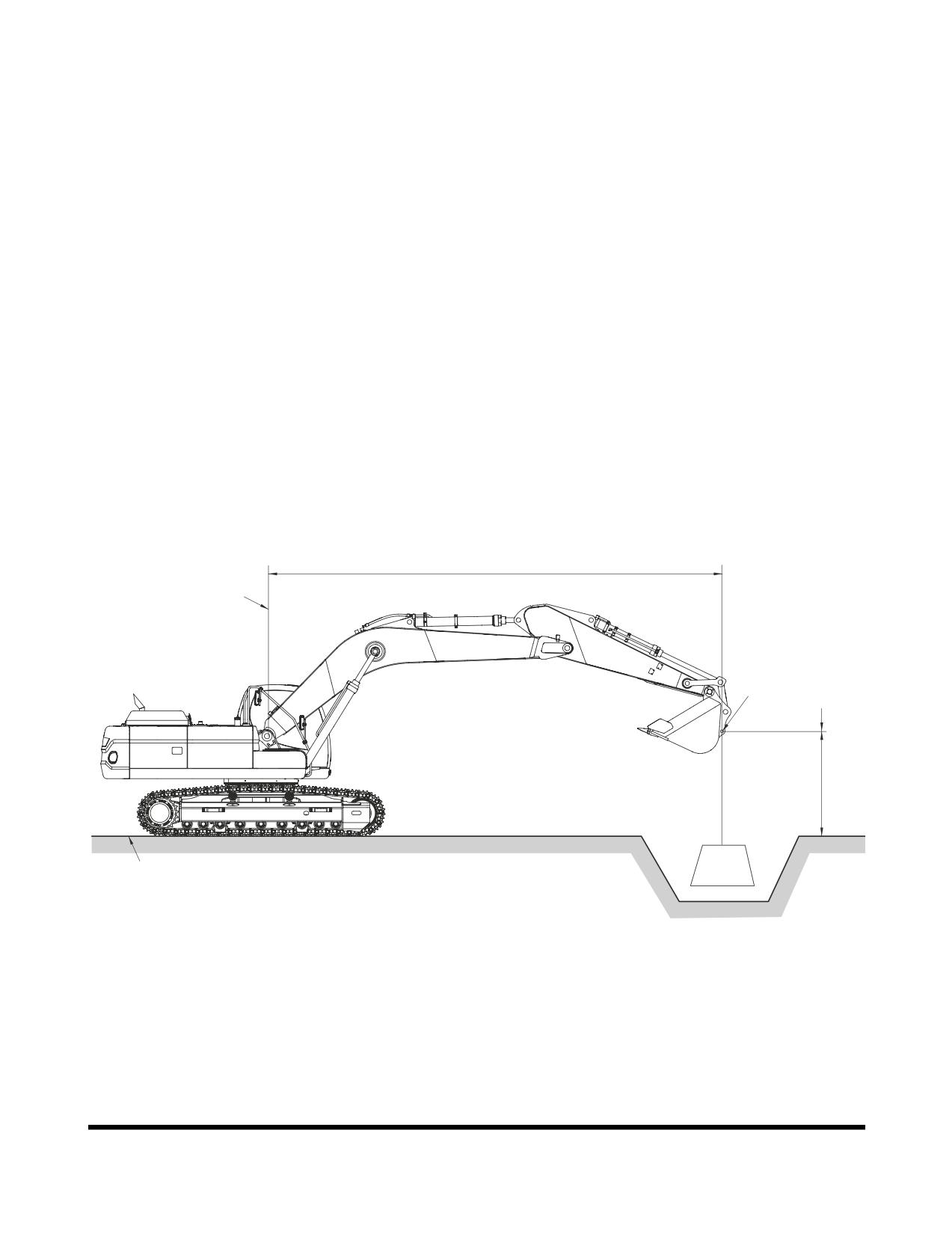
•
Keep the bucket hook point directly over the load.
Tag lines on opposite sides of the load can help
maintain greater stability against side loads and
wind gusts.
Avoid traveling with a suspended load. Before swinging (or if
required, traveling), bring the load into an arm position
(radius and height) that has a safer weight capacity rating
and adequate movement clearance. The operator and all
work site personnel should be thoroughly familiar with safety
instructions and procedures within this Operation and
Maintenance Manual.
The following weight loads are in compliance with SAE
(J1097) and ISO applicable, recommended standards for
hydraulic excavators performing lifting operation on a firm
supporting surface. An asterisk
(*) next to the lift rating
indicates rated load does not exceed
87% of hydraulic
capacity. All other ratings have been determined not to
exceed 75% of tipping capacity.
Do not attempt to lift or hold any load that exceeds rated
load capacity at the specified distances (from the machine's
rotation center line and height - see "lift radius" and "lift
height" in the reference drawing, Figure 49).
Lifting Radius
Centerline
of Rotation
Lifting
Point
Lifting
Point
Height
Ground Line (Machine Supporting Surface)
FG006911
Figure 49
The weight of slings and any auxiliary lifting device (and/or
the weight difference of any attachment heavier than
standard configuration) must be deducted from the rated lift
capacity to determine allowable net lifting load. The lift point
should be on the back of the bucket, as shown in Figure 49.
Safety
OP000481
1-50
IMPORTANT
Select the Digging Mode switch on the Instrument Panel
before using the excavator for lifting work. Engine and
hydraulic oil should both be fully warmed up to
operating temperature before starting a lift.
OP000481
Safety
1-51
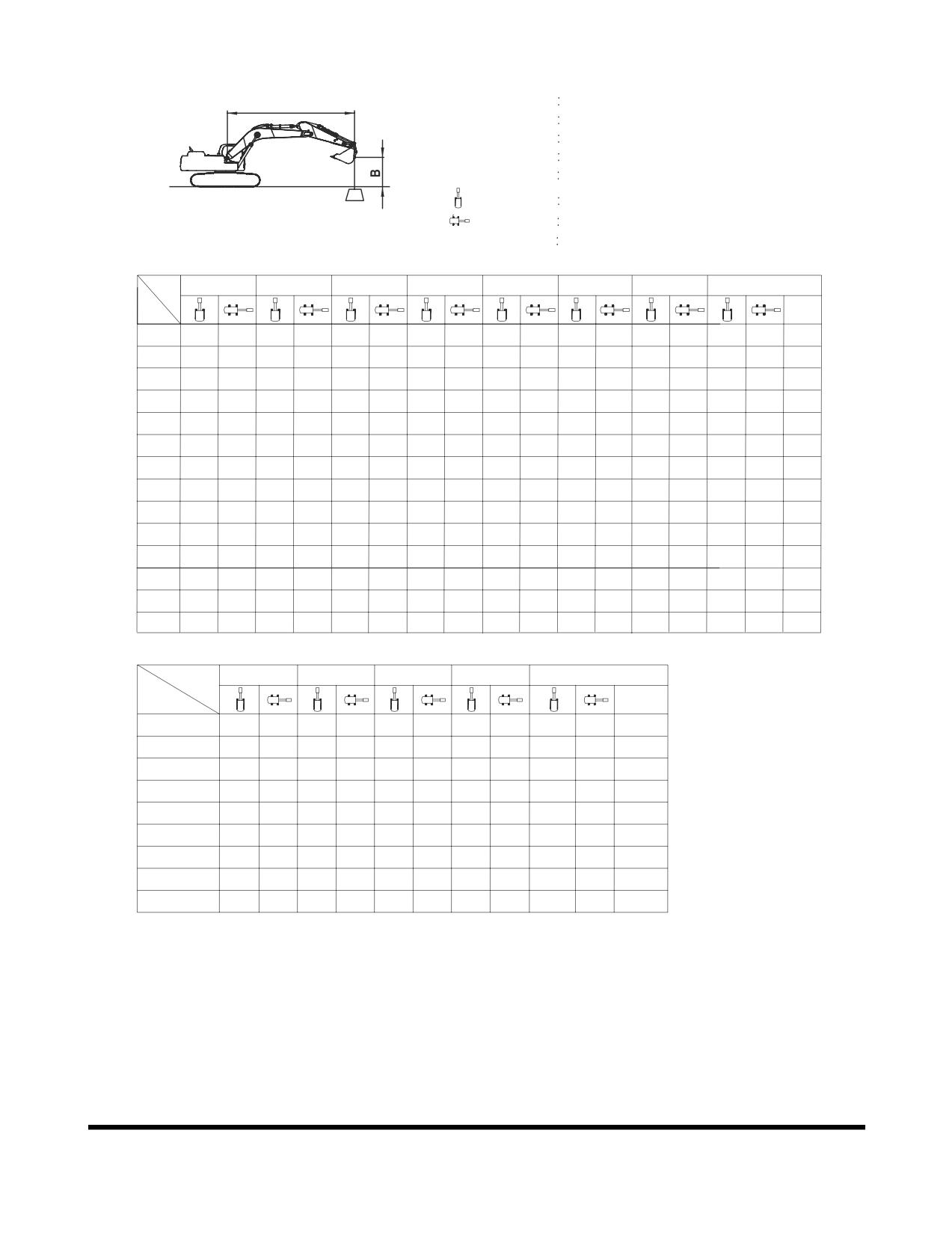
A
TRACK WIDTH
3.2 m (10' 6") STD TRACK
BOOM
5.9 m (19' 5")
ARM
3 m (9' 10")
BUCKET
SAE 1.1 m3 (CECE 0.95 m3)
SHOE
600mm (24'')
RATING OVER FRONT
RATING OVER SIDE OR 360 degree
UNIT
1,000 kg (1,000 lb)
METRIC
A(m)
2
3
4
5
6
7
8
MAX. REACH
A(m)
B(m)
8
*
3.86
*
3.86
6.46
7
*
4.50
*
4.50
*
3.78
*
3.78
7.29
6
*
5.10
5.03
*
3.79
*
3.79
7.90
5
*
5.56
*
5.56
*
5.36
4.96
*
4.97
3.95
*
3.87
3.66
8.35
4
*
6.91
*
6.91
*
6.22
*
6.22
*
5
.77
4.86
*
5.48
3.90
*
4.01
3.40
8.66
3
*
14.39
*
14.39
*
10.14
*
10.14
*
8.13
8.02
*
6.98
6.04
*
6.25
4.74
*
5.78
3.83
*
4.21
3.23
8.85
2
*
6.79
*
6.79
*
12.12
10.93
*
9.33
7.73
*
7.75
5.86
*
6.76
4.63
5.71
3.75
*
4.48
3.15
8.91
1
*
5.90
*
5.90
*
13.53
10.55
*
10.32
7.48
*
8.42
5.70
6
.95
4.52
5.64
3.69
4.81
3.14
8.87
0 (GROUND)
*
3.58
*
3.58
*
7.22
*
7.22
*
14.27
10.35
*
10.98
7.32
8.73
5.58
6.86
4.44
5.58
3.64
4.91
3.20
8.70
-1
*
6.23
*
6.23
*
9.35
*
9.35
*
14.46
10.27
*
11.29
7.23
8.65
5.51
6.80
4.39
5.55
3.61
5.15
3.35
8.42
-2
*
8.80
*
8.80
*
12.04
*
12.04
*
14.20
10.27
*
11.25
7.21
8.62
5.48
6
.78
4.37
5.56
3.61
8.00
-3
*
11.63
*
11.63
*
15.40
*
15.40
*
13.51
10.33
*
10.83
7.24
8.64
5.50
6.81
4.40
6.25
4.05
7.42
-4
*
14.97
*
14.97
*
15.66
*
15.66
*
12.31
10.46
*
9.94
7.32
*
8.10
5.57
*
7.04
4.83
6.63
-5
*
13.01
*
13.01
*
10.36
*
10.36
*
8.30
7.48
*
7.22
*
6.39
5.56
FEET
10'
15'
20'
25'
MAX. REACH
A (ft)
B (ft)
A (ft)
25
*
8.42
*
8.42
22' 4"
20
*
9.84
9.57
*
8.35
*
8.35
25' 9"
15
*
12.76
*
12.76
*
11.89
9.41
*
8.65
7.79
27' 11"
10
*
30.61
*
30.61
*
19.33
*
19.33
*
15.12
13.01
*
13.04
9.14
*
9.25
7.14
29' 0"
5
*
13.94
*
13.94
*
24.06
19.20
*
17.55
12.43
13.51
8.85
*
10.25
6.91
29' 3"
0 (GROUND)
*
16.48
*
16.48
*
26.88
18.50
18.78
12.02
13.26
8.63
10.83
7.05
28' 7"
-5
*
24.06
*
24.06
*
27.50
18.26
18.55
11.82
13.15
8.53
11.76
7.65
26' 11"
-10
*
34.96
*
34.96
*
26.08
18.35
18.59
11.85
13.88
9.00
24' 3"
-15
*
31.09
*
31.09
*
22.04
18.74
*
15.79
12.27
19' 11"
1. LOAD POINT IS THE HOOK ON THE BACK OF THE BUCKET.
2.
* RATED LOADS ARE BASED ON HYDRAULIC CAPACITY.
3. RATED LOADS DO NOT EXCEED 87 % OF HYD. CAPACITY OR 75 % OF TIPPING CAPACITY.
FG006912
Safety
OP000481
1-52