Yanmar engines LV series (L48V, L70V, L100V). Manual - part 4
 

  Index      Engines     Yanmar industrial engines LV series (L48V, L70V, L100V) - service manual 2000 year


Search            


Content   ..  2  3  4  5   ..


Yanmar engines LV series (L48V, L70V, L100V). Manual - part 4


LV Operation Manual

1

SAFETY

LV Operation Manual

SAFETY STATEMENTS

Yanmar is concerned for your safety and your 
machine’s condition. Safety statements are one 
of the primary ways to call your attention to the 
potential hazards associated with Yanmar LV 
Series engine operation. Follow the precautions 
listed throughout the manual before operation, 
during operation and during periodic 
maintenance procedures for your safety, the 
safety of others and to protect the performance of 
your engine. Keep the labels from becoming dirty 
or torn and replace them if they are lost or 
damaged. Also, if you need to replace a part that 
has a label attached to it, make sure you order 
the new part and label at the same time.

This safety alert symbol appears with 
most safety statements. It means 
attention, become alert, your safety is 
involved! Please read and abide by the 
message that follows the safety alert 
symbol.

A

 DANGER

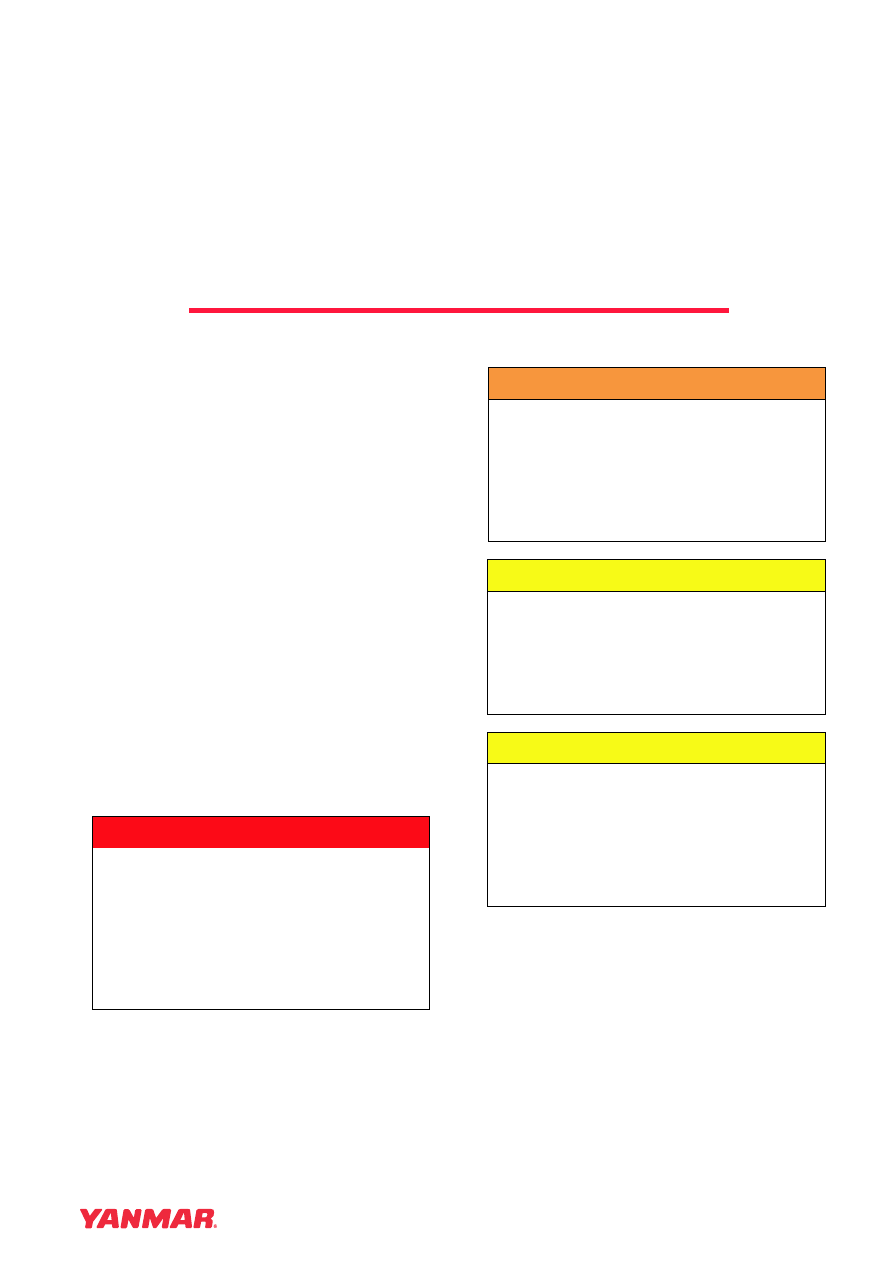
Danger (the word “DANGER” is in white 
letters with a red rectangle behind it) – 
indicates an imminently hazardous 
situation which, if not avoided, will 
result in death or serious injury. Danger 
is limited to the most extreme 
situations.

0000001en

A

A

 WARNING

Warning (the word “WARNING” is in 
black letters with an orange rectangle 
behind it) – indicates a potentially 
hazardous situation which, if not 
avoided, could result in death or serious 
injury.

0000001en

A

 CAUTION

Caution (the word “CAUTION” is in black 
letters with a yellow rectangle behind it) 
– indicates a potentially hazardous 
situation which, if not avoided, may 
result in minor or moderate injury.

0000001en

CAUTION

Caution without the safety alert symbol 
indicates a potentially hazardous 
situation that can cause damage to the 
machine, personal property and / or the 
environment or cause the machine to 
operate improperly.

0000001en

SAFETY

2

LV Operation Manual

SAFETY PRECAUTIONS

Before You Operate

During Operation and Maintenance

CAUTION

NEVER permit anyone to operate the 
engine or driven machine without proper 
training.

• Read and understand this Operation 

Manual before you operate the 
machine to ensure that you follow safe 
operating practices and maintenance 
procedures.

• Machine safety signs and labels are 

additional reminders for safe operating 
and maintenance techniques.

• See your authorized Yanmar industrial 

engine dealer or distributor for 
additional training.

0000002en

A

 DANGER

EXPLOSION HAZARD!

• Keep the area around the battery well 

ventilated. While the engine is running 
or the battery is charging, hydrogen 
gas is produced which can be easily 
ignited.

• Keep sparks, open flame and any other 

form of ignition away.

• Failure to comply will result in death or 

serious injury.

0000003en

A

 DANGER

FIRE AND EXPLOSION HAZARD!

• Diesel fuel is extremely flammable and 

explosive under certain conditions.

• When you remove any fuel system 

component to perform maintenance 
(such as changing the fuel filter) place 
an approved container under the 
opening to catch the fuel.

• NEVER use a shop rag to catch the 

fuel. Vapors from the rag are extremely 
flammable and explosive.

• Wipe up any spills immediately.

• Wear eye protection. The fuel system 

is under pressure and fuel could spray 
out when you remove any fuel system 
component.

• Failure to comply will result in death or 

serious injury.

0000009en

SAFETY

LV Operation Manual

3

A

 DANGER

FIRE AND EXPLOSION HAZARD!

• Only use the key switch to start the 

engine.

• NEVER jump start the engine. Sparks 

caused by jumping the battery to the 
starter terminals may cause a fire or 
explosion. 

• Failure to comply will result in death or 

serious injury.

0000004en

A

 DANGER

FIRE AND EXPLOSION HAZARD!

• Diesel fuel is extremely flammable and 

explosive under certain conditions.

• NEVER use diesel fuel as a cleaning 

agent.

• Failure to comply will result in death or 

serious injury.

0000012en

A

 DANGER

FIRE AND EXPLOSION HAZARD!

• Diesel fuel is extremely flammable and 

explosive under certain conditions.

• NEVER remove the fuel cap with the 

engine running.

• Failure to comply will result in death or 

serious injury.

0000011en

A

 DANGER

FIRE AND EXPLOSION HAZARD!

• Diesel fuel is extremely flammable and 

explosive under certain conditions.

• Only fill the fuel tank with diesel fuel. 

Filling the fuel tank with gasoline may 
result in a fire.

• NEVER refuel with the engine running.

• Wipe up all spills immediately.

• Keep sparks, open flames or any other 

form of ignition (match, cigarette, 
static electric source) away when 
fueling / refueling.

• NEVER overfill the fuel tank.

• Fill the fuel tank and store fuel in a 

well-ventilated area only.

• Failure to comply will result in death or 

serious injury.

0000005en

SAFETY

4

LV Operation Manual

A

 DANGER

FIRE AND EXPLOSION HAZARD!

• Diesel fuel is extremely flammable and 

explosive under certain conditions.

• Be sure to place the diesel fuel 

container on the ground when 
transferring the diesel fuel from the 
pump to the container. Hold the hose 
nozzle firmly against the side of the 
container while filling it. This prevents 
static electricity build-up which could 
cause sparks and ignite fuel vapors.

• NEVER place diesel fuel or other 

flammable material such as oil, hay or 
dried grass close to the engine during 
engine operation or shortly after shut 
down.

• Failure to comply will result in death or 

serious injury.

0000014en

A

 DANGER

FIRE AND EXPLOSION HAZARD!

• Diesel fuel is extremely flammable and 

explosive under certain conditions.

• Before you operate the engine, check 

for fuel leaks. Replace rubberized fuel 
hoses every two years or every 2000 
hours of engine operation, whichever 
comes first, even if the engine has 
been out of service. Rubberized fuel 
lines tend to dry out and become 
brittle after two years or 2000 hours of 
engine operation, whichever comes 
first.

• Failure to comply will result in death or 

serious injury.

0000015en

A

 DANGER

EXPLOSION HAZARD!

• NEVER check the remaining battery 

charge by shorting out the terminals. 
This will result in a spark and may 
cause an explosion or fire. Use a 
hydrometer to check the remaining 
battery charge.

• If the electrolyte is frozen, slowly warm 

the battery before you recharge it.

• Failure to comply will result in death or 

serious injury.

0000007en


Content   ..  2  3  4  5   ..