Technology of watch production - part 46
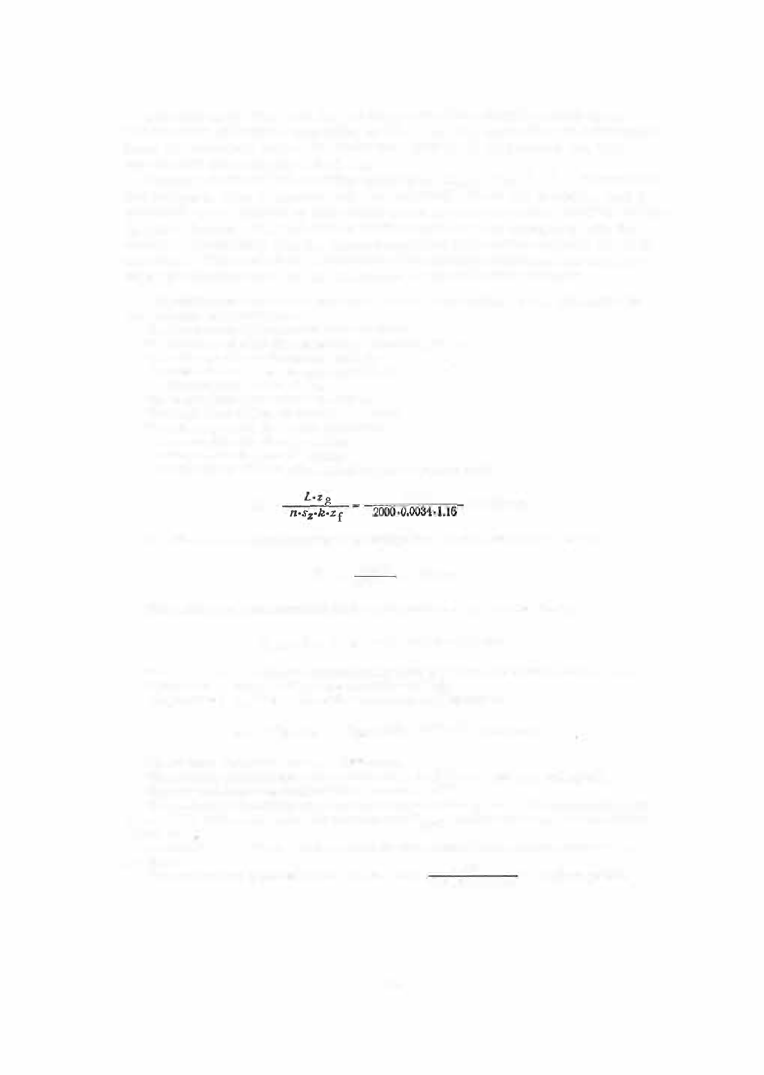
The idle-cycle time and the machine-s etup time must be added to the
milling time calculated according to (2
)
.
The idle-cycle time is determined
from the technical data of the machine. For the S - 4 0 machine the idle
m ovements take roughly 7 % of
T
m .
Having calculated the machine-cycle tim e
Tmach= T m
+ T
i
for machin-
ing one part, it is compared with the technical data of the machine, and the
camshaft speed closest to that which would give one camshaft rotation during
T
mach
is s elected. The calculated cutting speed is also compared with the
machine capabilities and the closest available fo rm - cutter spindle speed is
s elected. The method of calculation of the cutting c onditions and the ma
chine production rate will be illus trated in the following example .
It is required to mill the teeth of a third-wheel pinion of module 0.103 mm,
z =
8 . The length of cut
is
I =
0.80 mm, the material U7A V steel.
The data necessary for the calculation are first written down.
The feed per tooth of the form cutter is
Sz
=
0 .0034 mm (Table 8).
The cutting speed is
fl
=
50.3 m/min (Table 9).
The form-cutter dimensions are taken from Table 4 :
diameter 8 mm, 1 6 cutter teeth.
The cutter-spindle speed chosen is
n =
2000 rpm.
The length of cut is, from the drawing,
I =
0.8 mm.
The cutter approach is
/1 =
1 .5 mm (Appendix 3),
The overtravel is selected as
/2 =
1 .2 mm.
The total travel is therefore
L
=
3.5 mm.
The time required
for
milling the pinion in one pass is according to (2)
T.
=
m
3.5 · 8
.
=
0'25
mm.
The idle movements taking, according to the machine data, 7 o/o of the milling time, we have
0.25 .7
0 2
.
Ti
=
IOO
_
1
=
.0
mm.
The machine-cycle time required for machining the pinion in one pass will therefore be
Tmach = T m + T i
=
0.25
+
0.02
�
0.27
min.
If two passes are to be made, we must add the time taken by the form-cutter shifting which requires one
camshaft revolution. At naux
=
20 rpm this takes 1/20
=
0.05 min.
The piece time,
T
p• for one cycle of the S-40 machine will therefore be
T
0
=
Tm + T i
+
Taux =
0.25 + 0.02
+
0.05
=
0.32
min.
For two passes, this time is doubled, and is 0 .64 min.
The calculated production rate of the machine will
be A = ..i§.Q.
=
750 pieces per working shift.
The data obtained are then compared with the machine dat
g
:64
The camshaft speeds available are n
=
9, 19.2 or 3 0 rpm ; the time per camshaft revolution will accord
ingly be : 0.11, 0.052 , or 0.033 min. The calculated time T mach required for milling one tooth is 0.27/8
=
=
0.034 min.
According to the specifications of the machine, the value closest to this is 0.033 min, corresponding to
n=
30 rpm.
480
The actual machine production rate will therefore be
A =
2 ( 0.0033 .8
+
0.05)
=
764 pieces per shift.
1 8 1