Military reference books and manuals (2009-2023, Volume 8) - page 1
ATP 3-07.6
Protection of Civilians
OCTOBER 2015
DISTRIBUTION RESTRICTION. Approved for public release; distribution is unlimited.
SUPERCESSION STATEMENT. This publication supersedes ATTP 3-37.31, 18 July 2012.
Headquarters, Department of the Army
This publication is available at Army Knowledge Online
To receive publishing updates, please subscribe at
*ATP 3-07.6
Army Techniques Publication
Headquarters
Department of the Army
No. 3-07.6
Washington, DC, 29 October 2015
Protection of Civilians
Contents
Page
Preface
iii
Introduction
v
Chapter 1
INTRODUCTION TO THE PROTECTION OF CIVILIANS
1-1
Overview
1-1
Protection of Civilians During Military Operations
1-2
Considerations for the Protection of Civilians
1-5
Framework for the Protection of Civilians
1-6
Chapter 2
UNDERSTANDING CIVILIAN RISKS
2-1
Operational Environment
2-1
Intelligence
2-14
Civil Information
2-15
Assessing Protection of Civilians
2-16
Chapter 3
PROTECTING CIVILIANS DURING OPERATIONS
3-1
The Operations Process and the Protection of Civilians
3-1
Warfighting Functions and the Protection of Civilians
3-6
Chapter 4
SHAPING A PROTECTIVE ENVIRONMENT
4-1
Comprehensive Approach
4-1
Synchronization of Information-Related Capabilities
4-3
Stability Tasks
4-3
Ensuring Protection of Vulnerable Groups
4-4
Chapter 5
MITIGATING CIVILIAN CASUALTIES
5-1
Civilian Casualty Overview
5-1
Considerations for Civilian Casualty Mitigation
5-1
Preventing Civilian Casualties
5-3
Responding to Civilian Casualty Incidents
5-9
Conclusion
5-16
Distribution Restriction: Approved for public release; distribution is unlimited.
*This publication supersedes ATTP 3-37.31, 18 July 2012.
i
Appendix A CIVILIAN CASUALTY DATA COLLECTION
A-1
GLOSSARY
Glossary-1
REFERENCES
References-1
INDEX
Index-1
Figures
Figure 1-1. Layers of civilian protection
1-2
Figure 1-2. Framework for the protection of civilians
1-7
Figure 2-1. Civilian vulnerability characteristics
2-2
Figure 2-2. Civilian threat characteristics
2-3
Figure 2-3. Commander’s Critical Information Requirements
2-15
Figure 3-1. Protection of civilians smart card
3-3
ii
ATP 3-07.6
29 October 2015
Preface
Army Techniques Publication (ATP) 3-07.6, Protection of Civilians, replaces Army Tactics, Techniques, and
Procedures (ATTP) 3-37.31, Civilian Casualty Mitigation, dated 18 July 2012. ATP 3-07.6 is the primary
doctrinal publication for the protection of civilians during unified land operations, including the mitigation of
civilian casualties and mass atrocity response operations (MARO).
The principal audience for ATP 3-07.6 is commanders and staffs at the tactical to operational levels of war.
Commanders, staffs, and subordinates ensure their decisions and actions comply with applicable United States,
international, and, in some cases, host nation laws and regulations. Commanders at all levels ensure that their
Soldiers operate according to the law of war and the rules of engagement (see FM 27-10).
ATP 3-07.6 uses joint terms where applicable. Selected joint and Army terms and definitions appear in both the
glossary and the text.
ATP 3-07.6 applies to the Active Army, Army National Guard/Army National Guard of the United States, and
U.S. Army Reserve unless otherwise stated.
The proponent for this publication is the United States Army Combined Arms Center. The preparing agency is
the United States Army Peacekeeping and Stability Operations Institute, United States Army War College.
Send written comments and recommendations on Department of the Army (DA) Form 2028 (Recommended
Changes to Publications and Blank Forms) directly to: Director, United States Army Peacekeeping and Stability
Operations Institute, 22 Ashburn Drive, Carlisle, PA 17013-5234. Send comments and recommendations by e-
mail to usarmy.carlisle.awc.list.pksoi-operations@mail.mil.
29 October 2015
ATP 3-07.6
iii
This page intentionally left blank.
iv
ATP 3-07.6
29 October 2015
Introduction
Army Techniques Publication (ATP) 3-07.6, Protection of Civilians, replaces ATTP 3-37.31, Civilian
Casualty Mitigation, dated 18 July 2012. ATP 3-07.6 expands on the discussion of the protection of
civilians in Army Doctrine Reference Publication (ADRP) 3-07, Stability, and Field Manual (FM) 3-07,
Stability.
As Army Professionals, we are servants of the Nation, morally committed by Oath to support and defend
the Constitution. This Duty depends on Trust with the American people, reinforced through Military
Expertise, Honorable Service, Esprit de Corps, and Stewardship. Within the Army Profession, we earn and
sustain Trust by demonstrating our Character, Competence, and Commitment—making decisions and
taking actions that are ethical, effective, and efficient. As Stewards of the Army Profession, we provide
coaching, counseling, and mentoring while properly managing the Army’s resources entrusted to our care.
ATP 3-07.6 discusses the importance of civilian protection during unified land operations and presents
guidelines for Army units that must consider the protection of civilians during their operations. Protection
of civilians refers to efforts to protect civilians from physical violence, secure their rights to access
essential services and resources, and contribute to a secure, stable, and just environment for civilians over
the long-term. ATP 3-07.6 describes different considerations including civilian casualty mitigation and
mass atrocity response operations.
ATP 3-07.6 contains five chapters:
Chapter 1 provides an overview of the protection of civilians, discusses its legal underpinnings, and
addresses considerations including civilian risks. It discusses civilian protection during military operations
and introduces the protection of civilians framework used in the document, which includes three
components: understanding civilian risks, conducting operations to protect civilians, and shaping a
protective environment.
Chapter 2 addresses situational understanding of civilian risks. It discusses civilian protection in the
context of an operational environment, intelligence activities, information sharing, and assessments.
Chapter 3 discusses the relationship of the operations process and the warfighting functions to the
protection of civilians. It also discusses the conduct of operations that support the protection of civilians.
Chapter 4 describes the relevance of governance, rule of law, conflict-related sexual violence, protection
of children, and other issues for achieving enduring protection of civilians. It also discusses the importance
of a comprehensive approach that engages the population, host nation leaders and organizations, and other
actors.
Chapter 5 discusses the mitigation of civilian casualties, including preventive measures and methods to
address civilian casualties that occur.
The glossary lists acronyms and terms with Army, multi-service, or joint definitions, and other selected
terms. Where Army and joint definitions are different, (Army) follows the term. Terms for which ATP 3-
07.6 is the proponent manual (the authority) are marked with an asterisk (*). The proponent manual for
other terms is listed in parentheses after the definition.
29 October 2015
ATP 3-07.6
v
This page intentionally left blank.
Chapter 1
Introduction to the Protection of Civilians
This chapter provides an overview of the protection of civilians during military
operations and discusses considerations including civilian risks, cross-cutting themes,
and legal underpinnings. The chapter introduces a three-part framework for the
protection of civilians: understanding civilian risks, protecting civilians during
operations, and shaping a protective environment.
OVERVIEW
1-1. Protection of civilians refers to efforts that reduce civilian risks from physical violence, secure their
rights to access essential services and resources, and contribute to a secure, stable, and just environment for
civilians over the long-term. Protection of civilians is important for moral, political, legal, and military
reasons and must be addressed during unified land operations regardless of the primary mission. According
to the law of war, civilians may not be the object of attacks and must be spared and protected.
1-2. A civilian is any person who is not a combatant. They are not a member of their country’s armed
forces, a militia or other armed group, nor do they directly participate in hostilities. In case of doubt about
whether a person is a civilian, that person shall be considered a civilian. Collateral damage involves
unintentional or incidental injury or damage to persons or objects that would not be lawful military targets
in the circumstances ruling at the time. Such damage is not unlawful if it is not excessive in light of the
overall military advantage anticipated from the attack.
1-3. The protection of civilians is a layered set of issues, broadly categorized as shown in figure 1-1, on
page 1-2. Challenges and solutions are more complex when civilian protection is expanded beyond
physical violence perpetrated by armed actors during a conflict. Many peace operations or stability efforts
build the capacity of a host nation to achieve long-term stability. However, such activities do not
automatically reduce violence against civilians, and in some cases can spark greater risks for civilians.
Moreover, cooperation with some host nation actors, such as the governmental leadership and security
forces, create moral and legal dilemmas if there is a record of abuses by these actors. While host nation
actors are important partners for achieving other goals or reducing threats to civilians over time, they may
be contributing to abuses in the short term.
29 October 2015
ATP 3-07.6
1-1

Chapter 1
Figure 1-1. Layers of civilian protection
1-4. Various actors interpret the protection of civilians differently. It has military and nonmilitary aspects
and requires more than a short-term focus on imminent threats of violence. Protection of civilians
incorporates important sub-topics including:
z
Civilian casualty mitigation: Measures to avoid or minimize unnecessary civilian casualties and
to reduce the adverse impact of those that occur.
z
Mass atrocity response operations (MARO): Military activities conducted to prevent or halt
mass atrocities (JP 3-07.3).
z
Conflict-related sexual violence: Violent acts of a sexual nature, including rape, sexual slavery,
enforced prostitution, forced pregnancy, enforced sterilization, mutilation, indecent assault,
trafficking, inappropriate medical examinations, and strip searches.
PROTECTION OF CIVILIANS DURING MILITARY OPERATIONS
1-5. The protection of civilians is an important consideration during all military operations. Army leaders
address the protection of civilians whether they are engaged in foreign humanitarian assistance missions,
peace operations, specific combat, and noncombat responses to contingencies and crises, or large-scale
combat operations. Depending upon the situation, protection of civilians may be the primary purpose of a
mission, an important supporting task, or a constraint.
1-6. In addition to overarching legal and moral civilian protection requirements, there are three other
significant reasons to support the protection of civilians. First, counterinsurgency and stabilization
1-2
ATP 3-07.6
29 October 2015
Introduction to the Protection of Civilians
experiences highlight that the population is often the center of gravity for military operations, and the
population’s support is partly related to providing protection from perpetrators or, in some cases, from rival
identity groups. Second, harming civilians undermines military efforts and becomes a divisive issue
between multinational partners. Even if a military force is not responsible for civilian casualties that occur,
there are expectations that the force prevents widespread harm to civilians, regardless of the cause.
1-7. Finally, during most operations, Army units are concerned with civilian welfare while achieving the
desired outcomes to a conflict or crisis. Operational objectives may include a safe and secure environment,
good governance, rule of law, social well-being, a sustainable economy, and ensuring the protection of
civilians from future threats. Under certain circumstances, other urgent human security threats are the main
operational focus of Army units as they support other actors. In any case, it may be unlikely that a peaceful
political settlement can be achieved unless the protection of civilians is adequately addressed.
1-8. Regardless of the operation, Army units support the protection of civilians in two general ways.
z
Avoidance of civilian harm. Army units comply with the law of war and other relevant bodies of
law to minimize civilian harm. Additionally, Army units avoid actions that undermine the efforts
of other actors to improve human security.
z
Deliberate civilian protection actions. Army units perform offensive, defensive, and stability
tasks that mitigate harm to civilians and create an environment conducive to the protection of
civilians.
1-9. The protection of civilians involves many actors aside from Army units. These include domestic and
international civilian, police, and military organizations that address security, governance, rule of law,
humanitarian, and developmental needs. The latter considerations are relevant to the protection of civilians
because they affect civilian well-being and mitigate grievances and root causes of conflict that harm
civilians. Civilian protection actors have dissimilar goals and use different methods, even if they agree
about the general desirability to protect civilians.
1-10. To the extent possible, civilian populations (including those loyal to the enemy) must be protected
from the effects of combat. In addition to humanitarian reasons and the need to comply with the law of
war, excessive civilian casualties create political pressure that limits freedom of action of Army units.
Civilian harm creates ill will among the population, with lasting repercussions that impair post-conflict
reconstruction and reconciliation.
1-11. Civilians are vulnerable to the direct effects of combat operations and the indirect effects of having
their lifestyles, livelihoods, and infrastructure disrupted. The law of war, particularly the principles of
proportionality and discrimination, directs units not to target civilians and other noncombatants. However,
enemies may be located among civilians and place these civilians in danger. It may be appropriate to
modify or delay operations when civilians are at risk and the expected civilian harm is excessive in relation
to the actual military advantage anticipated.
1-12. Units may have to contend with large numbers of dislocated civilians, and enemy combatants may
attempt to blend into these groups. This can complicate matters if dislocated civilians seek security, shelter,
or sustainment from Army units. Whenever possible, units establish specific routes and control measures
for civilian movement and avoid contact between civilians and maneuver units. Tactical military
information support operations (MISO) units use face-to-face communications, printed products, broadcast
media, and loudspeakers to inform civilians of such measures. Traffic control points may be used to guide
civilians away from areas of expected combat. In some cases, “stay put” messages may be effective in
keeping civilians out of the way of maneuver units, especially if humanitarian assistance can be delivered
to civilian locations. See ATP 3-57.10 for more information.
1-13. Civilian harm jeopardizes any operation. The population’s support is critical during many operations,
and civilian harm can undermine such support if civilians conclude that Army units and their partners (such
as host nation security forces or security contractors) are their greatest threats or cannot provide security.
1-14. Protection of civilians is a consideration during limited contingency operations involving Army units
and may be one of the objectives of such an operation. Protection of civilians may be a subordinate task for
some missions such as the removal of an adversarial regime, strikes, raids, shows of force, or sanctions
29 October 2015
ATP 3-07.6
1-3
Chapter 1
enforcement. Civilian protection is related to the objective of other operations such as foreign humanitarian
assistance missions, noncombatant evacuation operations, consequence management, or a MARO that
addresses mass atrocities. See the Protection of Civilians Military Reference Guide for more information
on the military’s role in protecting civilians.
MASS ATROCITY RESPONSE OPERATIONS
1-15. MARO refers to military activities to prevent or halt mass atrocities. A MARO can be the primary
mission or be incorporated as part of any operation that includes the potential for mass atrocities. Mass
atrocities can intensify and expand once they begin. Army units may have to defend vulnerable civilians,
defeat enemies that perpetrate mass atrocities, and perform stability tasks to address the root causes of mass
atrocities. See JP 3-07.3 and The MARO Handbook for more information on MARO.
IRREGULAR WARFARE
1-16. Civilian protection is problematic during irregular warfare. It is difficult to distinguish enemies from
the surrounding population, and because enemies often use civilian noncombatants as human shields or
occupy their places of worship, homes, and other civilian locations. Enemies avoid attacks on well-
defended targets, preferring instead to strike weakly defended locations. These often include terrorist acts
in which most of the victims are civilians. One motivation for such attacks is to demonstrate that U.S. and
partnered forces are incapable of providing adequate security and are illegitimate. Another motivation for
such attacks may be to cause Army units to respond disproportionately, causing civilian casualties and
eroding their support from the local population. Insurgents may attempt to gain genuine popular support
for their efforts, and if such attempts fail, the insurgent group may resort to the violence against the
population to intimidate them into cooperating.
1-17. In their efforts to defeat irregular enemies, Army units and their partners avoid actions that create
more adversaries from the population. Civilian harm, whether directly caused by lethal action or because
the population’s welfare is seriously disrupted, generates resentment and undermines popular support for
the mission. Operations against insurgents are postponed or modified if civilian harm undercuts mission
goals or political support.
PEACE OPERATIONS
1-18. Peace operations include peacekeeping operations, peace enforcement operations, peacemaking,
peace building, and conflict prevention. With the exception of peace enforcement, these operations occur
when the main parties to a conflict agree to a peace process, and external forces perform peace operations
to monitor and enable this process. During peace enforcement, some of the parties do not consent to the
peace process and are influenced to do so. Most modern peace operations authorized by the United Nations
(UN) include mandates to protect civilians. While it is often the highest priority of these missions, the
protection of civilians is typically their most difficult challenge. See JP 3-07.3 for more information on
peace operations.
MILITARY ENGAGEMENT, SECURITY COOPERATION, AND DETERRENCE
1-19. While protection of civilians is normally viewed in the context of armed conflict or peace operations,
civilian deaths and injuries during noncombat military operations have serious repercussions. The law of
war does not apply in these circumstances; instead, relevant national laws, international human rights law,
and the Uniform Code of Military Justice (UCMJ) govern these situations. Although such deaths and
injuries entail a different means of consequence management under the Foreign Claims Act, they involve
considerations that are similar to those arising from civilian harm during conflict.
1-20. During their contacts with foreign security forces, it is important for Army leaders to emphasize
protection of civilians and the general imperatives to treat civilian populations with dignity and to respect
human rights. This emphasis ensures that foreign security forces properly address protection of civilians in
their own domestic and international operations. In many cases Army units provide training to foreign
militaries to help them prepare for international peacekeeping missions. As most peacekeeping missions
1-4
ATP 3-07.6
29 October 2015
Introduction to the Protection of Civilians
include a mandate to protect civilians, it is important that Army units effectively convey this information to
their counterparts.
CONSIDERATIONS FOR THE PROTECTION OF CIVILIANS
1-21. Army units should incorporate several considerations while accounting for civilian protection during
operations. These include legal considerations, legitimacy, unity of effort, host nation ownership and
capacity, and gender issues.
LEGAL CONSIDERATIONS
1-22. Obligations regarding the protection of civilians emanate from two separate but related bodies of
international law—the law of war and international human rights law. As a matter of policy, the U.S. holds
that during armed conflict, the law of war and customary international law adequately secure the intent of
international human rights law. The law of war (also known as international humanitarian law, the law of
armed conflict, and the law of land warfare) includes four principles: military necessity, distinction,
proportionality, and humanity.
1-23. Depending on the nature and location of the operation, as well as other factors, additional legal
authorities that could affect Army operations and the conduct of Army personnel include:
z
The Uniform Code of Military Justice (UCMJ).
z
Status-of-forces agreements (SOFA).
z
Host Nation (HN) laws.
z
Rules of engagement (ROE).
z
Department of Defense directives and service regulations.
1-24. In most cases, legal instruments with the most significant relevance for Army units will be the law of
war, the UCMJ, and rules of engagement (ROE). Army leaders ensure their subordinates abide by the law
of war. Under the legal doctrine of command responsibility, commanders are criminally responsible for
war crimes committed by personnel in their unit if they directed them or if they know that war crimes
occurred and failed to prevent them or investigate and hold accountable those perpetrating the offenses.
For more information on the law of war, see FM 27-10. On legal issues, commanders and their staffs seek
legal guidance from their units’ judge advocates.
LEGITIMACY
1-25. Legitimacy is a function of the operation’s purpose, the way in which it is conducted, and the results
that are achieved. Legitimacy, which can be a decisive factor in operations, is based on the actual and
perceived legality, morality, and rightness of the actions from the various perspectives of interested
audiences. Legitimacy is often a matter of perception, and inadequate protection of civilians undermines
the legitimacy of military operations. (See JP 3-0.)
1-26. Corruption occurs in fragile states, erodes legitimacy, and jeopardizes civilian welfare. There is a
fine line between corrupt activities (such as bribes, misappropriation, and nepotism) and some culturally-
acceptable behavior (such as gifts, reallocation of resources, and patronage). Local and international actors
may have different interpretations regarding the appropriateness of particular actions. Corruption is not just
a host-nation problem, but can also be found in international organizations including military units,
contractors, and others.
1-27. Corruption undermines civilian protection efforts and results in the diversion of resources from their
intended purposes. It empowers enemies and adversaries who jeopardize the protection of civilians,
threatens friendly forces and partners, and fosters a culture of impunity rather than a culture of lawfulness.
In practice, there is not always a clear distinction between criminals, corrupt administrators, and
responsible officials. For example, an official may occasionally perform a corrupt act if a bribe is large
enough or if the official’s family is threatened. Additionally, perpetrators obtain indirect leverage over
legitimate officials through personal relationships with criminal actors and corrupt officials.
29 October 2015
ATP 3-07.6
1-5
Chapter 1
UNITY OF EFFORT
1-28. Unity of effort is the coordination and cooperation toward common objectives, even if the
participants are not necessarily part of the same command or organization, which is the product of
successful unified action (JP 1). Nonmilitary actors are vital for civilian protection, and Army units
coordinate and cooperate with these actors to achieve this objective. Army units provide security so that
other actors have space to operate. Ultimately, protection of civilians depends on the effectiveness of police
forces and other host-nation organizations assisted by international organizations with the necessary
nonmilitary expertise. Other actors have the lead role for many of the tasks necessary to protect civilians.
Civilian protection actors have different interests and objectives and their willingness to cooperate with the
military force will vary. Additionally, they are often responsive to different lines of authority. While Army
units strive for unity of effort, achieving it is a difficult challenge in the best of circumstances.
HOST NATION OWNERSHIP AND CAPABILITY
1-29. Host nation ownership and capability ensures protection of civilians. Moreover, protection of
civilians is an obligation of any sovereign authority. Some host-nation actors lack the capability or will to
protect civilians and in some cases oppose necessary civilian protection measures. Conversely, external
actors have limited expertise, capability, or staying power, and the different organizations lack unity of
effort. It may be difficult to determine whether some host-nation actors, including the government or its
security forces, are friendly or adversarial. Some host-nation cultural norms (such as gender rights and
acceptable levels of corruption) differ from international norms, creating challenges for actors that seek to
protect civilians effectively while navigating the cultural landscape. The respective roles of host nation and
external actors require balancing and continual adjustment to support transitions, and all involved should
understand that host-nation police forces ultimately are the primary protectors of civilians.
GENDER ISSUES
1-30. Often overlooked in the past, there is now increasing awareness of sexual violence during conflicts
and other unstable situations. Sexual violence is usually, but not always, directed against women and girls.
There is also greater recognition that women are vital to establishing peace and maintaining future stability.
Gender issues include protective and participatory dimensions. The protective dimension mitigates harm,
exploitation, discrimination, abuse, conflict-related sexual violence, and human trafficking while holding
perpetrators accountable. This protective dimension also addresses access to humanitarian assistance,
relief, and recovery and protection of human rights. Gender issues also include women’s participation in a
nation’s political, economic, and security sectors and institutions. This participatory dimension helps to
ensure that women’s interests are safeguarded and results in greater stability. Institutions are more effective
and societies are more stable when women are integrated and not marginalized.
FRAMEWORK FOR THE PROTECTION OF CIVILIANS
1-31. Protection of civilians is a moral, political, and legal priority for most Army operations.
Communities on the ground and around the world expect Army units and Soldiers to protect the
population. Failure to do so jeopardizes the credibility and legitimacy of the operation and undermines
other objectives. The framework for the protection of civilians includes three main elements, as depicted in
figure 1-2.
1-6
ATP 3-07.6
29 October 2015

Introduction to the Protection of Civilians
Figure 1-2. Framework for the protection of civilians
UNDERSTANDING CIVILIAN RISKS
1-32. Army units comprehend an operational environment
(OE) to identify civilian threats and
vulnerabilities as well as the opportunities for improving protection of civilians. Civilians face a variety of
risks including collateral damage from armed conflict, deliberate targeting from terrorist attacks or mass
atrocities, conflict-related sexual violence, and others. Army units must understand the relevant political,
military, economic, social, information, infrastructure, physical environment, and time
(PMESII-PT)
considerations. In many cases the nonmilitary issues are more important than the military matters. Units
influence (and often should be influenced by) a wide range of other actors. In many situations, Army units
support other actors whose efforts are more important to achieve protection of civilians. Additionally, it is
important to comprehend dynamics such as the enemies’ strategic logic, the impact of operations, changing
vulnerabilities and threats that relate to civilian protection, emerging opportunities to enhance protection of
civilians, and changes in the OE. Civilian protection requires accurate intelligence and effective current
assessments. Although different civilian protection actors are often reluctant to exchange information and
compromise their neutrality, confidentiality, security, or operational independence, it may be possible to
develop formal and informal information-sharing mechanisms that improve protection of civilians. This
element is discussed in greater detail in Chapter 2.
PROTECTION OF CIVILIANS DURING OPERATIONS
1-33. In some situations, such as while participating in a MARO mission, Army units plan, prepare, and
execute operations to protect civilians. In other circumstances, they conduct unified land operations to
achieve other purposes, but their operations have an impact on civilian protection. The operations process
accounts for the protection of civilians and Army units apply the warfighting functions to reduce civilian
risks. It is important for Army units to incorporate civilian protection considerations into their planning and
operations to protect civilians, mitigate civilian casualties, and anticipate unintended consequences. This
element is discussed further in Chapter 3.
SHAPING A PROTECTIVE ENVIRONMENT
1-34. It is important to set conditions that provide enduring protection of civilians. This is achieved with
five desired outcomes: a safe and secure environment, good governance, the rule of law, social well-being,
and a sustainable economy. Failure to achieve these outcomes affects civilian well-being and causes
29 October 2015
ATP 3-07.6
1-7
Chapter 1
grievances that renew conflict. Recognizing that this requires contributions from a variety of actors
(including the host-nation government and security forces, nongovernmental organizations, international
organizations, and others), Army units adopt a comprehensive approach to achieve unified action with
these organizations. Synchronizing information-related capabilities is critical for managing expectations,
supporting the desired outcomes, and enhancing the effectiveness of Army efforts to protect civilians.
Army units help establish a protective environment by accomplishing the five essential stability tasks
described in FM 3-07. It is important to ensure that vulnerable groups such as minorities, women, and
children are protected. This element is discussed in Chapter 4.
1-8
ATP 3-07.6
29 October 2015
Chapter 2
Understanding Civilian Risks
Army units understand a changing operational environment to protect civilians. The
wide array of operational variables, actors, and dynamics affect civilian risks and
potential remedies. Situations will change and units must remain current in their
understanding of these variables so that they can anticipate, act, and adapt effectively.
This requires focused commander’s critical information requirements, effective
intelligence activities, management of civil information, and realistic assessments.
OPERATIONAL ENVIRONMENT
2-1. Army units must understand how the protection of civilians is affected by an operational
environment (OE). Civilian vulnerabilities and threats, the operational variables, relevant actors, and
dynamics affect civilian risks and the effectiveness of Army operations to protect them. Leaders understand
the many nonmilitary issues that impact civilian protection. The OE changes and Army units must
understand and anticipate evolving circumstances. An effective intelligence preparation of the battlefield
synthesizes information from a variety of internal and external sources, including nonmilitary aspects that
relate to the protection of civilians. See ATP 2-01.3 for more information on the intelligence preparation of
the battlefield.
CIVILIAN PROTECTION RISKS
2-2. Civilian protection risks are functions of vulnerabilities and threats that create situations where
violence and deprivation harms civilian well-being. Assessments and plans account for the interplay
between vulnerabilities and threats, and operations are effectively tailored to address them. Some risks are
preventable, some can be mitigated, and some are directly relevant to military operations while others are
less relevant and more appropriate for mitigation by other actors. Many civilian protection risks include
intent or action by an enemy to harm civilians. Enemies often have deliberate or strategic motivations for
harming civilians; however, their motivations may be more local and opportunistic in nature. Some civilian
protection risks originate from a surrounding structural context, such as an authoritarian government, a
failed state, natural disaster, or environmental degradation. This structural context creates specific patterns
of violence, coercion, exploitation, and deprivation against particular victims for specific reasons. Other
risks can be less visible or physical, such as economic marginalization or discriminatory social practices.
Civilian protection risks may be incidental, such as collateral damage that occurs during military
operations. Army units should understand vulnerabilities and threats perceived by the local population,
which may have a different perspective from international actors.
Vulnerabilities
2-3. Vulnerabilities refer to civilian exposure to imminent or specific threats. For example, ethnic or
sectarian violence targets certain groups within a population, rendering those more vulnerable than others.
Civilians in the proximity of military targets are more vulnerable to collateral damage. Some groups are
vulnerable in certain contexts, such as women, children, or the elderly, infirmed, and disabled. In other
situations young adult males may be the population in the greatest danger. Vulnerabilities also include a
lack of access to services such as food and life-saving assistance.
2-4. Vulnerabilities are mitigated with different approaches and often involve other actors besides Army
units. Some actors such as parties to a conflict and state authorities have formal legal obligations to protect
29 October 2015
ATP 3-07.6
2-1

Chapter 2
civilians in accordance with the law of war. Some relevant vulnerability characteristics are summarized in
figure 2-1.
Figure 2-1. Civilian vulnerability characteristics
Threats
2-5. Threats are based on the capability, intent, and opportunity to harm civilians. The most important
aspect of the threat is the motivation or strategic logic behind the violence. These motivations may change
over time and may overlap. Army units need to understand enemy motivations and operational patterns to
understand the threat.
2-6. A specific violent threat to civilians varies in terms of its dimensions, type, the enemy, and the
enemy’s motivations. Figure 2-2 includes many of the variables that characterize particular threats:
2-2
ATP 3-07.6
29 October 2015

Understanding Civilian Risks
Figure 2-2. Civilian threat characteristics
CIVILIAN RISK SITUATIONS
2-7. Vulnerabilities and threats combine to create a variety of civilian risk scenarios that confront Army
units and other civilian protection actors. Potential situations generally include armed conflict including
insurgencies and civil wars, mass atrocities (including genocide and ethnic cleansing), regime crackdowns,
post-conflict instability resulting in revenge killings and violent power struggles, communal conflict, and
widespread predatory violence. See Protection of Civilians: Military Planning Scenarios and Implications
for more information on potential scenarios.
Armed Conflict
2-8. All combatants are obliged to abide by the law of war whether or not they are signatories to relevant
international agreements and treaties. Combatants should perform their operations according to the law of
war principles of military necessity (actions must fulfill a legitimate military objective), distinction (actions
target combatants and not civilians), proportionality (actions must not cause excessive incidental civilian
harm in relation to the anticipated military advantage to be gained), and humanity (actions must not use
means that cause unnecessary suffering). Nevertheless, civilians are often deliberately targeted and are also
at great risk from collateral damage during military operations, particularly when some combatants are
irregular elements that are indistinguishable from civilians. Civilians are also in jeopardy when combatants
of any type are located among them. This includes the intentional and forcible use of civilians as
auxiliaries, human shields, or hostages to dissuade attacks by enemies.
29 October 2015
ATP 3-07.6
2-3
Chapter 2
2-9. In many situations civilians are at risk because, through choice or compulsion, they are supporting or
located with a party to the conflict. Examples of such at-risk civilians include camp followers, sex slaves,
family members, contractors, workers, and crews of merchant marine vessels. Other civilians, such as
humanitarian assistance workers, can also be at risk due to a perception that they may be directly or
indirectly supporting a party to a conflict, or because enemies view them as vulnerable and convenient
targets. While protected under the law of war, humanitarian workers could find themselves inadvertently or
deliberately targeted because of their activities or locations. For more information regarding security of
government contractors (authorized and unauthorized) and Department of Defense civilians, see JP 3-10
and JP 4-10.
2-10. Civilians may also be in jeopardy immediately after combat situations or in post-conflict settings.
Damaged infrastructure, fires, flooding, destruction of crops, disease, landmines and other unexploded
ordnance, societal disruption, and other factors can result in long-term civilian suffering after hostilities
have stopped.
Mass Atrocities
2-11. A mass atrocity refers to widespread and often systematic acts of violence against civilians by state
or nonstate armed groups, including killing, causing serious bodily or mental harm, or deliberately
inflicting serious bodily or mental harm. Genocide is a form of mass atrocity and refers to acts committed
to destroy a national, ethnic, racial, or religious group. Ethnic cleansing is similar in nature, but is intended
to force a group to leave an area. Civilians are often deliberately targeted to inflict terror, reduce popular
will to continue a struggle, punish an adversary, deter or compel civilian behavior, or achieve other
objectives. Widespread targeting occurs in other situations such as reprisals against civilians during a
guerrilla or counterinsurgency campaign. A crime against humanity is an extremely brutal act committed
on any scale, such as systematic rape or some human rights violations such as torture. It may be difficult to
distinguish mass atrocity situations from other circumstances such as political violence, massacres, or
large-scale violations of human rights, particularly during the early stages of a conflict or when low levels
of violence have been occurring for an extended period of time. Civilians can also be vulnerable to
perpetrators who are less systematic or who do not have underlying political or strategic objectives.
Protecting civilians from such targeting is an important supporting task of unified land operations, and it
could be the primary objective of an operation.
Conflict-Related Sexual Violence
2-12. Conflict-related sexual violence consists of violent acts of a sexual nature, including rape, sexual
slavery, enforced prostitution, forced pregnancy, enforced sterilization, mutilation, indecent assault, human
trafficking, inappropriate medical examinations, and strip searches. Sexual violence occurs during armed
conflict and in fragile states, particularly when undisciplined militaries, police forces, or other armed
groups believe that they can act with impunity. In addition to occurring as nonsystematic acts of violence,
conflict-related sexual violence can be part of a deliberate campaign of terror against a population group,
and it is frequently a part of genocide, ethnic cleansing, or other mass atrocities. See Chapter 4 for a more
detailed discussion of conflict-related sexual violence.
Human Trafficking
2-13. Human trafficking such as slavery, prostitution, and theft of body organs frequently occurs in fragile
states and post-conflict situations due to the widespread poverty and limited rule of law. These activities
are often controlled by organized criminal groups with transnational ties and linkages to those in official,
legitimate, and respectable positions. It should be a topic of emphasis when interacting with host-nation
leaders, especially those in security forces. Army units tasked with broader stabilization responsibilities
should know the possibility of human trafficking and criminal networks exist and address these issues
aggressively. This is an area where it is important for Army units to create a secure environment in which
the host-nation police and other rule-of-law organizations operate.
2-4
ATP 3-07.6
29 October 2015
Understanding Civilian Risks
Children Risks
2-14. Children depend on others to take care of them and are vulnerable to numerous threats and forms of
exploitation. Orphans are at risk, and any support programs require adequate resources and close
monitoring. Some governmental and nongovernmental armed groups kidnap, conscript, and indoctrinate
children as soldiers, which is a war crime. Planning for Army operations accounts for the possibility of
vulnerable children and child-soldiers among enemy forces. When detained or captured, child-soldiers
require special handling, treatment, and reintegration.
Dislocated Civilian Risks
2-15. In armed conflicts, civilian deaths occur from an array of non-violent causes including starvation,
disease, exposure, and dehydration. Civilians are vulnerable when they flee or are forced from their homes
and lose their sources of sustainment and communal networks. A refugee is a person who, owing to a well-
founded fear of being persecuted for reasons of race, religion, nationality, membership of a particular
social group or political opinion, is outside the country of their nationality and is unable or, due to such
fear, is unwilling to avail themselves of the protection of that country. A dislocated civilian (DC) is the
broad term primarily used by the Department of Defense that includes a displaced person, an evacuee, an
internally displaced person, a migrant, a refugee, or a stateless person. Many DCs overwhelm the available
capacity to sustain them and are vulnerable to extortion, human trafficking, conflict-related sexual
violence, and other acts of violence.
Impeded Access to Humanitarian Assistance and Essential Services
2-16. Even if not displaced from their homes and communities, civilians may lack essentials such as food,
water, medical care, and fuel. This can occur either because the necessities are not available or because it is
too risky for civilians to travel even short distances to obtain them. Additionally, although the law of war
obligates parties to facilitate humanitarian aid, civilian humanitarian workers may be unable to deliver
assistance because they are prevented or targeted by enemies. In many cases, armed actors could
wrongfully appropriate civilians’ supplies and humanitarian relief items. When deprived of humanitarian
assistance or essential services, civilians can become victims of malnutrition, dehydration, illness,
exposure, and lack of medical care. In some cases civilian deaths from these conditions have exceeded
those from violence.
Other Civilian Risk Types
2-17. Particularly in fragile states, armed conflict situations, and post-conflict environments, civilians are
confronted with crime, human rights violations, corrupt officials, property disputes, unemployment, health
risks, environmental risks, and other issues. Civilians may take actions that could increase their
vulnerability to violence (for example, to protest against grievances, support “enemies” of the state, protect
their property, help family or community members, or resist displacement efforts). Army units will often
not have direct responsibility for reducing such risks. However, in some situations they can mitigate these
risks while working with civilians and police and by establishing a secure environment for suitable actors
to address them.
OPERATIONAL VARIABLES
2-18. Commanders and staffs understand the OE by analyzing eight interrelated operational variables:
political, military, economic, social, information, infrastructure, physical environment, and time
(PMESII-PT). Leaders narrow their focus for particular missions by understanding the mission variables:
mission, enemy, terrain and weather, troops and support available, time available, and civil considerations.
Political Factors
2-19. Army civilian protection efforts are carried out within a political context where the military is just
one actor. Political issues frequently underlie threats to civilians and political structures, and political
entities enhance or undermine protection of civilians. The local, sub-national, national, regional, and
29 October 2015
ATP 3-07.6
2-5
Chapter 2
international political contexts surrounding a mission shape civilian protection objectives, operations, and
constraints. Additionally, the failure to protect civilians causes severe political repercussions at all levels.
2-20. Civilians are at risk from conflict related to political issues such as boundaries, sovereignty,
ideology, and the struggle for political power between rival factions. Within these factions, violence often
occurs between sub-groups such as moderates and extremists, with a spillover effect that harms civilians. A
powerful centralized political authority characterizes some countries; in others political power largely
resides with local actors. Both situations create their own opportunities and challenges regarding protection
of civilians. Unofficial actors in the host nation such as businessmen, tribal and religious leaders, and
elders may have substantial political clout.
2-21. Political conflict exists in a variety of forms including insurgency, civil war, terrorism, and political
violence. Civilians are at risk from incidental harm or may be targeted to support political objectives.
Civilians are potentially vulnerable both when the host government is either too powerful or when it is too
fragile. Any international response is shaped by political discourse between nations (especially in the
United Nations [UN] and regional organizations) and by the domestic politics within these nations.
2-22. Local norms regarding governance, justice, and rule of law contribute to problems and solutions. For
example, councils of elders may resolve disputes effectively, although in some cases punishments are
extreme by international standards. Army units and other international actors may not be accustomed to
such practices, but they must understand local perspectives regarding justice and dispute resolution to
foster an appropriate rule of law.
2-23. Civilian casualty incidents undermine political support for the mission in the host nation,
internationally, and among the American public and policymakers. These audiences have high expectations
that Army units will use their training, discipline, and technology to avoid civilian casualties and to create a
secure environment where civilians are protected from violence. Civilian casualties undermine the political
objectives of the operation by generating hostility and active resistance in the population and by creating
friction between the U.S. and host-nation political leadership. Coalition states and the host nation may
experience domestic pressure if civilian casualties are not addressed sufficiently. In short, civilian
casualties undermine the political objectives of the operation and, if perceived as a chronic problem,
become political issues. In some cases, an action may be militarily sound and legally permitted, but should
not be taken because of political considerations. Civilian casualties that occurred during conflict is a
serious issue during post-conflict periods. Future instability will most often occur when the citizens or
societal groups demand justice or retribution, and long-term stability may not be possible until these
grievances are addressed.
2-24. During a conflict or in a post-conflict society, most civilians view their personal security and the
security of their families as the most urgent issue. It is one of the elements of good governance that affects
early perceptions of the legitimacy of the state and is always one of the first and most important stability
tasks. Those providing security will claim leadership and gain support from citizens who see them as the
only immediate option for protection of persons and property, however undemocratic and unaccountable
the security providers may be.
2-25. Mass Atrocity Response Operations (MARO), like many conflicts, are political in nature. Mass
atrocities are often politically motivated by leaders who foster ethnic tensions as a way to consolidate
power or seek scapegoats. National, transnational, and sub-national political dynamics impact the crisis and
resolution efforts and give planners insight toward the primary objective of a perpetrator’s actions. Key
political factors include a country’s political structure, political doctrine and ideology, centers of political
power and authority, level of competence, extent of control, and factions that complicate the problem or
can be exploited to achieve a solution. The country in question ranges from a failed or fragile state with
limited government control to a totalitarian regime with near absolute power. It is important to understand
the flow of power, who is politically dominant and who is subordinate, and who stands to gain what from
the atrocities. Other political concerns include levels of corruption, key charismatic leaders, secessionist
tendencies of factions, and existing peace agreements.
2-26. The role of provincial or state governments should be understood and the authority and identity of
key political figures should be noted. In some cases, these governing elements are more powerful and
2-6
ATP 3-07.6
29 October 2015
Understanding Civilian Risks
influential than the central government and may facilitate or hinder civilian protection efforts. An
understanding of the justice system is important if courts and prisons are used to support atrocities.
Understanding regional and international politics is also critical. Refugees and armed actors from one
country may be located in another country. Once military operations begin, second and third order effects
have an impact on civilian well-being, regional stability, and security, requiring continual reassessment of
the political factors.
2-27. Army leaders should know the relevant political issues at each level that affect civilian protection in
their areas of operation. They understand that their operations serve a political purpose and that their
successes and failures have political consequences. They must know the formal and informal authorities
and the structural processes that impact the OE and their own actions. For example, if Army units operate
with multinational forces, some of these units have national constraints on their employment. Army units
provide the security to enable these processes and otherwise support these efforts when it is appropriate to
do so. Additionally, Army units may be involved in political processes, such as elections or the
improvement of governance, which contribute to the mission’s effectiveness.
Military Factors
2-28. This category accounts for the size, organization, locations, activities, capabilities, vulnerabilities,
objectives, and intentions of armed groups including military, paramilitary, police, intelligence services,
and criminal groups. Army units understand these factors as they apply to themselves, other friendly
forces, enemies, adversaries, and any neutral armed parties relevant to the OE and civilian well-being.
2-29. Armed groups may threaten civilians, protect civilians, or do both. Victim groups may defend
themselves and the creation of any self-defense militias potentially constitutes a new threat to other
civilians. While they could be attacked simply because they are members of an ethnic or other group, in
other cases civilians may not be at great risk from such deliberate targeting. Rather, in a lawless
environment, the population in its daily activities is vulnerable to widespread individual acts of violence
such as murder, rape, robbery, and kidnapping. Other civilians, such as aid workers, are also at risk. It is
important for Army units to understand civilian attitudes towards and perceptions of different military and
security actors.
2-30. Army units may have host nation and multinational security partners with differing capabilities and
attitudes with respect to civilian casualty mitigation. Civilian casualties can occur if units do not have
intelligence or forces to control an area. Leadership and training reinforce desired Soldier attitudes towards
civilian casualties and shape their actions. Regardless of nationality, Soldiers are influenced by factors such
as fear, the tendency to respond with overwhelming force against a threat, the desire for revenge, fatigue,
frustration with the mission or the environment, apathy regarding civilians (as compared with their own
well-being or that of their comrades), the fog of war, risk-aversion, or insufficient attention regarding
extended weapons effects (such as the surface danger zones of most direct fire weapons).
2-31. Enemy forces exploit and exaggerate U.S. civilian casualty incidents for propaganda purposes.
Additionally, they take advantage of Army unit efforts to minimize civilian casualties by operating among
civilians, disguising themselves as civilians, and using civilians as human shields. Multinational forces can
use restrained measures to avoid civilian casualties, which could result in a larger operational burden on
Army units.
2-32. In MARO situations, the enemy may consist of regular military units that operate under the direction
of the state, rogue military units that operate more or less independently, temporary paramilitary units,
police units, internal security forces, or other armed groups such as rebels, militias, gangs, or private
armies. Other armed factions may be aligned with victim groups who may have developed their own self-
defense militias. Some armed groups may be uninvolved in the mass atrocity situation, but Army units
must understand all armed entities in the OE; while particular groups may not actually be involved in mass
atrocities, they may oppose or support Army units during a MARO.
2-33. Security forces, including secret police, may orchestrate mass atrocities. In some countries, rival
organizations compete with the military and with each other for the leader’s favor. This either accelerates
tendencies toward mass atrocities or creates vulnerable divisions that Army units exploit. The military
29 October 2015
ATP 3-07.6
2-7
Chapter 2
assessment should include potential actors such as UN or regional peacekeeping forces in the country in
question or its neighbors, and an overview of the military capabilities of these neighboring countries as
appropriate. Some multinational forces may also be perpetrators of abuses.
Economic Factors
2-34. Economic issues impact civilian vulnerabilities and potential threats. Economic grievances and
drivers of conflict impact an operational environment, while armed conflict and natural disasters disrupt
livelihoods and make civilians vulnerable to various deprivations. Although usually not relevant in terms
of physical violence towards civilians, economic issues are meaningful when the overall mission objectives
include the welfare of the population and securing its support. Additionally, civilians concerned about
personal property may remain in conflict areas and resist removal efforts. Consequently, Army units should
not assume that an objective area is devoid of civilians.
2-35. Understanding the OE’s economic factors helps identify potential sources of instability and suggests
solutions. The analysis includes key considerations with respect to agriculture, manufacturing, trade, gross
domestic product, natural resources, income distribution, poverty, unemployment, corruption, the black
market, narcotics trafficking, human trafficking, and humanitarian assistance needs. If not controlled,
humanitarian assistance supplies during and after an intervention risk appropriation by criminals, military
forces, or other armed groups.
2-36. Mass atrocity situations can develop over a struggle for control and access to natural and strategic
resources or because the majority of the populace resents an economically advantaged minority.
Widespread deprivation and unemployment results in increased criminal activity when people believe it is
their only means to survive. Civilians suffer as illicit economic activities flourish such as human
trafficking, kidnapping, theft, looting, extortion, corruption, narcotics trafficking, and black market
activities. Illegal exploitation of natural resources fuels conflict and there are economic incentives for some
actors to prolong a conflict and avoid a peaceful political settlement. Civilian suffering is further
compounded when criminal influences corrupt governmental regulatory, fiscal, and decision-making
processes and programs.
Social Factors
2-37. Social factors such as religion, demographics, culture, identity groups, and other issues affect
civilian risks. Ethnic, religious, regional, or other social cleavages may motivate violence against civilians
and contribute to mass atrocity situations. However, contrary to conventional wisdom, religious or ethnic
diversity in itself does not necessarily create a greater likelihood for genocide or mass atrocity. More
commonly, perpetrators manipulate tribal, ethnic, religious, linguistic, or regional differences to convince
those within the perpetrating group and, potentially, internal and external bystanders to take part in or
provide support to mass atrocities. One potential focus for the Army unit is the subversion of this
manipulation. Any attacks on civilians, regardless of the source, jeopardize mission objectives. Many
expect Army units to prevent such incidents, particularly if some of the actors that harm civilians are
viewed as their partners.
2-38. A society disrupted by armed conflict has numerous civilian vulnerabilities, particularly if there are
large numbers of dislocated civilians who lack food, water, shelter, medical care, and security. As
previously mentioned, disease, starvation, dehydration, and the climate may be more threatening to
civilians than violence. Dislocated civilians may migrate to Army units to obtain assistance, and in some
cases hostile actors may attempt to blend in with the civilians. This poses a challenge to Army units
attempting to balance force protection measures with the desire to provide assistance to dislocated
civilians.
2-39. Sexual discrimination, marginalization, and sexual exploitation and abuse by those in authority,
including military forces or unified action partners, can be serious problems. Sexual violence is usually
directed at females, but members of both genders can be victims. It can be fostered by a culture of
impunity, culturally accepted biases against women, lack of discipline in security forces, and beliefs and
behavior that violate accepted human rights standards. High levels of sexual violence indicate that civilians
are not adequately protected.
2-8
ATP 3-07.6
29 October 2015
Understanding Civilian Risks
2-40. Cultural norms will be relevant in how the local population responds to incidents where civilians are
harmed and, accordingly, the appropriate mitigation measures Army units should adopt in different
situations. In some cultures, family members may be expected to perform acts of revenge for the rest of
their lives. In others, a one-time token gesture may suffice. Revenge may not be common in some cultures,
provided appropriate compensation is made. Monetary compensation could be expected in some places,
while it may be viewed as an insult in others. In some situations it may be expected that family members
are contacted directly, while in other cultures such contact would not be advisable. Contact with female
members of the population may be problematic in some societies and could require specially trained teams
of female Soldiers or the use of intermediaries. In many societies widows, orphans, and victims of sexual
violence are vulnerable to deprivation of essential needs.
2-41. Soldiers should be able to recognize and understand the normal patterns of life in the host nation,
which can help them be more aware of emerging threats to civilians or Army units. Army units should
obtain training and insight regarding culturally appropriate behavior from host-nation partners and others
who provide useful advice, including how to act if they are the first responders to conflict-related sexual
violence. In most cases, key leader engagement will be important to mitigate civilian casualties and prevent
incidents from escalating. When engaging with women and girls, the use of female Soldiers can help
maintain credibility and avoid misperceptions. However, this does not imply that only female Soldiers
should address these issues.
2-42. Social unrest over a variety of issues generate civil disturbance in which Army units are confronted
by large numbers of angry civilians who could potentially become a threat to Soldiers or others. This may
occur because of long-term fundamental political concerns, new struggles for political power in a post-
conflict setting, or as a result of sudden situational shifts such as when humanitarian assistance is being
distributed to a large and desperate crowd. During these occasions, civilians could be harmed as Soldiers
attempt to protect themselves or others, and such incidents could cause even greater unrest. For more
information on civil disturbance operations, see ATP 3-39.33.
2-43. Army leaders should be cognizant of dislocated civilian camps if they have been formally or
spontaneously set up, and should note their populations, conditions, and what groups control them—all key
social factors that could predict violence against civilians. In the early stages of a mass atrocity situation,
flows and encampments of displaced persons may not be evident or easily recognizable. Camps could be
internally run by gangs to the detriment of the dislocated civilians, or they could serve as safe havens for
insurgents (or others) that could incite government action against the camps. Additionally, the camps could
provide lucrative targets for those intending to commit mass atrocities.
2-44. A variety of other societal characteristics may be relevant to the analysis of an operational
environment. For example, xenophobia could galvanize national resistance against any outsiders, however
well-intentioned they might be. Social issues such as crime, drug use, child-soldiers, and human trafficking
have direct impact on civilian protection. Finally, the analysis should include any significant health issues
such as diseases, which, in addition to affecting the population, could affect Army units.
Information Factors
2-45. Information technology facilitates the instantaneous global impact of the professional media and
individual commentators. In most countries, information technology has a profound local impact via social
media. Messages can be widely and rapidly distributed, whether or not they are accurate. A limited and
local minor action can have far-reaching strategic consequences.
2-46. Army leaders must know the importance of information and should consider audiences, messages,
and methods of delivery. Potential audiences include the local population, host-nation leaders, enemies and
adversaries, international audiences, and the leaders and populations of the countries contributing troops to
the operation. Messages might include that Army units are committed to protection of civilians, have
adopted stringent measures to protect civilians, and sincerely regret any civilian harm caused by their
actions. If appropriate, other messages may emphasize civilian harm caused by enemies or the role of
enablers who provide support to enemies and adversaries.
29 October 2015
ATP 3-07.6
2-9
Chapter 2
2-47. Delivery methods may include a range of audio, visual, and audio-visual methods, websites,
television broadcasts, radio broadcasts, leaflets, posters, signs social media, and key leader engagement.
Army units should maintain a consistent pattern of truthfulness and timeliness in their messages.
Additionally, commanders manage local and international expectations regarding the provision of security
and protection of civilians. The legitimacy of and commitment to the operation may suffer if expectations
are not properly managed. Army units synchronize information-related capabilities to ensure that the local
population has a realistic understanding of the mission, actions, and capabilities of Army units.
2-48. Enemies will use information as a weapon to advance their narratives to justify violence against
civilians. They will also attempt to discredit the efforts of Army units, and protection of civilians may be a
theme they attempt to exploit. They will not necessarily be truthful in these efforts, but perceptions can be
more important than reality. Army units may be challenged by rumors of civilian casualties and inaccurate
media reports. Particularly in a vacuum of authoritative information, sensationalist rumors are prone to
spread. Army units should know the rumors that are being circulated and address them directly with key
leader engagements and synchronizing information-related capabilities such as military information
support operations (MISO) and public affairs efforts. An established pattern of accurate and timely
messages can develop the credibility required to counteract rumors that can undermine the mission.
2-49. It is critical to supplement military information and intelligence with information from nonmilitary
sources because of the complexity and ambiguity that characterizes civilian risks. These sources include
victim groups, international organizations, and nongovernmental organizations, including human rights
organizations that may be monitoring the situation.
2-50. International media reports about an unfolding mass atrocity are likely to be a catalyzing agent for
response, and may powerfully shape how various elements of an operation are perceived and prioritized.
The actions of enemies, victims, and others are likely to be affected by how they perceive the responses of
the international community. Enemies may be less likely to perform mass killings in the direct presence of
international observers, peacekeepers, and media.
2-51. Enemies attempt to control the information environment
(both international and local), and
manipulate it to conceal, deny, or legitimize a mass atrocity. Local or national media, whether it is radio,
TV, word-of-mouth, village loudspeakers, or the internet, are an important part of an enemy’s efforts.
Victim groups can also use media to advocate for a response or retribution. Enemy and victim groups can
both use media to recruit from groups outside the country. Informational analysis includes details about
key media outlets, and whether they are open or restricted, balanced or partisan. The language and rhetoric
advanced by enemies and victim groups should be closely monitored by MISO teams and by Army units
more generally, with a focus on identifying hate media, inflammatory speeches, and the dehumanization of
victim groups. Army units should consider the potential for dissuading or blocking inflammatory
information and promoting other messages.
Infrastructure Factors
2-52. Infrastructure affects civilian protection as it relates to enemy capabilities, access to the civilians,
civilian well-being, Army operations and logistics, and humanitarian efforts. Key considerations include
power generation and distribution, road and rail networks, river ways, ports, airfields, medical systems,
water sources, and communications systems. Commanders should ensure that humanitarian and other
important actors have appropriate access to the available infrastructure. Transportation infrastructure
affects access to vulnerable populations and supports throughput, operational reach, and responsiveness of
Army units. Infrastructure is subject to disruption from enemies and natural causes, and a range of other
actors will likely compete for access.
2-53. Key infrastructure, such as bridges and power plants, is often targeted during conflict, which places
civilians in close proximity at risk. Damaged infrastructure disrupts the provision of essential services
necessary for civilian well-being that could cause suffering and casualties among the local population. In
contemplating combat operations, the military benefit of doing so should be balanced against the
possibility that the targets are close to civilians, the potential that destroying such targets will unduly harm
civilians, or that their destruction will have undesired long-term effects after the operation. Conversely,
2-10
ATP 3-07.6
29 October 2015
Understanding Civilian Risks
enemies may attack key infrastructure in areas controlled by Army units, and the protection of civilians in
these areas should be considered.
2-54. If left unrepaired, damaged infrastructure such as building, bridges, and roads can cause civilian
casualties if the structures collapse or if they otherwise create unsafe conditions. Infrastructure that
deteriorates from lack of maintenance, as might occur in a fragile or failing state, can also present a threat
to civilian well-being and inhibit access to civilians and the return to previous economic activity. Some
infrastructure, such as dams, can have catastrophic consequences if they fail. When time and resources
permit, the clearance and repair of damaged infrastructure can help prevent future harm to civilians. Army
units may be directly involved in such efforts or may help other developmental actors who would be better
suited to the task.
2-55. It may be useful to prioritize new infrastructure that needs to be created or old infrastructure
requiring replacement to enhance the protection of civilians. Generally, port capacities, airfield capacities,
and rail capacities are of particular importance to support deployment and sustainment of the operation,
and are also vital for other actors such as nongovernmental organizations.
Physical Environment Considerations
2-56. Physical features affect both civilian protection and any Army operations. Terrain and climate will
affect general civilian vulnerability, particularly with respect to dislocated civilians. Enemies may use
restrictive terrain such as dense jungles to facilitate or conceal violence against civilians. Mountains,
deserts, and harsh climates can hinder victims’ survival. Features such as river areas and other water
sources can serve as flash points because large numbers of civilians live in these vicinities.
2-57. As with all Army operations, terrain, weather, and illumination affect a unit’s ability to mitigate
civilian casualties to the extent that these conditions impair effective control of the areas of operation.
Army presence in remote and rugged areas may be sporadic, resulting in tenuous control and limited unit
familiarity with the area and population. This, in turn, results in more situations where civilian casualties
occur as these environments lend themselves to operations such as airstrikes and raids that can result in
civilian casualties.
Time Considerations
2-58. Enemies may accelerate their efforts to destroy victims, particularly if they determine that a
perceived window of opportunity is closing. Military operations to protect civilians may be delayed by the
need for political leaders to gain situational awareness, build consensus, and make the necessary decisions
to respond. Army units and other intervening forces need time to mobilize, deploy, and prepare before
effective operations can commence. In some cases, it can be anticipated that mass atrocities might occur in
conjunction with upcoming events such as elections, seasonal changes, or weather periods. In others, they
may be sparked by unforeseen events such as civil unrest, a terrorist attack blamed on the victim group, or
the death of a prominent political or social leader.
2-59. A commander’s decision to attack an objective or a Soldier’s decision to engage a target often must
be made rapidly, to maintain the initiative, exploit a fleeting opportunity, or protect against a potential
threat. When decisions are made quickly, there is greater likelihood of acting upon incorrect information,
causing incidental harm to civilians, or engaging a target that in fact was not a threat. In some cases,
tactical patience is possible to develop the situation and gain more accurate information. Units and Soldiers
reduce the potential for civilian casualties by creating standoffs in time or space to avoid the need for split-
second decisions.
2-60. In many situations it is important to have a long-term perspective with respect to the security in an
area of operations. For example, patrols that are concerned about their own immediate protection and adopt
a consistent pattern of maneuvering aggressively, firing weapons indiscriminately, threatening civilians,
and causing civilian casualties could generate widespread resentment. This results in a much more insecure
OE in the future. Similarly, civilian casualty mitigation entails an extended cycle that addresses much more
than the moment a decision is made to engage a target. Unit actions that are conducted before and after an
incident are also important.
29 October 2015
ATP 3-07.6
2-11
Chapter 2
2-61. Cyclical events such as seasons or holidays affect whether civilian casualty events are more likely.
For example, farmers may work their fields at night during the planting and harvesting seasons and may be
mistaken as enemies by units that are not accustomed to seeing civilians at night. Civilians may be more
apt to travel during holidays, which could increase their vulnerability. Civilian casualty incidents that occur
on some holidays may be more inflammatory than events that occur at other times.
2-62. As discussed later, civilian protection can be enhanced by having good relationships with key host-
nation leaders and the population. Cultivating such relationships requires time, and civilian casualty
mitigation efforts can have an important effect on these relationships.
ACTORS
2-63. Army units should have a comprehensive understanding of the domestic and international actors in
their areas of operation. These actors may include individuals, organizations, or broad categories such as
ethnic groups, religious sects, socio-economic classes, or regional populations. Particular actors may be
victims of violence against civilians while others perform such violence. Some may provide support to
victims or to those that target them, while others may attempt to be bystanders. Actors may change their
inclinations. For example, today’s victims may seek revenge in the future. When inter-communal violence
occurs between ethnic groups or religious sects, a particular group could simultaneously target other
civilians while it is in turn being targeted.
2-64. Some actors, such as many nongovernmental organizations, will avoid being perceived as partners of
the military and should not be referred to in this manner. Nongovernmental organizations that maintain
neutrality perform an important role in protecting civilians, and Army units should not attempt to
compromise their neutrality. The type of conflict or mission will determine how the military and
nongovernmental organizations interact with each other. It is essential for nongovernmental organizations
to keep their distance during conflict in order to retain their neutrality, unless cooperation is absolutely
necessary. However, during humanitarian assistance and disaster relief missions, the military may act in a
supporting role to nongovernmental organizations, as they may have a common objective. Generally,
nongovernmental organizations will be more willing to interact with civilian agencies such as those from
the UN, and the U.S. Agency for International Development, although even these relationships may be
limited. Nevertheless, these entities may be effective intermediaries between Army units and
nongovernmental organizations.
DYNAMICS
2-65. Army units must understand how armed conflict and other situational dynamics affect the protection
of civilians. This necessitates a thorough understanding of the conflict’s root causes and consequences.
Dynamics are the major influences that affect the overall situation and potentially include the type of
conflict, the strategic logic of enemies, and the impact of the Army unit’s own operations. Additionally, as
situations will not be static, civilian vulnerabilities and threats will change and new civilian protection
issues will emerge. Finally, key PMESII-PT considerations regarding the OE and the relevant actors will
continually evolve and require reassessment. Understanding the dynamics will enable effective application
of the Army design methodology, including framing the problem comprehensively and developing an
operational approach. See ADRP 5-0 for more information on the Army design methodology.
2-66. Conflict dynamics present changing challenges including new vulnerabilities and threats, but they
also create new opportunities. An understanding of the broad dynamics will help explain specific incidents
related to the protection of civilians. Conversely, proper interpretation of incidents that occur help Army
units understand emerging dynamics so they can perform operations that protect civilians more effectively.
Commanders and staffs identify the dynamic influences which affect the situation, anticipate their impact,
and understand how the dynamics can be constructively influenced.
Type of Conflict
2-67. Civilian protection will have to be addressed within the context of a conflict already underway or
likely to emerge. Examples include inter-state war, a proxy war, civil war, insurgency, secessionist or
2-12
ATP 3-07.6
29 October 2015
Understanding Civilian Risks
irredentist conflict, terrorism, a failed state situation, or instability in the aftermath of a natural disaster. The
type of conflict will affect the civilian vulnerabilities and threats as well as the Army unit’s actions and
mission priorities. The type of conflict may change, particularly as actors adapt and develop new ways to
pursue their objectives.
Strategic Logic of Enemies
2-68. Although they are often portrayed as irrational, perpetrators of mass atrocities may target civilians to
achieve their strategic objectives. Motivations could be rooted in deep-seated ethnic, political, ideological,
or economic grievances; alternatively, the enemy leadership could manipulate such grievances. Violence
against victims could be intrinsic to the enemy’s goals, including their own perceived survival, or it could
be an instrumental means to an end. An accurate understanding of the enemy’s strategic logic may suggest
a range of methods to improve civilian protection. Some enemies may be influenced by a cost-benefit
analysis or opportunism and potentially dissuaded from undesired actions. Others may be undeterred from
conducting civilian violence because they believe such action is necessary for their own survival or for
other reasons. The enemy’s leadership, facilitators, and rank-and-file members may be influenced in
different ways.
Impact of Operations
2-69. Army units protect civilians by conducting offensive, defensive, and stability tasks. The balance
between them will vary at different times and in different parts of the area of operations. Commanders
should anticipate and understand both the short and long-term effects of the operations on an operational
environment. A heavy emphasis on offensive operations may seize the initiative and weaken enemies, but
it could provoke retaliation, generate national resistance, and result in civilian casualties. Operations that
are primarily defensive in nature may protect some important locations, but could cede both initiative and
territory to enemies and consequently fail to protect many civilians or to obtain the security needed for
development and the rule of law. Multinational operations that are led by Army units or other international
forces could fail to develop host-nation forces adequately. Operations by host-nation forces may be
ineffective or could pose a threat to civilians. Some operations could result in the short-term protection of
civilians but result in greater long-term risk, such as through subsequent retaliation by enemies.
Changing Vulnerabilities and Threats
2-70. Civilian vulnerabilities and attendant threats will constantly change. Army units should anticipate
that conflict-related sexual violence and threats to children are likely to be constant features of any
complex situation. The nature of these threats may evolve with changing circumstances.
2-71. Enemies may adapt and modify their approaches to targeting civilians, and new adversaries could
emerge that pose challenges for civilian protection. Enemies may want to take revenge, intimidate civilians
from cooperating with Army units or host-nation authorities, and demonstrate the authorities’ inability to
provide security and governance, or perform criminal activities such as kidnapping for ransom, human
trafficking, narco-trafficking, extortion, and robbery. It is possible that actors who were previously victims
may target other civilians. New threats could include host-nation security forces and other armed actors
who have previously cooperated with Army units.
2-72. Civilians can be threatened when old grievances flare up or when new disputes arise over issues such
as land and water rights, political and religious matters, employment, and a rate of progress that is
perceived as too slow or excludes part of the population. Even if violence is held at reasonably low levels,
civilians may still be vulnerable to other human security threats such as malnutrition, disease, and a lack of
essential services. These can be magnified by natural or other disasters, or policy changes by humanitarian
organizations or governments.
Emerging Opportunities
2-73. Army units should be alert for events and trends that can have a positive impact. Events may be
specific occurrences such as meetings, holidays, elections, ceasefires, ceremonies, or seasonal and
29 October 2015
ATP 3-07.6
2-13
Chapter 2
climactic changes. Progress in one region may be highlighted as a successful model that should be
emulated elsewhere. Conflict fatigue may also provide an opportunity. This may be most prominent among
groups such as women, the elderly, students, religious leaders, or farmers. It may be possible to encourage
and enable such sentiments through effective synchronization of information-related capabilities.
Other Dynamics
2-74. All of the operational variables contain dynamics that potentially can affect the protection of
civilians. Army units must know of such changes in an operational environment and continually reassess
the variables and actors described earlier. Additionally, they should reappraise their situational
understanding with partners and other actors to ensure a common appreciation of the issues and measures
that should be taken.
Potential Operational Environment Dynamics
2-75. Some of the possible PMESII-PT changes include the following.
z
Political—emerging international, regional, national, and sub-national issues and debates.
z
Military—new conflicts; capability and capacity changes.
z
Economic—indicators such as employment, trade, growth, and illicit economic activity.
z
Social—dislocated civilian movements; changed health threats; changed group preferences and
expectations.
z
Information—changes in capability, messages, or population access.
z
Infrastructure—changes in capacity and needs.
z
Physical environment—seasonal changes, natural disasters, and droughts.
Potential Actor Dynamics
2-76. The array, interests, and activities of relevant actors are also likely to change. New groups can form,
organizations may have internal divisions, and new leaders emerge. Army units should maintain awareness
of evolving capabilities, requirements, motivations, intentions, and vulnerabilities so they can anticipate
new civilian protection risks and opportunities.
INTELLIGENCE
2-77. Accurate intelligence is critical for the protection of civilians. Intelligence enables situational
understanding of the civilian vulnerabilities and threats, and it is important to comprehend how these are
viewed from the population’s perspective. Intelligence activities and protection of civilians are mutually
reinforcing; civilians will provide information more freely when they can do so safely and if it enhances
their security. In turn, accurate intelligence should drive operations that improve protection of civilians and
make the population more secure.
2-78. Information should be obtained and cross-referenced from a variety of sources including military
assets and those from the host nation. Close working relationships with host-nation organizations help
formulate a comprehensive understanding of the local population. This includes a focus on the people and
the degree to which the population accepts the mission’s legitimacy, the degree to which the government is
accountable to its people, and the degree to which other actors support the mission.
2-79. In addition to their normal information collection assets, Army units capitalize on their other
activities to support collection of information related to the protection of civilians. For example, a logistical
unit may deliver supplies to a remote outpost and while doing so may observe civilian protection indicators
that can satisfy some information requirements. This implies that intelligence requirements should be
systematically included in pre-mission briefings and that post-mission debriefs can be a useful collection
method. See FM 2-91.6 for additional information on mission pre-briefs and debriefs.
2-80. Civilian harm is more likely when actions are based on information that is inaccurate, incomplete, or
if critical information regarding civilians is lost in a large mass of other data. Information collected on
threats should be crosschecked with other sources to improve confidence in its accuracy. While collecting
2-14
ATP 3-07.6
29 October 2015

Understanding Civilian Risks
on threats, information on civilians in the proximity should also routinely be gathered to support decision-
making on whether or not to engage a target.
2-81. Efforts to protect civilians include actions taken before, during, and after incidents of civilian harm
and incorporate key leader engagements and engagement with the population. When performed effectively,
and if accompanied by improved civilian protection, these mitigation efforts can make the population more
forthcoming with information. Effective interface with host-nation leaders and the local population can
also provide situational understanding regarding their protection concerns.
2-82. Host-nation government officials, leaders in host-nation security forces, local leaders, and
nongovernmental organization personnel can be valuable sources of information regarding the civilian
population, including civilian protections issues of which Army units may be unaware. Information from
local sources should be crosschecked, as some host-nation personnel may manipulate Army units into
taking actions that support ulterior motives
(such as to undermine a rival). Information from
nongovernmental organizations and other sources must be handled discretely because their neutral status
will be jeopardized if they are seen as intelligence providers for the military.
2-83. Commanders ensure that protection of civilians is adequately reflected in their commander’s critical
information requirements (CCIR), as it will often compete for attention with other mission considerations.
A representative set of CCIR related to protection of civilians is shown in figure 2-3. For more information
on intelligence and the intelligence preparation of the battlefield, see ADP 2-0, ADRP 2-0 and ATP 2-01.3.
Figure 2-3. Commander’s critical information requirements
CIVIL INFORMATION
2-84. Units may have to exchange information with other actors in order to protect civilians effectively.
This cultivates productive relationships, obtains a common understanding of the situation, achieves
common objectives, improves operational effectives, avoids duplication of effort, and synchronizes
information-related capabilities.
2-85. To support a comprehensive situational understanding of civilian protection in a complex
environment, Army units should draw a distinction between information and intelligence. Civil information
29 October 2015
ATP 3-07.6
2-15
Chapter 2
management is the process whereby civil information is collected, entered into a central database, and
internally fused with the supported element, higher headquarters, other United States Government (USG)
and Department of Defense agencies, international organizations, and nongovernmental organizations. This
process ensures the timely availability of information for analysis and the widest possible dissemination of
the raw and analyzed civil information to military and nonmilitary partners throughout the area of
operations. Additionally, to obtain information from various sources units will share information with other
actors to achieve a common appreciation of civilian risks. Information sharing depends on the level of
mutual trust and requires time and dedicated effort to build this. Information sharing must always be done
in accordance with National Disclosure Policies. Units must consult with their Foreign Disclosure Officer
before releasing information outside of the Department of Defense. Information shared with others can
potentially be compromised, either through maliciousness or carelessness, thus endangering either
operational security or the sources of the information. For more information on civil information
management, see FM 3-57, Change 1 and ATP 3-57.50.
2-86. Valuable nonmilitary information sources include civilian agencies, nongovernmental organizations,
the media, and the local population. Many human rights organizations monitor conflict situations and make
their reports readily available. These are useful to analyze trends and to gain familiarity with a situation at
the outset of an operation. Army leaders must carefully handle information they receive from
nongovernmental organization representatives in the field. Normally, they should not attribute information
to the nongovernmental organizations and in some cases it may be advisable to delay any use of the
information obtained from these sources.
2-87. Because of their concerns for neutrality and security, many organizations are reluctant to cooperate
with Army units. It may be more effective to interact with them through civilian intermediaries. In any
event, units should generally treat them as protected sources and refrain from attributing information to
them. Local leaders and members of the population can be excellent sources of information, particularly
when they believe that their well-being and that of their families will be preserved. Operations that protect
civilians will make the population more forthcoming with information, which in turn will improve the
effectiveness of future operations.
ASSESSING PROTECTION OF CIVILIANS
2-88. Because of the dynamics, an operational environment will continually change. Army leaders monitor
and evaluate civilian risks and the effectiveness of operations with respect to the protection of civilians and
direct changes as necessary. Assessment is part of the operations process and is discussed further in
Chapter 3.
2-16
ATP 3-07.6
29 October 2015
Chapter 3
Protecting Civilians During Operations
Protection of civilians requires disciplined, trained, and prepared Army units that
plan and operate effectively. This chapter applies the operations process to the
protection of civilians and discusses civilian protection within the context of the
warfighting functions. Many tasks for Army units apply to any military operation
whether or not protection of civilians is a significant consideration. However, civilian
protection could be severely impeded if these tasks are not successfully
accomplished.
THE OPERATIONS PROCESS AND THE PROTECTION OF
CIVILIANS
3-1. The operations process has four key steps: plan, prepare, execute, and assess. It can be applied to the
protection of civilians and related topics such as civilian casualty mitigation and mass atrocity response
operations (MARO). Protection of civilians includes measures that occur long before and long after the
moment that civilians are in jeopardy from acts of violence. Protection of civilians should be routinely
incorporated into staff processes such as targeting, intelligence planning, and synchronization of
information-related capabilities.
PLANNING
3-2. Army leaders plan for protection of civilians in two circumstances. The first is when the protection
of civilians is the primary purpose of an operation and the second is the protection of civilians during other
operations. In either case, commanders and staffs should address protection of civilians in their plans and
operations. By incorporating protection of civilians into routine planning efforts (patrol, target, or convoy
planning), leaders can ensure their unit’s actions minimize the potential for civilian harm. It may be
appropriate to include protection of civilians as a line of effort for planning and conducting Army
operations. Because protection of civilians is a multidimensional issue, its planning will be enhanced with
the involvement of other unified action partners when possible.
3-3. Plans address civilian casualty avoidance, and any specific response, as an important shaping effort
to other decisive operations. Commanders at higher levels may want to reserve for themselves the approval
authority for operations that have an excessively high risk of civilian casualties. In any case, distinction,
proportionality, and precautions should be incorporated into mission planning.
3-4. A MARO contingency plan potentially can include the six doctrinal phases presented in JP 3-05
(shape, deter, seize initiative, dominate, stabilize, and enable civil authority). It may be prepared before an
Army unit deploys or it may be appropriate to develop a MARO contingency plan during an operation.
MARO plans, and other plans to protect civilians can reflect one or more of the following seven general
approaches described in JP 3-07.3:
z
Area security.
z
Shape-clear-hold-build.
z
Separation.
z
Safe areas.
z
Partner enabling.
29 October 2015
ATP 3-07.6
3-1
Chapter 3
z
Containment.
z
Defeat perpetrators.
3-5. Different approaches will likely be combined. For example, an operational concept could
simultaneously employ the area security, partner enabling, and containment approaches. Some approaches
may predominate in different geographic areas or during different phases of the operation. See JP 3-07.3
and The MARO Handbook for more information on MARO.
PREPARATION
3-6. Preparation includes measures to train, orient, equip, inform, and inspect Soldiers and units so that
they can protect civilians while performing other military tasks. Units should include preparations that will
better enable them to interact with the population and other actors. Units prepare for protection of civilians
both by conducting long-term preparation for deployments as well as short-term preparations for specific
operations. Preparations include measures such as individual and unit training, development of standard
operating procedures, and the integration of specialized equipment.
3-7. Leaders must continually emphasize protection of civilians to ensure that units are adequately
prepared. Leaders at all levels demonstrate commitment to protection of civilians and exercise necessary
initiative when they encounter unforeseen circumstances. Pre-deployment preparations will be challenging
for teams that do not come together until after they are deployed. Once deployed and operationally
committed, Army units may find it difficult to make appropriate procedural and training adjustments.
3-8. Leaders anticipate that, despite their best efforts to prevent them, civilian casualty incidents occur.
Similarly, mass atrocities may occur even if commanders take all possible steps to preclude them. Systems
should be established in advance to respond to civilian casualty incidents; these include reporting, tracking,
investigation, public response, and making amends to families and communities through the recognition of
harm, appropriate compensation, and apologies and dignifying gestures if necessary. Officers should be
designated to be in charge of incident handling. They should be reasonably senior within the unit but still
have the capacity to spend sufficient time on the task.
Pre-Deployment Preparations
3-9. Army units include protection of civilians as a major area of focus when preparing for deployments.
In addition to ensuring that Soldiers receive training on the law of war, commanders should incorporate
civilian protection, civilian casualty, and mass atrocity response scenarios into training and exercises.
Effective pre-deployment preparation includes:
z
Commander and leader emphasis on protection of civilians, including the importance of
minimizing and addressing civilian harm.
z
Training on the law of war.
z
Rules of engagement (ROE) training.
z
Escalation of force training.
z
Cultural awareness training.
z
Identification of and training for unit and staff civilian protection subject matter experts.
z
Inclusion of civilians in training exercises.
z
Training on civilian casualties and other civilian protection issues.
z
Development of and training on consequence management procedures.
3-10. Leaders establish and are familiar with procedures, lessons learned, and any relevant information for
their expected area of operation. During training and exercises, commanders avoid focusing exclusively on
fighting a hostile adversary. This could reinforce a shoot-first mentality. Exercises include civilians who
are not hostile, and units should receive training on the ROE and escalation of force procedures so that
Soldiers know how to act towards civilians. Leaders provide Soldiers a protection of civilians “smart card,”
such as that shown in figure 3-1, to assist Soldiers’ awareness.
3-2
ATP 3-07.6
29 October 2015
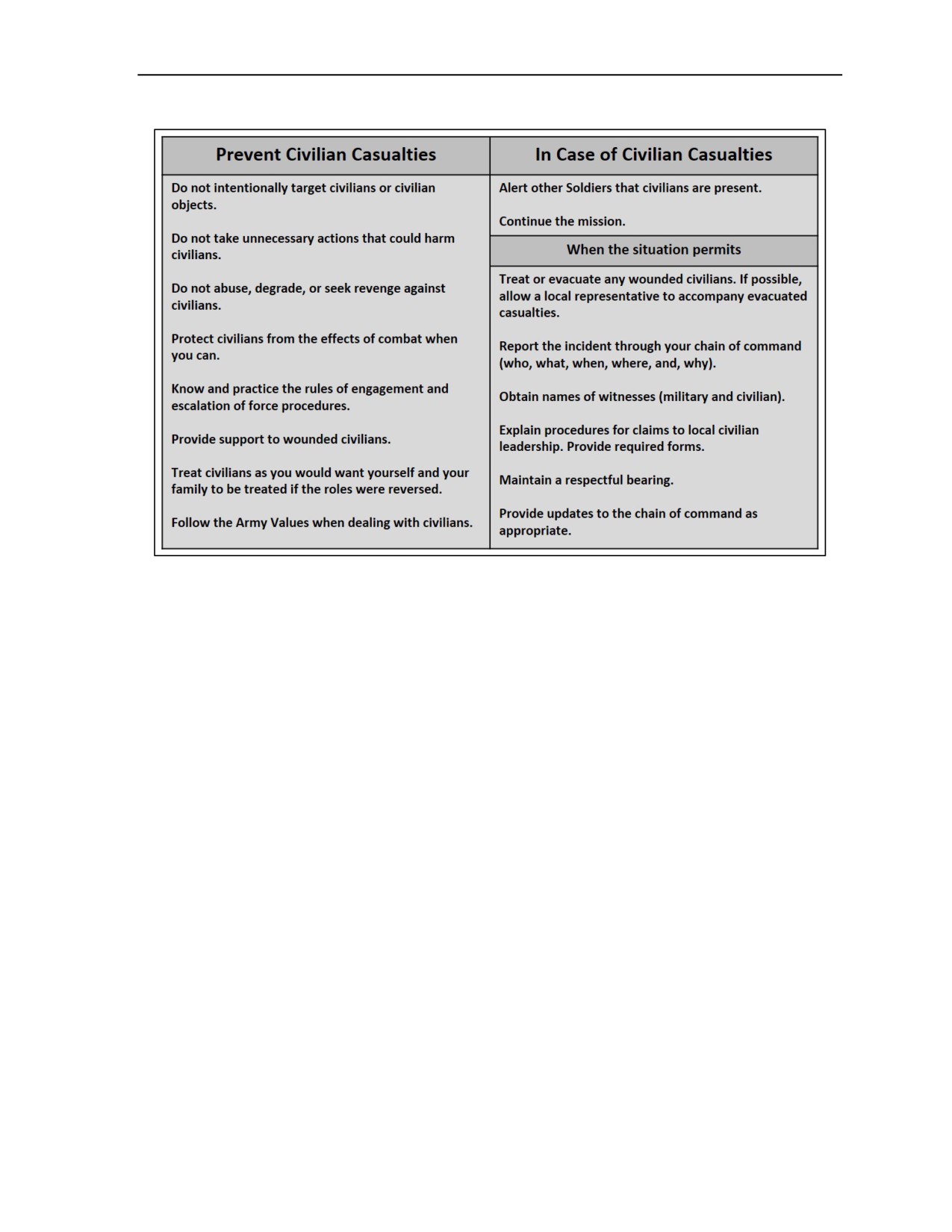
Protecting Civilians During Operations
Figure 3-1. Protection of civilians smart card
3-11. During training, units should practice the appropriate response procedures, such as inquiries or
investigations, making of amends, and key leader engagements. Units war-game potential situations,
develop unit standard operating procedures, and ensure that Soldiers understand the importance of civilian
protection and their own responsibilities. Units should also develop and train on response procedures when
civilians become victims. This includes potential civilian casualty situations or extreme cases where
genocides, mass atrocities, or crimes against humanity are committed by enemies.
Cultural Awareness
3-12. Effective pre-deployment cultural awareness training can help prevent disdainful perceptions of local
civilians. Negative attitudes, such as perceiving local civilians as inferior, must be avoided. Leader
emphasis on the importance of all human life and cultural respect will help reinforce desired attitudes.
Soldiers must not, for example, refer to civilians with disparaging slang terms. Cultural awareness training
should address issues such as the forms of violence anticipated in an area of operations (blood feuds,
sexual violence, ethnic conflict, or suicide attacks), the likelihood that civilians carry weapons, the form
and level of host-nation rule of law, and whether the host-nation government and security forces
deliberately target civilians. The training should also include local customs, particularly those that are
relevant for protection of civilians. For example, elders or religious leaders may play a key role in
mediating grievances, or women, especially mothers and grandmothers, could exert a strong but publicly
unseen influence over the behavior of males.
Command Post Organization
3-13. Unit commanders assign oversight of civilian protection issues to a staff section or to an integrating
functional cell. Depending on the circumstances, the operations section might provide oversight and
control during operations. The G-9/S-9 is the principle and coordinating staff officer to ensure the effective
integration of civil considerations into the planning cycle. The civil affairs section could also manage civil
information databases, the civil reconnaissance plan, or the making of amends. It may be appropriate to
establish a protection of civilians control element that meets periodically and includes representation from
29 October 2015
ATP 3-07.6
3-3
Chapter 3
the operations, intelligence, civil affairs, public information, legal, and fire support sections. The staff
proponent monitors the protection of civilians in coordination with other relevant staff sections, civil-
military operations centers, subordinate units, other commands, unified action partners, and other actors
including civilian or host-nation organizations. The protection of civilians control element may include
some full-time staff members who collect and analyze data, assist and monitor progress, assess mitigation
activities and incorporate lessons learned, monitor protection of civilians response actions, and respond
promptly to reports of civilian casualties and other incidents of civilian harm. Such a control element
should be established before deployment. Examples of its responsibilities include:
z
Monitoring all movements and engagements, possible incidents of civilian harm, reports,
inquiries or investigations, the synchronization of information-related capabilities, and making
of amends.
z
Collecting, maintaining, analyzing, and disseminating relevant data, including lessons learned.
z
Ensuring other staff members and subordinate units understand the importance of civilian
protection as well as their responsibilities for reporting, investigating, and taking action.
z
Providing frequent and accurate assessments to the commander and other key unit personnel.
z
Coordinating effectively with higher, lower, and adjacent units and other partners including the
host nation, U.S. government agencies, international organizations, and nongovernmental
organizations.
z
Specialized Training and Equipment
3-14. Pre-deployment preparations may also include acquisition of and training on specialized equipment
that can help reduce civilian casualties, such as signaling equipment and other nonlethal items. Some unit
personnel may receive specialized training to help with protection of civilians. For example, unit points of
contact should be identified for incidents involving civilian harm, and appropriate staff members can
become trained in reports, inquiries, or investigations, including interviews of victims. Units may train
Soldiers on tasks that support protection of civilians such as mentoring and advisory skills, first aid, or
medical evacuation. Selected Soldiers may be trained as designated marksmen so that small units have an
improved capability to engage targets with discrimination and precision.
Post-Deployment Preparations
3-15. After deploying to an area of operations, Army units make adjustments to their pre-deployment
preparations, set conditions in their areas, and prepare for specific missions. Post-deployment preparation
includes early engagements with local leaders to establish relationships, understand the population’s
perspective on threats and vulnerabilities, explain that Army units have good intentions, discuss procedures
for handling unfortunate incidents such as civilian harm, and convey any expectations Army units might
have of the local population. Engagements with other civilians, such as nongovernmental organizations,
may also be appropriate to develop mutual understanding and to reduce the risk of harm as a result of
Army operations or enemy actions. Leaders frequently emphasize the importance of civilian protection to
their subordinates. This can be particularly challenging if their units have suffered casualties, if it is
difficult to distinguish enemies from the general population, or if the population provides support to
enemies and adversaries.
Relationships with the Host Nation
3-16. Good personal relationships established in advance with respected host-nation leaders at all levels
can be critical in mitigating the effects of any civilian harm that occurs. Host-nation representatives may
include political, religious, or tribal leaders. In some situations, it may be appropriate for Army units to
expand contacts to include members of the business community, academia, women’s groups, minority
groups, or others. Host-nation leaders frequently will interact with Army units on a variety of issues, and
protection of civilians should be included in the dialogue when appropriate.
3-17. In some cases, protection of civilians concerns may be addressed before an actual incident. In their
engagements with community leaders, Soldiers emphasize the importance they assign to protecting
civilians, explain the rationale behind some military procedures, discuss ways to prevent incidents and
3-4
ATP 3-07.6
29 October 2015
Protecting Civilians During Operations
enable local leaders to report imminent civilian threats to Army units, and mutually develop procedures
should incidents of civilian harm occur.
3-18. It is also helpful to inform the population regarding measures they can take to minimize civilian
casualties and other incidents of civilian risk. In particular, if civilians are expected to behave in a certain
way when encountering Army units (pulling their vehicles over to the side of the road), this should be
clearly promulgated to the extent possible. Units should carefully consider whether any such expectations
are reasonable and support the overall mission. Depending on the situation, this may potentially be
accomplished by radio and television broadcasts, websites, leaflets, key leader engagements, or signs that
warn people to keep away or slow down. Some signs may be permanently installed at suitable locations;
others may be affixed to Army vehicles or be portable enough to be transported to temporary locations.
Signs should be in host-nation language(s) and a native speaker should verify the content. Keep in mind
that a large percentage of the population may be illiterate or very minimally educated. Therefore, it may be
more beneficial to provide portable speakers or other acoustic devices to communicate with civilians
verbally and at a distance. It is important to convince the population that the Army never intends to cause
deliberate harm to civilians.
3-19. Protection of civilians should also be addressed with any partnered host-nation security forces,
which develop their own procedures to protect civilians. This should be a recurring area of emphasis
during any security cooperation efforts. In many situations, host-nation security forces will ultimately
assume the lead for civil security, and their approaches to civilian protection could be decisive.
Consequently, the protection of civilians should be an integral part of the training and mentoring provided
to host-nation forces.
Mission Preparation
3-20. Protection of civilians should be a routine consideration as units prepare for specific missions. As
part of their planning and rehearsals, units should include civilian protection contingencies such as: unit
encounters with civilians, situations where civilians are being threatened or attacked, enemy contact in
populated areas, and procedures if casualties occur including incident reporting. Leader inspections verify
that units are equipped with items such as signs to inform the population and claims cards that can be
provided to civilians in the event of an incident. Leaders should continue to emphasize that civilians should
always be treated with respect and kindness. Interpreters are usually more effective with advance
preparation, and they should be instructed regarding possible situations such as encountering civilians,
directing civilians from danger, responding to civilian casualties, and engaging with host-nation leaders. In
some situations, interpreters may be able to provide helpful cultural advice as to how Soldiers should
address these situations.
3-21. Civilian protection preparations may include the procurement, distribution, and maintenance of
nonlethal equipment, including signaling items, items to disable individuals and equipment, and equipment
such as shields, batons, and faceguards that may be issued to Soldiers performing crowd control tasks.
Army units may require large quantities of barrier materials for bases and checkpoints to provide security
and standoff. Engineering support may need to assist with these efforts, and infrastructure repairs reduce
the risks to civilians. For example, road craters could be repaired which would remove a hazard to civilian
traffic and would also reduce the ability of adversaries to seed these craters with explosive devices. In
some cases, Army units may provide transportation, supplies, or other support for delivering humanitarian
assistance.
3-22. After they are well-established in an area of operations, Army units should be adaptive and conduct
other required preparations. This includes any necessary additional training, based on changing situations,
experiences (including those of other units), new equipment, or newly-assigned personnel or subordinate
organizations.
EXECUTION
3-23. The “execute” step addresses unified land operations that are conducted to protect vulnerable
civilians or to neutralize enemies that threaten them. It also applies to other operations with a potential
impact on civilian welfare. A key consideration is minimizing the possibility of civilian harm caused by
29 October 2015
ATP 3-07.6
3-5
Chapter 3
Army unit operations. Execution also includes actions taken after civilians have been harmed, whether as
collateral damage to Army operations or by the actions of other actors. These follow-up actions are
discussed further in Chapter 5.
ASSESSMENT
3-24. Assessments are conducted to compare the current situation with desired end state conditions.
Assessment of the protection of civilians begins with civil reconnaissance and includes monitoring,
evaluating, and recommending or directing action. Assessments are conducted to enhance the unit’s
understanding and to provide meaningful information to higher headquarters and other organizations.
3-25. A protection of civilians assessment has two purposes. The first is to understand an operational
environment and identify problems, capabilities, and gaps that need to be addressed in order to reduce
civilian risks. The second purpose is to evaluate the performance and effectiveness of Army units, and
other relevant actors, in their implementation of a civilian protection approach to determine if any changes
are required. Changes could include a revision of the civilian protection approach, modifications in the
employment of Army units, additional training or resources, or transition from one phase of an operation to
another.
3-26. Assessments should be conducted on the general situation, including the operational variables,
actors, and conflict dynamics described earlier. A general assessment additionally helps gauge progress
towards the protective environment described in Chapter 4. Assessments may also be conducted on
particular issues. For example, a unit may require an assessment of the policing capabilities in a small city
and gather information including the number of police, their organization, training, special capabilities
such as investigators and forensics, status of equipment such as vehicles and radios, and adequacy of such
administrative and logistical systems such as pay, schools, maintenance, and supplies. Information from
Army units may inform integrated assessments at higher political levels, and assessments may be
accomplished in conjunction with the host nation or other international actors.
3-27. Army units must learn and adapt quickly to protect civilians in complex environments. Lessons can
be obtained from near-miss situations as well as incidents in which civilians were actually harmed. Units
should collect and analyze information related to the protection of civilians, including intelligence and
inquiry or investigation reports, and disseminate insights to higher, lower, and adjacent organizations.
Useful information can also be obtained from nonmilitary actors, including the civilian population. This
learning process can be facilitated and made more rigorous with a staff section that has clear responsibility
for monitoring protection of civilians. However, as with most issues, leader emphasis is the critical
variable. See ADRP 5-0 for additional information on assessment.
WARFIGHTING FUNCTIONS AND THE PROTECTION OF
CIVILIANS
3-28. The following is a discussion of each of the Army’s six warfighting functions, mission command,
movement and maneuver, intelligence, fires, sustainment, and protection, and how they can be applied to
the protection of civilians during Army operations.
MISSION COMMAND
3-29. The commander is the central figure in mission command. Commanders provide subordinates with
their intent, the purpose of the operation, the key tasks, the desired end state, and resources. Mission
command is based on mutual trust and shared understanding and purpose. Shared understanding of the
importance of protection of civilians and the framework in this document will minimize incidents of
civilian harm.
3-30. The mission command warfighting function consists of the specific mission command warfighting
function tasks and the mission command system. The mission command warfighting function integrates the
other warfighting functions (movement and maneuver, intelligence, fires, sustainment, and protection) into
a coherent whole. It provides purpose and direction to the other warfighting functions. Commanders use
3-6
ATP 3-07.6
29 October 2015
Protecting Civilians During Operations
the mission command warfighting function to help achieve objectives and accomplish missions including
protecting civilians or minimizing harm to them.
3-31. Mission command includes command relationships, networks and other communications systems,
effective decision-making processes, leadership, comprehensive engagement with a variety of actors, and
synchronization of information-related capabilities. Mission command can be used to overcome issues
resulting when vague or multiple lines of authority exist. Effective mission command can contribute to
minimizing incidents of civilian harm, while deficient mission command can result in failure to protect
civilians adequately. Protection of civilians must be emphasized within command channels and when
leaders engage with other actors. A responsive mission command system is critical to provide useful
guidance when unforeseen civilian protection issues develop. In the absence of such guidance or the
necessary time to obtain it, leaders must exercise the initiative required to address civilian vulnerabilities
and threats.
3-32. Leadership is often the most important variable with respect to protection of civilians. Leaders
emphasize the importance of minimizing civilian harm to their subordinates and make it clear that
protection of civilians is a priority. Army leaders should also be mindful of this factor as it applies to host-
nation and international partners. Confronted with a complex or ambiguous situation, leaders can either act
decisively or remain passive. When protection of civilians is the issue, a commander should intend for their
subordinate leaders to take the necessary actions to protect civilians.
MOVEMENT AND MANEUVER
3-33. Patrolling is one of the most important tasks Army units perform to support protection of civilians. It
is necessary to understand the situation, secure and reassure the population, and deter or defeat enemies
that threaten civilians. Patrols may be conducted specifically to protect civilians or conducted primarily for
other objectives, with civilian protection as a secondary effect. For example, patrols may be conducted so
that women in villages may safely gather firewood or obtain water. Conversely, patrols for any purpose can
also protect civilians, as long as patrol members understand these expectations and conduct the patrols
accordingly. Patrols should proactively ask questions to assess threats to the population; they may be
approached by civilians with protection concerns, such as abducted women or children who have escaped
their captors and who are seeking assistance.
3-34. In addition to patrols, Army units establish outposts that can include fixed sites such as checkpoints,
guard posts, and observation posts to help provide security at critical locations or over a large area. These
outposts may be temporary (i.e., operational for a few hours) or relatively permanent in nature, and they
usually are austere. They are normally manned with a small force (squad or platoon) that may reside at the
site or be rotated during their daily shifts. Outposts, like patrols, help Army units establish a presence over
a large area. They provide surveillance, control activity at key areas, and monitor vulnerable populations as
well as potential perpetrators. Outposts are an important method to reassure the population and support
engagement with local civilians.
3-35. Cordon and search operations may be conducted to locate perpetrators of violence against civilians,
evidence of such actions, criminals who are attempting to escape justice, or vulnerable civilians who need
assistance. These operations are often conducted for other purposes, yet they impact protection of civilians.
Army units should refrain from causing inadvertent civilian harm during cordon and search operations.
Accurate intelligence is required for successful cordon and search operations, which in turn can provide
additional information that should be acted upon as rapidly as possible. Units will have to protect sources
as well as civilians who cooperate with units during these operations. These operations may be more
effective if host-nation security forces play a prominent role. However, such integration could undermine
operations security and can be counterproductive if these forces do not respect human rights. Operations
should be conducted in a manner that does not reduce the population’s support or result in civilian harm.
Neutralization of Threats
3-36. Army units conduct offensive and defensive tasks to disrupt, defeat, or destroy enemies who threaten
civilians. Combat operations may be necessary to gain the initiative against threats. By demonstrating that
29 October 2015
ATP 3-07.6
3-7
Chapter 3
it has both the will and the capability to defeat enemies, an Army unit establishes the credibility required to
deter future aggressive behavior by the threats.
3-37. Combat operations should be carefully planned and conducted to avoid civilian harm, including
collateral damage. Civilians could be located with or near intended targets, and in accordance with the
principle of proportionality their potential harm must be balanced against the military necessity of
conducting an operation. In some cases, these civilians may be present against their will, and provisions
may also be required for the possibility that enemy forces include child soldiers who should be protected as
much as possible. Commanders should integrate nonlethal means, such as electronic warfare and
synchronizing information-related capabilities, in their efforts to neutralize or defeat their enemies.
3-38. Combat operations, especially those that occur outside of strictly self-defense situations, could result
in unintended escalation and additional civilian harm. Even if combat operations are largely successful,
enemies could elect to retaliate against vulnerable civilians if Army units do not have the resources to
secure the entire area of operations. Positioning Army units close to civilians may be intended to protect
them, but could also make civilians vulnerable to collateral damage if the military assets are attacked. See
FM 3-90-1 for more information on offensive and defensive tasks.
Security Operations
3-39. Army units may screen, guard, or cover vulnerable civilians from enemies that potentially threaten
them. Army units can also protect civilians with area security and local security operations. Security
operations can be conducted during armed conflict or after a cease-fire has been arranged. These
operations will not necessarily protect vulnerable civilians that are outside Army units’ areas of operations.
See FM 3-90-2 for more information on security operations.
INTELLIGENCE
3-40. Effective intelligence is critical to support protection of civilians by providing the commander and
staff a full appreciation of the civilian vulnerabilities and threats in an operational environment. For more
on intelligence, see ADRP 2-0, ATP 2-01.3, and Chapter 2.
FIRES
3-41. Fire support is significant to protection of civilians for five reasons. First, fires can suppress,
neutralize, defeat, or destroy enemies who have attacked or threaten to attack civilians. Second, fire
support assets (including radars and defensive systems such as air defenses) can be deployed to protect
civilians. Third, the employment of fire support should avoid causing collateral damage. Fourth, the
deployment and employment of fire support assets should not place civilians in proximity at risk because
of enemy action. Finally, unexploded munitions can pose a hazard to civilians. When feasible, they should
be identified and disposed of as soon as possible.
3-42. In many cases, the use of fires to support protection of civilians will be restricted because of rules of
engagement (ROE), a lack of assets, or concern over collateral damage. In other situations, there will be a
heavy reliance on the employment of fires because enemies are easily targeted and because some fires,
such as airstrikes, can be delivered from great distances. The principles of the law of war govern the use of
fires (military necessity, distinction, proportionality, and humanity). The primary challenge is the provision
of accurate and timely fire support while avoiding undesired lethal effects upon civilians, friendly forces,
other partners, or infrastructure. Positive identification, target location error (TLE), and the clearance of
fires are three technical fire support considerations that are particularly important for the protection of
civilians.
SUSTAINMENT
3-43. Sustainment affects all military activities and will seldom be specifically related to the protection of
civilians. However, inadequate sustainment could critically impair the ability of Army units to provide
protection of civilians. Unified land operations require extensive logistical support, which could strain
3-8
ATP 3-07.6
29 October 2015
Protecting Civilians During Operations
limited infrastructure used by other actors such as nongovernmental organizations, drive up wages and
prices, and reduce the availability of already scarce resources. This can indirectly have a negative impact
on civilian welfare. In some emergency situations, Army logistical resources may be used to support other
actors or to provide essential goods and services to needy civilians, many of whom may seek security and
support from Army units. Protection of civilians may impose other unique sustainment requirements, such
as security lighting for large numbers of dislocated civilians.
3-44. Infrastructure improvements, such as airfields and roads, can expand operational reach while
improving access to vulnerable civilians. Medical personnel should consider appropriate screening
measures for Soldiers from foreign countries who may carry diseases that could threaten civilians. Some
partners may not follow sound environmental protection methods, which can further harm civilians. Units
should be careful to avoid unnecessary environmental pollution by properly disposing of human waste,
trash, and used petroleum products.
3-45. Some unified action partners, such as host-nation security forces, may lack adequate sustainment
capabilities. If their personnel are not paid or supplied properly, they may prey upon the population. Army
security cooperation activities that improve sustainment functions in these partners can indirectly support
the protection of civilians.
PROTECTION
3-46. Effective force protection helps preserve the capability to achieve mission objectives, including
protection of civilians. However, concern about force protection may result in a cautious posture that
ultimately reduces operational effectiveness and inhibits protection of civilians. Additionally, Soldiers who
focus on force protection may be prone to adopt a “shoot first and ask questions later” approach that
jeopardizes civilians.
3-47. Conflict and other disasters result in a large number of dislocated civilians who need security and
other essentials such as food, water, shelter, and medical care. When they leave their homes and
communities, civilians become more vulnerable to malnutrition, disease, exposure to harsh climates, crimes
including sexual violence, and other afflictions. In addition, they may still be subject to the effects of
armed conflict. Large numbers of civilians may seek protection from Army units, resulting in spontaneous
camps adjacent to military bases and outposts. Assistance for dislocated civilians is normally managed by
civilian organizations such as humanitarian relief agencies from nongovernmental organizations or
intergovernmental organizations. Army units will usually be concerned with the security of the areas
surrounding dislocated civilians, particularly camps and any routes that might be travelled by civilians and
relief agencies. Units may be responsible for local security immediately outside of the camps’ perimeters.
More information on the protection and handling of dislocated civilians and dislocated civilian camps can
be found in ATP 3-57.10.
3-48. Public unrest can threaten other civilians and their property, with increased chances of civilian harm
as individuals attempt to protect themselves and their belongings. Public unrest can be manipulated to
result in the targeting of vulnerable population groups, especially minorities. In addition, civilians could be
at risk from actions of host nation security forces, especially overreaction with disproportionate means by
poorly trained and ill-disciplined units. Army units may perform different tasks to mitigate public unrest,
including crowd control or the protection of facilities. These tasks are normally performed to support
police forces or host-nation military units. See ATP 3-39.33 for more information on civil disturbances.
3-49. Army units may need to evacuate civilians from conflict areas or from other situations in which they
are at risk. The evacuation could be for a temporary or extended time period. The evacuees could include
all civilians in the area or members of a particular group (such as humanitarian workers, third-country
nationals, or members of an ethnic group). An operation may entail ground evacuation to a safe haven
several kilometers away, or it may be a complex endeavor using multiple modes of transportation to more
remote locations. While possibly removing civilians from an immediate threat, an evacuation can result in
large numbers of dislocated civilians with subsequent humanitarian and resettlement challenges. Civilians
could be vulnerable as they leave their homes and travel to a safe area. An evacuation may indirectly
support enemy goals, if these include ethnic cleansing. See JP 3-68 for more information on noncombatant
evacuation operations.
29 October 2015
ATP 3-07.6
3-9
This page intentionally left blank.
Chapter 4
Shaping a Protective Environment
It is important to establish an environment in which civilians are protected over the
long term. This requires a comprehensive approach that includes other actors who are
better suited to set the necessary conditions. Effective synchronization of
information-related capabilities is also critical. It is important for Army units to help
establish a safe and secure environment that protects civilians from threats of
violence. However, this security usually cannot be sustained over long periods
without the attainment of four other desired outcomes including good governance,
rule of law, social well-being, and a sustainable economy. Army units perform
essential stability tasks to support other actors with the capability, responsibility, and
authority to achieve these outcomes. All of these outcomes directly relate to civilian
vulnerabilities. Particular attention must be devoted to the protection of vulnerable
groups such as women, children, and minorities.
COMPREHENSIVE APPROACH
4-1. Effective protection of civilians requires coordination with other actors, engagements with host
nation leaders and the population, multinational operations, and security cooperation that improves the
capabilities of host-nation security forces.
COORDINATION WITH UNIFIED ACTION PARTNERS
4-2. A range of other actors have a role in the protection of civilians including host-nation security forces,
governmental agencies, local leaders, multinational partners, intergovernmental and international
organizations, U.S. government agencies, nongovernmental organizations, the private sector, and the
media. However, these actors will often have dissimilar goals, protection priorities, and authorities. To the
extent possible, coordination with these actors is essential to achieve an integrated approach to protection
of civilians, avoid gaps and redundancies, and resolve disagreements.
4-3. Army leaders should determine what level of cooperation is possible and desirable with other actors.
This determination is largely shaped by higher level guidance, will change over time, and will depend on
how the other actors view the desirability of a cooperative relationship. The overall operational-level
determination may differ from that at local levels in certain areas. Potential areas for coordination may
include information-sharing regarding civilian risks and needs, humanitarian assistance, planned
operations, requests for assistance, transitions, and security concerns. Eventually, it will be important for
host-nation actors to assume control over protecting civilians, maintaining security, and achieving other
desired outcomes including good governance, the rule of law, social well-being, and a sustainable
economy. This can be problematic when host-nation actors, who are to be entrusted with the future, may be
the same actors who perpetrated abuses against civilians in the past. Many nongovernmental organizations
and other important actors will attempt to preserve their neutrality and avoid the appearance of
collaborating with political and military entities such as Army units or the host-nation government.
Consequently, great care must be taken in safeguarding the information provided by these individuals,
organizations, and agencies.
4-4. Civilian casualty mitigation can be enhanced when Army units work with other actors. Although
many of these actors may be reluctant to cooperate closely with Army units, they may nevertheless be
willing to exchange information related to civilian casualty incidents and their prevention, and may support
29 October 2015
ATP 3-07.6
4-1
Chapter 4
mitigation efforts. If these actors share some level of agreement with Army units, such as the importance of
preventing civilian casualties, a degree of cooperation may be achievable. Army commanders will need
diplomatic skills to influence some of these actors and achieve unity of effort. See JP 3-08 for more
information on interorganizational coordination.
KEY LEADER AND POPULATION ENGAGEMENTS
4-5. Engagements with key leaders and the population are important ways to coordinate with other actors
and to support the protection of civilians. Specific engagements can have a variety of purposes such as to
foster relationships, clarify intentions, establish desired conditions to support future efforts, convey
messages (including promises, threats, condolences, or apologies), or address problems. Engagement is
critical to gain a mutual understanding of civilian risks such as conflict-related sexual violence, to explain
how Army units protect civilians while achieving their other objectives, and to obtain the cooperation
needed from other actors to support protection of civilians. Engagements with adversaries may at times be
appropriate to reduce civilian risks. Army units will occasionally have to engage actors who are
competitors with each other and leaders must be careful about losing their impartiality or being
manipulated by an actor for ulterior motivations. Additionally, some of the actors may be perpetrators or
otherwise have questionable legitimacy. Army units should be careful not to overlook or marginalize
important groups such as women or minorities so that their concerns are understood and addressed. If
possible, engagements should be coordinated with those of other unified action partners to avoid sending
contradictory messages. See FM 3-13 for more information on engagements with key leaders and the
population.
MULTINATIONAL OPERATIONS
4-6. Multinational operations are those in which Army units are teamed with other international and host-
nation actors. These organizations may include civilian or police agencies that integrate their expertise with
Army units. Multinational operations support the objectives of the participating organizations and can
facilitate monitoring, assessments, and the operational effectiveness of the contributing actors. They are
particularly important to obtain host nation involvement in and ownership of civilian protection efforts,
since the host nation retains its obligation to protect civilians and eventually must be capable of doing so.
Additionally, multinational operations expand mutual situational understanding and can improve the
effectiveness of the participants and enhance their relationships with each other. See FM 3-16 for more
information on multinational operations.
SECURITY COOPERATION
4-7. Security cooperation activities support and enable partners and other supporters so that these
contributors can better protect civilians. Ultimately, the host nation must have the capacity to ensure a safe
and secure environment in which civilians are protected and must likewise develop the capacity to maintain
acceptable conditions related to good governance, the rule of law, social well-being, and a sustainable
economy. One of the most significant security cooperation efforts related to protection of civilians is the
improvement of host-nation policing and, when authorized, Army units may be able to contribute to this
and other security efforts. See FM 3-22 for more information on security cooperation.
CIVIL-MILITARY OPERATIONS CENTER
4-8. A civil-military operations center
(CMOC) supports the protection of civilians by facilitating
information sharing and coordination between Army units and other actors, including the host-nation
population and institutions such as police forces. As described in Chapter 2, information sharing will
always be done in accordance with National Disclosure Policies. Units must consult with their foreign
disclosure officer before releasing information outside of the Department of Defense. In the case of a
CMOC, a formal information sharing agreement may already be in place to facilitate the rapid exchange of
information. The unit’s foreign disclosure officer can assist CMOC members in understanding the
requirements. Different echelons may establish their own CMOCs. Supporting Civil Affairs elements,
company and above, possess a standing CMOC capability. A CMOC provides the unit a proponent agency
4-2
ATP 3-07.6
29 October 2015
Shaping a Protective Environment
to improve understanding and facilitate remedial action regarding civilian vulnerabilities and threats. See
FM 3-57 for more information on CMOCs.
SYNCHRONIZATION OF INFORMATION-RELATED CAPABILITIES
4-9. Army units conduct informational efforts to promulgate messages, inform audiences, and influence
perceptions regarding the situation and particularly the objectives and actions of Army units. These efforts
can dissuade enemies who target civilians, influence other actors to support civilian protection efforts,
inform vulnerable populations, and increase support for Army units as legitimate protectors of civilians.
Synchronization of information-related capabilities is also essential to manage expectations and to mitigate
the effects of incidents that result in civilian harm. The synchronization of information-related capabilities
is an important part of civilian casualty mitigation. As discussed in chapter 5, this can help reduce the
likelihood of civilian casualties, mitigate the damage should they occur, and address associated rumors that
may be circulating among the population. Examples of enduring messages could include:
z
Army units and their partners are committed to the protection of civilians.
z
The international community, as well as responsible host-nation actors, supports the mission and
the protection of civilians.
z
Enemies that deliberately attack civilians or internationally sanctioned peacekeepers are
committing war crimes or crimes against humanity and will be held accountable.
z
It is important to establish a safe and secure environment that does not foster conflict-related
sexual violence, threats to children, or other threats to civilians. Army units and their host-nation
partners will not tolerate such acts.
4-10. See FM 3-13 and JP 3-13 for additional information.
4-11. Messages should foster realistic expectations regarding the scope, actions, and success of Army units
and other actors that strive to protect civilians. This will help reduce audience frustrations that can develop
over time and consequently undermine the mission’s credibility. Army units should not encourage any
perception that they can protect all civilians at all times, even when protection of civilians is their highest
priority. While it is important for Army leaders to gain host nation support, they must be careful not to
exaggerate the collective ability to make quick and significant improvement in a country crippled by armed
conflict or that is in an otherwise fragile state.
STABILITY TASKS
4-12. For civilian protection to be more than a temporary condition, five desired outcomes are required.
These include a safe and secure environment, good governance, rule of law, social well-being, and a
sustainable economy. These outcomes affect civilian welfare and reduce grievances that can result in
conflict which threatens civilians. Of these, Army units will focus on establishing and maintaining a safe
and secure environment in order to protect civilians and enable other host-nation and international actors to
operate effectively.
4-13. Army units shape a protective environment by accomplishing the primary stability tasks:
z
Establish civil security.
z
Establish civil control.
z
Restore essential services.
z
Support to governance.
z
Support to economic and infrastructure development.
4-14. Efforts such as security sector reform; disarmament, demobilization, and reintegration; transitional
justice; community building; and humanitarian assistance are particularly critical for ensuring the
protection of civilians. Transitions can result in high-risk situations for civilians if they are poorly
managed. While other actors will normally have responsibility for these programs and activities, Army
units may perform an important supporting role. See ADP 3-07, ADRP 3-07, FM 3-07, and ATP 3-07.5 for
more information on stability tasks. See JP 3-29 for more information on humanitarian assistance.
29 October 2015
ATP 3-07.6
4-3
Chapter 4
ENSURING PROTECTION OF VULNERABLE GROUPS
4-15. Army units should know the risks facing particularly vulnerable groups. Depending upon the
situation, religious, tribal, ethnic, or other groups may be deliberately targeted or marginalized. Women,
children, the elderly, and infirm are often at risk during conflict situations.
PROTECTION OF WOMEN
4-16. Women and girls are frequently victims in conflict and unstable environments. Executive Order
13595, which promulgated the United States government’s National Action Plan on Women, Peace, and
Security
(Executive Order
13595), directed that the plan be implemented throughout the federal
government. The Department of Defense subsequently created an implementation guide to support the
National Action Plan and instructed that the National Action Plan’s objectives be incorporated into relevant
documents.
4-17. When appropriate, Army protection of civilian efforts should integrate the following five objectives
from the National Action Plan on Women, Peace, and Security:
z
National integration and institutionalization. Army units contribute to gender-responsive policies
in conflict-affected environments and support the integration of women into host-nation
positions of responsibility.
z
Participation in peace processes and decision-making. Army units support prospects for
inclusive, just, and sustainable peace by promoting and strengthening women’s rights and
effective leadership and substantive participation in peace processes, conflict prevention, peace
building, transitional processes, and decision-making institutions in conflict-affected
environments.
z
Protection from violence. Army units protect women and children from harm, exploitation,
discrimination and abuse, including sexual and gender-based violence and trafficking in
persons, and hold perpetrators accountable in conflict-affected environments.
z
Conflict prevention. Army units support the promotion of women’s roles in conflict prevention,
improve conflict early-warning and response systems through the integration of gender
perspectives, and assist efforts to invest in women and girls’ health, education, and economic
opportunity to create conditions for stable societies and lasting peace.
z
Access to relief and recovery: Army units support the distinct needs of women and children in
conflict-affected disasters and crises. This includes ensuring safe, equitable access to
humanitarian assistance.
Conflict-Related Sexual Violence
4-18. Conflict-related sexual violence refers to violent acts of a sexual nature, including rape, sexual
slavery, enforced prostitution, forced pregnancy, enforced sterilization, mutilation, indecent assault, human
trafficking, inappropriate medical examinations, and strip searches. Conflict-related sexual violence often
occurs when undisciplined militaries, police forces, or other armed groups believe that they can act with
impunity against vulnerable populations, especially women and girls. Army units, in conjunction with
other actors, must ensure that sexual violence is addressed as a major area of focus and is routinely
incorporated into their civilian protection efforts.
4-19. Conflict-related sexual violence frequently occurs during and after armed conflict and is common in
fragile states. It is impossible to obtain a safe and secure environment with adequate protection of civilians
if conflict-related sexual violence is a widespread problem. Sexual violence is often a component of
genocide, mass atrocities, and crimes against humanity and may occur as part of a deliberate and
systematic campaign to target a victim group (for example, to destroy families and communities or to
support ethnic cleansing from an area). It may also occur in a more decentralized fashion due to a general
lack of security and stability. Sexual violence is a crime and should not be dismissed simply as a social
problem; however, conflict-related sexual violence is a problem that persons in authority too easily
overlook. While conflict-related sexual violence is often assumed to be directed against women and girls,
conflict-related sexual violence also includes assaults against men and boys. The mere threat of conflict-
4-4
ATP 3-07.6
29 October 2015
Shaping a Protective Environment
related sexual violence also has an adverse effect, as potential victims may avoid necessary activities such
as traveling, working, farming, obtaining water, or collecting firewood if they are vulnerable when doing
so.
4-20. Sexual violence results in long-term physical and psychological harm to the victims themselves and
may cause disrupted families, unwanted pregnancies, infant mortality and deaths from childbirth, and the
spread of sexually transmitted diseases. It can break down the society and social networks for victims,
which contributes further to gender inequality and poverty. Women may be more vulnerable to conflict-
related sexual violence in traditional societies, even if the culture tends to shelter them, because of stigmas
that are attached to victims. Widows may have additional vulnerabilities if they have no means of earning
wages, and mothers or other guardians must also see to the needs of children as well as their own. Women
often remain silent about conflict-related sexual violence because they fear retribution or being ostracized,
or because they are not permitted to have a public voice.
4-21. Other actors have a larger role than does the military in mitigating conflict-related sexual violence.
These include police forces, advocacy groups, and specialists in international organizations. The rule of
law is important in criminalizing sexual violence, regardless of the perpetrator. Army units can support
conflict-related sexual violence reduction in critical ways and must be perceived as a decisively positive
force in combating it. In insecure environments in which social services are absent, Army units may often
be the first responders to conflict-related sexual violence incidents. Soldiers and leaders must be prepared
to take appropriate action in such situations. When perpetrated by military personnel, sexual violence
undermines the mission’s legitimacy and has adverse effects on military unit cohesion and discipline.
4-22. Army units should view conflict-related sexual violence elimination as an important and distinct
task, but conflict-related sexual violence must also be incorporated in other efforts. For example, units
must include conflict-related sexual violence as a focus area when attempting to understand an operational
environment. Gender issues should also be incorporated in the pursuit of the desired outcomes and while
executing the primary stability tasks. Regardless of their primary intended purpose, patrols and other
operations should reduce vulnerabilities and threats related to conflict-related sexual violence. Units should
be alert for conflict-related sexual violence indicators such as changes in mobility patterns, anti-women
propaganda, and the absence of girls from schools. Army units should address conflict-related sexual
violence when engaging security forces, women (who can be too easily marginalized in some societies),
local leaders, and other actors.
4-23. Leaders must emphasize the importance of eliminating conflict-related sexual violence, as well as its
significance to the mission, and ensure that Soldiers receive adequate training. This may include scenario-
based training and the inclusion of conflict-related sexual violence incidents in exercises. Training should
be tailored to local and cultural circumstances and address both the standards of conduct expected of
Soldiers and how to respond to conflict-related sexual violence incidents that occur (such as medical
treatment for victims, conduct of inquiries or investigations, and detention of perpetrators). Leaders should
consider the use of female teams to interact with women in the population, and members of these teams
may require their own specialized training in cultural awareness and how to handle victims of sexual
violence. Units will require reliable interpreters, and some of these should be women. Army units may also
identify and liaise with local women’s organizations that can advise them on the local culture and services
available.
4-24. Some operations may be specifically intended to reduce conflict-related sexual violence. For
example, security patrols may be scheduled to protect women as they conduct their regular activities such
as gathering firewood, obtaining water, travelling to markets, or taking children to school. During other
operations, such as routine patrols and checkpoints, units should be alert for indicators of conflict-related
sexual violence such as the tendency for women to hide, large numbers of displaced women, and
statements from witnesses. Interviews with potential victims can help identify incidents and chronic
perpetrators, but these should be conducted discretely to prevent retaliation against those who provide
information. Units should be prepared to intervene and halt acts of sexual violence when they encounter
them and, depending upon their guidance, detain perpetrators. As early as possible, these operations should
be conducted jointly with host-nation security forces, including police. Preventive measures can also
29 October 2015
ATP 3-07.6
4-5
Chapter 4
reduce the necessity for women to place themselves at risk. For example stockpiling wood in villages or
providing water tanks that are regularly replenished can help keep women secure.
4-25. In many cases conflict-related sexual violence will require responsive actions such as medical
treatment for victims, inquiry or investigation, accountability of perpetrators, and remediation. While these
measures will largely be beyond the expertise of Army units, they can nonetheless identify requirements,
enable other actors with the necessary capabilities, and exert pressure to address these issues. As the
victims’ social networks will likely be destroyed, it may be necessary to establish one-stop centers that
provide medical care, psychological counseling, and access to police investigators, legal assistance, and
essential services. Transitional justice efforts must account for survivors of conflict-related sexual violence
and ensure they have access to health, education, property rights, justice, and compensation. Host-nation
justice and medical structures must work to support victims, rather than make their situations worse. A
responsive and trained judiciary, perhaps through the use of mobile courts and enhanced with witness
protection programs, will help end a culture of impunity. International teams of experts may be necessary
to monitor, advise, and report the deficiencies of host-nation institutions that have a role in conflict-related
sexual violence mitigation. Collaboration with nongovernmental organizations and civil society can help
the international teams perform these functions.
4-26. Conflict-related sexual violence should be emphasized as a prominent theme while synchronizing
information-related capabilities and during engagements with key host-nation leaders and other partners.
Commanders should ensure that conflict-related sexual violence receives appropriate emphasis, and host-
nation authorities should be aware that this is an important standard by which they are judged. Leaders
should solicit women’s views regarding conflict-related sexual violence and, if they do not already exist, it
may be possible to facilitate the creation of women’s groups to provide insight on conflict-related sexual
violence and other issues. Women’s groups, nongovernmental organizations, the media, and civil society
organizations can increase awareness, generate the communal interest to eliminate conflict-related sexual
violence, conduct local activities, implement and strengthen local norms in accordance with international
standards, share information, form multinational partnerships, and advocate to generate political pressure to
eliminate conflict-related sexual violence.
Sexual Exploitation
4-27. Prevention of sexual exploitation and abuse refers to the responsibility to respect the physical and
sexual integrity of beneficiaries receiving assistance and protection. Sexual exploitation and abuse includes
two distinct problems: 1) sexual exploitation, which includes any actual or attempted abuse of a position of
vulnerability, differential power, or trust, for sexual purposes, including, but not limited to, profiting
monetarily, socially or politically from the sexual exploitation of another, and 2) sexual abuse, which
includes the actual or threatened physical intrusion of a sexual nature, whether by force or under unequal
or coercive conditions. International organizations have codes of conduct that further specify what is
considered serious misconduct and grounds for disciplinary measures. When Soldiers or aid workers
exploit the local population, they can erode trust in the purpose of the mission and seriously undermine the
legitimacy of operations.
4-28. Army leaders must be alert to sexual exploitation and abuse incidents that may be conducted by
persons in authority, including Soldiers in the unit or police and civilians associated with the mission. It
may also be perpetrated by partners such as host-nation security forces, members of organizations or
institutions that are intended to assist civilians, and other authorities who believe they will not be held
accountable in a surrounding culture of impunity. Such actions constitute criminal behavior, undermine the
legitimacy of the mission, and generate hostility among the population. Training and education, leader
emphasis, clearly articulated policies, quick and thorough inquiries or investigations of reported sexual
exploitation and abuse, and disciplinary measures, when appropriate, can reduce these actions. Sexual
exploitation and abuse prevention requires command emphasis, and every Soldier must have a basic
understanding of the issue. It cannot simply be mentioned as one of many topics during pre-deployment
training and subsequently ignored. Leaders must ensure that their own actions, policies, and statements do
not implicitly condone sexual exploitation and abuse or related problems such as human trafficking.
4-6
ATP 3-07.6
29 October 2015
Shaping a Protective Environment
4-29. Host-nation education programs will be vital to shape attitudes, stress the importance of eliminating
conflict-related sexual violence, and counter myths such as victims are to blame or that conflict-related
sexual violence is anything but a serious crime. Army leaders should encourage the inclusion of women in
community meetings and in sectors such as politics, economics, and security. Perhaps more importantly,
they should encourage such gender perspectives in the host nation. Positive role models can be highlighted
and Army leaders should not be perceived as condoning negative behavior either through their statements
or by failing to take action when conflict-related sexual violence or sexual exploitation and abuse occurs.
Women constitute half of the adult population, and their active participation is essential for development
and reconciliation. Notwithstanding local cultural restrictions that may exist, in many traditional societies
women, particularly mothers, often exert a decisive influence on the perceptions and actions of males, even
if this largely occurs in the home.
4-30. In addition to any operational difficulties associated with stopping perpetrators of conflict-related
sexual violence, Army units are likely to encounter three major challenges. First, leaders must ensure that
their own Soldiers are disciplined and that unit climates preclude conflict-related sexual violence and
sexual exploitation and abuse. Discipline is potentially a challenge with partnered host-nation security
forces as well. Second, the host nation’s culture may include traditions that discriminate against women
and in effect condone sexual violence. Cultural norms may also discourage women and men from reporting
sexual violence, thus complicating an Army unit’s ability to obtain accurate situational understanding.
Finally, a culture of impunity may exist in which important partners are in fact egregious sexual predators.
PROTECTION OF CHILDREN
4-31. Children are particularly vulnerable to armed conflict due to their greater needs for care, their
dependence upon others to provide that care, and their greater vulnerabilities. They suffer from the impact
of dislocation and disruption to their normal lives. Children are exposed to a variety of threats including
malnutrition, disease, psychological harm, separation from or loss of their families, physical attack,
unexploded ordnance, sexual abuse, child pornography, abduction, and forcible conscription as slaves,
laborers, child-soldiers, or auxiliaries such as lookouts, smugglers, suicide bombers, or messengers. Girls
are especially marginalized in some societies and may even be sold into bondage by their families.
4-32. Child protection prevents children from becoming victims of violence, exploitation, neglect, and
abuse and allows them to grow into healthy and productive adults. Army units, in conjunction with other
actors, address child protection both as a major focus of protection of civilians and within many of the
other efforts discussed in this manual. While the protection of children is a distinct task, it should also be
integrated into other tasks that relate to situational understanding, operations, and environmental shaping.
Army units primarily have a supporting role, as other actors are better able to provide for the unique needs
of children. Units may modify their methods and objectives if they know that an adversary’s forces include
child-soldiers.
4-33. It is generally best for children to remain with their immediate or extended families. This is not
always possible, however, and children may end up in foster homes, orphanages, in gangs, or wandering
alone or in small groups. While many orphanages are reputable and do their best to care for the resident
children, others have squalid conditions in which children do not receive adequate care and are subjected to
exploitation and abuse. Establishing or restoring schools should be an early priority to care for and develop
children while establishing a normal environment for communities.
4-34. Child welfare should be consciously incorporated within the desired outcomes and primary stability
tasks discussed earlier. In addition to improving the current environment, it will be an important investment
that will pay dividends as children become adults, often within the timeframe of a mission. It is particularly
important to develop institutional capabilities to work with children, such as training police officers who
specialize in incidents involving juveniles. While Army units will have limited ability to affect these
outcomes directly, they can support and enable the creation of effective institutions such as schools,
orphanages, juvenile justice systems, recreation opportunities, and medical care. The primary means is by
achieving and ensuring a secure environment in which host-nation actors, nongovernmental organizations,
and international organizations such as the United Nations Children’s Fund (UNICEF) can operate. Army
units can also identify and report needs, monitor progress, and emphasize the importance of child
29 October 2015
ATP 3-07.6
4-7
Chapter 4
protection with host-nation counterparts. Civil-military task forces may be established to care for and
reintegrate abandoned or abducted children and child-soldiers.
4-35. Leaders emphasize the importance of child protection, and Soldiers should be trained regarding
expected standards of behavior and the situations they are likely to encounter. For example, child-soldiers
that are captured must be separated from other combatants and given the necessary physical and
psychological support to be reintegrated into society. Unit plans and operations may account for the
likelihood that child-soldiers will be encountered, but the practical impact on tactical operations may be
limited due to the difficulty in determining whether or not an armed and deadly enemy is a child.
4-36. Army units may conduct missions that are specifically related to child protection, such as securing
schools or clearing unexploded ordnance. Other operations, such as routine patrols, can also support the
protection of children by being alert for indicators that child protection is deficient. These may include the
prevalent behavior of children, the presence of abandoned children or abducted children who have escaped
their captors, and information obtained from interviews. Units should be alert for child abuse in institutions
such as orphanages and hospitals. Interacting with and interviewing patients and orphans can mitigate this
while caretakers are not present. In addition to creating the secure space for child specialists to work, units
can respond to identified problems by coordinating for necessary civilian support, if reasonably available.
Ultimately, child abuse should be addressed as a criminal matter by legal systems that are capable of
handling such incidents.
4-37. Children require protection against disease and from stronger competitors for food and other
essentials. Especially in situations involving large numbers of dislocated civilians, it will be difficult to find
the capacity necessary to adequately care for children who have been separated from their families.
Traumatized children, in particular, will require supportive resources that will undoubtedly be lacking.
Basic human needs such as food and water may be an urgent priority, and the provision of other
requirements, such as schools for children, may be delayed.
OTHER VULNERABLE GROUPS
4-38. A protective environment should safeguard other groups that may be vulnerable. Ethnic, religious,
and other identity groups may become victims of violent acts including mass atrocities. Dislocated civilians
may encounter violence when they seek to return and reclaim their homes. Army units should anticipate
such problems and ensure that adequate security is provided to these groups. This may require physical
protection as well as engagement with other actors and effective synchronization of information-related
capabilities.
4-8
ATP 3-07.6
29 October 2015
Chapter 5
Mitigating Civilian Casualties
This chapter discusses civilian casualty mitigation during unified land operations.
After a brief overview, it presents considerations for preventing civilian casualties
and responding to incidents that occur.
CIVILIAN CASUALTY OVERVIEW
5-1. Civilian casualties refer to civilians who are either killed or wounded as a result of armed conflict.
They could include members of the local population, civilians from nongovernmental organizations,
representatives from intergovernmental and international organizations, and other noncombatants. Civilian
casualties have historically been tragic but frequent consequences of conflict. Because contemporary
combat increasingly occurs among populations, civilians comprise the vast majority of casualties in
modern conflict and in many instances are deliberately targeted.
5-2. Civilian casualties may occur as collateral damage, which consists of unavoidable and unintentional
damage to civilian personnel and property incurred while conducting lawful military operations during
conflict. They can also be caused by enemy actions against civilians and their property either through
deliberate targeting or the excessive use of force. The law of war regulates the conduct of armed hostilities
and includes the principles of military necessity, distinction, proportionality, and humanity. Discussed
comprehensively in FM 27-10, it includes the following considerations:
z
It is unlawful to direct attacks against civilians or civilian objects. Civilians and civilian objects
enjoy this protection unless and for such time as they directly participate in hostilities.
z
In the conduct of military operations, constant care must be taken to spare civilians. Army units
and their security partners must take all feasible precautions to avoid, and in any event to
minimize, incidental harm to civilians and civilian objects.
z
It is unlawful to conduct an attack that may be expected to cause collateral damage excessive in
relation to the concrete and direct military advantage anticipated
5-3. As counterinsurgency and stability doctrines emphasize, minimizing civilian casualties and collateral
damage is more than a legal obligation. It is also good policy that supports the mission, and adherence to
the law of war is the minimum standard. Minimizing and addressing civilian casualty incidents supports
strategic imperatives and is also at the heart of the profession of arms. Excessive civilian casualties call the
legitimacy of U.S. operations into question and may assist the enemy. In addition to abiding by the law of
war, Army units also act in accordance with other legal directives from U.S. policy makers, such as the
rules of engagement and other directives. Civilian casualty prevention may be a fundamental requirement
of the mission, rather than simply being viewed as a limitation.
5-4. Unified land operations are increasingly transparent and evaluated by external actors, and Army
units are expected to uphold the highest standards in an environment where the enemy will make false
accusations and seek to exploit mistakes. Even squad-level actions can have strategic and other significant
second-order effects.
CONSIDERATIONS FOR CIVILIAN CASUALTY MITIGATION
5-5. Army units must balance the necessity of using force with the likely effects of using that force. The
rules of engagement indicate when the use of force is authorized. However, not all permissible force is
necessary in every case, and leaders must consider second-order effects as well. In other words, even if
Soldiers or units are permitted to use lethal action, they should not necessarily do so.
29 October 2015
ATP 3-07.6
5-1
Chapter 5
5-6. This does not mean that engagements cannot be conducted if civilians will be harmed; it involves a
decision of operational benefit versus cost. Some targets are of such benefit that military commanders
could determine that the risk of civilian incidental harm and collateral damage is warranted by military
necessity. Other targets can be engaged because of self-defense considerations.
5-7. Accidents involving U.S. military vehicles can be another source of civilian casualties. While
casualties tend to be low per event, these can cause resentment with the local population and even become
a rallying point for political opposition to U.S. forces being present. Accidents can involve either a local
vehicle or pedestrians. Operating vehicles safely at regulated speeds mitigates both accidents and resulting
casualties, and military personnel should be trained to document accidents and to provide civilians claims
cards and contact information whenever accidents occur.
LEADERSHIP AND CIVILIAN CASUALTY MITIGATION
5-8. Leader emphasis on civilian casualty mitigation is critical. Leaders must understand its significance,
convince their subordinates of its importance, and ensure that the proper climate regarding civilian casualty
mitigation exists in their organizations. As decision-makers, leaders are responsible for balancing military
necessity against the risk of harm to both forces and civilians. As trainers, they must prepare their units to
mitigate civilian casualties with foresight and agility. In directing their subordinates, commanders must
phrase their intent and guidance to best influence those making decisions while in harm’s way.
5-9. Commanders should understand the larger context in which civilian casualty mitigation relates to
mission goals. They must skillfully balance short-term military needs with long-term mission objectives
and consider the effect of civilian casualties on the mission, risks to units when exercising restraint, and
expectations of the population regarding the actions of Army units. Commanders should include civilian
casualty issues as appropriate when engaging with host-nation leaders and unified action partners.
5-10. Civilian casualty guidance is only as effective as its dissemination and reinforcement. Civilian
casualty mitigation is most effective when leaders at all levels emphasize the importance of the issue at
appropriate opportunities. This may require particular emphasis in units that have recently suffered
casualties. The noncommissioned officer support chain is vital for emphasizing that civilian casualty
mitigation is a duty, not an option, and noncommissioned officers must foster the proper climate regarding
the protection of civilians. Small unit leaders are key, as they are the Soldiers most challenged when
balancing imperatives to preserve the force, defeat the enemy, and protect civilians.
MISSION VARIABLES
5-11. The mission variables that include mission, enemy, terrain and weather, troops and support available,
time available and civil considerations address the detailed considerations that apply to specific operations.
Army units should routinely incorporate civilian casualty mitigation when analyzing the mission variables.
5-12. The unit’s mission may dictate that preventing civilian casualties is a higher priority than securing a
particular objective or destroying a particular enemy. This may especially be the case during
counterinsurgency efforts or stability tasks. Moreover, the mission may indicate that Army units should
strive to prevent civilian casualties caused by other actors. For example, long-range enemy assets that can
strike friendly population centers may be higher priority targets than other assets that can be employed
against the U.S. military.
5-13. The enemy is usually the most critical variable regarding civilian casualties. The enemy may be an
irregular force that is indistinguishable from and exists among civilians. They may use this anonymity both
for protection and to facilitate their own operations. Additionally, they may attempt to provoke Army units
and their partners into overreacting or demonstrate their inability to provide security. Conventional enemy
forces may also be located among civilians, and some enemies may intentionally use civilians as shields to
dissuade attack by U.S. forces. Although the enemies are still legitimate targets in such circumstances, the
civilians retain their right of protection. Discrimination and proportionality, as well as other considerations,
may dictate that indirect fires, air strikes, or reconnaissance by fire should be restricted or reserved for a
higher approval authority.
5-2
ATP 3-07.6
29 October 2015
Mitigating Civilian Casualties
5-14. Terrain considerations may have civilian casualty implications that should be incorporated into the
analysis for each mission. Terrain must be covered by the available troops and other support. Inadequate
coverage increases the risk of civilian casualties because units will be less familiar with the area and
people, and because enemy forces will have greater operational freedom. When Army units have limited
presence in and access to remote areas, cooperating partners and other actors such as nongovernmental
organizations may be helpful in civilian casualty mitigation, particularly with respect to engagement with
local host-nation leaders and the population. It may be hard to identify civilians in some types of terrain.
5-15. The time available for an operation will affect the ability to incorporate civilian casualty mitigation
during planning and preparations, including the gathering of accurate intelligence that may help prevent
civilian casualties. The time required to conduct an operation may determine whether units can use tactical
patience to prevent civilian casualties. Leaders should always be mindful that civilian casualty prevention
may actually be more important than the tactical objective of the operation they are conducting.
5-16. Civil considerations are also critical and include the areas, structures, capabilities, organizations,
people, and events that are relevant for a specific mission. An Army unit’s appreciation of civil
considerations is based on its operational experience, previous civilian casualty incidents, and information
that can be gained from other units, host-nation representatives, and other actors.
CIVILIAN CASUALTY TRACKING, ASSESSMENT, AND RESPONSE ELEMENT
5-17. Commanders may elect to establish a permanent civilian casualty tracking, assessment, and response
element to assist in effective civilian casualty mitigation, collect and analyze data, track progress,
incorporate lessons learned, monitor any monetary payments made, and respond promptly to allegations of
harm with accurate information. The civilian casualty tracking, assessment, and response element should
be established before deployment and its responsibilities may include:
z
Monitor all movements and engagements, possible civilian casualty incidents, reports,
investigations, the synchronization of information-related capabilities, and making of amends.
z
Collect, maintain, analyze, and disseminate civilian casualty data, including lessons learned.
z
Ensure other staff members and subordinate units understand the importance of civilian casualty
mitigation as well as their responsibilities for reporting, investigating, and making amends.
z
Provide frequent and accurate assessments to the commander and other key unit personnel.
z
Coordinate effectively with higher, lower, and adjacent units as well as host-nation, U.S.
government, international, and nongovernmental organizations.
5-18. Officers should be designated to be in charge of incident handling. They should be reasonably senior
in the unit but still have the capacity to spend sufficient time on the task. They should also have sufficient
operational awareness and ready access to relevant Soldiers and information. Standard operating
procedures should be developed to address established timelines for investigations and response. Civilian
casualty incidents should be systematically tracked and included in the commander’s critical information
requirements. Every Soldier should be trained on what to do in the case of a known or suspected civilian
casualty incident. They should know who to report to and what information to have on hand, as well as
how to advise host-nation personnel to bring forward claims or grievances to ensure that all alleged
incidents of civilian casualties are treated in the same manner.
PREVENTING CIVILIAN CASUALTIES
5-19. Civilian casualty mitigation involves more than adhering to the law of war at the moment a target is
engaged. It should be routinely incorporated into the military decision-making process, troop leading
procedures, staff battle rhythms, the operations process, the decide-detect-deliver- assess methodology that
supports targeting processes, and the find-fix-finish-exploit-analyze-disseminate methodology used by
maneuver commanders and their staffs to conduct operations. Planning processes should provide an
accurate picture of the OE including civilian concentrations, their vulnerabilities, and implications for
Army units in terms of their operations and potential responses to civilian casualty incidents. More
information on the operations process can be found in Chapter 3 of this ATP.
29 October 2015
ATP 3-07.6
5-3
Chapter 5
5-20. Courses of action should account for possible civilian casualties, and its minimization may be one of
the decision criteria used to analyze the different options. Depending upon the situation, actions against
legitimate targets may even be deferred if the likelihood of civilian casualties is too great. Commanders at
higher levels may want to reserve for themselves the approval authority for operations that have an
excessively high risk of civilian casualties. In any case, distinction, proportionality, and precautions should
be incorporated into mission planning.
5-21. Civilian casualty risks may include direct fires, indirect fires, or traffic accidents; plans should
account for these possibilities and include controls to minimize their impact. Comprehensive risk
management should also account for the possibility of civilian casualties caused by partnered host-nation
security forces, multinational forces, or security contractors associated with U.S. forces. Civilian casualty
risks increase when Army units and host-nation security forces have limited capacity to secure an area,
prevent civilian casualties, and tend to the consequences of civilian casualties. Host-nation security forces
may be unable to protect the civilian population or, even worse, they may be major contributors to civilian
casualties.
5-22. Civilian casualty mitigation is similar to fratricide avoidance in many respects, in that both are
intended to avoid inflicting casualties upon an unintended target. Civilian casualties are more challenging
in that there may be more civilians throughout the area, in unexpected locations, outside of a common
command chain with Army units, and in many cases are virtually indistinguishable from the enemy. In the
same way that Army units continually consider the possibility of fratricide and take measures to mitigate its
risk, they should adopt a similar mindset regarding civilian casualty avoidance.
5-23. It is also important to consider civilian casualty incidents that are indirectly caused by combat
operations and civilian casualties resulting from noncombat activities of Army units. As discussed
previously, unexploded ordnance and damaged infrastructure present a residual threat to civilians, and
civilians also could become victims to traffic accidents or range accidents. National law prohibits Army
units from conducting humanitarian demining, but they can dispose of ordnance when there is an
operational need to do so. For example, when unexploded ordnance poses a threat to Army units that
operate in the area, or if the ordnance could be used by enemy forces to create improvised explosive
devices. Army units can also train host-nation explosive ordnance disposal units so that local security
forces can take the lead in removing unexploded ordnance that is a threat to civilians. When conducting
activities such as convoys or live-fire exercises in the host-nation, units should include the possibility of
civilian casualties in their risk management.
5-24. Effective partnerships between Army units and host nation security forces can support civilian
casualty mitigation and response efforts. Local security forces tend to have a better understanding of the
local culture and environment, which can aid in discrimination and more effective response if civilian
casualties occur. These host-nation security forces should be involved in planning and decision-making as
much as possible. Partnered operations also can lead to shared responsibility for negative consequences of
those operations.
5-25. Soldiers should be trained on the importance of civilian casualty mitigation and the law of war. Units
conduct collective training and develop procedures to minimize civilian casualty likelihood and how to
respond to civilian casualty incidents as effectively as possible. Civilian casualty scenarios should be
incorporated into training exercises. If such simulate incidents occur, units should practice the appropriate
consequence management procedures discussed in this chapter, such as investigations, making of amends,
and key leader engagements.
5-26. In their engagements with community leaders, Army personnel should emphasize the importance
they assign to avoiding civilian casualties, explain the rationale behind some escalation-of-force
procedures, discuss ways to prevent incidents, and mutually develop procedures should civilian casualty
incidents or allegations occur. Host-nation leaders should be assured that allegations will be taken seriously
and will be investigated.
5-27. Civilian casualty mitigation should be addressed with any partnered host-nation security forces who
should also develop their own procedures to mitigate civilian casualties. This should be a recurring area of
emphasis during security cooperation activities. In many situations, host-nation security forces will
5-4
ATP 3-07.6
29 October 2015
Mitigating Civilian Casualties
ultimately assume the lead for civil security, and their approaches to civilian casualties could be decisive.
Consequently, civilian casualty mitigation should be an integral part of the training and mentoring provided
to host-nation forces.
ESCALATION OF FORCE CONTINUUM
5-28. Escalation of force is a process by which forces can escalate from military presence to nonlethal or
lethal uses of force, with the goal of using minimal force to deal with the situation. Escalation of force
procedures are appropriate when civilians are present and serve two purposes. One is to respond to clear
hostile intent with the minimum required force. This is often in the context of situations such as civil
disturbance, when an Army unit may be facing a crowd that has shown hostile intent or perhaps committed
hostile acts, such as throwing stones. The second purpose of escalation of force is to determine whether an
individual has hostile intent. An example of this is when a car approaches a checkpoint in an environment
where there is a risk of vehicle-borne improvised explosive devices and the car does not respond to initial
warnings.
5-29. Escalation of force procedures warn or impede approaching civilians, some of whom may be
potential threats. The procedures may vary depending upon whether an Army unit is stationary (such as at
a checkpoint) or moving (such as on a patrol). Appropriate measures depend upon the proximity of the
civilians, their activities, available response time, and the overall security level.
5-30. When escalation of force aims to determine whether hostile intent is present, it is particularly
important to avoid misunderstandings with the local individuals involved. This implies that the local
population should understand instructions from Army personnel so it can comply with them. Appropriate
warning signs and instructional signs should be displayed in local language and in symbols understood by
the local population. Separate but mutually supporting messaging by military information support
operations (MISO) and public affairs supported by MISO loud speaker teams should be used to emphasize
the need to cooperate with U.S. military forces.
5-31. It is also important that Army units have an understanding of normal civilian behavior, or the
prevailing patterns of life, so that they can assess possible threatening behavior in an appropriate context.
Misunderstandings can occur on both sides. For example, civilians who appear to be approaching too
closely may be unaware of the presence of the Army unit, may be attempting to establish contact for
legitimate purposes, may be distracted by other matters, or may be accustomed to less restricted norms of
behavior. This can occur especially when civilians travel from an area that is highly secure and stabilized
to one that is less so, or if an Army unit or partner does the reverse, so there is benefit in establishing
standard escalation of force procedures that apply across unit areas of operation and that are shared with
the civilian population. Escalation of force procedures and any civilian casualties caused by them should be
analyzed to ensure timely capture of lessons learned. Escalation of force stages can include:
z
Verbal or visual warnings.
z
Demonstrations.
z
Nonlethal force.
z
Warning shots.
z
Disabling force.
z
Lethal force.
5-32. Warnings can be conveyed by voice, signs, hand and arm signals, or using other visual means such
as laser dazzlers or pyrotechnics. Demonstrations include actions such as steering a vehicle in the direction
of an oncoming civilian vehicle to get the driver’s attention, charging weapons, adopting a defensive
posture, or pointing weapons in the general direction of the potential threat.
5-33. When warnings or demonstrations are inadequate, other escalation-of-force procedures may be
employed to impede the progress of a potential threat. These may include blocking the path with an
armored vehicle, executing a pre-planned obstacle, or the use of nonlethal measures such as dazzlers or
other means. If warnings, demonstrations or other nonlethal means fail to achieve the objective, or are not
practical, warning shots (when authorized in rules of engagement) may be fired in the air or in the vicinity
of the target. Warning shots should be used judiciously, considering surroundings, chance of ricochets, or
29 October 2015
ATP 3-07.6
5-5
Chapter 5
presence of bystanders. They could also inadvertently result in undesired escalation by nearby Soldiers or
other actors. In some cases, warning shots may not be authorized. Disabling shots (for example to the tires
or engine block of an approaching vehicle) may be required. In some cases such escalation of force may be
preferable to lethal force.
5-34. Soldiers should be aware that excessive use of some aggressive escalation of force measures may
generate resentment among the local population even if civilian casualties do not occur. For example,
civilians may become more hostile if they feel that Soldiers are too frequently pointing weapons or firing
warning shots at them or their families.
USE OF FORCE
5-35. Some situations will require instantaneous decisions about using force. In other cases, tactical
patience will be appropriate to develop the situation with due consideration for preventing civilian
casualties. While many urgent situations will preclude a methodical review of these questions, units can
proactively consider them when preparing for their operations. Some factors that may be considered
include the following:
z
Is action necessary for self-defense, defense of other Soldiers, defense of partners, or defense of
civilians?
z
Can action be taken without endangering civilians or by minimizing the danger to civilians?
z
Is immediate action required, or can it be delayed until better conditions are obtained (such as
removing vulnerable civilians from the area)?
z
Are other options readily available?
z
What are the rules of engagement (ROE) and standard operating procedures for this situation?
z
What action will best support the mission over the long term?
5-36. Whether higher command levels or Soldiers make decisions in direct observation of a potential
enemy, the risks of civilian casualties increase when time is short and information is incomplete or
inaccurate. Civilian casualty risks can be mitigated if time can be bought with tactical patience, when
Soldiers are afforded standoff that gives them more time to decide whether or not to engage a target, and
when enemies are denied their own ability to maneuver. Key questions related to tactical patience include:
How important is the objective? How great is the threat to self or unit? What are the potential negative
consequences of waiting? Is the situation likely to be clarified or improved with time? What are the
potential benefits and costs associated with exercising tactical patience?
5-37. Direct fire can result in civilian casualties either through collateral damage and incidental harm
during an engagement of the enemy, or misidentification when forces target civilians mistakenly believed
to be hostile. Civilian casualties can be mitigated by consideration of the local environment and where
locals are likely to be located, as well as surface danger zones and beaten zones to avoid situations in
which direct fire projectiles go through populated areas. When possible, unit maneuvers should attempt to
minimize civilian exposure to these fires. Misidentification can be reduced with tactical patience as
discussed above.
5-38. Self-defense engagements can be particularly prone to civilian casualties. There are two components
to the decision to engage: whether there is a threat, and whether the nature of a threat is immediate,
requiring prompt action. Discerning whether there is a threat means deciding if there is a hostile act or
hostile intent present. The first is usually relatively straightforward to determine—small arms fire aimed at
Army units, incoming artillery, or throwing rocks can all constitute hostile acts. The second can be more
difficult to discern, as this involves interpreting the behavior of a potential threat, when no hostile act has
been committed. U.S. forces can sometimes misunderstand the intent of local nationals, such as individuals
digging in the ground at night. This behavior, which may be an indicator of hostile intent could be the
emplacement of an improvised explosive device, could also be a local farmer working at night to avoid the
heat during the day. In addition, some societies are armed cultures in which it is common for citizens to
possess weapons for self-defense. In this context, the fact that a person is armed may not be a sufficient
indicator of hostile intent. U.S. forces can often use verbal or visual warnings, barriers, and physical
standoff to gain more time to determine whether hostile intent is present.
5-6
ATP 3-07.6
29 October 2015
Mitigating Civilian Casualties
5-39. At the same time, civilian casualties can often be avoided if an Army unit can employ tactical
options that are more limited than extreme measures. This requires considering both alternative tools—
lethal and nonlethal—and the timing of the response. Civilian casualty mitigation requires the adoption of a
thought process that, when feasible, incorporates tactical patience and the consideration of alternatives.
Examples of this thought process include the following:
z
Use Soldiers and weapons that are precise, locally controlled, and limited. For example, snipers
or designated marksmen in some situations are preferable to indirect fires, airstrikes, or giving
all Soldiers in a unit the permission to engage at their discretion.
z
Conduct census operations and assessments in partnership with host-nation forces, rather than
raids, in order to cull out a hidden enemy, in manners that positively engage the population and
minimize civilian casualties. For information on census, civil affairs assessments, and
management of relevant information, see FM 3-57, ATP 3-57.10, ATP 3-57.20, and ATP 3-
57.50.
z
During actions on contact, use fire and maneuver rather than indirect fires and airstrikes as the
default response, and raise the authority for fires clearance to higher levels.
z
Develop small unit standard operating procedures that facilitate quick distinction between
civilians and actual threats.
z
Employ nonlethal capabilities to warn away civilians and help determine the presence of hostile
intent. Depending upon the tactical situation, during periods of limited visibility lights or
pyrotechnics may be necessary to signal civilians in time.
z
Change vantage points to gain better observation of a suspected target, or contact other Soldiers
and units that may have a better view. Observation can often be improved by using binoculars
and magnified individual and vehicle weapon sights. Helicopters and tactical unmanned aircraft
systems (UAS) can change vantage points quickly.
z
Proactively share information between units. For example, with prior coordination Army
aviation forces can provide digital communication and digital video feed sharing from the
aircraft’s day video system through a one system remote viewing terminal to the ground force
commander, thereby increasing situational awareness.
5-40. Army units and their partners who are conducting administrative movements such as convoys also
can cause civilian casualties. If moving through areas that they believe are not secure, they may be inclined
to shoot at possible threats or fire indiscriminately in an effort to suppress potential threats. These actions
can cause civilian casualties and, as discussed earlier, can undermine long-term security by causing
resentment in the population. A greater civilian casualty threat may be accidents involving civilian vehicles
and pedestrians, which can be likely if military vehicles drive rapidly and aggressively, particularly in
congested areas.
5-41. Convoys that travel long distances may not be familiar with the different areas they pass through.
Close coordination with the U.S. or host-nation units responsible for different areas of operations,
including escort by these local units if appropriate, can avoid some of the civilian casualty risks associated
with a unit passing through unfamiliar territory. Depending upon the tactical situation, convoys may use
signs, advance and trail elements, lights, and pyrotechnics to warn civilians regarding their presence.
Soldiers should not assume that host-nation drivers are alert, skilled at operating their own vehicles safely,
or familiar with informally expected ways to behave (such as stopping on the side of a road when a military
convoy approaches). When possible, Army units should use alternate routes away from civilian
populations and, possibly, not use main civilian thoroughfares. While this may be more inconvenient and
time consuming, it could lessen the chances of civilian casualty incidents and improve overall relations
with the population.
5-42. Army units should avoid becoming complacent because civilian casualty incidents have not
occurred. They should also monitor relevant information such as near misses and escalation-of-force
occurrences that did not actually result in civilian casualties. This may help prevent future civilian casualty
incidents or identify related host-nation concerns and perceptions that should be addressed.
29 October 2015
ATP 3-07.6
5-7
Chapter 5
LEARNING FROM CIVILIAN CASUALTY INCIDENTS
5-43. Army units can prevent civilian casualties by incorporating lessons learned from previous incidents,
including near misses. Collection, analysis, and dissemination of civilian casualty information horizontally
and vertically are critical for civilian casualty mitigation. Insights on civilian casualties can be obtained
from mission after action reviews and debriefs, assessments of unit experiences, cross-talk with other units,
data management and analysis, investigation results, and a focused effort to gather lessons from host-nation
individuals and organizations, other U.S. government agencies, nongovernmental organizations, and other
actors. Relevant information can be obtained from professional literature, social networking websites, and
new doctrine.
5-44. Learning is best achieved when the chain of command continues to emphasize civilian casualty
mitigation at appropriate opportunities. Within units, civilian casualty mitigation lessons can be absorbed
with training sessions, mission briefings, rehearsals, noncommissioned officer calls, and officer calls.
These sessions can discuss engagements, ROE changes, and other topics and can use resources such as
storyboards, gun tapes, and reports.
5-45. Army leaders should foster an appropriate organizational climate that balances trust, transparency,
and accountability. When a civilian casualty incident occurs, leadership should avoid creating an overly
punitive environment where the focus is on finding someone to blame for an incident. Sometimes, civilian
casualty is simply an unfortunate part of warfare. A purely punitive approach provides incentives for
subordinates to suppress information and cover up incidents, keeps valuable lessons in legal channels, and
limits initiative and learning. Instead, leaders should first mentor units and individuals to help them to
refine their approaches and overcome challenges with which they may be struggling. Monitoring of
civilian casualties at all echelons can aid leaders in deciding when mentoring is needed and what kind of
mentoring is appropriate.
5-46. Investigations for civilian casualty incidents often contain valuable lessons but are often too
restricted to disseminate widely. The investigation team can overcome this by producing a summary of key
lessons that can be distributed separately from the investigation itself. Since investigations of civilian
casualty incidents can vary widely, there is also benefit from the investigation team having a standard list
of issues and facts to include in their investigation (see example in Appendix A).
5-47. Collection, analysis, and dissemination of civilian casualty data is vital. Units should maintain an
accessible, historical civilian casualty database that includes the “who/what/when/where/why” of incidents.
It can also include information regarding the area of operations such as local customs and key points of
contact. Such information should be used for lessons learned, as an archive for actions such as amends and
as a resource for future units that rotate into the area of operations. This database should be updated as a
case progresses and should also include information on the response to the case, including any amends
made. It is preferable for such a database to be established early at a high echelon and have subordinate
units conform to it, rather than to have subordinate units independently develop their own systems.
5-48. Despite the inevitable challenge of incomplete and conflicting information, Army leaders and staffs
must analyze data and significant insights from both involved Soldiers and civilians. Pattern analysis can
help identify locations where civilian casualty incidents have greater likelihood of occurring as well as the
procedures or units that may be prone to cause such incidents. Conversely, analysis might identify useful
methods that could be emulated more widely. Analysis may also provide other relevant insights. For
example, the local population may perceive that civilian casualties are a significant problem while Army
units might believe that a problem does not exist. These dissimilar viewpoints should then be reconciled.
Further analysis may reveal that while Army units may not be involved in civilian casualty incidents, the
population may blame them for not preventing civilian casualties by other actors such as host-nation
security forces, security contractors, armed militias, criminal gangs, or the enemy. Additionally, the
population may blame Army units for hardships and decreased human security resulting from a lack of
infrastructure or diminished essential services.
5-49. Civilian casualty lessons do not come solely from actual civilian casualty incidents, but also from
incidents that posed a high risk of civilian casualties which did not actually happen. Such near misses can
offer valuable lessons and best practices. While collecting information on near misses can be a challenge,
5-8
ATP 3-07.6
29 October 2015
Mitigating Civilian Casualties
Soldiers may be more willing to discuss these experiences more openly than those involving actual
casualties. Leaders should ensure that these incidents are also used for training, mentoring, and learning.
Lessons learned that result in a change in civilian casualty mitigation procedures should be shared across
the entire area of operations and implemented wherever appropriate, to maximize the benefit and minimize
the tendency to create ad hoc or disparate procedures.
5-50. For more information, see Reducing and Mitigating Civilian Casualties: Enduring Lessons.
RESPONDING TO CIVILIAN CASUALTY INCIDENTS
5-51. Army units should anticipate that, despite their best efforts to prevent civilian casualties, serious
incidents of civilian harm will occur. Army units must be able to recognize possible incidents of civilian
harm, conduct inquiries or investigations, analyze imperfect information to ascertain facts and trends, and
take appropriate action when they receive reports that civilians have been harmed. Effective response will
enhance the Army units’ legitimacy and build trust among the civilian population and other actors.
5-52. A major challenge will be determining which reports are true and which are false or inaccurate.
Deceitful reports may be generated by adversaries seeking to discredit Army units or their partners, or by
false claimants who are hoping for monetary compensation. Another challenge will be to convince
different audiences that any military inquiries or investigations are truthful, which will require effective
synchronization of information-related capabilities.
5-53. It is important to identify when immediate information efforts are required to respond to media or
rumors after a reported incident, even if the facts are not completely known, because the first credible story
usually has the greatest influence. Effective synchronization of information-related capabilities must
respond quickly to local, international, and US national media, and not wait until after the incident has
been fully investigated, to prevent enemies from spinning the incident in their favor.
5-54. Civilian casualty response includes the following stages:
z
Incident awareness.
z
Initial response.
z
Investigation.
z
Sharing findings.
z
Making amends.
z
Informing local media and wider communities.
INCIDENT AWARENESS
5-55. Army units may directly witness civilian casualty incidents, and these should always be reported
through the chain of command. However, many allegations may be brought to their attention by other
sources. Allegations may be legitimate, mistaken, or false. Allegations may be referred to Army units
indirectly because complainants are reluctant to make contact with U.S. forces. Allegations that are not
raised directly with Army units or host-nation security forces may nevertheless be genuine and damaging
to U.S. interests.
5-56. Ideally, civilians should be confident that they can report civilian casualty incidents without fear of
retribution or harassment. Even if relatively assured of the former, base access procedures that are
perceived as unreasonable or humiliating may compound the complainants’ anger and resentment. Soldiers
should treat civilians respectfully and take their concerns seriously. They should refrain from appearing
rude, impatient, or dismissive. This respectful attitude needs to be command-driven and reflected at all
levels, as all Soldiers, regardless of rank, have the potential to be approached and must know their
appropriate actions and attitudes.
5-57. Army units should be proactive in their situational understanding of civilian casualty incidents and
the population’s perceptions. This can be accomplished by regular engagement and effective liaison with
local leaders, intergovernmental and international organizations, and nongovernmental organizations, as
well as monitoring the local media, enemy propaganda, and local rumors. American perceptions of such
29 October 2015
ATP 3-07.6
5-9
Chapter 5
information are largely irrelevant; local assessments of the credibility are what matters. Army leader
interest in civilian casualties can enhance improved relations with local leaders, and constructive
relationships with these leaders can also enhance commanders’ situational awareness regarding civilian
casualty and mitigation efforts.
5-58. Accurate information may be obtained through a civilian casualty battle damage assessment (BDA),
in which Army units inspect the site where the incident took place to understand what effects an operation
had on the civilian population. Units must be prepared to support basic site exploitation activities including
evidence preservation, biometric enrollment, and forensic collection. Site exploitation may require
specialty teams with capabilities typically not found in Brigade and below conventional force maneuver
units (see ATP 3-90.15, Site Exploitation Operations, for a more detailed discussion of Site Exploitation).
Host-nation security forces, which can be more culturally attuned to the population, may be better able to
find key evidence at the site. Storyboards based on BDA results can be provided through the chain of
command and to inform host-nation civilian and military leaders. It can also be helpful for local or
provincial leaders to visit the site and help with investigations, thus adding legitimacy to the findings.
5-59. On-site BDA is not feasible in all circumstances, due to the locations of Army units and threat
considerations. When air platforms are involved, full motion video (if available) can be used as a surrogate
for on-site BDA. Recorded video can be declassified, if necessary, and used as evidence in an
investigation. Recognizing the value of this capability for providing a record of events, aviators may adopt
the practice of "talking to the tape," and provide a narrative of their decisions and the operational context to
provide a complete account of a potential civilian casualty incident.
INITIAL RESPONSE
5-60. Initial responses to civilian casualties are critical both by Soldiers at the site of an incident and by the
higher headquarters of the units involved. Soldiers who are aware of civilian casualties should alert other
Soldiers of the presence of civilians, as this may prevent additional casualties. When the operational
situation permits, unit leaders should:
z
Treat or evacuate any wounded civilians. When circumstances permit, the law of war requires
taking all possible measures to search for, collect, and evacuate wounded combatants and
civilians. Treatment may also be provided subsequently, once Army units are aware of the
casualties. If possible, allow a local representative to accompany any evacuated casualties.
z
Report the incident through the chain of command (who, what, when, where, why) and provide
updates as appropriate. See Appendix A.
z
Obtain names of witnesses (military and civilian).
z
Explain procedures for claims to local civilian leadership. Provide any required forms.
z
Maintain a respectful bearing.
z
Provide updates to the chain of command as appropriate.
5-61. When a command post receives a report of a civilian casualty incident, the following actions should
be conducted as an initial response:
z
Confirm circumstances with the unit, and update information as available.
z
Arrange necessary medical or other support for casualties or the unit(s) involved.
z
Document incident in accordance with procedures and update information as required.
z
Contact local key leaders to express condolences, exchange information, or coordinate
subsequent steps.
z
Develop public affairs guidance and command message, and disseminate to media and other
outlets. Identify and counter enemy information activities related to the incident.
z
Initiate any required investigations or other procedures.
5-62. The synchronization of information-related capabilities, including key leader engagement and public
affairs, is particularly critical to maintain credibility, preempt rumors, and minimize the enemy’s possible
exploitation of a reported incident for propaganda purposes. This may be required before all the facts are
5-10
ATP 3-07.6
29 October 2015
Mitigating Civilian Casualties
known, but should be as credible and responsive as possible. A consistent pattern of accuracy and
transparency regarding civilian casualties and other issues will help maintain credibility.
Allegations
5-63. If an allegation is clearly well founded, Army units should begin to make amends. Conversely, if an
allegation is clearly incorrect, leaders should explain this in as much detail as possible. When in any doubt,
leaders should opt for an investigation of an incident. Often, the process itself can play a major part in
addressing local anger and concerns. The worst thing that can be done is to ignore a grievance, and local
civilians will not necessarily accept Soldiers’ credibility without question. If an investigation is required,
Soldiers should explain the relevant procedures, clearly establish the expected timeframes, and identify the
assistance and cooperation required. The entire process of consequence management works best when it is
done in a transparent fashion and in frequent contact with victims, survivors, or their community
representatives.
5-64. When dealing with people who claim to have lost relatives or have been involved in an incident,
Soldiers should show empathy and respect even if they are unsure as to whether the civilian casualty claim
is genuine. People show grief in different ways, even within a culture, and Soldiers should act as they
would want to be treated if the roles were reversed. Soldiers should also be prepared for the fact that
civilian casualty response can be an emotional and intense experience. In the immediate aftermath of an
incident, Soldiers should be sensitive to local anger and any cultural norms (such as not touching dead
bodies). In some cultures, extensive discussion of important events is expected; Soldiers should be patient
during such sessions even if they seem unnecessarily repetitive.
5-65. Leaders should know cultural norms, as the negative effects of a civilian casualty incident can be
compounded if these are disregarded. In some cases it may be appropriate to contact the victim’s family
directly, while in other situations this should never be done; an intermediary such as a tribal leader should
be used instead. Some cultures may "require" acts of vengeance by surviving family members, though in
some cases token gestures of vengeance will suffice. Monetary compensation may be appropriate in some
situations; in others it would be perceived as an insult.
5-66. In some cultures, female Soldiers and interpreters, or female engagement teams, will be invaluable to
interview host-nation women who are potential witnesses to a civilian casualty incident. These Soldiers
should be trained beforehand regarding interview procedures, cultural norms, and civilian casualty
mitigation procedures.
5-67. Some complainants will be insulted if they are asked to provide evidence to back up an allegation,
rather than being believed outright. The need for evidence can be justified in several ways, such as
explaining chain-of-command requirements to back up reports with evidence before compensation money
is released. Requiring all claimants to provide sufficient evidence should be weighed against the potential
for fostering resentment by not paying real claims that have insufficient evidence for legitimate reasons.
5-68. Personnel services include financial support and procedures to provide compensation to victims and
their families. Army units can anticipate requiring legal support for civilian casualty investigations and any
related judicial proceedings. Psychological or religious support may be required for Soldiers involved in
civilian casualty incidents and, when directed by the commander, for liaison with host-nation religious
leaders or family members. Graves registration and forensics capabilities may be required to handle the
remains of civilian casualties. Health service support may be required for wounded civilians, and Soldiers
involved in civilian casualty incidents may need psychiatric treatment. Medical needs could persist long
after the incident occurred.
5-69. Army units may need to assist host-nation security forces and multinational forces with their
requirements to address civilian casualties. Additionally, they may be tasked to facilitate humanitarian
assistance to reduce civilian suffering caused by conflict. Much of the aid work for host-nation civilians,
including treatment of casualties, may be accomplished by intergovernmental organizations, other U.S.
government agencies, and nongovernmental organizations. They will be particularly important to provide
assistance in rural or remote areas. Army units can support the efforts of these other actors by facilitating
29 October 2015
ATP 3-07.6
5-11
Chapter 5
their transit through checkpoints, ensuring adequate security, providing emergency transportation, and
assisting with their situational understanding.
Mass Atrocity Sites
5-70. During a mass atrocity response operation (MARO), Army units should expect to discover mass
graves or other mass casualty locations. These situations will require mobilization of civilian-military
resources to treat wounded, conduct burials and graves registration, establish security, provide essential
goods and services to survivors, conduct investigations, and cope with a wide range of other activities such
as media requests and visits by political authorities. It will be important to establish on-site coordination
with a senior officer who can ensure effective cooperation with local and international civilian and police
officials. Army units may be critical to provide security, communications, transportation, and logistics to
other organizations until they are established and fully operational. Higher headquarters must proactively
provide any required support to the on-site commander, including conducting the external coordination
required to obtain such support.
5-71. The following steps should be considered when Army units encounter a mass atrocity situation or
other extreme cases of civilian harm. For more information on site exploitation see ATP 3-90.15.
z
Provide medical treatment to survivors.
z
Secure site.
z
Report to higher headquarters.
z
Avoid disturbing site, and try to prevent others from disturbing site (looters or family members
of victims).
z
Document the situation, especially with photographs and video. Combat camera teams, if
available, can be useful in recording the circumstances.
z
Bring in experts to begin an investigation as soon as possible. These may include qualified
police/legal/medical experts from higher headquarters or outside experts from the International
Committee of the Red Cross, international organizations such as the United Nations, civilian
agencies, or from the host nation. Army units may have to facilitate their transportation, access,
and logistical support. Ideally, qualified investigators should interview witnesses, if available.
z
Synchronize information-related capabilities and consider access of media outlets.
z
Attempt to determine perpetrators’ modus operandi to determine indicators that might help
identify other atrocities, including those that may be imminent.
z
Incidents can be stressful for Soldiers that come across them. Soldiers that are involved in such
situations may require counseling or other services.
INVESTIGATION
5-72. Civilian casualty investigations may include commanders’ inquiries, investigations in accordance
with Army Regulation 15-6, criminal investigations, and independent investigations by other organizations
such as the United Nations or host-nation agencies.
5-73. Commanders’ inquiries are conducted to determine if it is reasonably likely that civilians were
harmed. The inquiries are nonpunitive, base their conclusions on the preponderance of the evidence, and
should be conducted expeditiously. Commanders’ inquiries are conducted in response to most reports and
allegations of civilian casualties. These investigations often have two goals: to determine the facts of the
incident, and to identify lessons for the future.
5-74. AR 15-6 investigations are initiated in response to serious and credible civilian casualty reports and
allegations. They may require an extended timeframe to complete. As with commander’s inquiries, the
standard of proof is the preponderance of the evidence. These investigations may result in determinations
of fault, misconduct, recommended procedural changes, or appropriate compensation to victims and
families. It is desirable that amends be made quickly when it is reasonably likely that civilians were killed
or injured. If allegations of U.S. abuse or misconduct are made, care must be taken to ensure that amends
are not perceived as an attempt to pay off the victims without conducting the proper investigations and
5-12
ATP 3-07.6
29 October 2015
Mitigating Civilian Casualties
ensuring disciplinary action is taken. In cases of confirmed abuse or misconduct, the Foreign Claims Act
should be used to compensate victims appropriately. Thorough, comprehensive, and well-documented AR
15-6 investigations can also serve to rebut false allegations of the cause or nature of a civilian casualty
incident, which the enemy may make in an effort to discredit or delegitimize U.S. forces.
5-75. If a criminal investigation is warranted, it should be initiated as early as possible in accordance with
the SOP or regulations applicable to the servicing investigative unit or, if charges have been preferred,
Article 32 of the Uniform Code of Military Justice (UCMJ). Adherence to due process and protection of
the accused’s rights will become additional important considerations for the command.
5-76. Independent investigations may provide several benefits including integrity, credibility, effective
countering of false or misleading information, the ability to take prompt action regarding short and long-
term mitigation, and the opportunity to incorporate external perspectives. However, independent
investigations will often not be feasible and Army investigations should also strive for as many of these
benefits as possible. Reports from the International Committee of the Red Cross may be used to assist
Army investigations and actions.
5-77. Investigative reports provide information that support trend analysis and assessments. See
Appendix E for standardized civilian casualty data elements that should be considered when conducting
investigations.
Conducting an Investigation
5-78. Investigators should make effective use of internal military records and crosscheck allegations with
them. However, allegations should not be automatically dismissed if relevant internal records do not exist.
Investigators should also interview and obtain statements from Soldiers and host-nation security personnel
who are potential witnesses.
5-79. Investigations should involve the community. This gives the population an opportunity to tell their
story, air grievances, and strengthens the credibility of the investigation’s findings by demonstrating that a
serious investigation has taken place. Witnesses should be interviewed separately and results checked with
other accounts and evidence for consistency. In some cultures, special arrangements should be made to
interview female witnesses. This may require female interpreters and interviewers. If possible, injured
personnel should be interviewed. Interviewers should consider such factors as education, social and
familial ties, and political motivations when assessing credibility.
5-80. Interviewers should ask for evidence such as pictures of dead or wounded, their names, and pictures
of damaged and destroyed items. Many people in the host nation may have camera phones that can be used
to provide pictures. If unable to visit locations personally, interviewers may be able to obtain footage from
Soldiers or host-nation personnel who have access to the area. The importance of an investigator taking
photographs and video footage cannot be overstated. The adage "a picture is worth a thousand words" is
especially true when conducting an investigation of civilian casualties. Photographs and video preserve
important factors that may not be recognized until much later.
5-81. Investigations should seek to determine key facts and factors regarding the civilian casualty incident.
If there is no overall template for an investigation, investigations can be hit or miss in identifying key
factors at play. Appendix A includes a civilian casualty investigation format containing information that
may be addressed.
Investigation Challenges
5-82. Investigators may have to cope with inaccurate or false claims, which in some cases may be
extremely sophisticated. Inaccurate claims may be a result of genuine confusion about circumstances
surrounding a civilian casualty incident. For example, witnesses may attribute any occurrence to actions by
U.S. forces regardless of whether or not that was actually the case. The enemy may also deliberately
conduct attacks against civilians and attempt to make it appear that U.S. forces or their partners are at fault.
False claims may be made to discredit U.S. forces, perhaps as a result of intimidation by enemy elements.
They may also be made simply to make money through compensation payments. Casualties may have
actually occurred from accidents or the actions of other entities such as host-nation security forces, but the
29 October 2015
ATP 3-07.6
5-13
Chapter 5
allegations may be made against Army units to obtain monetary compensation or for some other
motivation. For example, they may not know who actually caused the harm or may not have a readily
available alternative for making a report. It may be possible to mitigate these investigation difficulties by
involving local leaders with whom long-term relationships have been established, but this may not be
feasible or effective in all cases. Concern about false claims can be mitigated if Army units or trusted host-
nation partners are familiar with the areas and people where the claims are made.
5-83. Cultural sensitivities can impede investigations, including a host-nation reluctance to involve women
or provide photographs of bodies. These may require sensitive handling such as assurances regarding the
use of evidence and the involvement of female investigators. In the same way that the potential for civilian
casualties must be weighed against military necessity, the possibility of paying a false claim should be
weighed against the potential for fostering resentment by requiring what civilians perceive as too high a
standard of proof. It is important to work closely with host-nation partners to help strike the right balance.
5-84. Witnesses may refuse to cooperate because they are afraid of retribution or because the civilian
casualty problem is so widespread that an investigation of a particular case is viewed as a token effort that
ignores broader issues. Army units should establish systems that handle all civilian casualty incidents in
their areas of operations. This necessitates regular coordination and sharing of relevant information
between Army units, other U.S. and multinational forces, host-nation security forces, host-nation
government agencies, local leaders, and nongovernmental organizations.
SHARING FINDINGS
5-85. An investigation’s findings should be shared with the affected community, potentially during
engagements with local key leaders. Depending upon the culture, it may be preferable for victim family
members to be present. Any amends to be made can often be incorporated into the same forum. Accurate
translations will be particularly important during these sessions.
5-86. Determinations that civilians were harmed need not entail findings of fault, and need not be
presented as such. Individual U.S. and host-nation sources should be protected from possible retaliation.
The local community may not be satisfied with the findings; the less likely the conclusions will be well
received, the more important the explanation of the evidence and reasoning becomes. It may be possible to
agree to disagree, although ideally a face-saving compromise may be reached. Army leaders should be
concerned about maintaining a reputation for credibility, which will be established by acknowledging
actual incidents and convincingly refuting false allegations.
MAKING AMENDS
5-87. Whenever it is likely that civilians were harmed, Army leaders should make appropriate amends,
which may include apologies, ex gratia monetary payments (paid without obligation or liability), other
tangible dignifying gestures, and/or explanations of any resulting changes such as new guidelines or
policies. Making amends does not imply legal liability and is separate from other military systems of
accountability. Amends may be directed at individual families, the wider community, or both (a community
project in the memory of the victims). The making of amends may also include truth and justice
commissions and dignifying gestures such as ceremonies, memorials, and community projects in honor of
victims. Higher-level commands must carefully prescribe procedures and standards for any monetary
disbursement to ensure that Army units act consistently and legally and to prevent abuse of any funds.
5-88. A program of amends is most effective when it operates equitably and fairly across an area of
operations. Army leaders should streamline civilian casualty response mechanisms, so that civilians
suffering losses do not see an ad hoc response that they could mistake for political or economic bribery or
other deceitful efforts. This requires coordination among commanders in a particular area of operations,
tactical guidance on the proper civilian casualty procedures, appropriate mechanisms to capture and
analyze information on civilian casualties, and the rapid sharing of lessons learned.
5-89. Communities may be concerned with accountability. If the facts warrant, it may help to explain that
more detailed investigations may continue. Military systems of accountability and due process may not
align with local expectations of accountability, and it may be necessary to explain why these processes are
5-14
ATP 3-07.6
29 October 2015
Mitigating Civilian Casualties
inevitably slow. Sharing the outcomes from formal investigations, even months or years after the relevant
event, can have a positive impact and this should always be considered as a default public relations action.
5-90. The harming of civilians can cause considerable economic hardship, especially when a wage earner
is killed or wounded. Federal law prohibits paying claims for death, personal injury or property that were
incurred while incidental to combat. However, the making of ex gratia payments for harm is an important
goodwill gesture as part of a wider making of amends, showing that US forces care about the host-nation
population. Providing compensation also has operational benefit. For example, in World War II, US forces
found that providing compensation for military harm had a pronounced stabilizing effect that more than
justified the expenses of the program. While not intended as a means for civilian casualty compensation
unless guidelines permit it, a commander’s discretionary fund can sponsor projects as a means to facilitate
community-wide reconciliation. If no such payment mechanism is in place, it should be requested through
the chain of command.
5-91. Ex gratia payment processes must strike a balance between not being excessively bureaucratic and
not becoming viewed as an opportunity for local populations and their leaders to make a quick profit.
Payments should be governed by a principle of fairness and be proportionate in amount and accessibility
for all those harmed. Amounts and means of payment should be linked to local tradition when possible.
Standardized payment guidelines and conducting credible investigations that are shared with the
communities can avoid bargaining and ill will. Payments given are meant to be token amounts as
recognition for loss as opposed to strict compensation and should be explained as such to avoid anger and
resentment. Guidance on amounts should be established at the beginning of an operation based upon input
from area and cultural experts, and can be given in ranges so that the commander maintains some
discretion to suit the situation. The range should be similar across the area of operations, and should be
reviewed periodically to ensure they are still appropriate in the context of economic shifts such as inflation,
or changes in an operational environment.
5-92. Units and their servicing judge advocates or other designated responsible personnel should
judiciously track payments made in an area of operations to ensure standardization and avoid double
payments. They should designate amends points of contact who are culturally sensitive, possess
connections with the local community, and can develop mutual trust between their units and the
community. All Soldiers should know who the point of contact is and how to refer cases for amends.
5-93. In addition to cash payments, amends may also include programs to help rebuild lives after civilian
casualty incidents, particularly as widows and orphans may have no support in some societies. Support
arrangements may be required for women, children, and elderly survivors who have lost the primary
breadwinners in their families. These programs may best be developed by civilian organizations from the
U.S. government, the host nation, or nongovernmental organizations and can follow the immediate offering
by the military of condolences.
INFORMING LOCAL MEDIA AND WIDER COMMUNITIES
5-94. Army units, often through their public affairs officers, should respond promptly to any allegations
even if they simply state that allegations will be investigated. These announcements should provide an
anticipated timeline for the findings. It may be appropriate to deny the accuracy of some aspects of an
allegation, while promising an investigation into the rest. Immediate and broad denial, without complete
and accurate information in hand, potentially leads to later changes in the official story, which undermines
credibility.
5-95. Local media representatives may not have the professional standards, investigative skills,
corroboration requirements, or English capability found with most international journalists. Units should
attempt to cultivate relationships with local journalists and opinion leaders, and provide them updates
regularly by cell phone or face-to-face meetings.
5-96. Centralized public affairs activities may not be completely effective, and public affairs officers may
need to be assigned at lower echelons than normal. In some situations, a publicly accessible website may
be useful. All messages should be translated, carefully tailored to local environments, and vetted with
advisors who can confirm the translation’s accuracy and gauge the message’s suitability and probable
29 October 2015
ATP 3-07.6
5-15
Chapter 5
impact. Messages may need to be reinforced in public settings and meetings with local leaders and should
address rumors as well as actual events.
5-97. The enemy will likely go to great lengths to calibrate messages for their intended audiences. They
may use local folklore, religious and historical allusions, and language to great effect. They are also apt to
cultivate relations with local media or seek to intimidate them. Army units must anticipate these measures
and attempt to disrupt them while implementing their own sophisticated information efforts. These can
include official reporting, radio, television, and communication through local community or government
leaders.
CONCLUSION
5-98. Civilian casualty mitigation is a requirement that must always be considered alongside other
imperatives such as defeating the enemy and preserving the force. Depending upon the mission, civilian
casualty mitigation may in fact be one of the most important considerations when deciding to take action at
any level. Civilian casualty mitigation is an extended cyclical process that includes measures to prepare,
plan, employ, assess, respond, and learn. Each of the warfighting functions has applicability to civilian
casualty mitigation, but the following considerations are particularly important:
z
Commanders and leaders must emphasize the importance of civilian casualty mitigation.
z
Accurate, complete, and prioritized intelligence is critical.
z
Planning and decision-making processes should routinely account for civilian casualty
considerations.
z
Relations with the host-nation population and leaders are vital to and influenced by civilian
casualty mitigation.
z
Commanders must effectively synchronize information-related capabilities to provide timely and
accurate messages.
z
Minimal, controlled, and precise force should be used when possible.
5-16
ATP 3-07.6
29 October 2015
Appendix A
Civilian Casualty Data Collection
Section 1 of this appendix includes civilian casualty data elements that can be
incorporated into standard unit incident reports. Section 2 contains data elements and
issues of inquiry that civilian casualty investigations should consider. They should
also be provided to replacement units to facilitate their deployment preparation and
preserve institutional knowledge.
SECTION 1: DATA ELEMENTS FOR UNIT-SUBMITTED CIVILIAN CASUALTY
INCIDENT REPORTS
A-1. Reports and investigations should be disseminated horizontally and vertically to increase situational
understanding.
GENERAL INCIDENT INFORMATION
A-2.
General incident information includes—
z
Date and time of the incident.
z
Location of the incident (include grid reference as well as village, province, address, or other
identifying information).
UNIT INFORMATION
A-3. Unit information includes the unit name (including parent organizations up to brigade level). This
should be standard numerical identification, not nicknames of units.
MISSION SPECIFIC INFORMATION
A-4. Mission specific information discusses—
z
Type of mission (such as convoy, checkpoint, raid, operational area security, of reconnaissance
patrol).
z
Time and duration of operation.
z
Weather conditions.
z
Facts and circumstances that led to the engagement.
z
Involvement and role of host-nation security units.
ENGAGEMENT INFORMATION
A-5. Engagement information answers each engagement that results in civilian casualties.
Shooter Information
A-6. Shooter information identifies—
z
Unit or nationality.
z
Time in the theater of operations during this deployment.
z
Number of previous deployments.
z
Shooter location (grid reference and description).
29 October 2015
ATP 3-07.6
A-1
Appendix A
Target Information
A-7. Target information answers—
z
Intended target (with grid reference and description).
z
Range from the shooter to the intended target.
z
How unit acquired target identification (hostile act, hostile intent, or deliberate targeting).
z
What rules of engagement (ROE) unit used for the engagement.
z
If unit maintained target identification throughout the entire engagement.
z
What weapon system was used.
z
What ammunition was used.
z
From what platform the unit fired the weapon.
z
If shooter was under effective enemy fire.
z
If rounds impacted their intended target. If no, explain.
z
If weapon malfunctions were a factor in the engagement. If so, how?
z
If obscuration impacted the shooter’s ability to engage the target. If so, how?
z
Number of confirmed and suspected civilians wounded and/or killed during this engagement.
z
If civilian casualties were caused as a primary effect (primary munitions hit civilians) or a
secondary effect. (falling debris hit civilians)
z
Whether the rounds (during an escalation-of-force incident) that caused civilian casualties were
intended to be warning, disabling, or killing shots.
BATTLE HANDOVER AND BATTLE DAMAGE ASSESSMENT
INFORMATION
A-8. Battle handover and battle damage assessment information answers—
z
If a battle handover occurred after the mission. If so, to which unit.
z
Whether a battle damage assessment (BDA) focusing on identifying civilian casualties was
conducted after the operation.
z
How soon after the operation was complete that the civilian casualties battle damage assessment
was conducted.
z
If there were factors limiting the civilian casualty battle damage assessment. If so, explain.
MITIGATION INFORMATION
A-9. Mitigation information answers—
z
If medical care was provided to any civilian casualties.
z
If key leader engagements were conducted. If so, what was the effect?
z
If ex gratia payments were made. If so, to whom and in what amount.
z
How soon after the mission payments were made.
z
If any information efforts conducted. If so, explain.
z
If any additional mitigation measures were taken. If so, explain.
SECTION 2: DATA ELEMENTS AND ISSUES OF INQUIRY FOR
INVESTIGATION REPORTS
A-10. The following required set of data elements are recommended for every civilian casualty
investigation to capture the lessons and identify trends in order to facilitate operational learning.
Investigations should be distributed throughout the chain of command, shared with adjacent units, and
provided to replacement units.
A-2
ATP 3-07.6
29 October 2015
Civilian Casualty Data Collection
GENERAL INCIDENT INFORMATION
A-11. General incident information answers—
z
Date and time of the incident.
z
Location of the incident (grid reference as well as village, province, address, or other identifying
information).
z
Number of civilians confirmed killed.
z
Number of civilians confirmed wounded.
z
Number of civilians suspected killed.
z
Number of civilians suspected wounded.
z
List of names, ages, genders, and type of injury for all casualties.
z
Previous incidents at or near this location.
UNIT INFORMATION
A-12. Unit information answers—
z
Unit name (including parent organizations up to brigade level). This should be standard
numerical identification, not nicknames of units.
z
Time this unit or individual has been in theater on current deployment.
z
Unit’s authorized, assigned, and available strength.
z
If the was trained on ROE. If so, the date of the last training.
z
If the unit was trained on escalation-of-force (if this is an escalation-of-force incident). If so,
date of the last training.
z
If unit has experienced any casualties in the previous 30 days. If so, explain.
MISSION SPECIFIC INFORMATION
A-13. Mission specific information answers—
z
Type of mission unit was conducting (convoy, checkpoint, raid, operational area security, or
reconnaissance patrol).
z
If this a deliberate operation or if this was an operation with a condensed planning timeline.
z
How much time the unit had for mission planning.
z
If this unit had conducted this type of mission before. If so, how many times.
z
What time the operation began or ended.
z
If this was a day or night operation?
z
What the enemy situation was before the operation.
z
What the civilian situation was before the operation.
z
What the weather conditions were during this operation.
z
If troops were in contact with the enemy and the circumstances of the engagement.
z
If HN security forces were involved in the mission. If so, explain.
z
If any civilian leaders were involved in the planning process for the mission. If so, explain.
ENGAGEMENT INFORMATION
A-14. Engagement information answers for each engagement that results in civilian casualties.
SHOOTER INFORMATION
A-15. Shooter information identifies—
z
Unit.
z
Nationality.
29 October 2015
ATP 3-07.6
A-3
//////////////////////////