Military reference books and manuals (2009-2023, Volume 7) - page 15
Construct of Inform and Influence Activities
182
1-24. To gain and maintain support of populations in conflict areas, commanders consider the perceptions
183
and ramifications of their actions. Gaining and maintaining support or empathy for the mission is critical to
184
successful unified land operations. Commanders first understand host-nation laws and cultures enabling
185
them to operate more effectively in the information environment. Then they determine how to inform
186
audiences at home, gain support abroad, and generate support or empathy for the mission in the area of
187
operations. By leading inform and influence activities, commanders ensure their staff is integrating all
188
available information-related capabilities and other designated operational assets to support messaging and
189
communications efforts and ultimately operational objectives and the mission end state.
190
1-25. Commanders orchestrate themes, messages, and actions with operations to inform or influence
191
audiences within the commander’s area of operations and area of interest. Commanders often have two
192
intentions. First, they want to promote and shape the attitudes, values, beliefs, and behaviors of foreign
193
audiences residing in the area of operations. Second, they want to marginalize or defeat adversary or enemy
194
information efforts towards the same. Synchronized themes, messages, and actions support the
195
commander’s operational goals by integrating words and deeds that serve to avoid confusion or information
196
fratricide.
197
INFORMATION MANAGEMENT AND KNOWLEDGE MANAGEMENT
198
1-26. The G-7 (S-7) uses information management and knowledge management activities to assist the
199
commanders in building and maintaining situational understanding. Situational understanding is the
200
product of applying analysis and judgment to relevant information to determine the relationships among the
201
mission variables to facilitate decisionmaking
(FM 6-0). To build situational understanding, staffs
202
determine and communicate relevant information. In digital tactical operations centers, the common
203
operational picture most effectively communicates relevant information commanders need. The common
204
operational picture is a tool commanders and staffs use to track and refine information and develop
205
knowledge and understanding. Using information management procedures and knowledge management
206
principles, the staff assists the commander in identifying information gaps, opportunities, and threats to the
207
force and mission accomplishment.
208
1-27. Information management is the science of using procedures and information systems to collect,
209
process, store, display, disseminate, and protect data, information, and knowledge products (FM 6-0).
210
Information management far exceeds the technical control of data. It involves all aspects of the mission
211
command system. This system assists the commander by anticipating and answering the commander’s
212
critical information requirements. Commander’s critical information requirements are used to prioritize the
213
processing effort. Information requirements are answered with relevant information—all information of
214
importance to commanders and staffs in the exercise of mission command. (See FM 6-0 for details about
215
information requirements.) Information requirements focus on collecting and processing data into
216
information developed and used as knowledge.
217
1-28. Knowledge management is the art of creating, organizing, applying, and transferring knowledge to
218
facilitate situational understanding and decisionmaking
(FM 6-0). The staff and commanders use
219
knowledge management to generate knowledge products that help generate collaboration, improve
220
organizational performance, and aid in the conduct of operations. The by-products of knowledge
221
management are improved staff performance, better decisionmaking, and improved situational
222
understanding. Since knowledge transfer occurs among people, knowledge management includes creating
223
techniques and procedures to develop knowledge skills in leaders, build experience, and transfer expertise.
224
(See FM 6-01.1 for detailed information on knowledge management.)
225
LEGAL CONSIDERATIONS
226
1-29. The planning and execution of inform and influence activities typically involve complex legal and
227
policy issues requiring careful review, coordination, and approval. The U.S. constitution, U.S. laws, and
228
international laws set boundaries and establish precedence for military activities in the information
229
environment. Another country’s legal basis and limitations for a military activity in the information
230
environment may differ. U.S. forces conducting military activities in the information environment are
231
subject to U.S. laws and policy. (See JP 3-13 for discussion about legal support.)
25 October 2011
FM 3-13 (FD—NOT FOR IMPLEMENTATION)
1-5
Chapter 1
232
1-30. As commanders and staffs consider the legal implications for inform and influence activities, there
233
are many things to consider in addition to standing authorizations, regulations and laws. The timeline and
234
process to gain new approval and authorization for capability use under certain conditions is often a long,
235
tedious, and man-power extensive process. Other aspects to consider could be the perceptions of host-
236
nation or external audiences regarding use of particular capabilities as a hostile or intrusive action. How
237
domestic, international, criminal, and civil laws affect national security, privacy, and information exchange
238
might impact planning options, as well as what international treaties, agreements, and customary
239
international laws apply to inform and influence activities. Commanders and staffs also consider the effects
240
of inform and influence activities on the structures and relationships among U.S. intelligence organizations
241
and the overall interagency environment, including nongovernment organizations.
242
INTELLIGENCE SUPPORT
243
1-31. Intelligence support is critical to the planning, execution, and assessment of joint information
244
operations and inform and influence activities. Useful intelligence is timely, accurate, usable, complete,
245
relevant, and objective, supporting military inform and influence requirements. The intelligence
246
warfighting function is the related tasks and systems that facilitate understanding of the operational
247
environment, enemy, terrain, and civil considerations. Intelligence is more than just a collection of
248
information. Staffs develop intelligence. This development is a continuous process that involves analyzing
249
information from all sources and conducting operations to develop the situation. Intelligence is the product
250
resulting from collecting, processing, integrating, evaluating, analyzing, and interpreting available
251
information. This information pertains to foreign nations, hostile or potentially hostile forces or elements,
252
or areas of actual or potential operations.
253
1-32. Intelligence preparation of the battlefield support to inform and influence activities differs from the
254
traditional intelligence preparation of the battlefield in purpose, focus, and end state. The purpose is to gain
255
an understanding of the information environment and to determine how the threat will operate in that
256
environment. The focus is on analyzing the threat’s information systems and the use of those systems to
257
gain the advantage in the information environment. The end state is the identification of the threat
258
vulnerabilities friendly forces can exploit with inform and influence activities and threat information
259
capabilities against which friendly forces must defend. Intelligence preparation of the battlefield is vital to
260
successful inform and influence activities at all echelons. Intelligence preparation of the battlefield follows
261
the doctrinal principles and four-step methodology as portrayed in FM 2-01.3.
262
1-33. Conducting inform and influence activities depends on the intelligence warfighting function for three
263
reasons. First, intelligence operates many of the Army’s collection assets that help define the information
264
environment and identify potential inform and influence activities targets. Second, intelligence provides
265
real-time insight into how the adversary or enemy uses information-related capabilities to its advantage or
266
counter friendly information-related capabilities. Third, intelligence provides capabilities that support the
267
collection of metrics that enhance inform and influence activities assessment.
268
1-34. The commander’s critical information requirements are elements of information required by
269
commanders that directly affect decisionmaking and dictate the successful execution of military operations.
270
Commander’s critical information requirements include priority information requirements and friendly
271
forces information requirements. The G-7
(S-7) recommends commander’s critical information
272
requirements to the G-3 (S-3). Establishing commander’s critical information requirements is one means
273
commanders use to focus assessment effort.
274
275
1-6
FM 3-13 (FD—NOT FOR IMPLEMENTATION)
25 October 2011
1
Chapter 2
2
Aspects of Inform and Influence Activities
3
This chapter discusses the aspects of inform and influence activities. It discusses how
4
inform and influence activities is an integrating activity with an inform line of effort
5
and an influence line of effort and simultaneously employs the information-related
6
capabilities both offensively and defensively throughout unified land operations. The
7
chapter then discusses the information environment and how inform and influence
8
activities focuses on shaping it to achieve the commanders’ mission objectives. It also
9
discusses how inform and influence activities supports joint information operations
10
and strategic communication. Lastly, the chapter addresses how inform and influence
11
activities is the commander's means to affect the cognitive aspect of the operational
12
environment.
13
INTEGRATING ACTIVITY
14
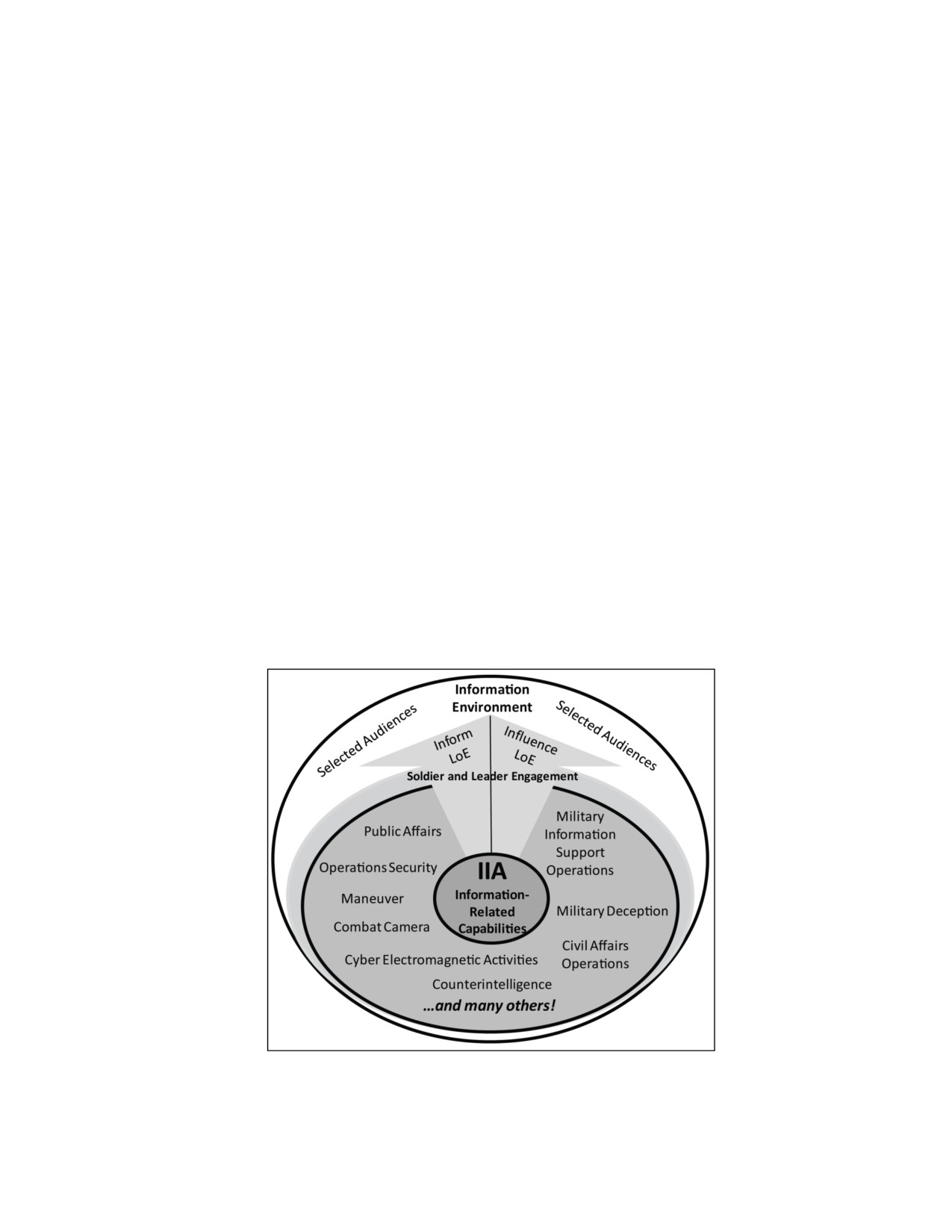
2-1. The inform and influence activity concept brings together several separate functions as information-
15
related capabilities which commanders use to shape the information environment. While staff officers and
16
operators of each information-related capability integrate within their area of expertise and with other staff
17
sections for execution coordination, it is the G-7 (S-7) inform and influence activities officer and section’s
18
responsibility to plan for and integrate all potential operational assets. This allows for message alignment,
19
reinforcement, and consistency in support of the overall concept of operations rather than individual events
20
or missions. To center their integration efforts, the G-7 (S-7) plan using lines of effort to focus their
21
strategy.
22
Figure 2-1. Integrating inform and influence activities
25 October 2011
FM 3-13 (FD—NOT FOR IMPLEMENTATION)
2-1
Chapter 2
23
LINES OF EFFORT
24
2-2. Two lines of effort contribute to inform and influence activities: the inform line of effort and the
25
influence line of effort. These lines of effort enable commanders and staffs to apply the right capability or
26
mix of capabilities to the right circumstance and audience ensuring statutory and regulatory compliance.
27
2-3. All activities in the information environment communicate in some way. They serve to make an
28
impression on the mind of those that observe or hear them. What distinguishes the two lines of effort is the
29
intention of the communicator and the message. Sometimes, a communication intended merely to inform
30
might eventually lead to a changed opinion or behavior. And a communication designed to influence may
31
not achieve the desired outcome.
32
INFORM LINE OF EFFORT
33
2-4. The inform line of effort aims to provide information to domestic and global audiences that
34
accurately describes operations. It does not try to force a particular point of view on these audiences but
35
rather provides them with facts to make their own decisions. Providing factual and accurate information
36
serves as a venue to counter false information disseminated by others (misinformation or disinformation).
37
Maintaining transparency and credibility is paramount within the inform line of effort. Capabilities under
38
the inform line of effort include public affairs, military information support operations, and Soldier and
39
leader engagements. In addition, capabilities such as combat camera, civil affairs operations, operations
40
security, and cyber electromagnetic activities provide support to executing the inform line of effort.
41
INFLUENCE LINE OF EFFORT
42
2-5. The influence line of effort aims to change attitudes, beliefs, and ultimately behavior of foreign
43
friendly, neutral, adversary, and enemy audiences to support operations. It tries to guide target audiences to
44
make decisions that support the U.S. forces commander’s objectives. Examples of influence objectives
45
include misleading enemy decisionmakers or convincing enemy forces to surrender or cease their efforts.
46
The influence line of effort also includes actions designed to extend influence over foreign partners,
47
civilians, and actors in the area of operations. This type of influence seeks to create and strengthen
48
relationships when Army forces do not have command over partner forces. Effective Army forces leverage
49
relationships based on trust and mutual confidence, demonstrating how the U.S. Army provides added
50
value to others’ objectives. Capabilities that primarily support the influence line of effort include military
51
information support operations and Soldier and leader engagement. Additionally, information-related
52
capabilities such as military deception, combat camera, counterintelligence, civil affairs operations,
53
operations security, and cyber electromagnetic activities provide support to executing the influence line of
54
effort.
55
INFORMATION ENVIRONMENT
56
2-6. A complex relationship exists among the operational factors—political, military, economic, social,
57
infrastructure, information, physical environment and time (known as PMESII-PT). This relationship
58
requires commanders to holistically perceive how operations and the information environment relate and
59
affect their actions and processes. Inform and influence activities focuses on shaping the information
60
environment to achieve mission objectives. A subset of the operational environment, the information
61
environment is the aggregate of individuals, organizations, and systems that collect, process, disseminate or
62
act on information (JP 3-13).
63
CONSIDERATIONS OF THE INFORMATION ENVIRONMENT
64
2-7. The information environment presents commanders with significant and interrelated opportunities
65
which, if seized upon, can enhance operational success. Leveraging the information environment
66
effectively requires that commanders have four considerations. First, they understand the effects of the
67
information environment. Effects in the information environment affect local, regional, and global
68
audiences with or without commanders’ ability to control actions or seek the audience’s consent.
69
Commanders strive to shape and optimize these effects to support their operational objectives and
2-2
FM 3-13 (FD—NOT FOR IMPLEMENTATION)
25 October 2011

Aspects of Inform and Influence Activities
70
commander’s intent. Second, commanders recognize that military operations occur in full view of the
71
global audience, to include adversaries and enemies, due to real-time media and global communications
72
capabilities. Third, commanders consider the influence of their communications on others. They consider
73
how their units’ actions, words, and messages will shape information and operational environments and
74
affect perceptions among audiences. They shape their training and planning from this influence. Lastly,
75
commanders respect and appreciate the various aspects of the information environment. Such aspects
76
include indigenous channels of communication, key influencers in the area of operation, cultural and civil
77
considerations, and the various audiences and stakeholders involved. Potential audiences and stakeholders
78
include the Americans, decisionmakers (friendly, neutral, and adversarial), multinational partners and
79
allies, interagency partners, international organizations, and the local civilians.
80
DIMENSIONS OF THE INFORMATION ENVIRONMENT
81
2-8. The information environment consists of the physical dimension, informational dimension, and
82
cognitive dimension. See figure 2-2.
83
2-9. The physical dimension is composed of command and control systems and supporting infrastructures
84
that enable individuals and organizations to conduct operations across the air, land, sea, and space domains.
85
This dimension has physical platforms and the communications networks that connect them.
86
Communications networks include the means of transmission, infrastructure, technologies, groups, and
87
populations. Comparatively, the elements of this dimension are the easiest of the three dimensions to
88
measure. Combat power has traditionally been measured primarily in this dimension.
89
2-10. Units use the informational dimension to collect, process, store, disseminate, display, and protect
90
information. In this dimension, commanders execute mission command and convey their commander’s
91
intent. It consists of the content and flow of information. Consequently, military forces strive to protect the
92
informational dimension.
93
Figure 2-2. Information environment
94
2-11. The cognitive dimension encompasses the mind of the decisionmaker and relevant audiences. In this
95
dimension, people think, perceive, visualize, and decide upon their future actions. It is the most important
25 October 2011
FM 3-13 (FD—NOT FOR IMPLEMENTATION)
2-3
Chapter 2
96
of the three dimensions. A commander’s orders, training, and other personal motivations affect this
97
dimension. Battles and campaigns are won or lost in the cognitive dimension. Many factors of the cognitive
98
dimension influence its workings. The factors include leadership, morale, unit cohesion, emotion, state of
99
mind, level of training, experience, situational awareness, public opinion, perceptions, media, public
100
information, and rumors.
101
2-12. The dimensions of the information environment are dynamic and constantly evolving. The global
102
media, networked communications, and other factors feed the information environment with data that can
103
be inaccurate, incomplete, or presented out of context. Effective commanders anticipate how all
104
information-related capabilities could shape the information environment to better meet their operational
105
requirements. By using information as an element of combat power, commanders work to maintain the
106
initiative while preventing the adversary from setting the terms of a conflict in the public arena. (See
107
JP 3-13 for additional information on the information environment.)
108
JOINT INFORMATION OPERATIONS AND STRATEGIC
109
COMMUNICATION
110
2-13. Inform and influence activities supports joint information operations and strategic communications.
111
Creating shared understanding and purpose is not simply a tactical goal but an operational and strategic
112
one. The Army achieves this goal through the conduct of mission command. Mission command supports
113
joint information operations and strategic communication, in support of national objectives. At the strategic
114
level, information is recognized as an element of national power, coequal with diplomatic, military, and
115
economic efforts (all the elements of national power are referred to as DIME).
116
JOINT INFORMATION OPERATIONS
117
2-14. Information operations is the integrated employment, during military operations, of information-
118
related capabilities in concert with other lines of operation to influence, disrupt, corrupt, or usurp the
119
decision-making of adversaries and potential adversaries while protecting our own (JP 1-02). Information
120
operations are joint operations. Each Service component contributes to an integrated whole synchronized
121
by the joint force headquarters. Through the mission orders process, the Army supports joint information
122
operations and strategic level objectives by integrating the information-related capabilities through inform
123
and influence activities.
124
2-15. Army units may work as subordinate elements of a joint task force or form the core headquarters of a
125
joint task force. While Army forces use the inform and influence activities staff section (G-7) to integrate
126
information-related capabilities into the operations process, joint headquarters integrate information
127
operations within the J-39 staff section. Army headquarters transitioning to become the staffs of joint task
128
forces have the option of maintaining the functional cell, integrating cell structure outlined in FM 5-0 or
129
converting to a joint organizational model.
130
2-16. The theater campaign plan and communication strategy guides the planning of inform and influence
131
activities and cyber electromagnetic activities. The Army contributes an integrated inform and influence
132
activities plan—which includes cyber electromagnetic activities and other capabilities and processes—to
133
support joint information operations. The joint force headquarters then synchronizes inform and influence
134
activities into the overall joint information operations plan.
135
STRATEGIC COMMUNICATION
136
2-17. Strategic communication is United States Government efforts to understand and engage key
137
audiences to create, strengthen, or preserve conditions favorable for the advancement of United States
138
Government interests, policies, and objectives through the use of coordinated programs, plans, themes,
139
messages, and products synchronized with the actions of all instruments of national power (JP 5-0). The
140
themes and messages that strategic communication provides have a whole of government application and
141
support national objectives.
142
2-18. Strategic communication, information operations, and inform and influence activities overlap. The
143
Department of Defense does not engage in public diplomacy directly, but it supports the strategic
2-4
FM 3-13 (FD—NOT FOR IMPLEMENTATION)
25 October 2011
Aspects of Inform and Influence Activities
144
communication effort. The Department of Defense ensures its objectives are synchronized and
145
complementary in nature with other information efforts. At the strategic and theater levels, joint
146
information operations support strategic communication. In turn, at the operational and tactical levels,
147
inform and influence activities support joint information operations, ensuring themes, messages, and
148
actions are nested and integrated across all lines of operation.
149
COMMANDER’S MEANS
150
2-19. Inform and influence activities is the commander's means to affect the cognitive aspect of the
151
operational environment. The operational environment is a composite of the conditions, circumstances, and
152
influences that affect the employment of capabilities and bear on the decisions of the commander (JP 3-0).
153
The operational environment has always been complex and ambiguous. It is even more so in a networked
154
and interconnected world. Threats to U.S. security and its interests have become increasingly diverse,
155
innovative, adaptive, globally connected, and networked. These threats increasingly defy the traditional
156
definition of a threat. They operate conventionally or unconventionally using adaptive tactics and
157
techniques to accomplish their goals. They can use sophisticated information campaigns, in combination
158
with lethal and nonlethal attacks, on a range of targets to sway and influence local to global audiences. The
159
complexity of the threat and thus the operational environment makes simultaneous support to offensive and
160
defensive operations all the more critical for commanders and their staffs.
161
OFFENSIVE AND DEFENSIVE OPERATIONS
162
2-20. Inform and influence activities officers plan for both offensive and defensive operations throughout
163
unified land operations. Planning and execution of information-related activities includes simultaneous
164
offensive and defensive actions that support desired effects ranging from informing and influencing
165
(nonlethal) to destroying (lethal) within the same area of operations. What is also crucial for inform and
166
influence activities are the second and third order effects from operations driven by the various audience
167
perceptions and how commanders can mitigate negative reactions and exploit positive ones.
168
2-21. Commanders and staffs synchronize offensive and defensive inform and influence activities to
169
produce complementary and reinforcing effects. Offensive inform and influence activities supports the
170
decisive operation, while defensive inform and influence activities protects friendly force critical assets
171
and centers of gravity. Conducting offensive and defensive inform and influence activities independently
172
detract from the efficient employment of information-related capabilities. Without simultaneous support to
173
offensive and defensive operations, redundant employment of information-related capabilities leads to
174
inefficient use of resources. Likewise, uncoordinated efforts increase potential for conflicts and operational
175
interference. This could compromise friendly intentions or result in information fratricide.
176
INFORM AND INFLUENCE ACTIVITIES SIMULTANEOUS SUPPORT OF OFFENSIVE
177
OPERATIONS
178
2-22. Inform and influence activities supports offensive operations by proactively integrating information-
179
related capabilities. These activities either adversely affect enemy decisionmaking or influence others in
180
order to achieve or promote specific mission objectives. Commanders can use all information-related
181
capabilities to support offensive operations.
182
2-23. Inform and influence activities in support of offensive operations helps units seize the initiative.
183
Inform and influence activities creates a disparity between the quality of information available to friendly
184
forces and that available to adversaries and enemies. Commanders apply actions—destroy, disrupt,
185
degrade, deny, deceive, and exploit—to inform and influence audiences to create this information
186
advantage.
187
2-24. Destroy means to use lethal and nonlethal means to physically render enemy information
188
useless or information systems ineffective unless reconstituted. It is most effective when timed to occur
189
just before enemies need to execute a mission command function or when focused on a resource-intensive
190
target that is hard to reconstitute.
25 October 2011
FM 3-13 (FD—NOT FOR IMPLEMENTATION)
2-5
Chapter 2
191
2-25. Destroy means to use lethal and nonlethal means to physically render enemy information
192
useless or information systems ineffective unless reconstituted. It may be desired when attack resources
193
are limited, to comply with rules of engagement or to create certain effects. Electronic attack is a common
194
means of disrupting the information system and networks.
195
2-26. Degrade means to use nonlethal or temporary means to reduce the effectiveness or efficiency of
196
targeted information system and information collection efforts or means. Offensive inform and
197
influence activities can also degrade the morale of a unit, reduce the target’s worth or value, or reduce the
198
quality of decisions and actions.
199
2-27. Deny means to withhold information about friendly forces, operations, or situations that can be
200
used by the adversary and enemy. Effective denial leaves opponents vulnerable to offensive capabilities.
201
Operations security is the primary nonlethal means of denial.
202
2-28. Deceive means to cause a person to believe what is not true. Military deception seeks to mislead
203
adversary and enemy decisionmakers by manipulating their perceptions of reality to come to a false
204
conclusion or decision.
205
2-29. Exploit means to gain access to targeted information networks to collect information or to
206
insert false or misleading information.
207
2-30. Influence means to cause audiences to think or behave in a manner favorable to the
208
commander’s objectives. It results from applying perception management to affect the target’s emotions,
209
motives, and reasoning. Perception management also seeks to influence the target’s actions, perceptions,
210
plans, and will to oppose friendly forces. Targets may include noncombatants and others in the area of
211
operations whom commanders want to support friendly-force missions or not to resist friendly-force
212
activities. Perception management achieves the influence effect by conveying or denying selected
213
information to targets.
214
INFORM AND INFLUENCE ACTIVITIES SIMULTANEOUS SUPPORT OF DEFENSIVE
215
OPERATIONS
216
2-31. Information-related capabilities simultaneously support defensive operations through inform and
217
influence activities. Officers of inform and influence activities may not have primary responsibility for
218
many defensive activities. However, they will still remain involved and serve as the primary information
219
advisor for assessment, perception, and potential effects from activities and procedures that commanders
220
require. These activities and procedures protect and defend friendly information, troops, and systems, as
221
well as the ability to continue shaping their area of operations. Inform and influence activities in support of
222
the defense also denies adversaries and enemies the opportunity to exploit friendly information systems and
223
information for their own purposes through the exploitation or insertion of misleading information.
224
Commanders apply actions—protect, detect, and respond— to maintain an operational advantage by
225
safeguarding their area of operations to the best of their ability.
226
2-32. Protect is to take action to guard against manipulation, damage, destruction, or capture of personnel,
227
equipment and information. In inform and influence activities, operations security is integrated into the
228
operations process to mitigate the effects of adversary or enemy access to or action upon friendly
229
personnel, networks, information systems, and equipment. It denies adversaries and enemies information
230
about friendly information-related capabilities and intentions by controlling indicators and capabilities.
231
Protect also includes actions in support of perception management.
232
2-33. Detect is to discover or discern the existence, presence, or fact of an intrusion into information
233
systems. Detection is the identification of adversary or enemy attempts to gain access to friendly
234
information and mission command systems. Timely detection and reporting enable units to initiate
235
restoration and response.
236
2-34. Respond is to react quickly to an adversary or enemy information operations attack or intrusion.
237
Timely identification of adversaries, enemies, and their intentions and capabilities is the cornerstone of
238
effective response to adversary offensive information operations. Inform and influence activities could also
239
be preemptive actions to mitigate follow-on events or situations.
240
2-6
FM 3-13 (FD—NOT FOR IMPLEMENTATION)
25 October 2011
1
Chapter 3
2
Capabilities of Inform and Influence Activities
3
This chapter discusses only a number of information-related capabilities that
4
typically support inform and influence activities. It also discusses why the integration
5
of these capabilities is critical to the commander and successful operations.
6
INFORMATION-RELATED CAPABILITIES
7
3-1. A capability is the ability to execute a specified course of action. Given the complex challenges
8
confronting the Army and conduct of unified land operations, rarely is a single course of action or
9
capability enough. Complex problems demand complex solutions that appear simple through the skillful
10
coordination, integration, and synchronization of multiple capabilities, each complementing and amplifying
11
the other. This synergy is especially critical if inform and influence activities are to be successful and
12
decisive. Therefore, commanders may delegate any of their organic capabilities and request many others to
13
support their objectives and desired effects in shaping the operational environment.
14
3-2. Information-related capabilities are capabilities that support a commander’s ability to communicate
15
across a range of operations and to many audiences to inform or influence and, consequently, shape desired
16
outcomes. Theoretically, all capabilities send a message (or make an impression) and serve to inform and
17
influence audiences. While conducting inform and influence activities, commanders consider all
18
capabilities in devising solutions and plans. The commander and staff regularly use traditional information-
19
related capabilities to inform and influence audiences:
20
z
Public affairs.
21
z
Military information support operations.
22
z
Soldier and leader engagement.
23
z
Combat camera.
24
z
Military deception.
25
z
Cyber electromagnetic activities.
26
z
Operations security.
27
3-3. The commander and staff can delegate many other capabilities. Using these other organic
28
information-related capabilities to support efforts of inform and influence activities enhances and reinforces
29
mission objectives and shaping the operational environment. The other delegated information-related
30
capabilities that support inform and influence activities include—
31
z
Counterintelligence.
32
z
Civil-military operations and civil affairs operations.
33
z
Special technical operations.
34
z
Presence, posture, and profile.
35
z
Physical attack.
36
z
Physical security.
37
z
Other capabilities.
38
PUBLIC AFFAIRS
39
3-4. Public affairs fulfills the Army’s obligation to keep the American people and the Army informed. It
40
helps to establish conditions that lead to confidence in the Army and its readiness to conduct unified land
41
operations and decisive actions. It strives to enhance public understanding and garner American, as well as
25 October 2011
FM 3-13 (FD—NOT FOR IMPLEMENTATION)
3-1
Chapter 3
42
global, support for the Army by engaging with both domestic and foreign media entities. See FM 46-1 for
43
additional information on public affairs.
44
3-5. Public affairs fulfills its mission through public information, command information, and community
45
relations. Public information focuses on external audiences. It primarily engages the media to convey its
46
themes and messages to American and global audiences. Command information focuses on internal
47
audiences—Soldiers, civilians, and family members. It recognizes that an informed force is a more ready,
48
reliable, and resilient force. Community relations focus on the communities surrounding military
49
installations. It recognizes that a positive rapport between the Army and its host communities is mutually
50
beneficial, supporting the Army as an institution as well as its individual Soldiers.
51
3-6. Public affairs integration with other information-related capabilities helps the commander shape the
52
information environment, provides valuable media assessment, and counters enemy propaganda and
53
disinformation. It assists the commander develop themes and messages and collaborates with other
54
information-related capabilities to protect operations security and avoid information fratricide.
55
3-7. Public affairs participates in the information integration process within the inform and influence
56
activities section by continually assessing the media to determine the degree and nature of media coverage,
57
taking steps to correct misinformation or propaganda. It also seeks to leverage other information-related
58
capabilities, such as combat camera or civil affairs operations, to provide greater accuracy and breadth of
59
information. Additionally, it provides reinforcing messaging for other information-related capability
60
actions and the overarching engagement strategy.
61
MILITARY INFORMATION SUPPORT OPERATIONS
62
3-8. Military information support operations is the commander’s primary dedicated information-related
63
capability to inform and influence foreign populations within the operational area. Military information
64
support operations is conducted to induce or reinforce specific attitudes and behaviors favorable to U.S.
65
military objectives. See FM 3-53 for more information on military information support operations.
66
3-9. Inform and influence activities receives support from military information support Soldiers. These
67
Soldiers provide a staff subject matter expert within the G-7 (S-7) inform and influence activities section
68
and primary member of the inform and influence activities working group for advising, planning,
69
operations oversight, and assessing of military information support operations. The military information
70
support units also provide military information support products and are the the primary executors for many
71
of their audio, visual and audio-visual products for the purpose of informing, influencing, and directing
72
target audiences. They also provide the inform and influence activities section and staff post-delivery
73
measures of performance and measures of effectiveness assessment. The inform and influence activities
74
section also relies heavily on its audience analysis and continuous assessment of adversary information and
75
capability, including information for effect, misinformation, disinformation, and propaganda.
76
SOLDIER AND LEADER ENGAGEMENT
77
3-10. Soldier and leader engagement broadly describes interactions that take place among Soldiers, leaders,
78
and audiences in the area of operations. Chapter 6 discusses the specific contributions of Soldier and leader
79
engagements to inform and influence activities.
80
COMBAT CAMERA
81
3-11. Combat camera provides commanders with a directed imagery capability to support operational and
82
planning requirements. These forces use video documentation capabilities ranging from aerial photography
83
to underwater photography to support inform and influence activities. They access areas and events
84
inaccessible to other personnel or media. Furthermore, combat camera teams have a technological
85
capability to transmit real-time images. The accurate portrayal they provide of U.S. forces in action enables
86
the inform and influence activities section to reinforce other information-related capability efforts.
87
Likewise, their documentation of operations and provided imagery products support countering
88
misinformation or propaganda. For more information on combat camera, see FM 3-55.12.
3-2
FM 3-13 (FD—NOT FOR IMPLEMENTATION)
25 October 2011
Capabilities of Inform and Influence Activities
89
MILITARY DECEPTION
90
3-12. Military deception involves actions executed to deliberately mislead adversary military, paramilitary,
91
or violent extremist organization decisionmakers. This information-related capability intends the adversary
92
to take specific actions (or inactions) that contribute to accomplishment of the friendly mission. Military
93
deception does not fall under the direct purview of the G-7 (S-7) but is considered a primary influencing
94
capability of inform and influence activities. Military deception consists of counterdeception, deception in
95
support of operations security, and tactical deception.
96
3-13. Counterdeception contributes to situational understanding by protecting friendly human and
97
automated decisionmaking from adversary deception. Counterdeception strives to make Army commanders
98
aware of adversary deception activities so they can formulate informed and coordinated responses.
99
3-14. A deception in support of operations security protects friendly operations, personnel, programs,
100
equipment, and other assets against foreign intelligence security services collection. It creates multiple false
101
indicators. These indicators confuse the adversary or enemy. Sometimes they make friendly intentions
102
harder for the adversary or enemy intelligence gathering apparatus to interpret. Often it limits the adversary
103
or enemy’s ability to collect accurate intelligence on friendly forces.
104
3-15. Tactical deception consists of deception activities planned and conducted to support battles and
105
engagements in real time. Tactical-level commanders plan and execute tactical deception to cause enemy
106
actions favorable to U.S. objectives. These activities aim to gain a tactical advantage over an adversary, to
107
mask vulnerabilities in friendly forces, or to enhance the defensive capabilities of friendly forces. Tactical
108
deception usually nests in other operations as part of the joint force command or joint task force’s
109
Annex C-3-A.
110
CYBER ELECTROMAGNETIC ACTIVITIES
111
3-16. Cyber electromagnetic activities seize, retain, and exploit advantages in cyberspace and the
112
electromagnetic spectrum. The result enables Army forces to retain freedom of action while denying
113
freedom of action to enemies and adversaries, thereby enabling the overall operation. For more information
114
on cyber electromagnetic operations, see FM 3-36.
115
3-17. Although inform and influence activities and cyber electromagnetic activities are interrelated, each
116
requires a uniquely different skill set to perform the required processes effectively. Ultimately both work
117
towards contributing to affecting personal cognition, and both activities are able to mutually support one
118
another. Therefore, cyber electromagnetic activities is considered an information-related capability that
119
must be synchronized and integrated through inform and influence activities. Not only can it reinforce
120
messaging efforts by providing additional means for message distribution, but it is also incorporated to
121
execute or support offensive and defensive operational planning against an adversary or enemy audience.
122
OPERATIONS SECURITY
123
3-18. Operations security is the process by which the Army protects human and automated decisionmaking
124
in peacetime and in conflict. It is a commander’s responsibility and is supported by every Soldier and
125
supporting civilian staff members and operators. Operations security aims to enhance the probability of
126
mission success by preserving the advantages of initiative secrecy and surprise. Operations security is a
127
force multiplier. It includes reducing predictability and eliminating indicators of operations. Commanders
128
use operations security countermeasures to deny adversaries knowledge of friendly operations, requiring
129
adversaries to expend more resources to obtain the critical information needed to make decisions. For more
130
information on operations security, see FM 3-37.
131
3-19. Inform and influence activities’ primary focus is the successful integration of words, images, and
132
deeds into the commander’s overall plan. Operations security is very important to inform and influence
133
activities because its primary focus is to protect the unit’s words, images, and deeds. In order to achieve
134
success by meeting the commander’s desired effects and intended end state, effective messaging through
135
those words, images, and deeds must occur. A successfully executed operations security program enables
136
successful messages by preventing misinformation, disinformation, and information fratricide.
25 October 2011
FM 3-13 (FD—NOT FOR IMPLEMENTATION)
3-3
Chapter 3
137
COUNTERINTELLIGENCE
138
3-20. Within inform and influence activities, counterintelligence has two specifics contributions. First, it
139
counters human intelligence targeting of friendly inform and influence activities. Second,
140
counterintelligence provides threat analysis for enemy signals intelligence analysis. Information provided
141
by counterintelligence becomes usable intelligence for the commander and staff. With it, they develop an
142
inform and influence activities strategy. This strategy aims to counter, deter, neutralize, exploit, or at least
143
mitigate the adversary’s information operations program. For more information on counterintelligence, see
144
FM 2-0.
145
3-21. Counterintelligence includes all actions taken to detect, identify, track, exploit, and neutralize the
146
multidiscipline intelligence activities of adversaries. By executing their mission, counterintelligence
147
elements are instrumental in contributing to situational awareness in the area of influence. Their asset
148
reporting also provides valuable information and assessments that contribute to determining inform and
149
influence activities measures of effectiveness.
150
CIVIL-MILITARY OPERATIONS AND CIVIL AFFAIRS OPERATIONS
151
3-22. The difference between civil-military operations and civil affairs operations as they relate to inform
152
and influence activities is purpose, focus, and specialization. Civil military operations are activities by a
153
commander to build relationships between military forces and civilians to aid the friendly cause. Civil
154
affairs operations involve applying specialty skills (normally the responsibility of civil government) to
155
enhance the conduct of civil-military operations. Both civil-military operations and civil affairs operations
156
focus on the local population and creating favorable civil considerations in which military operations can
157
occur. Where any unit can perform civil military operation, because of their specialization, civil affairs
158
forces focus on issues such as infrastructure, governance, agriculture, health and human services, and
159
finance. For more information on civil-military operations, see FM 3-28. For more information on civil
160
affairs operations, see FM 3-05.40.
161
3-23. Since any civil-military operation or civil affairs operation involves direct interaction with the local
162
populace, inform and influence activities integrates both functions to support the commander’s engagement
163
strategy. It recognizes the power of civil-military operations and civil affairs operations to contribute to the
164
commander’s overall inform and influence activities effort and harmonizes this contribution with other
165
capabilities, such as military information support operations, public affairs and Soldier and leader
166
engagement.
167
SPECIAL TECHNICAL OPERATIONS
168
3-24. The integrated joint special technical operations process is an option when addressing inform and
169
influence activities problem sets the staff identified and when traditional information-related capabilities
170
will not successfully accomplish the desired end state. The staff requests assistance through established
171
staff channels and procedures for planning. Currently, special technical operations billets exist in division
172
and higher echelons. From these echelons, they can support these planning and execution requests and
173
attempt to fill the gap between traditional information-related capabilities and special problem sets. When
174
requesting integrated joint special technical operations support, the staff focuses on the desired end state
175
and not specific capabilities or desired effects. The integrated joint special technical operations support is a
176
complicated and thorough process. It involves many agencies to develop the concept of operations and
177
acquire authorization, typically in requiring an average of 90 days. Unless concepts and authorizations are
178
already established, staffs of integrated joint special technical operations do not plan for time-sensitive
179
events.
180
PRESENCE, POSTURE, AND PROFILE
181
3-25. Although not considered a traditional information-related capability, presence and posture and other
182
combined arms assets are often used to deliver a commander’s message to an intended audience.
183
Depending on the intended effects the commander desires, forces can be used to inform and influence by
184
simply their presence to provide safety for a village from adversary and enemy elements, to deter adversary
185
and enemy actions, or to shape the operational environment with lethal action when necessary. Because all
3-4
FM 3-13 (FD—NOT FOR IMPLEMENTATION)
25 October 2011
Capabilities of Inform and Influence Activities
186
tactical action or inaction through execution of unified land operations sends a message, ground
187
commanders must be cognizant of how their actions within their area of operations support or negate the
188
commander-in-chief’s overall strategy for strategic communication.
189
PHYSICAL ATTACK
190
3-26. Physical attack is the application of combat power to destroy or degrade adversary forces, sources of
191
information, command and control systems, and installations. It includes direct and indirect fires from
192
ground, sea, and air forces. Also included are direct actions by special operations forces.
193
OTHER CAPABILITIES
194
3-27. Commanders designate other capabilities during the operations process. The operations process aids
195
the commander and staff to decide what other capabilities, not specified as an information-related
196
capability, to use to support the lines of effort (see paragraphs Error! Bookmark not defined. through 2-
197
5).
198
INTEGRATED AND SYNCHRONIZED CAPABILITIES
199
3-28. The complexities and scope of the information environment make it difficult to achieve the desired
200
effects using a single information-related capability. Effective integration and synchronization of all
201
information-related capabilities is necessary to achieve a holistic approach to operations. Likewise,
202
protecting friendly mission command systems and their components also requires carefully integrating and
203
synchronizing information-related capabilities.
204
3-29. Commanders often rely on two means of integration: coordination and deconfliction. Coordination
205
focuses on how activities or capabilities come together to reinforce and amplify each other. Deconfliction
206
focuses on how activities or capabilities might compete for resources or create effects that negate or impair
207
each other and focuses on taking action to avoid or mitigate such outcomes. To achieve complementary and
208
reinforcing effects, commanders effectively coordinate and deconflict information-related capabilities. This
209
action decreases the probability of conflicts and interference that may compromise friendly intentions or
210
result in information fratricide.
211
3-30. Commanders use synchronization to protect their forces. Information fratricide results when the
212
effects of information-related capabilities conflict or compete with one other. More importantly, it occurs
213
when information-related messages or effects are contradicted by actions, creating a “say-do” gap. Such a
214
gap places commanders’, the Army’s, and the nation’s credibility at risk.
215
216
25 October 2011
FM 3-13 (FD—NOT FOR IMPLEMENTATION)
3-5
1
Chapter 4
2
Roles, Responsibilities, and Organizations
3
The chapter discuses the roles, responsibilities, and organizations of inform and
4
influence activities. It first discusses the role of the commander. Then it discusses the
5
roles of the G-7 (S-7) and the staff. Lastly it discusses the role of others—the inform
6
and influence activities section and working group, the information operations
7
command, the theater operations group, and the Joint Information Operations Warfare
8
Center.
9
ROLE OF THE COMMANDER
10
4-1. Commanders lead inform and influence activities, primarily advised by the G-7 (S-7) and supported
11
by the entire staff. Commanders acknowledge the social aspects and dynamics of different languages of the
12
information environment. Through mission command, inform and influence activities address the audiences
13
in each area of operations.
14
4-2. Commanders establish and synchronize information themes and messages to inform audiences and
15
decisionmakers. The audiences are friendly, both domestic and foreign. These themes and messages
16
influence specific foreign audiences, adversary and enemy audiences, and decisionmakers.
17
4-3. Commanders incorporate cultural awareness, relevant social and political factors, and other
18
informational aspects. These aspects relate to the mission in how commanders understand and visualize the
19
end state and throughout operational design.
20
4-4. Commanders, with the advice from the staff, guide the integration of the information-related
21
capabilities with other actions in their concept of operations.
22
4-5. Commanders require the staff to determine how these information activities affect the various
23
audiences and their perceptions.
24
4-6. Commanders, with the advice from the staff, assess and reassess how their staff uses the inform and
25
influence lines of effort to achieve their commander’s intent with all audiences.
26
4-7. The commander’s intent drives the military decisionmaking process, enabling units to incorporate
27
inform and influence activities into each operation. The commander’s intent envisions a future state. It
28
acknowledges and incorporates the affects of people on the area of operations. The commander’s intent
29
enables the staff and subordinate units to focus planning efforts focused on envisioned future end state. The
30
staff and subordinate units must change attitudes, perceptions, and behaviors. Reaching that desired end
31
state can involve breaking the enemy’s will or can foster wider and more enduring support among other
32
audiences. These audiences range from the U.S. audiences to indigenous people in the area of operations.
33
ROLE OF THE G-7 (S-7) OFFICER
34
4-8. The G-7
(S-7), inform and influence activities officer, serves as the commander’s primary
35
coordinating staff officer for integrating information-related capabilities and assessing measures of
36
performance and measures of effectiveness in accordance with the plan. To best advise the commander, the
37
G-7 (S-7) must understand the information and operational environments. Additionally, the G-7 (S-7) must
38
have a cultural understanding of the area of operations, as well as that of joint and multinational forces and
39
civilian organizations.
40
4-9. Inform and influence activities brings together multiple information-related capabilities
(see
41
chapter 3). To provide unity of effort, a coordinating staff officer, the G-7 (S-7), is responsible for overall
25 October 2011
FM 3-13 (FD—NOT FOR IMPLEMENTATION)
4-1
Chapter 4
42
integration of those capabilities in accordance with the larger operations, including maneuver, fires, and
43
other such efforts. Placing responsibility for synchronizing activities of the information-related capabilities
44
on one coordinating staff officer helps commanders mass their effects to integrate information as a combat
45
element in the planning process.
46
4-10. The G-7 (S-7)’s primary responsibilities include—
47
z
Involvement in every step of the military decisionmaking process (MDMP) (see chapter 5).
48
z
Monitoring execution of approved activities.
49
z
Continuously assessing measures of performance and effectiveness against the intended plan.
50
z
Advising the commander and staff when they might need to make adjustments in the plan based
51
on the assessment.
52
The inform and influence activities officer also advises the commander on how commanders can use
53
information to help shape the operational environment.
54
4-11. The G-7 (S-7) section contributes to the overall intelligence preparation of the battlefield by
55
developing inform and influence activities input. This section works with the G-2 (S-2) section to develop
56
products that portray the information infrastructure of the area of operations and aspects of the information
57
environment that can affect operations. In addition to information about the adversary, these products
58
include information on all audiences and other decisionmakers, key people, and significant groups in the
59
area of operations. They address potential strengths and vulnerabilities of adversaries and other groups as
60
well as friendly force operations security considerations.
61
4-12. A headquarters monitors the effects of its inform and influence activities and coordinates any
62
activities that directly affect operations of other commands. To do this, the G-7 (S-7) section coordinates
63
with the G-7 (S-7) section of higher and adjacent commands to obtain effects assessments in near real-time.
64
With this information, the G-7 (S-7) section tracks how the effects of other organizations’ inform and
65
influence activities impact the commander’s overall operation.
66
4-13. Secondary responsibilities include ensuring the unit inform and influence activities strategy is nested
67
with joint information operations and unified action partner inform and influence efforts, as well as the
68
overall strategy, themes, and messages for strategic communication. This includes both vertical and
69
horizontal staff coordination to ensure consistency of messaging. The G-7 (S-7) can accomplish much of
70
this through conducting their own inform and influence activities working group (appendix A) and
71
participating in information operations and other unit’s information working group meetings.
72
4-14. Through the staff planning and coordinating process, the G-7 (S-7) will determine and nominate
73
nonlethal and potentially lethal targets for approval and will also need to establish inform and influence
74
measures for performance and effectiveness to provide post activity assessment in accordance with the
75
decide, detect, deliver, and assess targeting model (appendix A). Coordination with the G-2 (S-2) is also
76
necessary to plan collection assets to support inform and influence activities assessment.
77
4-15. The G-7 (S-7) trains individuals within the inform and influence activities section on staff action
78
battle drills and inform and influence activities mission-essential tasks. The G-7 (S-7) might also be tasked
79
to train or support training for units and other staff sections, sections for inform and influence activities
80
planning, or sections for conducting Soldier and leader engagement.
81
4-16. The G-7 (S-7) is finally also responsible for standard leader actions, such as government contract
82
management and oversight, required supply and equipment coordination with the sustainment personnel,
83
and Soldier actions and unit readiness requirements regarding the personnel in the G-7 (S-7) section.
84
ROLE OF THE STAFF
85
4-17. The G-2 (S-2) section has staff responsibility for producing intelligence about adversaries and the
86
environment. Intelligence analysts process and analyze information (to include open-source information) to
87
produce intelligence. They incorporate aspects of inform and influence activities into intelligence
88
preparation of the battlefield to accurately describe the audiences in the information environment and
89
throughout the area of interest. Intelligence products focus on answering priority intelligence requirements
4-2
FM 3-13 (FD—NOT FOR IMPLEMENTATION)
25 October 2011
Roles, Responsibilities, and Organizations
90
and identifying high-payoff targets as well as providing initial baseline and ongoing assessment of the area
91
of operations and enemy capability status.
92
4-18. Through the intelligence system, the G-2 (S-2) section has access to higher echelon information
93
sources and intelligence collection assets. The staff analyzes information from these sources with
94
information from organic sources to produce the information environment portions of the common
95
operational picture. Advanced mission command systems, adequate procedures, and trained Soldiers use
96
the mission command network to disseminate this product throughout the command. Effective information
97
management provides different commanders and staffs with a common operational picture based on
98
intelligence and friendly force information.
99
4-19. The G-3 (S-3) section exercises primary staff responsibility over reconnaissance operations. To
100
answer priority intelligence requirements, the G-3 (S-3) section tasks organic reconnaissance and sur-
101
veillance assets. Together, the G-2 (S-2) and G-3 (S-3) sections exploit all available resources to answer the
102
priority intelligence requirements. The G-7 (S-7) section submits information requirements to the G-2 (S-2)
103
section. The staff submits information requirements it cannot answer with organic assets to appropriate
104
agencies as requests for information.
105
The role of the staff includes coordination. Responsive staff coordination of the information-related
106
capabilities intensifies as execution of the operation progresses and variances from the operation order
107
increase. The decentralized nature of inform and influence activities execution, combined with the multiple
108
command levels involved and the allocation of information monitoring responsibilities among the unit’s
109
assets, places a heavy demand on the G-7 (S-7) section.
110
ROLE OF OTHERS
111
4-20. The inform and influence activities section neither owns nor controls any of a unit’s assets, but it
112
must coordinate with many who do. Therefore, inform and influence activities officers cannot support the
113
section’s mission by themselves. To plan and integrate successfully, inform and influence activities officers
114
collaborate via several means both internally to their unit and supporting units as well as externally to
115
reachback units and centers.
116
INFORM AND INFLUENCE ACTIVITIES SECTION AND WORKING GROUP
117
4-21. The inform and influence activities section is part of the mission command functional cell.
118
Functional cells coordinate and synchronize forces and activities by warfighting function. The mission
119
command functional cell consists of the inform and influence activities section, the signal staff section, and
120
the civil affairs operations staff section. In the mission command functional cell, staff sections that reside in
121
this cell report directly to the chief of staff and not through a cell chief. The G-7 (S-7) leads the inform and
122
influence activities section. This officer oversees the cross-functional integration of information-related
123
capabilities and planning product development.
124
4-22. The G-7 (S-7) also leads the inform and influence activities working group. The inform and influence
125
activities working group meets as necessary to analyze, coordinate, and provide recommendations for a
126
particular purpose or function. Working groups are cross-functional by design to synchronize the
127
contributions of multiple command post cells and staff sections, as well as any necessary external agencies
128
or organizations required. The inform and influence activities working group is integrated with the staff’s
129
battle rhythm. As a critical planning event, information as an element of combat power is leveraged to best
130
achieve an operational advantage contributing to mission accomplishment.
131
FIRST INFORMATION OPERATIONS COMMAND (LAND)
132
4-23. Upon tasking by Army G-3, First Information Operations Command (Land) assists commanders in
133
conducting (planning, preparing, executing, and assessing) information operations. It coordinates with joint
134
and multinational commands, other Services, and governmental and nongovernmental agencies and
135
organizations. Army Service component commands, corps, and divisions request support by field support
136
teams or assessment teams, as needed. First Information Operations Command
(Land) can receive
137
reinforcement from both the Army National Guard and the Army Reserve to meet peacetime and
25 October 2011
FM 3-13 (FD—NOT FOR IMPLEMENTATION)
4-3
Chapter 4
138
contingency information operations requirements for the Army. It is under operational control of the Army
139
Cyber Command and is tasked by the Army G-3 and U.S. Forces Command.
140
4-24. First Information Operations Command (Land) has the following:
141
z
Field support teams.
142
z
Army Computer Emergency Response Team.
143
z
Information operations vulnerability assessment teams.
144
z
Vulnerability assessment blue teams.
145
z
Vulnerability assessment red teams.
146
z
Army reprogramming analysis team-threat analysis.
147
z
Current operations center.
148
4-25. A field support team is a mission-tailored team of subject matter experts that provides direct
149
support for information operations or inform and influence activities to the ARFORs and joint task
150
forces of land components of combatant commands, and corps and divisions as requested. Subject
151
matter experts consist of military forces, civilians, and contractors. Normally these teams deploy first in
152
response to a request for information operations or inform and influence activities support. For long
153
duration missions, field support teams deploy in an attached (less administrative) status and become part of
154
the supported commander’s information operations cell or inform and influence activities section to
155
reinforce the commander's information efforts.
156
4-26. The Army Computer Emergency Response Team is part of a computer network operations division.
157
This team deters, detects, coordinates, responds, and reports Army information systems security incidents.
158
The Army Computer Emergency Response Team leverages and integrates intelligence support, network,
159
and system management capabilities into a unified, defensive information operations effort. The Army
160
Computer Emergency Response Team, operating around the clock, is the Department of the Army’s single
161
point of contact for reporting information systems security incidents and vulnerabilities. It is responsible to
162
Headquarters, Department of the Army, for coordinating an appropriate response to incidents. This team
163
exchanges reports of computer incidents with other Service, joint, and national agencies and activities.
164
4-27. First Information Operations Command
(Land) provides information operations vulnerability
165
assessment teams. These teams enhance Army force protection. Information operations vulnerability
166
assessment teams assess a commander’s ability to incorporate defensive information operations into
167
peacetime operations, operational and contingency missions, training, and exercises.
168
4-28. Vulnerability assessment blue teams, in coordination with the supported unit’s staff, conduct
169
information operations force protection assessments. These assessments focus on networks and information
170
flow in the First Information Operations Command (Land). Teams assimilate information to identify
171
existing or potential vulnerabilities, estimate the level of risk, and recommend measures to diminish or
172
eliminate that risk. Assessments consider all information operations elements, unless the assessed unit’s
173
commander requests otherwise. Normally, an assessment includes an analysis of the unit’s information
174
flow infrastructure and decisionmaking process. This analysis identifies choke points or potential-conflicts
175
within a commander’s mission command system.
176
4-29. Vulnerability assessment red teams emulate adversarial capabilities targeted against a unit’s
177
information, information systems, networks, and decisionmaking process. Red team missions have a dual
178
purpose: strengthen unit readiness and verify the effectiveness of countermeasures applied by the unit and
179
blue teams. Red team operations are designed to provide realistic training and detailed feedback needed to
180
strengthen a unit’s defensive information operations posture. However, public law and Army policy limit
181
the scope of red team operations. In addition, the assessed unit’s commander may impose operational
182
limitations. The more permissive and open the rules of engagement, the more extensive and valuable the
183
red team’s observations and recommendations.
184
4-30. The Army Reprogramming Analysis Team-Threat Analysis supports warfighters and combat and
185
materiel developers. It identifies and reports changes in worldwide signature information that may require
186
the rapid reprogramming of Army target sensing systems. Army target sensing systems consist of those
187
radar warning, surveillance, self-protection systems, and smart munitions that incorporate software
188
algorithms to identify threat systems based upon embedded reprogrammed threat parameter data. Examples
4-4
FM 3-13 (FD—NOT FOR IMPLEMENTATION)
25 October 2011
Roles, Responsibilities, and Organizations
189
include smart munitions, sensors, processors, and aviation electronic combat survivability equipment. The
190
Army Reprogramming Analysis Team-Threat Analysis provides assistance that supports Army aviation
191
survivability.
192
4-31. The First Information Operations Command (Land) current operations center supports its deployed
193
teams and the supported commands with products and requests for information. The teams receive their
194
support through the concept of split-based operations and reachback support. The current operations center
195
can access multiple external departments, agencies, and databases and produce tailored analytical products
196
to meet a deployed team’s immediate needs.
197
THEATER INFORMATION OPERATIONS GROUP
198
4-32. A theater information operations group provides information-related capabilities to the Army Service
199
component command and its subordinate commands. It supports brigade combat teams to provide joint and
200
Army missions with information-related capabilities. It provides commanders with a scalable capability
201
that is regionally focused and culturally aware. At Army Service component command through the brigade
202
combat team, teams support the command with offensive and defensive information operations and inform
203
and influence activities with a regional cultural focus. The group’s S-2 provides capabilities for direct
204
support information operations and inform and influence activities reachback. This officer also analyzes
205
information operations and inform and influence activities regarding regional, cultural, social, political,
206
economic, and human terrain considerations. Each theater information operation group maintains
207
deployable inform and influence activities, operations security, and military deception capabilities. It
208
deploys in its entirety or as modular teams. Deployable elements are scalable and determined by mission
209
requirements to support specific operations. Teams are packaged to provide the supported command with
210
regionally focused, culturally aware joint information operations and Army inform and influence activities
211
support.
212
4-33. At the Army Service component command level, tactical field support teams assist with theater
213
security cooperation planning and joint information operations missions. At any unit level, an operations
214
security support detachment will provide information operations vulnerability assessments and operations
215
security planning support, while a web operations security support detachment will assess and enhance
216
website security. Information operations and inform and influence activities assessment teams will deploy
217
to evaluate the effectiveness of operational and tactical information operations and inform and influence
218
activities efforts. These teams will also evaluate the effectiveness of open source, cultural affairs, and
219
human terrain team analysis for regional ethnology planning support.
220
JOINT INFORMATION OPERATIONS WARFARE CENTER
221
4-34. The Joint Information Operations Warfare Center, a special tasking element of the joint staff J-39,
222
enables information operations and other missions for the commander of the United States Strategic
223
Command and other joint force commanders as directed. This center coordinates and synchronizes regional
224
and global information operations efforts and enhances information operations support across the
225
Department of Defense. Additionally, the Joint Information Operations Warfare Center partners with other
226
entities related to information operations—internal and external to the Department of Defense—to further
227
enhance the global information operations mission.
228
4-35. The Joint Information Operations Warfare Center can provide information subject matter experts
229
with special emphasis on electronic warfare, military deception, and operations security. It also maintains a
230
cadre of intelligence professionals tightly focused on the information operations problem set. It maintains a
231
working relationship with the information operations staffs of the combatant commanders and Service
232
elements, so it can provide focused and tailored products for information operations planning.
233
25 October 2011
FM 3-13 (FD—NOT FOR IMPLEMENTATION)
4-5
1
Chapter 5
2
Inform and Influence Activities Integration
3
Commanders lead inform and influence activities. This chapter discusses the
4
activities as an integrating function. It also discusses how the inform and influence
5
activities work with the military decisionmaking process.
6
INFORM AND INFLUENCE ACTIVITIES AS AN INTEGRATING
7
FUNCTION
8
5-1. Inform and influence activities is an integrating function. It owns no capabilities but rather
9
holistically ties together information-related capabilities to achieve the commander’s intent and operational
10
objectives. Like command itself, integration is both art and science. Since it involves not only achieving
11
effects in the physical dimension but also in the informational and cognitive dimensions, it is less about
12
certainty and more about probability. Integration attempts to maximize the probability of achieving effects
13
favorable to the commander’s desired end state.
14
5-2. To integrate inform and influence activities effectively, commanders—
15
z
Understand the operational and information environments.
16
z
Frame their commander’s intent and mission narrative not only with the physical end state in
17
mind but also the informational end state.
18
z
Consider the informational aspects of operations. In other words, they continually ask how
19
relevant audiences perceive operations and how they can shape these perceptions to their benefit.
20
z
Lead the military decisionmaking process with inform and influence activities in mind.
21
z
Frame themes and messages.
22
z
Ensure that themes, messages, and actions interrelate and are cohesive.
23
z
Develop their engagement strategy, including media engagements, Soldier and leader
24
engagements, civil affairs engagements, and diplomatic engagements.
25
z
Actively engage individuals and entities who will help to shape the desired end state.
26
INFORM AND INFLUENCE ACTIVITIES AND THE MILITARY
27
DECISIONMAKING PROCESS
28
5-3. The military decisionmaking process (MDMP) is a seven-step process done sequentially. The staff
29
analyzes each problem that the unit needs to address using this process to determine the proper
30
requirements for addressing the problem.
31
5-4. The MDMP unifies the efforts of each staff section to solve a problem. Each staff section provides a
32
piece contributing to the whole solution. Inform and influence activities frames the problem and conceives
33
solutions by focusing the information environment and the effects of this environment on other efforts. For
34
example, if the problem is that extremist voices are swaying the local populace to support the adversary,
35
then a solution might involve presenting a counternarrative to divide the populace from the adversary.
36
Implementing this solution means understanding how the local populace receives information, who they
37
trust and listen to, what messages will resonate effectively, what friendly actions will threaten messaging
38
efforts, and which channels of communications have the widest appeal and staying power.
39
5-5. From an inform and influence activities perspective, the MDMP would look like figure 5-1.
25 October 2011
FM 3-13 (FD—NOT FOR IMPLEMENTATION)
5-1
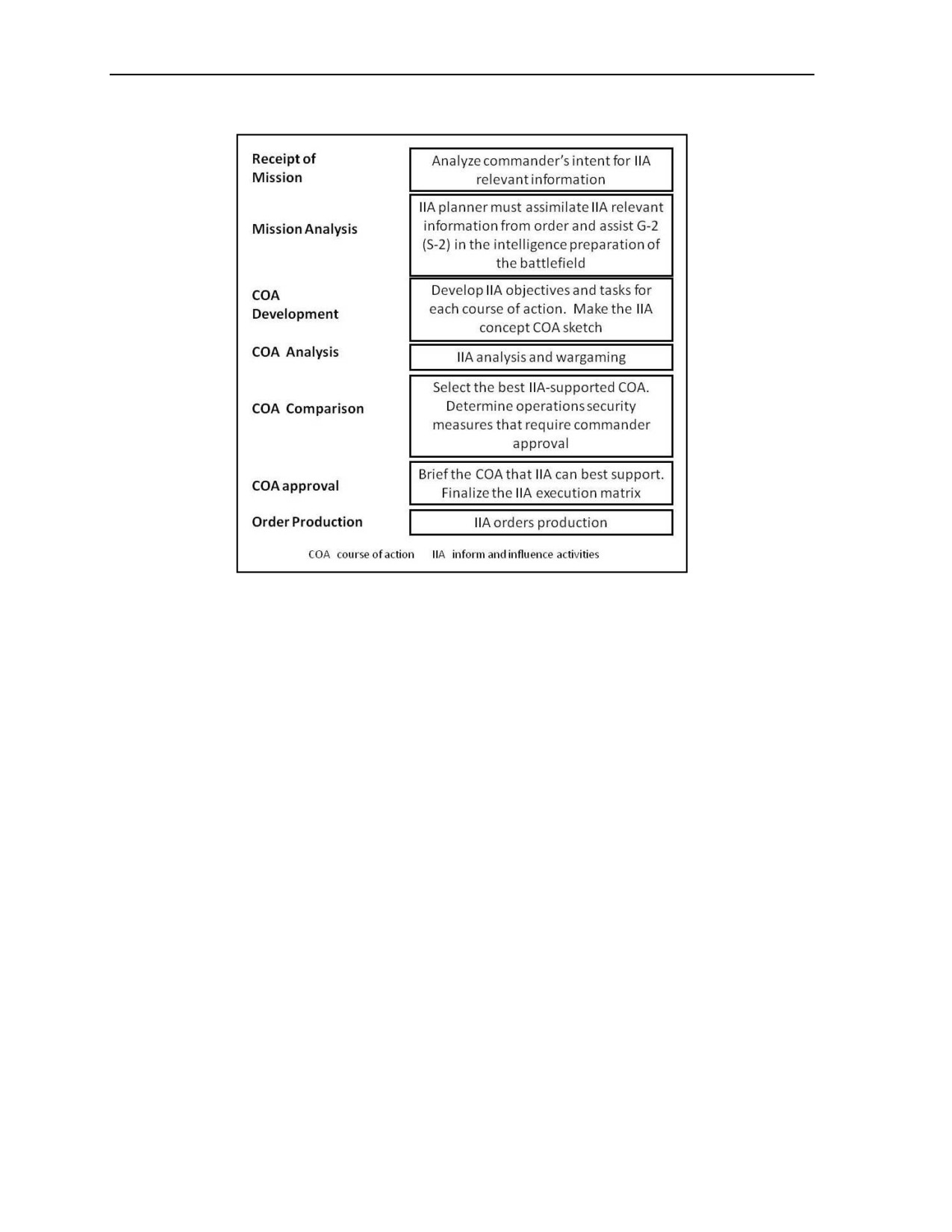
Chapter 5
40
Figure 5-1. The MDMP from an inform and influence activities perspective
41
5-6. For each step in the MDMP, the G-7 (S-7) or inform and influence activities planner is responsible
42
for actions and planning products that paragraphs 5-7 through 5-13 discuss.
43
RECEIPT OF MISSION
44
5-7. In the receipt of mission, the G-7 (S-7) participates in commander’s initial assessment actions,
45
receives the commander’s initial guidance, and performs an initial inform and influence activities
46
assessment. Lastly, this officer prepares for subsequent planning.
47
5-8. During receipt of mission, the staff updates the inform and influence activities estimate. The staff
48
also creates inform and influence activities planning products. They—
49
z
Develop input to initial intelligence preparation of the battlefield, including initial essential
50
elements of friendly information.
51
z
Develop input to initial intelligence asset tasking.
52
z
Submit information requirements in support of inform and influence activities concerning
53
adversary capability to collect essential elements of friendly information to G-2 (S-2).
54
z
Develop an inform and influence activities input to a warning order. Input includes initial
55
essential elements of friendly information.
56
MISSION ANALYSIS
57
5-9. During mission analysis, the G-7 (S-7) assists the G-2 (S-2) in conducting intelligence preparation of
58
the battlefield; submits information on threat information operations capabilities and vulnerabilities; and
59
submits inform and influence activities input to intelligence preparation of the battlefield products. This
60
officer coordinates inform and influence activities intelligence support requirements with the collection
61
manager. Lastly the G-7 (S-7) ensures the G-2 (S-2) staff clearly understands the intelligence support and
62
products required for inform and influence activities planning and execution.
5-2
FM 3-13 (FD—NOT FOR IMPLEMENTATION)
25 October 2011
Inform and Influence Activities Integration
63
5-10. The staff produces key inform and influence activities planning products during mission analysis. For
64
the inform and influence activities portion of mission analysis brief, they detail applicable concepts and
65
objectives; intelligence preparation of the battlefield tasks, assets, critical factors, and assumptions; risk
66
assessment; and information requirements. Other specific inform and influence activities products
67
include—
68
z
Requests for information for intelligence support.
69
z
A refined inform and influence activities estimate.
70
z
A statement of the inform and influence activities strategy.
71
COURSE OF ACTION DEVELOPMENT
72
5-11. During course of action development, the G-7 (S-7) provides advice on the potential impact of
73
friendly and enemy information operations activities-related actions or activities on relative combat power
74
of the two sides. This officer focuses inform and influence activities planning efforts on achieving
75
operational advantage at the decision point in each course of action. Lastly, the G-7 (S-7) develops schemes
76
of support and objectives for inform and influence activities and input to a high-payoff target list for each
77
course of action.
78
5-12. The staff produces key inform and influence activities planning products during course of action
79
development. These include—
80
z
Objectives and tasks for inform and influence activities annotated on the G-3 (S-3) sketch.
81
z
The concept for the inform and influence activities graphic (inform and influence activities
82
specific course of action sketch).
83
z
A draft task organization and synchronization input for inform and influence activities.
84
z
A high-payoff target list.
85
z
An inform and influence activities assessment plan.
86
COURSE OF ACTION ANALYSIS
87
5-13. During course of action analysis, the G-7 (S-7) assists the G-2 (S-2) with adversary information
88
operations, provides input on high-value targets, develops an inform and influence activities concept. This
89
concept supports each friendly course of action, addresses critical events, and reviews and refines task
90
organization of information-related capabilities in support of inform and influence activities.
91
5-14. The key inform and influence activities planning products built during course of action analysis
92
include an inform and influence activities wargaming worksheet and a draft task organization of
93
information-related capabilities in support of inform and influence activities. As a result of wargaming, the
94
staff also refines and integrates inform and influence activities information requirements and essential
95
elements of friendly information into the operational concept. Additionally as a result of wargaming, the
96
staff hones and synchronizes core tasks for the inform and influence activities annex.
97
COURSE OF ACTION COMPARISON
98
5-15. During course of action comparison, the G-7 (S-7) provides input. This input applies to course of
99
action selection and evaluation criteria, inform and influence activities planning products, and an inform
100
and influence activities course of action decision matrix.
101
COURSE OF ACTION APPROVAL
102
5-16. During course of action approval, the G-7 (S-7) participates in the course of action selection briefing.
103
This officer is prepared to discuss how information-related capabilities support each course of action. The
104
G-7 (S-7) helps finalize the commander’s intent based on course of action selected. The output from the
105
G-7 (S-7) is a finalized inform and influence activities execution matrix.
25 October 2011
FM 3-13 (FD—NOT FOR IMPLEMENTATION)
5-3
Chapter 5
106
ORDERS PRODUCTION
107
5-17. During order production, the G-7 (S-7) produces inform and influence activities orders. This officer
108
also produces the following planning products:
109
z
Paragraph 3.a. (subparagraph 7), paragraph 3.b, and paragraph 3.c of the base order.
110
z
Input to Annex A (Task Organization).
111
z
Annex J (Inform and Influence Activities) and its appendixes (public affairs, military deception,
112
military information support operations, and Soldier and leader engagement).
113
z
Input to other functional area annexes—intelligence, fire support, signal, and civil affairs—as
114
required.
115
116
5-4
FM 3-13 (FD—NOT FOR IMPLEMENTATION)
25 October 2011
1
Chapter 6
2
Soldier and Leader Engagement
3
This chapter discusses Soldier and leader engagement. It defines and identifies the
4
principles of Soldier and leader engagement. Then it details the types of Soldier and
5
leader engagements. Lastly this chapter discusses the roles of the command and staffs
6
in Soldier and leader engagement.
7
DEFINITION OF SOLDIER AND LEADER ENGAGEMENT
8
6-1. Soldier and leader engagement is defined as interpersonal interactions by Soldiers and leaders with
9
foreign audiences in an area of operations. It can occur as an opportunity, face-to-face encounter on the
10
street or as a scheduled meeting. This interaction can also occur via telephone calls, video teleconferences,
11
or other audio visual mediums. Soldier and leader engagement supports both the inform and the influence
12
lines of effort within the inform and influence activities construct. Soldiers and leaders conduct this
13
engagement to provide information or to influence attitudes, perceptions, and behavior. It provides a venue
14
for building relationships, resolving conflict, conveying information, calming fears, and refuting rumors,
15
lies, or incorrect information. Effectively integrating Soldier and leader engagement into operations
16
increases the potential for commanders to mitigate unintended consequences, counter adversary
17
information activities, and increase local support for friendly forces and their collective mission.
18
6-2. Commanders lead Soldier and leader engagement throughout unified land operations. A fundamental
19
and complex aspect of being a land force is that Soldiers may have to operate among local audiences.
20
Often, audiences in an area of operations look, act, and think differently from Soldiers. The aims and
21
ambitions of even a friendly or neutral audience may fail to align with those of Soldiers and leaders. As
22
such, Soldiers and leaders must be prepared to bridge these differences to build alliances, encourage
23
cooperation or noninterference, and drive a wedge between the friendly and neutral audiences and
24
adversary or enemy audiences.
25
6-3. Soldier and leader engagement is a component of a larger commander’s engagement strategy and an
26
even larger inform and influence strategy collaborated by the G-7 (S-7) through inform and influence
27
activities. This larger strategy includes public affairs engagements, especially with the media; civil-military
28
operations or civil affairs engagements, such as medical civil action programs; and civil-military
29
engagements, such as those in support of security force assistance efforts.
30
PRINCIPLES OF SOLDIER AND LEADER ENGAGEMENT
31
6-4. Six principles characterize the effective conduct of Soldier and leader engagement in support of
32
decisive actions:
33
z
Consistent.
34
z
Culturally-attuned.
35
z
Adaptive.
36
z
Credible.
37
z
Balanced.
38
z
Pragmatic.
39
CONSISTENT
40
6-5. Soldier and leader engagements are consistent when they communicate the same essential meaning
41
as other operational activities. Achieving consistency requires that commanders and their staffs understand
25 October 2011
FM 3-13 (FD—NOT FOR IMPLEMENTATION)
6-1
Chapter 6
42
effects in cognitive terms—the perceptions and interpretations that various actors and populations assign to
43
operations and the conditions they cause. When audiences perceive engagement dialogue (words) as
44
inconsistent with observable behavior (actions), Soldiers and leaders lose credibility.
45
CULTURALLY-ATTUNED
46
6-6. Soldiers and leaders conduct this engagement in the context of local customs, beliefs, and ways of
47
communicating. Doing so builds understanding and cooperation while mitigating insensitivities and
48
mistrust. Beyond familiarization with cultural practices, interacting in a culturally-attuned manner requires
49
that Soldiers and leaders understand each population’s orientation toward indirect versus direct
50
communication styles, relationship versus task, and finally, time. A cultural support team illustrates a
51
culturally-attuned engagement. These teams consist of female Soldiers. They interact with indigenous
52
women in regions where contact between a unrelated male and female is culturally unacceptable. Cultural
53
support teams enable friendly forces to interact with a key demographic group while respecting cultural
54
norms.
55
6-7. Culturally-attuned Soldier and leader engagement acknowledges that indigenous communicators and
56
leaders are sometimes the most effective at framing messages for populations within the area of operations.
57
In the past, commanders and staffs have developed messages unilaterally from their own cultural
58
perspective and simply translated them into the local languages. Invariably, something was lost in
59
translation or the message conflicted with local views or norms. Leveraging key leaders or actors from
60
target audiences allows units to draw on their familiarity and credibility with those same key audiences. It
61
increases the likelihood that an interaction will inform or influence audiences as desired. Understandably,
62
units must balance the use of such individuals against security concerns. Units should also exploit trained
63
influence specialists (such as military information support operations) and resident cultural experts to assist
64
efforts to structure carefully crafted messages and deliver them through culturally familiar means.
65
ADAPTIVE
66
6-8. Operational adaptability is the ability to shape conditions and respond to a changing operational
67
environment with appropriate, flexible, and timely actions. Successful Soldier and leader engagement
68
depends upon operational adaptability, and thus, relies on Soldiers and leaders who exhibit the ability to
69
think critically, reasoned judgment, comfort with ambiguity, willingness to accept prudent risk, and the
70
ability to rapidly adjust to evolving situations.
71
6-9. Recognizing the interpersonal and, often, cross-cultural nature of Soldier and leader engagement,
72
adaptability requires a commitment to learning. Acknowledging that a richer understanding of the target
73
audiences within an area of operations can improve human communication is a precondition for successful
74
adaptation. Engagement characterized by an assumed superiority—a conviction that a message’s inherent
75
rightness disqualifies it from audience scrutiny—fails to support the conditions necessary to discover and
76
adopt more effective communication approaches. Thus, effective Soldier and leader engagement is more
77
about dialogue and advising rather than dictating expected behavior.
78
CREDIBLE
79
6-10. Successful Soldier and leader engagement depends on trust. A fundamental criterion for trust is the
80
degree of confidence populations have in the credibility of the Army forces with whom they interact.
81
Openness and transparency, with consideration for operations security, are fundamental to this effort. Thus,
82
credibility results from an observable, sustained, and consistent pattern of factually accurate words and
83
principled deeds attuned to the local culture.
84
6-11. Establishing habitual relationships between U.S. leaders or Soldiers and representatives of key
85
audiences helps to promote credibility. The habitual partner becomes the primary conduit though which
86
information is passed. A conduit reduces the likelihood of information fratricide—the chance that key
87
audiences will receive conflicting messages or commitments from U.S. or friendly partners. It also reduces
88
the occurrence of engagement fatigue in which a single audience becomes overwhelmed by the number of
89
Soldier and leader engagements in which that audience must participate. At higher levels, these habitual
6-2
FM 3-13 (FD—NOT FOR IMPLEMENTATION)
25 October 2011
Soldier and Leader Engagement
90
engagements form the basis of strategic partnering, especially important to security force assistance and
91
building partner capacity.
92
BALANCED
93
6-12. Soldiers and leaders balance their engagement efforts between the inclination to achieve the desired
94
effect and the requirement to actively listen and understand the other’s point of view. During a single
95
Soldier and leader engagement, Soldiers or leaders may achieve little more than increased understanding of
96
the audience with which interact. Increased understanding is an acceptable objective for a Soldier and
97
leader engagement. Understanding is critical to the success of subsequent Soldier and leader engagement as
98
it lays the foundation for establishing solid relationships. A balanced approach to engagements helps to
99
ensure both parties benefit from the event.
100
6-13. Imbalanced information engagement tends to have one-way communications, implying that people
101
mutely receive information. This imbalance may create the perception with an audience that a Soldier
102
considers the audience and their ideas irrelevant, disrespected, and marginalized. These perceptions could
103
ultimately prove to be significant obstacles to future engagements and achieving a commander’s intent.
104
PRAGMATIC
105
6-14. Pragmatism involves acknowledging that the ultimate effects of one’s efforts to communicate are
106
difficult to both predict and control. Pragmatic Soldier and leader engagement accepts the unpredictable,
107
often opaque, nature of communications and operates with realistic expectations of message control.
108
Leaders guide what their units say and do. They cannot, however, control how others interpret friendly
109
force messages and actions. Soldiers and leaders understand that the culture, biases, religion, education, and
110
experience of the individuals and groups observing them shape perceptions or interpretations. Given the
111
prevalence of technology, Soldiers and leaders cannot control who eventually receives communications
112
beyond the intended receiver.
113
6-15. Pragmatism also reflects an expectation and acceptance of prudent risk. Soldiers and leaders should
114
expect small setbacks. Nurturing relationships and building trusted networks means that sometimes they
115
will interact with someone who is untrustworthy. Soldiers and leaders may even reveal those maligned
116
actors who previously went undetected.
117
6-16. Soldier and leader engagement is a long-term, building effort assessed in terms of months or years
118
rather than in hours or days. Pragmatism acknowledges that the effects of Soldier and leader engagement
119
may not be immediately achievable or recognizable. Influencing audiences within an area of operations
120
requires credibility. Building credibility, or trust, requires repeated and meaningful interaction.
121
Recognizing any resulting change from these interactions requires familiarity or experience with the culture
122
in which the Soldier and leader engagement occurs.
123
TYPES OF SOLDIER AND LEADER ENGAGEMENT
124
6-17. Two types of Soldier and leader engagements exist: deliberate and dynamic. Primarily deliberate and
125
dynamic engagements differ in the planning and execution.
126
DELIBERATE
127
6-18. Deliberate engagements are anticipated and planned interpersonal interactions undertaken to achieve
128
a specified effect or objective. These engagements may be face-to-face interactions or may be interactions
129
via other means such as telephone or video teleconference. Examples of deliberate engagements are—
130
z
Scheduled meetings with key communicators or formal leaders.
131
z
Participation in the planned opening of a local school.
132
z
Delivery of information to a ministry official.
133
6-19. Effective deliberate Soldier and leader engagement integrates other information-related capabilities.
134
This integration aims to achieve or complement desired effects. Examples of the integration of other
135
information-related capabilities into Soldier and leader engagement include—
25 October 2011
FM 3-13 (FD—NOT FOR IMPLEMENTATION)
6-3
Chapter 6
136
z
Humanitarian and civic assistance.
137
z
Military information support activities, such as delivery of military information support
138
operations products to target audiences.
139
z
Media engagements with local newspapers or radio stations coordinated by the unit public
140
affairs officer.
141
Planning
142
6-20. Soldier and leader engagement involves method planning. Appendix D discusses planning for
143
Soldier and leader engagement.
144
Preparation
145
6-21. Soldiers and leaders prepare for deliberate Soldier and leader engagements as they would any
146
military task or mission. See appendix D for preparation for Soldier and leader engagement.
147
DYNAMIC
148
6-22. Dynamic Soldier and leader engagement interactions are unanticipated or impromptu encounters for
149
which Soldiers and leaders have not conducted deliberate planning. Dynamic interactions occur frequently.
150
They may be spontaneous face-to-face conversations with local civilians during dismounted patrols or
151
unsolicited visitations by local leaders to an operating base or combat outpost.
152
6-23. Although unplanned, leaders can prepare their subordinates at all levels to negotiate impromptu
153
interactions successfully before deployment. Preparation for Soldier and leader engagement starts as early
154
as initial entry training when they begin the process of internalizing the Army Values found in FM 1.
155
Displaying respect for others and communicating honestly (integrity) inevitably increases the likelihood of
156
positive outcomes in any human interaction. Training for law of land warfare, rules of engagement, and
157
culture as well as role-playing exercises for Soldier and leader engagement all prepare Soldiers and leaders
158
to have successful interactions.
159
6-24. In theater, Soldiers and leaders use tools that communicate general guidance while enabling
160
adaptability and initiative. These tools include the commander’s intent, mission narrative, themes,
161
messages, commander’s critical information requirements, rules of engagement, and public affairs officer
162
talking points. Frequently reviewing the tools helps Soldiers and leaders act or speak in ways consistent
163
with the commander’s objectives. Units review significant activity reports, intelligence estimates or
164
summaries, and patrol reports to gain situational awareness of local grievances. In its simplest form,
165
preparation for dynamic Soldier and leader engagements reflects preparation for any military operation. Its
166
characteristics may be found in the standard operating procedure for many Army units.
167
ROLE OF THE COMMANDER IN SOLDIER AND LEADER
168
ENGAGEMENT
169
6-25. Inform and influence activities are an essential component of mission command. Mission command
170
seeks to propagate leadership throughout the organization and empower subordinates to lead at their levels.
171
Still, the commander bears the responsibilities of establishing and expressing a vision that sets everything
172
else in motion and creating an environment that encourages creative outcomes through structured
173
processes. With regard to Soldier and leader engagement, the commander—
174
z
Frames the narrative.
175
z
Is the central delivery asset for the unit for themes and messages.
176
z
Fosters a culture of engagement.
177
FRAMES THE NARRATIVE
178
6-26. Mission narrative is the expression of the operational approach for a specified mission (FM 5-0). The
179
mission narrative verbalizes the commander’s visualization for a specified mission and forms the basis for
180
the concept of operations developed during detailed planning. An explicit reflection of the commander’s
6-4
FM 3-13 (FD—NOT FOR IMPLEMENTATION)
25 October 2011
Soldier and Leader Engagement
181
logic, the staff uses the mission narrative to inform, influence, and educate the various relevant partners
182
whose perceptions, attitudes, beliefs, and behaviors are pertinent to the operation. Along with the
183
commander’s intent and initial planning guidance, the mission narrative guides the staff in its development
184
of the commander’s themes and messages.
185
IS THE CENTRAL DELIVERY ASSET
186
6-27. Commanders are the key engagers because their position and authority often invest them with the
187
greatest degree of credibility and access to undertake engagements. They do more than simply model
188
appropriate actions. During stability operations in particular, commanders should maximize interactions
189
with the local populace through frequent Soldier and leader engagement. Doing so enables commanders
190
to—
191
z
Assess attitudes, beliefs, and behaviors first-hand.
192
z
Sense shifts in perceptions, both positive and negative, and take appropriate action.
193
z
Engender the trust and confidence of the local populace.
194
z
Sense and map the social networks operative in the area of operations.
195
z
Discover who the key leaders are, as well as trusted, credible voices, both formal and informal.
196
z
Bolster confidence in and consensus behind deserving local leaders.
197
z
Deliver messages.
198
z
Assess how effectively units synchronize words, images, and actions and make needed
199
refinements.
200
z
Quickly correct adversary information.
201
z
Ensure Soldiers and subordinate leaders are engaging the populace in their areas effectively.
202
6-28. Commanders balance their duty as key engager with their understanding of cultural and local
203
dynamics. Often, indigenous leaders will only engage the commander because it serves to reinforce their
204
own importance and their people’s view of them. This may have unintentional effects, such as undermining
205
the influence of subordinate leaders in the unit or decreasing the commander’s credibility with influential
206
leaders of other target audiences.
207
FOSTERS A CULTURE OF ENGAGEMENT
208
6-29. Commanders foster a culture to achieve both their vision and their unit’s mission. As commanders
209
seek to shape a culture that exhibits and upholds the Army Values (among many other shared beliefs and
210
practices), they shape a culture of engagement. This culture buoys Soldiers’ confidence in their ability to
211
engage many audiences, especially the populace in and through which they operate. Commanders may
212
foster a culture of engagement in multiple ways:
213
z
Guidance in the development of a robust engagement strategy.
214
z
Commander’s critical information requirements and reporting requirements.
215
z
Organization of the staff (such as the engagement element).
216
z
Employment of information-related capabilities, public affairs, or military information support
217
operations for advice and assistance.
218
z
Leading by example (such as actively conducting engagements).
219
z
Training requirements (cultural and negotiation training).
220
z
Resourcing of staff (manning, funds, and time).
221
z
Building partner capacity with joint, interagency, intergovernmental, and multinational partners.
222
6-30. Critical to fostering a culture of engagement is the commander’s supplying subordinates with proper
223
training and guidance. The commander’s themes and messages and unit cultural training requirements
224
provide subordinates with critical tools for engagements. Still, Soldiers and leaders will likely make
225
mistakes as they navigate the values and norms of an unfamiliar culture. In accordance with the mission
226
command philosophy, commanders balance their response to cultural missteps with the task to actively
227
seek engagement with target audiences.
25 October 2011
FM 3-13 (FD—NOT FOR IMPLEMENTATION)
6-5
Chapter 6
228
ROLE OF THE STAFF IN SOLDIER AND LEADER ENGAGEMENT
229
6-31. The staff actively contributes to the mission narrative and Army design methodology. The staff then
230
takes the outcome of the commander’s intent, guidance, and mission narrative and turns them into plans
231
and orders. With regard to Soldier and leader engagement, the G-7 (S-7) leads staff integration. The staff
232
responsibilities include the following:
233
z
Develops an overall engagement strategy that supports the commander’s lines of effort.
234
z
Coordinates information capabilities to support planning and execution of Soldier and leader
235
engagement.
236
z
Assists the commander in writing mission narrative and themes.
237
z
Utilizes the targeting process, integrates and synchronizes deliberate engagements, and ensures
238
de-confliction.
239
z
Analyzes target audiences or individuals of interest; provides targeting packets.
240
z
Develops military information support products and delivery methods to augment Soldier and
241
leader engagement.
242
z
Collects, analyzes, and maintains engagement data.
243
z
Assesses results of engagements.
244
z
Coordinates refinement of future engagements.
245
z
Recommends re-engagement.
246
z
Updates the inform and influence running estimate.
247
6-32. Chapter 4 discusses other staff responsibilities during the planning process. Chapter 3 discusses
248
information-related capabilities through the inform and influence activities section into the planning
249
process.
250
251
252
6-6
FM 3-13 (FD—NOT FOR IMPLEMENTATION)
25 October 2011
1
Appendix A
2
Working Group
3
INFORM AND INFLUENCE ACTIVITIES WORKING GROUP
4
A-1. The inform and influence activities working group is the primary mechanism for ensuring the
5
effective and ongoing integration of all information-related capabilities. Like other working groups, the
6
inform and influence activities working group reviews ongoing efforts, evaluates their effectiveness,
7
adjusts their application as required, and determines upcoming requirements. Chaired by the G-7 (S-7), the
8
inform and influence activities working group can meet daily, weekly, or monthly, depending on the
9
situation, echelon, and time available.
10
A-2. The chief of staff, with assistance from the G-7 (S-7), determines the members of the inform and
11
influence activities working group. The chief of staff tailors the working group to the agenda. Participants
12
are selected because they represent a critical element or capability or have expertise in a field critical to the
13
inform and influence activities operation. Figure A-1 depicts the potential inform and influence activities
14
working group members.
15
chaplain
joint, interagency, intergovernmental, and
multinational representative
electronic warfare coordination cell
military deception planner
engineer coordinator
military information support operations
fire support coordinator targeting
operations security planner
foreign affairs officer
G-2 representative
other unit G-7s (S-7)s
G-3 representative
political advisor
G-5 (S-5) plans officer
public affairs officer
G-6 (S-6) signal officer
special operations forces liaison officer
G-7 (S-7) section
Staff Judge Advocate
G-9 civil affairs officer
various liaison officers
16
Figure A-1. Potential members of inform and influence activities working group
17
A-3. Active staff preparation is the key to a successful inform and influence activities working group.
18
Participants of the inform and influence activities section work together to prepare for an inform and
19
influence activities working group. Preparation tasks by the G-7 (S-7) include the following:
20
z
Notify the participants—
21
Verifying time and place of the inform and influence activities working group.
22
Identifying additional participants.
23
z
Review the status of due-outs. Contact those participants with due-outs.
24
z
Coordinate with participants who have formal input.
25
z
Publish a read-ahead packet prior to the meeting:
26
If possible, provide inform and influence activities working group materials to participants.
27
Ensure participants provide input to inform and influence activities working group
28
presentations.
29
z
Assign a recorder to take minutes for the working group.
30
A-4. The G-7 (S-7) organizes the working group in two fashions. Some organize inform and influence
31
activities working groups along the lines of a targeting meeting. Others organize the meetings similar to an
32
operations meeting. Regardless of the organization, the purpose remains the same. The working group
25 October 2011
FM 3-13 (FD—NOT FOR IMPLEMENTATION)
A-1

Appendix A
33
integrates information-related capabilities into operations and synchronizes the lines of effort of inform and
34
influence activities.
35
A-5. Targeting and inform and influence activities are both integrating processes that affect and reinforce
36
the other. As figure A-2 reveals, inform and influence are added to the list of delivery effects that the
37
targeting process seeks to achieve. Information-related capabilities provide assets that detect targets, deliver
38
effects, and then assess these effects. For example, individual Soldiers provide spot reports after interacting
39
with civilians. These reports support detection efforts. Civil affairs units provide nonlethal nation-building
40
assistance that ultimately seeks to build confidence in governance structures and separate the populace
41
from the enemy. Public affairs assets assess the impact of a specific campaign or operation by analyzing
42
media reporting.
43
Figure A-2. The Army targeting methodology
44
A-6. Inform and influence activities supports the targeting process while the targeting process helps to
45
shape how a commander informs and influences audiences. Audiences include all relevant people—
46
friendly and adversary—in and beyond the area of operations. In practical terms, this means that the G-7
47
(S-7), the inform and influence activities section, and participants in the working group have the following
48
concurrent tasks:
49
z
Contribute to the targeting process by identifying, delivering, and assessing nonlethal target sets
50
and targets.
51
z
Integrate and synchronize available information-related capabilities to achieve target objectives
52
and, more broadly, the effects necessary to support the commander’s intent.
53
z
Help the commander to frame the broader mission narrative in which the targeting process
54
occurs and ensure all discrete actions contribute to this narrative. In other words, they ensure that
55
themes and messages synchronize with actions to reinforce intended consequences and mitigate
56
unintended consequences.
A-2
FM 3-13 (FD—NOT FOR IMPLEMENTATION)
25 October 2011
Working Group
57
INFORM AND INFLUENCE ACTIVITIES SYNCHRONIZATION MATRIX
58
A-7. The primary tool employed by the G-7 (S-7) and refined and ratified by the inform and influence
59
activities working group is the synchronization matrix. The sample matrix provided in figure A-3 is a
60
comprehensive management tool that ties together objectives, themes, messages, targets, and assessments.
61
Used effectively, it helps the staff ensure that themes, messages, and actions are synchronized with each
62
other and with operations to convey a unified narrative of effects.
63
A-8. Inform and influence activities primarily strives to maximize intended consequences and mitigate
64
unintended consequences. The G-7 (S-7) and the entire staff must continually consider how to coordinate
65
what the unit does with what it says and vice versa. The synchronization matrix facilitates this
66
coordination.
25 October 2011
FM 3-13 (FD—NOT FOR IMPLEMENTATION)
A-3
Appendix A
67
Figure A-3. Example of synchronization matrix
A-4
FM 3-13 (FD—NOT FOR IMPLEMENTATION)
25 October 2011
Appendix B
Running Estimate
CONSIDERATIONS OF RUNNING ESTIMATES
B-1. A running estimate is the continuous assessment of the current situation used to determine if the
current operation is proceeding according to the commander’s intent and if planned future operations are
supportable (FM 5-0). The commander and each staff section maintain a running estimate. In their running
estimates, the commander and each staff section continuously consider the effects of new information and
update the following:
z
Facts.
z
Assumptions.
z
Friendly force status.
z
Enemy activities and capabilities.
z
Civil considerations.
z
Conclusions and recommendations.
B-2. The commander’s running estimate summarizes a problem, integrating information and knowledge
of the staff’s and subordinate commanders’ running estimates. Each staff section builds and maintains
running estimates. The running estimate helps the staff to track and record pertinent information as well as
to provide recommendations to commanders.
B-3. The running estimate assesses and analyzes the courses of action the commander is considering. It
includes an evaluation of how factors in the staff section’s functional area influence each course of action
or mission, and includes conclusions and recommendations. The commander and staff develop running
estimates as part of the operations process. They can present running estimates verbally or in writing. When
written, they may include maps, graphics, or charts. Estimates are as comprehensive as possible, yet not
overly time-consuming. A comprehensive running estimate addresses all aspects of operations and contains
both facts and assumptions based on the staff’s experience within a specific area of expertise.
SAMPLE RUNNING ESTIMATE
B-4. The inform and influence activities running estimate is an estimate tailored to the specific needs of
the inform and influence activities section. It assesses the situation in the information environment and
analyzes the best way to achieve the commander’s objectives for inform and influence activities. Leaders
focus on the information environment and the use of information by enemy and friendly forces. When
possible, the staff adds graphics to illustrate the less-tangible aspects of inform and influence activities.
B-5. The written estimate is a six-paragraph document. The first two paragraphs, Situation and
Considerations and Mission, are necessary for all plans. See figure B-1.
25 October 2011
FM 3-13 (FD—NOT FOR IMPLEMENTATION)
B-1
Appendix B
1.
SITUATION AND CONSIDERATIONS.
a. Area of Interest. Identify and describe those factors of the area of interest that affect inform
and influence activities.
b. Characteristics of the Area of Operations.
(1) Terrain. State how terrain affects each information-related capability.
(2) Weather. State how weather affects information-related capabilities.
(3) Enemy Forces. Describe enemy disposition, composition, strength, and systems within the
information environment as well as enemy capabilities and possible courses of action (COAs)
with respect to their effects on inform and influence activities.
(4) Friendly Forces. List current inform and influence activities resources in terms of
equipment, personnel, and systems. Identify additional resources available for inform and
influence activities located at higher, adjacent, or other units. List those information-related
capabilities from other military and civilian partners that may provide support within inform and
influence activities. Compare requirements to current capabilities and suggest solutions for
satisfying discrepancies.
(5) Civilian Considerations. Describe civil considerations that may affect inform and influence
activities to include possible support needed by civil authorities from inform and influence
activities as well as possible interference from civil aspects.
c. Assumptions. List all assumptions that affect inform and influence activities.
2.
MISSION. Show the restated mission resulting from mission analysis.
3.
COURSES OF ACTION.
a. List friendly COAs that were war-gamed.
b. List enemy actions or COAs that were templated that impact inform and influence activities.
c. List the evaluation criteria identified during COA analysis. All staffs use the same criteria.
4.
ANALYSIS. Analyze each COA using the evaluation criteria from COA analysis. Review enemy
actions that impact inform and influence activities as they relate to COAs. Identify issues, risks, and
deficiencies these enemy actions may create with respect to inform and influence activities.
5.
COMPARISON. Compare COAs. Rank order COAs for each key consideration. Use a decision
matrix to aid the comparison process.
6.
RECOMMENDATIONS AND CONCLUSIONS.
a. Recommend the most supportable COAs from the perspective of inform and influence
activities.
b. Prioritize and list issues, deficiencies, and risks and make recommendations on how to mitigate
them.
Figure B-1. Sample running estimate format for inform and influence activities
B-2
FM 3-13 (FD—NOT FOR IMPLEMENTATION)
25 October 2011
1
Appendix C
2
Assessment
3
ASSESSMENT TASKS
4
C-1. Assessment refers to the continuous monitoring and evaluation of the current situation, particularly
5
the enemy, and progress of an operation. Assessment entails the following three tasks:
6
z
Continuously assess the reactions and vulnerabilities of relevant audience and targets.
7
z
Continuously monitor the situation and progress of the operation toward the commander’s
8
desired end state.
9
z
Evaluate the operation against measures of effectiveness and measures of performance.
10
C-2. Assessment helps commanders to better understand current conditions and determine how the
11
operation is progressing and whether the operation is achieving desired effects. The information
12
commanders receive from the staff often shapes how they identify, frame, and seek to solve a problem.
13
Assessing the effectiveness of inform and influence activities is one of the greatest challenges confronting
14
the staff and especially the G-7 (S-7). This challenge arises because inform and influence activities effects
15
rarely occur in the physical domain, making them harder to evaluate in objective and quantitative terms.
16
Therefore, the correlation between cause and effect is usually not immediate. Effects often take weeks,
17
months, and even years to manifest themselves, rather than seconds or minutes as with lethal assets.
18
C-3. Inform and influence activities may require assessment by means other than those normally used in a
19
battle damage assessment. The G-7 (S-7) can use a variety of means to conduct assessments, some internal
20
to the organizations, others external. When time and resources permit, multiple assessment sources help to
21
corroborate other sources and strengthen the conclusions drawn from results. Assessments can be obtained
22
from various sources. The most common are—
23
z
Intelligence assets.
24
z
Soldier and leader engagement.
25
z
Civil-military operations.
26
z
Polling and surveys, often conducted by contracted organizations.
27
z
Media monitoring and analysis, especially local channels.
28
z
Reports or information sharing with joint, interagency, or nongovernmental partners.
29
z
Reports or conversations with local partners.
30
z
Passive monitoring, often by locals paid to submit reports on what they see and hear.
31
z
Patrol and spot reports.
32
C-4. Despite the challenge, assessment is vital to inform and influence activities efforts. The aim is to
33
synchronize themes, messages, and actions so the commander projects or portrays a consistent and
34
cohesive narrative. The G-7 (S-7) notes anything that compromises this aim as quickly as possible so that
35
the commander can direct adjustments and refinements to the operation plan.
36
ASSESSMENT TERMS
37
C-5. Battle damage assessment is the estimate of damage composed of physical and functional damage
38
assessment, as well as target system assessment, resulting from the application of lethal or nonlethal
39
military force (JP 3-0).
40
C-6. A measure of effectiveness is a criterion used to assess changes in system behavior, capability, or
41
operational environment that is tied to measuring the attainment of an end state, achievement of an
42
objective, or creation of an effect (JP 3-0). Measures of effectiveness focus on the results or consequences
43
of actions taken. These measures also assess the quality of those results. They answer such questions as, “Is
44
the force doing the right things? Is it achieving the effects it wants? Are additional or alternative actions
25 October 2011
FM 3-13 (FD—NOT FOR IMPLEMENTATION)
C-1

Appendix C
45
required?” Measures of effectiveness provide a benchmark against which the commander assesses progress
46
toward accomplishing the mission. Figure C-1 illustrates the development of measures of effectiveness.
47
Figure C-1. Sample MOE and MOP development
48
C-7. Numerous challenges hinder developing successful measures of effectiveness and performance for
49
inform and influence activities. These challenges include—
50
z
A lack of baseline information on the area of operations.
51
z
Media bias (local, U.S., or international).
52
z
Limited polling (overt and covert) resources.
53
z
Tester bias (pride) and qualification (training).
54
z
Limited time and resources to collect and evaluate data.
55
z
An inadequate number of samples.
56
z
Limited access to specific audiences.
57
z
Long approval times for information products.
58
z
Language and cultural differences.
59
z
Restrictions emplaced by a higher command.
60
C-8. When writing measures of effectiveness for inform and influence activities, the following guidelines
61
apply:
62
z
Give each effect one or more measure of effectiveness associated with that effect.
63
z
Use the effect’s purpose as a guide to what units must observe, report, and assess.
64
z
Include objective and subjective metrics in measures of effectiveness.
C-2
FM 3-13 (FD—NOT FOR IMPLEMENTATION)
25 October 2011
Assessment
65
z
Create subjective measures of effectiveness that are observable, quantifiable, precise, and
66
correlated to the effect.
67
z
Write the objective measures of effectiveness directly to the effect and give the commander a
68
direct input into assessment.
69
z
If a measure of effectiveness is difficult to write for a particular effect, then re-visit the effect to
70
ensure it has a clearly defined and attainable result. Re-write the effect if necessary.
71
C-9. A measure of performance is a criterion used to assess friendly actions that is tied to measuring task
72
accomplishment (JP 3-0). This quantitative measure expresses the manner in which the task or action was
73
performed. Measures of performance answer such questions as: “Did we do the things we set out to do?
74
Did we do them properly? Did we do enough or too much?” Measures of performances are based on task
75
assessment and are relatively easy to answer. Inform and influence activities examples include the number
76
of media engagements executed in a given week, the number of military information support operations
77
posters or leaflets created and disseminated, or the number of Medical Civil Assistance Program events
78
held. Figure C-1 illustrates development of measures of performance.
79
C-10. When writing a measure of performance for inform and influence activities, apply the following
80
guidelines:
81
z
Use quantity to describe how often or how many products need to be delivered to achieve the
82
effect.
83
z
Use medium to describe the product format to best deliver the message.
84
z
Use delivery to describe the best means to deliver the medium.
85
z
Use target to understand the audience as described by the effect of the medium
86
C-11. Combat assessments amass the assessments for the measures of effectiveness. A combat assessment
87
is the determination of the overall effectiveness of force employment during military operations. A combat
88
assessment answers the questions, “What did inform and influence activities do? Did inform and influence
89
activities achieve the desired effect in the cognitive domain? Should the operation be modified?” Standards
90
should be measurable. Measure of effectiveness and measures of performance require qualitative or
91
quantitative standards or metrics to measure them.
92
C-12. Several different effects exist. The first-, second-, and third-order effects apply to dimensions. A
93
first-order effect is the estimate of effects in the physical dimension (such as maneuver and combat
94
operations). This effect indicates the level to which information systems and assets were affected. A
95
second-order effect is the estimate of how the informational dimension (information quality, content, and
96
flow) was affected. Affecting information collection, processing, and dissemination can present unreliable
97
information and hinder an adversary or enemy’s command and control abilities. A third-order effect is the
98
estimate of effects in the cognitive dimension. This affects adversary and enemy perceptions, attitudes, and
99
understanding and their decisionmaking accuracy and speed.
100
C-13. Other effects apply to outcomes or actions. Intended effects are the desired outcomes, events, or
101
consequences that contribute to achievement of objectives. Unintended effects are the unanticipated or
102
undesired outcomes, events, or consequences. They can help or hinder achievement of objectives. Direct
103
effect is the result of action with no intervening effect or mechanism between act and outcome. Indirect
104
effect is the effect created through an intermediate effect or mechanism that produces a final outcome or
105
result.
106
ASSESSMENT METHODOLOGY
107
C-14. Assessment is planned into the operation from the beginning. During the military decisionmaking
108
process, the G-7 (S-7) devises the mission and objectives for inform and influence activities that will help
109
accomplish this mission. Each objective is supported by one or more measures of performance (tasks) and
110
measures of effectiveness. Within each measure of performance are one or more indicators that signal that
111
the desired activity or changed behavior is occurring. Figure C-2 provides one way to view the inform and
112
influence activities assessment process.
25 October 2011
FM 3-13 (FD—NOT FOR IMPLEMENTATION)
C-3

Appendix C
113
Figure C-2. Assessment methodology for the information objective
114
C-15. Staffs conduct a deficiency or gap analysis when units fail to meet goals and objectives. They use the
115
deficiency analysis if the task assessment and effects assessment indicate a gap between what a unit is
116
doing (measure of performance) and how well they are doing it (measure of effectiveness). The deficiency
117
analysis illustrates what is wrong (or not going as intended or desired) and provides input during the plan
118
refinement stage. Next, the staff makes a recommendation for refinement of the plan based on the
119
conclusions of the deficiency analysis. This recommendation considers if the force has the required
120
capability to make the necessary adjustments. If not, commanders may determine other courses of action or
121
request additional information-related capabilities.
122
123
C-4
FM 3-13 (FD—NOT FOR IMPLEMENTATION)
25 October 2011
1
Appendix D
2
Deliberate Engagement
3
PLANNING
4
D-1. Deliberate Soldier and leader engagement involves method planning. A deliberate Soldier and leader
5
engagement plan involves developing the commander’s intent, commander’s themes, mission narrative,
6
mission statement, intelligence preparation of the battlefield, rules of engagement, and an assessment of the
7
area of operations. Planning considerations for Soldier and leader engagement are accounted for within the
8
targeting methodology of decide, detect, deliver, and assess.
9
DECIDE
10
D-2. Soldiers and leaders determine the answers to who, what, when, and where in their planning. When
11
deciding who is involved, they identify the key informal or formal leaders, actors, and target audiences.
12
Military information support forces are uniquely qualified to analyze the operating environment and
13
populations within that environment. Soldiers and leaders include these forces in the planning process.
14
D-3. Commanders decide what they want to achieve through interaction with various audiences within the
15
area of operations. Often they nest effects or objectives of the Soldier and leader engagement with their
16
commander’s intent. They also decide what effects best complement other operations within the operational
17
area.
18
D-4. Soldiers and leaders determine the frequency and timing of Soldier and leader engagement. They
19
decide how often they should engage the target and when to engage the target. Soldiers and leaders verify
20
that the timing of the engagement does not conflict with other operations (lethal or nonlethal) in the
21
operational area.
22
D-5. Soldiers and leaders determine the best location and setting in which to conduct meetings.
23
Intelligence support of the battlefield, cultural assessments, and current events may influence the venue for
24
Soldier and leader engagement.
25
DETECT
26
D-6. Just as knowing the location of a target is critical to lethal engagement, knowing the knowledge,
27
attitudes, and perceptions of an audience is critical to successful deliberate Soldier and leader engagement.
28
To simplify, in lethal targeting, one needs to know where someone stands on the ground, while in Soldier
29
and leader engagement one needs to know where someone stands on an issue. Unfortunately, gaining
30
information on knowledge, perceptions, and attitudes often requires creative collection methods. Possible
31
detection methods are:
32
z
Face-to-face or telephone conversations or overheard discussions.
33
z
Telephone hotlines.
34
z
Visual collection (activity).
35
z
Intelligence asset collection.
36
z
Written communications such as signs, posters, and billboards.
37
z
Media and Internet. Local, regional, and global media sources and Internet websites offer insight
38
into attitudes and perceptions of local populace.
39
D-7. Possible detection assets are:
40
z
Military information support operations.
41
z
Political or cultural advisor.
42
z
Human terrain team.
43
z
Combat patrols and their reports.
25 October 2011
FM 3-13 (FD—NOT FOR IMPLEMENTATION)
D-1
Appendix D
44
z
Civil affairs and civil-military operations center.
45
z
All-source intelligence assets.
46
z
Centers of excellence, the Defense Language Institute, and other academic institutions.
47
D-8. Forces for military information support operations are trained specifically to analyze potential target
48
audiences and the information environments in which they live to determine baseline perceptions and
49
develop trend analysis over time. Surveys of target audiences and informal face-to-face contact further
50
assess perceptions and attitudes toward both friendly force operations and adversary and enemy operations.
51
Forces assemble key information. This information consists of demographics, media infrastructures, values
52
and beliefs, symbolic views, and education. As a group, this information documents the best types of
53
products and delivery methods forces can use to effectively send messages without negative effects.
54
D-9. Political and cultural experts have special insight into the local population’s culture and their
55
traditional power and influence structures. Additionally, these experts can provide recommendations for
56
best practices for communication. Typically they accompany commanders during engagements.
57
D-10. The human terrain team provides several capabilities, including socio-cultural expertise, research,
58
analysis, and data-collection.
59
D-11. Combat Patrols collect data from deliberate or dynamic (Soldier and leader engagement) reported in
60
daily patrol reports submitted by units within the area of operations.
61
D-12. Civil affairs Soldiers provide civil reconnaissance capabilities, experience with working with civilian
62
leadership, and training in conducting bilateral engagements and negotiations. The civil-military operations
63
center often provides insight to local perceptions, attitudes, and social and power dynamics.
64
D-13. All-source intelligence assets consist of human intelligence, open-source intelligence, and signals
65
intelligence. Intelligence disciplines and collection assets provide relevant information and processed
66
intelligence products that enable forces to assess local attitudes about operations or key issues.
67
D-14. Centers of excellence, the Defense Language Institute, and academic institutions provide reachback
68
capability, analysis, and subject matter expertise. Forces use these assets to inform commanders and their
69
staffs about the attitudes of target audiences. More importantly, these organizations act as man-power
70
augmentation for units that lack the people or time to extensively analyze collected data.
71
DELIVER
72
D-15. The G-7 (S-7) coordinates closely with other staff elements to determine best method for delivery of
73
Soldier and leader engagement effects and achieving Soldier and leader engagement objectives. Most
74
importantly, the G-7 (S-7) integrates diverse information-related capabilities to maximize the opportunity
75
for operational success. Examples of delivery methods include:
76
z
Private meeting.
77
z
Provincial, regional, or district council meeting.
78
z
Humanitarian and civic assistance.
79
z
Face-to-face public interaction.
80
z
Telephone conversation or video teleconference.
81
z
Meeting with local merchants or residents.
82
ASSESS
83
D-16. One of the most difficult aspects of Soldier and leader engagement is assessment. During planning
84
the G-7 (S-7) accounts for—
85
z
Measures of performance.
86
z
Measures of effectiveness.
87
z
Reporting protocols.
88
z
Re-engagement criteria or triggers.
89
z
Subjective assessments of delivery method and asset.
D-2
FM 3-13 (FD—NOT FOR IMPLEMENTATION)
25 October 2011
Deliberate Engagement
90
z
Tracking of commitments.
91
z
Expressed grievances or appreciation.
92
D-17. The G-7 (S-7) measures performance. The officer checks that the message was delivered and
93
understood as planned to the intended individual or group.
94
D-18. The G-7 (S-7) measures effectiveness. The officer measures that the individual or group responded
95
or behaved as desired. This officer notes what actions it expects the individual or group to indicate that they
96
support the message.
97
D-19. As part of planning, the G-7 (S-7) follows certain reporting protocols during deliberate Soldier and
98
leader engagement. This officer includes priority information requirements as part of the commander’s
99
critical information requirements. The G-7
(S-7) formalizes reporting requirements for information
100
captured from Soldier and leader engagement information requirements within the command. Finally, the
101
G-7 (S-7) communicates suspense for post-Soldier and leader engagement reports in the operation order.
102
D-20. The G-7 (S-7) and other staff sections also determine the conditions that demand re-engagement
103
criteria or triggers of Soldier and leader engagement targets.
104
D-21. The G-7 (S-7) accounts for subjective assessments of those engaged. Capturing the impressions that
105
Soldiers and leaders experienced during interactions may inform the assessment process. Interpreters or
106
observers often provide helpful insight into capturing cultural idiosyncrasies. They notice some nonverbal
107
cues, facial expressions and gestures, voice intonation and inflection, or certain idiomatic expressions and
108
jargon.
109
D-22. The G-7 (S-7) accounts for tracking commitments or promises during planning. This officer notes
110
commitments or promises made by those conducting Soldier and leader engagement. The G-7 (S-7)
111
captures and shares those promises made for continuity and avoidance of information fratricide.
112
D-23. During planning, the G-7 (S-7) accounts for expressed grievances or appreciation. Understanding the
113
perceived issues of the population or the acknowledged unit successes may help assess Soldier and leader
114
engagement or other friendly operations and can inform future engagements. Soldiers and leaders should
115
scrutinize both, however, as cultural or political dynamics may result in over-emphasis or misrepresentation
116
for personal or collective gain.
117
PREPARATION
118
D-24. Soldiers and leaders prepare for deliberate Soldier and leader engagements as they would any
119
military task or mission. Some preparation—such as language and cultural preparation—occurs prior to
120
deployment. Cultural understanding, survival-level language, and negotiation training prepare Soldiers and
121
leaders to address the typically unfamiliar and dynamic foreign environment encountered by Soldier and
122
leader engagement.
123
D-25. In theater, units have numerous tactics, techniques, and procedures for capturing the data necessary
124
to conduct Soldier and leader engagement. Regardless of the preferred format, before executing the
125
mission, Soldiers and leaders should know or have the following information:
126
z
Subject’s target’s name.
127
z
Title or role of subject or target.
128
z
Relevant affiliations of target (religious, political, social).
129
z
Location of the engagement.
130
z
Date-time group of the engagement.
131
z
Picture (if available).
132
z
Others to be present at engagement and summary of relevance to event.
133
z
Commander’s intent or desired effect of the engagement, subject, or target.
134
z
Best alternative to negotiated agreement (if negotiating) for both parties.
135
z
Fields of possible agreement between parties.
136
z
Talking points, key themes, and messages.
137
z
Local grievances or sensitive issues.
25 October 2011
FM 3-13 (FD—NOT FOR IMPLEMENTATION)
D-3
Appendix D
138
z
Summary of previous engagements (if conducted) should include agreements made, kept, and
139
those unmet.
140
z
Agenda for Soldier and leader engagement (general order of events).
141
D-26. Additionally, Soldiers and leaders review relevant guidance from higher-level guidance as well as
142
recent updates to estimates or activity in the area of operations. Reviewing the commander’s intent, themes,
143
and public affairs officer’s talking points decreases the risk that information provided or action taken
144
during a Soldier and leader engagement contradicts higher-level guidance and themes. Finally, Soldiers and
145
leaders review local grievances and enemy activity. Understanding the issues most relevant to key leaders
146
or actors allows the Soldier to plan responses to potential accusations or queries.
147
D-27. In theater, Soldiers and leaders should rehearse planned engagements under conditions that closely
148
approximate the environment and conditions in which they will be conducted. If they use an interpreter,
149
they must include the interpreter in the rehearsal. They can rehearse the dialogue they plan to use during the
150
Soldier and leader engagement or use a back-translation for a document. (A back-translation is a translated
151
document translated back into the original language and then compared with the original to ensure the
152
meanings match.) Following these procedures assists in mitigating the risk that information contradicts the
153
commander's intent or guidance.
154
155
D-4
FM 3-13 (FD—NOT FOR IMPLEMENTATION)
25 October 2011
Glossary
SECTION I - ACRONYMS AND ABBREVIATIONS
DA
Department of the Army
FM
field manual
G-2 (S-2)
assistant chief of staff, intelligence
G-3 (S-3)
assistant chief of staff, operations
G-7 (S-7)
assistant chief of staff, information engagement
JP
joint publication
MDMP
military decisionmaking process
U.S.
United States
SECTION II - TERMS
battle damage assessment
The estimate of damage composed of physical and functional damage assessment, as well as target
system assessment, resulting from the application of lethal or nonlethal military force. (JP 3-0)
combat power
The total means of destructive, constructive, and information capabilities that a military unit or
formation can apply at a given time (ADRP 3-0)
*deceive
To cause a person to believe what is not true.
*degrade
To use nonlethal or temporary means to reduce the effectiveness or efficiency of targeted information
system and information collection efforts or means.
*deny
To withhold information about friendly forces, operations, or situations that can be used by the
adversary and enemy.
*destroy
To use lethal and nonlethal means to physically render enemy information useless or information
systems ineffective unless reconstituted.
*destroy
To use lethal and nonlethal means to physically render enemy information useless or information
systems ineffective unless reconstituted.
*detect
To discover or discern the existence, presence, or fact of an intrusion into information systems.
*exploit
To gain access to targeted information networks to collect information or to insert false or misleading
information
*field support team
A mission-tailored team of subject matter experts that provides direct support for information
operations or inform and influence activities to the ARFORs and joint task forces of land components
of combatant commands, and corps and divisions as requested.
*influence
To cause audiences to think or behave in a manner favorable to the commander’s objectives.
25 October 2011
FM 3-13 (FD—NOT FOR IMPLEMENTATION)
Glossary-1
Glossary
*inform and influence activities
The integration of designated information-related capabilities in order to synchronize themes,
messages, and actions with operations to inform U.S. and global audiences, influence foreign
audiences, and affect adversary and enemy decisionmaking.information environment.
The aggregate of individuals, organizations, and systems that collect, process, disseminate or act on
information (JP 3-13)
*information fratricide
The result of employing information-related capabilities operations elements in a way that causes
effects in the information environment that impede the conduct of friendly operations or adversely
affect friendly forces.
information management
The science of using procedures and information systems to collect, process, store, display,
disseminate, and protect data, information, and knowledge products (FM 6-0)
information operations
The integrated employment, during military operations, of information-related capabilities in concert
with other lines of operation to influence, disrupt, corrupt, or usurp the decision-making of adversaries
and potential adversaries while protecting our own (JP 1-02)
knowledge management
The art of creating, organizing, applying, and transferring knowledge to facilitate situational
understanding and decisionmaking (FM 6-0)
measure of effectiveness
A criterion used to assess changes in system behavior, capability, or operational environment that is
tied to measuring the attainment of an end state, achievement of an objective, or creation of an effect.
(JP 3-0)
measure of performance
A criterion used to assess friendly actions that is tied to measuring task accomplishment. (JP 3-0)
mission command
The exercise of authority and direction by the commander using mission orders to enable disciplined
initiative within the commander’s intent to empower agile and adaptive leaders in the conduct of
unified land operations. It is commander-led and blends the art of command and the science of control
to integrate the warfighting functions to accomplish the mission. (FM 6-0)
mission command system
The arrangement of personnel, networks, information systems, processes and procedures, and facilities
and equipment that enables commanders to conduct operations. (FM 6-0)
operational environment
A composite of the conditions, circumstances, and influences that affect the employment of
capabilities and bear on the decisions of the commander. (JP 3-0)
running estimate
The continuous assessment of the current situation used to determine if the current operation is
proceeding according to the commander’s intent and if planned future operations are supportable.
(FM 5-0)
situational understanding
The product of applying analysis and judgment to relevant information to determine the relationships
among the mission variables to facilitate decisionmaking. (FM 6-0)
Glossary-2
FM 3-13 (FD—NOT FOR IMPLEMENTATION)
25 October 2011
Glossary
strategic communication
United States Government efforts to understand and engage key audiences to create, strengthen, or
preserve conditions favorable for the advancement of United States Government interests, policies, and
objectives through the use of coordinated programs, plans, themes, messages, and products
synchronized with the actions of all instruments of national power. (JP 5-0)
25 October 2011
FM 3-13 (FD—NOT FOR IMPLEMENTATION)
Glossary-3
References
Field manuals and selected joint publications are listed by new number followed by
old number.
REQUIRED PUBLICATIONS
These documents must be available to intended users of this publication.
FM 1-02 (101-5-1). Operational Terms and Graphics. 21 September 2004.
JP 1-02. Department of Defense Dictionary of Military and Associated Terms. 8 November 2010.
RELATED PUBLICATIONS
These documents contain relevant supplemental information.
JOINT AND DEPARTMENT OF DEFENSE PUBLICATIONS
Most joint publications are available online: <http://www.dtic.mil/doctrine/new_pubs/jointpub.htm.>
JP 3-0. Joint Operations. 11 August 2011.
JP 3-13. Information Operations. 13 February 2006.
JP 5-0. Joint Operation Planning. 11 August 2011.
ARMY PUBLICATIONS
FM 1. The Army. 14 June 2005.
FM 2-0. Intelligence. 23 March 2010.
FM 2-01.3. Intelligence Preparation of the Battlefield/Battlespace. 15 October 2009.
FM 3-05.40.Civil Affairs Operations. 29 September 2006.
FM 3-28. Civil Support Operations. 20 August 2010.
FM 3-36. Electronic Warfare in Operations. 25 February 2009.
FM 3-37. Protection. 30 September 2009.
FM 3-53. Military Information Support
FM 3-55.12. Multi-Service Tactics, Techniques, and Procedures for Joint Combat Camera Operations.
24 May 2007.
FM 5-0. The Operations Process. 26 March 2010.
FM 6-0. Mission Command. 13 September 2011.
FM 6-0.1. Knowledge Management Section. 29 August 2008.
FM 46-1. Public Affairs Operations. 30 May 1997.
REFERENCED FORMS
DA Form 2028. Recommended Changes to Publications and Blank Forms. February 1974.
25 October 2011
FM 3-13 (FD—NOT FOR IMPLEMENTATION)
References-1
Index (Chapter Title)
F
M
S
first, 1-1
main, 1-1
second, 1-1
25 October 2011
FM 3-13 (FD—NOT FOR IMPLEMENTATION)
Index (Chapter Title)-1
ATP 2-33.4
Intelligence Analysis
August 2014
DISTRIBUTION RESTRICTION: Distribution authorized to U.S. Government agencies and their contractors only,
because it requires protection as specified by Memorandum, Deputy Chief of Staff, G-3/5/7, DAMO-ODA-A,
30 August 2010, subject: Operations Security Guidance for Counter-Improvised Explosive Device (C-IED) and
Improvised Explosive Device Defeat (IEDD). This determination was made on 2 March 2013. Other requests for
this document must be referred to ATTN: ATZS-CDI-D, U.S. Army Intelligence Center of Excellence, Fort
Huachuca, AZ 85613-7017, or via e-mail at usarmy.huachuca.icoe.mbx.doctrine@mail.mil.
DESTRUCTION NOTICE: Destroy by any method that will prevent disclosure of contents or reconstruction of the
document.
Headquarters, Department of the Army
FOR OFFICIAL USE ONLY
This publication is available at Army Knowledge Online
To receive publishing updates, please subscribe at
*ATP 2-33.4
Army Techniques Publication
Headquarters
Department of the Army
No. 2-33.4
Washington, DC, 18 August 2014
Intelligence Analysis
Contents
Page
PREFACE
v
INTRODUCTION
vii
PART ONE ANALYSIS FUNDAMENTALS AND SKILLS
Chapter 1
FUNDAMENTALS OF INTELLIGENCE ANALYSIS
1-1
Overview
1-1
The Analytical Process
1-3
Single-Source Analysis
1-3
All-Source Intelligence
1-4
Collaboration
1-4
Collaboration and the Intelligence Warfighting Function
1-5
Automation Support to Intelligence Analysis
1-5
Chapter 2
ANALYTIC SKILLS
2-1
Overview
2-1
Basic Thinking Abilities
2-1
Critical and Creative Thinking
2-2
Avoiding Analytical Pitfalls
2-9
PART TWO FUNDAMENTAL TASK TECHNIQUES
Chapter 3
BASIC STRUCTURED ANALYTIC TECHNIQUES
3-1
Overview
3-1
Sorting
3-2
Matrices
3-3
Threat Intentions Matrix
3-5
DISTRIBUTION RESTRICTION: Distribution authorized to U.S. Government agencies and their contractors only
because it requires protection as specified by Memorandum, Deputy Chief of Staff, G-3/5/7, DAMO-ODA-A,
30 August 2010, subject: Operations Security Guidance for Counter-Improvised Explosive Device (C-IED) and
Improvised Explosive Device Defeat (IEDD). This determination was made on 2 March 2013. Other requests for
this document must be referred to ATTN-ATZS-CDI-D, U.S. Army Intelligence Center of Excellence, Fort
Huachuca, AZ 85613-7017, or via e-mail at usarmy.huachuca.icoe.mbx.doctrine@mail.mil.
DESTRUCTION NOTICE: Destroy by any method that will prevent disclosure of contents or reconstruction of the
document.
*This publication supersedes TC 2-33.4, dated 1 July 2009.
i
FOR OFFICIAL USE ONLY
Contents
Event Mapping
3-6
Event Trees
3-7
Subjective Probability
3-9
Weighted Ranking
3-11
Chapter 4
DIAGNOSTIC ANALYTIC TECHNIQUES
4-1
Overview
4-1
Deception Detection
4-1
Key Assumptions Check
4-2
Quality of Information Check
4-4
Indicators
4-5
Conducting Studies
4-9
Chapter 5
CORE ARMY ANALYTIC TECHNIQUES
5-1
Overview
5-1
Analytic Techniques
5-1
Section I - Developing Situational Understanding and Conclusions
5-2
Brainstorming
5-2
Comparison
5-4
Mathematical Analysis
5-5
Situational Logic
5-8
Section II - Analyzing Complex Networks and Associations
5-8
Link Analysis
5-8
Network Analysis
5-14
Sociometrics or Social Network Analysis
5-24
Section III - Conducting Pattern Analysis
5-25
Chronologies
5-26
Pattern Analysis Plot Sheet
5-28
Incident Overlay
5-30
Pattern of Life Analysis
5-31
PART THREE CONSIDERATIONS FOR DECISIVE ACTION AND UNIQUE MISSIONS
Chapter 6
ANALYTIC SUPPORT TO DECISIVE ACTION
6-1
Overview
6-1
Analytic Support to Unified Land Operations
6-1
Analytic Support to Unique Activities
6-10
Chapter 7
ANALYTIC SUPPORT TO UNIQUE MISSIONS
7-1
Overview
7-1
Counterinsurgency
7-1
Counter-Improvised Explosive Device
7-2
Site Exploitation
7-4
Appendix A EMERGING ANALYTIC TECHNIQUES
A-1
Appendix B INDICATORS IN DECISIVE ACTION
B-1
GLOSSARY
Glossary-1
REFERENCES
References-1
INDEX
Index-1
ii
ATP 2-33.4
18 August 2014
Contents
Figures
Figure
2-1. The elements of thought
2-3
Figure
3-1. Matrix example
3-4
Figure
3-2. Threat intention matrix
3-5
Figure
3-3. Example of event mapping
3-6
Figure
3-4. Event tree example
3-8
Figure
3-5. Subjective probability example
3-9
Figure
3-6. Weighted ranking example
3-13
Figure
5-1. Matrix comparing courses of action
5-4
Figure
5-2. Comparison of targets
5-5
Figure
5-3. Example association matrix
5-10
Figure
5-4. Example activities matrix
5-12
Figure
5-5. Example link diagram
5-13
Figure
5-6. Nodal linkage example
5-16
Figure
5-7. Hierarchical organization
5-17
Figure
5-8. Networked organization and structural options example
5-18
Figure
5-9. Network chain
5-19
Figure
5-10. Network hub-and-wheel
5-19
Figure
5-11. All-channel network
5-19
Figure
5-12. Affiliated associate network
5-20
Figure
5-13. Centrality example
5-21
Figure
5-14. Network density comparison
5-23
Figure
5-15. Example to change in tactics based on density shifts
5-23
Figure
5-16. Fragmented network
5-24
Figure
5-17. Timeline example
5-27
Figure
5-18. Time event chart example
5-28
Figure
5-19. Pattern analysis plot sheet example
5-29
Figure
5-20. Incident overlay example
5-30
Figure
7-1. Example of an improvised explosive device activity model
7-3
Figure A-1. Futures wheel example
A-18
Tables
Introductory table 1. Summary of changes
vii
Table 2-1. Checklist for reasoning
2-5
Table 3-1. Subjective probability table
3-10
Table 6-1. Use of basic diagnostic analytical techniques
6-5
Table 6-2. Use of core Army analytical techniques
6-6
Table 6-3. Use of emerging and other structured analytical techniques
6-8
Table 7-1. Possible nodes located in an improvised explosive device network
7-3
18 August 2014
ATP 2-33.4
iii
Contents
Table B-1. Offensive indicators
B-2
Table B-2. Defensive indicators
B-3
Table B-3. Delaying indicators
B-4
Table B-4. Withdrawal indicators
B-5
Table B-5. Population indicators
B-5
Table B-6. Propaganda indicators
B-7
Table B-7. Commodities indicators
B-8
Table B-8. Environment-related indicators
B-10
Table B-9. Improvised explosive device indicators, observables, and signatures
B-10
Table B-10. Threat environment indicators
B-11
Table B-11. Recurrence of same-clan indicators
B-11
iv
ATP 2-33.4
18 August 2014
Preface
ATP 2-33.4 provides information on how intelligence personnel conduct intelligence analysis in support of
unified land operations. It describes approaches used to conduct intelligence analysis and describes how
intelligence analysis assists commanders with understanding the complex environments in which Army forces
conduct operations. This manual emphasizes the act of intelligence analysis as a collaborative networked
activity. This manual complements doctrinal guidance provided in ADP 2-0 and ADRP 2-0.
ATP 2-33.4 provides direction for intelligence personnel at all echelons. The principal audience for ATP 2-33.4
is Army intelligence officers, noncommissioned officers, Soldiers, and civilians. This publication provides
guidelines for the conduct of intelligence analysis to commanders and staffs of Army units and is recommended
for incorporation into institutional programs of instruction and unit training. Commanders and staffs of Army
headquarters serving as joint task force or multinational headquarters should also refer to applicable joint or
multinational doctrine concerning the range of military operations and joint or multinational forces. Trainers
and educators throughout the Army will also use this manual.
Commanders, staffs, and subordinates ensure their decisions and actions comply with applicable U.S.,
international, and, in some cases, host-nation laws and regulations. Commanders at all levels ensure their
Soldiers operate in accordance with the law of war and the rules of engagement. (See FM 27-10.)
This publication contains copyrighted material.
ATP 2-33.4 uses joint terms where applicable. Selected joint and Army terms and definitions appear in both the
glossary and the text. For definitions shown in the text, the term is italicized and the number of the proponent
publication follows the definition.
ATP 2-33.4 applies to the Active Army, the Army National Guard/Army National Guard of the United States,
and the United States Army Reserve unless otherwise stated.
The proponent of ATP 2-33.4 is the U.S. Army Intelligence Center of Excellence. The preparing agency is the
Capabilities Development and Integration Division, U.S. Army Intelligence Center of Excellence, Fort
Huachuca, Arizona. Send comments and recommendations on a DA Form 2028 (Recommended Changes to
Publications and Blank Forms) to Commander, U.S. Army Intelligence Center of Excellence,
ATTN ATZS-CDI-D (ATP 2-33.4), 550 Cibeque Street, Fort Huachuca, AZ 85613-7017; by e-mail to
usarmy.huachuca.icoe.mbx.doctrine@mail.mil; or submit an electronic DA Form 2028.
18 August 2014
ATP 2-33.4
v
Acknowledgements
The critical thinking material has been used with permission from The Foundation for Critical Thinking,
www.criticalthinking.org , The Thinker’s Guide to Analytic Thinking, 2012 and The Miniature Guide to Critical
Thinking: Concepts and Tools, 2009, by Dr. Linda Elder and Dr. Richard Paul. The copyright owners have
granted permission to reproduce material from their works. With their permission, some of the text has been
paraphrased and adapted for military purposes.
vi
ATP 2-33.4
18 August 2014
Introduction
ATP 2-33.4 discusses doctrinal techniques: non-prescriptive ways or methods for performing missions,
functions, or tasks as they apply to intelligence analysis. The intelligence warfighting function focuses first
on the threat network and second on the neutral network. ATP 2-33.4—
• Discusses analysis techniques performed by all intelligence Soldiers and civilians in each of the
intelligence disciplines.
• Describes the steps involved in implementing the analytic techniques presented.
• Describes critical thinking in detail.
Note. Critical thinking is a deliberate process of thought used to objectively evaluate data.
Critical thinking is the process of analyzing and assessing thinking with a view to improving it.
Critical thinking presupposes knowledge of the most basic structures in thinking (the elements of
thought) and the most basic intellectual standards for thinking (universal intellectual standards).
Critical thinking is key to the analysis conducted to better understand situations.
ATP 2-33.4 does not contain—
• Fundamentals on intelligence and the Army’s intelligence warfighting function. ADP 2-0 and
ADRP 2-0 describe this doctrine.
• Techniques used to perform intelligence preparation of the battlefield (IPB). FM 2-01.3 contains
this doctrine.
• Information on how tasks specific to individual intelligence disciplines are conducted. Discipline-
specific publications contain this doctrine.
• Information on manning documents or intelligence support to the various echelons. This
information is contained in publications on intelligence support to brigade combat teams, corps,
divisions, and echelons above corps.
Introductory table 1 outlines the changes in ATP 2-33.4.
Introductory table 1. Summary of changes
Chapter 1—Fundamentals of Intelligence Analysis
Chapter 1 is a revision of chapter 1 of the previous manual and provides—
• An overview discussion on the intelligence analysis process.
• An introductory discussion of single- and all-source analysis.
• A discussion of collaboration and automation support to intelligence analysis.
The redundant material from the previous manual was removed. This included information on the
intelligence warfighting function, the intelligence analyst, the intelligence process, intelligence preparation
of the battlefield, the intelligence running estimate, and the military decisionmaking process.
Chapter 2—Analytic Skills
Chapter 2 is a new chapter that discusses—
• Basic thinking abilities.
• Critical and creative thinking.
• How to identify and avoid analytical pitfalls.
18 August 2014
ATP 2-33.4
vii
Introduction
Introductory table 1. Summary of changes (continued)
Chapter 3—Basic Structured Analytic Techniques
Chapter 3 is a revision of portions of chapter 5 of the previous manual, which consolidated all the
analytical tools and techniques. ATP 2-33.4 subdivides these analytical tools and techniques into three
chapters (chapters 3, 4, and 5). Chapter 3—
• Describes the basic structured analytical techniques necessary to support problem solving.
• Discusses techniques that include sorting, matrices, threat intentions matrix, event mapping,
event trees, subjective probability, and weighted ranking.
Chapter 4—Diagnostic Analytic Techniques
Chapter 4 is a revision of portions of chapter 5 of the previous manual, which consolidated all the
analytical tools and techniques. ATP 2-33.4 subdivides these analytical tools and techniques into three
chapters (chapters 3, 4, and 5). Chapter 4—
• Discusses the primary purpose of diagnostic techniques to make analytic arguments,
assumptions, and/or intelligence gaps more transparent.
• Discusses techniques that include deception detection, key assumptions check, quality of
information check, indicators, and argument mapping.
Chapter 5—Core Army Analytic Techniques
Chapter 5 is a revision of portions of chapter 5 of the previous manual, which consolidated all the
analytical tools and techniques. ATP 2-33.4 subdivides these analytical tools and techniques into three
chapters (chapters 3, 4, and 5). Chapter 5—
• Discusses the core Army analytic techniques used at the strategic, operation, and tactical levels
and are routinely used by Army intelligence personnel conducting intelligence analysis.
• Discusses core Army techniques often incorporated into multiple basic structured analytic
techniques in combination with diagnostic techniques.
Chapter 6—Analytic Support to Decisive Action
Chapter 6 is a new chapter that discusses the analytical support to decisive action. It—
• Addresses the analytical support process to offensive, defensive, stability, and defense support to
civil authorities tasks.
• Describes analytical support to unique operations, to include building partnership capacity,
protection, and synchronizing information-related capabilities.
Chapter 7—Analytic Support to Unique Missions
Chapter 7 is a new chapter which discussed the analytic support required in unique missions. Unique
missions discussed in this chapter include—
• Counterinsurgency.
• Counter-Improvised Explosive Devices.
• Site Exploitation.
Appendix A—Emerging Analytic Techniques
Appendix A discusses in detail some of the more common techniques in use at the strategic and
operational levels. These techniques discussed are categorized under contrarian techniques, imaginative
techniques, and basic structured analytic techniques, although there is often overlap in specific
techniques.
Appendix B—Indicators in Decisive Action
Appendix B discusses and provides extensive examples of various indicators. The examples identify the
different types of indicators, as well as applicable activities. These tables are exemplary, not all inclusive.
The examples are designed to provide a starting point for more in-depth specific analysis for an
operation.
Term Changes
Not applicable.
viii
ATP 2-33.4
18 August 2014
PART ONE
Analysis Fundamentals and Skills
Chapter 1
Fundamentals of Intelligence Analysis
This chapter discusses the fundamentals of intelligence analysis. It defines the
intelligence analysis process and describes this process for single-source and all-
source analysis. This chapter also addresses collaboration through the intelligence
warfighting function and the automation support required to effectively perform the
analysis process.
OVERVIEW
1-1. Analysis is the examination of information in detail in order to understand it better and evaluate data
in order to develop knowledge or conclusions. Information is processed data of every description which
may be used when conducting analysis; information generally provides some of the answers to who, what,
where, and when questions. Knowledge is the fact or condition of knowing something with familiarity
gained through experience or association derived from information, facts, and descriptions. Knowledge
helps ascribe meaning and value to the conditions or events within an operation. Analysis performed by
intelligence personnel helps create knowledge in support of decisionmaking.
1-2. Commanders make decisions based on their understanding of the environment in which they are
operating; intelligence analysis aids the commander in gaining the situational understanding necessary to
decisionmaking. Forming a coherent intelligence picture during the decisionmaking process is difficult. In
addition to determining how the physical environment may affect operations, intelligence personnel must
assess how the presence and actions of thinking threats and civilian populations can influence situations
and affect desired outcomes. Intelligence personnel must often assess extremely complex situations.
1-3. Intelligence personnel must accept and embrace ambiguity in conducting analysis. Training,
knowledge, and experience are all critical parts of dealing with uncertainty. Intelligence personnel never
have all the information necessary to make an intelligence assessment. To be effective, intelligence
personnel must have a detailed awareness of their commander’s requirements and a thorough understanding
of the intelligence process and its ability to satisfy those requirements. Combining good analytical
techniques with area knowledge and experience is the best combination to provide accurate, meaningful
assessments to commanders and leaders. Subject matter expertise alone will not guarantee the development
of logical or accurate conclusions. Intelligence personnel must also know how to arrive at logical, well-
reasoned, unbiased conclusions based on analysis. To help alleviate the ambiguity, intelligence analysts
should identify gaps in their understanding of the operational environment.
18 August 2014
ATP 2-33.4
1-1
Chapter 1
The Complexity of the Intelligence Task
From
2003 to
2007 intelligence personnel supporting brigade combat team
operations in Ninewa Province, Iraq, had to provide commanders with intelligence
assessments for an area over 60,000 square kilometers influenced by three regional
powers, 3 internal governorates, 14 urban centers, and a population of over 4 million
people comprised of 4 major ethnic groups and 24 individual tribes. In addition to
these factors, the area of operations was also affected by an externally supported
insurgency comprised of over 5 separate major insurgent groups subdivided into over
70 separate operational cells. Additionally, all indigenous governmental, civil, and
security organizations had been infiltrated by threat groups. Essential services were
in disarray and security was a constant problem. The attitude of the population
toward U.S. forces was mixed and heavily influenced by insurgent organizations. Unit
boundaries were porous and not defendable. The complexity of the situation forced
intelligence personnel to continually reassess what they thought they knew and
continually revise the intelligence estimate in support of operations.
1-4. The goal of analysis is to provide the best possible intelligence, in a timely manner, to commanders
and leaders in order to support their decisionmaking. Analysts must gear their efforts to the time available.
Employing proven analytical techniques and having a high level of understanding of their area of
operations (AO) are a key component in overcoming denial and deception. Operational planning and
execution impose time constraints that must be considered. This may require assessments to be provided
without all the information analysts would like to form their conclusions but timely enough to affect
operations. Analysts should keep in mind that logical conclusions are not necessarily truth. When
presenting conclusions, intelligence personnel should state the degree of confidence they have in their
conclusions and any significant issues with the analysis. This confidence level is based normally on the
capability of the collection asset, evaluative criteria, the confidence in the collected data, and expertise and
experience of the analyst.
1-5. The conclusions reached during intelligence analysis should also adhere to the analytic standards
established by the Director of National Intelligence in Intelligence Community Directive Number 203
published 21 June 2007. This directive establishes the analytic standards that govern the production and
evaluation of national intelligence analysis to meet the highest standards of integrity and rigorous analytic
thinking. These standards act as guidelines and goals for analysts and managers throughout the intelligence
community who strive for excellence in their analytic work practices and products. Although created for
national-level intelligence agencies, these standards are valid at the operational and tactical level as well.
The following list identifies these standards. Intelligence analysis should be—
z
Objective.
z
Timely.
z
Based on all available sources of intelligence.
z
Exhibit proper standards of analytic tradecraft.
z
Properly describe quality and reliability of underlying sources.
z
Properly caveat and express uncertainties or confidence in analytical judgments.
z
Properly distinguish between underlying factual intelligence and the assumptions and judgments
used to form a conclusion.
z
Consider and explain alternative hypotheses.
z
Relevant, providing information and insight on issues important to the intended consumer and/or
provide useful context, warning, or opportunity analysis.
z
Facilitate clear understanding on the information and reasoning underlying analytic judgments
(logical argumentation).
z
Consistent with previous production on the topic or, if the key analytic message has changed,
highlight the change and explain its rationale and implications.
z
Accurate. Intelligence personnel should apply expertise and logic to make the most accurate
judgments and assessments possible given available information and known information gaps.
1-2
ATP 2-33.4
18 August 2014
Fundamentals of Intelligence Analysis
THE ANALYTICAL PROCESS
1-6. Intelligence analysis is the process by which collected information is evaluated and integrated with
existing information to produce intelligence. The steps of the all-source intelligence analysis process are
evaluate, analyze, and synthesize. This process is dynamic and continuously integrates new and existing
data throughout the effort. It also ensures that all data goes through a criterion-based logical process of
determining its value prior to updating existing assessments. For the purpose of this process—
z
Evaluate is when the data of reporting are assigned a value respective to the source and
application of the data.
z
Analyze is when data from information reports is dissected into each subcomponent of the report.
z
Synthesize is when the data is combined with previous holdings to update existing products,
which potentially creates new assessments (or corroborates the existing ones, although new data
may change previously accepted assessments).
1-7. Analysis requires the continuous examination of information, intelligence, and knowledge about the
threat and significant aspects of the operational environments to build a body of intelligence in order to
reach a conclusion. Intelligence analysis is performed by intelligence personnel and other personnel
conducting intelligence analytical tasks.
1-8. Intelligence analysis is enabled by the ability to order information, recognize patterns, and reason
soundly; the ability to apply critical and creative thinking; and the application of analytic techniques. Each
of these abilities is discussed fully in chapter 2. The application of various analytical techniques is designed
to aid in the evaluation of specific situations, conditions, entities, areas, devices, or problems. These
techniques are described in detail in chapters 3 through 5.
1-9. Unlike IPB or planning requirements and assessing collection—which are processes that follow
specific steps and are tied to other larger processes—intelligence analysis is a combination of unique
activities that occur within all-source intelligence and each of the Army’s intelligence disciplines. For
example, many of the processes, activities, and techniques used by signals intelligence (SIGINT) analysts
will differ from those used by human intelligence collectors. Yet, each examines information and
intelligence products and builds knowledge about the threat and other significant aspects of the
environment.
1-10. Working together, the individual members of each intelligence discipline within an intelligence
organization conduct intelligence analysis as part of an integrated and collaborative team focused on
providing timely, relevant, and accurate intelligence to the commander. The evaluation of information
collected by single-source intelligence collection assets leads to the development of all-source intelligence
products and assessments.
SINGLE-SOURCE ANALYSIS
1-11. Army intelligence personnel ensure the best possible intelligence is always available to support the
commander. Intelligence personnel do this by integrating the information compiled and analyzed within
each intelligence discipline or complementary intelligence capability and by integrating the knowledge,
judgment, experience, expertise, and perceptions of members of the intelligence community through
collaboration and dialogue.
1-12. U.S. Army intelligence personnel work within seven different intelligence disciplines that are
organized to collect, process, produce, and disseminate intelligence: counterintelligence, geospatial
intelligence, human intelligence, measurement and signature intelligence, open-source intelligence,
SIGINT, and technical intelligence. Each of these intelligence disciplines are integral components of the
Army’s multidiscipline intelligence support to operations and routinely use information and intelligence
generated within the other disciplines to aid the analytical effort. The intelligence analysis process—
evaluate, analyze, synthesize— within each intelligence discipline is the same as the process used in all-
source analysis.
1-13. Complementary intelligence capabilities contribute valuable information for all-source intelligence to
facilitate the conduct of operations. The complementary intelligence capabilities are specific to the unit and
18 August 2014
ATP 2-33.4
1-3
Chapter 1
circumstances at each echelon and can vary across the intelligence enterprise. These capabilities, further
discussed in ADRP 2-0, include but are not limited to—
z
Biometrics-enabled intelligence.
z
Cyber-enabled intelligence.
z
Document and media exploitation.
z
Forensic-enabled intelligence.
ALL-SOURCE INTELLIGENCE
1-14. All-source intelligence is the integration of intelligence and information from all relevant sources in
order to analyze situations or conditions that impact operations
(ADRP 2-0). Army forces conduct
operations based on all-source intelligence assessments and products developed by the intelligence staff.
All-source intelligence is used to develop the intelligence products necessary to aid the commander’s
situational understanding and the staff’s situational awareness, as well as to support the development of
plans and orders and answer the units’ operational requirements. Although all-source intelligence normally
takes longer to produce, it is more reliable and less susceptible to deception than single-source analysis.
1-15. All-source intelligence analysts are responsible for producing intelligence products related to threat
and civil considerations based on the analysis of information and intelligence provided by the other
intelligence disciplines and reporting by non-intelligence organizations.
COLLABORATION
1-16. Collaboration is communication, cooperation, and coordination. It is a process where two or more
individuals or groups work together on a common problem or task to achieve a common goal by sharing
knowledge and building consensus. Effective collaboration includes continuous dialogue that leads to
increased understanding. Effective collaboration also results in identifying dissent among participants.
Collaboration requires the candid exchange of ideas or opinions among participants and encourages frank
discussions when disagreement occurs. Decisionmakers should be made aware of dissent among
participants and be given the opportunity to review the reasons for that dissent as part of forming an
independent judgment. Creating rank barriers is not conducive to collaboration. Rank does not equate to
experience, knowledge, or best analytical practice.
1-17. Intelligence professionals must continually strive to improve collaboration. The following actions
can help build and maintain collaborative relationships:
z
Give and receive feedback from participants.
z
Share credit with others for good ideas.
z
Acknowledge others’ skills, experience, and contributions.
z
Listen to, and acknowledge the feelings, concerns, opinions, and ideas of others.
z
Help peers or team members explain their ideas.
z
State personal opinions and areas of disagreement tactfully.
z
Listen patiently to others in conflict situations.
z
Define problems with people or processes in a non-threatening manner.
z
Support group conclusions even if not in total agreement.
z
Give and seek input from others when forming conclusions.
z
Assist others in solving problems and completing individual tasks.
z
Share information, ideas, and suggestions.
z
Ask for help in identifying and achieving goals.
z
Notify others in a timely manner of changes or problems related to a task.
z
Make procedural suggestions to encourage progress toward goals.
z
Hold regular synchronization meetings to foster communication, cooperation, and focus
collection among the various intelligence sections.
1-4
ATP 2-33.4
18 August 2014
Fundamentals of Intelligence Analysis
1-18. Personnel involved in intelligence analysis can be involved in collaboration and dialogue on one or
two levels:
z
First, as part of a commander’s staff, collaboration and dialogue occur as a formal process.
Throughout operations, commanders, subordinate commanders, staffs, and other partners
collaborate and dialogue actively; sharing and questioning information, perceptions, and ideas to
better understand situations and make decisions.
(See ADP 5-0 and ADRP 5-0 for more
information on collaboration and dialogue as a formal process.)
z
Second, collaboration and dialogue occur continually as an informal process throughout
intelligence analysis that promotes the free-flowing exchange of information and ideas among
and with other command posts horizontally and vertically across echelons. This form of
collaboration is generally not structured and requires individual effort and a team mentality to be
successful. Both of these forms of collaboration are aided by participation within the intelligence
warfighting function.
COLLABORATION AND THE INTELLIGENCE WARFIGHTING
FUNCTION
1-19. Experiences in contemporary military operations in Iraq and Afghanistan have shown that
commanders at all echelons need access to more information than their organic information collection
assets can provide and more intelligence than their intelligence staffs can produce. Experiences in these
operations have also shown that intelligence staffs that routinely collaborate and share data with higher,
adjacent, and subordinate intelligence organizations are more able to provide the information and
intelligence commanders need.
1-20. The Defense Intelligence Agency has adopted an enterprise approach to its intelligence operations,
creating an integrated and interconnected virtual construct that facilitates information sharing,
collaboration, analytical support, and intelligence synchronization. The Defense intelligence enterprise is
defined as the Defense intelligence community; essentially, those organizations within the Department of
Defense that have an intelligence mission and/or function.
1-21. The Army has also adopted an enterprise approach to intelligence. The intelligence warfighting
function is the Army’s contribution to the Defense intelligence enterprise. The intelligence warfighting
function operates on a digital information and intelligence architecture that assists intelligence personnel at
all levels in producing intelligence and synchronizing intelligence support to commanders. The intelligence
warfighting function can leverage support from the Defense intelligence enterprise or partner nations, and
non-military members of the intelligence community. An enterprise is a cohesive organization whose
structure, governance systems, and culture support a common purpose. An enterprise approach educates
and empowers leaders to take a holistic view of organizational objectives and processes. It encourages
leaders to act cohesively for the good of the whole to achieve required output with greater efficiency. (See
ADRP 2-0, chapter 2, for additional information on the intelligence warfighting function.)
AUTOMATION SUPPORT TO INTELLIGENCE ANALYSIS
1-22. Automation and communications systems are vital to intelligence analysis and facilitate real-time
collaboration, detailed operational planning, support to planning requirements, and assessing collection, as
well as providing enhanced collection and source exploitation tools. Emerging technology continues to
improve the entire intelligence analysis system to operate more effectively. All communication,
collaboration, and intelligence analysis within the intelligence warfighting function is facilitated by the
Distributed Common Ground System-Army (DCGS-A).
1-23. DCGS-A provides a network-centric, enterprise intelligence, weather, geospatial engineering, and
space operations capabilities to maneuver, maneuver support, and sustainment organization at all echelons
from battalion to joint task forces. The DCGS-A integrates intelligence tasking, collection, processing, and
dissemination across the Army and joint intelligence community. DCGS-A provides Army forces (through
all phases of training and deployment) with a fully compatible information collection ground processing
system capable of supporting each computing environment.
18 August 2014
ATP 2-33.4
1-5
Chapter 1
1-24. As an element of the Army Mission Command System (MCS), the core functions of DCGS-A are
tasking of intelligence sensors, processing of data, exploitation of data, and dissemination of intelligence
information about the threat, weather, and terrain at all echelons. DCGS-A facilitates these functions by—
z
Receiving and processing select Joint and Army intelligence sensor data.
z
Controlling select Army sensor systems.
z
Fusing sensor information.
z
Providing weather-effects data for relevant threat, nonaligned, friendly, and environmental
conditions.
z
Providing a standard and sharable geospatial foundation to all common operational and
computing environments.
z
Aiding intelligence personnel with—
Data mining and research.
Collaborating in real time.
Conducting link and pattern analysis.
Developing threat and other IPB graphic templates.
Conducting information collection synchronization.
Maintaining intelligence databases and data files.
Automatically disseminating information.
1-25. DCGS-A operates across all echelons, all security and network domains (Unclassified, Secret, Top
Secret, Joint Worldwide Intelligence Communications Systems [also called JWICS], and National Security
Agency Network), to include multinational networks, and within and across all computing environments.
DCGS-A network-enabled capability enhances operations by allowing data access down to the battalion
level. DCGS-A provides users access to raw sensor data, reports, graphics, and Web services through the
DCGS-A Integration Backbone. The DCGS-A Integration Backbone—
z
Creates the core framework for distributed, network-enabled intelligence enterprise architecture.
z
Enables DCGS-A to task, process, post, and use data from Army, Joint, and National sensors.
z
Provides a metadata catalog that defines how you describe data. The metadata allows DCGS-A
to expose the required data elements to the user.
1-26. As the intelligence component of Army’s MCS, DCGS-A provides unprecedented timely, relevant,
and accurate targetable data to the Warfighter. DCGS-A is fully interoperable with the Army’s MCS and
provides access to data, information, and intelligence to support the commander’s visualization and
information collection. It provides a flattened network enabling information discovery, collaboration,
production, and dissemination to combatant commanders and staffs along tactical timelines to enable units
the ability to synchronize their maneuver and fires more effectively.
1-27. DCGS-A gives commanders a view of the operational environments by providing two-dimensional
and three-dimensional geospatial and weather products. It also provides single-, multi-, and all-source fused
information and intelligence on the enemy and nonaligned and friendly forces, including updating the
running estimate and view of the common operational picture.
1-28. DCGS-A provides users the capability to access and develop products of information and
intelligence continuously from all sources. It also provides the ability to conduct planning requirements and
to assess collection and geospatial collection management, content management, database management and
synchronization, analysis, production, and standardized dissemination.
1-29. DCGS-A will provide access to many databases that include those managed by the Defense
Intelligence Agency, the National Security Agency, the National Geospatial-Intelligence Agency, the
National Ground Intelligence Center, and the Army Geospatial Center. DCGS-A will also access
nontraditional information sources used by intelligence analysts, such as Army Civil Affairs, Military
Information Support Operations, Department of State, Federal Bureau of Investigation, human terrain
teams, and Department of Defense Biometrics and Forensics Enterprises.
1-6
ATP 2-33.4
18 August 2014
Chapter 2
Analytic Skills
This chapter discusses the analytical skills required to successfully analyze
information. It describes basic thinking abilities, critical and creating thinking, and
avoiding analytical pitfalls.
OVERVIEW
2-1. The conclusions reached during intelligence analysis must be objective and supported by facts and
reasonable assumptions. When communicating the results of intelligence analysis, the analyst must ensure
the commander and the staff understand not just the conclusion reached but how the analyst arrived at the
conclusion. This allows the commander and the staff to challenge the analysis based on objective measures.
In doing this, the analyst leverages the experience and analytical skill of the organization’s most senior
personnel.
BASIC THINKING ABILITIES
2-2. Army intelligence personnel are required to utilize a number of basic abilities and complex skills to
analyze information. All of these skills are related to the analyst’s ability to think. As an activity,
intelligence analysis is primarily focused on thinking. Intelligence analysts must continually strive to
improve the quality of their thinking. There are three basic thinking abilities required for intelligence
analysis: information ordering, pattern recognition, and reasoning.
INFORMATION ORDERING
2-3. Information ordering is the ability to follow previously defined rules or sets of rules to arrange data in
a meaningful order. In the context of intelligence analysis, this ability allows people, often with the
assistance of technology, to arrange information in ways that permit analysis, synthesis, and a higher level
of understanding. The arrangement of information according to certain learned rules leads the analyst to
make conclusions and disseminate them as intelligence. A danger arises, however, in that such ordering is
inherently limiting—the analyst may not look for alternative explanations because the known rules lead to
an easy conclusion.
PATTERN RECOGNITION
2-4. Humans detect patterns and impose patterns on apparently random entities and events in order to
understand them, often doing this without being aware of it. Intelligence analysts impose or detect patterns
to identify relationships, and often to infer what they will do in the future. Pattern recognition lets analysts
separate the important from the less important, even the trivial, and to conceptualize a degree of order out
of apparent chaos. However, imposing or seeking patterns can introduce bias. Analysts may impose
culturally defined patterns on random aggregates rather than recognize inherent patterns, thereby
misinterpreting events or situations.
REASONING
2-5. The ability to reason is what permits humans to process information and formulate explanations, to
assign meaning to observed actions and events. There are four types of reasoning that guide analysts in
transforming information into intelligence: inductive reasoning, analogical reasoning, deductive reasoning,
and abductive reasoning.
18 August 2014
ATP 2-33.4
2-1