Military reference books and manuals (2009-2023, Volume 6) - page 41
FM
90-8
7-10. Personnel and administration.
a. To remain an effective fighting force, the counterguerrilla unit
requires personnel and administrative support. Most, if not all, of
this support function occurs in the field trains at the brigade
support base.
b. The adjutant (S1) is at the battalion operational support base with
the supply officer (S4). The S1 is responsible for headquarters
management of the battalion base as well as S1 functions and
liaison with brigade. The headquarters commandant is with the
field trains of the battalion in the brigade base. This arrangement
keeps the battalion base as small as possible.
c.
Personnel and administrative support for counterguerrilla
operations is essentially the same as in conventional operations.
Administrative operations remain relatively the same and
flexible to support the situation.
(For further information on personnel and administrative support
functions, see FM 7-20 and FM 71-2.)
7-6
FM 90-8
APPENDIX A
Subsurface Operations
Section
1. General
A-1. Type facilities.
a. This appendix explains how guerrillas may use natural caves or
construct underground facilities in the course of their operations.
These may be used for command and control centers, logistical
staging areas, hospitals, or even fortifications.
b. The larger underground facilities may be complex. Caves may
have many large chambers connected by passageways, while
tunnel systems may have many large rooms joined by intercon-
necting tunnels. Underground facilities may be wired for
electricity and communications and may even have pumping
stations for supplying air to lower levels.
A-2. Tunnel uses.
Tunnels may be dug with zigzags and sumps to lessen the effects of
small arms fire, explosives, and gas inside them. Some tunnels and
rooms, or passageways and chambers, may contain concealed exits to
allow guerrillas to hide or escape if the complex or cave is penetrated
while others may be booby-trapped to kill intruders. Tunnels and caves
are difficult to detect from the air or ground, and their construction may
make them impossible to destroy with conventional ammunition.
Tunnel entrances are normally covered by fire from another point in
the complex.
a. Guerrillas may use tunnels in penetration operations to gain
access to restricted areas. In built-up areas they may infiltrate
through sewers, or tunnel from the basement of a nearby building,
or subway tunnel, or sewer to their target. When they are below
the target, they may either construct an exit and penetrate the
target from below or fill the tunnel with explosives and blow up
the target.
b. Tunnels may also be dug in the basements of safehouses for use as
escape routes if a house is compromised.
c.
Tunnels are used for approach and escape. They are used to obtain
access to caves and underground bunkers for use as firing
positions and protection against indirect fires. They are also used
as a common method of storing food and materials in underground
caches. Some tunnel complexes are large enough to house
underground hopitals and base camps.
A-1
FM 90-8
Section Il. Tunneling
A-3. Categories.
Tunnels vary from the simple to the complex. They are categorized as
hiding holes, access and escape routes, underground base areas,
fortified base camps, and bunkers.
a.
Hiding holes. There are three basic types of holes used by
guerrillas. They are classified more by their location than by their
construction. Methods of construction and dimensions can be
expected to vary, depending on the area of operations.
(1)
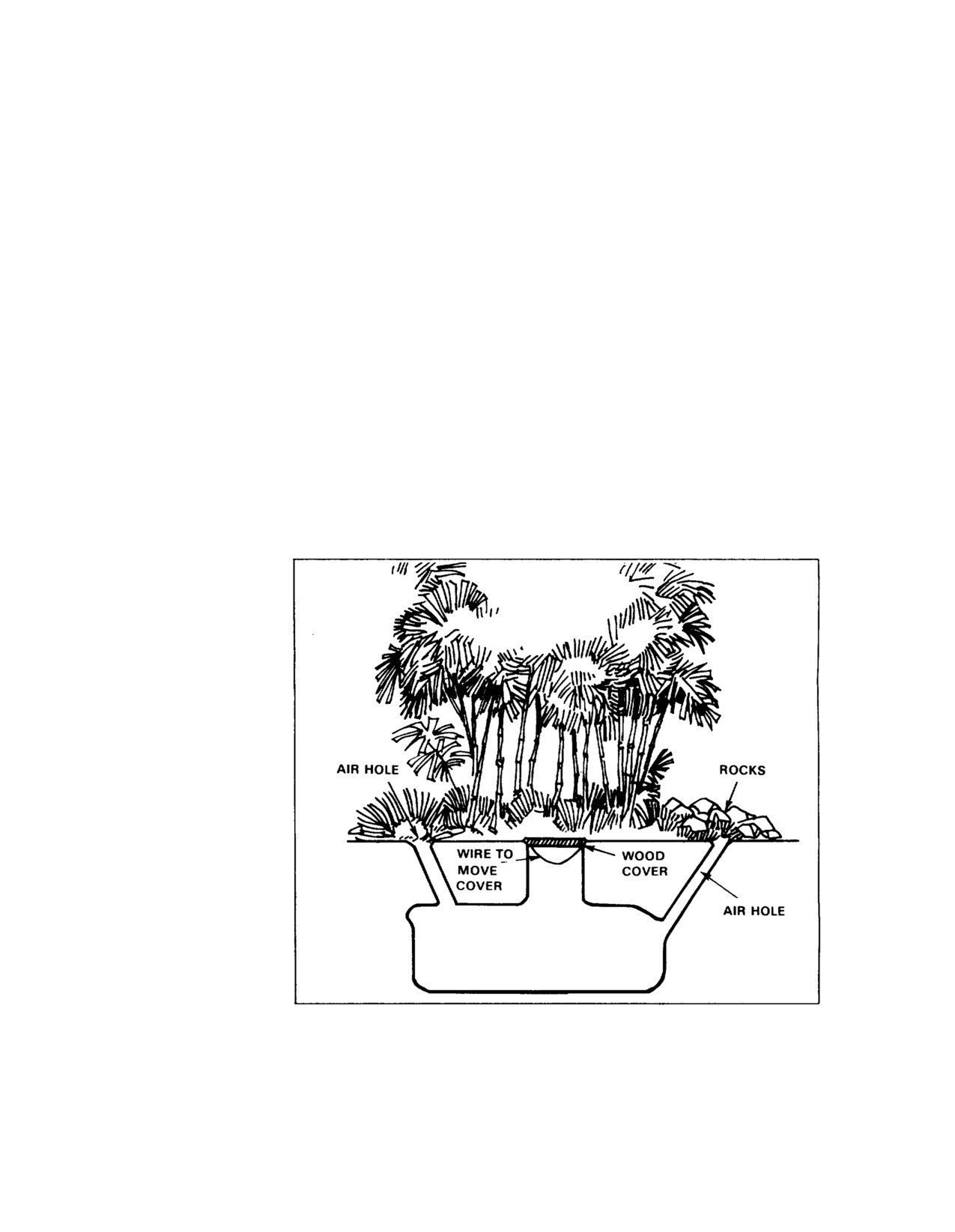
Bamboo hole. This is easily and quickly camouflaged
(Figure A-1 ). The entrances to the holes differ as do the
techniques of camouflage. Most of the entrances are within
the edge of a bamboo clump or dense thicket or just outside
the edge. The hole cover, or trapdoor, contains camouflage
material. Some have pieces of cut bamboo or other vegetation
affixed to the top of the door. The edges of the door fit snugly
into the structure of the entrance. Other entrances may be
covered by spreading materials over them.
Figure A-1. Under bamboo hole.
A-2
FM 90-8
(2) Air hole.
Another characteristic common to small tunnels is the
(a)
air hole, which is normally made from a hollow piece of
bamboo or pipe 3 to 4 inches in diameter and inserted
into the tunnel and camouflaged on the surface.
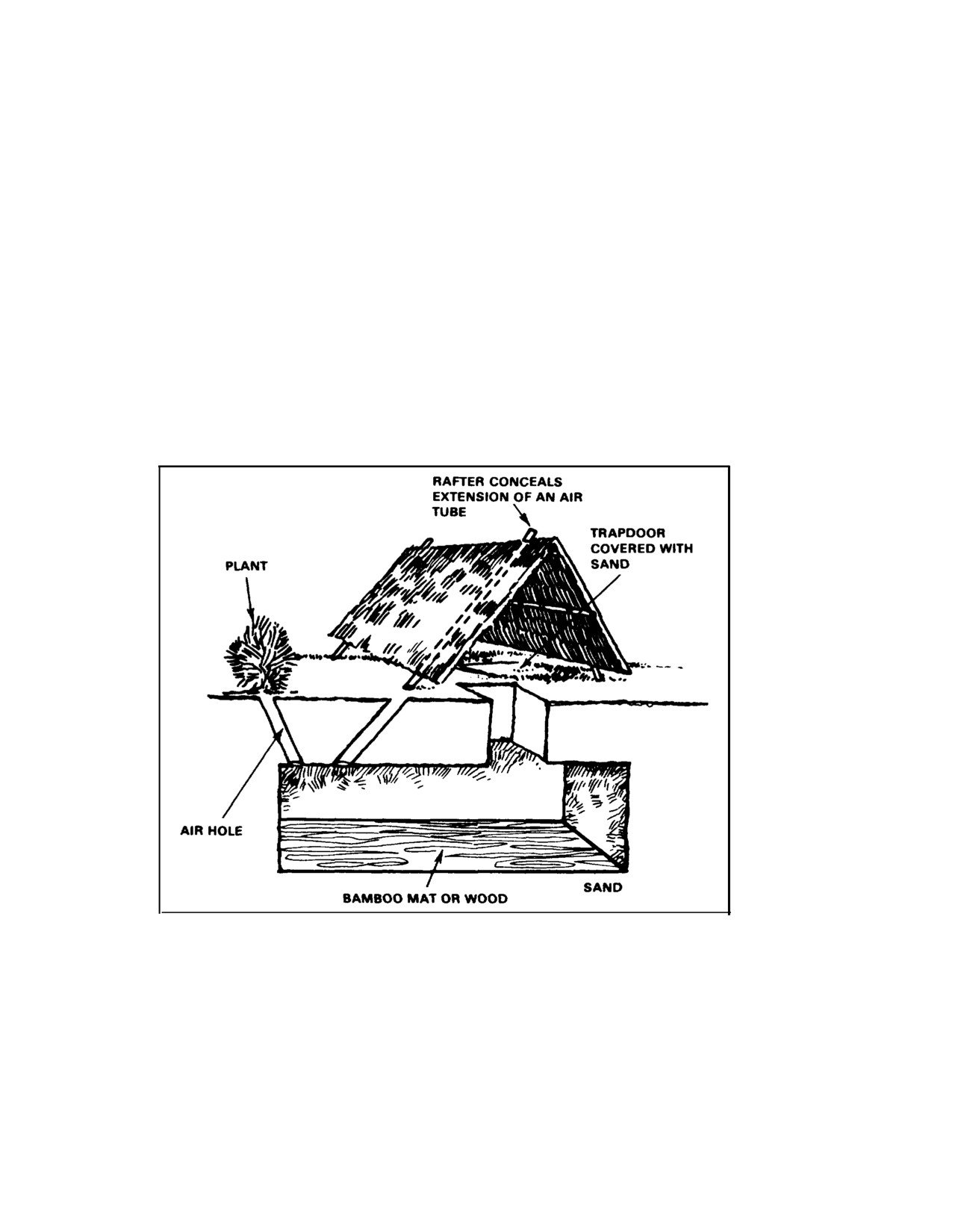
(b) The air hole is the only telltale indicator in a beach hole
or tunnel. It differs from the bamboo hole in that it is
constructed in sand or dirt and constructed from cut
timbers (Figure A-2). It does not depend on roots to add
rigidity to the roof. The entrance is hard to locate as it is
often buried under afoot of loose sand or dirt; however,
it can be found by first finding the breathing tubes.
Some air holes are a continuation of the supports that
hold up local buildings. Other air holes may be exposed
by pulling up plants that grow nearby.
Figure A-2. Beach hole.
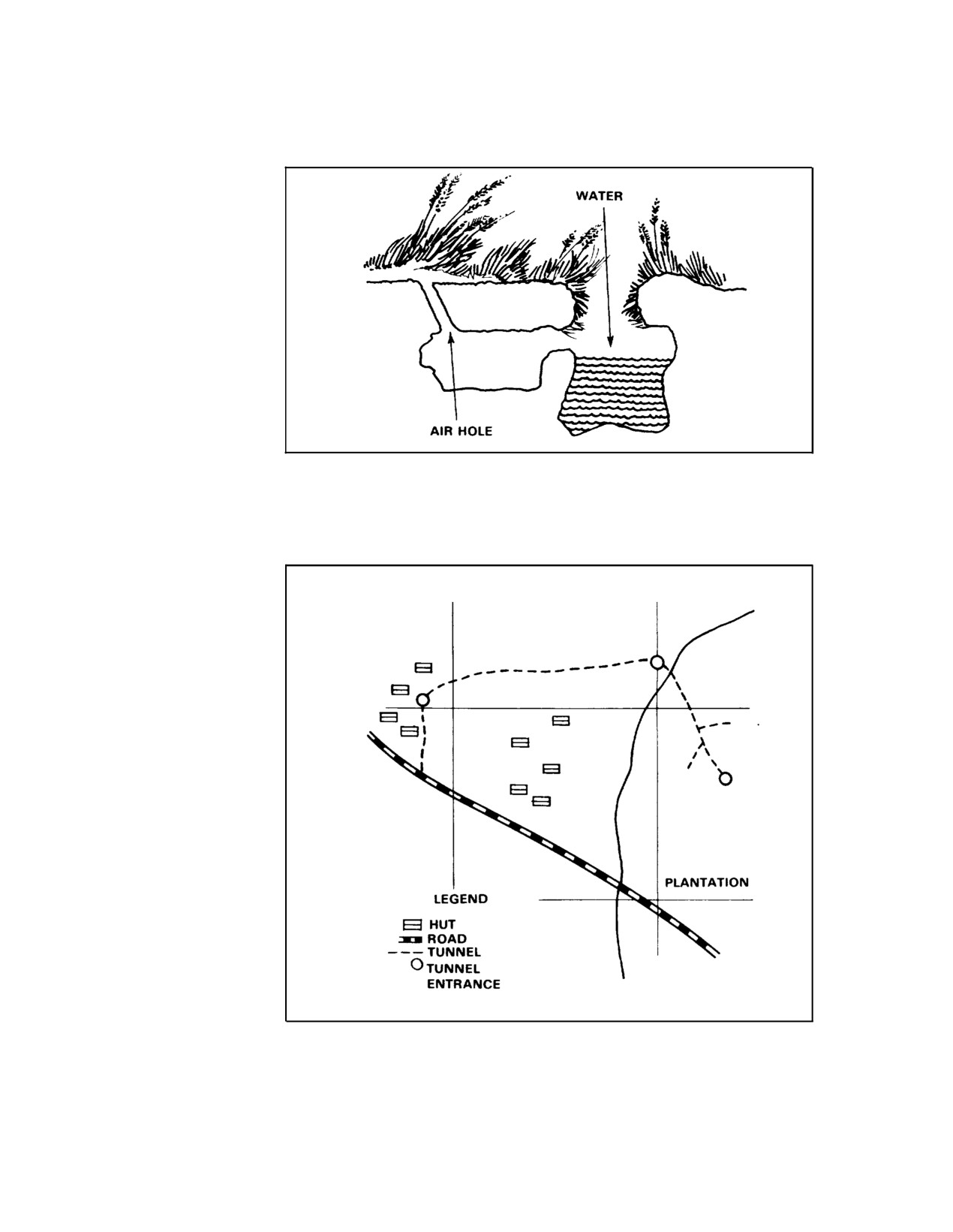
(3) Water entrance hole. This hole or tunnel (Figure A-3) is
located near a small stream or beside an old bomb crater
filled with water. These holes have no door and depend on
natural growth to hide the entrance. Sometimes the entrance
is completely submerged.
A-3
FM 90-8
Figure A-3. Water entrance hole.
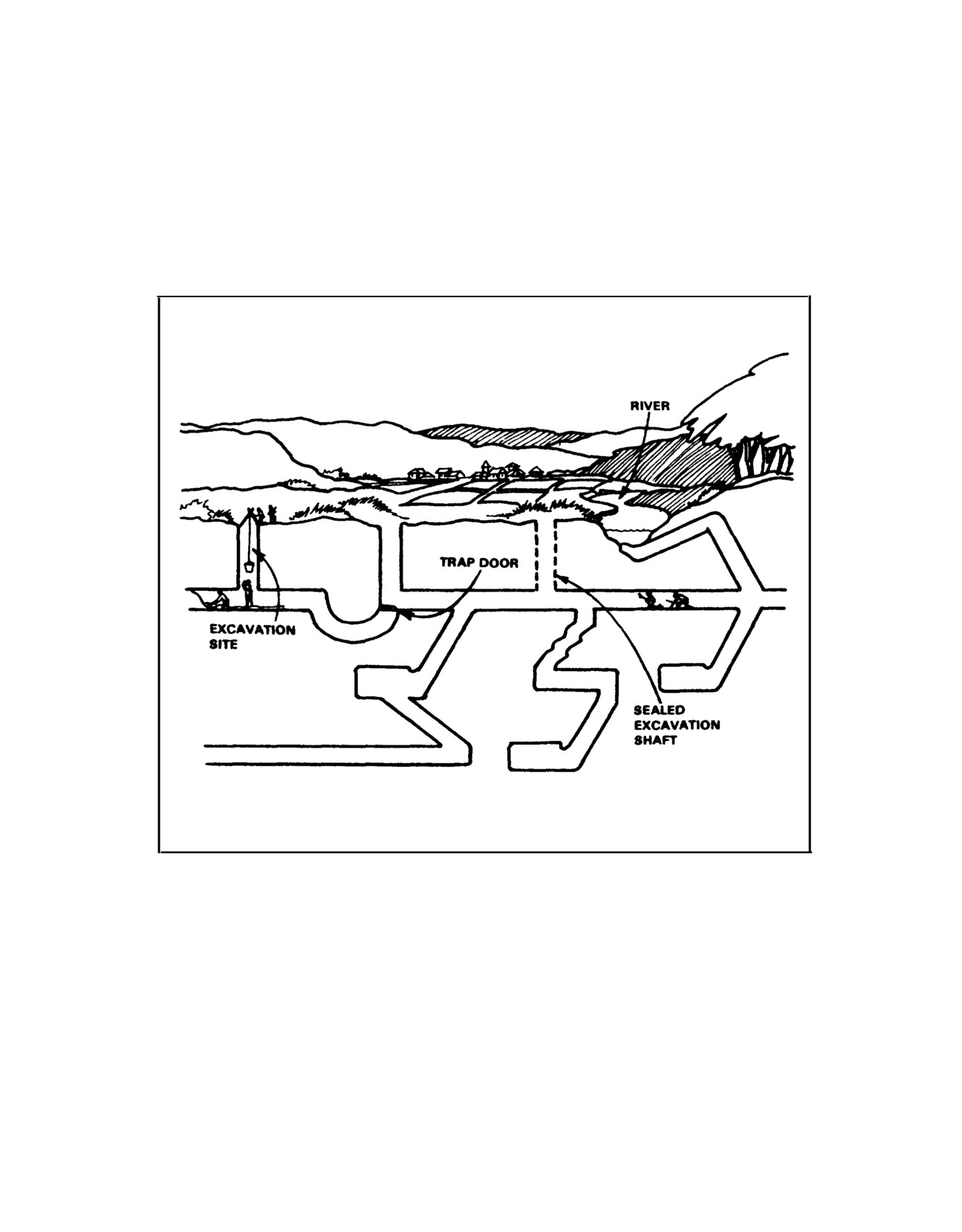
b. Access and escape routes. Guerrillas use tunnels to infiltrate
or exfiltrate an area. They may lead to villages, roads, or highly
fortified bunker systems (Figure A-4).
Figure A-4. Access and escape routes.
A-4
FM
90-8
c.
Base area. This may house a command post, ordnance shop, or
hospital. This type of tunnel system is not-as common as the ones
found in a fortified village or used as access or escape routes. It is
normally deep in guerrilla-controlled areas. This type of tunnel
complex may have several rooms, such as a 4- by 6-foot area or a
large 10-foot-square area with a 15-foot ceiling. They may also
include electric lighting or other comfort features (Figure A-5).
Figure A-5. Underground base area.
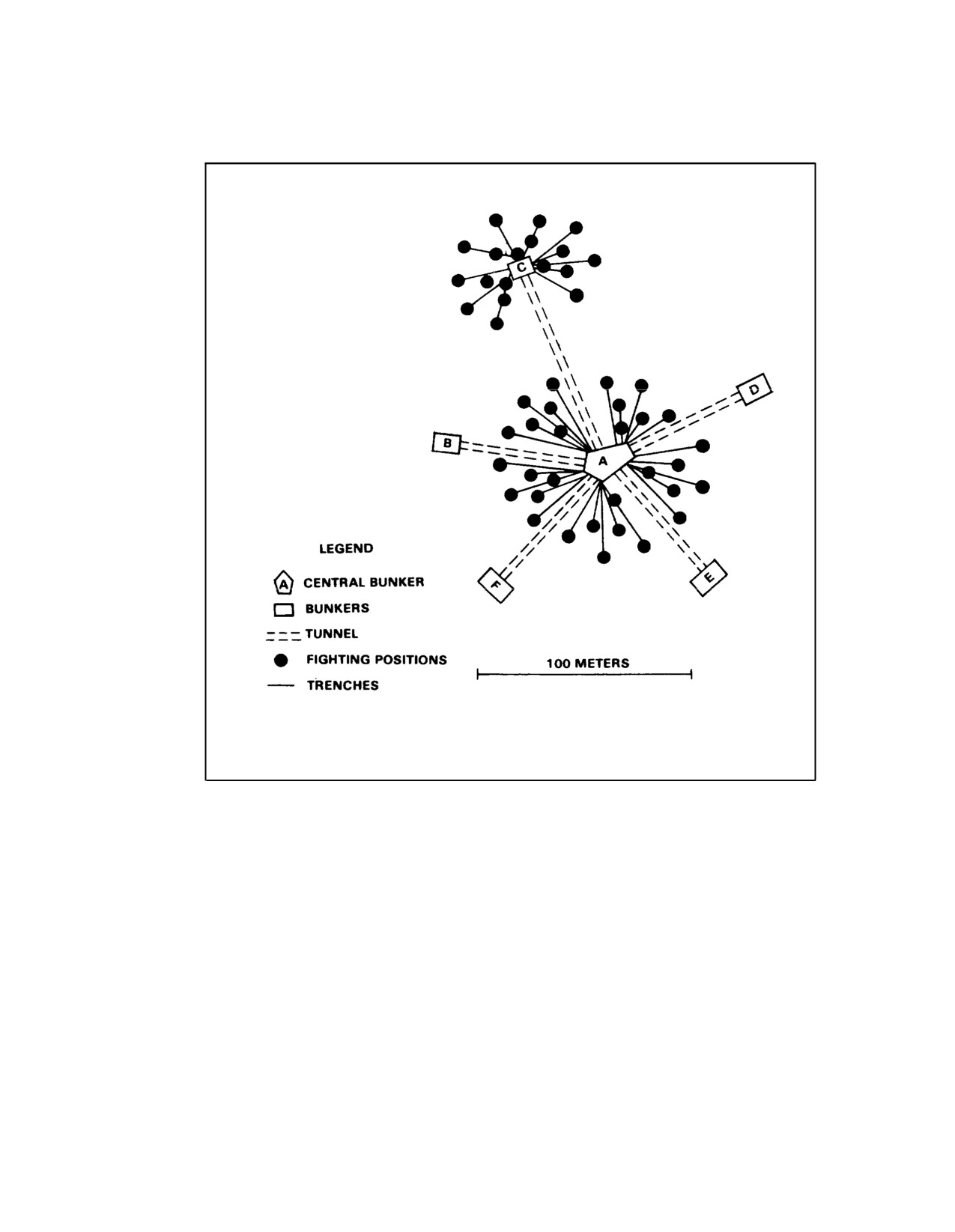
d.Base camps. These are usually fortified positions. They may
consist of a-central bunker, 18 inches above ground, and tunnels
100 to 150 meters long, connecting outer bunkers to the central
bunker. All bunkers have overhead cover and camouflaged firing
apertures. They are positioned to provide mutual support and
deny observation of the entire complex from any one location on
the ground (Figure A-6).
A-5
FM 90-8
Figure A-6. Fortified base camps.
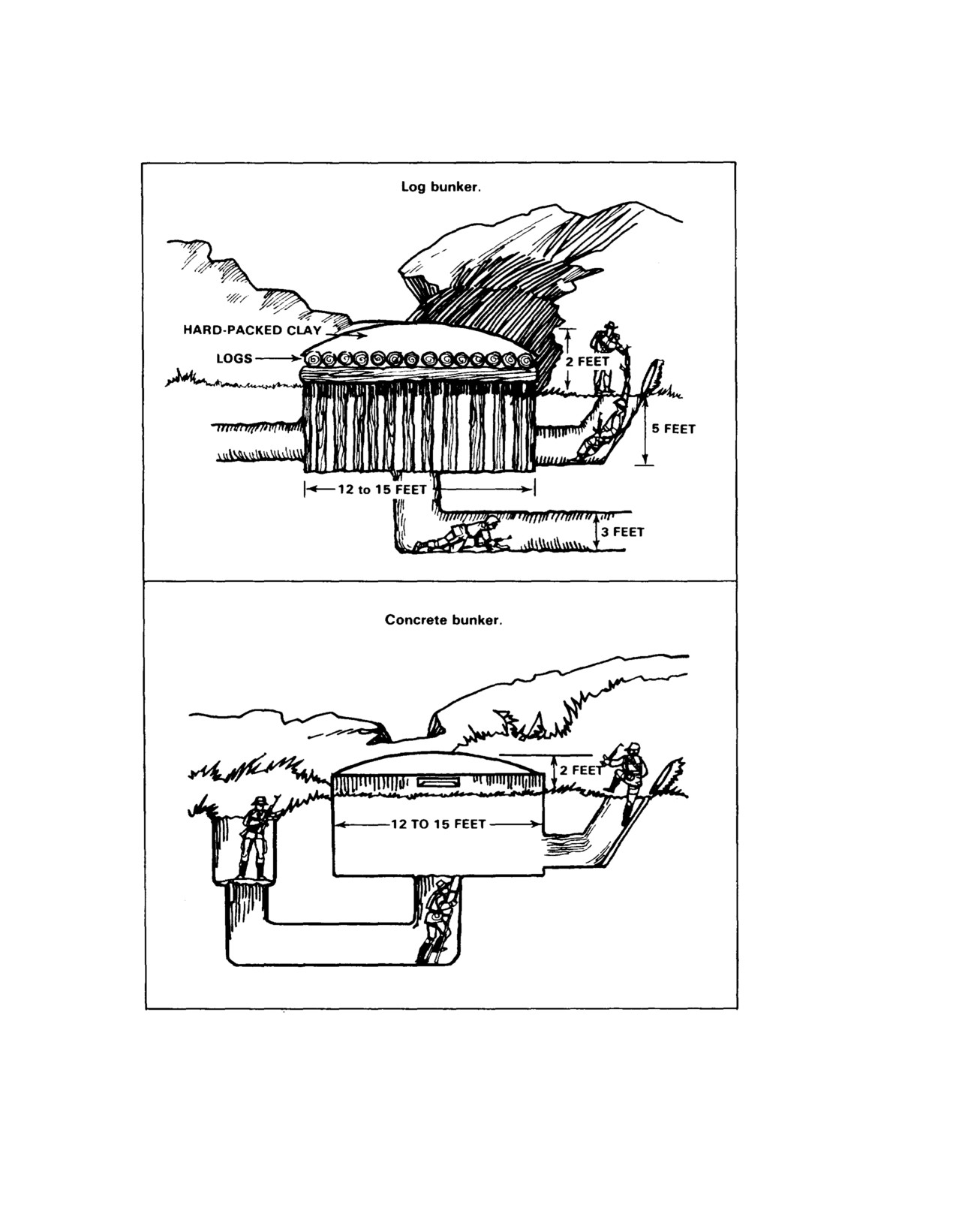
e.
Bunkers. Entrances are often in a house under a bed or table,
and have an outside exit. In many cases, bunkers are constructed
with walls up to 3 feet thick. The floor is below ground level. The
roof is normally constructed of logs covered with dirt, mud, or rock
from 3 to 6 feet thick. Sometimes, small logs (driven 3 to 6 feet into
the ground and extending upward to roof level) serve to reinforce
the walls. In some cases, the bunker maybe constructed entirely
of concrete. Most often, bunkers have one overt entrance and one
or more covert exits. The primary use of bunkers is to provide
cover and concealment. Firing apertures are just above ground
(Figure A-7).
A-6
FM 90-8
Figure A-7. Bunkers.
A-7
FM 90-8
A-4. Construction methods.
a.
One feature common to almost all tunnel complexes is the method
of excavation. The laborers are divided into a number of work
units and assigned tunnel sections. The units are placed
approximately 20 meters along the axis of the planned tunnel.
Each unit then digs a well or shaft to the desired depth where a
working area is enlarged. From this point, the units begin digging
toward each other. As the tunnel grows, the workers are formed in
a line to pass the soil out the excavation shaft. The soil is spead
evenly over the ground or a road, or under the forest canopy to
prevent detection. Once the main tunnel has been excavated, the
shaft is filled and camouflaged.
b.
As the tunnel becomes more extensive, lower levels may be
constructed to provide additional room and better protection. The
degree of sophistication is dependent upon the purpose of the
tunnel and frequency of its use. Most of the tunnels constructed by
guerrilla forces are hiding places or escape routes; therefore, they
may be extensive in length, but not complex in design.
c.
Whether their construction is complex or not, care is taken to
provide security throughout the tunnels. False corridors are
constructed, as are trapdoors and false walls. A U-shaped design
is often formed to give the impression that the corridor is a
deadend when actually a trapdoor leads to the way out.
d.
Most tunnel systems require substantial planning before actual
construction. The systems are never haphazard. The tunnel is
reinforced by reveting or other means. One common method used
to reinforce tunnels is to coat walls with mud 3 to 6 inches thick
and build fires throughout the system to bake the mud, turning it
into a ceramic texture.
e.
Tunnel systems are usually not constructed in a straight line.
They will follow a zigzag or serpentine course. This type of
construction is used to protect the occupants from small arms fire
in the event that tunnel systems are detected and breached.
f.
Tools for digging are simple. A bucket and pick or shovel are the
main tools. Common methods of illumination include carbide
lamps, flashlights, candles, and in larger complexes, small,
fuel-driven generators for electric lighting.
g.
Secrecy of location is considered of utmost importance. All means
are taken to camouflage and conceal tunnel entrances. Often,
tunnels are hidden in tombs, walls, floors, or under water.
h.
Extensive use of booby traps and mines should be expected in and
around tunnel complexes. Some common booby traps are mortar
and artillery duds rigged for command detonation. These may be
buried or suspended in trees in the immediate vicinity. Hand
A-8
FM 90-8
grenades and homemade bombs are used to booby-trapdoors and
hatches. Poisonous snakes may be placed in tunnels to inflict
casualties.
A-5. Detection of tunnels.
a.
The first step in detecting or locating tunnels is to reduce a large
geographical area of interest to a smaller area of probable
locations. This can be accomplished by studying general
indications of probable tunnel locations.
b.
Some indicators that tunnels are being employed by guerrilla
forces are:
(1) Movement of guerrillas in a specific direction after being
spotted by aircraft.
(2) Sniper fire occurring from areas where there are no obvious
avenues of withdrawal.
(3) Vegetable gardens far from places of habitation.
(4) Operations where guerrillas inflict casualties at relatively
long range and disappear without making close contact or
being detected by friendly forces.
(5) The smell of burning wood or food cooking in an area lacking
habitation.
c.
Conventional air photography produces results if the appearance
of the surface and vegetation are changed from normal. This
requires skilled personnel to interpret photos. In a jungle
environment, air photography may be prohibited because dense
vegetation, such as double or triple canopy jungle, obscures the
ground.
d.
Once determined that a specific area may contain a tunnel
system, there are several indicators that are helpful in detecting
tunnels. Visual inspections often disclose the general area of a
tunnel, but not its precise location. The key to finding a tunnel
system is the application of common sense to the situation. A
platoon or company should be assigned a small search area, never
larger than a 1000-meter grid square for a company. These small
areas are picked based on intelligence reports or past actions of
the guerrilla force. The unit searches every square meter of the
area. Some visual indicators usually found are:
(1) Worn places on trees that the guerrilla uses as handholds.
(2) A small trail, much like a game trail, through the brush into a
clump of small trees.
(3) Cut trees, although not a sure sign.
A-9
160-739
- 94 - 5
FM 90-8
(4) Limbs tied near tree top to conceal the use of a tunnel from
aircraft.
(5) Slight depression in or around a group of small trees.
(6) Air holes, a sure indicator.
(7) A lone individual, especially a female, in the area.
(8) Fresh cooked food with no one attending the site.
(9) Fresh human feces in an area.
e.
All these indicators are good. However, in different areas they
may vary. The places to look for indicators are in the corners of
hedgerows, in the corners of village huts, and in the secluded
corners of trails and streams. The enemy often hides in these
places so he can see while not being seen. Additionally, hiding in
these places allows those who put the finishing touches on the
camouflage to escape undetected. The guerrilla is aware of the
danger of establishing a pattern. However, he must have a
location that provides him with observation as well as concealment.
So look for observation posts that allow him to move into or out of
an area undetected.
f.
Occasionally, the specific location of a tunnel can be obtained by
interrogating the local populace, or prisoners of war (PW) who
may have occupied, or helped in digging, the system. Because of
the method of constructing a tunnel system, that of using an
excavation shaft to reach the level of the tunnel and then closing
this shaft once the tunnel is completed, the individual may not be
able to locate an entrance or exit unless he has seen or used the
completed tunnel.
A-6. Tunnel search operations.
a.
Entering an area where a tunnel complex is located requires a
methodical approach. Security to the flanks and rear is imper-
ative.
b.
The size of the objective area of operations determines the
strength of the unit assigned the search mission. Basically, the
unit, company, or platoon is task-organized for tunnel operations.
c.
A company is divided into three elements: security, search, and
reserve. (The headquarters element remains with the security
element.)
(1) Security — one platoon plus headquarters element to cordon
search area.
(2) Search — one platoon to search immediate area for tunnels.
The search element is subdivided into search and security
teams.
A-10
FM 90-8
(3) Reserve
- one platoon to assist in cordon and reinforce as
necessary.
d.
A platoon is divided into three elements:
(1) Security - one squad plus headquarters element to cordon
area.
(2) Search - one squad to search area for tunnels. The search
element is subdivided into search and security teams.
(3) Reserve - one squad to assist in cordon and reinforce as
necessary.
e.
The techniques of deliberate search are centered around the rifle
squad. Each squad is divided into a security and a search team.
f.
A slow, methodical search is conducted in the area of operations.
Once assigned a search area, the squad systematically searches
every square meter. The security element move toward the limits
of the search area. Once a hole (tunnel) is discovered, the security
element surrounds the area while the search team prepares to
destroy or neutralize the hole (tunnel).
A-7. Special equipment.
The unit may require the following special items to perform tunnel
operations:
a.
Mine detector — used to detect ammunition and weapon caches.
b.
Grenades - fragmentary, chemical (CS) gas, chemical (HC)
smoke, while phosphorus (WP), and concussion types. Grenades
should not be used after friendly forces have entered a tunnel.
c.
Demolitions — used to destroy tunnel system. Because of the
complexity of charges needed to destroy some tunnel complexes,
an engineer team should support the search unit. Also, the large
amount of demolitions required for some operations may present
unique logistical problems, especially in a jungle environment.
d.
Air generator — used to force smoke into tunnel complex.
e.
Flashlights — to search tunnels.
f.
Weapons — caliber .45 pistol should be used inside tunnels. The
pistol has good stopping power and is effective at close range.
g.
Loudspeaker — used to call enemy from tunnels.
A-11
FM
90-8
Section Ill. Destroying Underground Facilities
A-8. Four-step process.
a.
The destruction of a tunnel is a four-step process, beginning (1)
with a soldier firing one or two magazines from a rifle into the
tunnel entrance. This has a tendency to discourage the enemy
from staying close to the entrance.
b.
After gaining the attention of the guerrillas, they are told to
vacate the hole or tunnel or be killed. They may give up without a
fight, saving not only the efforts of killing, but of excavating the
hole or tunnel for weapons and documents.
c.
If this fails, breaching operations are used(2). A grenade is placed
on the entrance cover to gain access. The entrance cover is
removed in this manner to minimize the effects of any attached booby
traps.
d.
Once the entrance cover is destroyed, the following measures are
used (depending on the mission):
(1) Insert grenades (3), fragmentary or concussion, to kill the
guerrillas. Ensure that the grenades are cooked-off prior to
throwing them in the hole or tunnel.
(2) Insert a combination of HC smoke and CS chemical
grenades. This serves two purposes: HC smoke may reveal
the locations of other entrances or exits, and CS may force
the guerrillas to evacuate the hole or tunnel. Captured
guerrillas become a source of intelligence in finding other
holes or tunnels.
e.
The last step (4) is the entry of soldiers to ensure that all weapons
and documents are recovered and all enemy dead, wounded, and
living are removed. The hole or tunnel is thoroughly searched for
small compartments built to hide weapons and ammunition. If a
tunnel complex proves to be extensive with bunkers and large
rooms, it is cleared systematically. Bunkers are destroyed or
occupied to prevent the enemy from reoccupying them through
another tunnel. Do not clear more bunkers than friendly
forces can hold.
f.
Deliberate search techniques emphasize where to look for the
enemy (locations that provide him with observation, cover,
concealment, and an escape route). When the soldier learns what
to look for (a game trail, worn and cut trees, an air hole, human
feces, a depression, fresh food, a lone individual), any of these
indicators is likely to trigger a mental alert that the enemy is not
far away. After the tunnel is searched, it is destroyed with
explosives.
A-12
FM 90-8
A-9. Neutralization-demolition procedures.
a.
Tunnels. Since each tunnel system differs in size and construction,
a different quantity and placement of explosives is needed for
each type.
(1) The use of block explosives to destroy a tunnel system has a
disadvantage: all the explosive power is concentrated at one
point. Thus, the destruction is localized, and often portions of
the tunnel are unaffected. However, a large (10-to 12-pound)
block of explosive tamped against the ceiling may cause an
entire tunnel to collapse.
(2) Advantages of block-type explosives are the ease of em-
placement, ease of procurement, and feasibility of aerial
resupply. Also, block or satchel charges are effective in the
destruction of bunkers, sunken living quarters, and under-
ground rooms. Cratering charges are also effective for
underground rooms. Short tunnels can be destroyed effectively
by block explosives.
(3) The shaped charge in tunnel destruction is successful when
used in specific circumstances. A shaped charge placed
underground in the middle of a tunnel complex, and aimed
downward, destroys an area of the tunnel complex around
and above the charge. Also, a shaped charge placed in a deep
complex and aimed upward results in extensive destruction.
(4) Another effective method of tunnel destruction utilizes
bangalore torpedos placed throughout the tunnel length
(regardless of depth). The constant length of explosives
throughout the tunnel ensures complete destruction. The
bangalore (5 feet long) is adaptable to the twists and turns in
tunnels. Each tunnel where it can be pushed through). A
disadvantage of bangalore torpedoes is the logistical
problem arising from their size and weight. There may be a
problem with resupply if large quantities are used to
completely destroy a tunnel system.
b.
Bunkers. Underground living quarters, bunkers, and underground
hideaways can be destroyed by block or satchel charges placed
strategically inside the room. The following are examples of
structures and the size and placement of charges.
(1) Bunkers dug into the ground and covered by dense brush
(average size 4 by 8 by 4 feet) can be destroyed with 3 pounds
of explosives placed next to a wall.
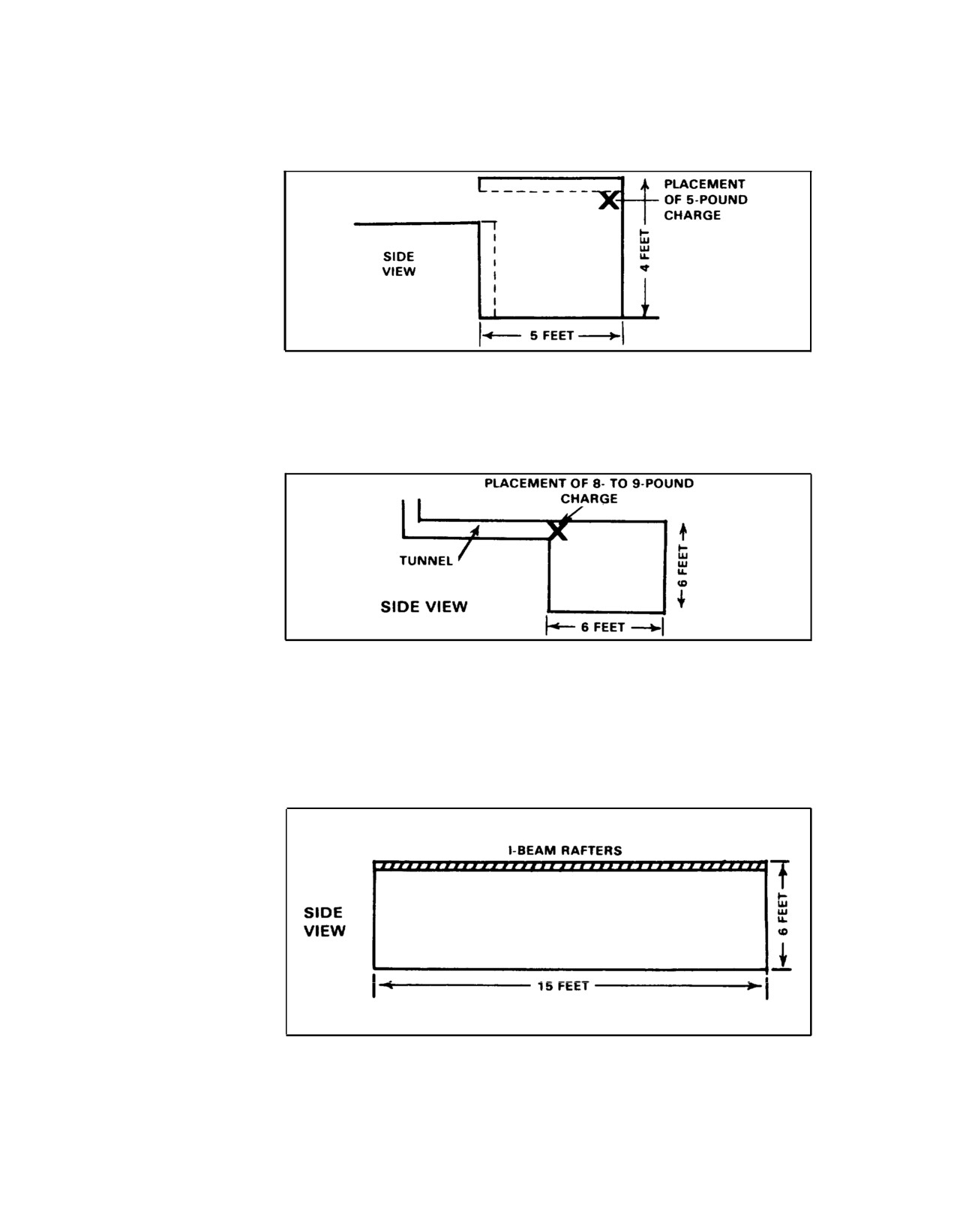
(2) This bunker (8 by 5 by 4 feet) can be destroyed by placing a
5-pound charge against the roof toward the side of the
strongest beam (Figure A-8).
A-13
FM 90-8
(3) This 4-inch-thick concrete wall bunker (6 by 6 by 5 feet) can
be destroyed by placing 8 to 9 pounds of explosives at the
point where the tunnel enters the bunker, and will also
destroy a portion of the tunnel (Figure A-9).
Figure A-9. Reinforced underground bunker.
(4) This bunker depicts an underground hospital capable of
holding 10 to 12 persons. It is about 10 feet below the surface.
Usually 15 feet long by 8 feet wide by 6 feet high, it is
constructed of cement and steel I-beams. The room is
completely destroyed by interlacing three bangalore
torpedoes in the I-beam rafters (Figure A-10).
Figure A-10. Underground hospital.
A-14
FM 90-8
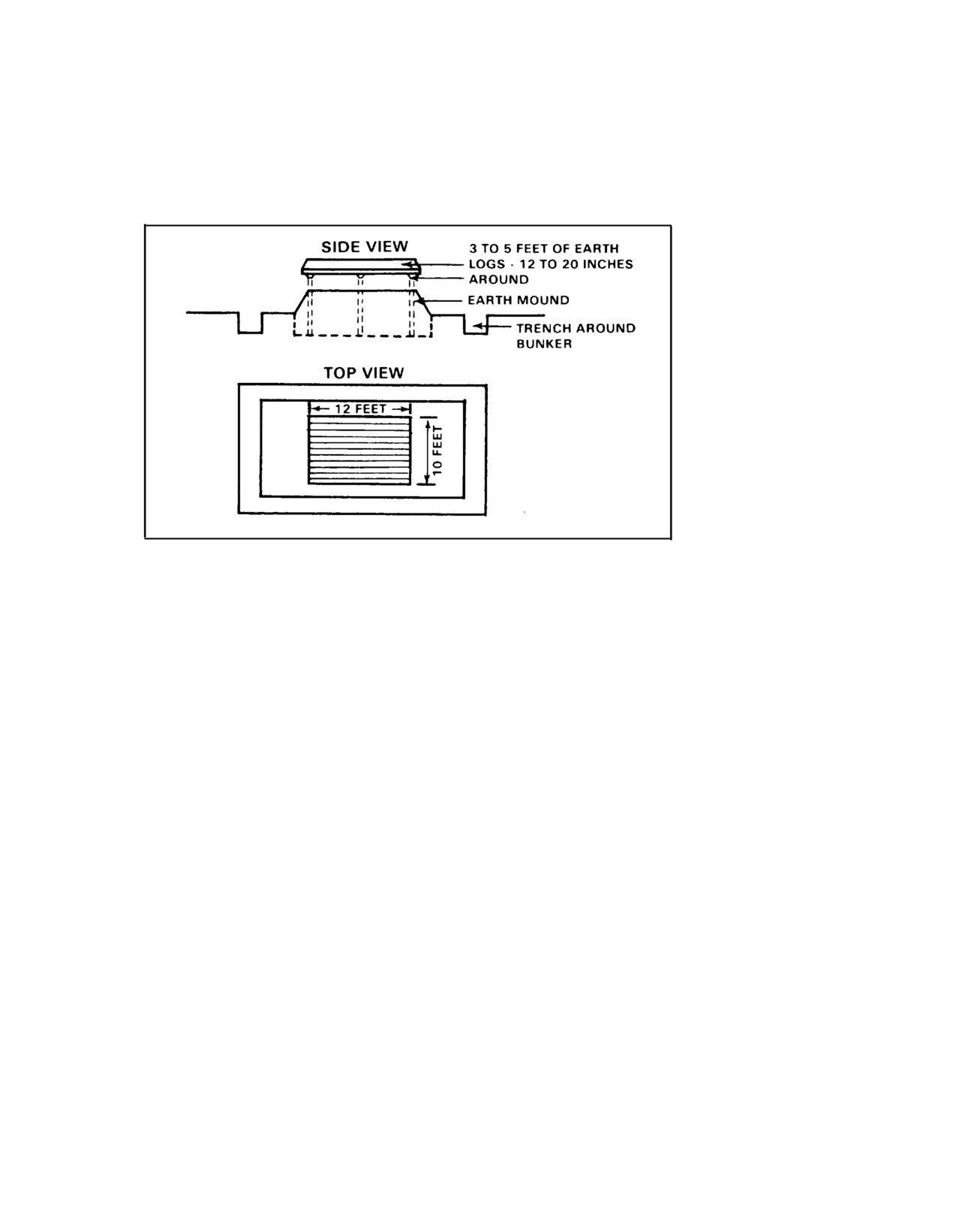
(5) This bunker design requires 10 to
12 pounds of explosives to
destroy it (Figure A-11).
A-15
FM 90-8
APPENDIX B
The Urban Guerrilla
Section I. General
B-1. Effects of the urban environment.
a.
Cities and towns are vulnerable to urban guerrilla violence
because they are the focus of economic and political power. In
many cases, public utilities and services can be disrupted. Thus,
the government may appear to have lost control of the situation.
b.
The concentration of a large number of people in a relatively small
area provides cover for the guerrilla. However, the insurgent may
find support only in certain areas of a town or city. In any event,
the urban guerrilla lives in a community that is friendly to him or,
as a minimum, is too frightened to withhold its support or inform
on him. He has a close relationship with leaders and other
guerrillas, and may have a communication system using women
and children who also provide cover for other activities.
c.
The urban guerrilla can operate more boldly than his rural
counterpart as reflected by his tactics: the sniper complements the
more conventional ambush and often replaces it; explosive
devices may be used either as instruments against the community
or more selectively against individuals or groups.
d.
The availability of large numbers of people ensures that crowds
can be assembled and demonstrations manipulated with
comparative ease. The presence of women and children restricts
counterguerrilla force reactions, and a clumsy reaction may
ensure a major incident that provides the guerrilla with
propaganda. Publicity is easily achieved in an urban area
because no major incident can be concealed from the local
population even if it is not widely reported by the news media.
Terrorist successes may be exploited to discredit the ability of the
police, counterguerrilla force, and civil government to provide
protection and control the guerrillas.
e.
The urban guerrilla cannot, like his rural counterpart, establish
bases and recruit large military units. He is an individual, a
member of a relatively small group, relying on the cover afforded
by the people of the city and on terror to avoid betrayal.
Individuals and small groups are effective in an urban environment
because it is easier for them to avoid capture; if captured, however,
the terrorist may be able to expose only two or three persons to
government or counterguerrilla forces.
B-1
FM 90-8
B-2. Guerrilla tactics.
a. The urban guerrilla works alone or in small cells, and his tactics
are different from those of his rural counterpart.
b. They include:
(1)
Disrupting industry and public services by strikes and
sabotage.
(2)
Generating widespread disturbances designed to stretch the
resources of the counterguerrilla force.
(3)
Creating incidents or massing crowds in order to lure the
counterguerrilla force into a trap.
(4)
Provoking the counterguerrilla force in the hope that it may
overreact and provide hostile propaganda.
(5)
Fomenting interfactional strife.
(6)
Sniping at roadblocks, outposts, and sentries.
(7)
Attacking vehicles and buildings with rockets and mortars.
(8)
Planting explosive devices, either against specific targets or
indiscriminately, to cause confusion and destruction, and to
lower public morale.
(9)
Ambushing patrols and firing on helicopters.
Section Il. Techniques to Counter the Urban Guerrilla
B-3. Urban counterguerrilla operations.
a.
Operations against urban guerrillas may vary from a passive
policy designed to curtail terrorist activities so that community
life can continue (under certain constraints), to an active policy
which involves the counterguerrilla force seeking out and
capturing or killing the enemy. The level of intensity at which
operations are conducted will be determined by the civil govern-
ment.
b.
Fighting the urban guerrilla is generally a police mission.
However, the military counterguerrilla force commander maybe
required to assist the police in this mission or even take it over.
The techniques used are similar to the ones used in rural areas.
Before operations are conducted, information must be obtained
about the enemy, his environment, and operations (Appendix H).
The techniques include:
(1) Installation of base defense (Appendix E).
(2) Roadblocks and checkpoints (Chapter 3).
B-2
FM
90-8
(3) Crowd dispersal (FM 19-15).
(4) Cordon-and-search operations (Chapter 3).
(5) Patrols (Chapter 3 and Appendix D).
B-4. Minimum force.
The principles remain the same, but in an urban environment the
principle of minimum force becomes more important and is directly
related to the rules of engagement. There is greater danger of injuring
or killing innocent civilians in heavily populated centem. Since there
are seldom large groups of guerrillas in cities, there are no base camps,
only safe houses. Opportunities for deliberate attacks rarely occur. Just
as fighting guerrillas in a rural environment, killing or capturing the
urban guerrilla is not a mission that is quickly accomplished.
B-3
FM 90-8
APPENDIX C
Ambush Patrols
Section
1. General
C-1. Purpose of ambushes.
The ambush patrols discussed in this appendix are combat patrols
with missions to establish and execute ambushes to harass or destroy
targets and/or capture personnel and equipment. Ambushes generally
are executed to reduce the guerrilla’s overall combat effectiveness.
Destruction is the primary purpose of an ambush since guerrillas killed
and/or captured, and equipment and/or supplies destroyed or
captured, critically affect the guerrilla force. Harassment, the
secondary purpose, diverts guerrillas from other missions. A series of
successful ambushes causes the guerrilla force to be less aggressive
and more defensive; to be apprehensive and overly cautious; and to be
reluctant to go on patrols and move in convoys or in small groups.
C-2. Types of ambushes.
a.
There are two types of ambushes. A point ambush involves patrol
elements deployed to support the attack of a single killing zone.
An area ambush involves patrol elements deployed as multiple,
related, point ambushes.
b. An ambush is categorized as either hasty or deliberate. A hasty
ambush is an immediate action drill, an action of a combat patrol
wilth little or no information. When information does not permit
detailed planning required for a deliberate ambush, a hasty
ambush is planned. In this case, the ambush patrol plans and
prepares to attack the first suitable guerrilla force. A deliberate
ambush is planned as a specific action against a specific target.
Detailed information of the guerrilla force is required: size, nature,
organization, armament, equipment, route and direction of
movement, and times the force will reach or pass certain points on
its route. Deliberate ambushes are planned when:
(1) Reliable information is received on the intended movement
of a specific force.
(2) Patrols, convoys, carrying parties, or similar forces establish
patterns of size, time, and movement sufficient to permit
detailed planning for the ambush.
c.
A unit conducting a combat patrol, before departing, plans and
rehearses the ambush of the type of guerrilla force it may
C-1
FM
90-8
encounter. It establishes and executes ambushes as opportunities
arise.
Section Il. Attack Fundamentals
C-3. Three elements.
Surprise, coordinated fires, and control are basic to a successful
ambush.
C-4. Surprise.
Surprise must be achieved or else the attack is not an ambush. Surprise,
which distinguishes an ambush from other forms of attack, allows the
ambush force to seize and retain control of the situation. Surprise is
achieved by careful planning, preparation, and execution. Guerrillas
are attacked in a manner they least expect.
C-5. Coordinated fires.
All weapons, including mines and demolitions, are positioned, and all
direct and indirect fires are coordinated to achieve:
a.
Isolation of the kill zone to prevent escape or reinforcement.
b.
Surprise delivery of a large volume of concentrated fires into the
kill zone to inflict maximum damage so the target can be
assaulted and destroyed.
C-6. Control.
a.
Close control is maintained during movement to, occupation of,
and withdrawal from the ambush site.
b. The ambush commander’s control of all elements is critical at the
time of target approach. Control measures provide for
(1) Early warning of target approach.
(2) Withholding fire until the target moves into the kill zone.
(3) Opening fire at the proper time.
(4) Initiating appropriate actions if the ambush is prematurely
detected.
(5) Lifting or shifting supporting fires when the ambush
includes assault of the target.
(6) Timely and orderly withdrawal to an easily recognized
rallying point.
C-2
FM 90-8
c.
Personnel conducting the ambush remain still and quiet while
waiting for the target to appear. They may have to forgo smoking;
endure insect bites and thirst in silence; and resist sleeping,
easing cramped muscles, and performing normal body functions.
(Ambushes should have a rest plan and a mess plan.) When the
target approaches, they do not open fire before the signal is given.
Section Ill. Planning
C-7. Flexibility.
a.
An ambush is planned and prepared using troop leading
procedures. Planning considerations include whether the ambush
is to be a deliberate ambush or a hasty ambush. In a deliberate
ambush, more target intelligence is available to permit planning
for every course of action at the target. Planning for a hasty
ambush includes tentative plans both for the types of targets that
may be ambushed and for varying situations. Both plans are
flexible enough to allow modifying, as appropriate, at the ambush
site. All plans are rehearsed in detail.
b. Planning provides for the following:
(1) Simplicity. Every soldier must thoroughly understand
what he is to do at every stage of the operation. In an
ambush, more so than in other operations, the failure of even
one soldier to perform exactly as planned can cause failure.
(2) Type of ambush. The type of ambush affects the organiza-
tion, number of men, and amount of equipment and
communications required.
(3) Deployment. Each possible formation is considered for its
advantages and disadvantages.
C-8. Manner of attack.
The attack may be by fire only (harassing ambush) or may include
assault of the target (destruction ambush).
C-9. Size of ambush force.
The force is tailored for its mission. Two men may be adequate for a
harassing ambush. A destruction ambush may require the entire unit
(squad, platoon, company).
a.
Organization. An ambush patrol is organized in the same
manner as other combat patrols to include a headquarters, an
assault element, a support element, and a security element. The
assault and support elements are the attack force; the security
C-3
FM
90-8
element is the security force. When appropriate, the attack force is
further organized to provide a reserve force. When an ambush site
is to be occupied for an extended period, double ambush forces
may be organized. One ambush force occupies the site while the
other rests, eats, and tends to personal needs at the objective
rail ying point or other concealed location. They alternate after a
given time, which is usually 8 hours. If the waiting period is over
24 hours, three ambush forces maybe organized.
b.
Equipment. The selection of equipment and supplies is based on
the:
(1) Mission.
(2) Size of the guerrilla force.
(3) Means of transportation.
(4) Distance and terrain.
(5) Weight and bulk of equipment.
c.
Routes. A primary route is planned which allows the unit to
enter the ambush site from the rear. The kill zone is not entered if
entry can be avoided. If the kill zone must be entered to place
mines or explosives, care is taken to remove any tracks or signs
that might alert the guerrillas and compromise the ambush. If
mines, mantraps, or explosives are to be placed on the far side, or
if the appearance of the site might cause the guerrillas to check it,
then a wide detour around the kill zone is made. Here, too, care is
taken to remove any traces which might reveal the ambush. Also,
an alternate route from the ambush site is planned.
d.
Site. Maps and aerial photographs are used to analyze the
terrain. When possible, anon-the-ground reconnaissance is made.
As far as possible, so-called “ideal” ambush sites are avoided.
Alert guerrillas are suspicious of these areas, avoid them if
possible, and increase vigilance and security when they must be
entered; surprise is even more difficult to achieve in these areas.
Instead, apparently unlikely sites are chosen, when possible.
Considering this, an ambush site must provide:
(1) Fields of fire.
(2) Concealed positions.
(3) Canalization of the guerrillas into the killing zone.
(4) Covered routes of withdrawal (to enable the ambush force to
break contact and avoid pursuit).
(5) No exit route for the guerrilla force.
e.
Occupation of the site. As a rule, the ambush force occupies the
ambush site at the latest possible time permitted by the tactical
C-4
FM 90-8
situation and the amount of site preparation required. This not
only reduces the risk of discovery but also reduces the time that
soldiers must remain still and quiet in position.
f.
Positions. The unit moves into the ambush site from the rear.
Security elements are positioned first to prevent surprise while the
ambush is being established. Automatic weapons are then
positioned so that each can fire along the entire killing zone. If
this is not possible, they are given overlapping sectors of fire so
that the entire killing zone is covered. The unit leader then selects
his position, located where he can see when to initiate the ambush.
Claymore mines, explosives, and M203 grenade launchers maybe
used to cover any dead space left by the automatic weapons. All
weapons are assigned sectors of fire to provide mutual support.
The unit leader sets a time by which positions are to be prepared.
The degree of preparation depends on the time allowed. All men
work at top speed during the allotted time.
g.
Camouflage. Camouflage is important. Each soldier must be
hidden from the target. During preparation for the patrol, each
soldier camouflages himself and his equipment and secures his
equipment to prevent noise. At the ambush site, positions are
prepared with minimal change in the natural appearance of the
site. All debris resulting from preparation of positions is con-
cealed.
h.
Movement, noise, and light discipline. Movement is kept to a
minimum and the number of men moving at a time is closely
controlled. Every man is as quiet as possible, especially at night.
Light discipline is rigidly enforced at night. Smoking is forbidden
at night and is closely controlled in the day.
C-10. Execution.
a. Three signals, often four, are needed to execute the ambush.
Audible and visual signals, such as whistles and pyrotechnics,
must be changed often to avoid establishing patterns. Too
frequently, use of the same signals may result in their becoming
known to the enemy. A guerrilla might recognize a signal and be
able to react in time to avoid the full effects of an ambush. For
example, if white star cluster is habitually used to signal
withdrawal in a night ambush, an alert guerrilla might fire one
and cause premature withdrawal.
b.
A signal by the security force to alert the patrol leader to the
guerrilla’s approach may be given by:
(1) Arm-and-hand signals.
(2) Radio, as a quiet voice message, by transmitting a prearranged
number of taps, or by signaling with the push-to-talk switch.
C-5
FM 90-8
(3) Field telephone, when there is no danger that wire between
positions will compromise the ambush.
c.
A signal to initiate the ambush, given by the patrol leader or a
designated individual, may be a shot or the detonation of mines or
explosives. The ambush should be initiated with a mass casualty
producing weapon
(Claymore antipersonnel mine or M60
machine gun).
A signal for lifting or shifting fires, if the guerrilla force is to be
d.
assaulted, may be given by voice command, whistles, or
pyrotechnics. All fire stops immediately so that the assault can be
made before the guerrilla can react.
e.
A signal for withdrawal may also be by voice command, whistles,
or pyrotechnics.
C-11. Fire discipline.
This is a key part of the ambush. Fire is withheld until the signal is
given, then immediately delivered with the heaviest, most accurate
volume possible. Properly timed and delivered fires contribute to the
achievement of surprise as well as to destruction of the guerrilla force.
When the guerrillas are to be assaulted, the lifting or shifting of fires is
equally precise. Otherwise, the assault is delayed, and the guerrillas
have an opportunity to recover and react.
C-12. Withdrawal to the objective rallying point.
a. The objective rallying point is far enough from the ambush site so
that it will not be overrun if the guerrilla force attacks the
ambush. Routes of withdrawal to the objective rallying point are
reconnoitered. If possible, each person walks the route he is to use
and picks out checkpoints. When the ambush is to be executed at
night, each person must be able to follow his route in the dark.
b. On signal, the unit quickly but quietly withdraws to the objective
rallying point, reorganizes, and begins its return march.
c.
If the ambush was not successful and the unit is pursued,
withdrawal may be by bounds. The last group may arm mines,
previously placed along the withdrawal route, to further delay
pursuit.
C-13. Four ambush techniques.
a.
A near ambush is a point ambush with the assault element within
reasonable assaulting distance of the kill zone (less than 50
meters). Close terrain, such as jungle and heavy woods, may
C-6
FM 90-8
require this positioning. It may also be appropriate in open terrain
in a “rise from the ground” ambush.
A far ambush is a point ambush with the assault element beyond
b.
reasonable assaulting distance of the kill zone (beyond 50 meters).
This location may be appropriate in open terrain offering good
fields of fire or when attack is by fire for a harassing ambush.
c.
A harassing ambush is an ambush in which attack is by fire
only.
d. A destruction ambush is an ambush which includes assault to
close with and decisively engage the guerrilla force.
Section IV. Point Ambush Formations
C-14. Positions.
a.
A point ambush, whether independent or part of an area ambush,
is positioned along the expected route of approach of the guerrilla
force. Formation is important because, to a great extent, it
determines whether a point ambush can deliver the heavy volume
of highly concentrated fire necessary to isolate, trap, and destroy
the guerrillas.
b.
The formation to be used is determined by carefully considering
possible formations and the advantages and disadvantages of
each in relation to terrain; conditions of visibility, forces,
weapons, and equipment ease or difficulty of control; force to be
attacked; and overall combat situation.
c.
This section discusses formations developed for the deployment of
point ambushes. The formations are identified with names that
correspond to the general pattern formed on the ground by
deployment of the attack element. They include:
(1) Line formation (two techniques, Paragraph C-15).
(2) L-formation (two techniques with variations, Paragraph
C-16).
(3) Z-formation (Paragraph C-17).
(4) T-formation (two techniques, Paragraph C-18).
(5) V-formation (two techniques, Paragraph C-19).
(6) Triangle formation (closed; open with variations, Paragraph
C-20).
(7) Box formation (two techniques, Paragraph C-21).
C-15. Line formation.
a. The attack element is deployed generally parallel to the guerrilla
force’s route of movement (road, trail, stream). This positions the
C-7
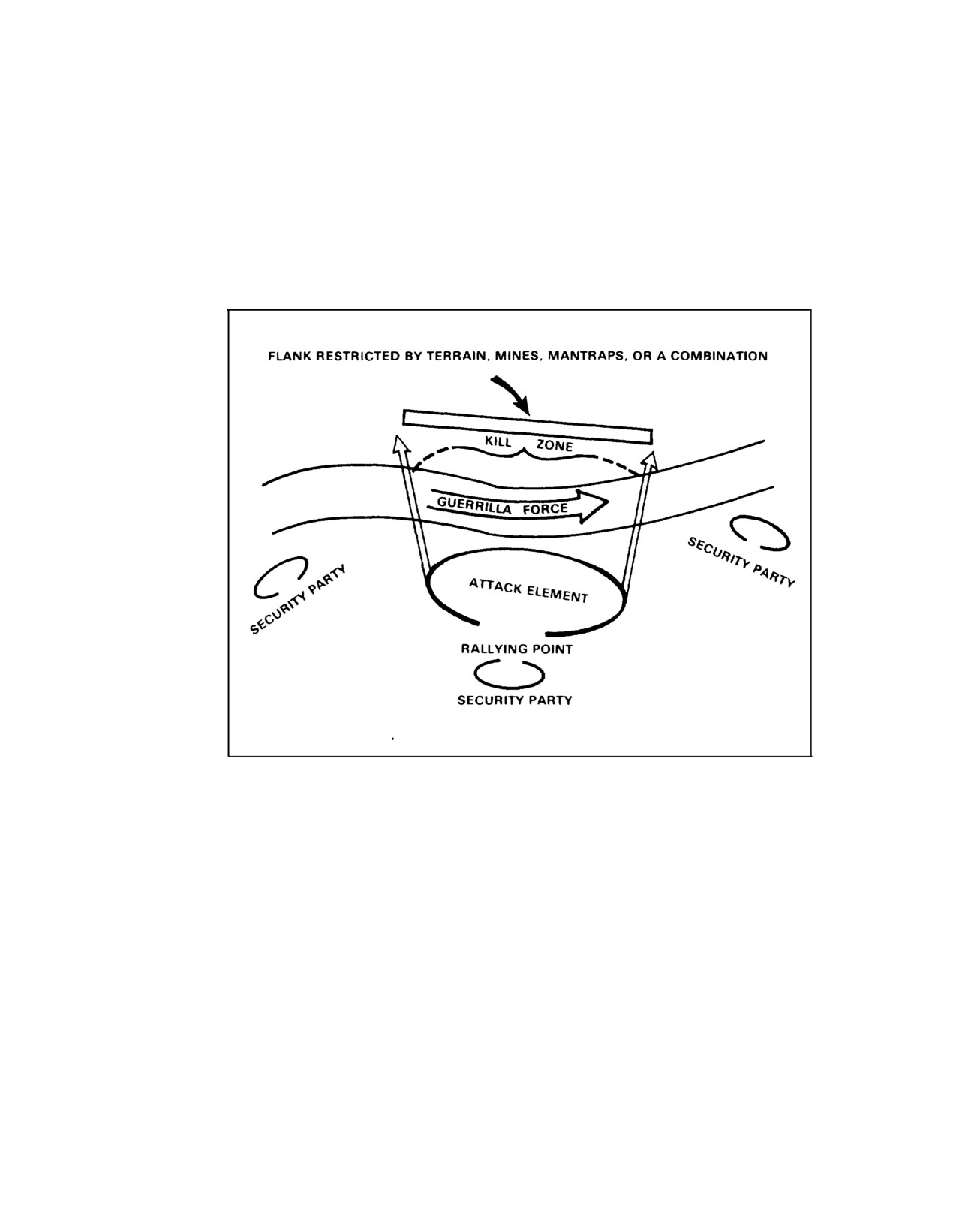
FM
90-8
attack element parallel to the long axis of the kill zone and
subjects the guerrilla force to heavy flanking fire. The size of the
force that can be trapped in the kill zone is limited by the area
which the attack element can effectively cover with highly
concentrated fire. The force is trapped in the kill zone by natural
obstacles. mines
(Claymore, antivehicular, antipersonnel),
demolition’s, and direct and indirect fires (Figure C-1).
Figure C-1. Line formation: harassing or destruction ambush.
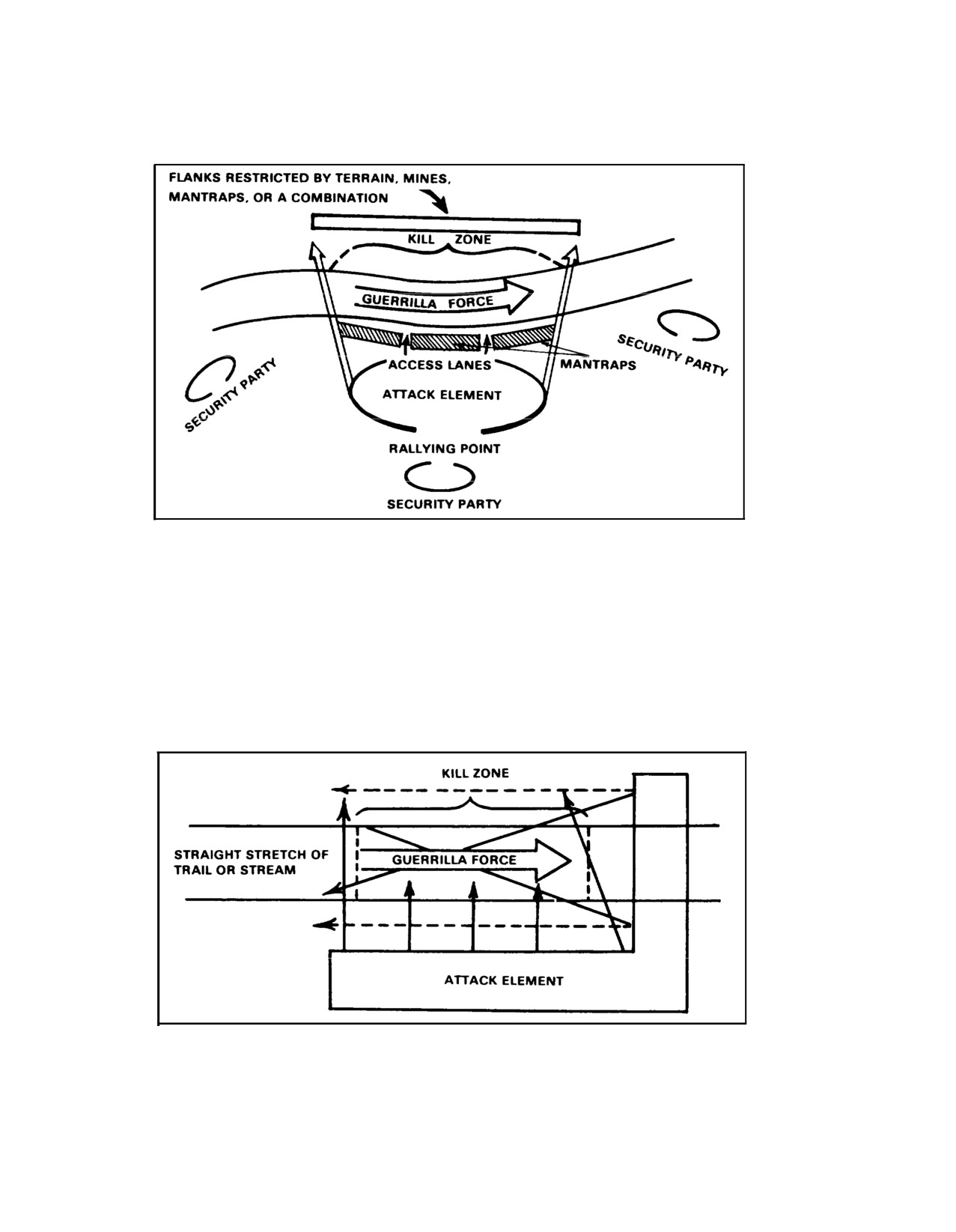
b. A disadvantage of the line formation is the chance that lateral
dispersion of the force maybe too great for effective coverage. The
line formation is appropriate in close terrain that restricts
guerrilla maneuver and in open terrain where one flank is
restricted by mines, demolitions, or mantraps. Similar obstacles
can be placed between the attack element and the kill zone to
provide protection from guerrilla counterambush measures.
When a destruction ambush is deployed in this manner, access
lanes are left so that the force in the killing zone can be assaulted.
The line formation can be effectively used by a “rise from the
ground” ambush in terrain seemingly unsuitable for ambush
(Figure C-2).
C-8
FM
90-8
Figure C-2. Line formation: destruction ambush with access lanes for assault of target.
c.
An advantage of the line formation is its relative ease of control
under all conditions of visibility.
C-16. L-formation.
a.
The L-shaped formation is a variation of the line formation. The
long side of the attack element is parallel to the kill zone and
delivers flanking fire. The short side of the attack element is at the
end of, and at right angles to, the kill zone and delivers enfilading
fire that interlocks with fire from the other leg (Figure C-3).
Figure C-3. L-formation: destruction ambush.
C-9
FM 90-8
b.
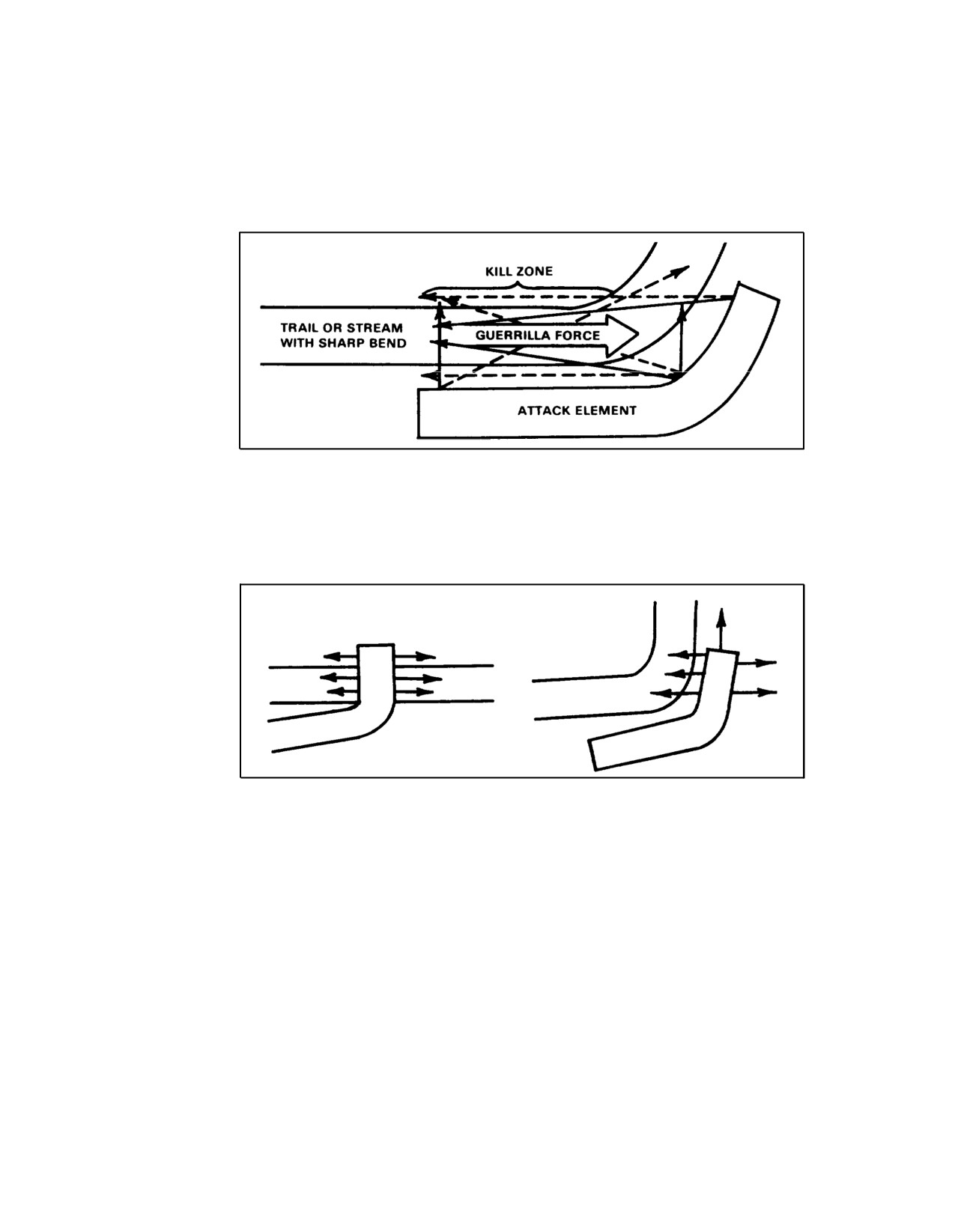
This formation is flexible. It can be established on a straight
stretch of a trail or stream or at a sharp bend in a trail or stream
(Figure C-4).
Figure C-4. L-formation: destruction ambush at bend of trail or stream.
c.
When appropriate, fire from the short leg can be shifted to parallel
the long leg if the guerrilla force attempts to assault or escape in
the opposite direction. In addition, the short leg prevents escape
in that direction or reinforcement from that direction (Figure C-5).
Figure C-5, L-formation: short leg prevents escape or reinforcement.
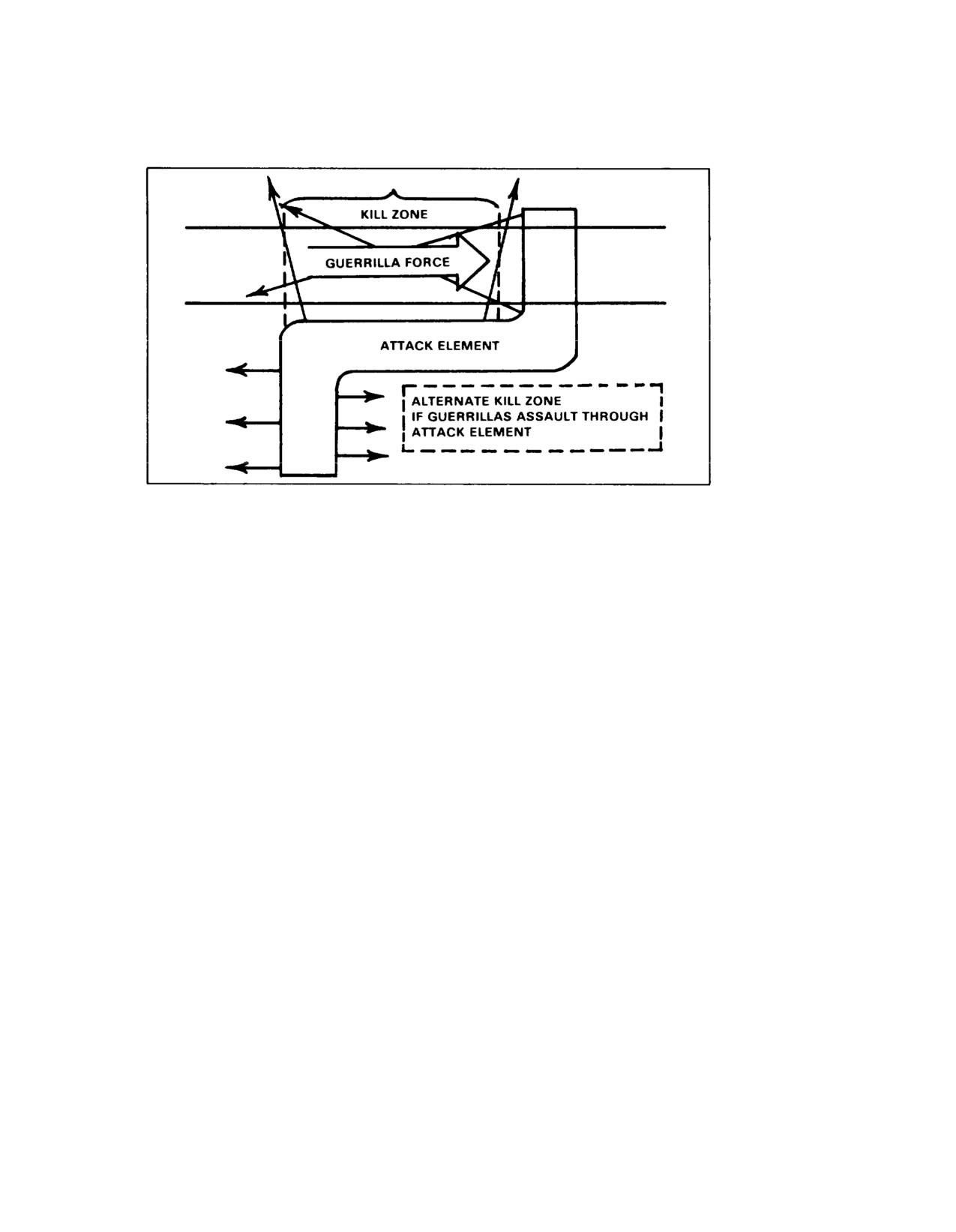
C-17. Z-formation.
The Z-shaped formation is another variation of the L-formation. The
attack force is deployed as in the L-formation but with an additional
side so that the formation resembles the letter Z. The additional side
may serve to (Figure C-6):
• Engage a force attempting to relieve or reinforce the guerrillas.
• Restrict a flank.
• Prevent envelopment (of the ambush force).
• Seal the end of the kill zone.
C-10
FM
90-8
Figure C-6. Z-formation: destruction ambush.
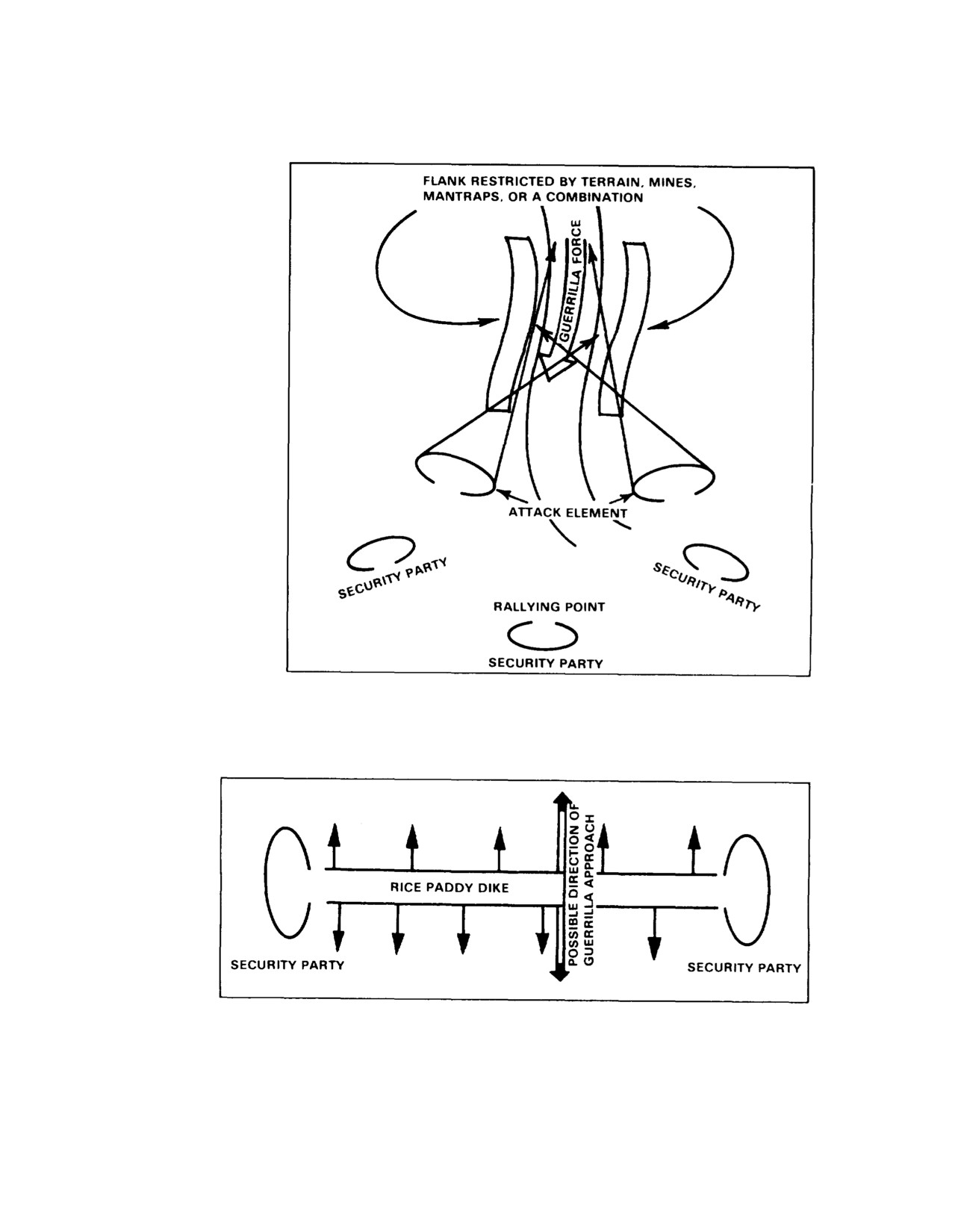
C-18. T-formation.
a.
In the T-shaped formation, the attack element is deployed across,
and at right angles to, the route of movement of the hostile force so
that the attack element and the target form the letter T. This
formation can be used day or night to establish a purely harassing
ambush, and at night to establish an ambush to interdict
movement through open, hard-to-seal areas (such as rice paddies).
b.
A small unit can use the T-formation to harass, slow, and
disorganize a larger force. When the lead guerrilla elements are
engaged, they will normally attempt to maneuver right or left to
close with the ambush force. Mines, mantraps, and other
obstacles placed to the flanks of the kill zone slow the guerrilla’s
movement and permit the unit to deliver heavy fire and then
withdraw without becoming decisively engaged. (Figure C-7).
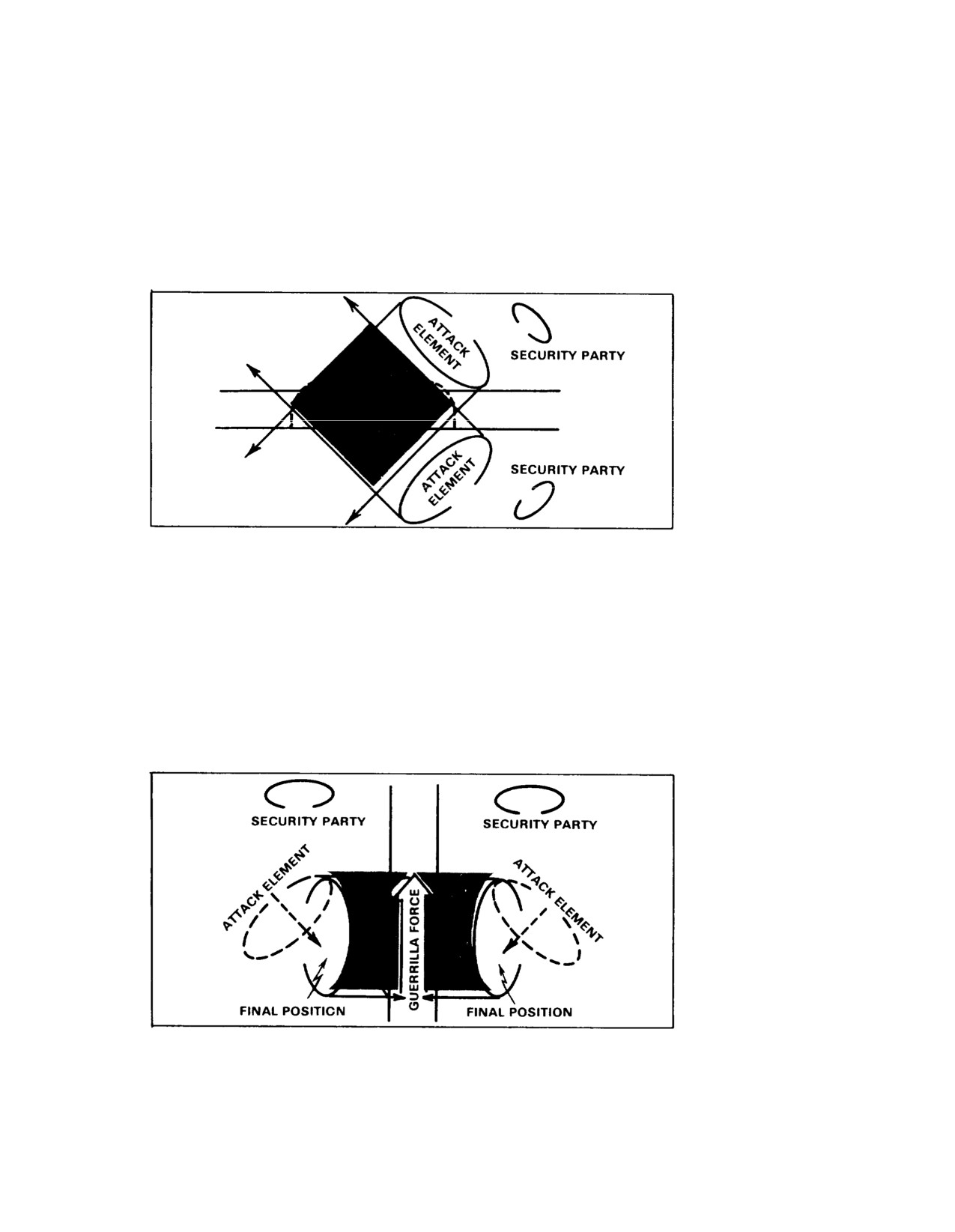
c.
The T-formation can be used to interdict small groups attempting
night movement across open areas. For example, the attack
element may be deployed along a rice paddy dike with every
second member facing in the opposite direction. The attack of a
force approaching from either direction requires only that every
second member shift to the opposite side of the dike. Each member
fires only to his front and only when the target is at close range.
Attack is by fire only, and each member keeps the guerrilla force
under fire as long as it remains to his front. If the force attempts to
escape in either direction along the dike, each member takes it
under fire as it comes into his vicinity. The T-formation is effective
at halting infiltration. (Figure C-8).
C-11
FM
90-8
Figure C-7. T-formation: harassing ambush.
d. It has one chief disadvantage: there is a possibility that while
spread out the ambush will engage a superior force. Use of this
formation must, therefore, fit the local enemy situation.
Figure C-8. T-formation: rice paddy harassing ambush where guerrilla approach
may be from either direction.
C-12
FM 90-8
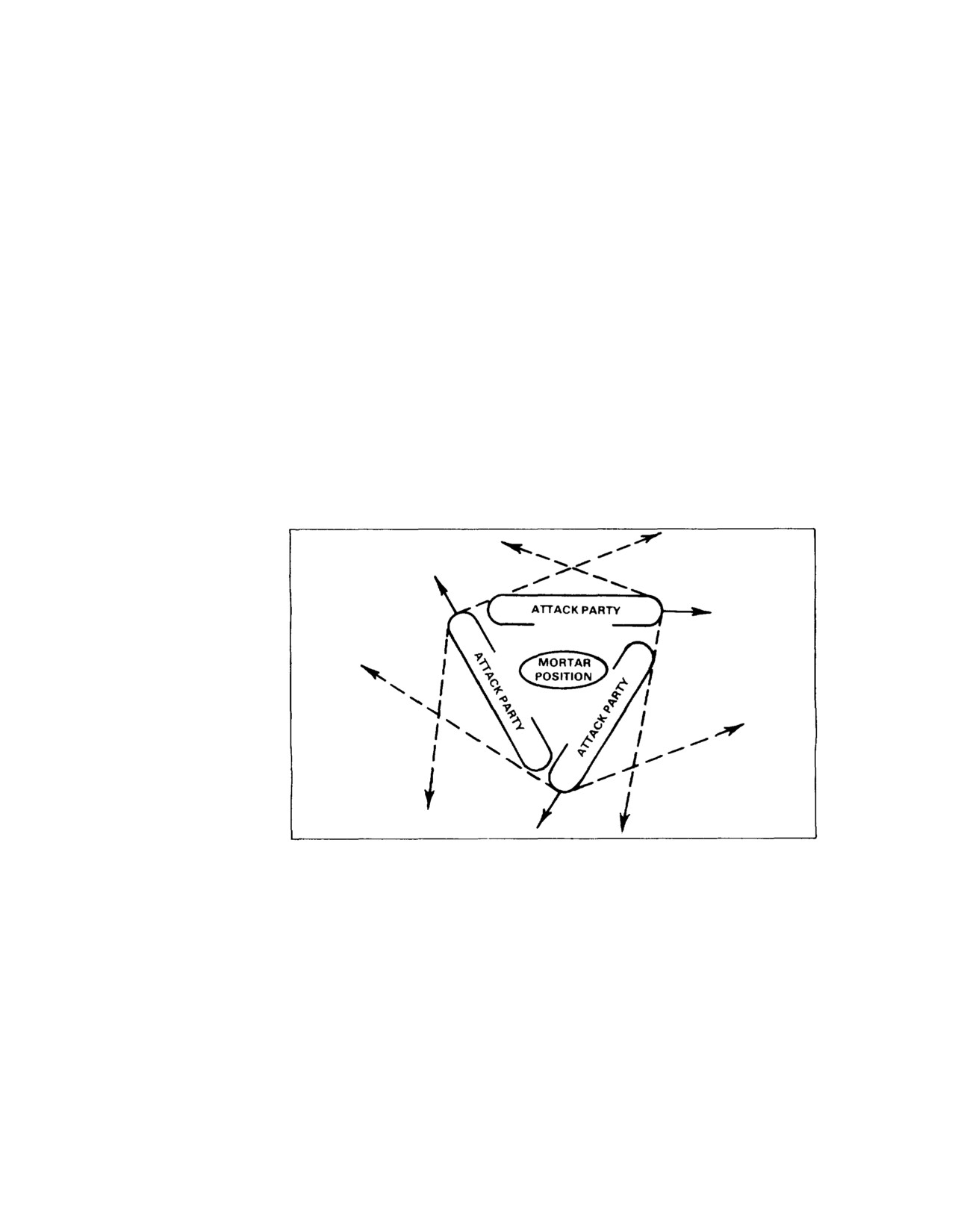
C-19. V-formation.
a.
The V-shaped attack element is deployed along both sides of the
guerrilla route of movement so that it forms a V. Care is taken to
ensure that neither group (or leg) fires into the other. This
formation subjects the guerrilla to both enfiladin
interlocking fire (Figure C-9).
Figure C-9. V-formation.
b.
The V-formation is suited for fairly open terrain but can also be
used in the jungle. When established in the jungle, the legs of the
V close in as the lead elements of the guerrilla force approach the
apex of the V; elements then open fire from close range. Here, even
more than in open terrain, all movement and fire is carefully
coordinated and controlled to ensure that the fire of one leg does
not endanger the other. Wider separation of the elements makes
this formation difficult to control, and there are fewer sites that
favor its use. Its main advantage is that it is difficult for the
guerrilla to detect the ambush until well into the kill zone (Figure
C-10).
Figure C-10. V-formation
(close range).
C-13
FM 90-8
C-20. Triangle formation.
This is a variation of the V-formation and can be employed in three
ways:
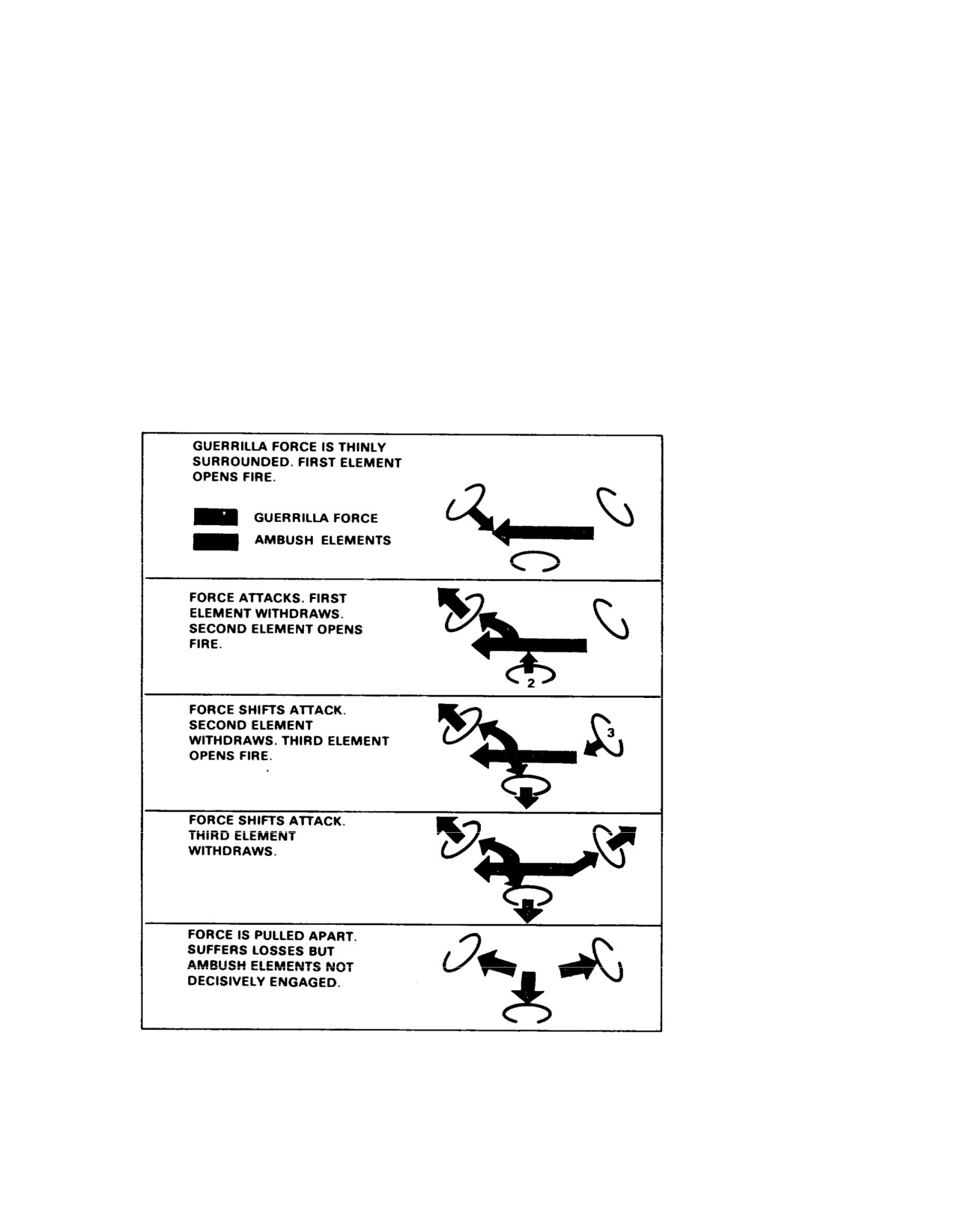
a.
Closed triangle. The attack element is deployed in three
groups, positioned so that they form a triangle (or closed V). An
automatic weapon is placed at each point of the triangle and
positioned so that it can be shifted quickly to interlock with either
of the others. Elements are positioned so that their fields of fire
overlap. Mortars may be positioned inside the triangle. When
deployed in this manner, the triangle ambush becomes a small
unit strongpoint which is used to interdict night movement
through open areas, when guerrilla approach is likely to be from
any direction. The formation provides all-round security, and
security elements are deployed only when they can be positioned
so that, if detected by an approaching target, they will not
compromise the ambush. Attack is by fire only, and the target is
allowed to approach within close range before the ambush force
opens fire (Figure C-11).
Figure C-11. Closed triangle.
(1)
Advantages include ease of control, all-round security, and
guerrillas approaching from any direction can be fired on by
at least two automatic weapons.
(2)
Disadvantages include the requirement for an ambush force
of platoon size or larger to reduce the danger of being overrun
by a large guerrilla force; one or more legs of the triangle may
come under guerrilla enfilade fire; and lack of dispersion,
particularly at the points, increases danger from guerrilla
mortar fire.
C-14
FM 90-8
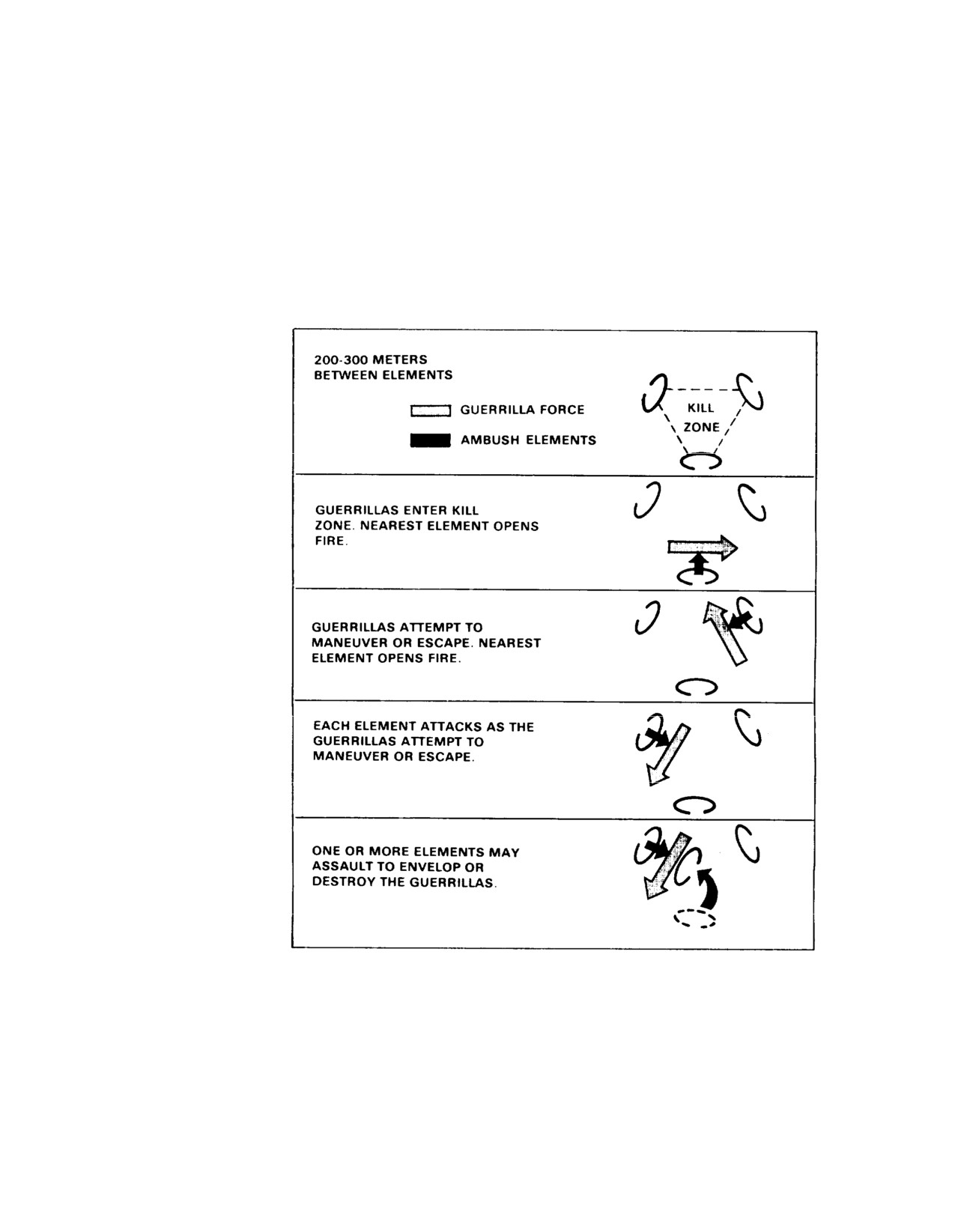
b. Open triangle (harassing ambush). This variation of the
triangle ambush is designed to enable a small unit to harass, slow,
and inflict heavy casualties upon a larger force without being
decisively engaged. The attack group is deployed in three
elements, positioned so that each element becomes a corner of a
triangle containing the kill zone. When the guerrillas enter the kill
zone, the element to the guerrillas’ front opens fire on the lead
guerrillas. When the guerrillas counterattack, the element
withdraws and an assault element to the flank opens fire. When
this group is attacked, the element to the opposite flank opens fire.
This process is repeated until the guerrillas are pulled apart. Each
element reoccupies its position, if possible, and continues to
inflict maximum damage without becoming decisively engaged
(Figure C-12).
Figure C-12. Open triangle formation: harassing ambush.
C-15
FM 90-8
c.
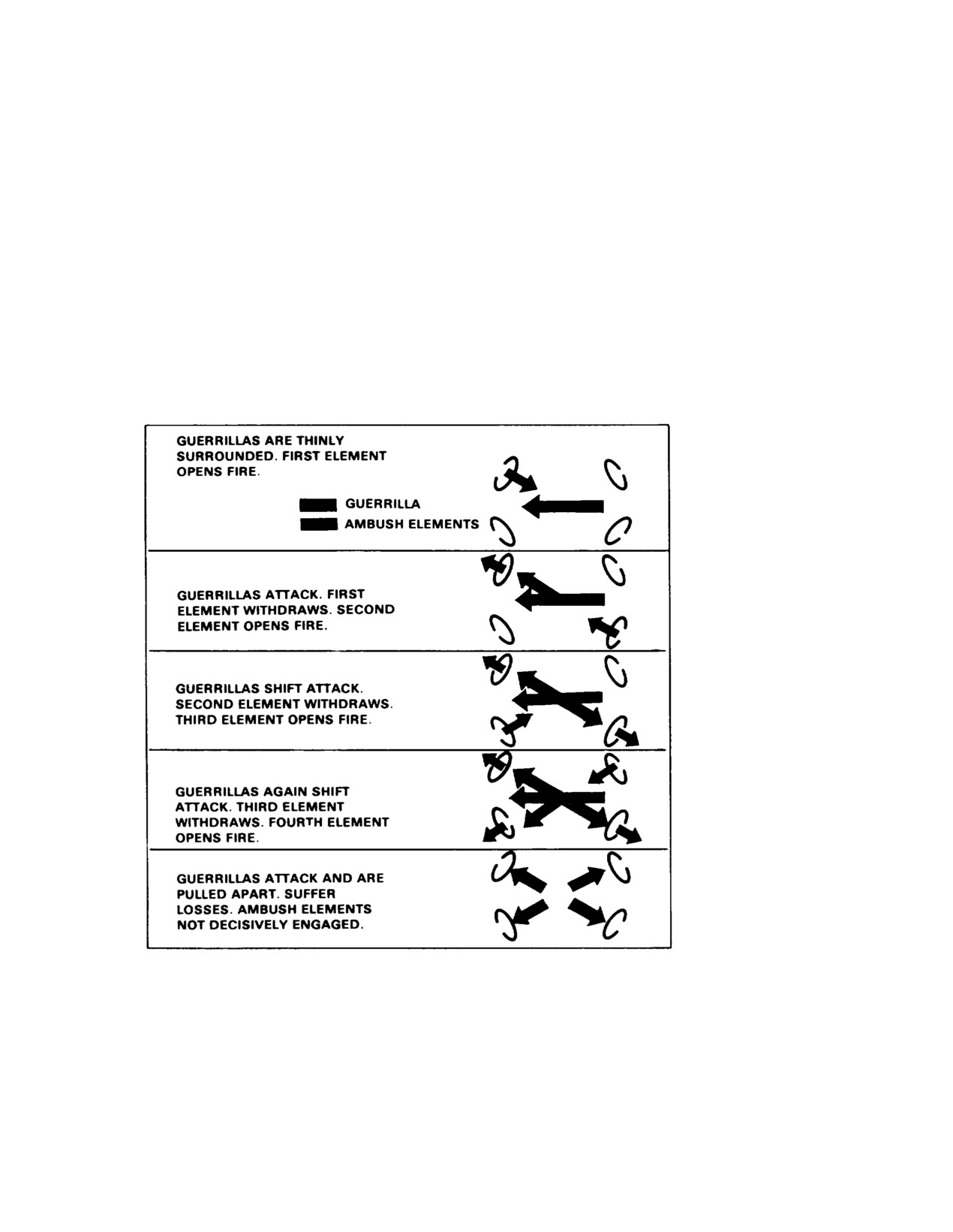
Open triangle (destruction ambush). The attack group is
again deployed in three elements, positioned so that each element
is a point of the triangle, 200 to 300 meters apart. The kill zone is
the area within the triangle. The guerrillas are allowed to enter
the killing zone; the nearest element attacks by fire. As the
guerrillas attempt to maneuver or withdraw, the other elements
open fire. One or more assault elements, as directed, assault or
maneuver to envelop or destroy the guerrillas (Figure C-13).
Figure C-13. Open triangle formation: destruction ambush.
(1) As a destruction ambush, this formation is suitable for
platoon-size or larger units; a unit smaller than a platoon
would be in danger of being overrun.
C-16
FM 90-8
(2)
Also, control, in assaulting or maneuvering, is difficult.
Close coordination and control are necessary to ensure that
assaulting or maneuvering assault elements are not fired on
by another party; and the ambush site must be a fairly level,
open area that provides (around its border) concealment for
the ambush elements (unless it is a “rise from the ground”
ambush).
C-21. Box formation.
a.
This formation is similar in purpose to the open triangle ambush.
The unit is deployed in four elements positioned so that each
element becomes a corner of a square or rectangle containing the
kill zone (Figure C-14).
Figure C-14. Box formation: harassing ambush.
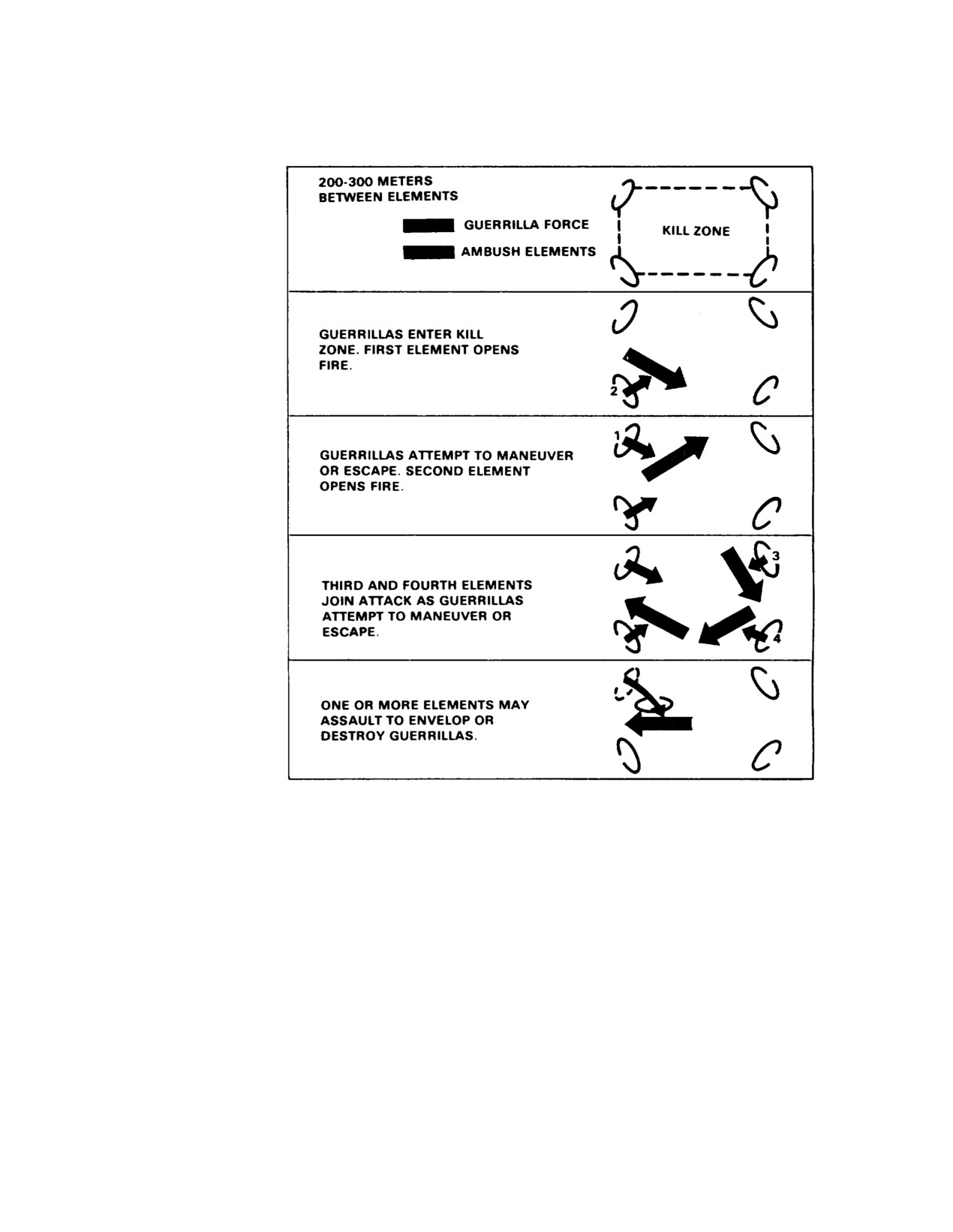
b.
It can be used as a harassing ambush or a destruction ambush in
the same manner as the two variations of the open triangle
ambush (Figure C-15).
C-17
FM 90-8
Figure C-15. Box formation: destruction ambush.
Section V. Area Ambush Formations
C-22. Kill zone.
A point ambush is established at a site having several trails or other
escape routes leading away from it. The site may be a water hole,
guerrilla campsite, or known rendezvous point, or a frequently traveled
trail. This site is the central kill zone.
C-23. Area ambush: multiple point
a.
Point ambushes are established along the trails or other escape
routes leading away from the central kill zone (Figure C-16).
C-18
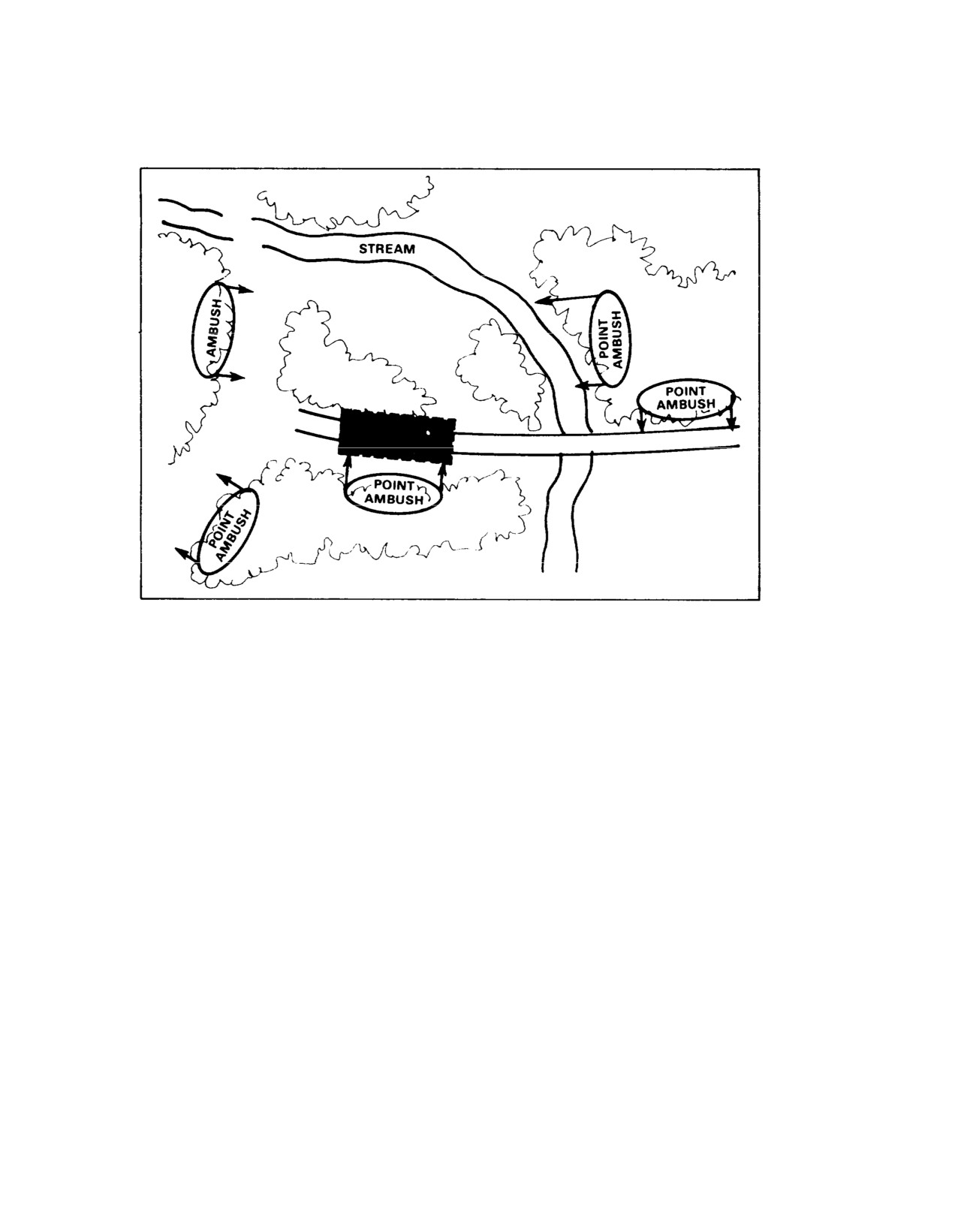
FM
90-8
Figure C-16. Area
(multiple point) ambush.
b. The guerrilla force, whether a single group or several parties
approaching from different directions, is permitted to move to the
central kill zone. Outlying ambushes do not attack (unless dis-
covered).
c.
The ambush is initiated when the guerrillas move into the central
kill zone.
d. When the guerrillas break contact and attempt to disperse,
escaping portions are intercepted and destroyed by the outlying
ambushes.
e. The multiple point ambush increases casualties and harassment
and produces confusion.
f.
This version of the area ambush is best suited in terrain where
movement is largely restricted to trails. It provides best results
when established as a deliberate ambush. When there is not
sufficient intelligence for a deliberate ambush, an area ambush of
opportunity (hasty ambush) may be established. The outlying
ambushes are permitted to attack guerrillas approaching the
central kill zone, if the guerrilla force is small. If it is too large for
the particular outlying ambush, the guerrillas are allowed to
continue and they are attacked in the central kill zone.
C-19
FM
90-8
C-24. Area ambush: baited trap
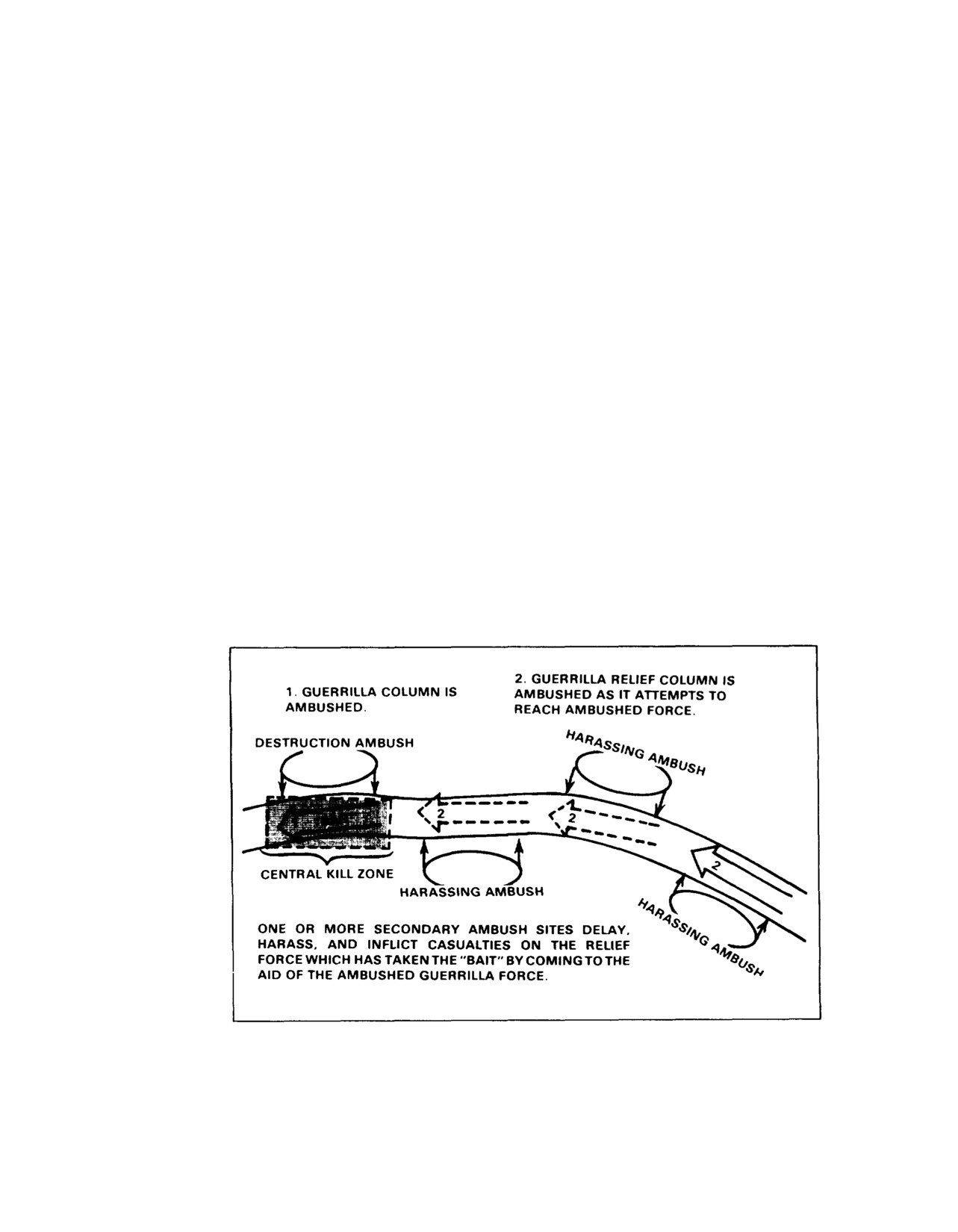
a. A variation of the area ambush is the “baited trap” ambush.
b. A central kill zone is established along the guerrilla’s route of
approach.
c. Point ambushes are established along the routes over which units
relieving or reinforcing the guerrilla will have to approach.
d.
The guerrilla force in the central kill zone serves as “bait” to lure
relieving or reinforcing guerrilla units into the kill zones of the
outlying ambushes. A friendly force can also be used as the “bait.”
e. The outlying point ambushes need not be strong enough to
destroy their targets. They may be small harassing ambushes
that delay, disorganize, and cause casualties by successive
contacts.
f.
This version can be varied by using a fixed installation as “bait”
to lure relieving or reinforcing guerrilla units into the kill zone of
one or more of the outlying ambushes. The installation replaces
the central kill zone and is attacked. The attack may intend to
overcome the installation or may use it as a ruse.
g. These variations are best suited for situations where routes of
approach for relieving or reinforcing guerrilla units are limited to
those favorable for ambush (Figure C-17).
Figure C-17. Area
(baited trap) ambush
C-20
FM
90-8
Section VI. Unusual Ambush Techniques
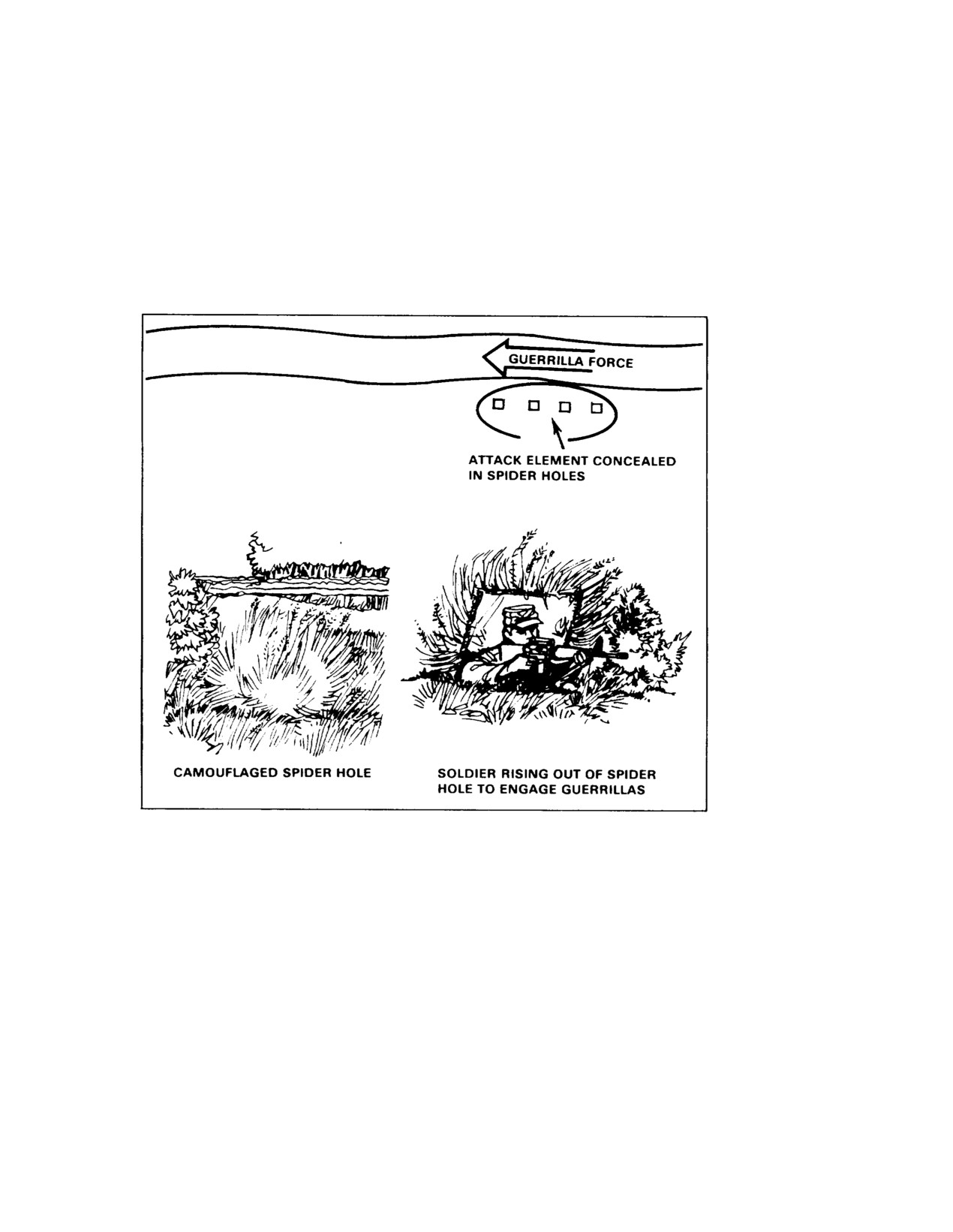
C-25. Spider hole ambush.
a. This point ambush is designed for open areas that lack the cover
and concealment and other features normally desirable in a
“good” ambush site. The attack element is deployed in the
formation best suited to the overall situation (Figure C-18).
Figure C-18. Spider hole ambush.
b.
The attack element is concealed in the “spider hole” type of
covered foxhole. Soil is carefully removed and positions expertly
camouflaged.
c.
When the ambush is initiated, the attack element members throw
back the covers and literally “rise from the ground” to attack.
d.
This ambush takes advantage of the tendency of patrols, and
other units, to relax in areas that do not appear to favor ambush.
e.
The chief disadvantage is that the ambush element is vulnerable
if detected prematurely.
C-21
160-739 O - 94 -
6
FM 90-8
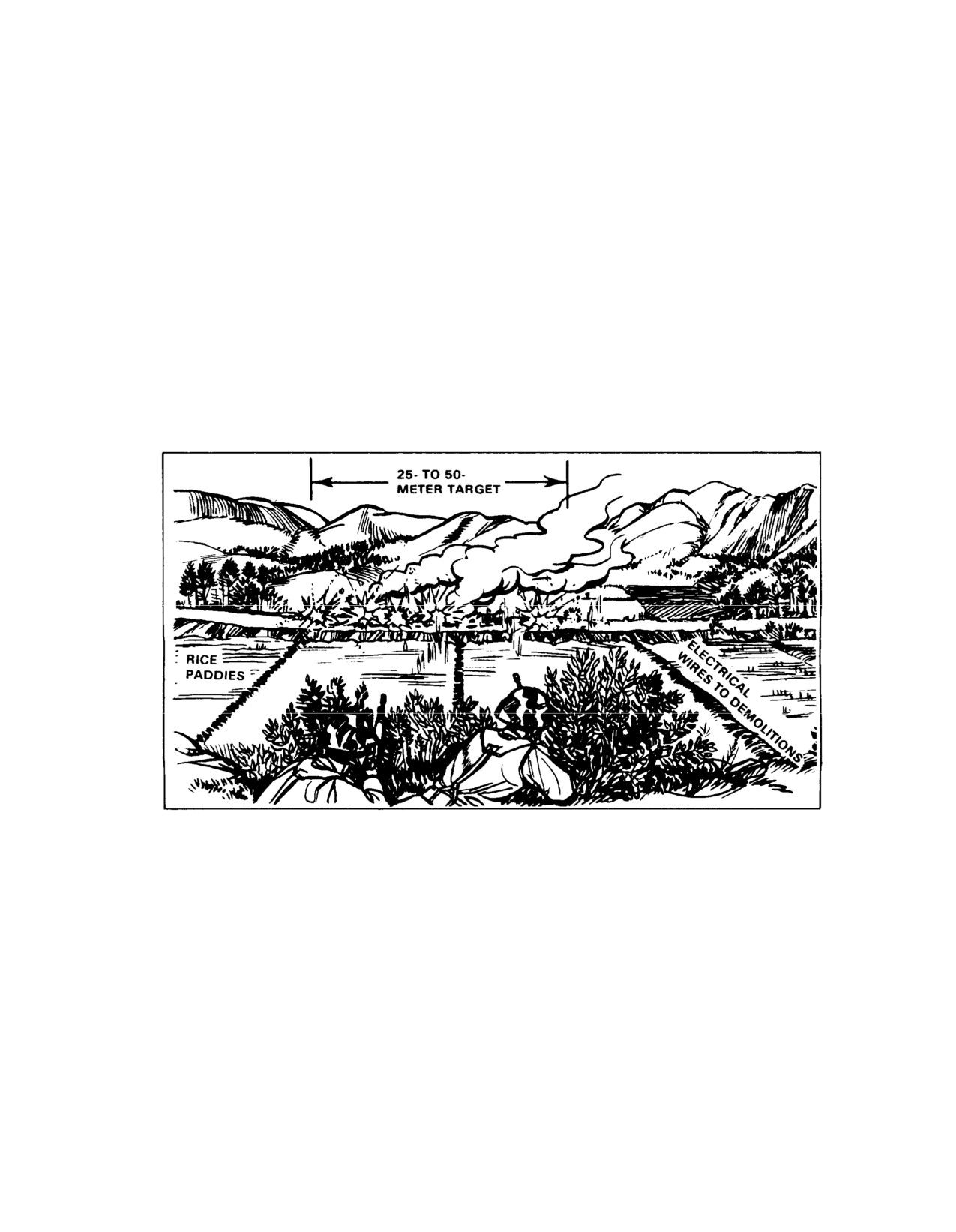
C-26. Demolition ambush.
a.
Dual primed, electrically detonated mines or demolition charges
are planted in an area over which a guerrilla force is expected to
pass. This may be a portion of a road or trail, an open field, or any
area that can be observed from a distance. Activating wires are
run to a concealed observation point sufficiently distant to ensure
safety of the ambush element.
b. As large a force as desired or necessary can be used to mine the
area. The ambush element remains to fire the charges; other
personnel return to the unit.
c.
When a guerrilla force enters the mined area (kill zone), the
element on site detonates the explosives and withdraws immediately
to avoid detection and pursuit (Figure C-19).
Figure C-19. Demolition ambush.
C-27. Special ambush situation.
Attacks against columns protected by armored vehicles depend on the
type and location of armored vehicles in a column, and the weapons of
the ambush force. If possible, armored vehicles are destroyed or
disabled by fire of antitank weapons, landmines, and Molotov
cocktails, or by throwing hand grenades into open hatches. An effort is
made to immobilize armored vehicles at a point where they are unable
to give protection to the rest of the convoy and where they will block the
route of other supporting vehicles.
C-22
FM 90-8
APPENDIX D
Patrolling
Section I. General
D-1. Patrols.
a. This appendix provides guidance on patrolling. It describes
various types of patrols and patrolling techniques.
b.
A patrol is a mission. The unit that has the mission organizes for
the conduct of the patrol. When organizing for the patrol, unit
integrity is maintained as much as possible.
c.
The requirements of the mission determine the size, organization,
and equipment of a patrol. Some missions may require only two or
three men, lightly armed with no special equipment; some
missions may require a squad or platoon, specially armed and
equipped. A unit is always tailored for the mission it is to execute.
d.
The effectiveness of a patrol is limited only by the ingenuity of the
planner and the skill and aggressiveness of the unit leader. For
this reason, they are one of the commander’s most valued tools.
Patrols are especially valuable in counterguerrilla operations.
Aggressive patrolling in an area greatly reduces the guerrillas’
freedom of movement, hampers their operations, and weakens
their influence on the local population.
e.
Patrols are classified according to the nature of the mission
assigned.
D-2. Reconnaissance patrols.
They collect information and confirm or disprove the accuracy of
information previously received. Reconnaissance patrols are further
classified as:
• Zone reconnaissance patrols.
• Area reconnaissance patrols.
D-3. Combat patrols.
They provide security and harass, destroy, or capture enemy
personnel, equipment, and installations. Combat patrols also collect
and report information whether it is related to the assigned mission or
not.
D-1
FM 90-8
Section Il. Planning
D-4. Five phases.
There are five phases involved in mission planning: patrol steps,
reverse planning sequence, the warning order, the time schedule, and
the operation order. The patrol leader uses patrol steps (derived from
troop leading procedures as discussed in FM 7-10) in planning the
mission. The leader considers all steps but executes only those required
by the mission. The steps may occur in various sequences, and some are
considered and accomplished simultaneously.
D-5. Patrol steps.
(Consider all steps; accomplish those necessary; sequence may vary.)
•
Study the mission.
•
Plan use of time.
•
Study terrain and situation.
•
Organize the patrol.
•
Select men, weapons, equipment.
•
Issue warning order.
•
Coordinate (continuous throughout).
•
Make reconnaissance.
•
Complete detailed plans.
•
Issue operation order.
•
Supervise (at all times), inspect, rehearse.
• Execute the mission.
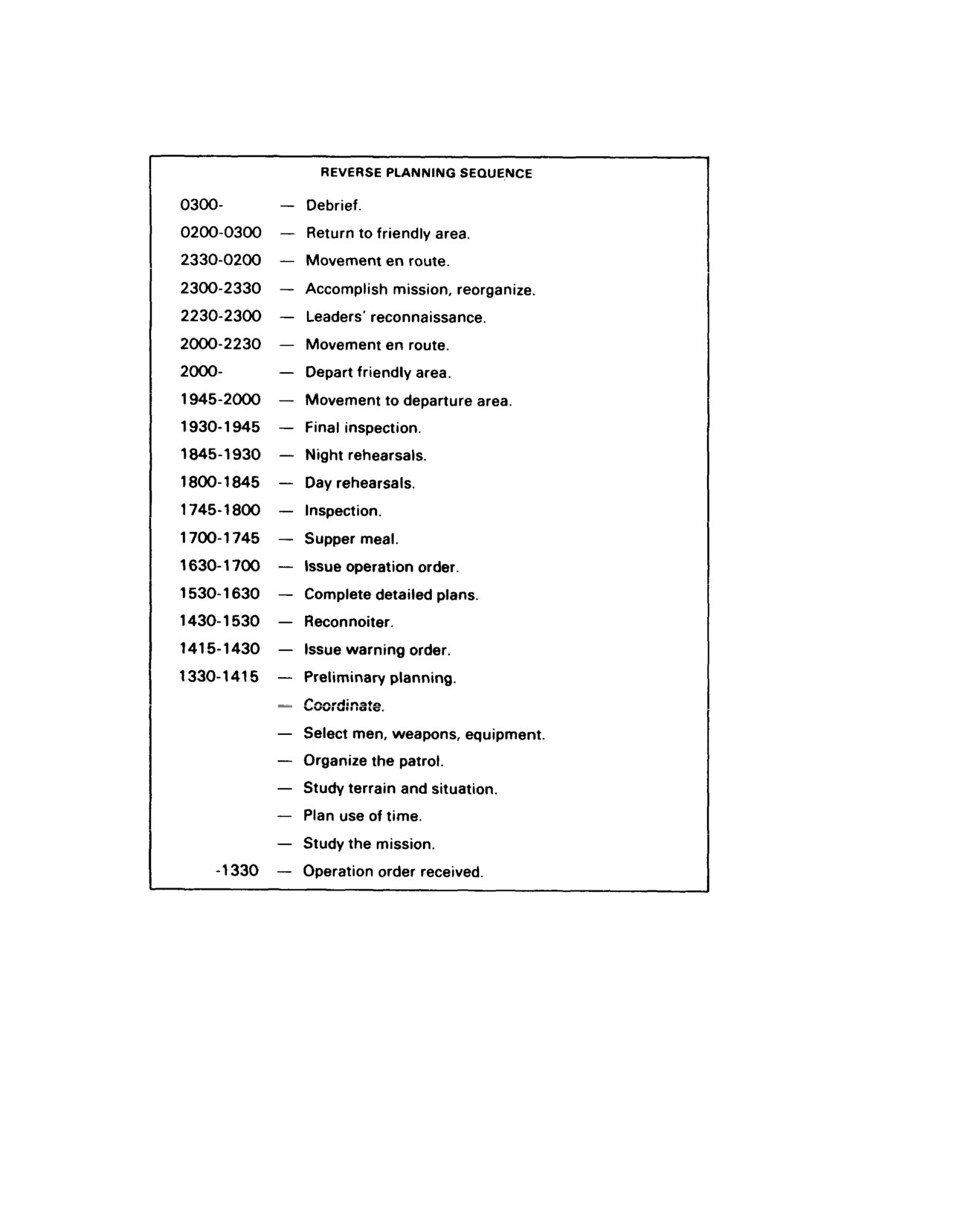
D-6. Reverse planning
The unit leader uses reverse planning sequence to allot time for each
action of the patrol. He plans this schedule around any critical times
specified in his order.
D-2
FM 90-8
D-7. Warning order.
There are two orders that the unit leader issues: the warning order and
the operation order. The warning order is issued as soon as a tentative
plan is made so that the men may have maximum time to prepare for
the patrol.
D-3
FM
90-8
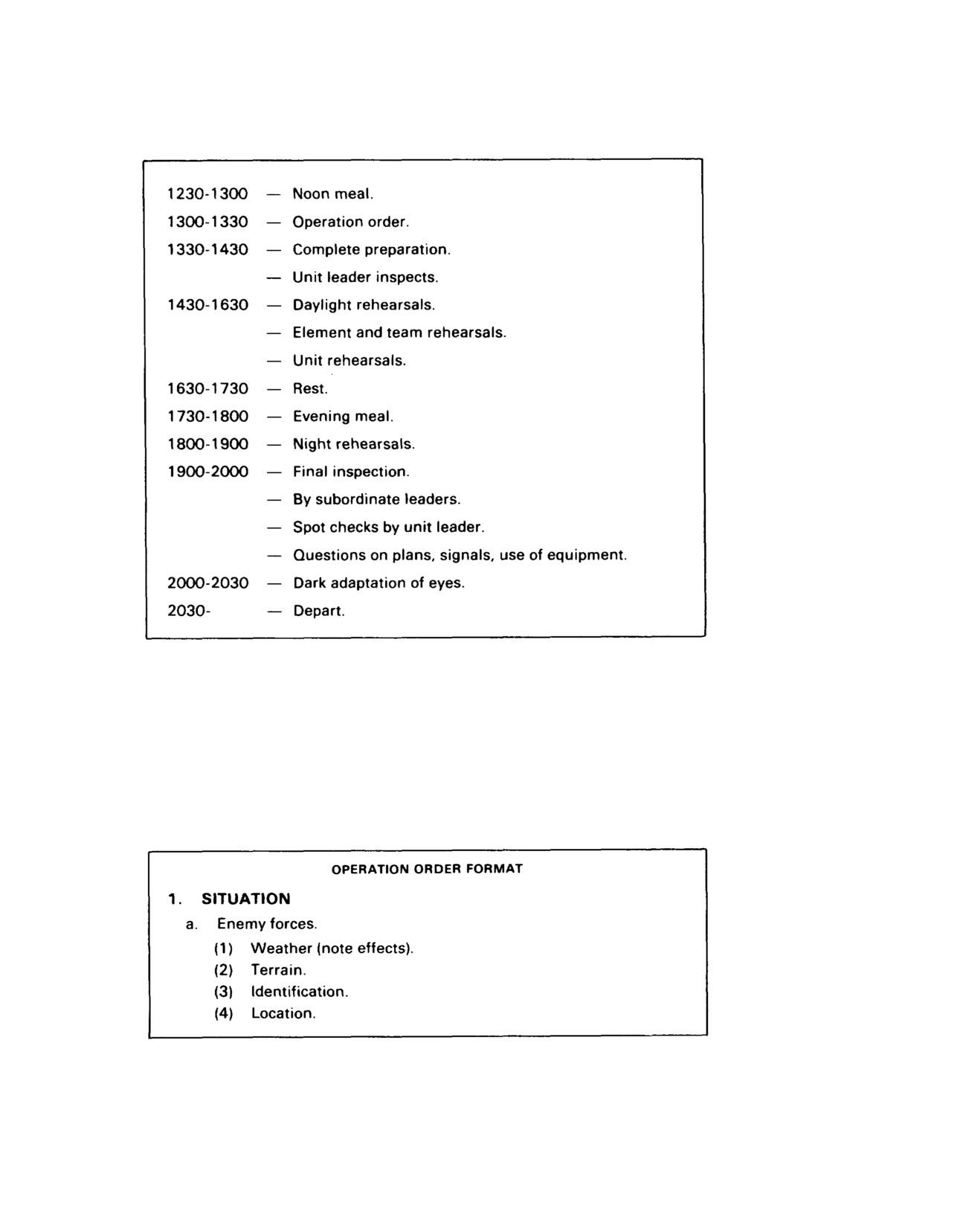
D-8. Time schedule.
When the warning order is issued, a time schedule is given for all
activities that must take place.
D-4
FM 90-8
D-9. Operation order.
The second order that the unit leader gives is the operation order. This
is issued in a standard (five-paragraph) field order format. The
situation determines whether the order is written in detail or prepared
in note form. The operation order, as well as the warning order, maybe
shortened by reference to unit SOPs. In addition, items unchanged
from the warning order are covered by stating "same as warning
order."
D-5
FM 90-8
D-6
FM 90-8
Section Ill. Reconnaissance Patrols
D-10. Information requirements.
a. Reconnaissance patrols provide the commander with timely,
accurate information of guerrillas and the terrain they control.
This information is vital in making tactical decisions.
b.
The commander may require information of a specific location or
small specific area, usually a known or suspected position or
activity. An area reconnaissance patrol secures this information
by reconnoitering the location or by maintaining surveillance
over the location.
c. The commander may require information of an extended area, or
may desire information of several locations within an area. A
zone reconnaissance patrol secures this information by recon-
noitering the area, by maintaining surveillance over the area, or
D-7
FM 90-8
by making the coordinated area reconnaissance of designated
locations within the area.
D-11. Security.
a.
In addition to reaching the objective without discovery, if
possible, a reconnaissance patrol also tries to conduct its
reconnaissance or surveillance without being discovered. Stealth,
patience, and maximum use of concealment are mandatory.
b. A reconnaissance patrol fights only to protect itself or, when
authorized, to accomplish its mission. The commander dispatching
the patrol is responsible for informing tha patrol whether it is to
fight, if necessary, to accomplish the mission.
c.
Day and night reconnaissance patrols use essentially the same
techniques. The principal differences are:
(1) Day reconnaissance requires greater use of concealment.
The patrol is more likely to be seen than at night and usually
will not be able to move as close to the objective.
(2) Night reconnaissance requires stealth. Sounds carry farther
at night, and reduced visibility usually requires a closer
approach to the objective.
d. When two or more teams of a patrol are to assembly at a linkup
point, one team is designated to secure the linkup point for the
arrival of other teams. The route and tasks of this team are
arranged so that it can reach the linkup point first and
accomplish these tasks.
Section IV. Combat Patrols
D-12. Seek and attack.
a. A combat patrol has the general mission of seeking out and
attacking targets of opportunity. An ambush is a combat patrol
(Appendix C).
b. In conventional operations, the enemy’s general location is
usually defined. Specific targets for patrols are not difficult to
locate and designate. Missions for patrols can be, and usually are,
specific and limited.
c.
This situation seldom exists in counterguerrilla operations,
however. Specific targets for raids and for other forms of attack
are much more limited, because of the characteristics of
guerrillas. They are elusive and highly mobile; they avoid decisive
engagement; they avoid prepared positions and establish
relatively few fixed installations.
D-8
FM
90-8
d.
A combat patrol searches for and, within its capability, engages
targets when and where found. Engagement is by raid, ambush,
or any form of attack suitable to the situation.
D-13. Flexibility.
a. The combat patrol is one of the commander’s most flexible
weapons. Uses vary from a two-man patrol executing a harassing
ambush of opportunity to a reinforced platoon conducting raids,
ambushes, and target-of-opportunity operations. In some
instances, a patrol encountering a superior force may maintain
contact with the force until reinforcements permit decisive
engagement. Effectiveness of the patrol depends, not on size, but
on the suitability to a given situation.
b.
The use of combat patrols forces guerrillas to engage in decisive
combat at unfavorable times and places. They can be used to
locate and destroy enemy camps, elements, and supply points.
Saturation of an area with patrols forces the guerrillas to either
curtail operations or consolidate in larger groups, which are
favorable targets for air, artillery, and large-scale attack.
c.
Patrols may be inserted by parachute, helicopter, surface or
subsurface watercraft, or ground methods. The conduct of the
patrol itself remains unchanged, even though the method of
insertion changes.
Section V. Motorized Patrols
D-14. Missions, organization.
a.
Patrols may be motorized (usually as an economy-of-force
measure) to allow them to:
(1) Cover greater distances in less time than dismounted patrols.
(2) Operate in contaminated areas too dangerous for dismounted
patrols.
(3) Carry more or heavier equipment, weapons, and ammuni-
tion.
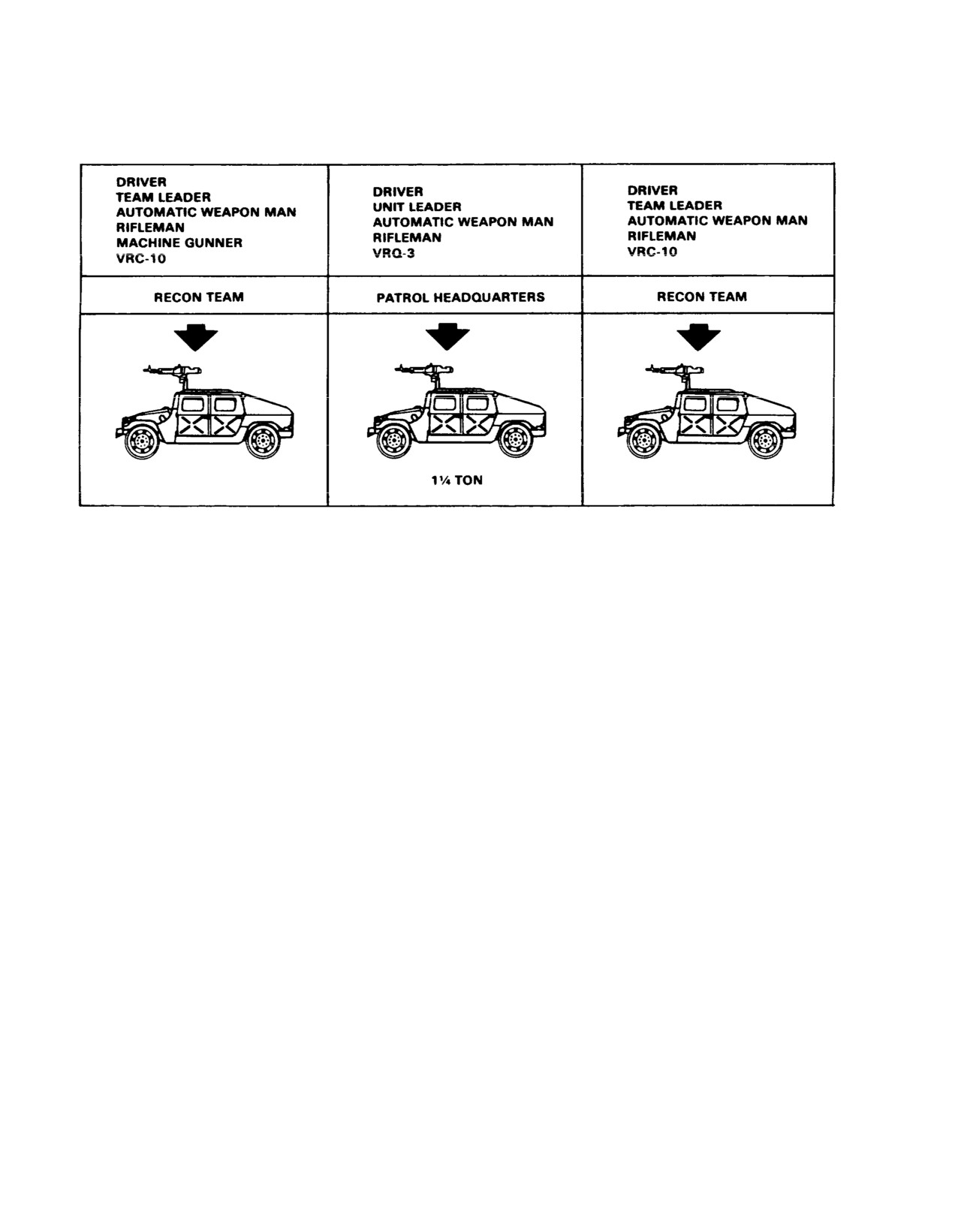
b. A motorized patrol is organized into elements and teams in the
same manner as a dismounted patrol. Substitution of tracked
carriers for wheeled vehicles provides an increased potential for
battlefield mobility (Figure D-1).
c.
When soldiers are assigned to vehicles, squad or fire team
integrity is maintained as far as possible. One soldier is
designated commander of each vehicle.
D-9
FM
90-8
Figure
D-1. Organization of a motorized reconnaissance patrol.
d. A motorized patrol is prepared in the same general manner as a
dismounted patrol. In addition, however, vehicles must be
checked to ensure that they are in good mechanical condition and
properly supplied with fuel, oil, and water. Drivers and other
personnel are as thoroughly prepared for the mission as regular
patrol members.
e. Motorizing enables a patrol to carry heavy and bulky equipment
such as:
(1) Antitank weapons and ammunition are placed near the front
and rear of the patrol. Personnel are designated to man and
support these weapons when they are employed.
(2) Surveillance equipment.
(3) Additional automatic weapons and ammunition.
f.
Communication between vehicles and between the patrol and
higher headquarters is essential. Within the patrol, radios, voice
commands, and visual signals may be used. Vehicular-mounted
radios are usually the best means for communication with higher
headquarters. Light aircraft may be used to drop messages and to
relay radio messages.
D-15. Movement.
A motorized patrol moves by one of three methods: continuous
movement, successive bounds, and alternate bounds:
D-10
FM
90-8
a.
In continuous movement, all vehicles travel at a moderate rate of
speed, with all personnel alert. The lead vehicles stops to
investigate only those areas that appear dangerous. This is the
fastest, but least secure, method of movement.
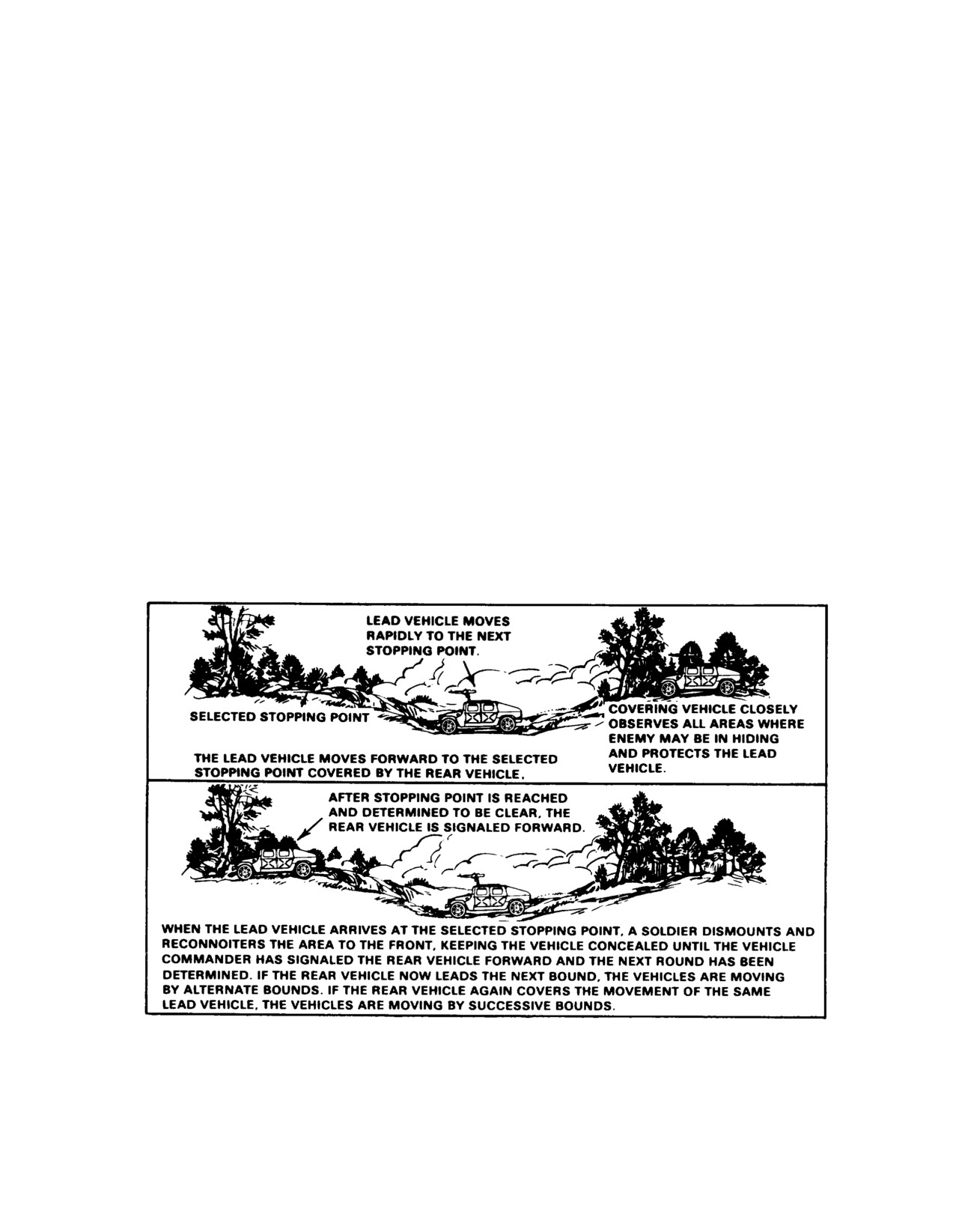
b. In successive bounds, vehicles keep their relative positions in the
column. The first and second vehicles operate as a team in moving
from one observation point to another. The second vehicle is
placed in a concealed position, occupants dismounting if
necessary, to cover movement of the first vehicle to an observation
point. On reaching this point, occupants of the first vehicle
observe and reconnoiter, dismounting if necessary. When the area
is determined to be clear, the second vehicle is signaled forward to
join the first vehicle. The commander of the first vehicle carefully
observes the terrain to the front for signs of guerrillas and selects
the next stopping point. The first vehicle then moves out and the
process is repeated. Movement distance of the lead vehicle does
not exceed the limit of observation or the range of effective fire
support from the second vehicle. The lead vehicle and personnel
are replaced frequently to ensure constant alertness. The other
vehicles in the column move by bounds from one concealed
position to the next. Each vehicle maintains visual contact with
the vehicle ahead but avoids closing up (Figure D-2).
Figure D-2. Lead vehicle moves by bounds.
D-11
FM
90-8
c.
In alternate bounds, all except the first two vehicles keep their
relative places in the column. The first two vehicles alternate as
lead vehicles on each bound. Each covers the bound of the other.
This method provides more rapid advance than movement by
successive bounds but is less secure; it does not allow soldiers in
the second vehicle enough time to thoroughly observe the terrain
to the front before passing the first vehicle. Security is obtained by
the vehicle commander who assigns each soldier a direction of
observation: to the front, flank(s), or rear. This provides each
vehicle with some security against surprise fire from every
direction and provides visual contact with vehicles to the front
and rear. For maximum observation, all canvas is removed from
the vehicles.
D-16. Actions at danger areas.
a.
The commander of the leading vehicle immediately notifies the
unit leader when he encounters an obstacle or other danger area.
Designated soldiers reconnoiter these places under cover of the
weapons in the vehicle. Obstacles are bypassed, if possible. When
they cannot be bypassed, they are cautiously removed.
b.
Side roads intersecting the route of advance are investigated.
Soldiers from one vehicle secure the road junction; one or two
vehicles investigate the side road. The amount of reconnaissance
of side roads is determined by the patrol leader’s knowledge of the
situation. Men investigating side roads do not, however, move
past supporting distance of the main body of the patrol.
c.
Bridges, road junctions, defiles, and curves (that deny observation
beyond the turn) are danger areas. Soldiers dismount and take
advantage of available cover and concealment to investigate
these areas. The vehicle is moved off the road into a covered or
concealed position; weapons from the vehicle cover the advance of
the investigating personnel (Figure D-3).
d.
When approaching a village, two or three soldiers may go forward
on foot to reconnoiter. Other soldiers cover their movement from
covered or concealed positions.
e.
Actions on contacting guerrillas depend on whether the mission
permits or prohibits engaging in combat. For example, if the
mission permits or requires the exploitation of opportunities for
combat and the lead vehicle detects, or is attacked by, an ambush,
then soldiers in the lead vehicle move to positions from which the
guerrillas can be brought under fire. The soldiers dismount and
maneuver to destroy the ambush. Higher headquarters is notified
of the situation.
D-12
FM
90-8
Figure D-3. Soldiers dismount to investigate danger areas.
f.
In any situation where the soldiers dismount, drivers remain with
and protect their vehicles. The vehicles are moved off the road,
after ensuring that the shoulders of the road are not mined. If
possible, they are positioned so that the drivers can support the
attack. At least one automatic weapon remains with the vehicles.
g.
Higher headquarters is notified when the action is completed and
the unit continues the mission.
D-13
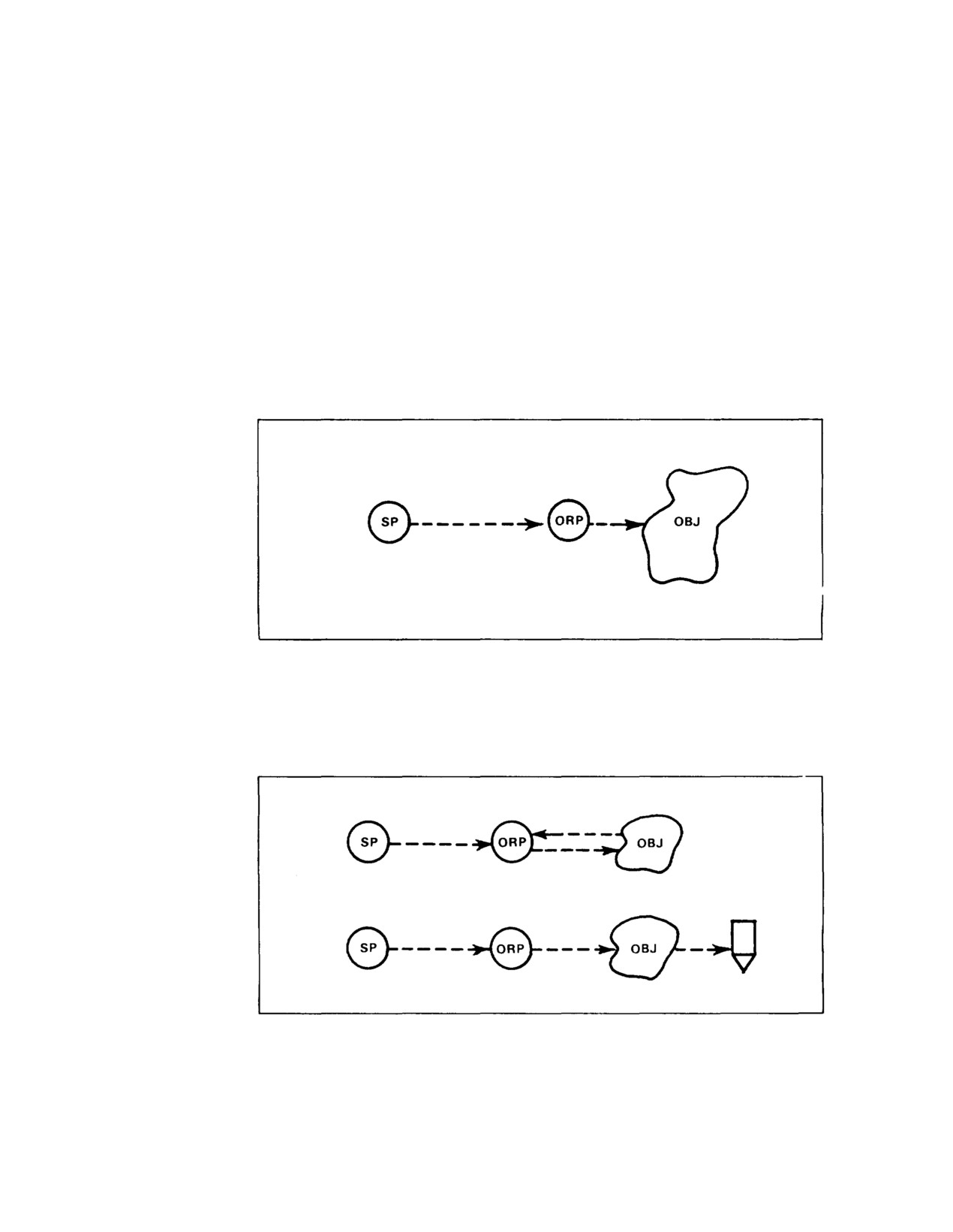
FM 90-8
Section VI. Dismounted Movement
D-17. Techniques.
There are many movement techniques that can be utilized. This section
describes basic and linear movements, and combat, zone, and area
reconnaissance.
D-18. Basic movements.
a.
In all cases, the unit moves from a start point (SP) to an objective
rally point (ORP) and then on to its objective (OBJ) area (Figure
D-4).
Figure D-4. Basic movement sequence.
b.
The unit may then return to the ORP upon mission accomplishment,
or it may proceed through the objective area and onto a linkup
point (LUP) (Figure D-5). From there the unit continues with a
follow-on mission, or returns to base.
Figure D-5. Other basic techniques.
D-14
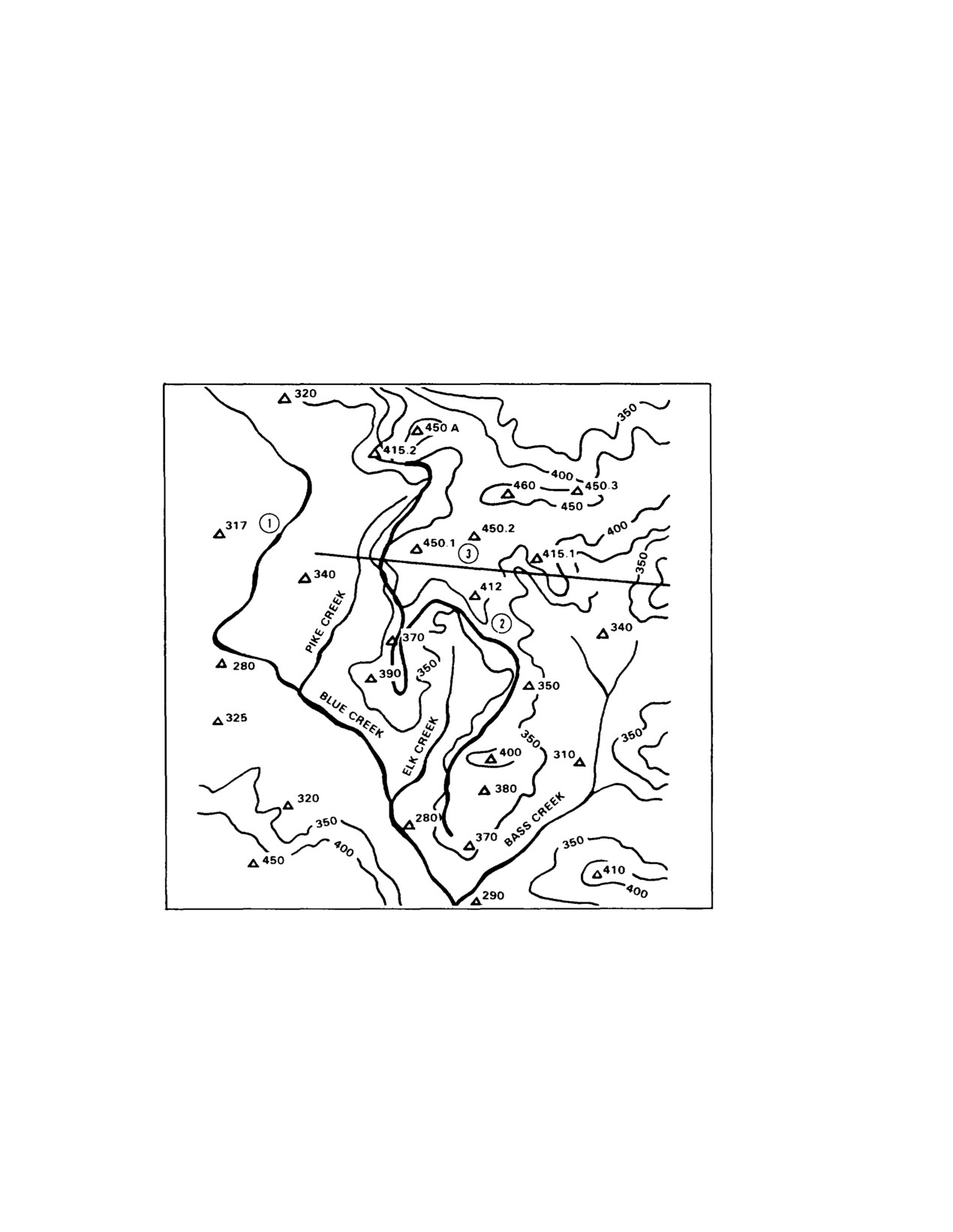
FM 90-8
D-19. Linear movement.
a.
Stream and trail. This technique of movement calls for the unit
to use a trail or stream as a navigation guide. The unit may not be
traveling on the trail or stream, but only in the vicinity of it for
security (1).
b. Contour. The unit selects a contour interval and follows that
elevation (2).
c.
Cross-compartment. The unit travels in a generally straight
path regardless of terrain features (3). Reference Figure D-6.
Figure D-6. Stream and trail
(1), contour
(2), and cross-compartment
(3).
D-20. Combat and zone reconnaissance patrols.
These techniques are general and illustrate how units operate on
sections of terrain in guerrilla territory (Figures D-7).
D-15
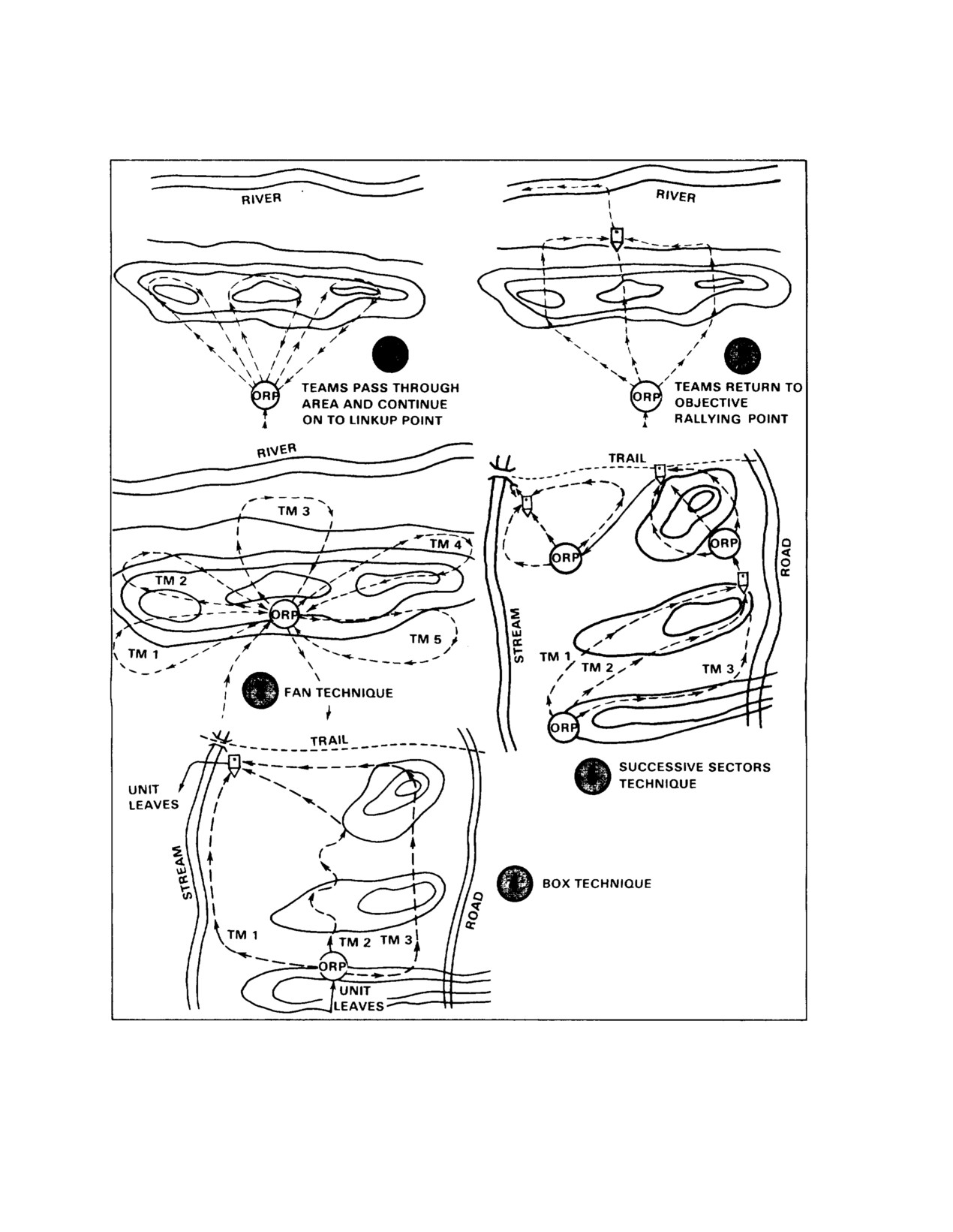
FM
90-8
Figure D-7. Combat and zone reconnaissance patrols.
D-16
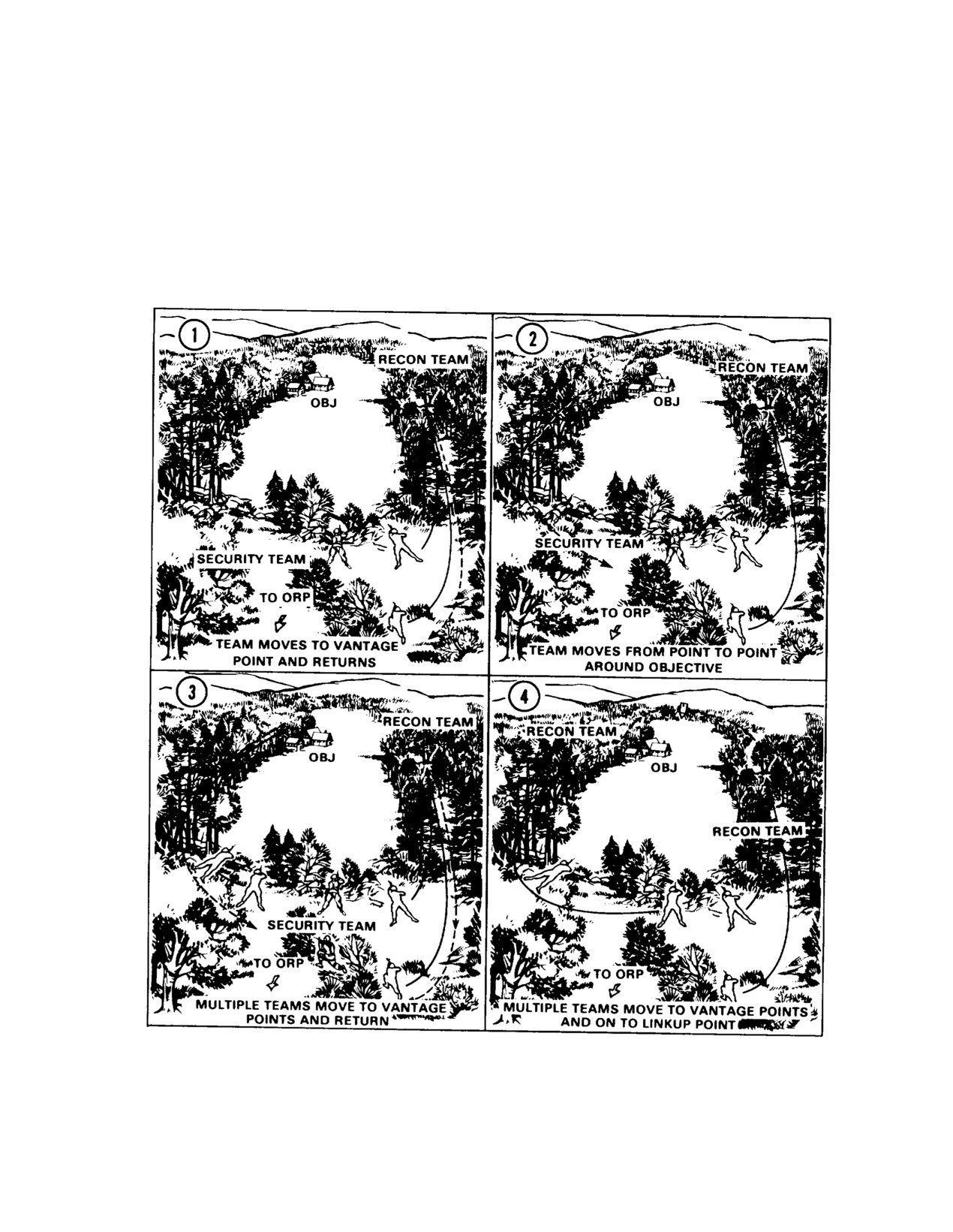
FM 90-8
D-21. Area reconnaissance patrol.
a.
This type of patrol differs from the others in that it has a specific
location to be observed for intelligence. There are several methods
that may be utilized by an area reconnaissance patrol to conduct
its mission. Four of the most common are illustrated (Figure D-8).
Figure D-8. Area reconnaissance patrol
D-17
FM 90-8
b. The movement techniques described in this section are basic
methods. Many other techniques may be developed depending
upon the terrain, the mission, and the unit leader’s initiative. The
leader always ensures, however, that no outline or pattern is
established that would allow a guerrilla force to ambush his unit.
D-18
FM 90-8
APPENDIX E
Bases
Section I. General
E-1. Three types.
This appendix explains the three types of bases generally used in a
counterinsurgency: patrol bases, operational support bases, and
support bases.
E-2. Tactical uses.
Patrol bases are used by a company or smaller units. Operational
support bases are used by battalions, and support bases are used by
brigades and larger units.
Section Il. Patrol Bases
E-3. Planning.
a. When a unit halts for an extended period, it takes active and
passive measures to provide maximum security. The leader
selects, occupies, and organizes an area so located that it provides
passive security from enemy detection. This is a patrol base.
Planning a patrol base is usually a part of the patrol’s operation;
b.
or it may be an on-the-spot decision. The length of time a patrol
base is occupied depends on the need for secrecy. In most
situations, occupation should not exceed 24 hours except in an
emergency. A patrol base is occupied the minimum time
necessary to accomplish the mission. The same base is not
(usually) used again.
c.
In counterguerrilla operations, patrol base secrecy is required;
and evacuation (if discovered) depends on the degree of control the
guerrilla force has in the base area, their ability to react to the
discovery of a base, and their ability to affect the unit’s mission.
When a guerrilla force is relatively small and weak, patrol base
secrecy may not bean overriding consideration; and if the base is
discovered, evacuation may not be required. In an area controlled
by a large guerrilla force with a high degree of combat capability,
patrol base secrecy is mandatory; and if discovered, evacuation is
required.
E-1