Military reference books and manuals (2009-2023, Volume 4) - page 1
DOMESTIC OPERATIONAL LAW
HANDBOOK
2018
FOR JUDGE ADVOCATES
CENTER FOR LAW AND MILITARY OPERATIONS
September 2018
2018 DOMESTIC OPERATIONAL LAW HANDBOOK
A PRACTITIONER’S GUIDE FOR JUDGE ADVOCATES
EDITORS and CONTRIBUTING AUTHORS
LTC Ted Martin, USA
MAJ Corey E. Thomas, ARNGUS
2018 CONTRIBUTING AUTHORS
LTC Richard Sudder
LTC Bayne Johnston
LTC Michael McCann
LTC Stephen Faherty
LTC Robert Kavanaugh
LTC Benjamin Currier
CDR Michael Gesele
MAJ Sean Rogers
MAJ Ryan Kerwin
Maj Dimple Nolly
LCDR James Zoll
LCDR Jonathan Perry
CPT Charles W. VanDerMiller
Mr. Kevin Kapitan
Mr. Robert Goodin
Mr. Jonathan Russell
As well as numerous past editors and contributors to the Domestic Operational Law
Handbook.
The contents of this publication are not to be construed as official positions, policies, or decisions of
the United States Government or any department or agency thereof.
Center for Law and Military Operations (CLAMO)
The Judge Advocate General’s Legal Center and School, U.S. Army
Charlottesville, VA 22903-1781
Cover design by MAJ Corey E. Thomas
The Judge Advocate General’s Legal Center & School
Cover Photos:
Hurricanes
Hurricane Irma rips through Puerto Rico. (September 7, 2017) (Photo courtesy Joshua Hoyos and Mi.I. Nestel ABC News)
Domestic Imagery/Incident Awarness and Assessment
Workers prepare an MQ-1C Gray Eagle drone at Michael Army Airfield, Dugway Proving Ground in Utah September 15, 2011.
Reuters/U.S. Army/Spc. Latoya Wiggins/Handout
Chemica/Biological/Radiological/Nuclear/Environmental
Staff Sgt. Hector Pena, 48th Chemical Bde., participates in a situational training lanes exercise during the 20th CBRN Command
Best Warrior Competition July 23, 2014 at Aberdeen Proving Ground, Md. (Photo courtesy Laurena Bell, 20TH CBRN
COMMAND)
Floods
Livestock stranded on high ground surrounding a house under construction during the 2016 flood in Louisiana. (Photo courtesy
Bossier Parish Sheriff’s Office)
Counterdrug
Arkansas Guard members help State Police remove marijuana plants from a Guard helicopter during a recent eradication mission in
support of the National Guard's Counterdrug Program. (September 3, 2008) (Photo courtesy Staff Sgt. Chris A. Durney)
Insurrection
Federalized Soldiers from the Arkansas Army National Guard and the 101st Airborne Division providing support to local law
enforcement in accordance with President Dwight Eisenhower’s Insurrection Act authority. (September 26, 1957) (Photo courtesy
Richard Austin of theclio.com)
National Special Security Events
The 2017 Presidential Inauguration (Photo courtesy Elijah Crawford, 2017)
Wildfires
In 2000, this wildfire burned just north of Sula, Montana. (Photo courtesy John McColgan, Bureau of Land Management)
EDITOR’S NOTE
The Domestic Operational Law (DOPLAW) Handbook for judge advocates is a product of the
Center for Law and Military Operations (CLAMO). The content is derived from statutes, Executive
Orders and Directives, national policy, DoD Directives and Instructions, joint publications, service
regulations, field manuals, as well as lessons learned by judge advocates and other practitioners
throughout Federal and State government. This edition includes substantial revisions. It
incorporates new guidance set forth in Department of Defense Directive 3025.18 (Defense Support
of Civil Authorities), Department of Defense Instruction 3025.21 (Defense Support of Civilian Law
Enforcement Agencies), numerous new National Planning Framework documents, and many other
recently updated publications. It provides amplifying information on wildfire response, emergency
mutual assistance compacts, the role of the National Guard and Army units in domestic response,
and provides valuable lessons learned from major disasters such as Hurricanes Harvey, Irma, and
Maria.
The Handbook is designed to serve as a working reference and training tool for judge advocates;
however, it is not a substitute for independent research. With the exception of footnoted doctrinal
material, the information contained in this Handbook is not doctrine. Judge advocates advising in
this area of the law should monitor developments in domestic operations closely as the landscape
continues to evolve. Further, the information and examples provided in this Handbook are advisory
only. The term “State” is frequently used throughout this Handbook, and collectively refers to the
50 States, Guam, Puerto Rico, U.S. Virgin Islands, and the District of Columbia. The same is often
referred to as “the 54 States and territories.” Finally, the content and opinions expressed in this
Handbook do not represent the official position of the U.S. Army or the other services, the National
Guard Bureau, the Office of The Judge Advocate General, The Judge Advocate General’s Legal
Center and School, or any other government agency.
This Handbook is also available in electronic format from the CLAMO website at
https://www.jagcnet.army.mil/, and the “Military Legal Resources” section of the Library of
Congress website at https://www.loc.gov/rr/frd/Military_Law/military-legal-resources-home.html.
CLAMO also posts lessons learned, after action reports, and other products in the National Security
Law Document Library on JAGCNET at https://www.jagcnet2.army.mil/IODocLib (CAC access
required), and the National Security Law Milbook site at
https://www.milsuite.mil/book/groups/international-and-operational-law (CAC access required).
The continued vitality of this publication depends upon feedback from the field. Accordingly,
CLAMO encourages your suggestions, comments, and work products for incorporation into the
next edition of this Handbook. You may contact CLAMO at (434) 971-3248/3210 (COMM), 521-
3248/3210 (DSN), via email at usarmy.pentagon.hqda-tjaglcs.mbx.clamo-tjaglcs@mail.mil, or via
regular mail at 600 Massie Road, Charlottesville, Virginia 22903-1781.
Domestic Operational Law Handbook 2018
TABLE OF CONTENTS
CHAPTER 1: OVERVIEW OF DOMESTIC SUPPORT OPERATIONS
1
A. BACKGROUND
1
B. PURPOSE OF THIS HANDBOOK
3
C. DOD’S ROLE IN CIVIL SUPPORT
3
D. DEFENSE SUPPORT OF CIVIL AUTHORITIES (DSCA)
6
E. HANDBOOK ORGANIZATION
6
CHAPTER 2: NATIONAL FRAMEWORK FOR INCIDENT MANAGEMENT
8
A. THE FEDERAL RESPONSE STRUCTURE
9
1.
E.O. 12656
10
2.
THE HOMELAND SECURITY ACT
11
3.
HOMELAND SECURITY PRESIDENTIAL DIRECTIVE 5 (MANAGEMENT OF DOMESTIC
INCIDENTS)
12
4.
PRESIDENTIAL POLICY DIRECTIVE 8
13
5.
PPD-8 AND THE NATIONAL PREPAREDNESS SYSTEM (NPS)
14
6.
NATIONAL RESPONSE FRAMEWORK
14
7.
NATIONAL PREVENTION FRAMEWORK
26
8.
NATIONAL MITIGATION FRAMEWORK
27
9.
NATIONAL DISASTER RECOVERY FRAMEWORK
28
10.
NATIONAL PROTECTION FRAMEWORK
29
11.
NATIONAL INCIDENT MANAGEMENT SYSTEM (NIMS)
30
12.
OTHER SIGNIFICANT RESPONSE PLANS AND AUTHORITIES RELATED TO NPS
31
B. THE STAFFORD ACT
34
1.
REQUESTS FOR EMERGENCY OR MAJOR DISASTER DECLARATIONS
37
2.
LIABILITY UNDER THE STAFFORD ACT
39
3.
CATEGORIES OF AGENCY SUPPORT UNDER THE STAFFORD ACT
39
4.
INTERPLAY BETWEEN THE STAFFORD ACT AND NPS
40
C. IMMEDIATE RESPONSE AUTHORITY
41
1.
FEDERAL MILITARY COMMANDERS
41
2.
STATE GOVERNORS
42
D. CONCLUSION
42
CHAPTER 3: STATUS AND RELATIONSHIPS BETWEEN COMPONENTS RESPONDING TO DOMESTIC
INCIDENTS
45
A. INTRODUCTION
45
B. RESERVE COMPONENT
46
1.
U.S. ARMY RESERVE (USAR)
46
2.
U.S. AIR FORCE RESERVE (USAFR)
46
Table of Contents
Domestic Operational Law Handbook 2018
3.
U.S. NAVAL RESERVE (USNR)
47
4.
U.S. MARINE CORPS RESERVE (USMCR)
47
5.
U.S. COAST GUARD RESERVE (USCGR)
47
6.
NATIONAL GUARD OF THE UNITED STATES (NGUS)
48
C. RESERVE COMPONENT CATEGORIES
52
1.
READY RESERVE
52
2.
STANDBY RESERVE
53
3.
RETIRED RESERVE
54
D. RESERVE COMPONENT TRAINING AND SUPPORT
54
1.
TRAINING
54
2.
SUPPORT
56
3.
MILITARY TECHNICIANS (DUAL STATUS) (MT)
57
E. MOBILIZATION/ACTIVATION OF RESERVE COMPONENT AND CALLING UP THE MILITIA
57
1.
FULL MOBILIZATION (10 U.S.C.A. § 12301(a))
58
2.
PARTIAL MOBILIZATION (10 U.S.C.A. § 12302(a))
58
3.
PRESIDENTIAL RESERVE CALL-UP (PRC) (10 U.S.C.A. § 12304)
58
4.
INVASIONS AND REBELLIONS (10 U.S.C.A. § 12406)
58
5.
THE INSURRECTION ACT (10 U.S.C.A. § 251-255)
58
6.
15-DAY INVOLUNTARY FEDERAL ACTIVE DUTY (10 U.S.C.A. § 12301(b))
59
7.
VOLUNTARY FEDERAL ACTIVE DUTY (10 U.S.C A. § 12301(d))
59
8.
MEDICAL CARE (10 U.S.C.A. § 12301(h))
59
9. RESERVISTS RECALLED FOR DOMESTIC EVENTS (10 U.S.C.A. § 12304a)
59
10.
ACTIVE DUTY FOR PREPLANNED COCOM SUPPORT (10 U.S.C.A. § 12304b)
59
F. UNITED STATES COAST GUARD (USCG)
60
G. NATIONAL GUARD OF THE SEVERAL STATES (ARNG, ANG)
62
1.
OVERVIEW
62
2.
TITLE 32 STATUS
63
3.
STATE ACTIVE DUTY
64
4.
ANG/ARNG PERSONNEL CATEGORIES
64
5.
UNIQUE HLS/HLD MISSIONS
66
6.
MISCELLANEOUS AREAS OF CAUTION
67
H. CIVIL AIR PATROL (CAP)
76
CHAPTER 4: MILITARY SUPPORT TO CIVILIAN LAW ENFORCEMENT
78
A. INTRODUCTION
78
B. THE POSSE COMITATUS ACT
78
1.
TO WHOM DOES THE PCA APPLY?
79
2.
WHERE DOES THE PCA APPLY?
81
3.
WHEN DOES THE PCA APPLY?
81
4.
STATUTORY CATEGORIES OF PCA APPLICATION AND POLICY IMPLEMENTATION
85
Table of Contents
Domestic Operational Law Handbook 2018
CHAPTER 5: CIVIL DISTURBANCE OPERATIONS
98
A. INTRODUCTION
98
B. AUTHORITIES FOR USE OF DOD FORCES FOR A CIVIL DISTURBANCE
100
1.
DEFENSE SUPPORT OF CIVIL AUTHORITIES
101
2.
NATIONAL GUARD CIVIL SUPPORT
102
C. USE OF NATIONAL GUARD FORCES IN A TITLE 32 OR SAD STATUS FOR CIVIL DISTURBANCE
OPERATIONS
103
1.
NATIONAL GUARD CIVIL DISTURBANCE MISSION
103
2.
NATIONAL GUARD BUREAU AND STATE CONCEPT PLANS
103
3.
NATIONAL GUARD CIVIL DISTURBANCE PLANNING CONSIDERATIONS
103
4.
NATIONAL GUARD CIVIL DISTURBANCE OPERATION MISSION SETS
105
D. USE OF TITLE 10 FORCES DURING A CIVIL DISTURBANCE OPERATION
106
1.
USE OF NATIONAL GUARD FORCES IN A TITLE 10 STATUS
106
2.
USE OF FEDERAL MILITARY FORCES IN A TITLE 10 STATUS
106
3.
SUPPORTING A STATE OR TERRITORIAL REQUEST
107
4.
ENFORCING FEDERAL AUTHORITY
108
5.
PROTECTING CONSTITUTIONAL RIGHTS
109
E. TAKING ACTION UNDER THE INSURRECTION ACT (PROCEDURAL CONSIDERATIONS)
109
F. DOD CONSIDERATIONS CONCERNING THE INSURRECTION ACT
110
G. ADDITIONAL POSSE COMITATUS ACT EXCEPTIONS
110
1.
EMERGENCY AUTHORITY
110
2.
BARMENT OR REMOVAL AUTHORITY
111
H. THE DEPARTMENT OF DEFENSE CIVIL DISTURBANCE PLANS
111
1.
THE FEDERAL FORCE CDO MISSION
112
2.
COMBATANT COMMANDERS' CONPLANS
112
I. FEDERAL MILITARY FORCE CIVIL DISTURBANCE OPERATIOAN PLANNING CONSIDERATIONS
113
1.
THE STANDING RULES FOR THE USE OF FORCE FOR U.S. FORCES
113
2.
CONSTITUTIONAL CONSIDERATIONS
113
3.
BILLETING OF TROOPS
114
4.
INTELLIGENCE
115
5.
CLAIMS
115
6.
MEDICAL SUPPORT
115
7.
INTERFERENCE WITH FEDERAL FORCES
116
8.
LOAN AND LEASE OF MILITARY EQUIPMENT
116
9.
FUNDING
116
J. RESPONSIBILITIES AND RELATIONSHIPS OF PARTIES INVOLVED IN CIVIL DISTURBANCE
OPERATIONS
117
1.
ATTORNEY GENERAL
117
2.
SENIOR CIVILIAN REPRESENTATIVE OF THE ATTORNEY GENERAL
117
Table of Contents
Domestic Operational Law Handbook 2018
3.
ASSISTANT SECRETARY OF DEFENSE FOR HOMELAND DEFENSE AND AMERICAS’ SECURITY
AFFAIRS
117
4.
CHAIRMAN, JOINT CHIEFS OF STAFF, JOINT DIRECTOR OF MILITARY SUPPORT (JDOMS)118
5.
COMBATANT COMMANDERS, U.S. NORTHERN COMMAND AND U.S. PACIFIC COMMAND118
6.
COMMANDER, U.S. ARMY NORTH
118
7.
COMMANDER, JOINT CIVIL DISTURBANCE TASK FORCE
118
8.
NATIONAL GUARD BUREAU
118
9.
STATE GOVERNOR/CHIEF EXECUTIVE OF A U.S. TERRITORY
119
10.
STATE HOMELAND SECURITY ADVISOR
119
11.
DIRECTOR, STATE EMERGENCY MANAGEMENT AGENCY
119
12.
THE NATIONAL GUARD
119
CHAPTER 6: DOD RESPONSE FOR CHEMICAL, BIOLOGICAL, RADIOLOGICAL, AND NUCLEAR (CBRN)
CONSEQUENCE MANAGEMENT (CM)
122
A. INTRODUCTION
122
B. CBRN CM OVERVIEW AND AUTHORITIES
124
C. DOD ENTITIES RESPONSIBLE FOR CBRN CM OPERATIONS
127
D. SPECIALIZED DOD CBRN RESPONDERS
128
1.
JOINT TASK FORCE CIVIL SUPPORT
128
2.
NATIONAL GUARD WEAPONS OF MASS DESTRUCTION CIVIL SUPPORT TEAMS
130
3.
NATIONAL GUARD CERFP TEAMS
131
4.
NATIONAL GUARD HRF
131
5.
USCG NSF AND STRIKE TEAMS
131
E. SPECIAL LEGAL CONSIDERATIONS DURING CBRN CM OPERATIONS
132
1.
QUARANTINE / ISOLATION
132
2.
ENVIRONMENTAL COMPLIANCE
133
3.
HEALTH CARE LICENSURE
133
4.
MORTUARY AFFAIRS
135
CHAPTER 7: COUNTERDRUG OPERATIONS
138
A. INTRODUCTION
138
B. TITLE 10 SUPPORT TO COUNTERDRUG OPERATIONS
138
1.
NATIONAL DEFENSE AUTHORIZATION ACT OF 1991
139
2.
DETECTION AND MONITORING
140
3.
CJCS IMPLEMENTATION
140
4.
COUNTERDRUG SUPPORT TASK FORCES
142
5.
COAST GUARD LAW ENFORCEMENT DETACHMENTS
143
C. NATIONAL GUARD SUPPORT TO COUNTERDRUG OPERATIONS
146
CHAPTER 8: MILITARY SUPPORT OPERATIONS
153
I. INTRODUCTION - MILITARY SUPPORT TO SPECIAL EVENTS
154
Table of Contents
Domestic Operational Law Handbook 2018
A.
SUPPORT TO SPECIAL EVENTS OR ORGANIZATIONS
154
1.
TYPES OF EVENTS AND SUPPORT FROM DOD OR NATIONAL GUARD
154
2.
REQUESTS FOR SUPPORT AND COORDINATION
158
B. INNOVATIVE READINESS TRAINING
160
1.
INNOVATIVE READINESS TRAINING PROCEDURES
160
2.
LEGAL CONSIDERATIONS FOR IRT PROJECTS
162
II. INTRODUCTION - MISCELLANEOUS DOMESTIC SUPPORT OPERATIONS
163
A. DISASTER AND DOMESTIC EMERGENCY ASSISTANCE
163
1.
MILITARY ASSISTANCE TO SAFETY AND TRAFFIC
163
2.
SEARCH AND RESCUE OPERATIONS
164
3.
EMPLOYMENT OF DOD RESOURCES IN SUPPORT OF THE U.S. POSTAL SERVICE
165
4.
PUBLIC HEALTH OR MEDICAL EMERGENCIES
166
5.
ANIMAL AND PLANT DISEASE ERADICATION
166
6.
MASS MIGRATION EMERGENCY
167
7.
NUCLEAR AND RADIOLOGICAL INCIDENTS
167
8.
DOD SUPPORT TO WILDFIRES
168
B. ENVIRONMENTAL MISSIONS
172
1.
THE DEEPWATER HORIZON OIL SPILL - USE OF THE NCP VS. STAFFORD ACT
174
C. MISCELLANEOUS MISSIONS IN SUPPORT OF LAW ENFORCEMENT
174
1.
SUPPORT OF UNITED STATES SECRET SERVICE
174
2.
IMAGERY INTELLIGENCE AND GEOSPATIAL SUPPORT
175
3.
CRITICAL ASSET ASSURANCE PROGRAM
175
4.
CONTINUITY OF OPERATIONS POLICIES AND PLANNING
175
5.
EXPLOSIVE ORDNANCE DISPOSAL
176
D. PANDEMIC INFLUENZA
176
CHAPTER 9: INTELLIGENCE AND INFORMATION ACQUISITION AND HANDLING DURING DOMESTIC
OPERATIONS
180
A. INTRODUCTION
181
B. THE ROLE OF DOD INTELLIGENCE COMPONENTS IN DOMESTIC SUPPORT OPERATIONS
183
C. INFORMATION HANDLING AND THE ROLE OF DOD NON-INTEL COMPONENTS
188
D. TITLE 10 DOMESTIC IMAGERY ACTIVITIES AND RESTRICTIONS
191
1.
DOMESTIC OPERATIONS
191
2.
DOMESTIC IMAGERY AND INTELLIGENCE OVERSIGHT PROGRAMS
192
3.
INCIDENT AWARENESS AND ASSESSMENT VERSUS INTELLIGENCE SURVELLANCE
AND RECONNAISSANCE
193
4.
DOMESTIC IMAGERY AND SENSITIVE INFORMATION PROGRAMS
195
5.
DOMESTIC IMAGERY SUMMARY
197
E. THE NATIONAL GUARD
197
1.
STATUS: STATE ACTIVE DUTY, TITLE 32, OR TITLE 10
198
Table of Contents
Domestic Operational Law Handbook 2018
2.
COLLECTION VIA AN INTELLIGENCE ACTIVITY
199
3.
METHOD OF COLLECTING
200
4.
PURPOSE OF THE COLLECTION
200
F. JUDGE ADVOCATE RESPONSIBILITIES
203
G. CONCLUSION
203
CHAPTER 10: RULES FOR THE USE OF FORCE (RUF) FOR FEDERAL FORCES
206
A. INTRODUCTION
206
B. THE JUDGE ADVOCATE’S ROLE IN THE USE OF FORCE (UOF)
207
C. PRACTICAL REALITIES OF USE OF FORCE SITUATIONS
209
1.
CAPABILITIES AND LIMITATIONS
209
2.
POTENTIAL THREAT
210
3.
PHYSICAL AND PSYCHOLOGICAL EFFECTS
210
D. SRUF AND AREAS OF CONFUSION AND CONCERN
210
E. LEGAL AUTHORITY AND STANDARD FOR U.S. MILITARY UOF IN DOMOPS
211
1.
MINIMUM FORCE NECESSARY OR DEADLY FORCE AS A LAST RESORT
212
2.
MANDATORY VERBAL WARNINGS
213
3.
DENIAL OF DEADLY FORCE IN SELF-DEFENSE
213
4.
OPERATIONAL ORDERS/EXECUTION ORDERS
214
5.
SRUF AUTHORITY TO USE DEADLY FORCE
214
6.
OTHER MISSION RELATED CIRCUMSTANCES FOR USE OF DEADLY FORCE
215
7.
AUGMENTATION OF THE RUF
216
F. LIABILITY FOR SERVICE-MEMBERS, LEADERS, AND RUF DRAFTERS IN UOF SITUATIONS
216
1.
FEDERAL CIVIL LIABILITY
217
2.
FEDERAL CRIMINAL LIABILITY
219
3.
STATE CIVIL AND CRIMINAL LIABILITY
219
G. OTHER TRIAL OR LITIGATION ISSUES
219
H. TRAINING OF JUDGE ADVOCATES
220
CHAPTER 11: RULES FOR THE USE OF FORCE FOR THE NATIONAL GUARD
223
A. INTRODUCTION
223
B. RUF AND STATE LAW
224
1.
STATE LAW APPLICABLE TO BOTH TITLE 32 AND SAD STATUSES
224
2.
SUBJECTS FOR INCLUSION IN STATE RUF FOR THE NATIONAL GUARD
224
C. SPECIFIC RUF ISSUES
230
1.
RUF IN INTERSTATE (CROSS BORDER) OPERATIONS
230
2.
STATE CRIMINAL LIABILITY OF NATIONAL GUARD MEMBERS FOR USE OF FORCE
234
3.
RUF IN MIXED NATIONAL GUARD AND ACTIVE COMPONENT OPERATIONS
237
D. ROLE OF THE NATIONAL GUARD JUDGE ADVOCATE
237
1.
DRAFTING RUF
237
Table of Contents
Domestic Operational Law Handbook 2018
2.
NEGOTIATING RUF WITH STATE AGENCIES
238
3.
PROVIDING LEGAL ADVICE ON LIABILITY
238
4.
TRAINING
238
E. CONCLUSION
238
CHAPTER 12: FUNDING DOMESTIC SUPPORT OPERATIONS
241
A. INTRODUCTION: BASIC FISCAL LAW FRAMEWORK
242
B. BASIC FISCAL CONTROLS
243
1.
PURPOSE
243
2.
TIME
247
3.
AMOUNT
249
C. MILITARY ASSISTANCE TO CIVIL AUTHORITIES
250
D. DODD 3025.18, DEFENSE SUPPOPRT OF CIVIL AUTHORITIES (DSCA)
252
E. DISASTER AND EMERGENCY RELIEF
253
1.
IMMEDIATE RESPONSE AUTHORITY (IRA)
254
2.
EMERGENCY RESPONSE FUND (ERF)
255
F. CIVIL DISTURBANCE OPERATIONS (CDOS)
256
G. SUPPORT TO CIVILIAN LAW ENFORCEMENT
257
1.
ECONOMY ACT
258
2.
MISCELLANEOUS RECEIPTS
258
3.
EXCESS PROPERTY
259
4.
EXPERT ADVICE AND TRAINING
259
5.
SHARING INFORMATION
261
H. COUNTERDRUG SUPPORT
261
1.
DETECTION AND MONITORING
262
2.
ADDITIONAL SUPPORT
262
I. INNOVATIVE READINESS TRAINING
263
J. DOD SUPPORT TO SPECIAL EVENTS
264
K. SUPPORT TO PRIVATE ORGANIZATIONS AND INDIVIDUALS
265
1.
BOY SCOUTS OF AMERICA
265
2.
GIRL SCOUTS OF AMERICA
265
3.
NATIONAL VETERANS’ ORGANIZATIONS
265
4.
AMERICAN RED CROSS
266
5.
NATIONAL MILITARY ASSOCIATIONS
266
6.
HOMELESS INDIVIDUALS
266
L. LOAN OR LEASE OF NON-EXCESS PROPERTY OF A MILITARY DEPARTMENT
266
1.
AUTHORIZED LOAN OR LEASE OF NON-EXCESS PROPERTY
266
2.
EMERGENCY EXCEPTIONS
268
3.
ADDITIONAL REQUIREMENTS
268
M. MILITARY ASSISTANCE TO SAFETY AND TRAFFIC
268
Table of Contents
Domestic Operational Law Handbook 2018
N. EXPLOSIVE ORDNANCE DISPOSAL
268
O. MILITARY WORKING DOGS
269
P. MISCELLANEOUS SUPPORT
270
Q. MISCELLANEOUS EXCEPTIONS
270
R. FUNDING ISSUES RELATED TO USE OF NATIONAL GUARD IN DOMESTIC OPERATIONS
270
CHAPTER 13: CYBERSPACE OPERATIONS IN THE NATIONAL GUARD
A. INTRODUCTION
274
B. DOD CYBER MISSIONS
274
1.
PROTECT THE DOD INFORMATION NETWORK (DODIN)
275
2.
DEFENSIVE CYBER OPERATIONS (DCO)
276
3.
OFFENSIVE CYBER OPERATIONS (OCO)
276
C. DOD CYBER MISSION FORCE (CMF)
277
1.
CYBER PROTECTION TEAM (CPT)
277
2.
NATIONAL MISSION TEAMS (NMT)
277
3.
COMBAT MISSION TEAMS (CMT)
278
4.
SUPPORT AND OTHER TEAMS
278
5.
DEFENSIVE CYBER OPERATIONS-ELEMENTS (DCO-E)
278
D. TITLE 32 CYBERSPACE ACTIVITIES
278
1.
SUPPORT TO ACTIVE COMPONENT
279
2.
SUPPORT TO CIVIL AUTHORITIES-GENERALLY
280
3.
SUPPORT TO CIVIL AUTHORITIES-INTELLIGENCE SUPPORT TO LAW ENFORCEMENT ..280
4.
SUPPORT TO CIVIL AUTHORITIES-ECONOMY ACT
280
5.
OTHER ENTITIES
281
E. NATIONAL CYBER INCIDENT RESPONSE PLAN (NCIRP)
281
F. STATE ACTIVE DUTY (SAD)
282
G. FEDERAL LAWS GOVERNING CYBER ACTIVITIES
283
1.
COMPUTER FRAUD AND ABUSE ACT (18 U.S.C. § 1030)
283
2.
WIRETAP ACT (18 U.S.C. § 2511)
284
3.
PEN REGISTER AND TRAP AND TRACE ACT (18 U.S.C. § 3121)
284
4.
STORED COMMUNICATIONS ACT (18. U.S.C. § 2701)
284
H. JUDGE ADVOCATE RESPONSIBILITIES
284
Table of Contents
Domestic Operational Law Handbook 2018
CHAPTER 1
OVERVIEW OF CIVIL SUPPORT OPERATIONS
A. Background
The core task of the U.S. military is “to defend our Nation and win its wars.”1 However, since the
terrorist attacks of September 11, 2001, the Department of Defense’s (DoD) highest priority has
been the protection of the United States from direct attack;2 however, terrorism does not represent
the only source of threats to the homeland. The extraordinary destruction wrought by Hurricanes
Harvey, Irma, and Maria in 2017 remind us that threats to the nation do not always originate from
the acts of man.3
Since September 11, 2001, the Federal government has taken aggressive and wide-ranging steps to
better address both the threat of direct attacks on the United States and the challenges of natural or
manmade disasters. Through the Homeland Security Act of 2002,4 Congress created the
Department of Homeland Security (DHS)—an executive agency that consolidated the functions and
responsibilities of more than a dozen Federal agencies and departments, including the U.S. Coast
Guard (USCG), the Federal Emergency Management Agency (FEMA), the Immigration and
Naturalization Service (INS), the Transportation Security Administration (TSA), and the U.S.
Secret Service (USSS), among others.5 On February 28, 2003, President George W. Bush signed
Homeland Security Policy Directive 5 (HSPD-5), “Management of Domestic Incidents.” The
purpose of HSPD-5 was “[t]o enhance the ability of the United States to manage domestic incidents
by establishing a single, comprehensive national incident management system [NIMS].”6 In
paragraph 14 of HSPD-5, President Bush tasked the Secretary of Homeland Security with
development and administration of the NIMS.7 On December 3, 2003, President Bush signed
Homeland Security Policy Directive 8 (HSPD-8), “National Preparedness.” HSPD-8 is a
companion to HSPD-5 and “describes the way Federal departments and agencies will prepare for”
1 JOINT CHIEFS OF STAFF, THE NATIONAL MILITARY STRATEGY OF THE UNITED STATES OF AMERICA 8 (2011), available
at https://www.defense.gov/Portals/1/Documents/pubs/2011-National-Military-Strategy.pdf [hereinafter 2011 National
Military Strategy].
2 See DEPARTMENT OF DEFENSE, STRATEGY FOR HOMELAND DEFENSE AND DEFENSE SUPPORT OF CIVIL AUTHORITIES 1
(Feb. 2013), available at http://www.defense.gov/news/Homelanddefensestrategy.pdf [hereinafter STRATEGY FOR
HOMELAND DEFENSE AND DSCA].
3 Federal analysis indicates that the direct toll in lives and financial costs from natural disasters in recent decades far
outweighs that from terrorist attacks. See Rawle O. King, Financing Recovery from Large-Scale Natural Disasters,
CONGRESSIONAL RESEARCH SERVICE (9 Feb. 2009); See also 9/11 Terrorism: Economic Global Costs,
CONGRESSIONAL RESEARCH SERVICE (5 Oct. 2004).
4 Homeland Security Act of 2002, Pub. L. No. 107-296, 116 Stat. 2135 (2002) (codified primarily at 6 U.S.C. §§ 101-
557) [hereinafter HSA 2002].
5 Id.
6 DEP’T OF HOMELAND SECURITY, HOMELAND SECURITY PRESIDENTIAL DIRECTIVE 5 [hereinafter HSPD-5], available
at https://www.dhs.gov/publication/homeland-security-presidential-directive-5 (last visited June 26, 2018).
7 Id. at para. 14.
Chapter 1
1
Overview of Domestic Support Operations
Domestic Operational Law Handbook 2018
incident response.8 “To help ensure the preparedness of the Nation to prevent, respond to, and
recover from threatened and actual domestic terrorist attacks, major disasters, and other
emergencies,” President Bush tasked the Secretary of Homeland Security to, “in coordination with
the heads of other appropriate Federal departments and agencies and in consultation with State and
local governments, . . . develop a national domestic all-hazards preparedness goal.9 As a result, The
National Response Framework (NRF) was published in January 2008, most recently updated in
June 2016.10
On October 1, 2002, the United States Northern Command (USNORTHCOM) was established
which “marked the first time a single military commander has been charged with protecting the U.S.
homeland since the days of George Washington.”11 USNORTHCOM has direct responsibility for
the defense, protection, and security of the continental United States, Alaska, and its territorial
waters including the Gulf of Mexico and the Straits of Florida. With the establishment of
USNORTHCOM, DoD now has Combatant Commands whose combined geographic
responsibilities cover all States and territories of the United States.12 On September 11, 2003,
USNORTHCOM reached full operational capability. USNORTHCOM’s current mission statement
is:
“USNORTHCOM partners to conduct homeland defense, civil support and security cooperation to
defend and secure the United States and its interests.”13
This mission statement recognizes the unique dual roles for USNORTHCOM in Homeland Defense
(HD) Defense Support of Civil Authorities (DSCA), Security Cooperation (SC), in addition to
standard Geographic Combatant Commander-assigned responsibilities.14 As discussed below, HD
and SC authorities and capabilities are generally beyond the scope of this handbook. However,
understanding how DoD and its organizations (such as USNORTHCOM) fit in the larger
emergency and disaster response framework allows for better comprehension of DoD’s ability to
provide support to civil authorities. Because of USNORTHCOM’s responsibility for operations in
8 GOVERNMENT PUBLISHING ONLINE, HOMELAND SECURITY PRESIDENTIAL DIRECTIVE 8, DECEMBER 2003 [hereinafter
HSPD-8], available at https://www.gpo.gov/fdsys/pkg/PPP-2003-book2/pdf/PPP-2003-book2-doc-pg1745.pdf.
9 The December 2003 version of HSPD-8 was replaced by Presidential Policy Directive 8 [hereinafter PPD-8] signed
by President Barack Obama on March 20, 2011, https://www.dhs.gov/xlibrary/assets/presidential-policy-directive-8-
national-preparedness.pdf.
10 DEP’T OF HOMELAND SECURITY, NATIONAL RESPONSE FRAMEWORK, June 2016 [hereinafter NRF], available at
9bcf8245ba4c60c120aa915abe74e15d/National_Response_Framework3rd.pdf. The NRF superseded the National
Response Plan (NRP) published in 2005.
11 A Short History of United States Northern Command, U.S. NORTHERN COMMAND OFFICE OF HISTORY (December 31,
2012),
12 The other Combatant Command with responsibility for the United States is U.S. Pacific Command (USPACOM),
with responsibility over Hawaii, Guam, American Samoa, and the Commonwealth of the Northern Mariana Islands.
13 About USNORTHCOM, UNITED STATES NORTHERN COMMAND,
http://www.northcom.mil/AboutUSNORTHCOM.aspx (last visited June 26, 2018). The geographic area of
responsibility for USNORTHCOM also contains Mexico, Canada, Bermuda, and portions of the Caribbean. Id. The
exact dimensions of this geographic area are contained in the Unified Command Plan.
14 Duties and assignments for Combatant Commanders are contained in the Unified Command Plan.
Chapter 1
Overview of Domestic Support Operations
2
Domestic Operational Law Handbook 2018
the homeland, it is engaged in nearly constant liaison with our national leadership and with the
Federal agencies that would lead civil support operations.
B. Purpose of This Handbook
In February 2013, DoD published a new Strategy for Homeland Defense and Defense Support of
Civil Authorities which updated DoD’s Domestic Support Strategy for the first time since 2005, and
set out DoD’s vision for transforming homeland defense and support to civil authorities.15
DoD has identified two priority missions for its activities in the homeland for 2012 through 2020:
1) to defend U.S. territory from direct attack by State and non-State actors, and 2) to provide
assistance to domestic civil authorities in the event of natural or manmade disasters.16
This handbook focuses on the latter of the two missions - providing assistance to domestic civil
authorities, also known as Defense Support of Civil Authorities (DSCA). Circumstances involving
the exercise of HD authority and capabilities, i.e. “countering air and maritime attacks and
preventing terrorist attacks on the homeland,”17 are beyond the scope of this handbook. The same
holds true for SC. Nonetheless, it should be kept in mind that actions taken within the HD function
may directly impact DoD’s DSCA mission once an event has occurred. Likewise, for ongoing
events or continuing attacks, DSCA actions may contribute immediately to HD capabilities.
C. DoD’s Role in Civil Support
Federal military support provided to civil authorities is neither new nor unique to a single service.
The Federal military has a history of providing assistance to the States and territories in times of
major disaster or emergency.18 During the Reconstruction after the Civil War, U.S. Marshalls
called on the Federal military to assist with maintaining order in the southern States.19 In the late
Nineteenth Century, the Army played a direct role in many disaster relief operations including the
great Chicago fire, the Johnstown Flood, and the Charleston, South Carolina earthquake. When
called on today, and under the proper authority, DoD will continue to fulfill its role in providing
support to civil authorities when necessary and authorized.
Under the control of their State Governor and The Adjutant General (TAG),20 National Guard units
are the primary military responders in all civil support operations. The use of Federal forces to
support State and local governments was, and remains, the exception rather than the rule. Federal
forces are generally used only after State and local resources are exhausted or overwhelmed and
Federal assistance has been requested, normally in writing, by the State’s Governor or delegated
official.
15 See STRATEGY FOR HOMELAND DEFENSE AND DSCA, supra note 2.
16 Id. at 1.
17 Id. at 9.
18 See U.S. DEP’T OF ARMY, FIELD MANUAL 3-07, STABILITY OPERATIONS (October 2008) [hereinafter FM 3-07].
19 Id., para 1-1.
20 In “State status” National Guard personnel are under the control of the particular Governor and The Adjutant General
(TAG) of their particular State. In this context, “State status” includes “State Active Duty (SAD)” and the status
maintained by members of the National Guard under Title 32 of the United States Code. See infra Chapter 3 for further
discussion of National Guard status.
Chapter 1
3
Overview of Domestic Support Operations
Domestic Operational Law Handbook 2018
Even though the core task of the DoD is to “defend our Nation and win its wars,”21 DoD has
capabilities and resources uniquely suited to provide support to civil authorities if necessary. Like
the National Guard, DoD consists of trained and disciplined personnel and organizations capable of
rapidly responding on short notice to a broad spectrum of emergencies. Although organized to
conduct combat operations abroad, Federal military personnel and equipment can be effectively
employed in domestic disaster relief operations.22 In these instances, DoD’s role is one of support -
civilian authorities retain primary responsibility for domestic operations.23 Civil authorities may
request Federal assistance, including DoD support, once it becomes clear that their capabilities will
be insufficient or have been exceeded.24
U.S. domestic law, Presidential Decision Directives (PDDs),25 National Security Presidential
Directives (NSPD), Homeland Security Presidential Directives (HSPDs), 26 Presidential Policy
Directives (PPDs),27 Executive Orders (EOs), and DoD regulations provide the framework for, and
set limits on, the use of Federal military forces to support civil authorities. While the types of
domestic support operations may vary widely, two forms of statutory restrictions as well as policy
concerns limit the scope of Federal support provided. Statutorily, judge advocates must carefully
consider fiscal law constraints28 as well and the Posse Comitatus Act.29 From a DoD policy
perspective, the “3025 series” of DoD Manuals, Instructions, and Directives are applicable.
The National Guard, while in State Active Duty (SAD) status, has primary responsibility for
providing civil support to State and local Governments.30 When Federal forces respond in a support
role, they operate under the direction of a designated Lead Federal Agency (LFA). Federal laws
recognize the importance of interdepartmental and interagency coordination and planning in this
area. For example, the National Response Framework (NRF) is designed to maximize unity of
effort when Federal agencies work together to respond to domestic emergencies. 31
21 See 2011 NATIONAL MILITARY STRATEGY, supra note 1.
22 U.S. DEP’T OF DEFENSE, DIR. 3025.18, DEFENSE SUPPORT OF CIVIL AUTHORITIES (29 Dec. 2010) (C2, 19 March
2018) [hereinafter DoDD 3025.18].
23 See STRATEGY FOR HOMELAND DEFENSE AND DSCA, supra note 3, at 9, 14. See also U.S. DEP’T OF DEFENSE,
INSTR. 3025.21, DEFENSE SUPPORT OF CIVILIAN LAW ENFORCEMENT AGENCIES Encl. 4 (27 Feb. 2013) [hereinafter
DoDI 3025.21] (noting “[t]he primary responsibility for protecting life and property and maintaining law and order in
the civilian community is vested in State and local [G]overnments.”).
24 See STRATEGY FOR HOMELAND DEFENSE AND DSCA, supra note 3, at 15.
25 The Presidential Decision Directive (PDD) series was the mechanism used by the Clinton Administration to
promulgate Presidential decisions on national security matters.
26 In the George W. Bush administration, the directives used to promulgate Presidential decisions on national security
matters are designated National Security Presidential Directives (NSPDs) and those on homeland security matters are
designated Homeland Security Presidential Directives (HSPDs). Unless otherwise indicated, past directives of previous
administrations remain in effect until superseded.
27 The Presidential Policy Directive (PPD) series is a mechanism that the Obama administration uses to promulgate
Presidential decisions on national security matters.
28 See infra Chapter 14.
29
18 U.S.C. § 1385 (2012). See infra Chapter 4.
30 DoDI 3025.21, supra note 18, at 27.
31 NRF, supra note 7.
Chapter 1
Overview of Domestic Support Operations
4
Domestic Operational Law Handbook 2018
In summary, DoD provides Federal military assistance only when civil resources are insufficient,
when requested to do so by appropriate civil authorities, and when properly ordered to do so by
DoD officials. In domestic operations, National Guard units and personnel, in non-Federal status
and under the command of their respective Governors, have primary responsibility for providing
civil support to local Governments. Unless otherwise authorized by law, the Federal Government
may provide support to civil authorities only in response to a valid request for assistance after State
and local Government resources have been exhausted or overwhelmed.
Practice Scenario: It is October 1st and Category 4 Hurricane
D. Defense Support of
XYZ has just made landfall in the Virginia Tidewater Region
Civil Authorities
(Norfolk/Virginia Beach). There is significant damage
(DSCA)
throughout the area. The region is home to several DoD units
including Norfolk Naval Station, Naval Air Station Oceana,
The primary reference for
Langley Air Force Base, and Fort Eustis, among others. What are
all DoD support to
the DoD’s responsibilities to assist in the community initially in
provided to civil
this scenario?
authorities during
domestic operations is
Answer: None. The responsibility to respond first to a disaster
DoD Directive (DoDD)
lies with the affected municipalities, counties, and States. There
3025.18, Defense Support
is no general Constitutional power nor statutory requirement for
of Civil Authorities.32
the Federal Government to engage in disaster response within a
DoDD 3025.18 was
sovereign State without a request for assistance from a civil
promulgated with
authority or a declaration from the President of the United States
changes on March 19,
(POTUS).* Disaster response is a tiered effort from the bottom
2018. It incorporates and
cancels DoDD 3025.1
(Military Support to Civil Authorities) and DoDD 3025.15 (Military Assistance to Civil
Authorities). Notably, DoDD 3025.18 states that DSCA plans shall be compatible with the National
Incident Management System (NIMS) and will consider command and control options that
emphasize “unity of effort.”33
DoDD 3025.18 provides criteria against which all requests for support must be evaluated. These
criteria are known as the “CARRLL” factors.34 Commanders at all levels should be cognizant of
these factors when forwarding a recommendation for Federal military support through the chain of
command.
32 DoDD 3025.18, supra note 22.
33 Id. at 4.
34 Id.
Chapter 1
5
Overview of Domestic Support Operations
Domestic Operational Law Handbook 2018
The criteria are:
Cost - Who pays and the impact on DoD budget.
Appropriateness - Whether it is in the interest of DoD to provide the requested support.
Readiness - Impact on DoD’s ability to perform its primary mission.
Risk - Safety of DoD forces.
Legality - Compliance with the law.
Lethality - Potential use of lethal force by or against DoD forces.
DoDD 3025.18 also outlines the roles and responsibilities of each DoD component and establishes
request procedures and approval authorities for each type of domestic support operation. The
Secretary of Defense has reserved approval authority of DoD support for civil disturbances and for
responses to acts of terrorism. The various types of domestic support authorities are covered in
more detail in specific DoD Directives and Instructions set out in the respective chapters of this
Handbook.
E. Handbook Organization
This Handbook specifically addresses the DoD civil support missions and their role in emergency
response operations within the United States. It additionally provides an understanding of the
overall Federal Government approach to preparing for and responding to major disasters and
emergencies. In the majority of domestic emergency and disaster response operations, DHS will
serve as the LFA to which DoD lends its support. Thus, a working knowledge of how DHS
addresses emergency and disaster response is vital to fully appreciate the various DoD authorities
and policies in this area. This Handbook, therefore, begins with a discussion on the role of the DHS
and the National Preparedness System and Incident Management doctrines that permeate all
emergency and disaster responses.
This Handbook then examines the roles, responsibilities and authorities of the DoD related to
specific domestic support operations including Chemical, Biological, Radiological, and Nuclear
(CBRN)35 incident management, support to civilian law enforcement, civil disturbance support,
counterdrug operations, and other miscellaneous operations. This Handbook concludes with
chapters that impact all domestic operations: intelligence law, rules for the use of force, fiscal law,
and cyber. Each chapter is best understood when considered in light of other chapters. However,
each chapter also stands on its own and can be used by judge advocates to develop an understanding
of the capabilities and limitations applicable to civil support.
35 Previously referred to as CBRNE - see Chapter 6, infra, for a discussion on the change from CBRNE to CBRN in
policy.
Chapter 1
Overview of Domestic Support Operations
6
Domestic Operational Law Handbook 2018
CHAPTER 2
NATIONAL FRAMEWORK FOR INCIDENT MANAGEMENT
KEY REFERENCES:
Homeland Security Act of 2002, Pub. L. No. 107-296, 116 Stat. 2135 (2002) as amended.
Robert T. Stafford Disaster Relief and Emergency Assistance Act, Pub. L. No. 93-288, 42
U.S.C. § 5121, et seq., as amended.
Post-Katrina Emergency Management Reform Act of 2006 (PKEMRA), Pub. L. No. 109-295,
120 Stat. 1394 (2006).
The Federal Water Pollution Control Act (Clean Water Act) , 33 U.S.C. § 1251 et. seq. (1972),
as amended, and the Oil Pollution Act of 1990 (OPA 90) (1991), as amended.
Executive Order 12241 - National Contingency Plan (1980), as amended.
Executive Order 12472 - Assignment of National Security and Emergency Preparedness
Telecommunications Functions (1984), as amended.
Executive Order 12580 - Superfund Implementation (1987), as amended.
Executive Order 12656 - Assignment of Emergency Preparedness Responsibilities, (1988), as
amended.
Executive Order 12657 - Federal Emergency Management Agency Assistance in Emergency
Preparedness Planning at Commercial Nuclear Power Plants (1988), as amended.
Executive Order 12777 - Implementation of Section 311 of the Federal Water Pollution Control
Act.
Executive Order 13228 - Establishing the Office of Homeland Security and the Homeland
Security Council.
Executive Order 13286 - Amendment of Executive Orders, and Other Actions, in Connection
with the Transfer of Certain Functions to the Secretary of Homeland Security (2003).
HSPD 15/NSPD 46 - U.S. Strategy and Policy in the War on Terror (classified directive),
March 6, 2006.
PDD 63 - Critical Infrastructure Protection, May 22, 1998.1
HSPD 5 - Management of Domestic Incidents, February 28, 2003.
HSPD 7 - Critical Infrastructure Identification, Prioritization, and Protection, December 17,
2003.
HSPD 8 - National Preparedness, December 17, 2003 and HSPD 8, Annex I - National
Planning.2
PPD 8 - National Preparedness, March 30, 2011.
Comprehensive Environmental Response, Compensation, and Liability Act (CERCLA), 42
U.S.C. §§ 9605 - 9675 (2011).
Defense Production Act of 1950, 50 U.S.C. § 2061, et seq.
1 Recommended for historical reference. President Bush promulgated HSPD 7 to update and supersede the pre-9/11
PDD-63 dealing with the protection of critical infrastructure.
2 Recommended for historical reference. President Obama promulgated PPD-8 to update and supersede HSPD 8 and
HSPD 8, Annex I, with the exception of paragraph 44 of HSPD-8 Annex I, which remains in effect. Individual plans
developed under HSPD-8 and HSPD-8 Annex I remain in effect unless otherwise replaced or rescinded.
Chapter 2
7
National Framework for Incident Management
Domestic Operational Law Handbook 2018
DoDD 3025.18, Defense Support of Civil Authorities (DSCA), September 21, 2012.
DoDI 3025.22, The Use of the National guard for DSCA, July 26, 2013.3
Chief National Guard Bureau Instruction (CNGBI) 3000.04, National Guard Bureau Domestic
Operations, January 24, 2018.
National Response Framework (NRF), June 2016.
National Mitigation Framework (NMF), June 2016.
National Prevention Framework (NPF), June 2016.
National Disaster Recovery Framework, (NDRF), June 2016.
National Incident Management System (NIMS), October 2017.
National Oil and Hazardous Substances Pollution Contingency Plan, 40 C.F.R. § 300.
ADP 3-28, Defense Support of Civil Authorities, July 2012.
A. The Federal Response Structure
In the 25 years since 1988, when President George H.W. Bush promulgated Executive Order (EO)
12656, the Federal Government has significantly changed its approach to preventing, preparing for,
and responding to major domestic incidents. This chapter addresses the Federal Government’s
current system for domestic all-hazards incident management, including the latest significant
changes to the National Preparedness System promulgated in 2013, as well as the vital role of the
Stafford Act as the primary authority for the use of Federal resources to assist State and local
governments during major disasters and emergencies.
1. Executive Order 12656: Emergency Preparedness and Response Responsibilities
Executive Order 12656, as amended, assigns national security emergency preparedness
responsibilities to Federal departments and agencies, delegating to the Department of Homeland
Security primary responsibility for coordinating the efforts of, among other things, Federal
emergency assistance.4
This Executive Order identifies several departments/agencies (e.g., Defense, Energy, Health and
Human Services) that have active, and potentially overlapping, roles regarding nuclear, biological,
and chemical assessment and response. It also identifies primary and support functions to be
performed during any national security emergency of the United States, development of plans for
performing these functions, and development of the capability to execute those plans. As part of
preparedness, EO 12656 mandates that the heads of Federal agencies plan for continuity of
government in the event of a national security emergency and plan for the mobilization of agency
alternative resources. In assigning areas of responsibility for domestic preparedness, EO 12656
provides the foundation for the former Federal Response Plan (FRP), now superseded by the NRF
under the National Preparedness System (NPS).
Executive Order 13228, establishing the Office of Homeland Security5, amended EO 12656 to
account for the responsibilities of the new office within the functional and legal structure of
3 Incorporating Change 1, May 15, 2017.
4 Exec. Order No. 12656, 3 C.F.R. 585 (1988); see also Exec. Order No. 12148, 3 C.F.R. 412 (1979), which transferred
to FEMA responsibility for coordinating Federal response to civil emergencies at the regional and national levels.
5 Exec. Order No. 13228, 66 Fed. Reg. 51812 (Oct. 10, 2001).
Chapter 2
National Framework for Incident Management
8
Domestic Operational Law Handbook 2018
emergency preparedness. This Executive Order identifies primary and support functions to be
performed during any national security emergency of the United States, directs the development of
plans for performing these functions as well as development of the capability to execute those plans.
Table 2-1 highlights some of the major areas of responsibility for several of the agencies identified
in EO 12656, as amended by EO 13286.6
AGENCY
LIST OF SELECT AGENCY ROLES AND RESPONSIBILITIES
Lead Responsibilities: Ensure continuation of agricultural production, food processing,
storage, and distribution; Oversee use and handling of agricultural commodities and land
Department of
exposed to or affected by hazardous agents.
Agriculture
Support Responsibilities: Assist Secretary of Defense in formulating and carrying out
plans for stockpiling strategic and critical agricultural materials.
Lead Responsibilities: Ensure military preparedness and readiness to respond to
national security emergencies ; Develop and maintain, in cooperation with the heads of
other departments and agencies, national security emergency plans, programs, and
mechanisms to ensure effective mutual support between and among the military, civil
government, and the private sector; Develop and maintain damage assessment
capabilities and assist the Director of the Federal Emergency Management Agency and
the heads of other departments and agencies in developing and maintaining capabilities
to assess attack damage and to estimate the effects of potential attack on the Nation; In
Department of
consultation with the Secretaries of State and Energy, the Director of the Federal
Defense
Emergency Management Agency, and others, as required, develop plans and capabilities
for identifying, analyzing, mitigating, and responding to hazards related to nuclear
weapons, materials, and devices.
Support Responsibilities: Development of plans and programs to support national
mobilization; Planning for the protection, evacuation, and repatriation of United States
citizens in threatened areas overseas; Coordinate with the Director of the Federal
Emergency Management Agency the development of plans for mutual civil-military
support during national security emergencies. .
Lead Responsibilities: Identify, analyze, assess, and mitigate hazards from nuclear
weapons, materials, and devices; All emergency response activities pertaining to DOE
Department of
nuclear facilities, to include recapture of special nuclear materials.
Energy
Support Responsibilities: Advise, assist, and assess the radiological impact associated
with national security emergencies.
Lead Responsibilities: Mobilize health industry and allocate resources to provide health,
mental health, and medical services to civilian and military claimants; reduce or
Department of Health
eliminate adverse health and mental health effects produced by hazardous agents;
and Human Services
Provide emergency services, e.g. social services, family reunification, mortuary services.
Support Responsibilities: Support Secretary of Agriculture in development of plans
related to national security agricultural health services.
Lead Responsibilities: Advise National Security Council on issues of national security
emergency preparedness, including mobilization preparedness, civil defense, continuity
Department of
of government, and technological disasters; Coordinate with the other agencies and State
Homeland Security
and local governments to implement national security emergency preparedness policies.
Support Responsibilities: Prepare plans and programs, to include plans and capabilities
related to nuclear emergencies; Promote programs for Federal buildings and installations.
6 Exec. Order No. 13286, 68 Fed. Reg. 10619 (Mar. 5, 2003) transferred key functions of FEMA to DHS. Note that
Exec. Order No. 13603, 77 Fed. Reg. 16651 (Mar. 16, 2012) revoked Sections 401(3)-(4) of Exec. Order No. 12656.
Chapter 2
9
National Framework for Incident Management
Domestic Operational Law Handbook 2018
Lead Responsibilities: Interdict and respond to terrorism incidents; advise the President
regarding national security emergency powers, plans, and authorities; Coordinate
domestic law enforcement activities related to national security emergency preparedness,
Department of Justice
respond to civil disturbances that may result in a national security emergency.
Support Responsibilities: Support the intelligence community in the planning of its
counter-intelligence and counter-terrorism programs.
Lead Responsibilities: Meet essential transportation needs; Provide direction to all
modes of civil transportation; Coordinate with State and local agencies in the
Department of
management of all publicly-owned highways, roads, bridges, tunnels; assist with
Transportation
maritime and port control.
Support Responsibilities: Assist Secretary of Energy in the transportation of energy
materials.
Table 2-1. Partial List of Agency Roles and Responsibilities during a National-Level Emergency
2. The Homeland Security Act
The Homeland Security Act of 2002 represented a watershed moment in the manner in which the
The Act established the DHS,
Federal government organizes to respond to national level incidents.7
and consolidated the consequence management missions, assets, and personnel of numerous Federal
The primary missions of DHS include:
departments and agencies into a single department.8
preventing terrorist attacks within the United States, reducing the vulnerability of the United States
to terrorism, and minimizing the damage and assisting in the recovery from terrorist attacks that
occur within the United States.9 DHS is comprised of various directorates and components
including the U.S. Coast Guard, Customs and Border Protection, U.S. Citizenship and Immigration
Services, U.S. Immigration and Customs Enforcement, U.S. Secret Service, the Federal Emergency
Management Agency (FEMA), the Transportation Security Administration, and the Federal Law
Enforcement Training Center.
FEMA maintains responsibility for “[h]elping people before, during, and after disasters.”10
Activities pursuant to this responsibility include managing responses; directing the strategic
response assets that were transferred to DHS; overseeing the Metropolitan Medical Response
System; and coordinating other Federal response resources in the event of a terrorist attack or major
disaster. The Homeland Security Act also directed the development of a National Incident
Management System (NIMS) to integrate the Federal, State, and local government response to
terrorist attacks, and consolidate existing Federal government emergency response plans into a
single, coordinated National Response Plan (NRP).11
In sum, the Homeland Security Act served as the foundation for the Government to reorganize and
consolidate incident management functions, assets and personnel under a single Department.
7 The Homeland Security Act of 2002, Pub. L. No. 107-296, 116 Stat. 2135 (2002) as amended [hereinafter HSA].
8 Id. § 101. The Act also established the Department of Homeland Security as the focal point for “natural and
manmade crises and emergency planning. See§ 101(b)(1)(D).
9 Id. § 101(b).
10 FEMA mission as stated on the FEMA website located at http://www.fema.gov/about/index (last visited on Jul. 10,
2018).
11 HSA, supra note 7, § 502. As explained below, the NRP was superseded by the National Response Framework,
which is now part of the National Preparedness System.
Chapter 2
National Framework for Incident Management
10
Domestic Operational Law Handbook 2018
Further, it served as the legal impetus for a revised approach to incident management, later set forth
in Homeland Security Presidential Directive 5 (HSPD-5), which is discussed below.
3. HSPD-5
Homeland Security Presidential Directive 5 (HSPD-5), “Management of Domestic Incidents,”
established a new paradigm for Federal emergency management.12 It centers on the need for all
levels of government across the nation to have a single, unified approach toward managing
domestic incidents. Pursuant to the Homeland Security Act of 2002, HSPD-5 tasked the Secretary
of Homeland Security to develop and administer a National Response Plan (now replaced by the
(NRF)) that would integrate Federal government domestic prevention, preparedness, response, and
recovery plans into one all-discipline, all-hazards plan. It also tasked the Secretary of Homeland
Security to develop and administer a National Incident Management System (NIMS) that would
unify Federal, State, and local government efforts to prepare for, respond to, and recover from
domestic events regardless of cause, size, or complexity. The intent of the NRF and NIMS is to
provide the structure and mechanisms for establishing national level policy and operational
direction regarding Federal support to State and local incident managers.
HSPD-5 also reaffirmed the Secretary of Homeland Security’s responsibility as the Principal
Federal Official (PFO) for domestic incident management. HSPD-5 tasked the Secretary of
Homeland Security with coordinating the Federal government’s resources in response to, or
recovery from, terrorist attacks, major disasters, or other emergencies. This coordination
responsibility exists when any one of the following four conditions applies: (1) a Federal
department or agency acting under its own authority has requested the assistance of the Secretary;
(2) the resources of State and local authorities are overwhelmed and Federal assistance has been
requested by the appropriate State and local authorities; (3) more than one Federal department or
agency has become substantially involved in responding to the incident; or (4) the Secretary has
been directed by the President to assume responsibility for managing the domestic incident.13 Table
2-2 summarizes the roles and responsibilities established by HSPD-5.
HSPD-5 also eliminates the previous distinction, established in Presidential Decision Directive 39,
between crisis management and consequence management, treating the two “as a single, integrated
function, rather than as two separate functions.”14 Whereas under the old FRP the Attorney General
was the lead Federal official for the Government’s response until the crisis management phase of a
response was over; now, under the NRF, the Secretary of Homeland Security remains the lead
Federal official for the duration of the period involving Federal assistance. Despite the fact that
HSPD-5 erased the distinction between crisis management and consequence management, it
reaffirms the Attorney General’s authority as the lead official for conducting criminal investigation
of terrorist acts or terrorist threats.15
12 Homeland Security Presidential Directive 5, Management of Domestic Incidents (Feb. 28, 2003) [hereinafter HSPD-
13 Id.
14 Id.
15 Id.
Chapter 2
11
National Framework for Incident Management
Domestic Operational Law Handbook 2018
Departments & Agencies
Roles and Responsibilities Established by HSDP-5
Sec. 3. Declares that U.S. Government policy is to treat crisis management and
Federal Government
consequence management as a single, integrated function, rather than as two
separate functions.
Sec. 4. Assigns Secretary of Homeland Security responsibility for coordinating
Federal operations within the U.S. to prepare for, respond to, and recover from
Secretary of Homeland
terrorist attacks, major disasters, and other emergencies.
Security
Sec. 15. Tasks the Secretary of Homeland Security to develop and administer a
National Incident Management System (NIMS).
Sec. 16. Tasks the Secretary of Homeland Security to develop and administer a
National Response Plan, or NRP (now the NRF).
Attorney General
Sec. 8. Reaffirms the Attorney General’s role as having lead responsibility for
criminal investigations of terrorist acts or terrorist threats.
Table 2-2. Roles and Responsibilities Established by HSPD-5
4. Presidential Policy Directive 8 (PPD-8)
On March 30, 2011, President Obama issued PPD-8 to update and replace HSPD-8 and HSPD-8,
Annex I, National Planning, which was originally issued in 2007, to “further enhance the
preparedness of the United States by formally establishing a standard and comprehensive approach
to national planning.”16 PPD-8 complements HSPD-5—which remains in effect. The goal of PPD-8
is:
“strengthening the security and resilience of the United States through systematic
preparation for the threats that pose the greatest risk to the security of the Nation,
including acts of terrorism, cyber attacks, pandemics, and catastrophic natural
disasters. Our national preparedness is the shared responsibility of all levels of
government, the private and nonprofit sectors, and individual citizens.”17
PPD-8 specifies that the Secretary of Homeland Security is responsible for developing the National
Preparedness Goal (discussed below) and coordinating the domestic all-hazards preparedness
efforts of all executive departments and agencies, in consultation with State, local, tribal, and
territorial governments, non-governmental organizations, private-sector partners, and the general
public. The directive further states that the heads of all executive departments and agencies with
roles in prevention, protection, mitigation, response, and recovery are responsible for national
preparedness efforts, including department-specific operational plans, as needed, consistent with
their statutory roles and responsibilities. PPD-8 also specifies that nothing in the directive shall
limit the authority of the Secretary of Defense with regard to the command and control, planning,
16 HOMELAND SECURITY PRESIDENTIAL DIRECTIVE 8 ANNEX I, Purpose (2007) [hereinafter HSPD-8 Annex I], available
17 PRESIDENTIAL POLICY DIRECTIVE 8, NATIONAL PREPAREDNESS (Mar. 30, 2011) [hereinafter PPD-8], available at
Chapter 2
National Framework for Incident Management
12
Domestic Operational Law Handbook 2018
organization, equipment, training, exercises, employment, or other activities of DoD forces, or the
allocation of DoD resources.18
HSPD-8, Annex I required the development of National Planning Scenarios.19 Consequently, the
Homeland Security Council developed fifteen scenarios depicting “a diverse set of high-
consequence threat scenarios of both potential terrorist attacks and natural disasters.”20
USNORTHCOM subsequently developed CONPLANs that address each of the scenarios where
DoD support is necessary. These CONPLANs can be accessed with permission of
USNORTHCOM.21 These and other individual plans developed under HSPD-8 and Annex I
remain in effect until rescinded or otherwise replaced.
5. PPD-8 and the National Preparedness System (NPS)
PPD-8 specifically directed the development of a National Preparedness Goal (NPG) that identifies
core capabilities necessary for preparedness, and the development of a National Preparedness
System (NPS) to guide activities that will enable the Nation to achieve the NPG.22 PPD-8 states
that NPS shall include guidance for planning, organization, equipment, training, and exercises to
build and maintain domestic capabilities, and shall provide a whole nation approach for building
and sustaining a cycle of preparedness activities over time. PPD-8 states that the NPS shall include
five integrated National Planning Frameworks covering the mission areas of Prevention, Protection,
Mitigation, Response, and Recovery. These frameworks set the strategy and doctrine for delivering
the 31 core capabilities identified in the NPG document that apply to these five mission areas.23
PPD-8 further directed the frameworks shall be built upon scalable, flexible, and adaptable
coordinating structures to align key roles and responsibilities to deliver the necessary capabilities.24
6. National Response Framework (NRF) History and Organization
The NRF predates the current NPS five-framework system. On March 22, 2008, the first NRF
became effective and superseded the National Response Plan. It established a comprehensive,
national, all-hazards approach to domestic incident management across a spectrum of activities.
The NRF was updated in 2013, implements the new requirements and terminology of PPD-8, yet
reiterates the concepts utilized in the 2008 version.25
18 Id.
19 HSPD-8 Annex I, supra note 16, para. 34.
20 National Preparedness Guidelines, DHS.GOV (last visited Jul. 8, 2013).
21 USNORTHCOM CONPLANs remain in force and effect until rescinded or replaced as specified in PDD-8.
22 The National Preparedness Goal (NPG) is summarized as “A secure and resilient Nation with the capabilities
required across the whole community to prevent, protect against, mitigate, respond to, and recover from the threats and
hazards that pose the greatest risk.” The NPG document identifies several core capabilities necessary to achieving the
goal. The core capabilities are grouped into the five mission areas of prevention, protection, mitigation, response, and
preparedness-goal.
23 DHS, OVERVIEW OF THE NATIONAL PLANNING FRAMEWORKS (June 2016) 1, available at
24 PPD-8, supra note 17.
25 DHS, NATIONAL RESPONSE FRAMEWORK, Third Edition (June 2016) 3, [hereinafter NRF], available at
Chapter 2
13
National Framework for Incident Management
Domestic Operational Law Handbook 2018
The NRF organizes governmental response to natural and manmade disasters and incidents
occurring in the United States, the District of Columbia, and U.S. territories and possessions. It
builds upon and complements the NIMS,26 and is designed to be used by the whole community,
since engaging the whole community is essential for the Nation’s success in maintaining resilience
and preparedness. The NRF is always in effect, and portions of it can be implemented at any time.
Selective implementation of NRF structures allows for a scaled response and an appropriate level of
coordination for each incident.27
The NRF is comprised of the base document, Emergency Support Functions (ESFs), Support
Annexes, and Incident Annexes.
Base Document. The Base Document contains background on the scope of the NRF, describes
roles and responsibilities of both public and private entities at the local, State, and Federal level, and
specifies authorities and best practices for managing incidents and coordinating response entities.28
Emergency Support Function (ESF) Annexes. The ESF Annexes are Federal coordinating
structures that group resources and capabilities into functional areas that are most frequently needed
in a national response.29 There are fourteen ESFs in the NRF (see Table 2-3).
Support Annexes. The Support Annexes describe how Federal, local, State, tribal, territorial,
insular area, private sector, and non-governmental organizations (NGOs) coordinate and execute
common processes and requirements necessary to ensuring effective incident management.30 The
support annex topics are: critical infrastructure and key resources, financial management,
international coordination, private-sector coordination, public affairs, tribal relations, volunteer and
donations management, and worker safety and health.31
Incident Annexes. The incident annexes describe the unique response aspects of incident
categories. They describe specialized response teams and resources, incident specific
responsibilities, and other considerations specific to a particular scenario. The address the
following events: Biological Incident, Catastrophic Incident, Cyber Incident, Food and Agriculture
Incident, Mass Evacuation Incident, Nuclear/Radiological Incident, and Terrorism Incident Law
26 DHS, NATIONAL INCIDENT MANAGEMENT SYSTEM (Oct. 2017), available at https://www.fema.gov/national-
incident-management-system [hereinafter NIMS] . The NIMS is a nationwide template enabling government and
nongovernmental responders to respond to all domestic incidents. NIMS provides the structure and mechanisms for
national-level policy and operational coordination for domestic incident management. NIMS does not alter or impede
the ability of Federal, State, local, or tribal departments and agencies to carry out their specific authorities. NIMS
assumes that incidents are typically managed at the lowest possible jurisdictional and organizational levels, and in the
smallest geographical areas feasible. There is further discussion on NIMS below.
27 NRF, supra note 26, at 4-5.
28 NRF, supra note 26.
29 Id. at 4.
30 Support Annexes: Introduction, FEMA (May 2013), https://www.fema.gov/media-library/assets/documents/32270
(last visited Jul. 10, 2018).
31 Id. The eight support annexes are available at http://www.fema.gov/national-preparedness-resource-library.
Chapter 2
National Framework for Incident Management
14
Domestic Operational Law Handbook 2018
Enforcement and Investigation. These documents can now be found as annexes to the Response
Federal Interagency Operational Plans (FIOP) rather than as supplements to the NRF.32
a. NRF Roles and Responsibilities
The NRF specifies the roles and responsibilities of the following parties:
Individuals, Families, Households, and Communities
Non-governmental Organizations
Private Sector Entities
Local Governments including the Chief Elected Official, Emergency Manager, and
Department or Agency Heads
State Governments including the Governor, State Homeland Security Advisor, State
Emergency Management Director, and National Guard
Tribal/Territorial/Insular Area Leaders
Secretary of Homeland Security
FEMA Administrator
Attorney General
Secretary of Defense
Secretary of State
Director of National Intelligence
b. Response Mission Area Core Capabilities
Of the 31 core capabilities determined necessary to achieve the NPG, the response mission area
includes 14 core capabilities (11 that are specific to response, and three that are common to all
mission areas). The 14 response core capabilities are: Planning, Public Information and Warning,
Operational Coordination, Critical Transportation, Environmental Response/Health and Safety,
Fatality Management Services, Infrastructure Systems, Care Services, Mass Search and Rescue
Operations, On-Scene Security and Protection, Operational Communications, Public and Private
Services and Resources, Public Health and Medical Services, and Situational Assessment. The
NRF summarizes each core capability and the critical tasks needed to achieve their objectives.33
c. NRF Coordinating Structures and Integration
Coordinating structures are used to aid preparedness and response at all governmental levels and
among the private sector, communities, and non-governmental entities. The structures help
organize and measure response community capabilities, establish and improve relationships, and
foster coordination prior to and following an incident. Examples of local coordinating structures
include local emergency planning committees (LEPCs) and community emergency response teams
(CERTs). State coordinating structures leverage capabilities and resources across the State.
Examples include State Emergency Response Commissions (SERCs), which manage State LEPCs,
and State Disaster Planning Advisory Committees. Private sector coordinating structures include
32 DHS, RESPONSE FEDERAL INTERAGENCY OPERATIONAL PLAN, Second Edition (August 2016) 3, [hereinafter FIOP],
507e23ad4d85449ff131c2b025743101/Response_FIOP_2nd.pdf.
Chapter 2
15
National Framework for Incident Management
Domestic Operational Law Handbook 2018
NGOs and industry trade groups, such as the American Pilots’ Association (a national association of
maritime pilots of commercial vessels). These entities often serve as a conduit to government
coordinating structures.34
(1) Federal Coordinating Structures
The National Security Council (NSC)
The NSC is the principal policy body for national security policy issues requiring Presidential
determination, and it advises and assists the President in integrating all aspects of national security
policy as it affects the United States. Along with its subordinate committees, the NSC is the
President’s primary method for coordinating Executive Branch departments and agencies in the
development and implementation of national security policy.35
Emergency Support Functions (ESFs)
Federal and State governments organize their response resources and capabilities under the ESF
construct. ESFs are groups of organizations that work together to support a response. The Federal
ESFs are the primary (but not exclusive) Federal coordinating structures for building, sustaining,
and delivering the 14 response core capabilities. Table 2-3 lists the ESFs and the designated lead
Federal agencies for each function.36
ESF #
ESF
ESF Coordinator
1
Transportation
Department of Transportation
Department of Homeland Security/National
2
Communications
Communications System
3
Public Works and Engineering
Department of Defense/U.S. Army Corps of Engineers
Department of Agriculture/U.S. Forest Service/U.S. Fire
4
Firefighting
Administration (DHS/FEMA)
5
Information and Planning
Department of Homeland Security/FEMA
Mass Care, Emergency Assistance,
6
Temporary Housing, and Human
Department of Homeland Security/FEMA
Services
7
Logistics
General Services Administration and DHS/FEMA
8
Public Health and Medical Services
Department of Health and Human Services
9
Search and Rescue
Department of Homeland Security/FEMA
Oil and Hazardous Materials
10
Environmental Protection Agency
Response
11
Agriculture and Natural Resources
Department of Agriculture
12
Energy
Department of Energy
33 Id. at 20.
34 Id. at 30-31.
35 Id. at 31.
36 There were previously 15 ESFs, however ESF #14 (Long Term Community Recovery and Mitigation) has been
superseded by the National Disaster Recovery Framework. Id. at 35.
Chapter 2
National Framework for Incident Management
16
Domestic Operational Law Handbook 2018
13
Public Safety and Security
Department of Justice/ATF
Superseded by National Disaster
14
Recovery Framework
15
External Affairs
Department of Homeland Security
Table 2-3. Emergency Support Functions Specified in the NRF
ESF coordinators oversee the preparedness activities for a particular ESF. Specific responsibilities
include maintaining contact with ESF primary and support agencies through meetings and other
interactions, ensuring the ESF is engaged in appropriate planning and preparedness activities, and
coordinating efforts with corresponding NGOs, private entities, and local, State, and Federal
partners.37
ESFs also have primary and support agencies. Primary agencies have numerous ESF
responsibilities including (but not limited to) orchestrating support within their functional areas for
the appropriate response core capabilities, obtaining assistance from support agencies, managing
Stafford Act mission assignments and coordinating resources needed for mission assignments,
planning for incident management, maintaining trained personnel to support interagency response
teams, and coordinating resources resulting from mission assignments. Support agency
responsibilities include (but are not limited to) providing input to periodic readiness assessments,
participating in planning for incident management, and coordinating resources needed for mission
assignments.38
ESF activation can be selectively accomplished by FEMA or as directed by the Secretary of
Homeland Security to support response activities for both Stafford Act and non-Stafford Act events.
Note, however, that not all incidents needing Federal support require ESF activation. When
departments or agencies are activated as part of ESF activation, they may assign resources at the
headquarters, regional, or incident level. Through the Stafford Act and in accordance with 6 U.S.C.
§ 741(4) and § 753(c), FEMA may issue mission assignments at all levels and across the ESFs to
obtain resources from Federal entities.
Mission assignments represent the practical and operational application of ESFs, through the FEMA
organizational structure, to executive branch departments and agencies. A mission assignment is by
definition a “[w]ork order issued to a Federal agency by the Regional Administrator, Assistant
Administrator for the Disaster Operations Directorate, or Administrator, directing completion by
that agency of a specified task and citing funding, other managerial controls, and guidance.”39
FEMA uses mission assignments to task other Federal departments and agencies to provide direct
assistance during emergencies and disasters. Mission assignments are used to reimburse Federal
entities as well. The mission assignment process has been expanded to include Pre-Scripted
Mission Assignments (PSMAs), which are prepared in advance to facilitate a more rapid response
37 NRF, supra note 26.
38 Id. at 36.
39
44 C.F.R. § 206.2(a)(18) (2017). “Administrator” refers to FEMA Administrators. See 44 C.F.R. § 206.2(a)(18)
(2017).
Chapter 2
17
National Framework for Incident Management
Domestic Operational Law Handbook 2018
and standardize the process of developing mission assignments.40 Mission assignments can be
issued from three FEMA-managed entities: Joint Field Offices (JFOs), Regional Response
Coordination Centers
Practice Scenario: The President of the United States has
(RRCCs), and the
declared major disaster as a result of the damage from Hurricane
National Response
XYZ. Army staff with dump trucks have deployed from Fort
Coordination Center
Eustis to assist with debris removal, pursuant to a mission
(NRCC).41
Passignment issued by FEMA. You are the Region III Def
ense
Coordinating Officer (DCO). As the DCO, you must verify the
lappropriate Emergency Support Function (ESF) to use for thi
s
from Naval Station Norfolk are assisting with removing large
sections of debris from the Elizabeth River to ensure emergency
service crews and supplies can move by water safely (assumeher
there is a imminent threat to
life and safety if the work is not
performed and that a civil authority contacted the Commanding
Officer to request assistance). FEMA has not issued a missionon
assignment to any of the units at Naval Station Norfolk but the
Naval Station Commanding Officer tells you that he knows a
mission assignment from FEMA is forthcoming, so the Navy will
be reimbursed for this work under the Stafford Act. Is he correct
in his assumption?
(2) Federal
Response Operational
Answer: No. Without a Stafford Act Declaration, the Navy in
Coordinating
this scenario is working under Immediate Response Authority
Structures/Personnel
(IRA) pursuant to DoDD 3025.18. Until there is a Stafford Act
and State Response
Declaration and an executed mission assignment there can be no
Entities
The following are several of the key NRF operational coordinating structures and personnel used to
manage emergencies and disasters. Several of these terms are derived from NIMS, which is
discussed further below.
Local/State Emergency Operations Center (EOC)
The location at which an effected municipal or State government coordinates the information and
resources necessary to support the local or State incident management activities.42
Incident Command Post (ICP)
The field location at which the primary tactical-level, scene incident command functions are
performed. The ICP may be co-located with the incident base or other incident facilities.43 The
40 FEMA, PRE-SCRIPTED MISSION ASSIGNMENTS: FACT SHEET (2009), available at
41 U.S. COAST GUARD, COMMANDANT INSTRUCTION 3006.1, FEDERAL EMERGENCY MANAGEMENT AGENCY (FEMA)
MISSION ASSIGNMENTS: OPERATIONAL ACCEPTANCE AND EXECUTION para. 6.a(1) (13 Aug. 2012).
42 NRF, supra note 26, at 41.
43 FEMA, INCIDENT COMMAND SYSTEM TRAINING: ICS GLOSSARY, available at:
https://training.fema.gov/emiweb/is/icsresource/glossary.htm#I (last visited Jul. 16, 2018).
Chapter 2
National Framework for Incident Management
18
Domestic Operational Law Handbook 2018
Incident Commander or Unified Command (in the event of a multi-agency or multi-jurisdictional
response) is located at the ICP.
Area Command (Unified Area Command)
An organization established to oversee the management of multiple incidents that are being handled
by separate ICPs, or to oversee the management of a complex incident dispersed over a large area,
and to broker critical resources. The Area Command does not have operational responsibility; that
authority resides with the Incident Commander. The Area Command can become a Unified Area
Command when incidents are multi-jurisdictional or involve multiple agencies.44
National Operations Center (NOC)
In the event of a major disaster or emergency declaration, the NOC acts as the principal operations
center for DHS, coordinating and integrating information from NOC components to provide
situational awareness for the Federal Government. Additionally, the NOC serves as the national
fusion center, collecting information on threats and hazards across the entire integrated national
preparedness system.45
National Response Coordination Center (NRCC)
The NRCC is a multiagency coordination center located at FEMA headquarters. When activated,
its staff coordinates overall Federal support for major disasters and emergencies. FEMA maintains
the NRCC as a component of the NOC for incident support operations.46
National Infrastructure Coordinating Center (NICC)
The NICC monitors the Nation’s critical infrastructure and key resources on an ongoing basis.
During an incident, the NICC provides a coordinating forum to share information across
infrastructure and key resource sectors. It is both an operational component of the DHS National
Protection and Programs Directorate and a watch operations element of the NOC.47
Strategic Information and Operations Center (SIOC)
The SIOC is the FBI’s worldwide EOC. It maintains situational awareness over threats and
provides FBI headquarters, field offices, and overseas legal attaches with timely notification of
strategic information. It shares information with EOCs at all other levels of government. It
provides command, control, and communications connectivity and a common operating picture for
managing FBI responses worldwide. In the event of an incident, the SIOC establishes the
44 Id.
45 NRF, supra note 26, at 44.
46 Id.
47 National Infrastructure Coordinating Center, DHS.GOV, http://www.dhs.gov/national-infrastructure-coordinating-
center (last visited Jul. 16, 2018).
Chapter 2
19
National Framework for Incident Management
Domestic Operational Law Handbook 2018
headquarters command post and develops connectivity to field command posts and Joint Operations
Centers (discussed further below). 48
Joint Field Office (JFO)
The JFO is the primary Federal incident management field structure. It is a temporary facility
established locally to coordinate Federal, State, tribal, and local governments, as well as private
sector and non-governmental organizations, with primary responsibility for response and recovery.
The JFO is organized and managed in a manner consistent with NIMS principles. The JFO uses the
Incident Command System (ICS) structure but does not manage on-scene operations. Instead, the
JFO provides support to on-scene efforts and conducts broader support operations that extend
beyond the incident site.49
Unified Coordination Group (UCG)
This group is comprised of senior leaders from Federal and State interests, and in certain
circumstances tribal governments, local jurisdictions, and the private sector. UCG members must
have significant jurisdictional authority and responsibility over the response at issue. The
composition will vary depending on the type and scope of incident. The UCG focuses on the JFO
mission - not on managing on-scene operations, but providing support to those operations. When
incidents affect multiple jurisdictions or the entire nation, multiple JFOs and UCGs may be
established.50
Unified Coordination Staff (UCS)
The UCS is led by the UCG. Personnel from State and Federal departments and agencies and other
entities (including the private sector and non-governmental organizations) make up the UCS and
may be assigned to work at various facilities (the JFO, staging areas, field offices, etc.).51
Joint Operations Center (JOC)
The JOC is the focal point for all investigative law enforcement activities during a terrorist or other
significant criminal incident. The JOC is managed by the FBI Special Agent in Charge (SAC) (also
known as the SFLEO in an incident, as described below). It becomes a component of the JFO when
the JFO is established.52
Regional Response Coordination Center (RRCC)
FEMA maintains an RRCC in each of its 10 regional offices (the regional offices coincide with the
10 FEMA Regions). When activated, RRCC’s are multi-agency coordination centers staffed in
48 NRF, supra note 26, at 45.
49 NIMS, supra note 26, at 65.
50 NRF, supra note 26, at 42.
51 Id.
52 DHS, JOINT FIELD OFFICE ACTIVATION AND OPERATIONS: INTERAGENCY INTEGRATED STANDARD OPERATING
PROCEDURE, VERSION 8.3 (April 2006) 10 [hereinafter JFO SOP], available at:
Chapter 2
National Framework for Incident Management
20
Domestic Operational Law Handbook 2018
anticipation of or in response to an incident. They operate under the direction of the FEMA
Regional Administrator. The RRCC staff coordinates response efforts and maintains connectivity
with FEMA headquarters, State EOCs, and other Federal and State coordination centers. The UCG
will assume responsibility for coordinating Federal response activities at the incident level once
established, freeing the RRCC to address other incidents.53
Principal Federal Official (PFO)
By Federal law and by Presidential directive, the Secretary of Homeland Security is the PFO for
coordination of all domestic incidents requiring multiagency Federal response. The Secretary may
elect to designate a single field representative to serve as his or her primary representative to ensure
consistency of Federal support and the overall effectiveness of the Federal incident management.54
Federal Coordinating Officer (FCO)
The FCO is a senior FEMA official who manages and coordinates Federal resource support
activities related to Stafford Act disasters and emergencies.55 The President appoints an FCO after
a recommendation by the FEMA Administrator and the Secretary of Homeland Security. The FCO
executes Stafford Act authorities, including committing FEMA resources and giving mission
assignments to other Federal departments and agencies. The role of the FCO in a Stafford Act
response is discussed further below.
Senior Federal Law Enforcement Official (SFLEO)
The SFLEO is the senior law enforcement official from the agency with primary jurisdictional
responsibility as directed by statute, Presidential directive, existing Federal policies, and/or the
Attorney General. The SFLEO directs the intelligence and investigative law enforcement
operations related to the incident and supports the law enforcement component of the on-scene
Unified Command. In the event of a terrorist incident, this official will normally be the FBI Senior
Agent-in-Charge (SAC).56
Federal Resource Coordinator (FRC)
The FRC manages Federal resource support activities related to non-Stafford Act incidents when
Federal-to-Federal support is requested from DHS by another Federal agency. The FRC is
53 NRF, supra note 26, at 43.
54 Congress limited the Secretary of Homeland Security’s ability to designate a “field representative” during a Stafford
Act declared major disaster or emergency by barring such an appointment absent a specific waiver. The Secretary of
Homeland Security may designate a person to operate in the field that is not titled “Principal Federal Official.” The
position must report through the Federal Coordinating Officer (FCO). The Secretary of Homeland Security must notify
Congress if she/he appoints someone to function as a field representative. 2010 DHS Appropriations Act, § 522.
55
“DISASTER MANAGEMENT ROLES AND RESPONSIBILITIES,” available at
https://training.fema.gov/emiweb/downloads/is208sdmunit1.pdf (last visited Jul. 19, 2018).
56 JFO SOP, supra note 52, at 15.
Chapter 2
21
National Framework for Incident Management

Domestic Operational Law Handbook 2018
responsible for coordinating the timely delivery of resources to the requesting agency. Requesting
agencies will appoint a senior official to work in coordination with the FRC as part of the UCG.57
Governor’s Authorized Representative (GAR)
The GAR, who is in most cases also the State Coordinating Officer (SCO) under a Stafford Act
response, represents the Governor of the State. The GAR/SCO is most often a senior leader in the
State’s emergency response organization, and is a member of the UCG.58
Defense Coordinating Officer (DCO)
Appointed by DoD, the DCO serves as DoD’s single point of contact at the JFO for the UCG.
With few exceptions, DSCA requests originating at the JFO will be coordinated with and processed
through the DCO. The DCO may have a Defense Coordinating Element (DCE) consisting of a staff
and military liaison officers in order to facilitate coordination and support to activated Emergency
Support Functions (ESFs). Specific responsibilities of the DCO (subject to modification based on
the situation) include processing requirements for military support, forwarding mission assignments
to the appropriate military organizations through DoD-designated channels, and assigning military
liaisons, as appropriate, to activated ESFs. Currently, DoD has assigned DCOs at each of the ten
Department of Homeland Security/FEMA regions. (See Figure 2-1 below).
Figure 2-1. Map of FEMA Regions59
57 FEMA, OVERVIEW OF FEDERAL TO FEDERAL SUPPORT IN NON-STAFFORD ACT SITUATIONS, available at
https://www.fema.gov/pdf/emergency/nrf/nrf-fedtofed.pdf (last visited Ju1. 16, 2018).
58 JFO SOP, supra note 52, at 15.
Chapter 2
National Framework for Incident Management
22
Domestic Operational Law Handbook 2018
Joint Task Force (JTF) Commander
Based on the size and type an incident a combatant commander may utilize a Joint Task Force (JTF) to
command Federal (Title 10) forces responding to the event. If a JTF is established, its command and
control element will be co-located with the PFO at the JFO to ensure coordination and unity of effort. A
JTF commander exercises operational control of all allocated DoD resources (excluding USACE
resources, National Guard personnel in State Active Duty or Title 32 status, and, in some circumstances,
DoD personnel in support of the FBI). The use of the JTF command and control element does not
replace the requirement for a DCO/DCE at the JFO interfaced with the UCG. Requests for DoD
assistance must still be coordinated through the DCO. The JTF command element will work with UCG
members to ensure a clear understanding of the Federal military roles and responsibilities during the
operation.60
Dual Status Commander
A Dual Status Commander maintains a commission in both a Title 10 and Title 32 capacity which
helps to unify the effort of the Federal and National Guard personnel involved in the response to a
major disaster or emergency. The National Defense Authorization Act for 201261 stated that when
Federal forces and the National Guard are employed simultaneously in support of civil authorities,
appointment of a Dual Status Commander should be the usual and customary command and control
arrangement.62 This includes Stafford Act major disaster and emergency response missions. The
use of Dual Status Commanders is becoming more common for incident response, and they have
been used for planned and special events since 2004. Dual Status Commanders receive orders
from both the State and Federal chains of command, and thus serve as a vital link between the two.
Dual Status Commanders can be appointed in one of two ways. First, under 32 U.S.C. § 315, an
active duty Army or Air Force officer may be detailed to the Army or Air National Guard of a State.
Second, under 32 U.S.C. § 325, a member of a State’s Army or Air National Guard may be ordered
to active duty. Regardless of method of appointment, the Secretary of Defense must authorize the
dual status, and the Governor of the effected State must consent.63
The figure below outlines the interplay between these entities and organizations.
60 JFO SOP, supra note 52, at 20.
61 National Defense Authorization Act of 2012, Pub. L. No. 112-81, § 515, 125 Stat. 1298 (2011). See also 32 U.S.C.
§§ 315, 325 (2012 & Supp. IV 2017).
62 National Defense Authorization Act of 2012, Pub. L. No. 112-81, § 515(c), 125 Stat. 1395 (2011), 32
U.S.C. § 317, note. Despite a Dual Status Commander being the usual and customary arrangement, this language “does
not limit, in any way, the authorities of the President, the Secretary of Defense, or the Governor of any State to direct,
control, and prescribe command and control arrangements for forces under their command.” Id.
63 See 32 U.S.C. §§ 315, 325 (2012 & Supp. IV 2017); and U.S. Gov’t Accountability Office, DoD Needs to Address
Gaps in Homeland Defense and Civil Support Guidance, GAO-13-128 (Oct. 2012).
Chapter 2
23
National Framework for Incident Management
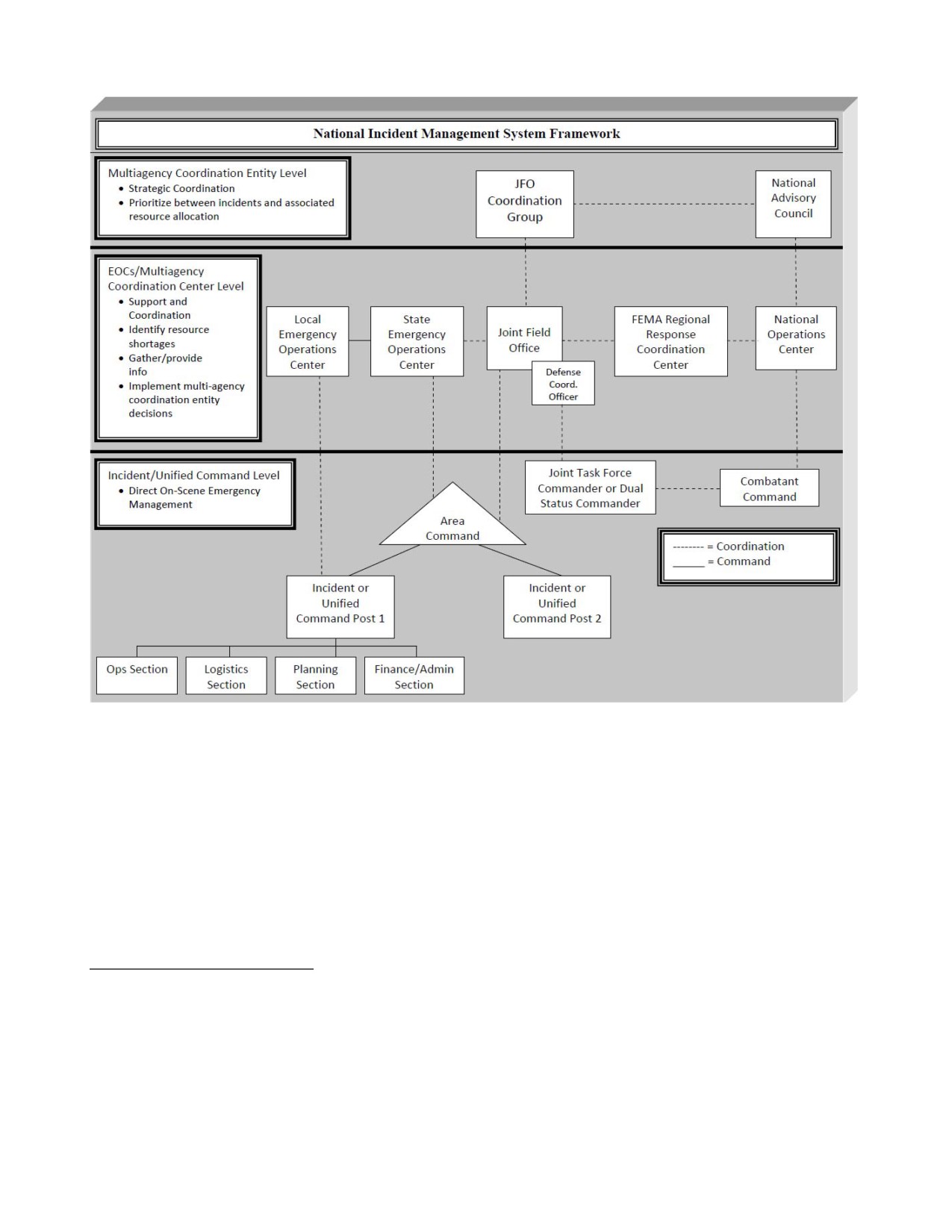
Domestic Operational Law Handbook 2018
Figure 2-264
7. National Prevention Framework (NPF)
The NPF provides guidance to leaders and practitioners at all levels of government, private- and
non-profit sector partners, and individuals, on how to prevent or stop a threatened or actual act of
terrorism.65 It helps achieve the National Preparedness Goal of a secure and resilient Nation that is
optimally prepared to prevent an imminent terrorist attack within the United States by:
Describing the core capabilities needed to prevent an imminent act of terrorism
Aligning key roles and responsibilities to deliver Prevention capabilities in time-sensitive
64 See JOINT CHIEFS OF STAFF, JOINT PUB. 3-28, CIVIL SUPPORT (14 Sept. 2007). This publication has been updated to
a 2013 version, the diagram is based on one first seen in JP 3-28 and not in the new version. It has been updated by the
authors to reflect changes since original publication.
65 For example, the Prevention framework describes the process through which the public is warned regarding credible
terrorist threats through National Terrorism Advisory System (NTAS) alerts. DHS, NATIONAL PREVENTION
83b72d5959787995794c0874095500b1/National_Prevention_Framework2nd.pdf.
Chapter 2
National Framework for Incident Management
24
Domestic Operational Law Handbook 2018
situations
Describing coordinating structures that enable all stakeholders to work together
Laying the foundation for further operational coordination and planning that will synchronize
Prevention efforts within the whole community and across the Protection, Mitigation, Response,
and Recovery mission areas.
As mentioned above, thirty-two core capabilities were developed and published in conjunction with
the National Preparedness Goal (NPG). Of the thirty-two, the seven Prevention core capabilities
are: Planning, Public Information and Warning, Operational Coordination, Forensics and
Attribution, Intelligence and Information Sharing, Interdiction and Disruption, and Screening,
Search, and Detection.
As with other frameworks, there are multiple coordinating structures for Prevention (some are
shared with the other mission areas). Departments or agencies, as well as private and nonprofit
entities with unique missions in Prevention, bring additional capabilities to bear through these
structures. Coordinating structures can function on multiple levels, to include national-level
coordinating structures such as the DHS National Operations Center (NOC), the Federal Bureau of
Investigation (FBI) Strategic Information and Operations Center (SIOC), the Office of the Director
of National Intelligence (ODNI) National Counterterrorism Center (NCTC), the DoD National
Military Command Center (NMCC), the FBI National Joint Terrorism Task Force (NJTTF), and
others. Field coordinating structures, such as the FBI JTTFs and Field Intelligence Groups (FIGs),
State and major urban area fusion centers, State and local counterterrorism and intelligence units,
and other entities, also play a critical role as coordinating structures in preventing imminent acts of
terrorism.66
8. National Mitigation Framework (NMF)
The NMF establishes a common forum for coordinating and addressing how the Nation manages
risk through mitigation capabilities.67 It describes mitigation roles for government, NGOs, and
private entities. The NMF also addresses how the Nation will develop, employ, and coordinate
mitigation core capabilities to reduce loss of life and property due to disasters. Building on a wealth
of evidence-based knowledge and community experience, the NMF seeks to increase risk awareness
and leverage mitigation products, services, and assets across the whole community.
The NMF is designed to advance operational planning throughout the whole preparedness community
by offering a comprehensive approach to reducing the impact of disasters through the development,
implementation, and coordination of seven mitigation core capabilities.
66 DHS, OVERVIEW OF THE NATIONAL PLANNING FRAMEWORKS 3 (June 2016), available at
67 Under PPD-8, mitigation capabilities “include, but are not limited to, community-wide risk reduction projects; efforts
to improve the resilience of critical infrastructure and key resource lifelines; risk reduction for specific vulnerabilities
from natural hazards or acts of terrorism; and initiatives to reduce future risks after a disaster has occurred.” See PPD-8,
supra note 17.
Chapter 2
25
National Framework for Incident Management
Domestic Operational Law Handbook 2018
The NMF seven core capabilities are: Planning, Public Information and Warning, Operational
Coordination, Community Resilience, Long-term Vulnerability Reduction, Risk and Disaster
Resilience Assessment, and Threats and Hazard Identification.68
As with the NRF and other mission area frameworks, the mitigation mission area and NRF refer to
the multiple levels of coordinating structures already discussed. Numerous existing coordinating
structures already support the mitigation mission area, such as the National Security Council
(NSC).69 The Mitigation Framework Leadership Group (MitFLG) is a coordinating structure
established to coordinate mitigation efforts across the Federal Government and to assess the
effectiveness of mitigation capabilities as they are developed and deployed across the Nation. The
MitFLG includes relevant local, State, tribal, and Federal organizations. It is chaired by FEMA in
consultation with Department of Homeland Security (DHS) leadership. Consistent with PPD 1
(Organization of the National Security Council System), the MitFLG coordinates with the relevant
National Security Council Interagency Policy Committees.70
9. National Disaster Recovery Framework (NDRF)
The NDRF was published in September 2011 as a guide to promote effective recovery from
incidents. It provides guidance that enables effective recovery support to disaster-impacted States,
tribes, and local jurisdictions. The NDRF also provides a flexible structure that enables disaster
recovery managers to operate in a unified manner. Last, the NDRF focuses on how best to restore,
redevelop, and revitalize the health, social, economic, natural, and environmental fabric of the
community after an incident.
The NDRF defines:
Core recovery principles
Roles and responsibilities of recovery coordinators and other stakeholders
A coordinating structure that facilitates communication and collaboration among all
stakeholders
Guidance for pre- and post-disaster recovery planning
The overall process by which communities can capitalize on opportunities to rebuild
stronger, smarter, and safer.
As with the other frameworks, the NDRF discusses the development and implementation of core
capabilities. The eight core capabilities71 for the NDRF are:
Planning
Public Information and Warning
library/assets/documents/117787 [hereinafter NMF].
69 Id. at 33.
70 Id. at 34.
71 DHS, OVERVIEW OF THE NATIONAL PLANNING FRAMEWORKS 8 (June 2016), available at:
63f68f6dced909f08cf8687deaa8e718/Overview_of_National_Planning_Frameworks.pdf.
Chapter 2
National Framework for Incident Management
26
Domestic Operational Law Handbook 2018
Operational Coordination
Economic Recovery
Health and Social Services
Housing
Infrastructure Systems
Natural and Cultural Resources
The NDRF introduces four new concepts and terms: Federal Disaster Recovery Coordinator
(FDRC), State or Tribal Disaster Recovery Coordinators (SDRCs or TDRCs), Local Disaster
Recovery Managers (LDRMs), and Recovery Support Functions (RSFs). The six new RSFs
provide a structure to facilitate problem solving, improve access to resources, and foster
coordination. The RSFs are similar in concept to ESFs in that each RSF has coordinating and
primary Federal agencies as well as supporting organizations that operate together with local, State
and Tribal government officials, non-governmental organizations (NGOs) and private sector
partners. As with the ESFs, RSFs can be selectively activated as needed.72 The FDRC,
SDRC/TDRC, and LDRM are three new positions that provide focal points for incorporating
recovery considerations into the decision making process and monitoring the need for adjustments
in assistance where necessary and feasible throughout the recovery process.73
10. National Protection Framework
The National Protection Framework was published in July 2014 and describes what the whole
community—from community members to senior government leaders—should do to safeguard
against acts of terrorism, natural disasters, and other threats or hazards.74 This Framework helps
achieve the NPG of a secure and resilient Nation that is prepared to protect against the greatest risks
in a manner that allows American interests, aspirations, and way of life to thrive.75 This Framework
provides guidance to leaders and practitioners at all levels of government; the private and nonprofit
sectors; and individuals by:
Describing the core capabilities needed to achieve the Protection mission area and end-state of
“creating conditions for a safer, more secure, and more resilient Nation”
Aligning key roles and responsibilities to deliver Protection capabilities
Describing coordinating structures that enable all stakeholders to work together
Laying the foundation for further operational coordination and planning that will synchronize
Protection efforts within the whole community and across the Prevention, Mitigation, Response,
and Recovery mission areas.76
The NPG identifies 11 core capabilities for the Protection mission area: Planning; Public
Information and Warning; Operational Coordination; Intelligence and Information Sharing;
Interdiction and Disruption; Screening, Search, and Detection; Access Control and Identity
Verification; Cybersecurity; Physical Protective Measures; Risk Management for Protection
Programs and Activities; and Supply Chain Integrity and Security. The first three core
72 DHS, NATIONAL DISASTER RECOVERY FRAMEWORK 2 (June 2016), available at https://www.fema.gov/media-
library-data/1466014998123-4bec8550930f774269e0c5968b120ba2/National_Disaster_Recovery_Framework2nd.pdf.
73 Id.
Chapter 2
27
National Framework for Incident Management
Domestic Operational Law Handbook 2018
capabilities—Planning, Public Information and Warning, and Operational Coordination—are
common to all five Frameworks. The Protection and Prevention mission areas share three core
capabilities: Intelligence and Information Sharing; Interdiction and Disruption; and Screening,
Search, and Detection. The Protection Framework provides detailed descriptions of each core
capability and the relationships to the other mission areas.77
Similar to the other NPS Frameworks, the Protection Framework describes coordinating structures
that provide the mechanisms to develop and deliver the core capabilities. In the context of the
National Protection Framework, coordinating structures support protection program implementation
and strenthen the Nation’s ability to increase the protective posture when required to augment
operations that take place during temporary periods of heightened alert, during periods of incident
response, or in support of planned events. The coordinating structures are used to conduct planning,
implement training and exercise programs, promote information sharing, shape research and
development priorities and technical requirements, address common vulnerabilities, align resources,
and promote the delivery of Protection capabilities.
11. National Incident Management System (NIMS)
HSPD-5 directed the Secretary of Homeland Security coordinate with other Federal department and
agencies along with State, local, and tribal governments to develop a NIMS. The Secretary of
Homeland Security remains responsible for administration of the NIMS. First published in 2004,
NIMS provided a consistent nationwide template to enable Federal, State, tribal, and local
governments as well as non-governmental organizations and private entities to work together to
prevent, protect against, respond to, recover from, and mitigate the effects of incidents. Since then,
NIMS has been revised to reflect input from a broad variety of stakeholders. In addition, lessons
learned from recent incidents were considered in the latest version. NIMS is not an operational
management plan. Instead, it is a core set of doctrine, concepts, terminology, and organizational
processes intended to enable efficient and collaborative management of incidents.78
As with the Stafford Act, NIMS is based on the premise that most incidents begin and end locally
and are managed on a daily basis at the lowest possible geographical, organizational, and
jurisdictional level.79
NIMS is comprised of three major components:
Preparedness. NIMS focuses on the following elements of preparedness: planning; procedures
and protocols; training and exercises; personnel qualifications and certification; and, equipment
certification.80 NIMS also stresses a unified approach to management and response activities, and
library/assets/documents/97350.
75 Id.
76 Id. at 1-2.
77 Id. at 10-11.
78 NIMS, supra note 26, at 4.
79 Id. at 10.
80 Id. at 50.
Chapter 2
National Framework for Incident Management
28
Domestic Operational Law Handbook 2018
that all levels of governments and organizations must identify their capabilities before incidents
occur.
Communications and Information Management. NIMS emphasizes that well-planned,
established, and utilized communications are critical for enabling the dissemination of information
during an incident.81 Common plans, standards and communication architecture help to facilitate
interoperability and maintain a constant flow of information during an incident.82 As with incident
response in general, communication systems should be flexible and scalable to effectively manage
any situation.
Resource Management. According to NIMS, resource management is divided into three
sections:83
¾ Resource Management Preparedness
¾ Resource Management During an Incident
¾ Mutual Aid
Command and Coordination. NIMS incorporates the existing Incident Command System
(ICS) and Multi-Agency Coordination Systems (MACS) as the command structure for response to
all hazards at all levels of government.84 The ICS works at the tactical level, organizing the on-
scene operations.85 In comparison, MACS coordinate activities above the field level and can be
either informal or formal. Formal coordination addresses issues before an incident occurs and is the
preferred process.86
Ongoing Management and Maintenance. HPSD-5 authorized the Secretary of Homeland
Security to establish a mechanism to ensure the ongoing management and maintenance of NIMS.
The National Integration Center (NIC) was established to assist government and private sectors in
implementing NIMS and to provide for its refinement.87 As part of this process, NIMS notes the
continued development of science and technology as playing a critical role in improving response
capabilities.
12. Other Significant Response Plans, Authorities, and Policies Related to the
National Preparedness Framework
When DHS initiates the response mechanisms of the NRF, including the ESFs, Support Annexes,
and Incident Annexes, existing interagency plans that address incident management are
incorporated as supporting plans and/or operational supplements to the NRF. For incidents not led
by DHS, other Federal agency response plans provide the primary Federal response protocol.
Common interagency plans responders may encounter during such incidents include the National
81 Id.
82 Id.
83 Id. at 6-11.
84 Id. at 3.
85 Id. at 24.
86 Id. at 19.
87 Id. at iii.
Chapter 2
29
National Framework for Incident Management
Domestic Operational Law Handbook 2018
Oil and Hazardous Substances Pollution Contingency Plan, more commonly called the National
Contingency Plan (NCP), and the National Emergency Communications Plan (NECP). Agencies
should note the NRF may modify their responsibilities in the event of a major disaster or
emergency.
a. The National Contingency Plan (NCP)
The NCP88 was developed pursuant to the Comprehensive Environmental Response, Compensation,
and Liability Act of 1980 (CERCLA) and the Federal Water Pollution Control Act or Clean Water
Act of (1972). It sets out procedures for preventing and responding to oil discharges into navigable
waters and releases of hazardous substances, pollutants, and contaminants into the environment.
The NCP provides that a predesignated on-scene coordinator (OSC) shall direct response efforts at
the scene of a discharge or release. Inland, the Environmental Protection Agency (EPA) is the lead
response agency and provides OSCs for responses. In coastal areas, the U.S. Coast Guard is the
lead response agency for coordinating the Federal response. Executive Order 12580 authorizes the
establishment of the National Response Team (NRT) for planning and preparing for response
actions; designates the EPA and the Coast Guard as co-chairs; and designates responsibilities of
other agencies on the NRT and on Regional Response Teams.89 Generally, DoD or Department of
Energy (DOE) will provide the OSC and have the lead for responding to the release of hazardous
substances, pollutants, or contaminants when the incident is on or comes from a facility or vessel
under the control, custody, or jurisdiction of DoD or DOE, respectively.90 Whether or not the NRF
is activated, the OSCs apply NIMS and Incident Command principles during a response.
ESF #10 governs the response to oil and hazardous materials. Although the EPA is the ESF #10
coordinator under the NRF, either the EPA or DHS/Coast Guard will serve as the primary agency
for ESF #10 response actions, depending on whether the incident is in the inland or coastal zone
(the role of primary agencies under the ESFs are discussed above). The NCP is considered an
operational supplement to the NRF. If the NRF or ESF #10 is activated for an oil discharge or
hazardous material release, the NCP will serve as the basis for actions taken in support of the
NRF.91
b. The National Emergency Communications Plan (NECP)
Congress directed the Department of Homeland Security’s (DHS) Office of Emergency
Communications (OEC) to develop the first National Emergency Communications Plan (NECP).
Title XVIII of the Homeland Security Act of 2002,92 as amended, calls for the NECP to be
developed in coordination with stakeholders from all government levels and with members from the
88
40 C.F.R. § 300 (2017). The NCP is required by section 105 of the Comprehensive Environmental Response,
Compensation, and Liability Act of 1980, 42 U.S.C. 9605, as amended by the Superfund Amendments and
Reauthorization Act of 1986 (SARA), Pub.L. 99-499, and by section 311(d) of the Clean Water Act (CWA), 33 U.S.C.
1321(d), as amended by the Oil Pollution Act of 1990 (OPA 90), Pub.L. 101-380. See 40 C.F.R. § 300.2 (2017).
Executive Orders 12580 and 12777 delegated to the EPA responsibility to amend the NCP as necessary.
89 Exec. Order No. 12580, 52 F.R. 2923, (23 Jan. 1987).
90
40 C.F.R. § 300 (2017).
91 FEMA, EMERGENCY SUPPORT FUNCTION #10 - OIL AND HAZARDOUS MATERIALS RESPONSE ANNEX, (Jun. 2016),
92 HSA, supra note 7.
Chapter 2
National Framework for Incident Management
30
Domestic Operational Law Handbook 2018
private sector. DHS worked with stakeholders from Federal, State, local, and tribal agencies to
develop this strategic plan establishing a national vision for the future state of emergency
communications. The desired future state is that emergency responders can communicate “[a]s
needed, on demand, and as authorized, at all levels of government, across all disciplines.”93
Emergency Support Function 2 of the NRF, Communications, supplements the NECP and sets out
procedures for coordinating the provision of temporary national security and emergency
preparedness telecommunications support in areas impacted by a major disaster or emergency.
c. Nuclear/Radiological Incidents
The Nuclear/Radiological Incident Annex (NRIA) of the NRF supersedes the Federal Radiological
Emergency Response Plan (FRERP) of 1996. The NRIA describes the policies, situations, concepts
of operations, and responsibilities of the Federal departments and agencies governing the immediate
response and short-term recovery activities for incidents involving release of radioactive materials.
The incidents may result from inadvertent or deliberate acts. Pursuant to the incident annex
paradigm, when DHS exercises domestic incident management functions, it is supported by other
Federal agencies that are either “coordinating” or “cooperating” agencies.94
“Coordinating agencies” provide the leadership, expertise, and authorities to implement critical and
specific nuclear/radiological aspects of the response, and facilitate nuclear/radiological aspects of
the response in accordance with those authorities and capabilities. The coordinating agencies are
those Federal agencies that own, have custody of, authorize, regulate, or are otherwise assigned
responsibility for the nuclear/radioactive material, facility, or activity involved in the incident.
“Cooperating agencies” include other Federal agencies that provide additional technical and
resource support specific to nuclear/radiological incidents to DHS and the coordinating agencies.95
When DHS is not exercising domestic incident management responsibilities, the coordinating
agency, as determined by their authorities, will be the responsible agency. DoD is the coordinating
agency for incidents involving nuclear facilities owned or operated by DoD, materials shipped by or
for DoD, nuclear weapons, and DoD satellites containing radioactive materials that impact within
the United States.96
d. National Security Presidential Directive 46 (NSPD-46) and Homeland Security
Presidential Directive 15 (HSPD-15)
NSPD-46/HSPD-1597 detail the policy of the United States for combating terrorism and reaffirm the
lead agencies for the management of various aspects of the counterterrorism effort. They recognize
93 DHS, NATIONAL EMERGENCY COMMUNICATIONS PLAN, DHS (2014) ES-1, available at
ctober%2029%202014.pdf.
94 FEMA, NUCLEAR/RADIOLOGICAL INCIDENT ANNEX, (Oct. 2016) 1,4,7, available at https://www.fema.gov/media-
library-data/1488825883577-fb52b6b7fd784dfb64aaee1fd886393a/NRIA_FINAL_110216.pdf.
95 Id. at 22.
96 Id. at 26.
97 NATIONAL SECURITY PRESIDENTIAL DIRECTIVE 46/HOMELAND SECURITY PRESIDENTIAL DIRECTIVE 15, “U.S.
STRATEGY AND POLICY IN THE WAR ON TERROR” (classified), March 6, 2006.
Chapter 2
31
National Framework for Incident Management
Domestic Operational Law Handbook 2018
that States have primary responsibility in responding to terrorist incidents, including actual events,
and the Federal Government provides assistance as required.
e. The Defense Against Weapons of Mass Destruction Act98
Title 50 of Chapter 40 of the U.S. Code concerns the U.S. Government’s response to the
proliferation of and use or threat to use nuclear, chemical, or biological WMD or related materials
and technologies.99 Title 50 U.S.C. § 2313 directs the Secretary of Defense to designate an official
within the DoD as Executive Agent to coordinate DoD assistance with Federal, State, and local
entities when responding to incidents involving such materials. The Secretary of Defense has
appointed the Assistant Secretary of Defense for Homeland Defense and Americas’ Security Affairs
(ASD (HD&ASA)) as Executive Agent. The Department of Energy (DOE) was directed to
designate an Executive Agent for its nuclear, chemical, and biological response, and the DoD and
DOE Executive Agents are responsible for coordinating assistance with Federal, State, and local
officials when responding to threats involving nuclear, chemical, and biological weapons.100
B. The Robert T. Stafford Disaster Relief and Emergency Assistance Act (Stafford Act)
The Stafford Act provides for assistance from the Federal government to States in the event of
emergencies or natural and other disasters.101 The Stafford Act is the primary legal authority for
Federal emergency and disaster assistance to State and local governments. Congress’ intent in
passing the Stafford Act was to provide for an “orderly and continuing means of assistance by the
Federal government to State and local governments in carrying out their responsibilities to alleviate
the suffering and damage which result from such disasters.”102 The Stafford Act sought, among
other things, to broaden the scope of disaster relief programs, encourage the development of
comprehensive disaster preparedness and assistance plans, programs, and capabilities of State and
local governments, and provide Federal assistance programs for both public and private losses
sustained in disasters.
Through the Stafford Act, Congress delegated to the President emergency powers that may be
exercised in the event of a declared major disaster or emergency. Generally, Federal Stafford Act
assistance is given upon request from a State Governor103 provided certain conditions are met;
primarily that the Governor certifies that the State lacks the resources and capabilities to manage the
98 The Defense Against Weapons of Mass Destruction Act, Public Law: 104-201, 1996, codified at 50 U.S.C. §§ 2301-
2371 (2012 & Supp. IV 2017).
99
10 U.S.C. § 12304 (2012 & Supp. IV 2017) provides the Federal authority for the mobilization of Reserve
Components in response to the use or threatened use of a weapon of mass destruction.
100
50 U.S.C. §§ 2301-2371 (2012 & Supp. IV 2017).
101 The Robert T. Stafford Disaster Relief and Emergency Assistance Act, 42 U.S.C. § 5121, et seq., as amended by the
Post-Katrina Emergency Management Reform Act of 2006, Pub. L. No. 109-295 (2007), and the Sandy Recovery
Improvement Act of 2013, Pub. L. No. 113-2 (2013) [hereinafter The Stafford Act].
102
42 U.S.C. § 5121 (2012 & Supp. IV 2017).
103 An example where a request is not required is in the case of an emergency in an area where the Federal government
is determined to have primary responsibility, as discussed below. See 42 U.S.C. § 5191(a) (2012 & Supp. IV 2017).
Additionally, 42 U.S.C. § 5170a(5) states that in a major disaster, the President may provide accelerated Federal
assistance in the absence of a request where necessary to save lives, prevent human suffering, or mitigate severe
damage as long as prompt coordination with the State occurs. Use of this authority may impede the ability of the
Federal government to implement the cost-share process.
Chapter 2
National Framework for Incident Management
32

Domestic Operational Law Handbook 2018
consequences of an event without Federal assistance. The Stafford Act lists the roles and
responsibilities of Federal agencies and departments when providing both major disaster and
emergency assistance, and it outlines the types of assistance that affected State(s) may receive from
the Federal government. (See Table 2-4 below).
The Stafford Act applies in the event of a major disaster or emergency. It details the emergency functions of the
President, which are delegated as per Executive Order 12656 and other directives.
DEPARTMENTS & AGENCIES
ROLES AND RESPONSIBILITIES
Executive Office of the President
Major Disaster Assistance—upon request of a State Governor. Provide
(President or as delegated)
specified essential services; coordinate disaster relief activities; direct
Federal agency assistance to States and localities; take other action as
consistent with the Act and within delegated authority.
Emergency Assistance, upon request of a State Governor or sua sponte:
Direct Federal agencies to provide resources and technical and advisory
assistance; provide essential services; coordinate all disaster relief
assistance.
Federal Coordinating Officer
Major Disaster and Emergency Assistance: Establish field offices;
coordinate relief efforts; take other necessary actions within authority.
Emergency Support Teams
Assist the Federal Coordinating Officer in carrying out his or her
responsibilities in a major disaster or emergency.
State Governor(s)
Request declaration by the President that a major disaster or emergency
exists.
Federal Agencies
Provide, consistent with appropriate authorities and upon request from the
President: Personnel for the Emergency Support Teams; and, assistance in
meeting immediate threats to life and property resulting from a major
disaster or emergency.
FEMA
Prepare, sponsor, and direct Federal response plans and programs for
emergency preparedness; provide hazard mitigation assistance in the form
of property acquisition & relocation assistance.
Department of Defense
Upon President’s direction, provide “emergency work” to protect life and
property prior to declaration of major disaster or emergency.
American National Red Cross
Major Disaster: As a condition of receiving assistance, comply with
and other relief organizations
regulations relating to non-discrimination and other regulations as deemed
necessary by the President for effective coordination of relief efforts.
Table 2-4. Stafford Act Roles and Responsibilities
FEMA operates under the Stafford Act and is the lead Federal agency for Stafford Act responses,
focusing its efforts on managing the consequences of disasters and emergencies. FEMA’s actions
under the Stafford Act are generally driven by requests from State and local governments. Figure 2-
3, provides an overview of the process of providing Federal support to States under the Stafford
Act.
Chapter 2
33
National Framework for Incident Management
Domestic Operational Law Handbook 2018
Figure 2-3.104
To coordinate the relief efforts of all Federal agencies in both major disasters and emergencies, the
Stafford Act authorizes the President to appoint a Federal Coordinating Officer (FCO) immediately
after declaring a major disaster or emergency. The Stafford Act also requires the President to
request that a Governor seeking Federal assistance designate a State Coordinating Officer (SCO) to
coordinate State and local disaster assistance efforts with those of the Federal government.105
The FCO may utilize relief organizations, such as State relief organizations and the American
National Red Cross (ANRC), in the distribution of emergency supplies, such as food and medicine,
and in reconstruction or restoration of essential services such as housing. The FCO may coordinate
all relief efforts. However, States, localities, and relief organizations must agree with the courses of
action. The President is authorized to form Emergency Support Teams (EST) of Federal personnel
to be deployed to the area of the disaster or emergency.106 By delegation, the FCO may activate
ESTs composed of Federal program and support personnel, to be deployed into an area affected by
a major disaster or emergency.107 The EST is the principal interagency group that supports the FCO
in coordinating the overall Federal disaster assistance.
1. Requests for Emergency or Major Disaster Declarations
Under the Stafford Act, the Governor of an affected State may request the declaration of a major
disaster or emergency, and must demonstrate, as a prerequisite for receiving assistance, both that the
104 Overview of Stafford Act Support to States, FEMA.GOV, http://www.fema.gov/pdf/emergency/nrf/nrf-stafford.pdf
(last visited Jul. 19, 2018).
105
42 U.S.C. § 5143 (2012 & Supp. IV 2017).
106
42 U.S.C. § 5144 (2012 & Supp. IV 2017).
107
44 C.F.R. § 206.43 (2017). These teams may also be called emergency response teams.
Chapter 2
National Framework for Incident Management
34
Domestic Operational Law Handbook 2018
State’s response plans have been activated and that State and local capabilities are inadequate for an
effective response.108 The Stafford Act’s definitions of “emergency” and “major disaster” are
referenced in many of the legal documents related to incident management and are used consistently
throughout this chapter.
a. Major Disasters
A “major disaster” is defined as follows:
[A]ny natural catastrophe (including any hurricane, tornado, storm, high water, wind
driven water, tidal wave, tsunami, earthquake, volcanic eruption, landslide,
mudslide, snowstorm, or drought), or, regardless of cause, any fire, flood, or
explosion, in any part of the United States, which in the determination of the
President causes damage of sufficient severity and magnitude to warrant major
disaster assistance under this Act to supplement the efforts and available resources of
States, local governments, and disaster relief organizations in alleviating the damage,
loss, hardship, or suffering caused thereby.109
A major disaster encompasses fires, floods, and explosions, regardless of cause, when such acts
cause damage of sufficient severity to warrant Federal disaster assistance, as determined by the
President. A WMD event involving fire or explosion, including the detonation of a high-yield
explosive, would likely meet this threshold. Following the letter of the law strictly, a chemical,
radiological, or biological WMD event in the United States would qualify as a major disaster only if
it results in a fire, flood, or explosion. A WMD event of catastrophic proportions could warrant
treatment as both a major disaster and an emergency.
Major disaster assistance is a more comprehensive grant of Federal aid for long-term consequence
management. In a major disaster, the President has broad authority to assist States and localities.
To receive Federal assistance, a Governor must not only indicate to the President that the State does
not have the capacity or resources to mount an effective response, but he or she must also furnish
information on the measures that have been or will be taken at the State and local levels to mitigate
the effects of the disaster. In addition, the Governor must certify that State and local government
obligations and expenditures will comply with all applicable cost-sharing requirements of the
Stafford Act.110
The President’s powers after the declaration of a major disaster include (but are not limited to) the
authority to provide the following assistance to States and localities: specified technical and
advisory assistance; temporary communications services; food; relocation assistance; legal services;
crisis counseling assistance and training; unemployment assistance; emergency public
transportation in the affected area; and fire management assistance on public or privately-owned
forest or grassland.111 In addition, the President is authorized to direct Federal agencies to provide
equipment, supplies and facilities to State and local governments; distribute food and medicine to
108 The specific requirements for a request for an emergency declaration are set forth in 44 C.F.R. § 206.35 (2017). The
specific requirements for a request for a major disaster declaration are set forth in 44 C.F.R. § 206.36 (2017).
109
42 U.S.C. § 5122(2) (2012).
110
42 U.S.C. § 5170 (2012).
111
42 U.S.C. §§ 5171-5189 (2012 & Supp. IV 2017).
Chapter 2
35
National Framework for Incident Management
Domestic Operational Law Handbook 2018
victims; and perform work and services (such as search and rescue) necessary to save lives and
protect property.112
b. Emergencies
The Stafford Act defines “emergency” as follows:
[A]ny occasion or instance for which, in the determination of the President, Federal
assistance is needed to supplement State and local efforts and capabilities to save
lives and to protect property and public health and safety, or to lessen or avert the
threat of a catastrophe in any part of the United States.113
An emergency is, more broadly, any situation in which Federal assistance is required to save lives,
protect health and property, or mitigate or avert a catastrophe. Generally, the existence or threat of
each type of WMD-chemical, biological, radiological, nuclear, and high-yield explosive - likely
would be deemed an “emergency” if the event or threat overwhelms State and local authorities and
warrants the assistance of the Federal government.
Emergency authority granted to the President is similar to that authorized for handling major
disasters, but it is not as extensive. Emergency assistance is more limited in scope and in time than
assistance under a major disaster declaration, and total assistance may not exceed $5 million for a
single emergency, unless the President determines there is a continuing and immediate risk to lives,
property, public health or safety, and necessary assistance will not otherwise be provided on a
timely basis.114 The Stafford Act authorizes the President to declare an emergency, but not a major
disaster, sua sponte with respect to an emergency that “involves a subject area for which, under the
Constitution or laws of the United States, the United States exercises exclusive or preeminent
responsibility and authority.”115
In any emergency, the President may direct any Federal agency, with or without reimbursement, to
use the authorities and resources granted to it under Federal law in support of State and local
emergency assistance efforts to save lives, protect property and public health and safety, and lessen
or avert the threat of a catastrophe.116 The President may coordinate all emergency relief assistance
and provide technical and advisory assistance to affected State and local governments for the:
performance of essential community services; issuance of hazard and risk warnings; broadcast of
public health and safety information; and management, control and reduction of immediate threats
to public safety. The President may also direct Federal agencies to provide emergency assistance;
remove debris pursuant to 42 U.S.C. § 5173; provide temporary housing assistance in accordance
with 42 U.S.C. § 5174; and assist State and local governments in the distribution of food, medicine,
and other consumable supplies.117
112 See id. § 5170b.
113 See id. § 5122(1).
114 See id. § 5193.
115 See id. § 5191(a).
116 See id. § 5192.
117
42 U.S.C. § 5192(a) (2012 & Supp. IV 2017).
Chapter 2
National Framework for Incident Management
36
Domestic Operational Law Handbook 2018
The Stafford Act also authorizes the President, upon request from the Governor of an affected State,
to provide “emergency work” essential for the preservation of life and property, by DoD for a
maximum of ten days before the declaration of either an emergency or a major disaster.118
2. Liability under the Stafford Act
The Stafford Act specifically provides for immunity from liability for certain actions taken by
Federal agencies or employees of the Federal government pursuant to the Act. 42 U.S.C. § 5148 of
the Stafford Act provides:
The Federal government shall not be liable for any claim based upon the exercise or
performance of or the failure to exercise or perform a discretionary function or duty
on the part of a Federal agency or an employee of the Federal government in
carrying out the provisions of this chapter.119
3. Categories of Agency Support Under the Stafford Act120
Once an emergency or major disaster is declared, it means a State(s) has/have requested assistance from
the Federal government (except in the case of the limited exception discussed above). The assistance
given will typically take one of three forms: Direct Federal Assistance, Federal Operations Support, or
Technical Assistance.
Direct Federal Assistance is assistance where one or more Federal departments or agencies provide
goods and services to State and/or local governments when the affected jurisdiction lacks the capability
needed to perform or to contract for eligible emergency work during a major disaster or emergency.
Direct Federal Assistance is authorized and reimbursed by FEMA, and is subject to Federal-State cost
sharing.
Federal Operations Support is assistance where one or more Federal departments or agencies provide
goods or services to FEMA and/or other Federal agencies to enable them to provide direct Federal
assistance or other supplemental Federal assistance. Federal operations support is requested by FEMA
or another Federal department or agency. Federal operations support is authorized and reimbursed by
FEMA, and is not subject to Federal-State cost sharing.
Technical Assistance is expertise support provided to State and local jurisdictions when those
jurisdictions lack the knowledge and/or skills needed to perform a required activity. Technical
Assistance is 100 percent Federally funded. However, FEMA is phasing out the concept of Technical
Assistance, and is categorizing assistance that previously fell into this category as either Direct Federal
Assistance or Federal Operations Support.
118 See id. § 5170b(c).
119 See id. § 5148.
120 U.S. COAST GUARD, COMDTINST 3006.1 (series), FEDERAL EMERGENCY MANAGEMENT AGENCY (FEMA)
MISSION ASSIGNMENTS: OPERATIONAL ACCEPTANCE AND EXECUTION (Aug. 13 2012).
Chapter 2
37
National Framework for Incident Management
Domestic Operational Law Handbook 2018
4. Interplay Between the Stafford Act and National Preparedness System (NPS)121
The following is a summary of how Stafford Act assistance typically occurs, with reference to
relevant NPS concepts.
As the DHS NOC monitors for potential major disasters or emergencies, it will receive advance
warning of an incident, at which time DHS may deploy representatives to State EOCs for situational
assessment. Regional Response Coordination Centers (RRCCs) and other coordinating structures
discussed above may be activated.
Immediately after the incident, local emergency personnel assess the situation. They may seek
additional resources through mutual aid agreements or the State. State officials will mobilize State
resources and may use mutual aid processes such as the Emergency Management Assistance
Compact (EMAC) to augment their resources. The Governor will activate the State emergency
operations plan, declare a state of emergency, and may request a State/DHS joint Preliminary
Damage Assessment (PDA). State and Federal officials conduct the PDA in coordination with
tribal/local officials as required and determine if the event warrants a request for a Presidential
declaration of a major disaster or emergency.
After a major disaster or emergency declaration, an RRCC coordinates initial activities until a JFO
is established. If regional resources are overwhelmed or if it appears that the event may result in
particularly significant consequences, DHS may deploy a national-level Incident Management
Assistance Team (IMAT). Depending on the scope and impact of the event, the NRCC carries out
initial activations and mission assignments and supports the RRCC. The Governor appoints a State
Coordinating Officer (SCO) to oversee State response and recovery efforts. A Federal Coordinating
Officer (FCO), appointed by the President in a Stafford Act declaration, coordinates Federal
activities in support of the State.
A JFO may be established locally to provide a central point for Federal, State, tribal, and local
executives to coordinate their support. The UCG leads the JFO. The UCG may need to meet
initially via conference calls to develop objectives and an initial action plan.
The UCG coordinates field operations from the JFO. In coordination with State, tribal, and/or local
agencies, ESFs are activated to assess the situation and identify response requirements. Federal
agencies provide resources under DHS/FEMA mission assignments or their own authorities.
As immediate response priorities are met, recovery activities begin. The Stafford Act Public
Assistance program provides disaster assistance to States, tribes, local governments, and certain
private nonprofit organizations. As the need for full-time interagency coordination at the JFO
decreases, the UCG plans for selective release of Federal resources and demobilization.
121 Example provided by Overview of Stafford Act Support to States, FEMA.GOV,
http://www.fema.gov/pdf/emergency/nrf/nrf-stafford.pdf (last visited Jul. 17, 2018).
Chapter 2
National Framework for Incident Management
38
Domestic Operational Law Handbook 2018
C. Immediate Response Authority
1. Federal Military Commanders
Federal military commanders, heads of DoD Components, and/or responsible DOD civilian officials
have “Immediate Response Authority” under DoDD 3025.18. In response to a request for
assistance from a civil authority, under imminently serious conditions and if time does not permit
approval from higher authority, DoD officials may provide an immediate response by temporarily
employing the resources under their control, subject to any supplemental direction provided by
higher headquarters, to save lives, prevent human suffering, or mitigate great property damage
within the United States, its territories, or the District of Columbia.122
“The civil authority’s request
for immediate response should be directed to the installation commander or other appropriate DoD
official responsible for the installation
”123 The DoD official must exercise judgement in
determining the maximum allowable distance from the installation that the immediate response may
take place and should also, unless otherwise directed by a higher authority, prioritize DoD resources
and requirements before addressing the civil authority’s request.124
Immediate Response Authority does not allow for actions that would subject civilians
to the use of military power that is regulatory, prescriptive, proscriptive, or compulsory (for
a detailed discussion, see the Chapters within on Military Support to Civilian Law
Enforcement and Civil Disturbance Operations).
Separately, per DoDD 3025.18., paragraph 4.i.4, any decision by an Immediate
Response Authority to temporarily deploy resources requires notification to the National
Joint Operations and Intelligence Center (NJOIC).
Commanders may not normally continue support under immediate response authority
beyond 72 hours. When using this authority DoD commanders shall reassess whether there
remains a continued need for a DoD response as soon as practicable, but no later than 72
hours after the request for assistance was received.
As noted in Chapter 1, all such requests from civil authorities for assistance must be evaluated for:
Cost - Who pays and the impact on DoD budget.
Appropriateness - Whether it is in the interest of DoD to provide the requested support.
Readiness - Impact on DoD’s ability to perform its primary mission.
Risk - Safety of DoD forces.
Legality - Compliance with the law.
Lethality - Potential use of lethal force by or against DoD forces.
122 U.S. DEP’T OF DEFENSE, DIR. 3025.18, DEFENSE SUPPORT OF CIVIL AUTHORITIES para. 4.i. (29 Dec. 2010) (C2, 19
Mar. 2018) [hereinafter DoDD 3025.18].
123 Id. at 5.
124 Id.
Chapter 2
39
National Framework for Incident Management
Domestic Operational Law Handbook 2018
2. State Governors
As the principle authority during State emergencies, Governors may direct an immediate response
using National Guard personnel under State command and control (including personnel in a Title 32
status).125 However, National Guard personnel will not be placed in or extended in Title 32 status to
conduct State immediate response activities.126 Additionally, State leadership must coordinate with
the Chief of the National Guard Bureau to approve the continued use of personnel in a Title 32
status responding in accordance with immediate response authority in excess of seventy-two hours.
D. Conclusion
The NPS and NIMS represent a significant shift from the pre-9/11 and pre-Hurricane Katrina
approach of the Federal government to domestic incident management. Although the Stafford Act
remains the primary mechanism for Federal support to State and local authorities, and State requests
for assistance still formally initiate the Federal response, the manner in which the Federal
government provides the assistance is changing. Consolidation, unification, anticipation, and
systemization are the unifying themes of these key changes. It is possible that DoD personnel127 or
assets could be among first responders to an emergency or disaster (e.g., an event in close proximity
to a DoD installation). In such a case, DoD personnel and assets might be employed pursuant to
immediate response authority per DoDD 3025.18 before a larger Federal response is orchestrated
under the NRF. Figure 2-4 below illustrates the process by which local requests for assistance
would be handled following a Stafford Act declaration and under immediate response authority.
Judge advocates should be familiar with and prepared to advise on the various authorities under
which DoD may provide assistance to non-Federal entities.
125 CHIEF NATIONAL GUARD BUREAU, INST. 3000.04, NATIONAL GUARD BUREAU DOMESTIC OPERATIONS (Jan. 24,
2018) para. 4.a. [hereinafter CNGBI 3000.04].
126 DoDD 3025.18, supra note 122, at para. 4.j.
127 Under 10 U.S.C. § 12304a, the Secretary of Defense may involuntarily order military reserve members and units to
active duty to support a Governor’s request for assistance in response to an emergency or major disaster under the
Stafford Act.
Chapter 2
National Framework for Incident Management
40

Domestic Operational Law Handbook 2018
Figure 2-4
Chapter 2
41
National Framework for Incident Management
Domestic Operational Law Handbook 2018
Chapter 2
National Framework for Incident Management
42
Domestic Operational Law Handbook 2018
CHAPTER 3
STATUS AND RELATIONSHIPS BETWEEN COMPONENTS
RESPONDING TO DOMESTIC INCIDENTS
KEY REFERENCES:
DoDI 1235.12 - Accessing the Reserve Component, June 7, 2016, incorporating Change 1,
February 28, 2017.
DoDD 5125.01 - Assistant Secretary of Defense for Reserve Affairs, December 27, 2006,
incorporating Change 1, June 4, 2008.
DoDI 6025.13 - Medical Quality Assurance (MQA) and Clinical Quality Management in the
Military Health System (MHS), February 17, 2011.
DoDI 1215.13 - Reserve Component (RC) Member Participation Policy, May 11, 2009.
DoDI 1215.06 - Uniform Reserve, Training and Retirement Categories for the Reserve
Component, March 11, 2014, incorporating Change 1, May 19, 2005.
DoDD 1200.17 - Managing the Reserve Components as an Operational Force, October 29,
2008.
A. Introduction
This chapter discusses various service components and the importance of their designated status to
the missions they perform. The Reserve Component (RC), which is comprised of the reserve of the
various services and the National Guard of the several States, plays a significant role in domestic
support operations. The purpose of the RC is to provide trained and qualified persons available for
active duty in time of war, national emergency, or at other times that national security may require.1
The RC has unique personnel/duty categories that are important to understand because they not only
determine what benefits (e.g. medical and retirement) and protections (e.g. Federal Tort Claims Act
or similar liability rules) RC members have, but they also determine the different types of duties
that the service-member may perform. The Assistant Secretary of Defense for Reserve Affairs
(ASD (RA)) is responsible for overall supervision of all RC affairs in DoD, and establishes the
directives that provide guidance on RC activation, mobilization, and training.2
Judge advocates practicing domestic operational law should also be familiar with the structure and
roles of U.S. Coast Guard, the National Guard in a non-Federal status, and the Civil Air Patrol,
because these entities have unique roles in domestic operations and will often work jointly with
DoD during domestic civil support missions. For example, in addition to being a branch of the U.S.
Armed Forces, the Coast Guard is also a Federal law enforcement agency and has the responsibility
to act as a lead agency for numerous domestic missions including environmental response, maritime
search and rescue, and maritime migrant interdiction.3 Also, while in a non-Federal status, the Air
and Army National Guard have different authorities and capabilities in domestic missions. Finally,
the Civil Air Patrol, a nonprofit corporation, also serves as an auxiliary to the United States Air
1
10 U.S.C. § 10102 (2012 & Supp. IV 2017).
2 U.S. DEP’T OF DEFENSE, DIR 5125.01, ASSISTANT SECRETARY OF DEFENSE FOR RESERVE AFFAIRS (27 Dec. 2006,
incorporating change 1, 4 Jun. 2008) [hereinafter DoDD 5125.01].
3 14 U.S.C. §§ 2, 3 (2012 & Supp. IV 2017).
Chapter 3
43
Status Relationships Between Components
Domestic Operational Law Handbook 2018
Force.4 Understanding the roles of these entities ahead of time will assist judge advocates during
future joint operations.
B. Reserve Component
The RC consists of the Army National Guard of the United States (ARNGUS), the Army Reserve,
the Naval Reserve, the Marine Corps Reserve, the Air National Guard of the United States
(ANGUS), the Air Force Reserve, and the Coast Guard Reserve.5 Members of the RC are a true
reflection and extension of civilian society. The defense of the United States has been based in
large part on the contributions of these citizens who prepare for active service during peacetime and
enter active duty during times of national emergency.
1. U.S. Army Reserve (USAR)6
The USAR’s mission is to meet Department of the Army contingency operations and mobilization
requirements.7 The Army Reserve makes up 20% of the Army’s organized units, but provides half
of the Army’s combat support, and 25% of the Army’s mobilization base expansion capability.8
2. U.S. Air Force Reserve (USAFR)9
The USAFR is composed of thirty-six wings that report to one of three Numbered Air Forces
(NAFs).10 With just over ten percent of the Air Force’s manpower, the USAFR performs more than
thirty percent of all Air Force missions.11 Like all of the other RCs, the role of the USAFR is to
provide trained and ready forces to support its parent service. Yet the USAFR also has several
unique missions. For example, the 731st Airlift Squadron, assigned to the 302nd Airlift Wing,
4
10 U.S.C. § 9442 (2012 & Supp. IV 2017).
5
10 U.S.C. § 10101 (2012 & Supp. IV 2017).
6 U.S. DEPT’ OF ARMY, REG. 140-1, MISSION, ORGANIZATION, AND TRAINING (20 Jan. 2004) [hereinafter AR 140-1];
U.S. DEP’T OF ARMY, REG. 140-10, ASSIGNMENTS, ATTACHMENTS, DETAILS, AND TRANSFERS (15 Aug. 2005); U.S.
DEP’T OF ARMY, REG. 140-30, ACTIVE DUTY IN SUPPORT OF THE UNITED STATES ARMY RESERVE (USAR) AND ACTIVE
GUARD RESERVE (AGR) MANAGEMENT PROGRAM (1 Sept. 1994).
7 AR 140-1, supra note 6, para. 1-8.
8 America’s Army Reserve, ARMY RESERVE, http://www.usar.army.mil/About-Us/ (last visited Jul. 19, 2018).
9 U.S. DEP’T OF AIR FORCE, INSTR. 36-2132, FULL-TIME SUPPORT (FTS) TO THE AIR FORCE RESERVE (23 Mar. 2012);
U.S. DEP’T OF AIR FORCE, INSTR. 36-2619, MILITARY PERSONNEL APPROPRIATION (MPA) MAN-DAY PROGRAM (22 Jul.
1994); U.S. DEP’T OF AIR FORCE, MANUAL, 36-8001 RESERVE PERSONNEL PARTICIPATION AND TRAINING PROCEDURES
(22 Jan. 2004).
11
The unit program of the USAFR is called the “Category A” program. Personnel perform a minimum of one weekend
of inactive duty training every month, referred to as a unit training assembly (UTA), and two weeks of active duty
(annual training) for pay and points each fiscal year. The “Category B” program is the individual mobilization
augmentee (IMA) program consisting of individual reservists assigned to major commands, field operating agencies,
joint organizations, direct reporting units and outside agencies. Although some commands allow training with other
units in the member’s local area, this decision is made on a case-by-case basis by the individual command. Inactive
duty training periods for pay and points, are usually performed during the week in increments of 4 IDTs per quarter. A
day is worth two IDT points. Members also perform a 12-14 day paid active duty training tour annually with one point
awarded for each day. In the “Category E” program, personnel do not earn pay for their service, but they do earn
retirement points. Examples of this are service with the Civil Air Patrol Assistance Program and the Chaplain
reinforcement designees.
Chapter 3
Status Relationships Between Components
44
Domestic Operational Law Handbook 2018
Peterson Air Force Base, Colorado, is trained in the use of modular airborne firefighting systems
that support local, State, and Federal agencies during wildland fire response.12 Additionally, the
53rd Weather Reconnaissance Squadron at Keesler Air Force Base, Mississippi, performs hurricane
reconnaissance exercises over the Atlantic, Pacific, Caribbean, and Gulf of Mexico and is the only
DoD unit tasked to perform weather reconnaissance in support of the Department of Commerce.13
3. U.S. Naval Reserve (USNR)14
The Naval Reserve is composed of both commissioned units (self-contained, deployable assets with
both personnel and mission equipment) and augmentation units (non-hardware units that provide
trained manpower to active Navy units). Typically, members of the Naval Reserve serve one
weekend a month, and an additional two weeks per year. However, members may also serve
fulltime as Navy Full-Time Support or Navy Individual Augmentees. USNR unique missions
include operation of a Mine Countermeasure Ship, Mobile Inshore Undersea Warfare Units, and
Helicopter Warfare Support Squadrons.15
4. U.S. Marine Corps Reserve (USMCR)16
The Marine Corps Reserve is composed of one Marine division, one Marine air wing, one service
support group, and a Marine Corps Reserve support command. Marine Forces Reserve is the
headquarters command for roughly 100,000 members of the USMCR.17 Unique units in this
reserve branch include Civil Affairs Groups and Air-Naval Gunfire Liaison Companies.
5. U.S. Coast Guard Reserve (USCGR)18
The USCGR, like its active duty counterpart, is an agency within the Department of Homeland
Security. Under Title 14 and Title 10 of the United States Code, the Coast Guard is at all times an
armed force, as well as a law enforcement agency. As an armed force, the Coast Guard is required
to maintain a state of readiness to function as a specialized service in the Navy in time of war or
upon Presidential declaration. The Coast Guard, discussed more below, is a unique member of
Joint Forces involved in civil support missions because of its mix of military, civil law enforcement,
and regulatory authorities that allow it to respond to a wide variety of threats at home and abroad.
12 Modular Airborne Fire Fighting System (MAFFS), 302ND AIRLIFT WING, http://www.302aw.afrc.af.mil/About-
Us/Fact-Sheets/Display/Article/627167/modular-airborne-fire-fighting-system-maffs/ (last visited Jul. 19, 2018).
13
53rd Weather Reconnaissance Squadron Hurricane Hunters, 403RD WING,
hurricane-hunters/ (last visited Jul. 19, 2018).
14 U.S. DEP’T OF NAVY, CHIEF OF NAVAL OPS, INSTR. 1001.20C, STANDARDIZED POLICY AND PROCEDURE FOR ACTIVE
DUTY FOR SPECIAL WORKS (ADSW) (4 Mar. 2008).
15 About the Reserve, NAVY RESERVE, http://www.navyreserve.com/about/mission.html (last visited Jul. 19, 2018).
16 U.S. MARINE CORPS, Order 1001.52J, ACTIVE RESERVE SUPPORT TO THE RESERVE COMPONENT (RC) (6 Jun 2011);
U.S. MARINE CORPS, ORDER 1001.59, ACTIVE DUTY FOR SPECIAL WORK IN SUPPORT OF THE TOTAL FORCE (22 Oct.
2001).
17 MARFORRES Media Information, U.S. MARINE CORPS FORCES RESERVE,
https://www.marforres.marines.mil/About/Media-Info/ (last visited Jul. 30, 2018)
18 U.S. COAST GUARD, COMDTINST M1001.28A, RESERVE POLICY MANUAL, (18 May 2003).
Chapter 3
45
Status Relationships Between Components
Domestic Operational Law Handbook 2018
Coast Guard reservists may be called in response to serious natural or man-made disasters,
accidents, or catastrophes such as hurricanes, earthquakes, tornadoes, or floods. The Secretary of
Homeland Security is authorized to order members of the Coast Guard Ready Reserve to active
duty without their consent in a domestic emergency.19 They may be used for not more than 60 days
in any four-month period and not more than 120 days in any two-year period to augment the
Regular Coast Guard. Coast Guard reservists perform unique missions as well. Among the most
important is the staffing of Guard Port Security Units (PSUs) - specialized deployable security units
that have served both domestically and abroad during times of war.20 Additionally, under 10 U.S.C.
§ 12302, the USCGR provided key support to Operation Iraqi Freedom and Operation Enduring
Freedom.21
6.
National Guard of the United States (NGUS)
a. Overview
The terms Army National Guard of the United States (ARNGUS) and Air National Guard of the
United States (ANGUS) refer to the National Guard as a RC of their respective service.22 The terms
“Federal service” and “Federalized” are applied to National Guard members and units when ordered
to active duty in their RC status or called into Federal service in their militia status under various
sections of Title 10 of the U.S. Code.23
The terms “Army National Guard”(ARNG) and “Air National Guard” (ANG) refer to the Federally-
recognized (and usually Federally trained and funded under Title 32, U.S. Code) organized militia
of the various States, in other words, members of the National Guard in a “State status” pursuant to
Article I, Section 8, Clause 16 of the Constitution.24 The ARNG and ANG train for their Federal
military missions according to Congressionally-established disciplines under Title 32, United Stated
Code, under State control. ARNG/ANG members also take oaths to obey their respective
Governors and abide by State law.25 As discussed section 6(c) below, upon
enlistment/commissioning in the Army and Air National Guard, members simultaneously become
members of the ARNGUS or ANGUS respectively, and thus may be called into Federal service.
Determining whether a National Guard member is in a State or Federal status can be critical to
defining their roles and responsibilities. Status is also the primary factor for determining the
applicability of law for such issues as benefits, protections, and liabilities. For instance, members of
19
14 U.S.C. § 712 (2012 & Supp. IV 2017).
21 The Center for Naval Analyses (CNA), upon request of the U.S. Coast Guard Historian, compiled a summary of
Coast Guard operations in Operation Iraqi Freedom. See BASIL TRIPSAS, ET AL., COAST GUARD OPERATIONS DURING
OPERATION IRAQI FREEDOM (Center for Naval Analyses 2004), available at
https://media.defense.gov/2017/Jul/01/2001772261/-1/-1/0/OIF_D0010862.PDF (last visited Jul. 19, 2018).
22
10 U.S.C. §§ 101(c), 10101 (2012 & Supp. IV 2017). Per 10 U.S.C. §§ 10105 and 10111 (2012 & Supp. IV 2017),
the Army National Guard of the United States (ARNGUS) and Air National Guard of the United States (ANGUS)
specifically consist of
(1) Federally recognized units and organizations of the ARNG/ANG, and (2) members of the
ARNG/ANG who are also members of the Army/Air Force Reserves.
23 See 10 U.S.C. chs. 13 and 1211 (2012 & Supp. IV 2017).
24 See 10 U.S.C. § 101 (2012 & Supp. IV 2017); 32 U.S.C. §§ 301, 307 (2012 & Supp. IV 2017).
25 32 U.S.C. §§ 304, 312 (2012 & Supp. IV 2017).
Chapter 3
Status Relationships Between Components
46
Domestic Operational Law Handbook 2018
the National Guard only become subject to the Uniform Code of Military Justice (UCMJ) when
Federalized (serving on active duty under Title 10); while in a State status they are subject to their
respective State codes of military justice. Additionally, some laws, such as the Posse Comitatus Act
(PCA) only apply to the National Guard when they are in a Title 10 status. National Guard
members are usually relieved from duty in the National Guard when on Federal active duty as a
member of the NGUS under 32 U.S.C. § 325. However, per the National Defense Appropriations
Act for Fiscal Year 2004, 32 U.S.C. § 325 was amended to allow Federalized National Guard
officers to retain command authority over State forces with the approval of POTUS and the consent
of the Governor (see the discussion in section 6(a) of this chapter on Dual Status Commanders, and
in Chapter 2 infra).
Guard personnel in Title 10 and Title 32 (discussed under National Guard of the Several States
section) status receive Federal pay and are covered under the Federal Torts Claims Act.26 Title 10
personnel always receive Federal military retirement credit for the performance of duty. It is
helpful to keep in mind that the determination of whether the National Guard is in Federal or State
service does not rest on the entity that funds the activity, but rather which entity has command and
control.
b. History
In 1903, the organized militia (i.e., the National Guard) was created.27 The National Defense Act of
1916 further strengthened the organization and training of the National Guard.28 Because members
of the National Guard had to be drafted as individuals for service in World War I, Congress in 1933
amended the National Defense Act of 1916 to establish the dual status of the National Guard by
creating the “two overlapping but distinct organizations,” i.e., the National Guard of the various
States and the National Guard of the United States.29 Although members of the National Guard
were relieved from their militia status while on Federal status, at the conclusion of that service, they
reverted to their State status. In other words, this statute created the “dual enlistment” requirement
that we know today.30
c. Federal Missions
Like the other RCs, ARNGUS/ANGUS31 members and units are integrated with the Active
Component as part of a total force capability for responding to a wide-range of national defense
26 See 32 C.F.R. § 536.97 (2012).
27 Military Act of 1903 (also known as the “Dick Act”), 57 Pub. L. No. 33, 32 Stat. 775; see also Perpich v. Department
of Defense, 496 U.S. 334, 342 (1990).
28 National Defense Act of 1916, 64 Pub. L. 85; see also Perpich, 496 U.S. 334, 343-44.
29 National Guard Act of 1933, 73 Pub. L. 64, § 18: see also Perpich, 496 U.S. 334, 345-46.
30 This is a system that the Perpich Court recognized as a statutory creation, causing a member of the militia to be
relieved from State status for the “entire period of Federal service.” Perpich, 496 U.S. 334, 345-346.
31 When ANG members enter Title 10 active duty, they are transferred from their ANG units and assigned to the Air
National Guard Readiness Center (ANGRC), either directly or to a detachment of the ANGRC created for the purpose
of deploying forces in support of an active duty mission. The ANGRC is a Field Operating Agency (FOA) of HQ
USAF that executes NGB policy for the ANG and ANGUS and exercises elements of command and control over
ANGUS units and members. It is a Title 10 organization with a 32 U.S.C. § 104 commander appointed on G-series
orders. The ANGRC commander, currently a brigadier general, also serves as the Deputy Director of the ANG
Directorate and is on Title 10 orders. See U.S. DEP’T OF AIR FORCE, INSTR. 10-402, MOBILIZATION PLANNING, para 2.2
Chapter 3
47
Status Relationships Between Components
Domestic Operational Law Handbook 2018
missions. To become an ARNGUS or ANGUS member, the service-member or service-member’s
unit must be “Federally recognized.”32 To be Federally recognized, the service-member or service-
member’s unit must meet prescribed Federal standards.33 NG units or members may be ordered to
Federal active duty in one of two basic ways. One way is to order NG members or units to active
Federal duty under various provisions of Title 10 (e.g. partial mobilization; volunteer duty; or pre-
planned Combatant Commander support),34 as members of the ARNGUS or ANGUS.35 The other
way is pursuant to the power of Congress to call out the militia to enforce Federal law, suppress
insurrections, or repel invasions; under this authority the NG is “called” to duty as part of the militia
of the United States.36 Congress has given the President the authority to call the NG to active duty
for these purposes.37 As discussed in section G(2) of this chapter, the National Guard can also be
utilized for “Federal missions” in a Title 32 status under certain conditions. Authorized duty under
32 USC 502(f) includes support of operations at the request of the President or Secretary of
Defense, for example, natural disaster response and assistance to the Department of Homeland
Security on the Southwest border.
d. Other Title 10 Duty
In addition to duties performed when Federalized under the aforementioned authorities, members of
the National Guard serve in a full-time Title 10 status in other ways. Members in this category
include: Members of the National Guard Bureau (NGB); U.S. Property and Fiscal Officers
(USPFO) in each State serving the National Guard;38 any other National Guard members serving a
tour of duty under Title 10 in support of NGB, Major Commands, or other “seats of government”
tours.
(1) National Guard Bureau (NGB)
The NGB is designated under Title 10 as a “joint activity” of DoD, serving as the National Guard
channel of communications between the Army and Air Force and the fifty-four States and
territories.39 While the NGB serves as the coordination, administrative, policy, and logistical center
for the ARNG and the ANG, NGB does not command and control either the Army or Air National
Guard. Pursuant to its charter, NGB is responsible for, among other things, implementing Army
(1 May 2012)) [hereinafter AFI 10-402]; NATIONAL GUARD BUREAU, MEMORANDUM 10-5/38-101, ORGANIZATIONS
AND FUNCTIONS OF THE NATIONAL GUARD BUREAU, ch. 4 (1 Jul. 2003).
32
10 U.S.C. §§ 10105, 10111, 10503(7), 12201, 12211, 12212 (2012 & Supp. IV 2017); 32 U.S.C. § 105(b) (2012 &
Supp. IV 2017).
33 See NATIONAL GUARD BUREAU, REG. 10-1, ORGANIZATION AND FEDERAL RECOGNITION OF ARMY NATIONAL
GUARD UNITS (22 NOV. 2002); U.S. DEP’T OF AIR FORCE, INSTR. 38-101, AIR FORCE ORGANIZATION (16 Mar. 2011).
34 10 U.S.C §§ 12302, 12304b (2012 & Supp. IV 2017); see also DODI 1215.06 Appendix to Enclosure 4.
35 U.S. CONST. art. 1, § 8, cl. 12; Perpich, 496 U.S. at 334; 10 U.S.C. §§ 12301-12304 (2012 & Supp. IV 2017).
36 U.S. CONST. art. I, § 8, cl. 15; 10 U.S.C. Chapter 13 (these statutes also include the use of the Armed Forces of which
the NGUS is part); 10 U.S.C. § 12406 (2012 & Supp. IV 2017). Although these statutes are in Title 10 of the U.S.
Code, members “called up” under these provisions retain their militia status.
37
10 U.S.C. Ch. 13 (2012 & Supp. IV 2017).
38
32 U.S.C. § 708 (2012 & Supp. IV 2017).
39
10 U.S.C. § 10501 (2012 & Supp. IV 2017); The “54,” as they are often called, include the fifty States, Puerto Rico,
Guam, U.S. Virgin Islands, and the District of Columbia.
Chapter 3
Status Relationships Between Components
48
Domestic Operational Law Handbook 2018
and Air Force guidance, prescribing and monitoring training discipline and requirements, and
supervising and administering the budgets of the ARNG and ANG.40
Through the 2012 National Defense Authorization Act, the Chief, NGB (CNGB), a four-star
general, became a member of the Joint Chiefs of Staff with responsibilities advising the President,
the National Security Council, Homeland Security Council, and the Secretary of Defense.41 As a
member of the Joint Chiefs, CNGB was also given the additional specific responsibility of
addressing matters involving non-Federalized National Guard forces in support of homeland
defense and civil support missions.42 CNGB also serves as the principal advisor on all NG matters
to the Secretaries of the Army and Air Force and to the Army and Air Force Chiefs of Staff.43
CNGB has executive agent responsibility for planning and coordinating the execution of NG
military support operations. The Director, ARNG, and the Director, ANG, are responsible to the
CNGB and assist in executing the functions of NGB as they relate to their respective branches. The
Chief Counsel’s office at NGB provides legal advice and assistance to the CNGB, the Directors of
the Army and Air National Guards, and to the full-time judge advocates at the State level. The
Chief Counsel’s office normally employs a joint staff of military and civilian attorneys in a wide
variety of disciplines, including administrative law, contract and fiscal law, international and
operational law, environmental law, legislation, labor law, and litigation.
(2) U.S. Property and Fiscal Officers (USPFO)
Each State and territory has a USPFO. As Title 10 officers assigned to the NGB, a USPFO is
detailed for duty to a State or territory and is accountable for all Federal funds and property
provided to the NG of each State.44 The USPFO and his staff also perform functions relating to
supply, transportation, internal review, data processing, contracting, and financial support for the
State NG. 45 When required, the USPFO staff can support AC or other RC forces on a reimbursable
basis.
e. Other NG Authorities for Duty
Members of the National Guard perform Inactive Duty Training (IDT) and Annual Training (AT) in
a Title 32 status. They can also perform Active Duty for Operational Support (ADOS) in a Title 10
status to support the ANG and ARNG at Federal headquarters levels.46 As noted above, some
40 DEP’T OF DEFENSE, DIR. 5105.77, NATIONAL GUARD BUREAU (NGB) (21 May 2008).
41
10 U.S.C. § 151 (2012 & Supp. IV 2017).
42 10 U.S.C. § 10502 (2012 & Supp. IV 2017).
43 Id.
44 32 U.S.C. 708 (2012 & Supp. IV 2017).
45 NATIONAL GUARD BUREAU REG. 130-6/AIR NATIONAL GUARD INSTRUCTION 36-2, UNITED STATES PROPERTY AND
FISCAL OFFICER APPOINTMENT, DUTIES, AND RESPONSIBILITIES (1 Jul. 2007).
46 See U.S. DEP’T OF ARMY, REG. 135-200, ACTIVE DUTY FOR MISSIONS, PROJECTS, AND TRAINING FOR RESERVE
COMPONENT SOLDIERS, ch. 6 (30 Jun. 1999).
Chapter 3
49
Status Relationships Between Components
Domestic Operational Law Handbook 2018
“AGR” tours are also in a Title 10 status. They also perform ADOS in a Title 10 status to support
Active Component requirements; this duty is paid by Army and Air Force appropriations.47
C. Reserve Component Categories
There are three Reserve categories: Ready Reserve, Standby Reserve, and Retired Reserve. Each
member of the National Guard and Reserve is assigned within one of these categories. All members
of the Army National Guard and Air National Guard, including those in the Inactive National Guard
(ING), are in the Ready Reserve or Retired Reserve.48
1.
Ready Reserve
The Ready Reserve consists of three subgroups: the Selected Reserve, the Individual Ready
Reserve, and the Inactive National Guard. These are units and individuals subject to order to active
duty to augment the Active Forces during a time of war or national emergency.49 This chapter will
primarily address the Selected Reserve.
a. Selected Reserve
The Selected Reserve consists of Soldiers assigned to Reserve Component units, Individual
Mobilization Augmentation (IMA) Program, Drilling Individual Mobilization Augmentation
(DIMA) Program, and the Active Guard Reserve (AGR) Program. These individuals and units are
considered essential to wartime missions and have priority for training and equipment over other
RC categories.
(1) Drilling Unit Reservists
Sometimes called Troop Program Units (TPU), these units consist of soldiers assigned to Tables of
Organization and Equipment or Tables of Distribution and Allowances who normally perform at
least 48 inactive duty training (IDT) assemblies and not less than 15 days, exclusive of travel time,
of annual training (AT) each year. In the alternative, they may perform Active Duty for Training
(ADT) for no more than 30 days each year, unless otherwise specifically prescribed by the
Secretary of Defense.50
(2) Individual Mobilization Augmentees and Drilling Individual Mobilization
Augmentees
47 See id. Note that ch. 2, sec. 521 of the FY 2001 National Defense Authorization Act, exempts reserve officers on the
reserve active-status list (RASL) serving on active duty for three years or less from placement on the active-duty list
(ADL). Previously, these soldiers were added to the ADL for promotion.
48 U.S. DEP’T OF DEFENSE, INST. 1215.06, UNIFORM RESERVE TRAINING AND RETIREMENT CATEGORIES, para. E5.1 (7
Feb. 2007, incorporating Change 2, 24 Dec. 2008) [hereinafter DoDI 1215.06].
49 Id. para. E.5.1.1. These individuals and units may be involuntarily ordered to active duty during war or national
emergency under the authority of 10 U.S.C. §§ 12301, 12302 (2012 & Supp. IV 2017) and 14 U.S.C. § 712 (2012 &
Supp. IV 2017).
50 U.S. DEP’T OF DEFENSE, INST. 1215.13, RESERVE COMPONENT MEMBER PARTICIPATION POLICY, Encl. 2, para.
1.a.(2) (11 May 2009).
Chapter 3
Status Relationships Between Components
50
Domestic Operational Law Handbook 2018
IMAs and DIMAs are RC members in a Selected Reserve status and not attached to an organized
Reserve unit. The IMA Program function is to provide qualified soldiers to fill pre-designated
mobilization required positions. IMAs are assigned to Active Component organizations or
Selective Service System positions that must be filled to support mobilization requirements,
contingency operations, operations other than war, or other specialized or technical requirements.
Drilling IMA positions are identified as critical elements for mobilization during a Presidential
Reserve Call-up (PRC) requiring an incumbent to maintain an even higher level of proficiency than
a regular IMA Soldier. Soldiers assigned to these positions are authorized to perform 48 paid IDT
periods per year. All IMAs must perform a minimum of 12 days of AT each year.51
(3) Active Guard and Reserve (AGR) Program
The AGR Program consists of Soldiers performing active duty or full-time National Guard duty
(FTNGD) for 180 days or more for the purpose of organizing, administering, recruiting, instructing,
or training the Reserves.
b. Individual Ready Reserve (IRR)
The IRR is a pool of pre-trained individuals who have already served in Active Component units or
in the Selected Reserve and have some part of their Military Service Obligation (MSO) remaining.
Some members volunteer to remain in the IRR beyond their MSO or contractual obligation and
participate in programs providing a variety of professional assignments and opportunities for
earning retirement points and military benefits.52 IRR members are subject to involuntary active
duty and fulfillment of mobilization requirements.
c. The Inactive National Guard (ING)
The ING consists of National Guard enlisted personnel in an inactive status in the Ready Reserve,
not in the Selected Reserve, and attached to a specific National Guard unit. These individuals must
muster once a year with their unit, but they do not participate in training activities. They may not
train for points or pay and are not eligible for promotion.53
2. Standby Reserve
The Standby Reserve consists of personnel who are maintaining their military affiliation without
being in the Ready Reserve, but have been designated key civilian employees, or have a temporary
hardship or disability. They are not required to perform training and are not part of units. The
51 DoDI 1215.06; supra note 48, para. E. 5.1.1.1.3. The Army National Guard and the Air National Guard do not have
IMA programs.
52 Id. para. E.5.1.1.2. The IRR also may include personnel participating in officer training programs, including
Merchant Marine Academy cadets, enlisted members awaiting IADT (except for those in the National Guard) who are
not authorized to perform IDT, and members of the Delayed Entry Program. Id.
53 Id. para. E.5.1.1.3. The Air National Guard does not have an inactive status. Officers may not be transferred to the
ING (see 32 USC §303).
Chapter 3
51
Status Relationships Between Components
Domestic Operational Law Handbook 2018
Standby Reserve is a pool of trained individuals who may be mobilized as needed to fill manpower
needs in specific skills.54
3.
Retired Reserve
This category consists of all Reserve personnel transferred to the Retired Reserve. These
individuals may voluntarily train with or without pay.55 All members retired for having completed
the requisite years of active duty service (Regular or Reserve), may be ordered to active duty when
required by the Secretary of the Military Department concerned.56
D. Reserve Component Training and Support
The Service Secretaries and the Commandant of the Coast Guard are required to ensure trained and
qualified RC units and individuals are available for AD throughout the entire spectrum of
requirements, including war or national emergency, contingency operations, military operations
other than war, operational support, humanitarian operations, and at such other times as the national
security may require.57 Each military department has its own regulations and instructions that
implement these training and support duties.58
1.
Training
All RC members receive training according to their assignment and required readiness levels. This
training may be conducted in Active Duty, Inactive Duty for Training, or Full-Time National Guard
status.
54 Id. para. E.5.1.2. The Standby Reserve consists of the active status list and the inactive status list categories.
Members designated as key employees and personnel not having fulfilled their statutory military service obligation, or
temporarily assigned for hardship reasons intending to return to the Ready Reserve, are on the active status list. Those
members who are not required to remain in an active program, but who retain Reserve affiliation in a non-participating
status and whose skill may be of future use to the Armed Force are on the inactive status list. These members cannot
participate in prescribed training and are not eligible for pay or promotion and do not accrue credit for years of service.
The Army National Guard and Air National Guard do not have a Standby Reserve.
55 Id. para. E.5.1.3. The Retired Reserve consists of the following retired categories: (1) Reserve members who have
completed the requisite qualifying years creditable for non-regular retired pay and are receiving retired pay (at, or after,
age 60); (2) those who have completed the requisite qualifying years creditable for non-regular retired pay and are not
yet 60 years of age, or are age 60 and have not applied for non-regular retirement pay; (3) those members retired for
physical disability; (4) members who have completed 20 years of service creditable for regular retired pay, or are 30-
percent or more disabled and otherwise qualified; (5) Reserve members who have completed the requisite years of
active service and are receiving regular retired or retainer pay (regular enlisted personnel of the Navy and Marine Corps
with 20 to 30 years of active Military Service who are transferred to the Fleet Naval Reserve or the Fleet Marine Corps
Reserve on retirement, until they have completed 30 years of total active and retired or retainer service, are not included
in this category); and (6) Reserve members drawing retired pay for other than age, service requirements, or physical
disability.
56
10 U.S.C. § 688 (2012 & Supp. IV 2017).
57 DoDI 1215.06, supra note 48, para. 5.2.2. Combatant commanders have oversight responsibility for the training and
readiness of assigned guard and reserve forces.
58 Id.
Chapter 3
Status Relationships Between Components
52
Domestic Operational Law Handbook 2018
a. Active Duty
Active Duty for Training (ADT) consists of structured individual and unit training, including on-
the-job training, or educational courses to RC members. It includes Initial Active Duty training
(IADT),59 Annual Training (AT), and Other Training Duty (OTD). Initial ADT includes basic
military training and technical skill training required for all enlisted accessions. AT is the minimum
period of active duty training that RC members must perform each year to satisfy the training
requirements associated with their RC assignment. By DoD policy, members of the Selected
Reserve must perform AT. For all members of Selected Reserve units, except for those in the
National Guard, that training is not less than 14 days, and not less than 12 days for the Coast Guard
Reserve. IMAs and DIMAs must perform 12 days of AT each year and National Guard units must
perform full-time military training for at least 15 days each year. OTD is used to provide all other
structured training, including on-the-job training and attendance at schools. ADT is funded by the
RC, but may support active component operational requirements and missions.60
b. Inactive Duty for Training (IDT)
This training is used to provide structured individual and unit training, or educational courses to RC
members. It includes regularly scheduled training periods, additional training periods,61 and
equivalent training. It is funded by the Reserve Component.62
c. Full-time National Guard Duty (FTNGD)
The National Guard performs their Federal training in a Title 32 status. Thus, while the various
terms used above also apply to the National Guard, there are variations. Full time National Guard
duty (FTNGD) is training or other duty (including support), other than inactive duty, performed by
a member of the National Guard in a member’s status as a member of the National Guard of a State,
territory under 32 U.S.C§§ 316, 502, 503, 504, 505. It is considered “active service” pursuant to 10
U.S.C § 101(d)(3), but it is not considered “active duty” under Title 10. However, members on
FTNGD generally receive the same pay and benefits as those on active duty in accordance with 10
USC §12602, subject to some exceptions.63 (For other reserve components, some of the categories
above are considered “active duty.”)
59 Id., para. 6.6.4.1.4.
60 DoDI 1215.06, supra note 48, para. 6.1.4.1.
61 Additional IDT periods are for the use of drilling Reservists who are not military Technicians. They include
additional training periods (ATPs) for units, components of units, and individuals for accomplishing additional required
training; additional flying and flight training periods (AFTPs) for primary aircrew members for conducting aircrew
training and combat crew qualification training; and Readiness management periods (RMPs) to support the following
functions in preparing units for training: the ongoing day-to-day operation of the unit, accomplishing unit
administration, training preparation, support activities, and maintenance functions. Id., para. 6.1.2.
62 Id., para. 6.1.2.1. Paid IDT periods cannot be under 4 hours. No more than two IDT periods may be performed in
any calendar day. In addition, IDT for points only (without pay) cannot be less than 2 hours with a maximum of two
points authorized in any one calendar day. Further, one retirement point in any one calendar day can be granted for
attendance at a professional or trade convention, with a minimum of four hours.
63 Some benefits statutes specifically exclude FTNGD, except when it meets certain conditions. See also 37 USC 101
which defines active duty for purposes of that title as including FTNGD.
Chapter 3
53
Status Relationships Between Components
Domestic Operational Law Handbook 2018
In 2006, as a result of the increasing use of the National Guard for domestic missions of national
importance, such as the response to Hurricane Katrina, Congress amended 32 U.S.C. § 502(f) to
expressly authorize the use of the National Guard for “Support of operations or missions undertaken
by the member’s unit at the request of the President or Secretary of Defense.”64
2. Support
RC members may be placed on Active Duty Other than for Training (ADOT), which includes the
categories of active duty for operational support (ADOS), Active Guard and Reserve (AGR) duty,
and involuntary AD. Support may also be provided during FTNGD, discussed above.65
a. Active Duty for Operational Support (ADOS)
The purpose of ADOS is to temporarily provide the necessary skilled manpower assets to support
existing or emerging requirements. Accordingly, total cumulative ADOS (and FTNGD) time per
service-member is limited to 1,095 days within the previous 1,460 days before that service-member
is counted against active duty end strength.66 ADOS may be funded by the Active Component to
support AC functions (ADOS-AC) or funded by the RC to support RC functions (ADOS-RC).67
b. Active Guard/Reserve (AGR)
This duty is funded by the RC and performed by an RC member of the Army, Navy, Air Force,
Marine Corps, Coast Guard, or FTNGD performed by a member of the NG under an order to active
duty or FTNGD for a period of 180 days or more. Unless a statutory exception exists, the scope of
duty for AGRs is generally limited to organizing, administering, recruiting, instructing, or training
the reserve components.68
64
32 U.S.C. § 502(f)(2) (2012 & Supp. IV 2017).
65 DoDI 1215.06, supra note 48, para. 6.1.5.3.
66 Id., para. 6.1.4.2.1.7. It is important to note the so called “1095 Rule” is not a restriction preventing members who are
on ADOS orders from remaining on active duty for more than three years in a four year period. As explained in DoDI
1215.06, the 1095 Rule is only a strength accounting and reporting requirement - not a limit that precludes the
performance of duty. Specifically, para 6.9.1 of DoDI 1215.06 states that, “Neither law nor DoD policy requires any
RC member to leave voluntary active duty under section 12301(d) (Operational Support Duty)…after 1,095 days.
However, consideration is to be given to documenting long-term tours as full-time requirement billets (AC, AGR, or
Civilian).”
67 For additional information on Army ADOS and FTNGD for Operational Support within the Army, as well as relevant
DoD-references, see ASSISTANT SECRETARY OF THE ARMY MEMORANDUM TO DEPUTY OF CHIEF OF STAFF G-1, POLICY
FOR MANAGEMENT OF RESERVE COMPONENT SOLDIERS ON ACTIVE DUTY FOR OPERATIONAL SUPPORT AND FULL-TIME
NATIONAL GUARD DUTY FOR OPERATIONAL SUPPORT, (21 Feb. 2008) available at:
21.pdf.
68
10 U.S.C. §§ 101(d)(6)(A) and 12310 (2012 & Supp. IV 2017) .
Chapter 3
Status Relationships Between Components
54
Domestic Operational Law Handbook 2018
c. Involuntary Active Duty (IAD)
IAD is used in support of military operations when the President or the Congress determines that
RC forces are required to augment the Active Component (AC). IAD is funded by the AC.69
3.
Military Technicians (Dual Status) (MT)70
Military Technicians are Federal civilian employees under 5 U.S.C. § 3101 or 32 U.S.C. § 709(b)
who are required to maintain military membership in the Selected Reserve. These individuals also
perform administration and training for that Selected Reserve unit or maintenance and repair of
supplies or equipment issued to that unit. Military and civilian positions must be compatible.
Military Technician involvement with the National Guard is discussed further in section G(4)(b) of
this chapter.
E. Mobilization/Activation of Reserve Component and Calling Up the Militia
The RC provides a full-spectrum operational capability in support of the national defense strategy.71
Various authorities exist to order RC members to active/full-time duty to meet varied operational
requirements. Such activations may be voluntary or involuntary. For major regional conflicts,
national emergencies and other crises, access to RC units and individuals through an order to AD
without their consent is assumed. When RC members are involuntarily Federalized, they will be
kept on AD “no longer than operationally necessary,” subject to limitations imposed by the
authorizing statute (e.g. under 12302, no more than 24 continuous months).72
Although the terms “Federalization” and “mobilization” are sometimes used interchangeably to
describe the process that “Federalizes” members of the RC, the terms have different meanings.
Activation is an order to active duty, for units and individuals, (other than for training) in the
Federal service pursuant to statutory authority granted to the President, Congress, or the service
secretaries.73 Reservists can be “Federalized” involuntarily or voluntarily with their consent
(members of the National Guard also need the consent of their respective Governors). Mobilization
is the process of bringing all national resources to a state of readiness for war or national
emergency; it includes activating the RC.74 Levels of mobilization include selective mobilization,
partial mobilization, full mobilization, and total mobilization. Therefore it is more helpful to use
the term “Federalize” when referring to placing a member of the RC on AD rather than using the
more encompassing term “mobilize.” The statutes below provide authority for activating reservists,
calling the militia into Federal service, and ordering reservists to active duty voluntarily.75
69 DoDI 1215.06, supra note 48, para. E.3.1.1.2.3; see also 10 U.S.C. §§ 12301, 12302, 12304 (2012 & Supp. IV 2017),
and 14 U.S.C. § 712 (2012 & Supp. IV 2017).
70
10 U.S.C. § 10216 (2012 & Supp. IV 2017).
71 U.S. DEP’T OF DEFENSE, INST. 1235.12, ACTIVATION, MOBILIZATION, AND DEMOBILIZATION OF THE READY
RESERVE, para. 4.1. (26 Nov. 2008, Incorporating Change 1, 21 Sep. 2011) [hereinafter DoDI 1235.12].
72 Id.
73 See generally id.; JOINT CHIEFS OF STAFF, JOINT PUB. 4-05, JOINT MOBILIZATION PLANNING (22 Mar. 2010).
74 DoDI 1235.12, supra note 71.
75 Occasionally older cases, regulations, and instructions will reference former versions of these statutes and it is
helpful to know the previous citations: In Title 10 of the U.S. Code, § 672(a) is now codified at § 12301(a); § 672(b) is
Chapter 3
55
Status Relationships Between Components
Domestic Operational Law Handbook 2018
1. Full Mobilization (10 U.S.C.. § 12301(a))
A full mobilization occurs through the duration of a war or emergency (plus six months). This
section may only be invoked when there is a Congressional declaration of national emergency or
war, or other authorization in law.
2.
Partial Mobilization (10 U.S.C § 12302(a))
A presidential declaration of national emergency or “when otherwise authorized by law” allows the
involuntary partial mobilization of up to 1,000,000 members of the Ready Reserve for up to two
years. Applies to units, and any member not assigned to a unit organized to serve as a unit.
3.
Presidential Reserve Call-up (PRC) (10 U.S.C§ 12304)
Involuntary activation of up to 200,000 Selected Reserves members for up to 365 days (these troops
are excluded from active duty end strength calculations) by the President. Such service must be for
other than training and may not exceed 365 days. This statute authorizes ordering members of the
RC to active duty without their consent, and without declaration of war or national emergency, for
operations other than domestic disasters with exceptions. The exceptions to the “other than
domestic disasters” clause are those operations involving a use or threatened use of a weapon of
mass destruction, a terrorist attack or threatened terrorist attack in the United States that results, or
could result, in significant loss of life or property.
4.
Invasions and Rebellions (10 U.S.C. § 12406)
If the United States or any U.S. State or territory is invaded, or when invasion is threatened by a
foreign nation, there is a rebellion or danger of rebellion against the U.S. Government, or the
President is unable to execute U.S. laws without active forces, the President can call the National
Guard into Federal service (i.e. Federalize the National Guard). Any orders for these purposes are
to be issued through the Governors of the States, or, in the case of the District of Columbia National
Guard, the Commanding General.
5.
Insurrection Act (10 U.S.C. § 251-255)
a.
10 U.S.C. § 251
If there is an insurrection in a State, the President, at the request of the State’s legislature, or
Governor if the legislature cannot be convened, may call National Guards of other States into
Federal service as well as use the Federal military to suppress the insurrection.
b.
10 U.S.C. § 252
Whenever the President considers that unlawful obstructions, combinations, or assemblages or
rebellion against authority of United States makes it impracticable to enforce the law of the United
States in any State or territory by judicial proceedings, the President may call into Federal service
now codified at § 12301(b); § 672(d) is now codified at § 12301(d); § 673 is now codified at § 12302; § 673(b) is now
codified at § 12304; and § 3500 and § 8500 are now codified at § 12406.
Chapter 3
Status Relationships Between Components
56
Domestic Operational Law Handbook 2018
the militia of any State and use the Federal military to enforce the laws or suppress the rebellion.
(Such authority was exercised in Arkansas in 1957; Mississippi in 1962; and Alabama in 1963).
c.
10 U.S.C. § 253
The President can use the National Guard and/or the Federal military to suppress insurrection,
domestic violence, unlawful combination or conspiracy if: (a) it so hinders the execution of law of
that State and of the United States and it deprives citizens of constitutional rights (e.g. due process);
or (b) it opposes or obstructs the execution of laws or impedes the course of justice. In the event of
the deprivation of rights, the State is deemed to have denied its citizens equal protection of laws.
6.
15-Day Involuntary Federal Active Duty (10 U.S.C. § 12301(b))
The Service Secretaries may order “units and any member not assigned to a unit organized to serve
as a unit” to a period of duty not to exceed 15 days (with the consent of the State’s Governor, or, in
the case of the District of Columbia National Guard, the Commanding General).
7.
Voluntary Federal Active Duty (10 U.S.C. A. § 12301(d))
An individual can be ordered (by an authority designated by the Secretary concerned) to active duty
with the consent of the individual (and, for members of the National Guard, with the consent of the
State’s Governor or, in the case of the District of Columbia, the Commanding General) for an
unlimited period of time.
8. Medical Care (10 U.S.C. § 12301(h) and 12322)
Reservists may be ordered to AD for medical care, evaluation, or to complete a health care study.
9.
Reservists Recalled for Domestic Events (10 USC §12304(a))
Section 515(a) of the 2012 National Defense Authorization Act included a provision that amended
Title 10 and allowed the SECDEF to order Army Reservists, Navy Reservists, Marine Corps
Reservists, or Air Force Reservists, without their consent, onto active duty for no more than 120
days to respond to a major disaster or emergency under the Stafford Act.76
10. Active Duty for Preplanned Missions in Support of the Combatant Commands (10
U.S.C. 12304(b))
The 2012 National Defense Authorization Act (NDAA) added a provision permitting the Service
Secretaries to order members of the “Selected Reserve” (including National Guard), without their
76 The full text states:
“(a) Authority- When a Governor requests Federal assistance in responding to a major disaster or
emergency (as those terms are defined in section 102 of the Robert T. Stafford Disaster Relief and
Emergency Assistance Act (42 U.S.C. 5122)), the Secretary of Defense may, without the consent of
the member affected, order any unit, and any member not assigned to a unit organized to serve as a
unit, of the Army Reserve, Navy Reserve, Marine Corps Reserve, and Air Force Reserve to active
duty for a continuous period of not more than 120 days to respond to the Governor's request.” 10
U.S.C. § 12304a (2012 & Supp. IV 2017).
Chapter 3
57
Status Relationships Between Components
Domestic Operational Law Handbook 2018
consent, onto active duty for no more than 365 days to “augment the active forces for a preplanned
mission in support of a combatant command.”
F. United States Coast Guard77
Per 14 U.S.C. § 1, 14 U.S.C. § 2, and 10 U.S.C. § 101(a)(4), the United States Coast Guard is
designated as both an armed force and a Federal law enforcement agency. The Coast Guard is a
principal Federal agency responsible for maritime safety, security, and stewardship. As such, the
Coast Guard protects vital economic and security interests of the United States, including the safety
and security of the maritime public, natural and economic resources, the global maritime
transportation system, and the integrity of U.S. maritime borders. The Coast Guard has eleven
statutory missions divided into two categories, homeland security and non-homeland security,
pursuant to section 888 of the Homeland Security Act of 2002, Pub. L. 107-296 (6 U.S.C. § 468).
The homeland security missions are: (1) port, waterways and coastal security; (2) drug interdiction;
(3) migrant interdiction; (4) defense readiness; and (5) other law enforcement.
The non-homeland security missions include: (1) marine safety; (2) search and rescue; (3) aids to
navigation; (4) living marine resources; (5) marine environmental protection; and (6) ice operations.
Due to the multi-mission nature of the Coast Guard, a member of the Coast Guard performing a
non-homeland security function, such as a recreational boating safety inspection, could have to
perform a homeland security function, such as drug interdiction, during the same mission.
Commonly referred to as “America’s maritime first responder,”78 the Coast Guard operates as part
of the Department of Homeland Security.79 Presently, approximately 41,000 personnel serve on
active duty in the Coast Guard. 80 Under Section 3 of Title 14 of the United States Code, upon a
declaration of war, if Congress so directs in the declaration or when directed by the President, the
Coast Guard will operate as a service in the Navy. When operating as a service in the Navy, the
Coast Guard is subject to the orders of the Secretary of the Navy who may order changes in Coast
Guard operations to render them uniform with Navy operations.81 The Coast Guard operated as a
component of the Navy in World War I and World War II. Both the Coast Guard and Navy are
authorized to exchange resources and information at all times. The Coast Guard receives
equipment, armament, and training support from the Navy while providing the Navy vessels,
personnel, and equipment for Naval vessel security and other Navy operations.
Occasionally, some are confused about the Coast Guard’s authority to operate as an armed force.
Some observers have assumed that the Coast Guard must switch from a Title 14 status to a Title 10
status when acting as an armed force of the United States, similar to the National Guard change
from a State to a Federal status depending on the mission. The Coast Guard is at all times both an
77 Additional details about the history, unique missions, capabilities, and authorities of the Coast Guard are available in
UNITED STATES COAST GUARD, COAST GUARD PUBLICATION 1 (1 May 2009).
79
6 U.S.C. § 468 (2012 & Supp. IV 2017).
80 Total Active Duty, U.S. COAST GUARD, https://www.overview.uscg.mil/Workforce/ (last visited Jul. 19, 2018)
[hereinafter CG Statistics].
81
14 U.S.C. § 3 (2012 & Supp. IV 2017).
Chapter 3
Status Relationships Between Components
58
Domestic Operational Law Handbook 2018
“armed force” under Title 10 and a “law enforcement agency” under Title 14. Said another way,
the Coast Guard does not switch “hats” between a serving as part of the armed forces and serving as
a law enforcement agency. Instead, the Coast Guard performs both functions simultaneously.
As discussed earlier in this chapter, the Coast Guard has a reserve component. Presently,
approximately 7,000 members of the Coast Guard comprise the total Coast Guard Ready Reserve.82
Finally, the Coast Guard Auxiliary is a civilian volunteer service, but one that is specifically
authorized to “assist the Coast Guard, as authorized by the Commandant, in performing any Coast
Guard function, power, duty, role, mission, or operation authorized by law.83 The Coast Guard
Auxiliary assists both the active duty and the reserve components of the Coast Guard in search and
rescue assistance missions, environmental protection, marine safety, boater safety education
programs, and patrolling/regulating regattas and marine events.84
Unique to the Coast Guard as an armed force, the Coast Guard is authorized by 14 U.S.C. § 141 to
use its personnel and equipment to assist any Federal or State agency, to include DoD, when the
Coast Guard assistance sought is of the type that the Coast Guard personnel or facilities are
especially qualified to provide.85 Thus, Coast Guard units can be attached to DoD without the
entire Coast Guard being fully absorbed into the Navy under 14 U.S.C. § 3. In addition, 14 U.S.C.
§ 141 allows the Coast Guard to accept the assistance of any Federal agency in the performance of
any Coast Guard function. This unique assistance authority makes the Coast Guard a powerful
partner in domestic contingency operations.
Because the Coast Guard is at all times a Federal law enforcement agency and an armed force of the
United States, the Coast Guard has legal authority to conduct both Maritime Homeland Security
Law Enforcement (MHS) and Maritime Homeland Defense (MHD), depending on the
circumstances.86 Coast Guard units conducting MHS operations may find themselves in an MHD
situation in a matter of minutes. The ability to handle evolving scenarios as a Federal law
enforcement agency or as an armed force offers tremendous flexibility to the Coast Guard.
MHS is a Federal law enforcement mission carried out by domestic law enforcement authorities,
including the Coast Guard.87 The mission is to protect the U.S. Maritime Domain and the U.S.
82 CG Statistics, supra note 80.
83
14 U.S.C. § 822 (2012 & Supp. IV 2017).
84 It is important to note Coast Guard Auxiliary members do not have law enforcement authority. Thus, they may not
directly issue letters of warning, notices of violation, or other civil penalties, nor may they participate in law
enforcement boardings. Operators supervising Auxiliary must ensure any assistance given is in accordance with the
U.S. COAST GUARD, COMDTINST 16798.3 (series), AUXILIARY OPERATIONS POLICY MANUAL. Despite this
limitation, the Auxiliary can and do provide tremendous assistance to the Coast Guard active component. During a
domestic emergency or disaster, Auxiliary members may be particularly helpful in staffing an incident or unified
command post, as many of them are extensively trained in National Incident Management System (NIMS) procedures.
85
14 U.S.C. § 141 (2012 & Supp. IV 2017). The Coast Guard may provide such assistance with or without the
requirement of reimbursement. See 14 U.S.C. § 141(a) (2012 & Supp. IV 2017).
86 In the event of a threat or incident requiring the exercise of national self-defense, DoD, acting through U.S. Northern
Command (USNORTHCOM) and supported by other agencies, would take the lead in carrying out MHD operations,
which involves the protection of U.S. territory, domestic population, and critical infrastructure.
87 The Coast Guard is required to perform Maritime Homeland Security law enforcement duties in support of the Ports
and Waterways Safety Act, the Espionage Act of 1917, the Magnuson Act of 1950, 33 C.F.R. § 6, Homeland Security
Chapter 3
59
Status Relationships Between Components
Domestic Operational Law Handbook 2018
Marine Transportation System (MTS) and deny their use and exploitation by terrorists as a means
for attacks on U.S. territory, population, and critical infrastructure. As the lead Federal agency for
MHS, the Coast Guard engages in maritime surveillance, reconnaissance, tracking, and interdiction
of threats to the security of the United States, and responds to the consequences of such threats.
Armed and uniformed Coast Guard law enforcement operations ashore are limited to activities at
waterfront facilities, public and commercial structures adjacent to the marine environment, and, to
the extent necessary to protect life and property, in transit ashore between such facilities or
structures.88
G. National Guard of the Several States (ANG, ARNG)
1. Overview
Militia are authorized by the code and/or constitution of each State or territory within the United
States. The definition of “militia” in the United States Code includes both the organized and the
unorganized militia; the National Guard, along with the Naval Militia, is considered the organized
militia.89 In the Constitution, the President of the United States (POTUS) is the Commander in
Chief of the militia only when it is “called into actual service of the United States.”90 This section
discusses the National Guard when it is under the control of the Governor or in “State status,” i.e.,
Title 32 status or State Active Duty (SAD). In a State status, members of the National Guard are
subject to the military code of the respective State to which they belong.91
Each of the States and territories has an Adjutant General (TAG) or equivalent (e.g., Commanding
General for the District of Columbia), a State officer whose rank may or may not be Federally
recognized.92 The Governor of the State or Territory or the TAG/ (depending on State law) is the
Commander in Chief of the State military unless it is Federalized under Title 10 of the United States
Code. In this instance, POTUS serves as the Commander in Chief of the State National Guard.93
Throughout the fifty States, District of Columbia, U.S. Virgin Islands, Guam, and Puerto Rico (the
“54”), there are roughly 107,000 members of the Air National Guard employed across 90 Air
Wings.94 In like fashion, there are roughly 343,000 members of the Army National Guard
employed across 8 division headquarters, 27 brigade combat teams, 55 functional support brigades,
42 multifunctional brigades, 8 combat aviation brigades, and 2 Special Forces Groups.95
Presidential Directive 5 (HSPD-5), the National Security Strategy of the United States of America, the National
Strategy for Homeland Security, and The Coast Guard Maritime Strategy for Homeland Security.
88 See 33 C.F.R. § 6 (2017).
89
10 U.S.C. § 311 (2012 & Supp. IV 2017).
90 U.S. CONST. art. II, § 2, cl. 1.
91 Pursuant to 32 U.S.C. § 327 (2012 & Supp. IV 2017), the President or active duty commanders may convene State
courts-martial. In 2003, Congress ordered the preparation of a model State code of military justice.
92 The U.S. President is the Commander in Chief of the National Guard of the District of Columbia. See Exec. Order
No. 11485, 34 Fed, Reg. 15411, (3 Oct. 2001) and Title 39, District of Columbia Code.
93
32 U.S.C. §§ 314, 325 (2012 & Supp. IV 2017).
94
2019 National Guard Bureau Posture Statement at 14,
Statement.pdf. [hereinafter NGB Posture Statement 2019]
95 Id. at 14.
Chapter 3
Status Relationships Between Components
60
Domestic Operational Law Handbook 2018
Currently, each State has a joint force headquarters (State JFHQs) to provide command and control
to its ANG and ARNG, a concept approved by Chief, NGB in October 2003.96 The Joint HQs
replaced the State Area Commands (STARCs) and ANG Headquarters in each State and any other
joint headquarters existing in the States.
2.
Title 32 Status
When performing duty pursuant to Title 32, U.S. Code, a National Guard member is under the
command and control of the State but paid with Federal funds. The majority of NG members
perform weekend drills of inactive duty training (IDT) once per month and annual training (AT)
two weeks per year. These traditional members of the National Guard are commonly referred to as
“M-Day (Mobilization Day).” Each year, M-Day Soldiers are required to perform 48 IDT drills and
15 days of AT.97 The operations of NG units in Title 32 status are controlled by the individual
States, and supplemented by funding from Federal sources pursuant to Federal regulations.98
Federal recognition of NG units and associated funding is conditioned upon the unit continuing to
meet applicable Federal standards.99 ARNG and ANG Soldiers performing duty in Title 32 status
have Federal Tort Claims Act (FTCA) coverage as long as they are acting within the scope of their
Federal employment.
There are many instances of the National Guard performing operations (as opposed to training) in a
Title 32 status (e.g., post 9-11 airport security duty, Hurricane Katrina, Southwest Border
operations, counter-drug operations, and WMD-CST teams). The use of Title 32 duty for
operational missions must be based on statutory authority (for example, counter drug authority at 32
U.S.C. § 112) or upon the request of the President or SecDef (see 32 U.S.C. § 502(f)(2)(A)).
Ultimately, the performance of many Homeland Security (HLS) missions in a Title 32 status,
instead of a Title 10 status, may be preferable because the Posse Comitatus Act (PCA) does not
apply, National Guard troops can respond more rapidly because they are in the local area, National
Guard troops typically have more situational awareness in local, domestic areas than their active
duty counterparts. Furthermore, HLS missions can enhance National Guard training through
“training by doing.” The benefits of allowing operations under Title 32 instead of Title 10 have
continually been raised by studies. Moreover, various legislative proposals have been advanced to
modify Title 32 to improve this capability.100
Ordinarily, NG personnel in a Title 32 status should not provide civil support to a State, such as
disaster assistance, unless such missions are otherwise authorized by law and receive funding.
Accordingly, National Guard members are often in a State Active Duty (SAD) status (funded by the
State) when providing civil support. If TAGs use NG members in a Title 32 status to perform civil
support without appropriate authority, the State may be required to reimburse the Federal
Government for the amount of Federal funds expended during the operation.
96 U.S. DEP’T OF DEFENSE, DIR. 5105.83, NATIONAL GUARD JOINT FORCE HEADQUARTERS - STATE (NG JFHQS-STATE),
Jan 5, 2011, Incorporating Change 1, Sep. 30, 2014.
97
32 U.S.C. § 502(a) (2012 & Supp. IV 2017).
98 See Illinois National Guard v. Federal Labor Relations Authority, 854 F.2d 1396, 1398 (D.C. Cir. 1988).
99
32 U.S.C. §§ 107-109 (2012 & Supp. IV 2017).
100 For example, H.R. 2073/S. 215, called “Guaranteeing a United and Resolute Defense Act of 2003,” set forth a
mechanism that allows centralized Federal funding and decentralized execution of National Guard homeland security
missions.
Chapter 3
61
Status Relationships Between Components
Domestic Operational Law Handbook 2018
3.
State Active Duty
Of the Armed Forces of the United States, only the National Guard has a status entitled State Active
Duty (SAD); such duty is performed pursuant to State constitutions and statutes.101 SAD status has
no relationship to USAR/USAFR or Active Duty (AD). In a SAD status, NG personnel are
controlled by their individual State, subject to the command and control of the respective Governor
and Adjutant General. National Guard units perform duties authorized by State law, such as
responding to emergencies or natural disasters (floods, hurricanes, fires), and are paid with State
funds. Because National Guard units are subject to State control unless Federalized under Title 10
of the United States Code, they are the primary military force that will respond to local disasters and
emergencies. For these types of operations, the Governor may declare an emergency and call any
State National Guard unit into SAD status. Federal funds are not obligated for any personnel or
units performing SAD. However, if the President declares a major disaster or an emergency after a
Governor’s request for assistance under the Stafford Act, then the State military department may be
reimbursed through FEMA for the SAD pay and allowances it has expended.102
4. ANG/ARNG Personnel Categories
On any given day in a particular State, members of the National Guard serve in a variety of duty
types such as Active Guard/Reserve (AGR), Active Duty Operational Support (ADOS), Fulltime
National Guard Duty (FTNGD), Inactive Duty Training (IDT), and Annual Training (AT).
a. T-32 AGR
Every State National Guard has members of the T-32 AGR program serving under 32 U.S.C. §
502(f).
10 U.S.C. § 101(d)(6)(a) defines “active Guard and Reserve duty” as “active duty” or “full-
time National Guard duty” for a period of 180 consecutive days or more for the purpose of
“organizing, administering, recruiting, instructing, or training the reserve components.”103
Members of the T-32 AGR program receive essentially the same benefits and pay as their active
duty counterparts of the same rank. Although they are required to perform drills with their units,
they do not receive additional pay to do so. These service-members may also be “Federalized” and
placed in a Title 10 status under appropriate sections of the Code.104 There is a material difference
between the AGR program under T-32 and the AGR program under T-10. Members of the National
Guard participating in the T-10 AGR program (ARNGUS, ANGUS) are performing in the service
of the United States whereas those in the T-32 AGR program (ARNG, ANG) are performing in the
service of their State. Service in the T-10 AGR program is discussed further in section B(6) of this
chapter.
101 For example, Arizona Constitution, art. 5, sec. 3; A.R.S. § 26-101 (Governor as commander-in-chief of State
military forces when not in Federal service), A.R.S. § 26-121 (composition of militia); A.R.S. § 26-172 (mobilization of
militia for emergencies and when necessary to protect life and property).
102
42 U.S.C. § 5121 (2012 & Supp. IV 2017).
103 See also U.S. DEP’T OF ARMY, REG. 135-18, THE ACTIVE GUARD RESERVE (AGR) PROGRAM (10 Dec. 2003);
NATIONAL GUARD BUREAU, REG. 600-5, THE ACTIVE GUARD/RESERVE PROGRAM, TITLE 32 FULL-TIME NATIONAL
GUARD DUTY (FTNGD) (30 Feb. 1990); and AIR FORCE NATIONAL GUARD, INSTR. 36-101, THE ACTIVE
GUARD/RESERVE PROGRAM (3 May 2002).
104 For a good discussion of FTNGD status, see United States ex rel. Karr v. Castle, 746 F. Supp. 1231, 1237 (Del.
1990).
Chapter 3
Status Relationships Between Components
62
Domestic Operational Law Handbook 2018
b. NG Federal Technicians (32 U.S.C. § 709)
Each State National Guard may employ persons as Technicians.105 Technicians are Federal civilian
employees under the exclusive control of a State official, the Adjutant General who hires, fires, and
supervises them. In terms of their civilian employment pursuant to 32 U.S.C. § 709, they are
military Technicians (“excepted service” civilian employees) as defined in 10 U.S.C. § 10216
during the normal workweek.106 They must also maintain membership in a State NG and maintain
Federal recognition in the military grade associated with their Technician position.107 Loss of NG
membership terminates the full-time Technician position.108
In some States, NG Technicians are members of collective bargaining agreements. Their civilian
job positions are tied to their military rank and they wear military uniforms to work. When they
perform drills and other training, they are in a Title 32 status just like traditional members of the
National Guard. These members are also subject to “Federalization” under Title 10 and can also be
called to serve in a SAD status.
In their civilian “excepted service” capacity, NG Technicians are responsible for organizing,
administering, instructing, or training the NG and for the maintenance and repair of supplies issued
to the NG or the Federal military. They are covered under the Federal Tort Claims Act. In their
civilian capacity, their participation in civil support operations is limited because any participation
must fall within the scope of their position as a NG Technician. To perform out of scope activities,
the NG Technician may be placed in a leave status and placed on SAD orders.
NG Technicians also have the responsibility to train and perform general military duties with their
unit and to be available to enter active Federal service when their units are Federalized. In many
cases, State headquarters principal staff officers also serve as Technicians. Because their
Technician and NG roles are very similar, these staff officers play extremely important leadership
roles in civil support operations in their non-Technician status.109
c. Full Time National Guard Duty - Operational Support (FTNGD-OS)110
If funding is available, NG units can place members of the National Guard (whether M-Day or
Federal Technicians) on FTNGD-OS orders (for as little as a day to as much as a year) to perform
particular functions necessary to support the NG. These orders should not be confused with the
requirements of members of the National Guard to perform “training.” Most members of the
National Guard that participate in the counter-drug program are on Full Time National Guard Duty
- Counter Drug (FTNGD-CD) orders under 32 U.S.C. § 502(f). FTNGD-CD is similar to FTNGD-
OS but given a separate moniker because it is aligned against a specific statutory program (i.e. 32
105
32 U.S.C § 709 (2012 & Supp. IV 2017).
106 See Lopez v. Louisiana National Guard, 733 F. Supp. 1059, 1065 (E.D. La. 1990).
107
10 U.S.C. § 101(c)(3), (5) (2012 & Supp. IV 2017).
108 NATIONAL GUARD BUREAU, REG. 635-100, TERMINATION OF APPOINTMENT AND WITHDRAWAL OF FEDERAL
RECOGNITION, ch. 6 (8 Sep. 1978).
109
32 U.S.C. § 709 (2012 & Supp. IV 2017).
110 Similar to Full Time National Guard Duty previously described in Section D.1.c., above, but here specifically for
“operational support.”
Chapter 3
63
Status Relationships Between Components
//////////////////////////