Military reference books and manuals (2009-2023, Volume 2) - page 42
FOR OFFICIAL USE ONLY
Implications of PLA decision-making principles and practices
90
No individual is clearly accountable for any decision
90
There are too many meetings
90
The bureaucratic process is slow
91
CHAPTER 5 : CHALLENGES TO PLA CULTURE
93
Changing world, changing China
93
The changing nature of warfare
93
Rapid growth of the market economy
94
Increasing access to foreign culture and information
94
Rippling effects of the “one child policy”
95
A long era of relative peace and stability
95
Challenges and responses
95
Challenge: The PLA does not have the force it wants
95
Response #1: Restructuring the enlisted force and officer corps to improve quality
97
Response #2: Improved living conditions on military bases
98
Challenge: Some servicemembers are demanding greater input in unit decision-making
99
Response: Increased (but controlled) “democracy”
100
Challenge: Younger personnel are seen as weak, immature, and morally deficient
101
Response #1: Targeted “political work”
105
Response #2: Psychological counseling
105
Response #3: “Heart-to-heart talks”
106
Challenge: Three decades of peace have weakened personnel’s sense of urgency about the
PLA’s missions
107
Response #1: Increased “real war” training
109
Response #2: Increased engagement in non-combat operations such as disaster relief and
humanitarian assistance
110
CHAPTER 6 : INTERACTING WITH THE PLA
111
Introduction: Overcoming frustration
111
What goals does the PLA have for its mil-mil relationship with the United States?
112
Goal # 1: Advance the overall bilateral relationship
112
Goal #2: Improve China’s image within the U.S. political and military establishments
115
Goal #3: Learn about the U.S. military
118
What distinctive viewpoints does the PLA bring to its interactions with the U.S. military?
119
Mutual trust
119
Relationship building
121
Transparency and reciprocity
123
What behaviors are Americans likely to encounter in their interactions with the PLA?
128
Planning and coordinating U.S.-China military-to-military events
128
Interacting with PLA hosts
132
Negotiating with the PLA
136
How can U.S. personnel make the most of exchanges with the PLA?
139
Prepare well
139
Be clear with the PLA about U.S. bottom lines
139
Be patient and persistent
140
Coordinate questions and presentations
140
Send signals of dissatisfaction that the Chinese will understand
141
Be prepared, and cleared, to say “no” and walk away without an agreement
141
Cultivate long-term relationships, but don’t expect too much
142
Develop long-term expertise
142
iii
FOR OFFICIAL USE ONLY
FOR OFFICIAL USE ONLY
APPENDIX 1: BASIC FACTS ABOUT THE PLA
145
China’s armed forces
145
PLA services
146
Personnel
146
Doctrinal change and force restructuring
151
APPENDIX 2: A SAMPLING OF PLA HEROES
153
APPENDIX 3: ENLISTED PERSONNEL CAREER PATHS
154
APPENDIX 4: OFFICER CAREER PATHS
155
APPENDIX 5: INSTITUTIONAL GRADES
156
APPENDIX 6: PLA GRADES AND RANKS
157
APPENDIX 7: SUGGESTED FURTHER READINGS
158
PLA personnel systems, organizational structures, and recent reforms
158
PLA doctrinal change
158
Chinese military history and traditions
159
About the Authors
161
iv
FOR OFFICIAL USE ONLY
FOR OFFICIAL USE ONLY
List of Tables and Figures
Table 3-1: Political officers and Party committees at various levels of the PLA
57
Table 3-2: The PLA's four General Departments and their functions
67
Table 3-3: Grade levels and their names
73
Table 3-4: Uniform grade insignia
76
Table 6-1: Swings in the U.S.-China mil-mil relationship since 1980
114
Table 6-2: Overview of U.S. and PLA views on military transparency
127
Table A-1: Three major differences between the U.S. and PLA NCO systems
149
Figure 1-1: A personality quiz based on Romance of the Three Kingdoms
13
Figure 1-2: Chinese territory lost and regained since 1840
22
Figure 3-1: Structure of the top levels of the PLA
62
Figure 3-2: Vertical lines in the PLA
68
Figure 3-3: Rank shoulder epaulets
75
Figure 6-1: Different approaches to building mutual trust
121
Figure A-1: Comparison of Chinese and American military personnel
146
Figure A-2: Changing PLA paradigms
152
v
FOR OFFICIAL USE ONLY
FOR OFFICIAL USE ONLY
Acronyms
AMS
Chinese Academy of Military Science
CCP
Chinese Communist Party
CMC
Central Military Commission
DCT
Defense Consultative Talks
DoD
U.S. Department of Defense
FAO
Foreign Affairs Office of China’s Ministry of National Defense
GAD
General Armament Department
GLD
General Logistics Department
GPD
General Political Department
GSD
General Staff Department
JCS
U.S. Joint Chiefs of Staff
KMT
Kuomintang
LSG
Leading Small Group
MND
Ministry of National Defense
MR
Military Region
NCO
Noncommissioned Officer
NDAA
National Defense Authorization Act
NDE
National Defense Education
OSD
Office of the U.S. Secretary of Defense
PACOM
U.S. Pacific Command
PLA
People’s Liberation Army
PLAAF
People’s Liberation Army Air Force
PLAN
People’s Liberation Army Navy
PME
Professional Military Education
PRC
People’s Republic of China
vi
FOR OFFICIAL USE ONLY
FOR OFFICIAL USE ONLY
Executive Summary
Background
This study examines the military culture of the Chinese People’s Liberation Army (PLA).
It focuses on the following:
• Values and traditions that the PLA regards as important
• Organizational characteristics that shape PLA practices
• Behaviors that result from these values, traditions, and organizational
characteristics.
Change is a central feature of present-day Chinese military culture. The PLA has
transformed itself from a mass peasant army to a modern military in just a few decades,
and now seeks to further transform to meet the needs of 21st century warfare. These shifts
require PLA leaders to examine whether traditional values and organizational structures
are compatible with modern demands. This study describes both those aspects of PLA
culture that are regarded as central to the PLA’s identity and those that are currently
undergoing rapid transformation.
The research for this study draws upon the following sources:
• PLA publications, including service newspapers, official histories, and leadership
manuals
• Chinese- and English-language scholarly studies and policy analyses of the PLA
• Interviews conducted with U.S. military and DoD personnel who have interacted
with the PLA.
vii
FOR OFFICIAL USE ONLY
FOR OFFICIAL USE ONLY
Key Findings
Origins of PLA Culture
Most PLA leaders believe that ancient Chinese values and war-fighting principles
remain relevant for managing a modern military.
PLA and Chinese Communist Party (CCP) leaders express great pride in China’s ancient
military traditions, which they believe are far richer than those of the West. PLA
publications draw extensively on these traditions for principles and lessons relevant to
current needs.
• PLA leaders draw on the teachings of ancient military thinkers, especially Sun
Tzu (Sunzi), for operational and strategic lessons.
• PLA leaders also draw on classic martial novels such as Romance of the Three
Kingdoms and Water Margin as important sources of strategic principles and
models of heroism and loyalty.
• PLA texts implicitly draw on the Confucian view of relationships as a framework
for how PLA members should interact, although this influence is seldom
acknowledged.
The PLA teaches that China’s martial traditions are uniquely moral and defensive.
The PLA instructs its personnel that they are the heirs to a martial tradition that:
• Is defined by an emphasis on morality
• Draws its support from the common people
• Is defensive in orientation
• Prefers to avoid direct combat when there are other ways to prevail
• Focuses on strategic and tactical cleverness over physical or material superiority.
The values and organizational structures of the PLA have been deeply influenced by
principles of Marxism-Leninism and Mao Zedong Thought.
Many of China’s early Communist military leaders were trained in Leninist theoretical
and organizational principles at the Whampoa Military Academy in the 1920s. Mao
Zedong later modified these ideas to give them a more populist orientation, creating what
came to be known as “Marxism-Leninism-Mao Zedong Thought.” This body of thought
provided the foundation for many of the PLA’s central principles, including the following:
• The Party-Army principle: The Party has absolute control over the armed forces.
• Mass mobilization: All of society should participate in the revolutionary tasks of
the Party and support the undertakings of the armed forces.
viii
FOR OFFICIAL USE ONLY
FOR OFFICIAL USE ONLY
• Broad consultation, limited participation: Ordinary people’s opinions and
concerns should be included in Party decisions, but their direct participation in
decision-making should be limited.
• Voluntarism: Human willpower can overcome great material disadvantage.
The PLA uses a selective interpretation of modern Chinese history to mold the
worldview and self-image of its personnel.
The PLA has developed distinctive beliefs about its own history, which give weight to
the PLA’s present-day tasks.
(These beliefs do not always match those of outside
observers.) The PLA teaches its members the following lessons about modern Chinese
history:
• Foreign nations have long sought to deny China her sovereignty.
• The PLA and the CCP “saved” China from foreign aggression, domestic tyranny,
and economic backwardness.
• The PLA has won every war it has fought, even when it has faced much larger
and more advanced adversaries.
• The PLA has only waged war when forced to do so, and has always fought in a
distinctly moral and defensive fashion.
The PLA’s Emphasis on Morality
Throughout its history, the PLA has claimed that its greatest advantage lies in the
moral, political, and spiritual excellence of its troops.
Mao and other early Communist military leaders saw war as the supreme test of the
human spirit and believed that strength of character, not advanced weaponry or
equipment, was the decisive factor in warfare.
This belief grew out of necessity: in its early days, the PLA (then known as the Red
Army) was quite weak in material capabilities. Its leaders had to rely instead on the
“human factor” - the physical, moral and political superiority of its troops, expressed
through their honesty, discipline, and hard work - as its comparative advantage. The Red
Army’s surprising successes against materially superior enemies in the Chinese civil war
and in World War II cemented its leaders’ belief that moral and personal qualities of
individual servicemembers can indeed shortcomings in other areas.
Despite any developments or acquisitions it has made in the last decade, today’s PLA still
views itself as materially outmatched by the U.S. and other militaries, and continues to
emphasize the importance of building its human capital to compensate for these
shortcomings.
ix
FOR OFFICIAL USE ONLY
FOR OFFICIAL USE ONLY
The PLA teaches its members that it has a special obligation to treat people
humanely and equitably.
The PLA considers itself a “people’s army” that draws its strength from the support of
the common people, and it teaches that this support was crucial to its past victories. Its
leaders assert that the PLA must both defend the Chinese people in wartime, and aid
them in their daily lives during peacetime. It considers this focus on the needs of the
people to be a central aspect of its identity, setting it apart from foreign militaries and
from previous, non-communist, Chinese armies.
This principle manifests itself in two beliefs:
• The PLA believes that treating its own personnel (particularly enlisted personnel)
with paternalistic kindness and mercy is an important indicator of its moral and
martial strength.
• The PLA believes that it must treat Chinese civilians with the utmost humanity
and courtesy.
The PLA sees itself as a beacon of moral values to Chinese society as a whole.
PLA texts stress that members of the Chinese military must be morally better than
average people. PLA publications emphasize the need for officers to model good
behavior and moral rectitude for the soldiers under their command, and for PLA
personnel to secure civilian support for PLA missions by acting as models of socialist
ethics.
To ensure that its personnel fulfill their obligations to each other and to society, the
PLA has developed a number of moral and disciplinary codes.
These codes include the following:
• The “Three Main Rules of Discipline and Eight Points of Attention” (late 1920s)
guided soldiers’ interactions with civilians. This code required the Red Army to
project the image of a benevolent force working to minimize the impact of
military activity on civilian life. PLA personnel still consider these to be
fundamental guidelines for military-civilian relations.
• The “Servicemen’s Moral Standards” (2001) were aimed at defining the PLA’s
core values and shaping interactions among personnel.
x
FOR OFFICIAL USE ONLY
FOR OFFICIAL USE ONLY
PLA Values
The PLA inculcates its personnel with a well-articulated set of values.
•
Loyalty. The PLA has a well-defined hierarchy of loyalties to the Party, the nation,
the people, and the military.
o The PLA takes loyalty to the Chinese Communist Party as its highest
value, maintained through continuous indoctrination and cultivation of a
strong “political consciousness.”
o The PLA’s concept of patriotism emphasizes its dual mission of ensuring
national security and safeguarding domestic stability and development.
o PLA servicemen are urged to enthusiastically “serve the people.”
o PLA personnel are expected to exhibit an “ardent love” for the Chinese
military.
•
Honor. “Honor” for the PLA means having a spirit of extreme devotion to one’s
tasks.
o PLA members are instructed that they must elevate their loyalties to the
Party, the nation, the people, and the military above all personal
considerations.
o The PLA teaches that honor can be manifested either in feats of heroism
or in everyday service to one’s fellow citizens.
o PLA personnel are taught that honor belongs to the group, not the
individual. The PLA actively discourages personnel from engaging in
“individual heroism” and showing off.
•
Discipline. The PLA emphasizes unquestioning obedience to superiors and to
PLA and CCP regulations. It also expects strict self-control on the part of all
personnel, including control over one’s emotions, frugality, and generally
responsible behavior.
•
Strength of will. Members of the PLA are expected to exhibit exemplary
toughness and steadfastness of character. This encompasses such qualities as:
o Unwavering bravery and morale
o Endurance in the face of extreme hardship and deprivation
o Psychological resilience to criticism and setbacks.
The PLA uses a number of methods to inculcate its personnel with its “core values.”
• Unit-level training in political values and ethics
• Education campaigns highlighting a specific message or goal
• Leadership and teaching materials that emphasize core values
xi
FOR OFFICIAL USE ONLY
FOR OFFICIAL USE ONLY
• Promotion of “model” soldiers whose example others are urged to follow
• Cultural and recreational activities that promote approved behaviors.
PLA Views on Officer-Enlisted Relations
The PLA promotes the belief that cohesion is based on the relationship between
officers and enlisted personnel.
• The PLA urges each member of a unit to think of that unit as a caring extended
family, where the relationship between officers or NCOs and enlisted personnel
mirrors that between parents and children.
• The PLA teaches that unity between officers and enlisted personnel rests on a
close relationship of mutual obligation, built in peacetime. Harmony and
cohesion within a unit suffers when officers and enlisted personnel fail to carry
out their obligations to each other.
The PLA view of superior-subordinate relationships implicitly incorporates both
Confucian teachings about authority relationships and Maoist egalitarian ideals.
Confucian society rested upon a series of idealized and unequal relationships between
superior and subordinate. The superior was expected to display a benevolent and caring
attitude toward subordinates, while the subordinate was expected to display an attitude of
respect and love toward superiors. This is reflected in the PLA’s view of unit cohesion:
• PLA personnel are taught that officers and enlisted personnel have specific
obligations toward one another.
• Officers are taught to “cherish” their subordinates and to care for their physical
and psychological needs.
• Enlisted personnel are told to unconditionally obey orders and give their superiors
unquestioning respect.
PLA views on cohesion also reflect Maoism’s emphasis on the inherent equality of all
people in society and in the military.
• PLA officers are instructed that they are politically equal to the enlisted soldiers
they command and must not think of themselves as “better” in any way.
• PLA writings assert that the difference between officers and enlisted soldiers rests
on the fact that they have different skill sets, but that both skill sets are equally
important.
xii
FOR OFFICIAL USE ONLY
FOR OFFICIAL USE ONLY
PLA Organizing Principles
The PLA is a “Party-Army” controlled by the CCP at all levels.
Central to the PLA’s organizational culture is its identity as a “Party-Army.” Party
control of the military is as fundamental to the PLA as civilian control is to the U.S.
military.
Central features of the Party-Army are:
•
Absolute allegiance to the Party above all else. PLA members swear loyalty to
the Chinese Communist Party, not to the Chinese State.
•
Centralized Party command.
o The PLA’s national command authority (the Central Military Commission,
or CMC, of the Central Committee of the Chinese Communist Party) is a
Party organization.
o Party structures exist at all levels of the PLA and play a central role in
unit-level decisions.
•
Weak state authority. State institutions also have little power over the Chinese
military.
o There is a State CMC, but it is a “shell” organization whose membership
is usually identical to that of the Party CMC.
o The Ministry of National Defense (MND) exists mostly for protocol
purposes and to organize exchanges with foreign militaries. Its Minister is
a powerful individual, but his power comes not from his state position but
from his positions in the top echelons of the Party.
•
Dual leadership. All PLA units are led jointly by a military commander and a
political officer. These two officers are considered co-equals and exercise joint
leadership over the unit.
•
A comprehensive system of Party organizations and “political work.” Political
officers and Party committees oversee the day-to-day implementation of “military
political work” at every level of the PLA. Political work is the primary mode by
which the PLA:
o Carries out the Party’s objectives
o Manages its human resources
o Manages its relations with the civilian population
o Conducts many aspects of training, indoctrination, and wartime activities
to co-opt, coerce, or undermine enemy forces.
xiii
FOR OFFICIAL USE ONLY
FOR OFFICIAL USE ONLY
The PLA operates within a bureaucratic system that is fragmented into vertical and
horizontal lines of authority.
• Vertical lines are based on functional divisions (e.g., political work, logistics).
They stream from higher to lower levels of the PRC bureaucracy: for example,
every PLA unit has a logistics department that is in the same vertical line as the
logistics department at the next level up.
• Horizontal lines exist within a single jurisdiction, such as a Military Region or a
province. These lines coordinate issues across multiple functional offices or
personnel in that that jurisdiction: for instance, procuring materials for training
tasks might require input from several departments in a single unit.
Decision-Making in the PLA
PLA decision-making is based on the principle of collective leadership.
• The Party committee is the central decision-making body in every PLA unit.
• No single individual at any level is authorized to make unilateral decisions or veto
decisions made by the Party committee.
• In a military unit’s Party committee, all members (including the committee’s
secretary and deputy secretary) are equal in status. In theory at least, none has a
disproportionate vote in committee decisions.
• That said, individual voices may carry more weight based on their Party status
and membership in informal networks (described on p. xv).
The PLA promotes a consultative and consensus-based decision making process.
• The PLA encourages decision-making bodies to pursue a wide-ranging debate on
major issues involving many individuals before making decisions.
• PLA leaders strive to uphold Maoist principles that allow all affected persons -
not just members of the Party committee - to have some input into the decision.
The PLA has established several institutions that allow all officers and enlisted
personnel to provide such input.
• Once a decision is made, further debate is discouraged: everyone is expected to
implement the decision even if they disagree with it.
These decision-making practices create a number of bureaucratic inefficiencies.
• Members of the PLA must participate in enormous numbers of meetings.
• The need to reach consensus on all issues means that decision-making can be
very slow.
• When Party committees at lower levels cannot reach consensus, they often pass
issues up to higher and higher levels of the bureaucracy.
xiv
FOR OFFICIAL USE ONLY
FOR OFFICIAL USE ONLY
Authority and Influence
The PLA hierarchy includes both ranks and grades.
• The PLA has a system of ten officer ranks that, on the surface, roughly
correspond to American military ranks.
• The PLA has a system of 15 “grade levels” that apply to all units, organizations,
and officers in all services and branches.
Officers’ status within the PLA is most reliably indicated by their grade level, not
their rank.
• Officers’ grade level determines their status within the overall PLA hierarchy.
• Grade determines billet, pay level and retirement age.
• Officers of the same grade level are equal in status even if they have different
ranks.
Individuals’ ability to influence decisions comes from three main sources.
The PLA’s organizational norms mean that no individual has the authority to make a
decision unilaterally. However, some people are more able to influence decisions than
others. This influence comes from the following sources:
• Position in the PLA. An officer holds a certain amount of authority based on the
responsibilities of his billet.
• Position in the Party. Because key decisions are made in Party meetings, an
officer’s position within the Chinese Communist Party is a source of influence
and authority.
• Informal networks, or guanxi (“connections” or “relationships”). Individuals can
wield a level of influence disproportionate to their formal positions. This can be
traced largely to their membership in powerful informal networks based on
personal connections. Some common networks on which PLA members draw
include those linking:
o Officers from the same province or region
o Officers who attended the same institutions of professional military
education
o Officers who served in particular corps or group armies
o Officers from particular “generations” or age cohorts
o Commanders and their former subordinates.
xv
FOR OFFICIAL USE ONLY
FOR OFFICIAL USE ONLY
Challenges to PLA Culture
The PLA is currently in a period of wide-reaching transformation.
The PLA’s current transformation has been prompted by changes in Chinese society and
in the nature of warfare.
• Changes in society. China’s rapid economic growth has created a range of
opportunities for young people who might previously have viewed the PLA as
their best path to personal advancement. Another key change has been the influx
into the PLA of “only child” soldiers (i.e. soldiers born since China introduced
strict population control policies in the late
1970s). Individuals from this
generation, often called “little emperors,” now predominate in the PLA’s enlisted
forces and junior officer corps.
• Changes in warfare. Some PLA leaders believe that the PLA’s exemplary human
qualities and strategic traditions are no longer sufficient to lead it to victory in
wars against better-equipped, more technologically advanced adversaries.
PLA leaders now suggest that traditional PLA values are not alone sufficient to win
future wars.
• PLA leaders increasingly express concern that winning 21st century wars will
require additional qualities that are not captured in the list of traditional PLA
values.
• The PLA has identified the following “new-type qualities” as crucial to its future
success, and is trying to recruit personnel who possess these qualities:
o
“talent,” which includes technological know-how and a broad knowledge
base
o
“innovation,” or stronger critical thinking skills.
• PLA publications express concern that the urban, educated youth who are most
likely to possess these qualities are also those who are hardest to inculcate with
traditional PLA values.
There is widespread concern within the PLA that the younger generation of officers
and enlisted personnel is morally inferior to its predecessors.
• PLA leaders have expressed concern that the generation of personnel born since
China introduced the “one child per family” policy are spoiled, selfish, and
undisciplined.
• PLA texts argue that these failings diminish the PLA’s traditionally strong
“human qualities” and hurt readiness and cohesion.
• PLA publications suggest that leaders remain somewhat stymied about how to
inculcate the younger generation with PLA values.
xvi
FOR OFFICIAL USE ONLY
FOR OFFICIAL USE ONLY
Interacting with the PLA
The CCP sees military diplomacy as an extension of political diplomacy.
• The PLA views interactions with foreigners as one means to advance the Party’s
strategic and diplomatic agenda.
• Military diplomacy is a particularly fragile aspect of U.S-China relations, and has
gone through many periods of volatility.
• When the overall bilateral relationship deteriorates, suspension of the military
relationship is usually one of the first consequences.
The PLA holds fundamentally different views from the U.S. military on some key
concepts.
•
Transparency.
o For the PLA, transparency is not an inherent good.
o The PLA leadership asserts that transparency is often used as a tool by
strong countries against weak ones.
o PLA leaders argue that “transparency of intentions” is more important
than “transparency of capabilities.” If one side is confident that the other’s
strategic intentions are clear and benign, they claim it is not necessary to
know the other’s exact capabilities.
•
Mutual Trust.
o For the PLA, “mutual trust” must be established before joint activities
with a foreign military can be considered.
o This approach contrasts with that of the U.S., which views joint military
activities as a foundation on which mutual trust can be built.
•
Relationship Building.
o The PLA seeks to build strong relationships with key individuals on the
U.S. side who are viewed as sympathetic to China, through whom they
hope to influence U.S. policies.
o The PLA seeks to build strong ties between individuals. Its leaders do not
consider the people with whom they deal to be interchangeable, and are
often frustrated by the rapid turnover among U.S. personnel.
The PLA tries to plan and coordinate military-to-military (mil-mil) events in ways
that ensure that the Chinese side retains the initiative at all times.
• U.S. participants who take part in mil-mil exchanges deal primarily with
specialized handlers.
• The PLA often withholds itineraries or changes them at the last minute.
xvii
FOR OFFICIAL USE ONLY
FOR OFFICIAL USE ONLY
• Access to PLA units and personnel is tightly controlled.
• Most of the PLA units U.S. visitors see are highly-prepared “showcases.”
Americans who have interacted with Chinese military and political officials have
observed consistent patterns in their negotiating behavior.
• Chinese negotiators normally seek agreement on basic principles before allowing
discussion on specific issues.
• Chinese negotiators prefer not to engage in the back-and-forth of incremental
concessions. They normally hold a “hard position” until they sense that the U.S.
has made all the concessions it can. At that point, the Chinese often “cut the knot”
and offer what they see as an acceptable compromise, in a single step.
• PLA members have a strong aversion to delivering bad news or saying “no”
directly, though they will signal in other ways when they consider something
unacceptable.
• The real decision-makers in any negotiation are often not at the table. American
offers or requests often have to be “taken back” to Beijing for a decision.
American military and civilian defense personnel who have interacted with the PLA
offer a range of advice for those engaging the PLA.
This advice includes the following points:
• Spend time, as the Chinese do, studying the history of the relationship and the
other side’s negotiating tactics.
• Be clear with the PLA about U.S. bottom lines.
• Expect frustrations and delays, and avoid setting arbitrary deadlines.
• Take advantage of opportunities for informal discussions.
• Send signals of dissatisfaction that the Chinese will understand, such as canceling
or shortening visits or restricting Chinese access to high-ranking U.S. personnel.
• Avoid conceding too much just to reach an agreement, and be prepared to return
from China with few or no tangible achievements.
• Cultivate long-term relationships that will be useful during periods of stability,
but don’t expect that these ties will be enough to relieve tension in times of crisis.
xviii
FOR OFFICIAL USE ONLY
FOR OFFICIAL USE ONLY
Introduction
Why does military culture matter?
The Chinese People’s Liberation Army (PLA) is the world’s largest standing army; it
protects the world’s fastest-rising economic power. The PLA is increasingly visible on
the world stage, yet it is a highly opaque military institution within a highly opaque
political system. Many of its inner workings are obscure not only to foreign observers,
but to officials of the Chinese government. In recent years much as been written about the
PLA’s equipment and capabilities. However, knowing what the PLA can do does not
provide us a full picture of how its members act, or why. This study focuses on an equally
important factor in understanding the PLA as an organization: its military culture.
The importance of “culture” as an aspect of military organization has received increasing
attention in American scholarship since the mid-1990s, and particularly since the 2003
onset of the Iraq War.1 Military scholars and practitioners agree that many of the crucial
decisions militaries make - particularly in reforming themselves to meet new challenges
- are shaped by their long-standing values and traditions, or those of the larger societies
to which they belong.2
Cultural differences can also have a significant impact on the way national militaries
interact. For instance, differing views on the nature of success or failure in military
operations, or of the way that officers and enlisted personnel should interact, can affect
military personnel’s understanding of their foreign interlocutors. In cooperative
endeavors
- combined exercises, military exchanges, negotiations
- divergent
expectations can lead to minor frustrations or even diplomatic stalemates.
What is “PLA military culture”?
Academic studies provide a wide range of definitions of “military culture.” It is not our
purpose here to adjudicate among them on an abstract level, but rather to shed light on
aspects of Chinese military behavior not captured by more traditional analyses of the
PLA’s hardware, training, or capabilities. For our purposes, we consider “PLA military
culture” to encompass persistent and shared values, traditions, and structures that shape
the observable attitudes and behaviors of members of the PLA. We might think of it as
the “connective tissue” that links all PLA members, from the top leadership down to the
newest conscripts. PLA military culture is expressed through such channels as shared
myths, heroic ideals, and rituals that promote group cohesion. It is transmitted among
PLA personnel and sustained across generations through formal education, informal
acculturation, and daily practice.
1 See e.g. Stephen Peter Rosen, “Military Effectiveness: Why Society Matters,” International Security 19:4
(Spring 1995), pp. 5-31; Patrick Porter, “Good Anthropology, Bad History: The Cultural Turn in Studying
War,” Parameters (Summer 2007), pp. 45-58.
2 See e.g. Lt. Col. Charles B. Breslin, Organizational Culture and the Military (Carlisle, PA: U.S. Army
War College), 2000.
1
FOR OFFICIAL USE ONLY
FOR OFFICIAL USE ONLY
Military culture in transition
Readers should keep in mind that military culture is not static. In fact, change is one of
the central features of present-day Chinese military culture. When Mao Zedong died in
1976, he left a military that was demoralized and in a state of technical and institutional
disarray. Over the past three decades, PLA leaders have struggled to overcome that
legacy, while playing catch-up both with a rapidly changing Chinese society and with
modernized militaries around the world. The PLA is currently seeking to meet the needs
of 21st century warfare by transforming itself into a smaller, higher quality fighting force;
this has required across-the-board reforms in its personnel system, its doctrine, and its
training routines and other daily practices.
One important aspect of this transformation has been a reconsideration of those PLA
values, beliefs, and organizational structures that its leaders deem incompatible with the
demands of modern, high-tech wars. At the same time, PLA leaders face the challenge of
not discarding those cultural features they deem central to the PLA’s institutional identity.
The ongoing tension between these two demands is a major focus of this study.
Purpose of the study
This study highlights features of PLA culture that are essential to understanding how its
members behave. It seeks to provide an overview of how members of the PLA act toward
one another, and how they interact with foreigners. It aims to explain why they might
behave in these ways: the values they strive to uphold, the structures that constrain their
behaviors, and the challenges they believe they are facing.
While it includes some basic facts about the PLA, the purpose of this study is not to
provide detailed information on the PLA’s force structure or capabilities. It is intended to
complement, not replace, traditional references on the Chinese military. Appendix 1
contains basic backg2round information on the PLA.
Specifically, this study has the following goals:
• To provide an overview of modern and traditional sources of PLA culture
• To highlight organizational and decision-making structures and practices that
shape PLA behaviors
• To outline the challenges that China’s larger social and economic changes pose
to PLA culture
• To identify those aspects of Chinese military culture that the PLA considers to be
unassailable elements of its identity, and those that are undergoing change
• To highlight the channels the PLA uses to convey its values to servicemembers
• To give American military personnel engaging with the PLA an idea of the
attitudes and behavioral patterns they will encounter.
2
FOR OFFICIAL USE ONLY
FOR OFFICIAL USE ONLY
Research approach
Our approach to this project was to consider, first and foremost, what the PLA says about
itself: what features PLA leaders and personnel consider most central to their military’s
identity, and how they believe these features should be passed on to new generations. In
addition, the authors consulted Chinese- and English-language scholarly works, drew on
CNA China Studies’ extensive research record, and conducted numerous interviews.
Specific sources included:
A wide variety of book-length texts published by the PLA and intended for PLA
servicemembers and policy-makers. These publications included:
• leadership manuals
• teaching materials
• official histories
• academic studies
• military encyclopedias.
PLA journals and newspapers, containing policy statements and announcements by
PLA leadership, scholarly analyses of military issues by PLA academics, and articles
about the daily lives and concerns of PLA personnel.
Interviews with American military and civilian defense personnel who have
worked with the PLA in various capacities, including military attachés and
participants in military-to-military exchanges.
English-language scholarly studies of the PLA’s organizational and decision-
making culture, and that of its parent organization, the Chinese Communist Party
(CCP).
Organization
The study is divided into six chapters:
Chapter One, “Origins of PLA Culture,” discusses the PLA’s roots in traditional
Chinese culture and in Marxism-Leninism-Mao Zedong Thought. It also examines
how the PLA has reinterpreted modern Chinese history, deriving lessons that form the
basis for the way it presents itself to its members and to the world.
Chapter Two, “PLA Values,” examines the core values that the PLA strives to
instill into its members.
Chapter Three,
“PLA Organizing Principles,” provides an overview of
organizational features unique to the PLA, and explains how these features shape and
constrain PLA members’ behaviors.
3
FOR OFFICIAL USE ONLY
FOR OFFICIAL USE ONLY
Chapter Four, “Decision-Making in the PLA,” focuses on PLA decision-making
culture and its roots in CCP practices. It describes the PLA’s largely Party-derived
decision-making principles and processes.
Chapter Five, “Challenges to PLA Culture,” looks at PLA leaders’ concerns that
the PLA’s traditional culture is under increasing pressure for change by internal and
external forces. It examines recent trends that are altering the environment in which
the PLA recruits, trains, and operates, and discusses their implications for the values
and organizational norms described in the previous chapters.
Chapter Six, “Interacting with the PLA,” focuses on the behaviors that the PLA
displays to its foreign interlocutors and how these are influenced by the values,
organizational structures, and decision-making patterns outlined in previous chapters.
It draws heavily upon the experiences of American civilian and military personnel
and summarizes the lessons they have drawn from their interactions with the PLA.
4
FOR OFFICIAL USE ONLY
FOR OFFICIAL USE ONLY
Chapter 1: Origins of PLA Culture
Introduction: Where does PLA culture come from?
Today’s PLA teaches its personnel that they belong to a uniquely Chinese institution. It
further instructs them that as heirs to China’s ancient legacies and
20th-century
revolutionary struggles, they bear the heavy mantel of defending both one of the oldest
civilizations in existence and one of the world’s few remaining Communist states. The
PLA looks to the rich traditions of China and of the Chinese Communist Party (CCP) for
lessons that will give meaning to this task.
The PLA draws values, self-perceptions, and beliefs about how warfare should be
conducted from a few major sources. Its leaders “cherry-pick” principles and lessons
from these sources that they deem relevant to current needs, while downplaying facts and
events that do not fit comfortably into CCP and PLA narratives about China’s history and
culture.
This chapter highlights several historical sources from which the PLA draws lessons for
today:
Ancient writings on war and social order, including:
• Confucianism
• Martial classics
• Literary classics
Marxism-Leninism-Mao Zedong Thought
China’s modern history, as selectively interpreted by PLA writers.
Ancient sources
Ancient Chinese philosophical texts, military treatises, and literary classics remain central
to the PLA’s identity. PLA military handbooks still reference battles fought 4,000 years
ago as object-lessons, and PLA leaders still seek guidance for modern-day operational
practices in writings that are more than 2,500 years old.3 For instance, the author of a
recent China Military Science article on psychological warfare stated that “the world’s
earliest explanation of psychological operations” can be found in Sun-tzu’s (Sunzi’s) Art
of War and that psychological operations were a central aspect of ancient Chinese
warfare.4 Numerous PLA leaders justify the PRC’s current focus on
“peaceful
3 See, e.g., the section on ancient battles in Zhang Huaibi, ed., Soldiers Handbook (junren shouce; 军人手
册) (Beijing: National Defense University Press, 2005), pp. 472-500.
4 Wu Juncang and Zhang Qiancheng, “The Doctrine of Psychological Operations in Ancient China,”
Zhongguo Junshi Kexue 2001-5, pp. 88-94, OSC CPP20020114000141; Qian Ruyi, Command Decision-
Making and Strategem (Beijing: Kunlun Publishing House, 1999), OSC CPP20030424000250.
5
FOR OFFICIAL USE ONLY
FOR OFFICIAL USE ONLY
development” and “a harmonious world” as emanating from “the Chinese nation’s
cultural traditions,” particularly the Confucian focus on harmony.5
The PLA teaches that longstanding Chinese
“Ancient Chinese books on the art of
ethical and military traditions are morally and
war stressed
abstraction
and
strategically superior to much newer and, they
generalization and were full of
say, less theoretically sophisticated Western
philosophical thinking, while ancient
traditions. 7
Western strategic theories seemed
somewhat disordered and not
Within the Chinese canon of philosophical and
systematic enough.”6
warfighting texts, a small number are
— China Academy of Military Science,
particularly influential for today’s PLA.
The Science of Military Strategy
Confucianism
Living in a period of near-constant warfare among small states, the scholar-sage
Confucius (~551-479 BC) taught that moral behavior (de; 德) was the basis of authority
and of social order. While the PLA only occasionally references Confucius in its writings,
it implicitly draws many of its norms for interpersonal relations from Confucian
precepts.8 These include the following:
Social morality - and thus social order - is preserved through the creation and
maintenance of a small set of foundational relationships between superior and
subordinate figures. Confucian society rests upon “five relationships,” most of
which are unequal: ruler and subject, father and son, husband and wife, older brother
and younger brother, and friend and friend. When these relationships are properly
upheld, Confucius and his followers asserted, social harmony can be attained.
These relationships are to be maintained by implementing a few clear principles of
interaction, two of which are reflected in the PLA today. First, each member of a
superior-subordinate relationship bears certain obligations to the other: superiors in
5 PLA Air Force General Zheng Shenxia, “China’s Peaceful Development and National Defense
Modernization,” Zhongguo Junshi Kexue 2006-5, OSC CPP20070104478001; see also Lt. Gen. Zhang
Qinsheng (Commander, Guangzhou Military Region), “Unswervingly Follow the Path of Peaceful
Development,” Liaowang No. 49 (3 Dec 2007), pp. 40-42, OSC CPP20080107710002.
6 Peng Guangqian and Yao Youzhi, eds. The Science of Military Strategy [English translation] (Beijing:
Military Science Press, 2005), p. 95.
7 Peng Guangqian and Yao Youzhi, The Science of Military Strategy, p. 93; see also Xu Jianjun and He
Shaohua, eds., College Military Course of Study (daxue junshi jiaocheng; 大学军事教程) (Changsha:
Zhongnan University Press, 2004), p. 26.
8 The principles described here are found scattered throughout a number of Confucian texts over several
centuries. For the “Four Books” at the core of Confucian tradition see Confucius, The Analects, translated
by D.C. Lau (New York: Penguin, 1998); Confucius, Confucian Analects, The Great Learning, & The
Doctrine of the Mean, translated by James Legge (New York: Dover Publications, 1971); Mencius,
translated by D.C. Lau (New York: Penguin, 2005). For a readable overview of Confucian ideals, see
Xinzhong Yao, An Introduction to Confucianism (Cambridge, UK: Cambridge University Press, 2000).
6
FOR OFFICIAL USE ONLY

FOR OFFICIAL USE ONLY
a relationship are expected to display a benevolent and
“Respecting officers
and
caring attitude (ai;爱) toward their subordinates; the
loving enlisted personnel is
subordinates, an attitude of respect and love (zun 尊)
the concrete embodiment of
toward their superiors. Not to act in this way is to shirk
the principle of unity between
one’s social responsibilities.
officers and men. Its basic
spirit is that officers should
These terms of “caring” and “respect” are still used by
cherish soldiers, and be
the PLA to describe the ideal relationship between
concerned
about
their
military commanders or leaders and their subordinates,
maturation and advancement
as will be discussed in Chapter 2.10
as well as their food and
clothing and daily life;
Second, the superior partner in a relationship relies on
soldiers
should
respect
the subordinate partner for support and advice. The
officers, obey their leadership,
wise advisor was viewed by Confucian thinkers as a
and support their work.”9
crucial figure in benevolent and effective rule. The
— How to Be a Good NCO
willingness to “readily listen to advice” (congjianruliu;
从谏如流) and to recognize and correct mistaken policies distinguished a successful
ruler from a merely well-intentioned one.11 In today’s PLA, commanders are
encouraged to be similarly humble about their position, and to accept the advice and
suggestions of their troops to correct their mistakes.12
Leaders gain moral and political authority through benevolent rule. Confucius
believed that morality had an inherent
“You should be a kindred spirit
attractiveness that would impel others to follow.
with your soldiers, using the heart
At the top of the Confucian social hierarchy
of a parent and the feelings of an
stood the emperor, whose political legitimacy
eldest brother to surmount their
derived from his benevolent behavior. A good
difficulties and alleviate their
Confucian ruler acted as father to his people
suffering, making sure to transfer
and cared for their material and moral welfare.
warmth to the bottom of their
hearts.”13
In today’s PLA, military leaders have taken on
the role of the benevolent ruler. A military
— How to Be a Good NCO
leader is expected to act as a father (or, at the
9 Ou Guozheng, Liu Changjian, and Sha Gongping, eds., How to Be a Good NCO (zenyang dang
haoshibing; 怎样当好士官) (Beijing: Long March Press, 2000), p. 223.
10 See, e.g., Ou Guozheng, Liu Changjian, and Sha Gongping, How to Be a Good NCO, pp. 222-224.
11 Zhang Shiping, Historic Strategies for Reference: Historical Reflections on Contemporary Chinese
Strategy (shijian dalüe - dangdai zhongguo zhanlüe de lishi kaolü; 史鉴大略 - 当代中国战略的历史思考)
(Beijing: Military Science Press 2005), p. 99.
12 Chen Zhou, Theory and Practice of the PLA Democratic System (zhongguo jiefangjun minzhu zhidu de
lilun yu shijian; 中国解放军民主制度的理论与实践) (Beijing: Military Science Press, 1993), p. 12.
13 Ou Guozheng, Liu Changjian, and Sha Gongping, How to Be a Good NCO, p. 94.
7
FOR OFFICIAL USE ONLY

FOR OFFICIAL USE ONLY
grassroots level, as an “elder brother”14) to his soldiers and to care for their well-
being, while exacting discipline, loyalty, and respect from them in exchange.
Moral behavior must be taught by example. Confucianism stresses the importance
of modeling moral behavior as an
example to others. Confucian rulers
SETTING A GOOD EXAMPLE
were expected to behave in an
After coming to power in
1949, the CCP
irreproachably moral fashion, in part
conducted numerous campaigns to present PLA
because doing so inspired their
personnel as models of moral and political
subjects to act with a similar degree
rectitude for Chinese society. The most
of benevolence and morality.
extensive of these was a 1964 CCP campaign
exhorting the Chinese people to “learn from the
A similar emphasis on modeling
PLA.”15 Today, even enlisted personnel who are
moral behavior exists in today’s PLA.
not Party members are seen as spokespeople for
Countless newspaper articles and
Party values, not just while they serve in the
political campaigns describe the
military but also when they leave the PLA for
selfless actions of
“model soldiers”
civilian life. A recent handbook for platoon
and exhort others to follow their
leaders notes that the PLA acts as a
“big
example. PLA publications also
smelting furnace” and “a big school” that brings
emphasize the need for grassroots
the Chinese people together and teaches them
leaders to serve as ethical role models
how to behave, not just as military personnel
for their troops, and stress the
but as citizens. 16
importance of moral behavior for
gaining civilian support.17
Martial classics
The same period that brought forth Confucius also produced a host of military writings
on which the PLA still draws. These texts were largely compendia of advice for the
leaders of small kingdoms. The PLA teaches its members that the lessons contained in
these “classics” (jing; 经) prove the superiority of the Chinese military tradition.
14 “Grassroots” (jiceng; 基层) refers to PLA units below the regiment level - i.e., battalions, companies,
and platoons.
15 William W. Whitson, The Chinese High Command: A History of Communist Military Politics, 1927-71
(New York: Praeger Publishers, 1973), p. 527; Ralph L. Powell, “Commissars in the Economy: ‘Learn
from the PLA’ Movement in China,” Asian Survey 5:3 (Mar 1965), pp. 125-138.
16 Liu Shihao, Techniques and Methods for Platoon Leaders Commanding Troops (paizhang daibing jifa;
排长带兵技法) (Beijing: PLA Publishing House, 2005), p. 242.
17 See, e.g., Huang Shaowen, Techniques for Squad Leaders Commanding Troops (Banzhang daibing
jiqiao; 班长带兵技巧), 2nd Edition (Beijing: PLA Publishing House, 2005), p. 29; Chen Anren, On the
Cultivation of Military Talent’s Moral Character (junshi rencai pinde peiyu lun; 军事人才品德培育论)
(Beijing: National Defense University Press, 2001), p. 275.
8
FOR OFFICIAL USE ONLY

FOR OFFICIAL USE ONLY
Seven of these works were gathered together by later Chinese scholars as the “Seven
Military Classics” (wujingqishu; 武经七书). The most prominent among these is Sun-
tzu’s
(Sunzi’s) Art of War. Zhu De, the first Commander-in-Chief of the PLA’s
predecessor Red Army, famously held The Art of War in such esteem that he committed
the entire book to memory, and used it to guide strategic decisions and plan key battles.18
Mao Zedong frequently referred to Sun-tzu’s principles in his own copious writings on
warfare. PLA textbooks today call The Art of War “the most valuable and influential
ancient book among all books, ancient and modern, Chinese and foreign,” and in 2006 it
was made a required text for all PLA academies, where it is used for “improving the
strategy
and
command
CHINA’S “SEVEN MILITARY CLASSICS”
proficiency
of
military
officers.”19
Sun-tzu’s Art of War (Sunzi Bingfa; 孙子兵法)
4th c BC
Wuzi (Wuzi; 武子)
4th c BC
The PLA draws the following
lessons from Sun-tzu and
Sima Fa (Simafa; 司马法)
4th c BC
other
Chinese
military
Wei Liaozi (Weiliaozi; 尉缭子)
4th-3rd c BC
classics:
Tai Gong’s Six Secret Teachings
4th-3rd c BC
Avoid or minimize war
(Tai Gong liutao; 太公六韬)
if
possible.
Sun-tzu
advocates
minimizing
Three Strategies of Huang Shigong
2nd-1st c BC
destruction and finding
(Huang Shigong sanlüe; 黄石公三略)
ways other than direct
Questions and Replies between
7th c AD
military engagement to
Tang Taizong and Li Weigong (Tang Taizong
win, particularly if one’s
Li Weigong wendui; 唐太宗李卫公问对)
physical
strength
is
inferior to that of one’s
adversary. Tactics of
“winning without fighting” include diplomatic negotiation,
breaking down enemy morale, and luring away enemy troops. When war is
unavoidable, the military classics discourage total annihilation of the enemy,
preferring to cow him rather than wipe him out.
These concepts are still used in today’s PLA. In one recent article, for instance, two
PLA senior colonels define tactics such as restricting access to information, disabling
but not physically destroying equipment and communications platforms, and
deceiving and demoralizing enemy troops as forms of “winning without fighting.”20
18 Li Xiaobing, A History of the Modern Chinese Army (Lexington, KY: The University Press of Kentucky,
2007), p. 48.
19 Xu Jianjun and He Shaohua, eds., College Military Course of Study(daxue junshi jiaocheng; 大学军事
教程) (Changsha: Zhongnan University Press, 2004), p. 30; “‘The Art of War by Sunzi’ Becomes Required
Course for Chinese Cadets,” Xinhua, 5 May 2006, OSC CPP20060505052010. See also Qian Ruyi,
Command Decision-Making and Strategem (Beijing: Kunlun Publishing House, 1999), OSC
CPP20030424000250: “The Art of War…is the most profound and influential book of all the Chinese books
on war, and a celebrated ‘bible of war’ throughout the world.”
20 Wang Xingsheng and Wu Zhizhong, “Opinion Piece on Military Soft Power,” Jiefangjun Bao, 7 Jun
2007, p. 6, OSC CPP20070607710013.
9
FOR OFFICIAL USE ONLY

FOR OFFICIAL USE ONLY
Victory depends on careful planning. Chinese martial tradition emphasizes the need
to plan a war well before it begins, studying the enemy’s strengths and weaknesses
and making an honest assessment of one’s own. This tradition stresses realism over
ideals and flexibility over absolute tactical principles. Mao Zedong similarly pointed
out that
“a careless military man bases his military plans on his own wishful
thinking.…He does not know or does not want to know that every military plan must
be based on the necessary reconnaissance and on careful consideration of the enemy’s
situation, his own situation, and their interrelations.”21
Stratagem and deception are key
elements of military strength. The
“Although you are
“Observe calmly;
Art of War is famous for its emphasis
capable, display
secure our position;
on “stratagem” - tricks or schemes to
incapability [to your
cope with affairs
outwit the enemy. Sun-tzu writes that
enemy]. When
calmly; hide our
wars are won largely on the enemy’s
committed to employing
capacities and bide
miscalculation of one’s capabilities
your forces, feign
our time; be good at
and plans, so exploiting elements of
inactivity. When your
maintaining a low
surprise and disinformation should be
objective is nearby,
profile; and never
a military priority.
make it appear as if
claim leadership.”
distant; when far away,
— Deng Xiaoping’s “24-
Deceiving the enemy about one’s
create the illusion of
Character Strategy”
intentions and capabilities remains
being nearby.”
central to the PLA approach to war, as
— Sun-tzu’s Art of War
reflected in Deng Xiaoping’s
“24-
character strategy” of the early 1990s,
which he proclaimed as the basic approach China should take toward its foreign and
security policy. U.S. Department of Defense officials today believe that “secrecy and
deception” remain a central component of Chinese military strategy.22
An army cannot win unless its members possess a strong fighting spirit. Ancient
martial texts place a premium on the mental and spiritual state, or qi (气), of the army.
We might think of qi as something like “morale,” which impels one to fight even
when one’s physical resources are exhausted. Commanders can nourish their troops’
qi by keeping them materially well-supplied, treating them benevolently, and
providing rewards and punishments that make their will to fight stronger than their
fear of death.23
21 Mao Zedong, “Problems of Strategy in China’s Revolutionary War” (1936),
22 Military Power of the People’s Republic of China 2008 (Washington, DC: Office of the Secretary of
Defense, 2008), Chapter 3.
23 See “The Methods of the Ssu-ma,” translated by Ralph D. Sawyer, in Ralph D. Sawyer, ed., The Seven
Military Classics of Ancient China (New York: Basic Books, 1993), p. 121.
10
FOR OFFICIAL USE ONLY

FOR OFFICIAL USE ONLY
Today’s PLA also views “fighting spirit” as the
“Experience shows that, given
key to martial success. Some PLA writers
equality of weaponry and
ascribe near-mystical qualities to this spirit,
armaments,
fighting
spirit
terming it a
“magic weapon for defeating
decides the result of wars; given
enemies.”25 Mao Zedong stressed the importance
inferiority in weapons and
of “fighting spirit” when discussing the PLA’s
armaments, a strong fighting
successes in the Korean war, explaining that the
spirit may make up for the
difference between the more-advanced U.S.
inferiority in armaments.…”24
military and the PLA was that the United States
— PLA Daily
had “more steel [weaponry] than qi” while China
had “more qi than steel.”26
Warfare will be successful only if it is just and has the support of the people.
China’s ancient strategists believed that only just wars could be successful. Both
ancient Chinese texts and modern PLA writings define a just war as one fought on
behalf of all the people; they suggest that a war entered into for the personal gain of a
ruler or commander (or, PLA texts argue, for the gain of the bourgeois class) is
doomed to failure.
“Only by a just war…will the
This principle links the justness of an army’s
military be able to maintain the
cause with its ability to inspire the
“fighting
morale to achieve victory for a
spirit” necessary to win wars. It also notes that,
long period of time, pressing
in times of war, national unity rests on the
forward with indomitable will,
support not just of military personnel but of
and crushing all opposition.”27
society as a whole.28
— “Discussion on Military Soft Power
Building,” 2006
24 “Vigorously Fostering Combat Spirit - Fourth Commentary on Education Activities on the Chinese
Military’s Loyal Fulfillment of the Historic Missions for the New Stage and the New Century,” Jiefangjun
Bao, 3 Apr 2006, p. 1, OSC CPP20060404515009.
25 “Fostering Combat Spirit with the Focus on Fulfillment of New Missions,” Jiefangjun Bao, 20 Apr 2005,
p. 1, OSC CPP20050420000118.
26 “Fostering Combat Spirit with the Focus on Fulfillment of New Missions.”
27 Wang Xingsheng and Wu Zhizhong, “Discussion on Military Soft Power Building,” Zhongguo Junshi
Kexue, 2007-1, pp. 92-98.
28 Sawyer, Seven Military Classics, p. 154.
11
FOR OFFICIAL USE ONLY

FOR OFFICIAL USE ONLY
DICTA OF SUN-TZU REFERENCED BY TODAY’S PLA
“The general who makes calculations before battle will win.”
(weizhan er miaosuan sheng; 未战而庙算胜)
“If you know yourself and you know your enemy, in a hundred battles you will
not lose one.” (zhiji zhibi, baizhan budai; 知己知彼,百战不殆)
“All warfare is based on deception.” (bingzhe guidao ye; 兵者诡道也)
“Subdue the enemy army without fighting.”
(buzhan er qu renzhibing; 不战而屈人之兵)
“The best thing is to attack the enemy’s plans, next best to attack his diplomatic
relations, next to attack his army, and only last to attack his cities.”
(gu shangbing famou, qici fajiao, qici fabing, qixia gongcheng;故上兵伐謀,其
次伐交,其次伐兵,其下攻城)
Literary classics
Members of the PLA also draw lessons from the heroic warriors and clever strategists
whose exploits are celebrated in Chinese literature. Many of these semi-legendary tales
draw on events from China’s wars of antiquity. They remain wildly popular in Chinese
society today, where they have been adapted into video games, television series, comic
books, and other popular culture products (see Figure 1-1).
Two 14th-century novels in particular - the Romance of the Three Kingdoms and Water
Margin (sometimes known as The Outlaws of the Marsh) - remain important touchstones
for the PLA. The heroes of these novels are depicted as the human embodiments of both
Sun-tzu’s martial principles and Confucius’ social and political mores. In Romance of the
Three Kingdoms, the main characters are powerful military and political leaders, while in
Water Margin they are outlaws and bandits. Their different social positions
notwithstanding, all fight cleverly, courageously, and in the name of righteous
government and fair treatment of the common people. 29
Present-day PLA publications frequently reference these novels, often as object lessons in
the efficacy of specific military tactics. Mao Zedong cited both works in his own writings,
and was known to be particularly fond of Water Margin.30 Most of the tactics and
strategies depicted in these novels mirror those described in Sun-tzu.
29 Lo Kuan-chung, Three Kingdoms: China’s Epic Drama, translated and edited by Moss Roberts (New
York: Pantheon Books, 1976), p. 9.
30 See, e.g., Mao Zedong, “Problems of Strategy in China’s Revolutionary War.”
12
FOR OFFICIAL USE ONLY
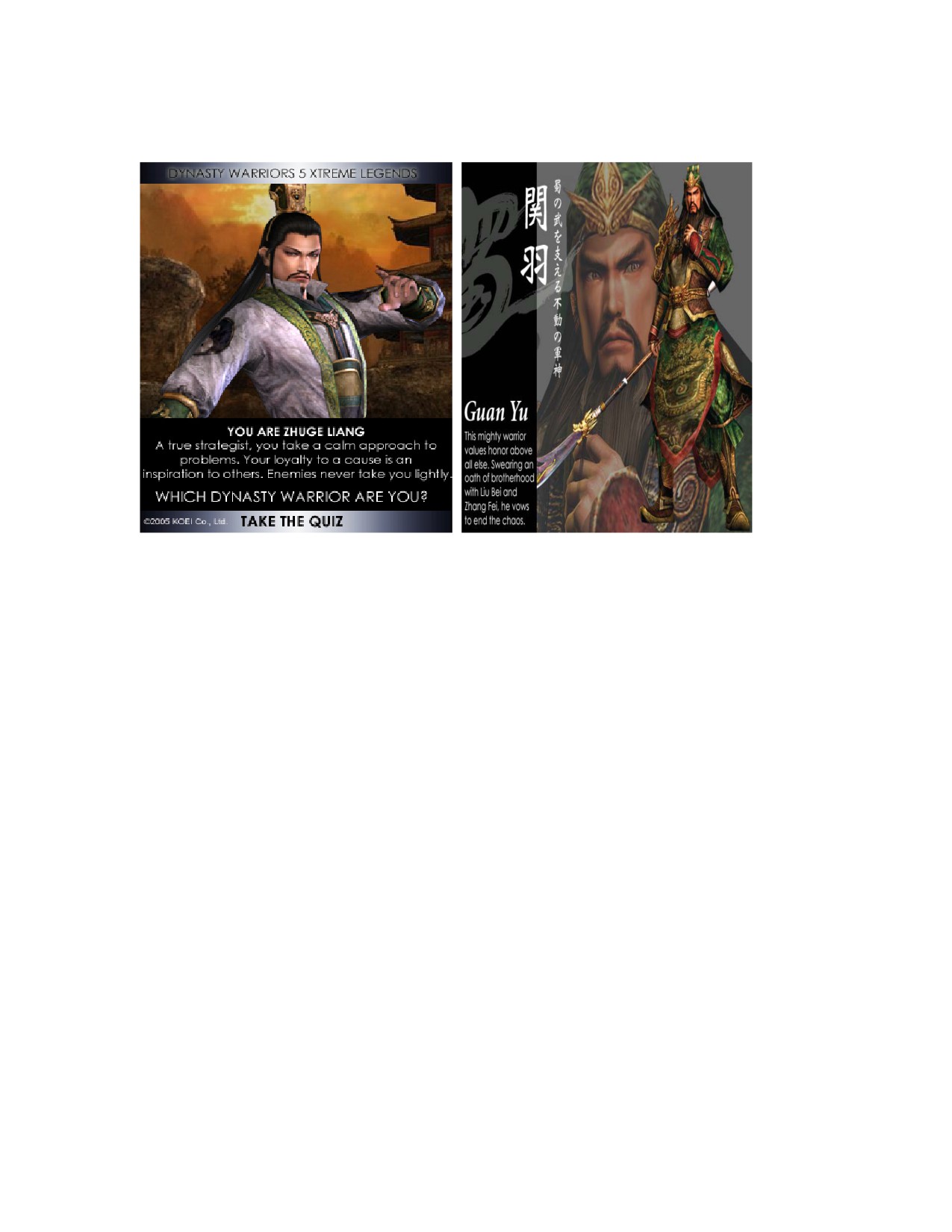
FOR OFFICIAL USE ONLY
Figure 1-1: A personality quiz based on characters from Romance of the Three Kingdoms
Both novels also highlight essential human qualities that the PLA considers important for
its own personnel. (PLA views on these qualities are discussed in greater detail in
Chapter 2.) These include:
Loyalty. In both novels, the heroes’ primary virtue is loyalty - to one another and to
principles of righteous imperial rule. Similar demands are made on PLA personnel,
who forswear their personal interests to fulfill their “Four Loyalties” to the Party, the
Motherland, the Chinese people, and the military profession.
Modesty. Both novels disdain characters driven by ambition for personal power. The
PLA also professes to eschew individual glory in favor of collective accomplishment.
Adherence to bonds of obligation. The heroes of both novels place a premium on
fulfilling their obligations to others, even at the cost of their own lives. Though not
often explicitly discussed in PLA writings, obligations based on a variety of personal
ties play an important role in the PLA.
13
FOR OFFICIAL USE ONLY

FOR OFFICIAL USE ONLY
Marxism-Leninism-Mao Zedong Thought
“Marxism-Leninism-Mao Zedong Thought” (makese liening zhuyi mao zedong sixiang;
马克思列宁主义毛泽东思想) permeates PLA doctrines and organizational structures.
Chapter 2 of this report outlines some of the values that derive from this ideology;
Chapter 3 discusses its most important organizational legacies for the PLA.
Marxism-Leninism-Mao Zedong Thought is inextricably linked to the historical
development of the CCP. The Party and its ideology developed in China throughout the
early part of the
20th century. This development can be broken into three phases,
discussed below.
Phase One: Soviet indoctrination and the First United Front (1921-1927)
In its early years, the CCP
forged close ties with the
THE FIRST UNITED FRONT
Kuomintang
(KMT, also
Although the CCP and the KMT were political rivals, both
called
the
“Nationalist
considered themselves revolutionary parties, fighting to
Party,” or guomindang; 国
strengthen China against the forces of “imperialism” and
民党) and the Soviet Union.
“warlordism.” Both sought financial support and
The CCP was founded in
organizational guidance from the Soviet Union. Russian
July 1921, without a military
advisors from the Communist International
(Comintern)
arm. In its first few years,
persuaded the two parties to set aside their ideological
the CCP had a minimal
differences and cooperate to overthrow the regional warlords
presence on China’s political
who then controlled much of China. Thus, the KMT and
scene, numbering only a few
CCP joined forces under the “First United Front” (~1923-
hundred members and led by
1927).
largely unknown figures.31
The KMT was much larger -
The combined KMT-CCP forces took part in the “Northern
it had
50,000 members by
Expedition” (1925-26), a military campaign that succeeded
1923, and was led by the
in breaking the power of many warlords and reuniting much
revered politician Sun Yat-
of China. Nonetheless, the First United Front was an uneasy
sen and the powerful general
alliance that ended in bloodshed in early 1927, when KMT
Chiang Kai-shek.
leader Chiang Kai-shek ordered the Communists purged
from the alliance.
These two parties joined
forces for several years in the “First United Front” (described in the shaded box above).
In 1924, under the guidance of the Comintern, they jointly established an institution that
would give shape to both parties’ ideologies and institutions for decades to come: the
Whampoa Military Academy (huangpu junxiao; 黄 埔 军 校 ). Modeled after Soviet
military academies, Whampoa was intended to provide professional military training, as
well as ideological guidance, to China’s revolutionary parties.
31 Figures suggest that the CCP had about 300 members in 1923, two years after its founding, and perhaps
1,500 by 1925. John King Fairbank, China: A New History (Cambridge, MA: Belknap Press, 1992), p. 282;
Jonathan D. Spence, The Search for Modern China (New York: W.W. Norton & Co., 1990), p. 336.
14
FOR OFFICIAL USE ONLY
FOR OFFICIAL USE ONLY
At Whampoa, Soviet military advisors trained Chinese officers in modern Russian and
German operational practices, in Marxist political theory, and in the theoretical and
organizational principles of Leninism.32 Many of the PLA’s organizational structures
(discussed in Chapter 3) retain a Leninist flavor, most notably the incorporation into the
military of a system of political officers who oversee the work of their comrades-in-arms
and infuse ideological correctness into their subordinates. Whampoa’s influence on the
PLA’s development is evidenced by the fact that among the first post-1949 generation of
PLA leaders, 5 of 10 supreme commanders and 3 of 10 three-star generals had trained at
Whampoa.33
The PLA inherited the following Marxist-Leninist legacies from Whampoa:
The revolutionary principle. Marxism holds that history is a violent process of class
struggle that will end in worldwide communism. Marx and his followers believed that
in the modern era those who benefit from labor - the capitalist or “bourgeois” class -
oppress and enslave those who labor - the “proletariat” or working class. The only
way this imbalance can be corrected is through a revolutionary uprising of the
working class, leading to the establishment of a new, communist society.34
The PLA teaches its members that the 1949 revolution “liberated” the Chinese
peasants from their feudal oppressors. Today’s PLA is expected to remain aware of
its revolutionary mission and guard against political
“backsliding.” The PLA
professes to abide by the principle that revolution does not end when the Party gains
power - it is a struggle that continues in perpetuity against “counter-revolutionary”
forces that seek to sap the ideological purity and fighting spirit of the PLA.
The Party-Army principle. Leninism holds that the Communist Party is the leader
both of the revolution and of the armed forces. For revolution to take place, the
oppressed classes need to become conscious of their own oppression. Marx thought
that this consciousness would arise spontaneously; Lenin, on the other hand, believed
that the Communist Party would need to act as the
“vanguard” or
“advance
32 Cheng Hsiao-shih, Party-Military Relations in the PRC and Taiwan: Paradoxes of Control (Boulder, CO:
Westview Press, 1990), p. 20. In addition to the strong Soviet influence, German advisors played a
prominent role in the development of the KMT army during this period; see, e.g., William C. Kirby,
Germany and Republican China (Stanford, CA: Stanford University Press, 1984).
33 Yuan Wei and Zhang Zhuo, eds., History of the Development of China’s Military Schools (zhongguo
junxiao fazhan shi; 中国军校发展史) (Beijing: National Defense University Press, 2001), p. 291.
34 For a basic explanation of Marxist views of the division of labor, see Frederick Engels, The Principles of
Communism (1847), http://www.marxists.org/archive/marx/works/1847/11/prin-com.htm; for Marxist
theories of political consciousness and revolution, see Karl Marx, Manifesto of the Communist Party (1848),
15
FOR OFFICIAL USE ONLY

FOR OFFICIAL USE ONLY
contingent” to lead the people into revolutionary self-awareness.35 In this sense, the
Party was an organization of “professional revolutionaries.”36
“The revolutionary army
Lenin further believed that revolution could take place
and the revolutionary
only through military conflict, writing that
“the
government are two sides
revolutionary army is needed because great historical
of the same medal.”37
issues can be resolved only by force.”38 His view is echoed
by Mao’s famous statement that “all power comes from
— Vladimir Ilyich Lenin
the barrel of a gun.”39 The revolutionary army must be
completely controlled by and subordinate to the Party - in fact, in Lenin and Mao’s
view, the army has no missions apart from those of the Party. Thus the PLA is a
“Party-Army.” The “absolute leadership” of the CCP over the PLA was confirmed in
resolutions adopted at one of the CCP’s early policy plenums, the 1929 “Gutian
Conference.”40
The mass mobilization principle. Lenin - and Mao after him - wrote that the
military must mobilize the entire population
“Let the people of the whole country
to participate in revolutionary war. The
mobilize, take up arms and join the
tasks of mobilization include setting up
War of Resistance. Let those with
mass organizations among the people to
strength contribute strength, those with
educate them on revolutionary theory;
money contribute money, those with
mobilizing ordinary citizens to join military
guns contribute guns, and those with
units, militias, and labor uprisings; and
knowledge contribute knowledge.”41
seeking material support from the people
for PLA tasks. In this view, there is no clear
— Mao Zedong, “Mobilize All the Nation’s
delineation between Party, people, and
Forces For Victory in the War of Resistance”
army: all are mobilized simultaneously
through a network of Party-managed, interwoven organizations.
35 See Vladimir Ilyich Lenin, “What is To Be Done? - Burning Questions of Our Revolutionary
Movement,” in Henry M. Christman, ed., The Essential Works of Lenin (New York: Bantam Books, 1966).
36 Benjamin I. Schwartz, “Themes in Intellectual History: May Fourth and After,” in John K. Fairbank and
Denis Twitchett, eds., The Cambridge History of China, Volume 12: Republican China 1912-1949 (Part I)
(Cambridge, UK: Cambridge University Press, 1983), p. 431.
37 Vladimir Ilyich Lenin, “The Revolutionary Army and the Revolutionary Government” (1905), in
Bernard Isaacs and Isador Lasker, eds., Lenin Collected Works, (Moscow: Foreign Languages Publishing
House, 1962), pp. 560-68, http://www.marxists.org/archive/lenin/works/1905/jul/10.htm.
38 Lenin, “The Revolutionary Army and the Revolutionary Government.” Emphasis in original.
39 Mao Zedong, “Problems of War and Strategy” (1938),
40 Liu Yuan, “The Historic Position of the Gutian Meeting in Our Army Building,” Qiushi No. 16, 16 Aug
2007, OSC CPP20070821710010.
41 Mao Zedong, “For the Mobilization of All the Nation’s Forces for Victory in the War of Resistance”
16
FOR OFFICIAL USE ONLY

FOR OFFICIAL USE ONLY
To accomplish these tasks, the Red Army integrated itself into the daily life of rural
communities, holding Marxist study sessions and recruiting peasants to the
revolutionary cause.42
Phase Two: Breaking with the KMT and forming the Red Army (1927-1930s)
The First United Front broke down in April
CHINESE COMMUNIST ARMIES
1927, after KMT forces, on Chiang Kai-shek’s
orders, killed thousands of CCP members and
The Red Army (originally known as
wiped out nearly all of the CCP’s urban bases.
the “Chinese Workers and Peasants
This purge forced the remaining CCP into the
Red Army”) was formed by the CCP
countryside. On August 1, 1927 - a date that
after the disintegration of the First
the PLA considers its founding moment
-
United Front in 1927.43
20,000 Communist troops, led by Marshal
During the “Anti-Japanese War” (i.e.,
Zhu De, attacked a KMT arsenal at Nanchang,
World War II), when the CCP and the
Jiangxi Province. Thus began the Chinese
KMT suspended their civil war to
civil war. With Mao at its helm, the CCP
jointly resist Japanese invasion, the
would fight against the KMT on and off for
main body of Red Army was absorbed
the next two decades.
into the joint forces and re-designated
the Eighth Route Army. A New
The Communist army, which came to be
Fourth Army was also formed around
known as the “Red Army” (hongjun; 红军)
a core of fighters who had served as the
was made up largely of poor, underequipped
rear guard during the Long March.44
peasants. It was faced with materially superior
In 1948, after the civil war against the
enemies: the KMT and, later on, the Japanese
KMT had resumed, these two forces
military.
were integrated into the People’s
Liberation Army.45
Phase Three: Modifying Marxist-Leninist
principles to fit Chinese circumstances
(1938 onward)
In October 1938 Mao called for the “Sinification of Marxism.”46 Having determined that
Lenin’s urban, industrial revolution was inappropriate for China’s largely rural
population, he modified Marxist-Leninist principles to better fit China’s circumstances.
42 Harlan W. Jencks, From Muskets to Missiles: Politics and Professionalism in the Chinese Army, 1945-
1981 (Boulder, CO: Westview Press, 1982), p. 3.
43 William Wei, “‘Political Power Grows Out of the Barrel of a Gun’: Mao and the Red Army,” in David A.
Graff and Robin Higham, A Military History of China (Boulder: Westview Press, 2002), p. 233.
44 Wei, “Political Power Grows Out of the Barrel of a Gun,’” pp. 243-244.
45 Li Xiaobing, A History of the Modern Chinese Army, p. 46.
46 Mao Zedong, The Collected Works of Mao Zedong (Mao Zedong ji; 毛泽东集) (Tokyo: Hokubosha,
1970), 6.260-1; see also Stuart Schram, The Political Thought of Mao Tse-tung (New York: Praeger
Publishers, 1969), pp. 172-73.
17
FOR OFFICIAL USE ONLY

FOR OFFICIAL USE ONLY
The many essays Mao produced on this topic are an essential part of what the CCP now
calls “Mao Zedong Thought” (mao zedong sixiang;毛泽东思想).
One of the most influential elements of Mao Zedong Thought was Mao’s belief that the
CCP’s best chance of winning was to adopt guerrilla tactics, a strategy that he later
developed into the concept of “People’s War.”47
PEOPLE’S WAR
“People’s War” combines Sun-tzu’s principles of deception and calculation with the
mobile, flexible tactics of guerrilla warfare. Mao articulated this concept most clearly in
his 1938 essay “On Protracted War.” Mao believed that the poorly equipped CCP army
could succeed against technologically superior enemies by arming and training large
numbers of peasants.48 Some of these soldiers were to be incorporated into the Red
Army’s regular forces, while others would form local militias and guerrilla units that
could be called upon in times of emergency.
As originally conceived, the components of “People’s War” included:
•
“Luring the enemy deep” into one’s territory, then attacking them
• Wearing down the enemy in a protracted war of attrition
• Focusing on the enemy’s weakest points
• Mobilizing the entire population to resist the enemy
• Using speed, surprise, deception, and stratagem
• Using guerrilla tactics when one’s forces are too weak for conventional warfare.
This concept seems far removed from the “local, high-tech wars” the PLA expects to fight
today. In 1979 Deng Xiaoping modified the doctrine of “People’s War” to “People’s War
Under Modern Conditions,” giving more credence to the use of high-tech weaponry while
maintaining an emphasis on striking the enemy’s weak points. Subsequent doctrinal shifts
have moved the PLA even further from the original principles of People’s War, but it
remains a revered concept and is frequently redefined to fit current operational doctrine.49
47 See, e.g., Mao Zedong, “On Guerilla Warfare” (1937),
48 William W. Whitson, The Chinese High Command, p. 18.
49 See Paul H. B. Godwin, “Change and Continuity in Chinese Military Doctrine, 1949-1999,” in Mark A.
Ryan, David M. Finkelstein, and Michael A. McDevitt, eds., Chinese Warfighting: The PLA Experience
Since 1949 (Armonk, NY: M. E. Sharpe, 2003), pp. 39-40; Peng Guangqian and Yao Youzhi, The Science
of Military Strategy, pp. 110-111; Mark Burles and Abram N. Shulsky, Patterns in China’s Use of Force:
Evidence from History and Doctrinal Writings (Santa Monica, CA: RAND, 2000), p. 26.
18
FOR OFFICIAL USE ONLY

FOR OFFICIAL USE ONLY
In addition to “People’s War,” today’s CCP and PLA leaders consider several other
Maoist principles to be relevant for the modern Chinese military, including the following:
Ordinary people should participate in decision-making, but only in a limited and
controlled fashion. Lenin’s concept of democratic centralism (minzhu jizhong; 民主
集中) continues to guide the CCP’s attitude toward participatory decision-making in
Party institutions. Defined as “freedom of discussion, unity of action,” democratic
centralism emphasizes the importance of controlled discussion and debate in Party
decision-making procedures.50 The Party allows all of its members to take part in
wide-ranging discussions on matters of policy
(the
“democratic” aspect), but
mandates that once a policy direction has been decided all discussion will end and all
members will uphold that decision (the “centralist” aspect).
Mao adapted democratic centralism
WHAT IS THE MASS LINE?
to more fully incorporate the
The mass line means “taking the ideas of
opinions of ordinary people into
the masses (the scattered and unsystematic
Party decisions. The uniquely
ideas) and concentrating them
(through
Maoist concept of the mass line
study, changing them into concentrated,
(qunzhong luxian; 群 众 路 线 )
systematic ideas), then going into the
posits that the Party needs to
masses to publicize explanations…
understand the masses’ ideas and
causing the masses to persist in them and
opinions in order to make informed
translate them into action, and through
decisions and design effective
mass action test these ideas to see if they
policies. However, it holds, the
are correct.…In this kind of unlimited
people themselves may not
cycle, every time around will be clearer,
comprehend how best to turn their
livelier, and richer.”51
scattered ideas into coherent policy.
— Mao Zedong, “Some Questions
Thus, the responsibility for actual
Concerning Methods of Leadership”
policy-making and implementation
continues to rest with the Party, which
“centralizes” the people’s wisdom and
“returns” well-crafted policies back to the citizenry. Succinctly expressed in the
slogan “from the masses, to the masses” (cong qunzhong zhong lai, dao qunzhong
zhong qu; 从群众中来, 到群众中去), the mass line principle remains central to the
participatory, “democratic” mechanisms built into the PLA. (For more on this topic,
see Chapter 4.)
Human willpower can overcome great material disadvantage. A distinctive
aspect of Mao’s thought was his focus on voluntarism - the notion that human will is
the determining factor of the success or failure of all endeavors. Mao believed that a
sufficiently strong will could overcome not only personal shortcomings, but even
50 Vladimir Ilyich Lenin, “Report of the Unity Congress of the R.S.D.L.P.: A Letter to the St. Petersburg
Workers” (1906), http://www.marxists.org/archive/lenin/works/1906/rucong/viii.htm.
51 Mao Zedong, “Some Questions Concerning Methods of Leadership” (1 Jun 1943),
19
FOR OFFICIAL USE ONLY
FOR OFFICIAL USE ONLY
material reality, to produce desired outcomes.52 This sometimes took on absurd
dimensions, as when Mao surmised at the beginning of the “Great Leap Forward”
(1958-61) that China’s economic backwardness could be solved by turning the
energies of the entire population from agricultural to industrial production, even
though the Chinese people had little appropriate training or equipment.53 Millions of
Chinese citizens starved in the aftermath of this attempt to prove the power of the
human will.
While today’s PLA avoids the most extreme formulations of voluntarism, it continues
to emphasize the centrality of willpower to success in warfare. PLA texts stress that
an army can win a war with inferior material resources, but is doomed to failure
without sufficient human resolve and commitment. This topic is explored in detail in
Chapter 2.
War follows “scientific” principles that should be studied and followed. Marx
and Mao believed that through a systematic analysis of history, one can understand
the objective principles that govern human endeavors. China’s military establishment
today follows the principles of “scientific Marxism” to determine how best to conduct
warfare. Its leaders believe that war is governed by broad, knowable trends or laws
(guilü; 规律) that, once determined, must be obeyed to ensure success. The field of
“military science” (junshi kexue; 军事科学) is thus dedicated to the study of the
“rules, guidelines, and laws” that govern the conduct of war, and is viewed as not
only an academic subject but also the starting point for decisions and policies.54
The PLA’s selective interpretation of China’s modern history
The PLA draws a number of lessons and beliefs about itself from recent Chinese history,
as filtered through Party-approved texts. On the broadest level, PLA writings retell
Chinese post-1840 history as a tale of loss, struggle and redemption. They depict a China
torn apart in the 19th century by internal rebellions, foreign invasion, political collapse,
and widespread social chaos; today the Chinese call the period between 1840 and 1949
the “Century of Humiliation” (bainian guochi; 百年国耻). Official histories today teach
that the CCP and the PLA, emerging victorious from the Chinese civil war in 1949,
“rescued the nation” (jiuguo; 救国) from these depredations and restored it to a position
of international prestige.
52 For more on Mao’s voluntarism, see Frederic Wakeman, Jr., History and Will: Philosophical
Perspectives of Mao Tse-tung’s Thought (Berkeley, CA: University of California Press, 1973).
53 See, e.g., June Grasso, Jay Corrin, and Michael Kort, Modernization and Revolution in China: From the
Opium Wars to World Power, 3rd Edition (Armonk, NY: M.E. Sharpe, 2004), Chapter 8.
Maryanne Kivlehan, Doctrinal Change in the Chinese People’s Liberation Army: Institutions,
54
Processes, and Influences, CNA Research Memorandum D0008391.A2/Final (Alexandria, VA: The CNA
Corporation, 2003), p. iii.
20
FOR OFFICIAL USE ONLY

FOR OFFICIAL USE ONLY
To give more texture to this narrative, PLA textbooks and official histories divide post-
1840 history into three major periods. Below, we summarize these periods, and the
lessons the PLA draws from them.
It is important to understand that the PLA’s version of China’s history is not presented
objectively. Historical events that do not resonate with this CCP-approved narrative are
barely discussed.
1839-1921: Foreign intrusion and internal disorder
This period of painful national loss is bounded on one end by the Opium War, which the
CCP considers the dawn of foreign aggression against China, and on the other by the
CCP’s own founding. During this period, China was under siege both externally and
internally. In addition to its struggles with foreign powers, it was plagued by internal
political division and a number of large-scale rebellions.
Figure 1-2 depicts the large territorial losses China suffered during this period.
KEY EVENTS, 1839-1921
1840-1842: The United Kingdom, determined to keep Chinese markets open to the
opium trade, launches the First Opium War (some accounts mark its beginning in
1839) against China’s Qing Dynasty. China loses, and is forced to open its seaports to
Western countries and Japan. The result is a semi-colonial system of extraterritorial
treaty ports, effectively depriving the Chinese imperial government of control over
significant parts of its own territory.
1850-1864: China is embroiled in the immense Taiping Rebellion, which results in
the deaths of millions of Chinese and is put down only with military assistance from
foreign powers resident in China.
1899-1900: The Boxer Uprising starts as a popular anti-foreign movement but quickly
turns against the Qing imperial court for not doing enough to stave off foreign
influences. Eventually the Qing court declares war on eight resident foreign powers; it
loses, and is plunged into debt by the massive indemnities it is forced to pay.
1894-1895: China loses the Sino-Japanese War and is forced to cede Taiwan and
other territories to Japan.
1911: The Qing Dynasty collapses and the last emperor of China formally abdicates.
China is declared a republic, under the leadership of the Nationalist Party, or
Kuomintang (KMT). Much of the country becomes a fractured collection of fiefdoms
controlled by regional “warlords” (junfa; 军阀).
1921: The Chinese Communist Party is founded in Shanghai.
21
FOR OFFICIAL USE ONLY

FOR OFFICIAL USE ONLY
Figure 1-2: Chinese territory lost and regained since 1840
1840
Greatest extent of imperial
China’s effective control
1920
Smallest extent of the
Republic of China’s effective
control
Present day
Effective territorial control of
the People’s Republic of China
22
FOR OFFICIAL USE ONLY

FOR OFFICIAL USE ONLY
1921-1949: The rise of the CCP and the Red Army
In Chinese history texts, this period of struggle is bounded on one end by the founding of
the CCP and on the other by its triumph over the KMT. This was a period of nearly
perpetual warfare in China. While the KMT and CCP came together twice to fight a
common enemy, their ideological and personal antagonisms persisted throughout.
For much of this period, the Red Army was essentially on the run, its ranks filled with
poor peasants who were hungry, poorly clothed, and poorly trained. When the Chinese
civil war re-ignited after the close of World War II, the Red Army slowly evolved toward
more mass-oriented battlefield tactics and eventually consolidated its diverse forces into a
single
“People’s Liberation Army.” However, it continued to think of itself as an
overmatched, essentially guerrilla army. 55
KEY EVENTS, 1921-1949
1921: The Chinese Communist Party (CCP) is founded in Shanghai.
1923-1927: The CCP and KMT join forces in the First United Front.
1926: United Front forces conduct the Northern Expedition, defeating regional
warlords and reuniting large portions of China.
April
1927: The KMT purges Communists from the United Front, massacring
thousands of CCP members, in the “White Terror.”
August 1, 1927: Communist forces under Zhu De attack KMT outposts in the
Nanchang Rebellion, which the PLA considers its founding moment. The Chinese
civil war begins.
1931-1932: Japan annexes Chinese Manchuria.
1934-1935: Communist forces endure the Long March (changzheng; 长征). After
breaking out of KMT encirclement in Jiangxi Province, Mao’s forces march more than
8,000 miles in 10 months, engaging in more than 500 battles and losing nearly 90
percent of their original 85,000 troops.
1937-1945: Japan declares war on China, and sacks and loots Chinese cities, most
notably in the 1937 Rape of Nanking. The KMT and CCP suspend their civil war to
form a Second United Front against the Japanese, whose occupation of large parts of
Chinese territory lasts until the end of the Anti-Japanese War (i.e., World War II).
1948: The Eighth Route Army and New Fourth Army are integrated to form the
People’s Liberation Army.
1946-1949: The Chinese civil war resumes, culminating in the founding of the
People’s Republic of China in 1949 and the retreat of KMT forces to Taiwan.
55 Larry M. Wortzel, “The Beiping-Tianjin Campaign of 1948-49: The Strategic and Operational Thinking
of the People’s Liberation Army,” in Ryan, Finkelstein, and McDevitt, Chinese Warfighting, p. 60.
23
FOR OFFICIAL USE ONLY
FOR OFFICIAL USE ONLY
1949-1979: “New China,” post-liberation wars, and the Great Proletarian
Cultural Revolution
Carried to power by the Red Army’s victories, the CCP founded the People’s Republic of
China on October 1, 1949. Chinese historians depict this as the end of the “Century of
Humiliation” and the beginning of China’s redemption, paving the way for China to
regain the prestige and power it had lost since 1840.
Much remained to be done, though. “New China” remained poor, heavily rural, and
shattered by war. The 30 years that followed saw great strides forward in China’s
modernization. It also saw a number of steps backward.
During this period the PLA engaged in a number of conflicts, large and small, outside
China’s borders. Though outside observers consider the outcome of many of these
conflicts ambiguous, the PLA depicts each of them as a clear military and moral victory
for the Chinese forces.
In the late 1960s, the PLA was drawn into the political and social chaos that split China
during the “Great Proletarian Cultural Revolution” (wenhua da geming; 文化大革命).
During this period, Mao encouraged masses of student “Red Guards” to denounce and
punish anyone deemed a “rightist,” sometimes including their own parents, teachers, and
other authority figures. As the chaos escalated, the PLA was brought in to suppress some
of the Red Guard factions, at times using deadly force.
The Cultural Revolution profoundly disrupted the PLA. Its modernization efforts were
halted, as members were instructed to focus on ideological concerns rather than on
training and preparedness. All educational institutions in China, civilian and military,
were shut down. Therefore the generation that came of age during this period - those who
are now at the highest echelons of the PLA - were unable to obtain any significant
professional military education until this period had ended, when they had already been
in the PLA nearly 20 years. As a result, one analyst explains, “the current PLA elite are
now responsible for shepherding a military modernization program that, given their
personal and professional histories, they are ill-equipped to manage or even
understand.”56 Today’s PLA acknowledges the great setbacks it experienced as a result of
this period of chaos.
When Mao died in 1976, the Cultural Revolution had effectively ended. Mao’s successor,
Deng Xiaoping, moved to professionalize and modernize the PLA. He reopened the
military academies, began a long-term process of PLA downsizing, updated operational
doctrine and training regimens, and began to expose the PLA to foreign ideas and
exchanges with foreign military personnel. In 1978 he declared the beginning of a period
of “reform and opening up” (gaige kaifang; 改革开放), in which China would begin to
modernize its economy, society, and military.
56 Dean Cheng, Kristen Gunness, and James Bellacqua, An Exploration of the Evolving PLA Elite, CNA
Research Memorandum D0017346.A1 (Alexandria, VA: The CNA Corporation, 2007), p. iii.
24
FOR OFFICIAL USE ONLY

FOR OFFICIAL USE ONLY
We end our discussion of Chinese history with the beginning of the reform period, since
PLA writers consider the decades since then to be part of the current era; much that has
happened in that era is covered in other chapters.
KEY EVENTS, 1949 -1979
1949: The People’s Republic of China is founded.
1950-1953: The Chinese military engages American forces in the Korean War, which
is referred to in China as the “Aid Korea, Resist America War.”
1954-1958: The PLA conducts a number of operations against KMT forces on
Taiwan, but does not invade.
1962: China conducts a brief border war with India.
1966-1976: The “Great Proletarian Cultural Revolution” profoundly disrupts the
PLA’s development.
1969: The PLA is involved in a number of skirmishes with Soviet forces along its
northern border.
1976-1978: After the death of Mao Zedong, Deng Xiaoping gradually amasses
power, eventually becoming China’s paramount leader and introducing a broad set of
reforms aimed at modernizing China’s economy, government, and military. The period
since 1978 has become known as China’s “reform and opening up” (gaige kaifang;
改革开放) period.
1979: China goes to war with Vietnam to “teach it a lesson” for invading Cambodia;
border skirmishes continue through the early 1980s.
Lessons the PLA takes from its history
The PLA promotes the following beliefs with regard to China’s post-1840 history.
The “Century of Humiliation” shows that Western nations are by nature
aggressive, forcing China to wage defensive wars.
The PLA takes the events of the 19th and early 20th centuries as evidence that Western
powers are fundamentally rapacious, greedy, and aggressive. Some PLA academics today
assert that this is a longstanding orientation, writing that Western nations were
historically
“slave states
[that] frequently launched wars of conquest and pillage to
expand their territories, plunder wealth, and extend their sphere of influence.”57
By contrast, PLA authors assert, China’s strategic tradition is distinguished by its
constant pursuit of peace.58 The PLA depicts China, both historically and in the current
era, as a
“peace-craving and peace-loving” nation, emphasizing that
“peace claims
57 Peng Guangqian and Yao Youzhi, The Science of Military Strategy, p. 93.
58 See, e.g., Gong Yuzhen, Analysis of China’s Strategic Culture (zhongguo zhanlüe wenhua jiesi; 中国战
略文化界斯) (Beijing: Military Science Press, 2002), Chapter 1.
25
FOR OFFICIAL USE ONLY

FOR OFFICIAL USE ONLY
precedence” (he wei gui; 和为贵) over war in the Chinese worldview.59 China wages war
only when all other means of securing peace have failed. PLA texts further declare that
China has never harbored territorial ambitions against other nations.60 Accordingly, the
PLA characterizes all Chinese wars as defensive actions against invaders.61 Any
confrontation between China’s military and that of another nation is depicted as the result
of the other nation’s aggressive actions, or “hegemony.”
The Maoist military principle of
REINTERPRETING “ACTIVE DEFENSE”
“active defense” (jiji fangyu; 积
The PLA justifies military actions against other
极防御) draws on the PLA’s
nations by distinguishing in its writings between
depiction of its mission as purely
“strategic attack” and
“tactical attack.” PLA
defensive, asserting that China
strategists claim that the principle of
“active
will strike only after the enemy
defense” allows for China to make the first tactical
has struck. This is a curious
strike when threatened
“strategically.”
“Strategic
assertion, given that the PRC has
attacks” are defined as those not only on the Chinese
launched first strikes in a number
military but also on China’s sovereignty, the Chinese
of military actions outside its
people, or the CCP’s political control - including the
borders. Nevertheless,
PLA
use of “hostile forces such as religious extremists,
publications consistently interpret
national separatists, and international terrorists.”62 In
China’s military actions as being
this way either military attacks on the PRC’s
driven by an overt threat to
territory or political attacks on the CCP may justify a
China’s national security.
counter-attack by the PLA.
The PLA justifies its current
defense modernization in part by recalling China’s legacy of victimization by the West
and Japan. It claims that it seeks merely to prevent future invasion, not to expand China’s
military footprint.63
59 Lin Chengdong and Chen Zhengdong, “The Importance of National Defense Construction and Army
Building in the Overall Layout for Socialism with Chinese Characteristics,” Jiefangjun Bao, 6 Oct 2007, p.
6, OSC CPP20071206710007; David Shambaugh, Modernizing China’s Military: Progress, Problems, and
Prospects (Berkeley: University of California Press, 2002), p. 21.
60 Wu Pin, “Military Scholar on Tactics Views Defense Issues” (interview with Maj. Gen. Cai Yuqiu), Ta
Kung Pao, 1 Aug 2007, OSC CPP20070806710004.
61 For example, two PLA scholars at the Academy of Military Science write that “China’s tradition of a
unified domain … [meant that the military] paid more attention to domestic order rather than expansion”
starting with the 2nd century BC. See Peng Guangqian and Yao Youzhi, The Science of Military Strategy, p.
72.
62 Peng Guangqian and Yao Youzhi, The Science of Military Strategy, p. 426; see also Wu Pin, “Military
Scholar on Tactics Views Defense Issues.”
63 David M. Finkelstein and John Unangst, Engaging DoD: Chinese Perspectives on Military Relations
with the United States, CNA Research Memorandum 99-0046.90 (Alexandria, VA: The CNA Corporation,
1999), p. 2.
26
FOR OFFICIAL USE ONLY

FOR OFFICIAL USE ONLY
DISTRUST OF FOREIGN INTENTIONS: A LEGACY OF THE PAST
As discussed above, the Chinese today view the late 19th and early 20th centuries as a
dark period in their history. The year 1840 is considered the dividing line between
China’s proud imperial past and her subsequent subjugation to foreign whims.
The impact of the “Century of Humiliation” on China’s self-image and national
aspirations cannot be overemphasized. Chinese citizens still display a deep sense of
wounded pride over this period. Due in large part to bitter memories of the sovereignty,
power, and human lives that China lost, feelings against foreign interference still run
very strong. For instance, one media commentator hailed the 2008 Beijing Olympics as
a chance to “dispel the lingering bitterness from the humiliating defeats China suffered
at the hands of imperialist aggressors in the past century.”64
The CCP at times actively encourages PLA members to distrust foreign intentions. For
instance, President Hu Jintao, in a 2004 speech on the PLA’s main tasks, warned that
“Western hostile forces have not given up the wild ambition of trying to subjugate us,
intensifying the political strategy of Westernizing and dividing up China.”65
China’s external sovereignty and domestic stability are closely linked; the PLA
must strive to protect both.
The Chinese have long believed that
“internal strife and external calamities”
(neiluanwaihuan; 内乱外患) are fundamentally linked.66 The PLA points to the unrest
and rebellions that characterized pre-1949 China as evidence that for the Chinese nation
to survive, it must respond effectively to both external pressures and internal forces of
disorder (such as ethnic separatism, local unrest, crime, and corruption). Even after the
PRC was founded, the PLA teaches, the security of the new nation was still shaky for
many years. PLA leaders proclaim that the PLA played a central role in guaranteeing the
PRC’s hard-won sovereignty and promoting its subsequent economic development.67
64 Hong Liang, “Time to Drop the Baggage of History,” China Daily, 2 Sept 2008, OSC
CPP20080902968010.
65 Hu Jintao, “Understand the New Historic Missions of our Military in the New Period of the New
Century” (renqing xinshiji xinjieduan wojun lishi shiming; 认清新世纪新阶段我军历史使命),
66 See, e.g., Christopher P. Twomey, “Chinese Strategic Cultures: Survey and Critique,” paper prepared for
Defense Threat Reduction Agency, Advanced Systems and Concepts Office, Comparative Strategic
Cultures Curriculum (Washington, DC: SAIC, 2006). Twomey argues that a concern with domestic
stability is “in no way … unique to China,” though China does “justif[y] these preferences through its own
history” (p. 8).
67 History Research Institute of the Academy of Military Science, Eighty Years of the People’s Liberation
Army (zhongguo renmin jiefangjun de bashinian; 中国人民解放军的八十年) (Beijing: Military Science
Press, 2007), pp. 265-274.
27
FOR OFFICIAL USE ONLY

FOR OFFICIAL USE ONLY
China’s wariness of external interference leads it to adopt what seems, from the outside,
to be a rather paranoid attitude toward other nations’ intentions. Many Chinese leaders
believe that “hegemonic” nations, such as the United States, are bent on undermining
weaker countries from within. In the PLA’s view, many of the world’s domestic
disturbances and regional hostilities may be traced to such interference. One influential
PLA text asserts, for instance, that “the hot issues in Southern Asia, Central Asia,
Northeastern Asia, and Southeastern Asia are all related to the meddling of the dominant
countries.”68
To toughen the nation’s defenses against external threats, the PLA believes that it must
also maintain domestic stability. This lesson was reinforced during the period of Western
intrusion, when the weak ability of the imperial army to resist foreign invaders was
further hampered by internal rebellions. As a result, the PLA is tasked with maintaining
domestic order not just for the sake of Party survival but also for the sake of national
survival.
The CCP and the Red Army “saved” China, providing the leadership and political
awareness necessary to liberate the country and to resist foreign aggressors and
domestic tyrants.
The PLA teaches that the Chinese people chafed under the “humiliations” brought about
by foreign imperialists and feudal warlords, but that their attempts to overthrow these
oppressors lacked any “firm core leadership”
and were doomed to failure.70
“An important reason why the
undertakings of the Party and the
PLA texts stress that the PRC would never have
people could constantly advance from
been founded, or China “liberated,” without the
victory to victory and socialist China
victories of the Red Army. They teach that the
has been able to gain a firm foothold
PLA’s victories over the Japanese invaders and
in the midst of international
the Nationalist Army “saved” China from its
turbulence…is that we have the PLA:
downward spiral, marking the beginning of
the heroic army that remains loyal to
China’s
“standing up” after a long era of
the Party, to socialism, to the
powerlessness,
division,
and
foreign
Motherland, and to the people.”69
exploitation.71
— PRC President Hu Jintao
68 Zheng Shenxia (PLAAF General, director of Academy of Military Science), “Thoroughly Study and
Implement the Party’s New Achievements in Military Guidance Theory,” Junshi Kexue 2007-4. Full-text
DoD translation at OSC CPP20080223563001.
69 Hu Jintao, speech delivered at rally marking the 80th founding anniversary of the PLA at the Great Hall
of the People in Beijing, 1 Aug 2007, OSC CPP20070801050015.
70 History Research Institute of the Academy of Military Science, Eighty Years of the People’s Liberation
Army, pp. 1, 5.
71 See, e.g., Zou Zhicheng, ed., College Military Instruction Course of Study (daxue junshike jiaocheng; 大
学军事科教成) (Changsha: Hunan University Press, 2004), pp. 9-11; Xu Jianjun and He Shaohua, College
Military Course of Study, pp. 7-11. The remaking of the Chinese military is depicted as central to halting a
28
FOR OFFICIAL USE ONLY
FOR OFFICIAL USE ONLY
The victories of the Red Army and the PLA derived largely from their loyalty to
the Party and its missions.
The PLA depicts its subordination to the CCP as one of its most distinctive and admirable
traits.72 It instructs its personnel that the PLA’s adherence to the CCP’s political missions
and moral codes drove its triumph in the Chinese civil war and all subsequent victories.73
The greatest victories of the Red Army and the PLA have been achieved against
larger, better-equipped, more technologically advanced adversaries. This is due to
the superior morality, just cause, and fighting spirit of Chinese Communist armies.
PLA histories depict the Communist military as a perpetual underdog. The PLA
indoctrinates its troops that in wars against the KMT, against Japan’s occupying forces,
and against the U.S. military in the Korean War, the
“In Chinese history, there have
PLA “miraculously…used a small force to defeat
large enemy forces, used poor weapons to defeat
been various kinds of armies. But
enemies armed with advanced weapons and used
only the People’s Liberation
Army has always managed to
weak forces to defeat enemies who were strong.”74
keep its advanced nature. It is
able to defeat any strong enemy.
The depiction that “our army has always been brave
and has always won” bolsters the PLA’s belief in its
It never collapses, no matter what
own just cause and in the power of human will.76
hardship it goes through.”75
The PLA instructs its personnel that with sufficient
— PRC President Hu Jintao
determination and moral fortitude, they can
overcome all obstacles. By contrast, they say, any foreign military attacking China “must
meet failure” because of its immoral purpose. Invading forces are “outwardly fierce but
inwardly faint-hearted, while our military is a flourishing and punitive force, defending
our sovereignty and repelling hegemony. Morality and justice are on our side.”77
The grueling experiences of the Chinese civil war period established among Red Army
personnel an intense loyalty to the Communist cause and a belief in their own ability to
withstand extreme physical hardship. The PLA teaches that the heroic figures of this
decline in power and a rise in corruption that had been building since the mid-Song Dynasty, in the 12th
century (see Zou Zhicheng, College Military Instruction Course of Study, pp. 8-9).
72 See, e.g., Fan Changlong (Jinan MR Commander) and Liu Dongdong (Jinan MR Political Commissar),
“Let the Iron Troop Spirit be Passed Down Generation After Generation,” Qiushi No. 15, 1 Aug 2007, OSC
CPP20070807710009; Liu Demou, Yun Shan, and Wu Liang, “The New Mission of the People’s Army”
(interview with major generals Yao Youzhi and Fu Liqun at Academy of Military Science), Liaowang, 8
Jan 2007, pp. 26-28, OSC CPP20070111710012.
73 Liu Shihao, Techniques and Methods for Platoon Leaders, p. 244.
74 “Fostering Combat Spirit with the Focus on Fulfillment of New Missions.”
75 Liu Demou, Yun Shan, and Wu Liang, “The New Mission of the People’s Army.”
76 Liu Demou, Yun Shan, and Wu Liang, “The New Mission of the People’s Army.”
77 Wang Xingsheng and Wu Zhizhong, “Discussion on Military Soft Power Building.”
29
FOR OFFICIAL USE ONLY
FOR OFFICIAL USE ONLY
period and their participation in arduous exploits such as the Long March illustrate the
effectiveness of the PLA’s superior fighting spirit.78
The PLA has won every war that it has fought.
The PLA depicts its war history as one glorious victory after another. In 2007, PRC
President Hu Jintao claimed that the PLA’s “revolutionary spirit…stresses beating all
enemies and not being beaten by any enemy, and overcoming all difficulties and not
being overcome by any difficulty.”79 Even in instances where outside observers have
judged the outcome to be ambiguous at best, PLA histories inevitably depict the Chinese
army as triumphant.80 For example, the PLA describes the Korean War - which it calls
the “Resist America, Aid Korea” war - as a “great victory for the people’s armies of
China and Korea.”81 China also claims victory in its 1979 war against Vietnam, even
though the PLA lost 26,000 men in just 19 days and withdrew before a clear conclusion
to the war had been reached.82 PLA histories of World War II generally do not mention
the U.S. involvement in the war against Japan at all.
78 Wei, “‘Political Power Grows Out of the Barrel of a Gun,’” p. 240.
79 Hu Jintao, speech delivered at rally marking the 80th founding anniversary of the PLA at the Great Hall
of the People in Beijing.
80 See, e.g., Wortzel, “The Beiping-Tianjin Campaign of 1948-49,” p. 274.
81 Zhang Huaibi, ed., Soldiers Handbook (junren shouce; 军人手册) (Beijing: National Defense University
Press, 2005), p. 522.
82 Li Xiaobing, A History of the Modern Chinese Army, p. 258.
30
FOR OFFICIAL USE ONLY
FOR OFFICIAL USE ONLY
Chapter 2: PLA Values
Introduction: The “human factor”
As discussed in the previous chapter, the PLA draws many beliefs about itself from its
philosophical and historical origins. One crucial belief is that the moral and personal
qualities of individual servicemembers are central to military success. Mao Zedong
believed that “a contest of strength is not only a contest of military and economic power,
but also a contest of human power and morale.”83 China’s military leaders attribute the
seemingly overmatched Red Army’s surprising victories in the Civil War to the excellent
moral, political, and spiritual values (jiazhi; 价值) of the Communist troops. The PLA
teaches that the immense difficulties faced by the Red Army helped to forge an
exceptionally virtuous, strong-willed fighting force; in the PLA’s view, this superior
“human factor” (ren de yinsu; 人的因素) won these wars.
Today’s PLA teaches that the “human factor” is more important than ever. While the
PLA has significantly improved its material capabilities over the last three decades, its
leaders recognize that these capabilities still lag far behind those of the U.S. and other
advanced militaries, and PLA texts state that “the gap between our military and foreign
militaries in weaponry and armaments cannot be fundamentally eradicated within the
near future.” 84 To compensate for this gap, they emphasize, the PLA must spare no effort
to maintain its greatest advantage: its personnel’s commitment to and practice of superior
moral and personal values.85
However, PLA leaders worry that as Chinese society changes, many of its mores are
diverging from the PLA’s traditional values, making the latter difficult to sustain. This
challenge, and the approaches the PLA is taking to meet it, are discussed in Chapter 5.
How the PLA developed the “human factor”
The PLA’s attention to the “human factor” likely arose partly out of necessity. As
discussed in Chapter 1, the Red Army drew the bulk of its recruits from poor peasant
communities. It also relied on these communities for material support, including lodging
and provisioning. To gain their trust, the Red Army had to be seen as morally upright and
deeply invested in the lives and concerns of the common people.
83 Mao Zedong, “On Protracted War” (1938), http://www.marxists.org/reference/archive/mao/selected-
works/volume-2/mswv2_09.htm.
84 Zhou Xiaoxian and Tian Wenming (eds.), Guidebook for Unit Construction under High-Tech Conditions,
Volume 2 (gaojishu tiaojian xia budui jianshe shiyong zhinan; 高技术条件下部队建设适用指南) (Hai
Chao Publishing House, 2002), p. 755.
85 Zhou Xiaoxian and Tian Wenming, Guidebook for Unit Construction under High-Tech Conditions, p.
755.
31
FOR OFFICIAL USE ONLY

FOR OFFICIAL USE ONLY
Soldiers’ poor traditional image
To gain the people’s trust, the Red Army needed to overcome the unfavorable public
image with which Chinese soldiers had been saddled for many generations. Imperial
China displayed an ambivalent attitude toward soldiers: the martial and literary classics
discussed earlier revered military
prowess, but the Confucian scholar-
“GOOD MEN DON’T BECOME SOLDIERS”
official elite viewed martial activities
The image of military personnel in imperial
with disdain. They saw the use of
China was captured in the popular saying that
violence as a
“failure of statecraft”
“just as good iron isn’t used for nails, good men
and its practitioners as lacking in
don’t become soldiers”
(haotie bu da ding
moral virtue.87 Military officer status
haonan bu dangbing; 好铁不打钉, 好男不当
was conferred not upon the highly
educated and capable but rather upon
兵).86
low-level government officials whose
work garnered little respect.88
This image was exacerbated by the behavior of the warlord armies during the early
decades of the 20th century. The warlords - regional power-holders who controlled
mercenary armies - had little interest in the people’s welfare. They levied high taxes and
siphoned revenues away from education and social services in order to feed and arm the
armies that sustained their power. People who lived in contested territories were
subjected to the “requisitions and abuses of passing armies” and often saw their homes
destroyed and livelihoods ruined by internecine warfare.89 Moral strictures on soldiers’
behavior toward ordinary people were weak or nonexistent, so the military was viewed
by the public as a “huge preparatory school for banditry” and soldiers gained a reputation
for corruption and lawlessness.90 Soldiers in these armies scarcely received better
treatment than the civilians they abused: commanders were known for inflicting extreme
brutality upon their subordinates.91
86 Edward L. Dreyer, “Continuity and Change,” in David A. Graff and Robin Higham, eds., A Military
History of China (Cambridge, MA: Westview Press, 2002), pp. 25-26.
87 Robin Higham and David A. Graff, “Introduction,” in Graff and Higham, A Military History of China, p.
16.
88 Dreyer, “Continuity and Change,” p. 26.
89 Edward A. McCord, “Warlordism in Early Republican China,” in Graff and Higham, A Military History
of China, p. 189.
90 Robert Slate, “Chinese Role Models and Classical Military Philosophy in Dealing with Soldier
Corruption and Moral Degeneration,” Journal of Third World Studies, Spring 2003,
91 Chen Zhou, Theory and Practice of the PLA Democratic System (zhongguo renmin jiefang jun minzhu
zhidu de lilun yu shijian; 中国人民解放军民主制度的理论与实践) (Beijing: Military Science Press,
1993), p. 3.
32
FOR OFFICIAL USE ONLY

FOR OFFICIAL USE ONLY
The KMT was portrayed by the CCP as similarly oppressive. Mao’s writings from the
1930s and 1940s are filled with vituperation against the KMT army, portraying its leaders
as exhibiting atrocious behavior toward the local populace and their own enlisted
personnel alike. The KMT government was widely seen as corrupt and unable to handle
social and economic problems.93
A new kind of Chinese army
Many of the bedrock values of today’s PLA were formulated to emphasize the distinction
between the Red Army and the warlord and KMT armies. To win the hearts and minds of
the peasant population, the Red Army sought to define itself as a new type of military,
and to present an alternative vision of civil-military interaction and internal command
relationships.
MAO’S PORTRAYAL OF THE KMT ARMY
Today’s PLA teaches that the Red Army
won popular support by exhibiting three key
In 1944, Mao wrote of a KMT general:
characteristics:
“Tang Enbo is fundamentally opposed to
the people of Henan
[Province], who
First, PLA texts assert, rather than being
say … ‘Henan has four disasters: flood,
mercenaries concerned only with
drought, locusts, and Tang.…Inside Tang
personal gain, Red Army personnel
Enbo’s units, officers and enlisted
possessed a selfless spirit of devotion to
personnel are isolated from each other.
the cause of ending the oppressive
The troops consist of people rounded up
“feudalist” system, and a willingness to
by force. On ordinary days they are
sacrifice material comfort and even their
berated and beaten, exhausted by hunger
lives to achieve this goal.
and fatigue.… In the face of battle they
Second, the Red Army was made up of
just desert and run, having no will to
soldiers who were the
“sons of the
fight.”92
people” (renmin de zidi bing; 人民的子
弟兵). Red Army soldiers were taught to see themselves as “fish” and the people as
the
“water” that nourished and sustained them.94 It was devoted to serving the
people’s interests, in contrast to previous armies that served the interests of a ruling
92 Mao Zedong, “Crisis Arising from the Fall of Changsha” (24 Jun 1944),
93 Li Xiaobing, A History of the Modern Chinese Army (Lexington, KY: The University Press of Kentucky,
2007), pp. 73-74.
94 Mao Zedong, “On Guerrilla Warfare” (1937),
“‘Political Power Grows Out of the Barrel of a Gun’: Mao and the Red Army,” in Graff and Higham, A
Military History of China, p. 236.
33
FOR OFFICIAL USE ONLY

FOR OFFICIAL USE ONLY
class.95 This concept of
“the
THE PLA VIEWS LENIENT TREATMENT OF
people’s interests above all” is
POWS AS AN EXAMPLE OF ITS HUMANENESS
captured in the name “People’s
Liberation Army.”96
The PLA considers humane treatment of prisoners
of war (kuandai fulu; 款待俘虏) to be an indicator
Third, the Red Army prided
of its unique focus on morality.97 When the PLA
itself on its humane and fair
discusses its own history it cites the
treatment of its personnel. As
compassionate treatment it has given to prisoners
Mao wrote in 1936, “We do not
of war in past conflicts as an example of its moral
permit any of our Red Army
superiority.
commanders to become a
blundering hothead.”99 The Red
For example, when allegations of prisoner abuse
Army aspired to produce
by U.S. forces at Abu Ghraib surfaced in the
commanders who viewed
international media in
2004, PLA and official
enlisted personnel as equal in
PRC media directly contrasted this abuse with the
human dignity to themselves.
PLA’s historical record. In an interview with a
Hence, food was distributed
former PLA officer who had been involved in the
equally among all Red Army
administration of POW camps during the Korean
members, commander and
War, the People’s Daily reported that “in sharp
subordinate alike, and officers
contrast to the atrocious behavior of U.S. troops,
were forbidden to
“beat and
the Chinese military treated U.S. prisoners of war
insult their soldiers” as officers
most humanely.” The former officer observed that
in the warlord armies had
“The Chinese troops practiced
‘revolutionary
done.100
humanitarianism’
toward
the
POWs
throughout.”98
95 Air Force Enlisted Forces Handbook Editorial Committee, PLA Air Force Enlisted Forces Handbook
(zhongguo renmin jiefang jun kongjun shibing shouce; 中国人民解放军空军士兵手册) (Beijing: Blue
Sky Publishing House, 2006), p. 159.
96 Wang Jingchao and Fang Ning, The Science of Military Management (jundui guanli xue; 军队管理学)
(Beijing: Military Science Press, 2001), p. 110; Chen Runsun, “Loving the Military and Making Combat
Preparations,” Jiefangjun Bao,16 Jan 2002.
97 Lian, “Giving Lenient Treatment to POWs,” in Song Shilun and Xiaoke, eds., The Chinese Military
Encyclopedia (zhongguo junshi baike quanshu; 中国军事百科全书), Vol. 4, Political Work and Military
Logistics in the Chinese People’s Liberation Army (Beijing: Military Science Press, 1997), p. 229.
98 Xie Rongbin, “Former POW Camp Administrator Recalls that China Practiced 'Revolutionary
Humanitarianism' Toward American POW's in the Korean War, in Sharp Contrast to U.S. Treatment of
Chinese POW's Then and Iraqi Prisoners Now,” Renmin Ribao, 25 May 2004.
99 Mao Zedong, “Problems of Strategy in China’s Revolutionary War” (1936),
100 Chen Zhou, Theory and Practice of the PLA Democratic System, pp. 5, 11.
34
FOR OFFICIAL USE ONLY

FOR OFFICIAL USE ONLY
Moral and disciplinary codes
The CCP’s desire to closely tie the military to the common people was the impetus for
the Red Army’s first code of moral conduct. Devised by Mao Zedong and Red Army
Commander-in-Chief Zhu De shortly after the Red Army’s founding, this code was
known as the “Three Main Rules of Discipline and Eight Points of Attention” (san da jilü
baxiang zhuyi; 三大纪律八项注意).102
The “Three Rules and Eight Points” acted primarily as a guide for Red Army soldiers in
their interactions with civilians. It required them to project the image of a benevolent
force genuinely concerned with minimizing the adverse impacts of military activity on
civilian life.
THREE MAIN RULES OF DISCIPLINE AND EIGHT POINTS OF ATTENTION
Three Main Rules of Discipline (san da jilü; 三大纪律):
1. Obey orders.
2. Take not even a needle or thread from the people.
3. Turn in all confiscated goods.
Eight Points of Attention (baxiang zhuyi; 八项注意):
1. Replace all doors and return the straw on which you slept before leaving a
house.
2. Speak courteously to the people and help them whenever possible.
3. Return all borrowed articles.
4. Pay for everything damaged.
5. Be honest in business transactions.
6. Be sanitary: dig latrines a safe distance from homes and fill them up with
earth before leaving.
7. Never molest women.
8. Do not mistreat prisoners.101
Although some of these rules now seem outdated when taken literally, the PLA still
considers them its “basic laws of discipline and social order, and the foundation for all
101 Wei, “Political Power Grows Out of the Barrel of a Gun,’” p. 235.
102 The “Three Rules and Eight Points” underwent a few incarnations. Chen Zhou, for instance, provides a
list of eight “Points of Attention” that are in a slightly different order and, for points 1 and 6, he substitutes
“Do not beat or curse at people” and “Do not damage crops.” There are other variations as well. It appears
that the final content of the “Three Rules and Eight Points” was not finalized until 1947. See PLA General
Headquarters, “Instruction on the Re-Issue of the Three Main Rules of Discipline and the Eight Points for
Attention,” in Selected Works of Mao Tse-tung (Beijing: Foreign Languages Press, 1965), 4:155-56.
35
FOR OFFICIAL USE ONLY

FOR OFFICIAL USE ONLY
military discipline.”103 The PLA also expects its personnel to treat the “Three Rules and
Eight Points” as fundamental guidelines for military-civilian relations. Soldiers
participating in the rescue and relief efforts following the Sichuan earthquake in May
2008, for instance, were praised in the PLA Daily for “strictly obeying the ‘Three Rules
of Discipline and Eight Points of Attention,’ and … [being] highly-disciplined troops.”104
Moral standards for today’s PLA
The PLA’s significant reforms since the 1990s have been accompanied by new attempts
to emphasize the importance of its core values. In October 2001, the General Political
Department (GPD) of the PLA, on the orders of then-Chairman of the CCP Central
Military Commission Jiang Zemin, issued eight “Servicemen’s Moral Standards” (junren
daode guifan; 军人道德规范).
Unlike the “Three Main Rules and Eight Points,” which were primarily concerned with
servicemen’s behavior toward civilians, the “Moral Standards” focus on ethical conduct
within the military. In an interview with a reporter from the PLA Daily shortly after the
new standards were issued, the GPD’s propaganda chief implied that these new standards
were formulated in reaction to the corrosive pressures of China’s rapid economic growth
and social change on PLA values.106 These pressures, and the negative impact that the
PLA leadership fears they are having on PLA mores, are discussed in Chapter 5.
SERVICEMEN’S MORAL STANDARDS, 2001 (JUNREN DAODE GUIFAN; 军人道德规范)
1.
Obey the Party’s Command (ting dang zhihui; 听党指挥).
2.
Be patriotic and devoted (aiguo fengxian; 爱国奉献).
3.
Love the military and practice for war (aijun xiwu; 爱军习武).
4.
Respect officers and take care of soldiers (zungan aibing; 尊干爱兵).
5.
Closely observe discipline (yanshou jilü; 严守纪律).
6.
Hold fast to integrity (jianshou qijie; 坚守气节).
7.
Work diligently in spite of difficulties (jianku fendou; 艰苦奋斗).
8.
Be civilized and courteous (wenming limao; 文明礼貌).105
103 Chen Zhou, Theory and Practice of the PLA’s Democratic System, p. 179.
104 Jie Zhengxuan, “Engrave Loyalty to the Mission on the Earthquake-Fighting and Disaster Relief
Battlefield,” Jiefangjun Bao, 3 Jul 2008, p. 6, OSC CPP20080703710001.
105 “Full Text of the ‘Soldiers’ Moral Standards,’” Xinhua, 26 Oct 2001.
106 Sai Zhongbao, interview with leader of the PLA General Political Department’s Propaganda Department,
Jiefangjun Bao, 2 Nov 2001, p. 3.
36
FOR OFFICIAL USE ONLY

FOR OFFICIAL USE ONLY
TWO TASKS FACING TODAY’S PLA
In the late
1990s, President Jiang Zemin announced two “historical tasks” facing the
modernizing PLA:
•
“Winning wars,” or remaining competitive in modern warfare; and
•
“Not degenerating,” or remaining true to PLA values and traditions.107
This pronouncement makes clear what the end goals are toward which PLA values are
oriented. It also highlights one of the most difficult challenges that the PLA now faces:
upgrading its professional capabilities while retaining the traditional values upon which it
bases its identity and self-image.
Old and new moral codes, along with a range of PLA publications, underscore the PLA’s
belief that certain values are crucial to maintaining the superior
“human factor” of
Chinese military personnel. The following section presents the most important of these
values and explains what they signify in the PLA context.
The PLA’s core values
Loyalty
THE “FOUR LOYALTIES” OF THE PLA
The PLA’s vision of loyalty links together Party,
• Loyalty to the Party
country, people, and military. One PLA publication
lists these as the PLA’s “Four Loyalties,” and Hu
• Loyalty to the Motherland
Jintao promoted them as “core military values” in
• Loyalty to the people
2008.109
• Loyalty to the military profession.108
To the Party
The PLA considers absolute, unwavering loyalty to the Chinese Communist Party (CCP)
and its missions to be its highest value and most important obligation. Accordingly, the
first of the 2001 Moral Standards calls upon personnel to “uphold the principle of the
Party’s absolute leadership of the military, preserve the power of the Party Central
Committee and Central Military Commission, and protect the status of Party
organizations at all levels as the core leaders of the unit.”110
107 See e.g. Jun Li, “New Development in the Party’s Military Guidance Theory - A Study of Jiang
Zemin’s National Defense and Army Building Theory,” Zhongguo Junshi Kexue 2003-1, pp. 42-50; OSC
CPP20080815436001; Sai Zhongbao, interview with leader of the PLA General Political Department’s
Propaganda Department, p. 3.
108 PLA Air Force Enlisted Forces Handbook, p. 160.
109 PLA Air Force Enlisted Forces Handbook, p. 160; “Chinese President Promotes Military Values,”
Xinhua, 30 Dec 2008, http://news.xinhuanet.com/english/2008-12/30/content_105.
110 “Full Text of the ‘Servicemen’s Moral Standards.’”
37
FOR OFFICIAL USE ONLY

FOR OFFICIAL USE ONLY
From its inception, the basic purpose of the PLA has been to assist the CCP in obtaining
and maintaining political power. Mao and all subsequent
Party control of the
Party leaders have taken it as an article of faith that firm
military is as fundamental
control over the PLA is indispensible to the CCP’s
a principle to the PLA as
monopoly on power. This firm control requires PLA
civilian control is to the
members to exhibit a strong sense of personal loyalty to
U.S. military.
the Party, achieved through continuous indoctrination on
why obedience to the Party is morally correct. PLA
personnel are urged to view the Party’s leadership as the ultimate guarantor that “the
nature, purpose, and inherent qualities of the people’s military will not change, the
excellent traditions and work styles of the people’s military will not be lost, and military
construction will be in the correct direction.”111
Unlike many other militaries, in which personnel are expected to separate themselves
from politics, the CCP considers heightening servicemen’s “political consciousness”
indispensible in ensuring their loyalty to the Party and enabling them to “dedicate their
lives to the struggle for the grand objectives of communism.”112 This “consciousness” is
deemed particularly important for mid- and senior-level officers.113
To the Motherland
Chinese President Hu Jintao has defined “serving the country” as “closely linking an
individual’s future and destiny with the country’s future and destiny.” For the PLA, this
means “resolutely defending the country’s sovereignty, security, and territorial integrity,”
upholding Party rule within the nation, and “building a prosperous, strong, democratic,
civilized, and harmonious modern socialist country.”114 These goals re-emphasize the
PLA’s dual mission, to both ensure national security and safeguard domestic stability and
development.
To the people
PLA servicemen are urged to enthusiastically “serve the people” (wei renmin fuwu: 为人
民服务). As a “people’s army,” the PLA is supposed to “share the same destiny and be of
111 Qiu Nengyang, “Strengthening ‘Five Types of Consciousness’ to Ensure the Party’s Absolute
Leadership of the Military” in Cai Dongchen, ed., Generals Discuss the Military (jiangjun lun bing; 将军
论兵) (Beijing: Military Science Press, 2006), p. 543.
112 Zhang Shusen and Cao Xueyi, eds., Guidebook to Military Life (junlü shenghuo zhinan; 军旅生活指南),
2nd Edition (Beijing: People’s Armed Police Publishing House, 2007), pp. 2-3.
113 Chen Anran, On the Cultivation of Military Talent’s Moral Character (junshi rencai pinde peiyu lun; 军
事人才品德培育论) (Beijing: National Defense University Publishing House, 2001), pp. 273, 279.
114 Xu Zhuangzhi and Cao Ruilin, “Hu Jintao Calls for Vigorously Cultivating the Core Values of ‘Being
Loyal to the Party, Deeply Cherishing the People, Serving the Country, Showing Devotion to Missions, and
Upholding Honor’ for Contemporary Revolutionary Soldiers,” Xinhua, 30 Dec 2008, OSC
CPP20081230172001.
38
FOR OFFICIAL USE ONLY

FOR OFFICIAL USE ONLY
one heart with the people, and place the interests of the people above everything.”115 PLA
writings state that the Chinese military’s strong connection with the common people was
crucial to its past victories. 116
Personnel are taught that when their own personal interests conflict with the people’s
interests, the people’s interests (as determined by the Party) must always come first.117
To the military profession
PLA personnel are also expected to exhibit an “ardent love” for the Chinese military.
They are taught to view the PLA as “a firm pillar of the people’s democratic dictatorship,
a steel wall defending the socialist Motherland, and an important force in the construction
of socialism with Chinese characteristics.” Studying the PLA’s “glorious history,” as
discussed in Chapter 1, is intended to inspire officers and enlisted men to carry forward
the “good traditions of our Party and military.”118
Honor and heroism
“Honor” for the PLA means having a spirit of extreme devotion to one’s tasks. This spirit
is believed to manifest itself in feats of heroism, as well as in everyday service to one’s
fellow citizens.119 It also means not doing anything to harm the public image of the
Chinese military or the Chinese nation.120
115 Wang Jingchao and Fang Ning, The Science of Military Management, p. 110.
116 See Wang Jingchao and Fang Ning, The Science of Military Management, p. 110
117 PLA Air Force Enlisted Forces Handbook, p. 159.
118 Ou Guozheng, Liu Changjian, and Sha Gongping, eds., How To Be a Good NCO (zenyang dang hao
shiguan; 怎样当好士官) (Beijing: Long March Press, 2000), p. 221.
119 “Worshiping Honor - Sixth Commentary on Vigorously Fostering Core Values of Contemporary
Revolutionary Servicemen,” Jiefangjun Bao, 10 Jan 2009, p.1, OSC CPP CPP20090112702008.
120 In a commentary on the 2008-09 promotion of “military core values,” a Jiefangjun Bao editor defined
“honor” as follows: “To uphold honor is to consciously cherish and defend the honor of the country, the
military, and military members; put honor ahead of one’s life; consciously practice the concept of socialist
honor and disgrace; promote the spirit of revolutionary heroism and collectivism; improve quality and
develop in an all-around way; strive for first-rate results and render meritorious service; uphold the
integrity of the revolution; and strictly observe military discipline.” See Xu Zhuangzhi and Cao Ruilin, “Hu
Jintao Calls for Vigorously Cultivating the Core Values of ‘Being Loyal to the Party, Deeply Cherishing
the People, Serving the Country, Showing Devotion to Missions, and Upholding Honor’ for Contemporary
Revolutionary Soldiers,” Xinhua, 30 Dec 2008, OSC CPP20081230172001.
The PLA’s current definition of “honor” incorporates the larger concept of “socialist honor and
disgrace,” a campaign initiated by Hu Jintao in April 2006. Hu Jintao promoted “8 honors and 8 disgraces”
(barong bachi; 八荣八耻) for the Chinese population; these focused on devotion to nation and to one’s
fellow citizens, and to being disciplined, honest, and hard-working. For more on the “8 honors and 8
disgraces,” see “New Moral Yardstick: 8 Honors, 8 Disgraces,” PRC Government’s Official Website, 5
39
FOR OFFICIAL USE ONLY

FOR OFFICIAL USE ONLY
The PLA’s concept of honor and heroism has three essential elements:
Honor and heroism manifest themselves in self-sacrifice. PLA members must be
willing to sacrifice their “individual interests, self-respect, or even life” in the service
of the Four Loyalties.121 This includes placing a lower priority on familial
responsibilities, something that conflicts with traditional Confucian obligations and
which “normal people would not be able to handle.” For instance, “when their parents
fall ill, soldiers may not be able to do their filial duty; on New Year’s Day or other
festivals, soldiers may not be together with their families.”122 PLA personnel are
taught that even though dedicating oneself to military service above other obligations
can lead to personal ruin, this should be viewed as “success in spite of failure” (shi de
qisuo; 失得其所). 123
Honor and heroism are collective, not individual. The PLA consistently
discourages personnel from engaging in “individual heroism” and showing off, and
encourages them to refuse personal honors
when the other members of their unit have also
“The value of honor is not in the
earned praise.124 The PLA has singled out a
direct benefits it can provide to
number of specific
“heroic figures” and
those who earn it, but rather in the
“honored models,” whose actions it promotes
recognition by organizations and
through propaganda activities (a few of these
society of the contributions made
heroes are profiled in Appendix
2). In most
by a person or a group.” 125
cases, though, these individuals are honored
— PLA Air Force Enlisted Forces
after perishing in the line of duty, and thus do
Handbook
not personally benefit from this lionization.
Heroism is manifested not just through extraordinary feats but also through
doing one’s ordinary work extraordinarily well. Most of the servicemen whom
the PLA propagandizes as heroes are not supermen with extraordinary capabilities
who achieve great feats of bravery on the battlefield (an increasingly rare distinction,
given that PLA personnel have not been on a battlefield in decades). Rather, PLA
heroes tend to be ordinary soldiers who earn praise by “completing their work and
carrying out their duties in an excellent fashion.” 126 The famous model soldier Lei
121 Zhou Xiaoxian and Tian Wenming, Guidebook for Unit Construction under High-Tech Conditions, p.
760.
122 Zhang Shusen and Cao Xueyi, Guidebook to Military Life, pp. 31-32.
123 Zhang Shusen and Cao Xueyi, Guidebook to Military Life, p. 24.
124 PLA Air Force Enlisted Forces Handbook, p. 160.
125 PLA Air Force Enlisted Forces Handbook, p. 160.
126 PLA Air Force Enlisted Forces Handbook, p. 160.
40
FOR OFFICIAL USE ONLY
FOR OFFICIAL USE ONLY
Feng, for instance, was martyred not in combat but while helping a comrade to back
up a truck.127 These are relatable heroes to be closely emulated, not just idolized.
Discipline
PLA “discipline” (jilü; 纪律) focuses on adhering to the laws, regulations, and policies of
the PLA and the CCP, and to controlling one’s own behavior to avoid besmirching the
honor of the PLA. It encompasses the elements discussed below.
Obedience to superiors
Each member of the PLA is expected to unconditionally obey his or her superiors, based
on a command hierarchy extending from grassroots units up to the Central Military
Commission. As one handbook puts it, “Orders and memos from superiors…all represent
the intentions of superior leaders and organizations, and must be followed. Enlisted
soldiers obey officers, subordinates obey superiors, and the entire military obeys the
unified leadership of the Central Committee and the Central Military Commission.”128
Based on the principles of democratic centralism and the mass line, described in Chapter
1, military personnel should feel free to offer their opinions before decisions are made by
their unit’s Party committee, but they must obey absolutely these decisions once they are
made. A Party committee in a lower-level unit must similarly obey any decisions handed
down by a higher-level Party committee.
Existing PLA literature does not provide much guidance as to what personnel should do
if they believe that
“superiors’ orders and instructions” contradict Party policies or
national laws. It is unclear whether there are any circumstances under which PLA
personnel could justify disobedience.
127 A full profile of Lei Feng was posted on the Jiefangjun Bao website in honor of the 80th anniversary of
the founding of the PLA in 2007: http://english.chinamil.com/cn/site2/special-
reports/80thannofpla/node_12570.htm.
128 PLA Air Force Enlisted Forces Handbook, pp. 105-106.
41
FOR OFFICIAL USE ONLY

FOR OFFICIAL USE ONLY
Self-control
PLA personnel are urged to act
WHAT IS “SELF-CONTROL?”
moderately
and soberly
in
all
circumstances. The PLA teaches that a
A recent PLA publication defines
“self-
lack of “self-discipline”
(zilü; 自 律 ) or
control” as
“being good at restraining
yourself, and controlling your emotions; not
“self-control” (ziwo kongzhi; 自我控制)
becoming inflamed, not grumbling, not
can lead to disobedience, an unwillingness
talking irresponsibly, and not eating or
to participate in daily military tasks, and
drinking excessively; and, consciously
disharmony among the ranks.
observing discipline and various systems of
regulation.” 129
Obedience to Party regulations
“Party discipline” (dangji; 党纪) refers to
One element of “self-control” about which
the standards of behavior or rules of
the PLA seems to be increasingly
conduct that all Chinese Communist Party
concerned, is frugality. Personnel are
(CCP) members must adhere to.131 It is
instructed to use their pay wisely, to deposit
limited to Party members in the military,
much of their wages every month, to avoid
who are subject to punishment by a
debt, and in general to repay their debts to
hierarchy of Party organizations if they
their family and to society.130
are found in violation of Party discipline.
The types of conduct which constitute a violation of Party discipline are many and varied,
essentially including anything that violates either Party or State law, or “endangers the
interest of the Party, the State, or the people.” 132 Examples include corruption, abuse of
power, dereliction of duty, and immoral behavior, such as rampant alcoholism and sexual
promiscuity. 133
129 Zhou Xiaoxian and Tian Wenming, Guidebook for Unit Construction under High-Tech Conditions, p.
759.
130 Ou Guozheng, Liu Changjian, and Sha Gongping, How to Be a Good NCO, p. 88.
131 “Regulations of Chinese Communist Party on Disciplinary Punishments,” Renmin Ribao, 18 Feb 2004,
132
“Regulations of Chinese Communist Party on Disciplinary Punishments.”
133
Cheng Baoshan, ed., The Fundamental Laws and Regulations of Military Political Work in the New
Century and New Era—Studying the Newly Revised and Promulgated “Regulations of the Chinese
People’s Liberation Army on Political Work” (xin shiji xin jieduan jundui zhengzhi gongzuo de genben
fagui—xuexi xin xiuding banbu de “zhongguo renmin jiefangjun zhengzhi gongzuo tiaoli”; 新世纪新阶段
军队政治工作的根本法规—学习新修订颁布的《中国人民解放军政治工作条例》) (Beijing: Military
Science Publishing House, 2004), p. 215.
42
FOR OFFICIAL USE ONLY

FOR OFFICIAL USE ONLY
SOURCES AND REQUIREMENTS OF DISCIPLINE IN THE PLA
A recent PLA handbook lists the sources and content of PLA discipline as follows:
The five primary sources of PLA discipline (in order of importance):
1. The line, guiding principles, and policies of the Chinese Communist Party
2. The national Constitution, laws, and regulations
3. The military’s systems of tiaoling, tiaoli, and guizhang [“regulations”]
4. Superiors’ orders and instructions
5. The “Three Main Rules of Discipline and Eight Points of Attention”
The ten basic requirements of PLA discipline:
1. Submit to leadership, and strictly enforce orders and prohibitions.
2. Guard posts closely, and carry out duties.
3. Respect officers and take care of soldiers, and uphold solidarity and friendship.
4. Keep soldiers’ discipline in neat formation, and have an upright bearing.
5. Raise the level of vigilance, and guard secrets.
6. Cherish weapons, equipment, and public property.
7. Be honest in your duties, and do not seek personal gain.
8. Support the government and cherish the people, and protect mass interests.
9. Abide by social morals, and pay attention to decorum.
10. Hand confiscated goods over to the public, and do not abuse prisoners.134
Strength of will
The PLA expects its personnel to exhibit exemplary toughness and steadfastness of
character. This encompasses such qualities as fighting spirit, endurance in the face of
hardship, and psychological resilience.
The “fighting spirit” so treasured in ancient martial classics remains an important PLA
value today. PLA personnel are expected to be “brave and fearless when faced with the
enemy,” have strong morale, and be willing to
“press ahead and face death
unflinchingly.”135
134 PLA Air Force Enlisted Forces Handbook, pp. 105-107.
135 Li Qiang, Cao Chuanbiao, and Wu Aili, "Fostering Combat Spirit Through Military Training,” Kongjun
Bao, 20 Mar 2007, p. 1, OSC CPP20070516436004; “Vigorously Fostering Combat Spirit - Fourth
Commentary on Education Activities on Chinese Military's Loyal Fulfillment of Historic Missions in New
Century and New Stage,” Jiefangjun Bao, 3 Apr 2006, p. 1,OSC CPP20060404515009.
43
FOR OFFICIAL USE ONLY

FOR OFFICIAL USE ONLY
The PLA also expects its personnel to be capable
“Soldiers’
[need to] endure
of bearing extreme hardship without complaint,
hardship is embodied by their
since many will have to live in unpleasant and
arduous surroundings. Very few
difficult environments. PLA personnel are taught
PLA units are garrisoned in well-
about the enormous difficulties their Red Army
to-do, bustling areas; in fact, most
forefathers overcame, reminding them that the
units are stationed in inland
hardships they face are mild by comparison.
villages with relatively backward
economic conditions, remote,
In addition to physical endurance, enlisted
bleak, and desolate border or
personnel are also expected to be thick-skinned in
coastal
defense
areas,
vast
receiving criticism from superiors. One PLA
expanses of frozen snowfields,
manual states,
“Soldiers must hear and absorb
faraway island outposts, the
unpleasant words. Doing so is very beneficial in
uninhabited
Gobi, windswept
guiding our work and study. As the ancients said,
deserts,
or
oxygen-deprived
‘good medicine tastes bitter but is beneficial for
plateaus with little water.” 136
illness; the truth often grates on the ear but is
— Guidebook to Military Life
beneficial for behavior.’”137
Unity of purpose
The PLA vision of unit cohesion is based on an idealized relationship between officers
and enlisted personnel. PLA leaders consider
“unity between officers and enlisted
personnel” (guanbing yizhi; 官 兵 一 致 ) to be the keystone of cohesion. When the
interests of officers and enlisted personnel diverge, as PLA texts claim they did in the
warlord and Nationalist armies, cohesion suffers, making it impossible to “realize internal
and external harmony and form a strong unit.”138 This causes dysfunction in peacetime
and impairs combat strength in wartime. In its views on unit cohesion, the PLA differs
from the U.S. military, which emphasizes strong, combat-forged bonds between
personnel at the same level, or “buddies.”
The PLA teaches that unity between officers and enlisted personnel rests on a close
relationship of mutual obligation, built in peacetime. Harmony and cohesion within a unit
suffers only when officers and enlisted personnel fail to carry out these obligations.
This relationship mirrors the Confucian bond between parents and children, referenced in
Chapter 1. The PLA urges each member of a unit to think of that unit as a caring
extended family. 139 The PLA instructs that - as in a family - officers and enlisted
personnel both have clear duties to perform:
136 Zhang Shusen and Cao Xueyi, Guidebook to Military Life, p. 31.
137 Zhang Shusen and Cao Xueyi, Guidebook to Military Life, p. 27.
138 Chen Zhou, Theory and Practice of the PLA’s Democratic System, p. 8; Chen Anren, On the Cultivation
of Military Talent’s Moral Character, p. 27.
139 Liu Shihao, Techniques and Methods for Platoon Leaders Commanding Troops (paizhang daibing jifa;
排长带兵技法) (Beijing: PLA Publishing House, 2005), p. 206.
44
FOR OFFICIAL USE ONLY

FOR OFFICIAL USE ONLY
Officers
(and, in some
texts, NCOs) must cherish
AMERICAN VS. CHINESE VIEWS OF UNIT COHESION
their
subordinates and
place these subordinates’
U.S. Army
PLA
welfare above their own, in
“The objective measure of
“If officers can take
order to “protect common
cohesion is whether a
care
of
[enlisted
soldiers’ human dignity…
soldier will choose to stay
personnel] just like
dispel worries, and over-
with his buddies and face
their
parents
did,
come difficulties.”142 This
discomfort and danger when
considerately helping
is deemed especially im-
given the opportunity or
them to solve various
portant
for
younger
temptation
to
choose
difficulties,
soldiers
personnel, whose
“indivi-
comfort and safety. The
will
be able
to
dual moral and psych-
extreme
measure
of
experience the warmth
ological characters are all
cohesion is willingness to
of the big family of the
still in a stage of forming
die with fellow soldiers
unit … and the unit will
and developing, and are not
rather than leave them to die
be able to form very
yet
very mature or
alone.”140
strong cohesion.”141
stable.”143
In return, enlisted personnel are expected to unconditionally obey orders, give
leaders the respect they deserve, and “actively assist officers in doing their work.”144
This includes accepting their assignments without question and respecting officers’
personal dignity.145
140Field Manual 22-51: Leader’s Manual for Combat Stress Control (Washington, DC: Headquarters,
Department of the Army, 2001), Section 3-10 (“Unit Cohesion”),
141 Li Xuezhi, Xia Xinxin, and Huang Yongjun, eds., Skills for Political Instructors Leading Troops
(zhidaoyuan daibing jiyi; 指导员带兵记忆) (Beijing: PLA Press, 2005), p. 57.
142 “Full Text of the ‘Soldiers’ Moral Standards.’”
143 Sai Zhongbao, interview with GPD Propaganda Department leader, p. 3.
144 “Full Text of the ‘Soldiers’ Moral Standards.’”
145 Ou Guozheng, Liu Changjian, and Sha Gongping, How to Be a Good NCO, p. 222.
45
FOR OFFICIAL USE ONLY

FOR OFFICIAL USE ONLY
Though the PLA’s views on cohesion are clearly
ABOLISHING RANKS
influenced by the Confucian emphasis on
harmony between superiors and subordinates,
One reflection of the PLA’s concern
relationships among personnel must also be
with equality is its ambivalence about
squared with the PLA’s Maoist principles.
ranks, which military leaders at
These principles, developed during the Red
certain points in PLA history have
Army period, emphasize “political equality” and
seen as creating class divisions in the
the avoidance of class divisions within
PLA.
“revolutionary” institutions like the PLA. 148
The Red Army identified its members
only by their job title, and the PLA
PLA leadership manuals emphasize that officers
did not introduce ranks until
1955,
and enlisted personnel are equal in human
when it sought to follow the Soviet
dignity (renge; 人格), and set apart only by their
rank system.146 This system lasted
different duties and divisions of labor (zhiwu,
just ten years before it was abolished
fengong; 职务,分工).149 Accordingly, officers
in
1965, in a period when foreign
are instructed that they are not inherently
influences were considered counter-
superior to enlisted personnel, and that they hold
revolutionary and military ranks were
leadership positions only because they are well-
considered bourgeois.147 The PLA
suited to carry out these particular tasks.
divided its forces only into “cadre”
Officers are expected to be good at managing
(officers) and
“fighters”
(enlisted
and commanding troops, just as enlisted soldiers
personnel). Military ranks were not
are expected to be adept at the physical and
re-established until 1988.
mental skills necessary for success on the
battlefield. PLA texts emphasize that both skill sets are equally important.150
In accordance with this principle, officers are instructed to avoid the following:
146 China’s People’s Liberation Army: An Introductory Course of Instruction (Alexandria, VA: The CNA
Corporation, 2004), 316.
147 Handbook of the Chinese People’s Liberation Army, DDB-2680-32-84 (Washington, DC: Defense
Intelligence Agency, 1984), p. 14, http://www.dia.mil/publicaffairs/Foia/PLA_handbook.pdf.
148 This principle is touted in contemporary media as well as older texts. For a recent statement on PLA
“equality,” see e.g. Ling Huanxin, "Democracy-Building in the Military Viewed From the Regulations of
the Servicemen Committee, "Jiefangjun Bao, 12 Jun 2008, p. 6, OSC CPP20080612710007. The origins of
the concept are discussed in Lai Zhuanzhu, The Gutian Conference from Beginning to End (gutian huiyi
qianhou; 古田会议前后), cited in Chen Zhou, Theory and Practice of the PLA Democratic System, p. 19.
149 Ou Guozheng, Liu Changjian, and Sha Gongping, How To Be a Good NCO, p. 222.
150 Liu Shihao, Techniques and Methods for Platoon Leaders Commanding Troops, p. 202.
46
FOR OFFICIAL USE ONLY

FOR OFFICIAL USE ONLY
Arrogance:
Officers
are
THE IDEAL OFFICER
cautioned
not
to
“think
exceptionally well” of themselves
“Each night when [the platoon leader] checked
or to see “officers as precious and
the bunks, he always looked to see if any
soldiers as worthless.”152
soldiers had kicked open their mosquito nets; in
the winter when the weather was cold, he
Favoritism: When their unit earns
prepared two kettles of hot water for soldiers on
praise, officers are told to ensure
sentry duty, so that they could warm up their
that the honors are evenly
feet after returning from duty. Whenever a
distributed and not
“enjoyed by
soldier contracted a hard-to-treat illness, he
only one or several people.” 153
would find a doctor by hook or by crook to
Hypocrisy: Officers must be
provide medicine. The soldiers felt in their
willing to do what they order their
hearts that he had earned the position of
subordinates to do; they must not
beloved eldest brother (xiongzhang; 兄长).” 151
“say one thing and do another”
— Techniques and Methods for Platoon Leaders
(yanxing buyi; 言行不一).
Commanding Troops
“Professional” qualities
Finally, the PLA has identified several human qualities that it considers crucial for the
“new-type” (xinshi; 新式) military officers and enlisted personnel it needs to carry out
the tasks essential to 21st-century warfare. PLA leaders have now determined that modern,
high-tech, information-based wars cannot be won on moral superiority alone. Thus, they
say, today’s ideal PLA serviceman is one who has not only the strong set of personal
values discussed above but also impeccable “professional” qualities. These qualities, as
described in recent PLA publications, can be divided into two categories: “talent” (rencai;
人才) and “innovation” (chuangzao; 创造).
WHICH QUALITIES ARE MOST IMPORTANT?
At present, the PLA stresses that - while professional qualifications are important -
personal qualities must take precedence. Chinese military leaders warn that the PLA
must not sacrifice its ethical principles in order to gain more technically proficient
personnel. One PLA handbook puts it this way: “In the relationship between morality
and [professional] talent, morality must be ‘talent’s commander.’”154
151 Liu Shihao, Techniques and Methods for Platoon Leaders Commanding Troops, p. 206.
152 Liu Shihao, Techniques and Methods for Platoon Leaders Commanding Troops, p. 202.
153 Huang Shaowen, Techniques for Squad Leaders Commanding Troops (Banzhang daibing jiqiao; 班长
带兵技巧), 2nd Edition (Beijing: PLA Publishing House, 2005), p. 29.
154 Chen Anran, On the Cultivation of Military Talent’s Moral Character, p. 1.
47
FOR OFFICIAL USE ONLY
FOR OFFICIAL USE ONLY
Talent
A recent PLA book defines “military talent” as “special abilities in areas such as physical
strength, technical ability, skills, intelligence, and knowledge.”155 PLA publications
suggest that the PLA is seeking to build two particular kinds of “talent”:
Sophisticated technological know-how. PLA authors write that “in the approaching
information age, information will become the foundation for action in warfare.”156
They note that while the PLA has put a good deal of effort into modernizing PLA
hardware, these upgrades are pointless without a corresponding upgrade of the
personnel operating this hardware. Hence, they seek personnel with
“high-tech
knowledge” who can “master this type of equipment.”157
This emphasis is not limited to junior officers and enlisted personnel. Many top
officers rose through the PLA’s ranks in earlier eras, when technical skills were
subordinated to political considerations; now, many depend upon staff officers to
oversee their communications and information management. Recent PLA
publications urge senior officers to master modern technologies and decrease their
dependence on subordinates in technical matters. 158
A broad knowledge base. PLA leaders note that a greater integration of weapons,
equipment, and information requires the “transition of personnel from having a single
skill to being expert in one thing and good at many.”159 One PLA manual asserts that
all military personnel should “study the key points” of a wide range of subjects, and
“grasp common knowledge on subjects such as Chinese language, mathematics, basic
Marxist theory, history, and logic.”160 Recent PLA reforms aimed at recruiting more
junior officers from civilian colleges point to the perceived importance of this broader
knowledge base.
Innovation
A recent leadership manual points out that too many PLA officers and enlisted soldiers
rely on outdated skills and stagnant routines, impairing effectiveness:
155 Zhou Xiaoxian and Tian Wenming, Guidebook for Unit Construction under High-Tech Conditions, p.
755.
156 Zhou Xiaoxian and Tian Wenming, Guidebook for Unit Construction under High-Tech Conditions, p.
755.
157 Zhou Xiaoxian and Tian Wenming, Guidebook for Unit Construction under High-Tech Conditions, p.
758.
158 Zhou Xiaoxian and Tian Wenming, Guidebook for Unit Construction under High-Tech Conditions, p.
764.
159 Zhang Shusen and Cao Xueyi, Guidebook to Military Life, p. 51.
160 Zhang Shusen and Cao Xueyi, Guidebook to Military Life, pp. 13-14.
48
FOR OFFICIAL USE ONLY

FOR OFFICIAL USE ONLY
Looking around us, we can see some leaders who work very hard, but the results
are not distinguished… they always do things in the same way and exert the same
effort…. The real problem is with their methods, which are designed without
creativity…. Outstanding successes always belong to those leaders of troops who
have a creative and path-breaking spirit.161
Instead, officers and enlisted personnel
WHAT IS INNOVATION?
are urged to use critical thinking skills to
One PLA text defines innovation as the
solve unit-level problems in an
ability to:
“innovative” way. A recent PLA
newspaper profile of a model student-
•
“Break away from convention, and
soldier, for instance, presents him as
not stick to one pattern in handling
“pioneering and innovative” and says
and resolving problems”
that he “always pursues perfection in his
•
“Take actions that the enemy cannot
work, and has no reservations in
anticipate”
speaking his mind.”163
•
“Vigorously and quickly master
While encouraging innovation, PLA
changes in the state of affair.”
leaders believe it is necessary to balance
•
“Invent new operational methods”
this imperative with the need for
discipline and obedience to centralized
• Engage “not just in logical thinking,
command and Party leadership. PLA
but also imaginary thinking.” 162
texts emphasize that personnel should
not be so bold in trying new methods that they violate policies and principles handed
down from above “in order to go their own way.”164
How does the PLA inculcate the “human factor” into its personnel?
The PLA employs many techniques to train its personnel in the values it deems most
important. They include the following:
Frequent unit-level training in political values and ethics. As part of its “political
work” system, discussed in detail in Chapter 3, the PLA conducts regular activities at
all levels to educate its members about the PLA’s core values and political beliefs.
These activities include:
161 Huang Shaowen, Techniques for Squad Leaders Commanding Troops, pp.19-20.
162 Zhou Xiaoxian and Tian Wenming, Guidebook for Unit Construction under High-Tech Conditions, pp.
761-763.
163 Jing Zhiyuan and Peng Xiaofeng, “To Unremittingly Cultivate a New Generation with the Innovative
Theory of the Party—Reflections on Learning From and Publicizing the Outstanding University Student
Soldier Gao Ming,” Beijing Qiushi, 16 Oct 2007.
164 Huang Shaowen, Techniques for Squad Leaders Commanding Troops, p. 19.
49
FOR OFFICIAL USE ONLY
FOR OFFICIAL USE ONLY
• Political classes: These classes are convened regularly for all members of the
PLA. Instructors employ simple language to explain difficult concepts and
provide explanations that are easy to understand.
• Reading teams: Teams of officers are organized to study Marxist theory and Party
policies.
• Central study groups: Regular meetings of Party committee members are
convened to study political theory.
• Discussion meetings: Group meetings are held to discuss political education.
These meetings are attended by all personnel in a unit. The goal is to guide
officers and enlisted personnel in adopting the “correct” positions, viewpoints,
and methods of analyzing problems, and to ensure that all personnel share
identical ideological beliefs.
• Watching or listening to approved media: Each unit organizes its personnel to
watch CCP-generated television newscasts, listen to radio news reports, or read
the newspaper on a daily basis.165
PLA media suggest that the requirements for such meetings and training have
decreased in the past few years, but it appears that personnel at the battalion level and
below still attend meetings on various issues, including values and ethics training, at
least a few times a month.166
Campaigns. The PLA conducts periodic education campaigns aimed at reasserting
the importance of its values; these campaigns may use multiple inculcation methods
in a coordinated fashion, with an eye towards conveying a specific message or goal.
Often education campaigns are initiated by a major speech by or release of a report or
document by the Chinese military leadership; comments made by PLA leaders then
become the subject of numerous editorials and commentaries. The PLA may then
develop discussion materials on the topic for use in unit-level training sessions, such
as those discussed above. An uptick in newspaper or other media discussions of a
given topic may be evidence that a campaign is underway.
One such campaign appeared to take place in late 2008 and early 2009. In December
2008, Chinese President and CMC Chairman Hu Jintao announced in a meeting with
senior PLA leaders that Chinese troops must embrace five “core military values”
165 Xu Caihou, “Military Ideological and Political Education,” in Song Shilun and Xiaoke, eds., The
Chinese Military Encyclopedia (zhongguo junshi baike quanshu; 中国军事百科全书) (Beijing: Military
Science Press, 1997), Vol. 4, p. 148; Ou Guozheng, Wang Zongyun, and Li Gang, eds., A Guide to the
Practice of Political Organ Work (zhengzhi jiguan gongzuo shijian zhinan; 政治机关工作实践指南)
(Beijing: Long March Publishing House, 2000), p. 268.
166
“Regulations on PLA Political Work Amended to Better Reflect Important Thinking of the 'Three
Represents,’” interview with leader of the PLA Political Department, Jiefangjun Bao, 26 Dec 2003, p. 1,
OSC CPP2003122600051.
50
FOR OFFICIAL USE ONLY
FOR OFFICIAL USE ONLY
(hexin junshi jiazhi;核心军事价值 ). 167 The topic was quickly picked up by the
Jiefangjun Bao, which printed several days’ worth of commentary focused on each of
these values:
• Being loyal to the Party
• Loving the people
• Serving the country
• Dedicating oneself to the [military] mission
• Worshipping honor.168
Leadership and teaching materials. The PLA publishes countless books on
leadership, which frequently include sections instructing officers and NCOs how to
pass on PLA values to their troops and how to embody those values in their own work.
These books often draw on examples and allegories from the sources discussed in
Chapter 1. For example, a recent manual for squad leaders invoked the ancient
general Wu Qi as a role model for officers’ interaction with enlisted personnel: “He
loved his soldiers like his own children, used his mouth to suck the soldiers’ blood
and pus, was of one heart and mind with them, and was ever victorious.”169
Promoting “model” soldiers. The PLA frequently singles out individual members as
“model” soldiers and urges all personnel to emulate them. These “model” soldiers are
usually praised for exemplifying specific PLA values, and are made the subjects of
hortatory newspaper reports; if their exploits are particularly impressive, they may
become the subject of campaigns for widespread study in the PLA. It should be noted
that these “model” soldiers are differentiated from the PLA “heroes” discussed earlier,
who occupy an even higher echelon in the PLA’s pantheon of praise.
Cultural activities. PLA units organize a variety of athletic, artistic, literary, musical,
and recreational activities for their personnel. Many of these activities are designed to
raise morale, build unity and cooperation among personnel in the unit, and provide
167 See e.g. “Chinese President Promotes Military Values,” Xinhua, 30 Dec 2008,
168 For the Jiefangjun Bao’s staff commentaries on these “core values,” see “Important Basic Project of
Ideological and Political Building - First Commentary on Vigorously Fostering Military Core Values of
Contemporary Revolutionary Servicemen,” Jiefangjun Bao, 4 Jan 2009, p. 1, OSC CPP20090104702004;
“Being Loyal to Party - Second Commentary …,” Jiefangjun Bao, 6 Jan 2009, p. 1, OSC
CPP20090106710001; “Loving the People - Third Commentary …,” Jiefangjun Bao, 7 Jan 2009, p. 1,
OSC CPP20090107710001; “Rendering Services to Repay Kindness of Country - Fourth
Commentary …,” Jiefangjun Bao, 8 Jan 2009, p. 1, OSC CPP20090108710001; “Devoted to Missions -
Fifth Commentary …,” Jiefangjun Bao, 9 Jan 2009, p. 1, OSC CPP20090109710001; “Worshiping Honor
- Sixth Commentary …,” Jiefangjun Bao, 10 Jan 2009, p. 1, OSC CPP20090112702008; and “Emphasis
on Training, Practice is Crucial - Seventh Commentary …,” Jiefangjun Bao, 15 Jan 2009, p. 1, OSC
CPP20090115710004.
169 Huang Shaowen, Techniques for Squad Leaders Commanding Troops, p. 52.
51
FOR OFFICIAL USE ONLY
FOR OFFICIAL USE ONLY
entertainment that is free of what the PLA considers corrosive to good order and
discipline.170 The PLA also has its own drama, opera, and song and dance troupes, as
well as orchestras and acrobatics organizations, all of which produce “artistic works”
aimed at promoting PLA values and history.171
170 Li Ying and Liu Xiaojiang, “Military Cultural Work,” in Song Shilun and Xiao Ke, eds., Chinese
Military Encyclopedia, vol. 4, p. 153.
171 Kristen A. Gunness, Julia Rosenfield, and James Bellacqua, Not Just Party Propaganda: An
Institutional Overview of the Political Work System in the Chinese People’s Liberation Army, CNA
Research Memorandum D0014745.A3/1Rev (Alexandria, VA: The CNA Corporation, 2006), pp. 6-7, 39-
40.
52
FOR OFFICIAL USE ONLY

FOR OFFICIAL USE ONLY
Chapter 3: PLA Organizing Principles
The values and ideal human qualities discussed in the previous chapter are end goals
toward which the PLA strives. The PLA's success in achieving these goals is both guided
and constrained by its organizational culture.
The PLA’s organizing principles are based on the interaction of three intertwined entities
that make up China’s political system: Party, State, and army. The President of the
People’s Republic of China, for example, is also the General Secretary of the Chinese
Communist Party and the Chairman of the Central Military Commission. This
intertwining of authority results in a number of organizational features unique to the PLA.
The PLA is a “Party-Army.”
The PLA’s status as a “Party-Army” is
THE PLA OATH
central to its identity. In the U.S.
military, newly commissioned officers
“I am a member of the People’s Liberation
swear to uphold the United States
Army. I promise that I will follow the
leadership of the Communist Party of China,
Constitution. Chinese military personnel,
serve the people wholeheartedly, obey
on the other hand, do not swear
orders, strictly observe discipline, fight
allegiance to the Chinese constitution or
even to the Chinese nation. Instead, they
heroically, fear no sacrifice, loyally discharge
swear to follow the leadership of the
my duties, work hard, practice hard to master
combat skills, and resolutely fulfill my
Chinese Communist Party (CCP).
missions. Under no circumstances will I
betray the motherland or desert the army.”172
As discussed in Chapter
1, the PLA
originated as the armed element of the
— Xinhua, “Internal Service Regulations of the PLA”
CCP, and today the CCP’s political
control is as fundamental to the PLA as “civilian control” is to the American military.
The vast majority of PLA officers are Party members. All PLA personnel, whether Party
members or not, are expected to abide by the principles that CCP leadership is the
foundation of national stability and that the PLA must support the CCP’s goals.
The Party controls the PLA’s national command authority.
The PLA’s national command authority is a Party institution: the Military Commission of
the Central Committee of the CCP, usually referred to as the
“Central Military
Commission” (CMC, zhongyang junshi weiyuanhui; 中央军事委员会). 173 It is normally
chaired by the General Secretary of the CCP and made up of top uniformed commanders.
172 “Internal Service Regulations of the Chinese People’s Liberation Army,” Xinhua, 1 Apr 2002, Chapter 2,
Article 12.
173 Nan Li, “The Central Military Commission and Military Policy in China,” in James C. Mulvenon and
Andrew N.D. Yang, eds., The People’s Liberation Army as Organization: Reference Volume v1.0
(Washington, DC: RAND, 2002), p. 46.
53
FOR OFFICIAL USE ONLY
FOR OFFICIAL USE ONLY
The CMC Chairman is not required by law to be
IF THE U.S. MILITARY’S
the CCP General Secretary, but this has been the
COMMAND STRUCTURE WERE
general practice since 1989, with one exception:
LIKE THE PLA’S ...
Jiang Zemin’s brief
2003-2004 stint as CMC
Chairman after resigning his Party post.
• The U.S. President would also
serve as the Chairman of the
As of early
2009 the CMC consisted of the
Joint Chiefs of Staff (JCS).
Chairman, two Vice Chairmen, and eight other
• Each member of the JCS
members (11 people in total). PRC laws do not
would also be a ranking
specify the size and membership of the CMC, and
member of the President’s
these have varied over the years. For instance,
political party.
during the 1970s the CMC included a number of
non-military personnel, and its membership expanded considerably, peaking at 64 in
1977. In the
1980s, Deng Xiaoping introduced reforms that shrank the CMC and
removed most civilian personnel. Since 1987, the Chairman and at most one Vice
Chairman have been the only civilians serving on the CMC.174
The Party maintains control of the PLA through its “political work” system.
The CCP sustains the Party-army linkage through an elaborate system of political control
over the military, which the PLA refers to as the “military political work” (junshi
zhengzhi gongzuo; 军事政治工作) system.175 This system encompasses a broad range of
missions and tasks that are considered vital to the operation of the PLA.
The PLA political work system grew out of the Soviet-influenced Whampoa Military
Academy curriculum, but it extends from the highest to the lowest levels - far deeper
than it ever did in the Soviet army. The political work system involves a vast network of
people and organizations, and oversees tasks that the CCP considers essential to the
PLA’s proper functioning, including - but not limited to
- its adherence to Party
orthodoxy.176
174 Nan Li, “The Central Military Commission and Military Policy in China,” pp. 66-70.
175 Ma Leqi, ed., Political Instructor’s Handbook (zhidaoyuan shouce; 指导员手册) (Jinan: Yellow River
Press, 2001), p. 9; Song Shilun and Xiao Ke, eds. The Chinese Military Encyclopedia (zhongguo junshi
baike quanshu; 中国军事百科全书) (Beijing: Military Science Press, 1997), Vol. 4, pp. 131-32; National
Defense University Political Work Research Department, The Science of PLA Political Work (zhongguo
renmin jiefangjun zhengzhi gongzuo xue; 中国人民解放军政治工作学) (Beijing: National Defense
University Press, 2006). For a comprehensive discussion of the PLA’s political work system, see Kristen A.
Gunness, Julia Rosenfield, and James Bellacqua, Not Just Party Propaganda: An Institutional Overview of
the Political Work System in the Chinese People’s Liberation Army, CNA Research Memorandum
D0014745.A3/1Rev (Alexandria, VA: The CNA Corporation, 2006).
176 Li Xiaobing, A History of the Modern Chinese Army (Lexington, KY: University Press of Kentucky,
2007), p. 53.
54
FOR OFFICIAL USE ONLY
FOR OFFICIAL USE ONLY
The Party conducts military political work to ensure adherence to Party
directives, both ideological and professional.
Political work is more than just Party propaganda. Its purpose is not only to inculcate
Party orthodoxy on ideological matters, but to manage many of the administrative and
operational tasks necessary for all militaries. Essentially, political work focuses on the
“human” dimensions of PLA institutions and of warfare. This includes the following:
• Managing CCP activities among Party members in the PLA
• Managing the people in the PLA (i.e., human resources functions)
• Managing aspects of individual and unit training and indoctrination
• Managing operations directed against enemy forces through cooptation, coercion,
and other activities aimed at degrading the enemy’s “will to fight”
• Managing relations between the PLA and civilians.177
These functions are carried out through a number of tasks that can be grouped into three
categories:178
Party tasks help cement the relationship between the Party and the PLA, ensure the
PLA’s loyalty to the Party, and implement CCP political and military priorities in the
PLA. These include such activities as: establishing Party organizations throughout the
armed forces; recruiting PLA members to join the Party and educating them on Party
rules, regulations, and ideology; evaluating Party members’ adherence to these rules;
and educating all servicemembers on the political values and ethics of the PLA.
Political work organs also carry out the cultural and recreational activities discussed
in Chapter 2.179
Operational tasks support warfighters and combat operations. These include, on the
one hand, tasks aimed at improving the capabilities and morale of military personnel
- including conducting intelligence activities and information operations, carrying out
certain types of training, and handling media and public affairs activities to ensure the
support of the civilian population. In addition, some operational tasks aim to
undermine the morale of the enemy: hence they focus on such activities as conducting
and defending against psychological operations, conducting counter-intelligence
activities, and handling military prisoners and prisoners of war.
177 James Bellacqua and Maryanne Kivlehan-Wise, Examining the Functions and Missions of Political
Work in the PLA, CNA Information Memorandum D0014286.A1/Final (Alexandria, VA: The CNA
Corporation, 2006), p. 1.
178 These three categories were developed by American PLA analysts, not by the PLA itself. See Gunness,
Rosenfield, and Bellacqua, Not Just Party Propaganda, pp. 2-15.
179 Gunness, Rosenfield, and Bellacqua, Not Just Party Propaganda, p. 8.
55
FOR OFFICIAL USE ONLY

FOR OFFICIAL USE ONLY
Administrative tasks support everyday PLA operations. These include managing
personnel, including officer assignments and promotions; managing some
mobilization, demobilization, and conscription issues; educating and training
personnel; and investigating and trying servicemen accused of criminal behavior.180
MILITARY POLITICAL WORK: NOT AS UNFAMILIAR AS IT SOUNDS
Many of the functions and tasks called “political work” in the PLA play a central role in
other militaries as well. Such tasks as managing human resources and personnel issues,
training personnel in military history, values and ethics, and conducting intelligence and
counter-intelligence operations are as familiar to the U.S. military as they are to the PLA.
Many of the missions that the PLA considers “political work” are performed by the
following U.S. Army organizations (or their equivalents in other U.S. services):
• The Office of the Inspector General
• The U.S. Army Personnel Command
• The Military Intelligence Branch
• The Judge Advocate General Corps
• The Military Police Branch
• The Training and Doctrine Command
• The Chaplain Corps
• The Army Public Affairs Program
• The U.S. Army Foreign Area Officer Program
• Psychological Operations Groups
• Civil Affairs battalions
• All institutions conducting Non-Appropriated Fund activities for the benefit of
military personnel and their dependents.
Party organizations exist at all levels of the PLA.
The CCP carries out political work tasks through a system of political officers and Party
committees, as shown in Table 3-1. These structures exist at nearly every level of the
PLA, and play a central role in everyday life.
180 Gunness, Rosenfield, and Bellacqua, Not Just Party Propaganda, p. 2.
56
FOR OFFICIAL USE ONLY

FOR OFFICIAL USE ONLY
Table 3-1: Political officers and Party committees at various levels of the PLA
ORGANIZATIONAL
POLITICAL OFFICER
PARTY COMMITTEE
LEVEL
Central Military
Commission
(zhongyang junshi
weiyuanhui;
中央军事委员会)
Military Region
(junqu; 军区)
Political Commissar
Party Committee
Army/Corps181
(zhengzhi weiyuan;
(dangwei; 党委)
(jun; 军)
政治委员)
Division
(shi; 师)
Brigade
(lü; 旅)
Regiment
(tuan; 团)
Political Instructor182
Grassroots Party Committee
Battalion
(zhengzhi jiaodaoyuan;
(jiceng dangwei;
(ying; 营)
政治教导员)
基层党委)
Political Instructor182
Party Branch
Company
(zhengzhi zhidaoyuan;
(dangzhibu;
(lian; 连)
政治指导员)
党支部)
Party Small Group183
Platoon
No political officer
(dang xiaozu;
(pai; 排)
党小组)
Political officers. Every unit at the company level and above has a political officer in
addition to its military commander. The political officer and the commander are
considered co-equals and share joint leadership over the unit, under what is called the
181 There is some disagreement among PLA analysts about how to translate the term jun (i.e, the
organizational level above division and below Military Region). Some have argued that the functions and
status of a jun in the PLA are significantly different from those of a corps in the U.S. military and hence the
term’s nearest American equivalent is “army.” On the other hand, PLA authors tend to translate the term as
“corps” in English translations. We provide both translations in this study.
182 Some PLA analysts translate the term for political officers at the battalion and company levels as
“political instructor,” while others use “political director.” The functions of the officers at the two levels are
the same.
183 “Party small groups” are generally established in platoon-level units, which consist mostly of NCOs and
conscripts, and where there are few Party members. They are also established on an ad-hoc basis in some
other organizations, to perform specific Party tasks under certain circumstances. Chang Yongfu, “Company
Party Branch,” in Song Shilin and Xiao Ke, eds., Chinese Military Encyclopedia (zhongguo junshi baike
quanshu; 中国军事百科全书), Vol. 4, Political Work and Military Logistics in the Chinese People’s
Liberation Army (Beijing: Military Science Press, Jul 1997), pp. 237-38.
57
FOR OFFICIAL USE ONLY
FOR OFFICIAL USE ONLY
“dual-leadership system” (junzheng shuang shouzhang zhi; 军政双首长制). They share
joint responsibility for issuing orders, giving directions to lower levels, and overseeing all
daily unit work.184 In practice, their responsibilities are usually divided, under a system
known as the “senior officer division of labor and responsibilities system” (shouzhang
fengong fuzezhi; 首长分工负责制): the unit commander oversees the implementation of
operational tasks while the political officer carries out political work tasks.185
According to PLA regulations, even with this division of responsibility the political
officer and commander are supposed to consult one other before implementing a decision
in the unit.186 In cases where one or the other senior officer makes a decision on a
political or operational matter without doing so, it must be reported to the Party
committee (discussed in the next section), where it is subject to review.187 In some
circumstances the political officer can override a commander’s operational and training
decisions on the basis of safety or other concerns.188
Political officers are not simply ideological “babysitters.” PLA political officers (who
bear different titles at different levels; see Table 3-1) are not outsiders inserted into the
military by the CCP. Rather, they are professional military officers who are specifically
trained by the PLA to carry out Party tasks. 189 Political officers must be prepared to
assume command if the unit commander is unavailable. Hence, they are expected to have
received significant operational training prior to assuming their political posts. Many
began their careers with a command billet, such as a platoon or company commander.190
In their daily work they may be required to perform duties normally associated in the
184 Cheng Baoshan, ed., The Fundamental Laws and Regulations of Military Political Work in the New
Century and New Era - Studying the Newly Revised and Promulgated ‘Regulations of the Chinese People’s
Liberation Army on Political Work (xin shiji xin jieduan jundui zhengzhi gongzuo de genben fagui - xuexi
xin xiuding banbu de ‘zhongguo renmin jiefangjun zhengzhi gongzuo tiaoli; 新世纪新阶段军队政治工作
的根本法规—学习新修订颁布的 “中国人民解放军政治工作条例”) (Beijing: Military Science Press,
2004) p. 225.
185 “Rules and Regulations for Political Work in the People’s Liberation Army,” Jiefangjun Bao, 31 May
1995, FBIS FTS19950531000166.
186 “Rules and Regulations for Political Work in the People’s Liberation Army.”
187 Chang Yongfu, “Company Party Branch,” in Song Shilin and Xiao Ke, eds., Chinese Military
Encyclopedia, vol. 4, p. 237.
188 Gunness, Rosenfield, and Bellacqua, Not Just Party Propaganda, p. 57.
189 See Harlan W. Jencks, From Muskets to Missiles: Politics and Professionalism in the Chinese Army,
1945-1981 (Boulder, CO: Westview Press, 1982), pp. 15-29.
190 Julia Rosenfield, Kristen Gunness, James Bellacqua, and Maryanne Kivlehan-Wise, Political Officers in
the PLA Political Work System, CNA Information Memorandum D0014288.A1/Final (Alexandria, VA:
The CNA Corporation, 2006), p. 5.
58
FOR OFFICIAL USE ONLY
FOR OFFICIAL USE ONLY
West with the unit commander, and throughout their careers they are routinely trained in
aspects of military command.191
Party committees. The CCP embeds its organizations in every PLA unit down to the
company level.192 Although these organizations have different names at different levels
(see Table 3-1), they are identified generically as Party committees. 193 Personnel in the
PLA command and staff chain are also the leaders of the Party committees; thus, all
command and staff functions in the PLA, from the national level down to the grassroots
level, are inseparable from the oversight of Party committees.194
The Party committee system extends not just to operational units but also to non-
operational entities and individual departments within units. For example, not only does a
division have its own Party committee, but each department within the division also has
its own Party committee.195
Although the commander and political officer share leadership over the unit, their
peacetime authority is limited. All major peacetime decisions in PLA units are made by
Party committees. This includes decisions on issues such as:
• Operations and training issues
• Officer evaluation, selection, and staffing
• Expenditure of funds
• Personnel management
191 Liu Zhenzhong, “Political Instructor at the Battalion Level,” in Song Shilun and Xiao Ke, eds., Chinese
Military Encyclopedia, vol. 4, pp. 376-77; Wu Shaojing, “Political Instructor at the Company Level,” in
Song Shilun and Xiao Ke, eds., Chinese Military Encyclopedia, vol. 4, p. 374.
192
Liu Yongshou and Wang Yongquan, “Military Party Committee System,” in Song Shilun and Xiao Ke,
eds., Chinese Military Encyclopedia, vol. 4, pp. 131-32.
193 This system is mirrored in Chinese civilian institutions: every government organ has a Party committee.
See e.g. Gunness, Rosenfield, and Bellacqua, Not Just Party Propaganda, p. 71.
194 Gunness, Rosenfield, and Bellacqua, Not Just Party Propaganda, p. 71.
195 At the regiment level and above, the Party committee is relatively large, with members elected at annual
Party congresses. This body meets only once or twice a year, and is represented in daily unit life by a
“standing committee” (changwu weiyuanhui; 常务委员会) that meets much more frequently and is
responsible for making key decisions for the unit. For convenience’s sake this study refers to all those
bodies that meet frequently and are responsible for daily decisions as “Party committees,” though at the
regiment level and above these are technically “standing committees.” See Gunness, Rosenfield, and
Bellacqua, Not Just Party Propaganda, pp. 73-75.
59
FOR OFFICIAL USE ONLY

FOR OFFICIAL USE ONLY
• Implementing
guidance
or
WOULD THESE COMPLEX SYSTEMS
regulations passed down by
PARALYZE WARTIME DECISION-MAKING?
higher-level Party committees 198
Not necessarily. PLA regulations state that:
• Any other issue it deems
important for the effective
• If the unit commander is incapacitated, on
functioning of the unit.199
leave, or otherwise unavailable, either the
political officer or the deputy commander
The Party committee is expected to
assumes command.196
reach decisions through a process of
• When an immediate tactical decision is
consensus-based
discussion
and
required during combat, commanders
deliberation, detailed in Chapter
4.
may act on their own to carry out existing
Although the commander and political
plans without securing a consensus in the
officer occupy leadership positions on
Party Committee or obtaining agreement
the Party committee, neither of them has
from the political officer. Afterwards,
the authority to dictate committee
however, they are required to justify their
decisions or to make decisions
decisions to the Party committee.197
countermanding the committee’s will.
Every member of the standing committee is supposed to have an equal say in decision
making.200 Once the Party committee reaches a decision, the unit commander and
political officer are responsible for implementing it according to the “division of labor
and responsibilities system” discussed above.
A unit-level Party committee usually comprises the political officer and commander, who
serve as the Party committee’s secretary and deputy secretary, respectively; the deputy
commanders and deputy political officers of the unit; and the heads of the unit’s four
functional departments
(including the chief of staff, also called the chief of the
“headquarters department,” the chief of the political department, the chief logistics
officer, and the chief armaments officer).201 It may also include key officers from sub-
units: for example, a regiment-level party committee would include the key officers from
associated battalion-level and company-level units.
196 Gunness, Rosenfield, and Bellacqua, Not Just Party Propaganda, pp. 57-58.
197 Xie Qingyun and Qiu Guilin, “Political Work in Wartime,” in Song Shilun and Xiaoke, eds., Chinese
Military Encyclopedia, Vol. 4.
198 Gunness, Rosenfield, and Bellacqua, Not Just Party Propaganda, p. 74.
199 James Bellacqua and Maryanne Kivlehan-Wise, Examining the Functions and Missions of Political
Work in the PLA, p. 2.
200 Shi Fang, “Senior Officer Division of Labor Responsibility System Under the Unified Leadership of the
Party Committee,” in Song Shilun and Xiao Ke, eds., Chinese Military Encyclopedia, vol. 4, pp. 28-29.
201 Gunness, Rosenfield, and Bellacqua, Not Just Party Propaganda, p. 78. Although it is common practice
for the political officer to serve as the secretary of the Party committee, it is not a requirement. In some
units, other individuals (most frequently unit commanders) serve as the secretary.
60
FOR OFFICIAL USE ONLY

FOR OFFICIAL USE ONLY
WHAT DO PLA PARTY COMMITTEES DO?
PLA newspapers run frequent stories on the activities of Party committees that shed
light on their role. Notable recent examples include the following:
• In
2002, the Party committee for the entire PLA Air Force
(PLAAF),
concerned about the large number of accidents during the previous year,
released PLAAF-wide regulations requiring stricter attention to operational
discipline and safety.202
• In
2004, a PLAAF unit Party committee established job training and
placement programs for the family members of unit personnel.203
• In 2004, a PLA Navy (PLAN) Party committee voted against extending Party
membership to a squad leader. Members of the Party committee agreed that
although he was technically proficient, he “lacked a sense of urgency about his
work and was not a self-starter.” They gave him the opportunity to reapply the
following year.204
• In 2006, a Second Artillery base Party committee evaluated the training
outcomes of several regiments and brigades and concluded that a number of
personnel were “not fit for the demands of combat.” The Party committee
demoted or demobilized a number of these “unfit” soldiers.205
State institutions have little authority over the PLA.
In the Party-State-Army triangle discussed at the beginning of this chapter, the Party is
the dominant element and main source of authority. As a result, State institutions that
appear in name to have military authority in fact have little or no power to influence the
PLA. When these institutions do have power, it derives from the Party status of their
leaders, rather than from their State positions.
A glance at the PLA’s high-level structures (see Figure 3-1) makes clear why this is so. It
is the Central Military Commission of the CCP, not the State Council or the Ministry of
National Defense, that has direct authority over the PLA.
202 Kongjun Bao, 27 Aug 2002, p. 1; see also Kongjun Bao, 10 Jul 2003, p. 1.
203 Kongjun Bao, 22 Jun 2004, p. 2.
204 Renmin Haijun, 15 Jun 2004, p. 2.
205 Huojianbing Bao, 14 Feb 2006, p. 1.
61
FOR OFFICIAL USE ONLY

FOR OFFICIAL USE ONLY
Figure 3-1: Structure of the top levels of the PLA206
PRC
Central Military
State Council
Commission
Ministry of
National Defense
The State CMC has no independent authority.
On paper, there are officially two Central Military Commissions:
• The “Party CMC,” which is an organ of the Party and answers to the CCP Central
Committee and Politburo
• The “State CMC,” which is an organ of the Chinese government and answers to
the National People’s Congress and the President.
The Party CMC has been in existence since just a few years after the establishment of the
CCP itself.207 The State CMC was established in 1982 as part of a short-lived set of
policies, advocated by then-Premier Zhao Ziyang and CCP General Secretary Hu
206 Adapted from “Structure and Organization of the Chinese Armed Forces,” Jiefangjun Bao, 2003;
207 The Party CMC was established as a Party post prior to the formal founding of the Red Army; in its
early days it was called the “Central Military Department” of the CCP.
62
FOR OFFICIAL USE ONLY
FOR OFFICIAL USE ONLY
Yaobang, to “separate the Party from the government” (dangzheng fenkai; 党政分开).208
However, the State CMC never attained real authority, and after Hu’s death and Zhao’s
purging in 1989, the attempt to separate State from Party authority was abandoned.209
Today the State CMC exists only as what one analyst calls a “hollow shell whose
membership totally overlaps with that of its party counterpart.”210 The two CMCs
currently have the identical roster of members, and the State CMC does not hold separate
meetings from the Party CMC.211 China’s 2006 defense white paper confirmed in writing
for the first time that the two CMCs “are completely the same in their composition and in
their function of exercising leadership over the armed forces.” 212 The two CMCs are
sometimes referred to within China’s government as “two signs, one organization”
(liangge paizi, tong yige jigou; 两个牌子, 同一个机构).213
The Ministry of National Defense serves primarily as a foreign liaison office.
Similarly, China’s Ministry of National Defense (MND, zhongguo guofang bu; 中国国防
部) has almost no power within the PLA’s command structure. It was established by the
1954 PRC Constitution, and is subordinate to the PRC State Council.214 At certain times
during the Mao era, the MND had some authority over the PLA’s scientific and
technological establishments, military academies, and recruiting and conscription systems.
However, its power was reduced in the early 1970s after then-Defense Minister Lin
Biao’s alleged abortive coup against Mao. After Deng Xiaoping assumed leadership of
the PLA in 1978, the MND ceded nearly all its authority to the CMC.
Today, the MND’s largest component is its Foreign Affairs Office
(FAO; waishi
bangongshi; 外事办公室), which acts as a liaison for military-to-military exchanges.
According to one analyst, it exists mostly for protocol purposes, to provide organizations
and officials with which counterparts in foreign defense establishments may organize
208 Academy of Military Science History Research Department, ed., 70 Years of the Chinese People’s
Liberation Army (zhongguo renmin jiefangjun de qishi nian; 中国人民解放军的七十年) (Beijing: Military
Science Press, 1997), p. 622.
209 David Shambaugh, Modernizing China’s Military: Progress, Problems, and Prospects (Berkeley:
Univeristy of California Press, 2002), p. 115.
210 Kenneth G. Lieberthal, Governing China : From Revolution Through Reform (New York: W.W. Norton
& Company, Inc., 1995), p. 229.
211 Shambaugh, Modernizing China’s Military, p. 115.
212 China’s National Defense in 2006 (Beijing: Information Office of the State Council of the People’s
Republic of China, 29 Dec 2006), III: “China’s Leadership and Administration System for National
Defense.”
213 Shambaugh, Modernizing China’s Military, p. 115.
214 China’s People’s Liberation Army: An Introductory Course of Instruction (Alexandria, VA: The CNA
Corporation, 2004), 128.
63
FOR OFFICIAL USE ONLY