Antonov An-2. Manual for Microsoft Flight Simulator
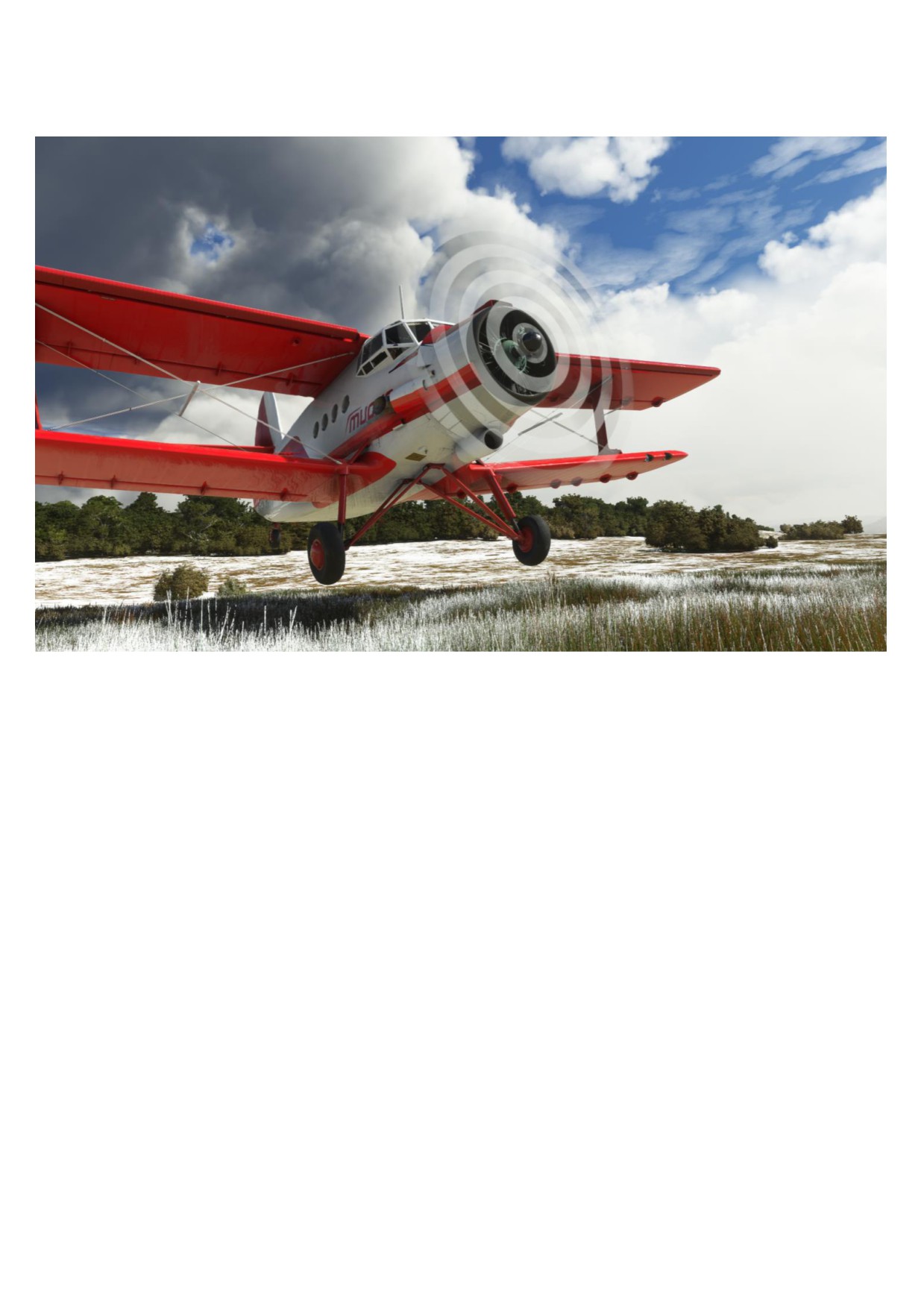
Microsoft/Asobo/ATSimulations
Antonov An-2
User Guide
Version 2
THIS USER GUIDE IS INTENDED SOLELY FOR MICROSOFT FLIGHT SIMULATOR

Antonov An-2 User Guide
TABLE OF CONTENTS
INTRODUCTION
3
SYSTEM REQUIREMENTS
4
FEATURES
4
HISTORY OF THE ANTONOV AN-2
5
SPECIFICATIONS
11
PANELS AND CONTROLS
12
MAIN PANEL
12
LEFT CONSOLE
14
ADF CONTROL PANEL
15
ENGINE CONTROLS
16
FUEL CONTROLS
17
FLIGHT CONTROLS
19
WINDOW HEAT CONTROL
20
CHECKLISTS AND PERFORMANCE
21
CONTACTS
26
Page 2 of 26

Antonov An-2 User Guide
INTRODUCTION
Welcome to the Antonov An-2 User Guide! ATSimulations, in cooperation with Microsoft
and Asobo, is happy to present the updated version of the Antonov An-2!
The An-2 is one of aviation’s most distinctive aircraft, both visually and in its place in
history. It was conceived and designed to meet a Soviet Ministry of Forestry request for a
utility aircraft. The result was one of the most widely-used airplanes in aviation history.
Due to its robust and highly-survivable design, adaptability, positive and responsive
control at slow speeds, power, and load carrying ability, it was adopted for more than
forty uses, from agriculture to military purposes. Over 18,000 An-2s were manufactured
over the course of its 45-year production run. The aircraft has operated in dozens of
countries for a broad spectrum of uses, from airline transport to military roles. Its ability
to fly low and slow, while maintaining full pilot control, helped earn it the status of aviation
legend.
This package comprises several An-2 iterations based on landing gear configuration:
wheels, skis, and floats. These virtual renditions replicate all of the An-2’s features in
exquisite detail, including exteriors and interiors
(with high-definition textures),
photorealistic and fully-functional cockpits, true-to-life audio, and realistic flight
dynamics. We worked closely with actual An-2 pilots in creating these renditions to
provide the most realistic experience for flight simulator users. Enjoy your An-2 cockpit
time!
We recommend that you invest time into learning about the An-2 and its unique
flight dynamics by reading this user guide before jumping into its cockpit and lifting into
the sky. Even if you are an experienced real-world pilot or an advanced Microsoft Flight
Simulator user, you’ll find certain concepts contained in this guide to be invaluable for
your An-2 experience.
The following sections provide information about operating the Antonov An-2,
historical facts about the airframe, flight configurations, a performance guide, and pre-
flight and post-flight checklists.
Have fun!
All base images Copyright the Microsoft Corporation except Public Domain images on Pages 6 and 7.
Page 3 of 26

Antonov An-2 User Guide
SYSTEM REQUIREMENTS
● Microsoft Flight Simulator 2020
● Available hard drive space: 3 GB
● Other: mouse, joystick, sound card, speakers/headphones, TrackIR
FEATURES
3D Models
● Accurate exterior and interior models created with 3D scan technology
● 4k textures with specular, bump, and reflection maps
● FPS friendly
Panel & Gauges
● All gauges are developed using 3D parts
● Realistic night lighting
Systems
● Fully simulated electrical system
● Partly simulated pneumatic system
● Realistic engine starting sequence
● Simulated window freezing and window heating system
Flight dynamics
● Flight dynamics were developed in close cooperation with experienced An-2 pilots
Sounds
● Engine sounds recorded from an actual An-2
● All switches, knobs and levers operate with realistic audio
Page 4 of 26

Antonov An-2 User Guide
HISTORY OF THE ANTONOV AN-2
The An-2 is a single-engine, multi-role, utility biplane developed by aerospace
engineer Oleg Antonov for agricultural and forestry purposes. It is notable for its short
take-off and landing
(STOL) capability, its versatility, ruggedness, and slow-speed
performance. Over 18,000 were manufactured over a record 45-year production run,
making it one of the most prolific of all aircraft in aviation history, and one of the most
influential. It has been used for myriad purposes, from crop dusting to military
applications. Users bestowed a number of nicknames to the An-2 over the decades,
including its most common, “Kukuruznik,” a Russian word meaning “related with corn,” a
fitting reference to its agricultural heritage͘ It also has been called “ nnushka,” (“ nnie”)͘
The NATO reporting name for the An-2 is “Colt͘”
THE AN-2: THE LEGEND’S BEGINNINGS
The An-2 traces its roots to the 1930s, when Soviet aerospace engineer Oleg
Antonov envisioned a tough, single-engine utility biplane that could serve a wide range of
civil needs. Years later, in 1946, the Soviet government gave Antonov his opportunity. The
Ministry of Forestry sought a replacement for the Polikarpov Po-2, an open-cockpit,
tandem two-seat biplane used as a general utility aircraft. The top-secret Soviet Research
and Design Bureau Number 153 (OKB-153), which would later become Antonov State
Enterprise, was established on May 31, 1946. Its first project was the biplane that Antonov
had conceptualized years earlier.
One of ntonov’s greatest influences during the engineering stage of his aircraft was
the wing design of the Fieseler Fi 156 Storch, a German military liaison airplane that was
renowned for its excellent STOL performance͘ ntonov sought to replicate the Storch’s
great slow-speed flying characteristics and its ability to operate out of austere,
unimproved airfields. The engineer’s merging of the myriad functional goals of his
prospect (including his original ideas), the guidelines set forth by the Ministry of Forestry,
and the performance of the Fi 156, would prove a great, and historically enduring, success.
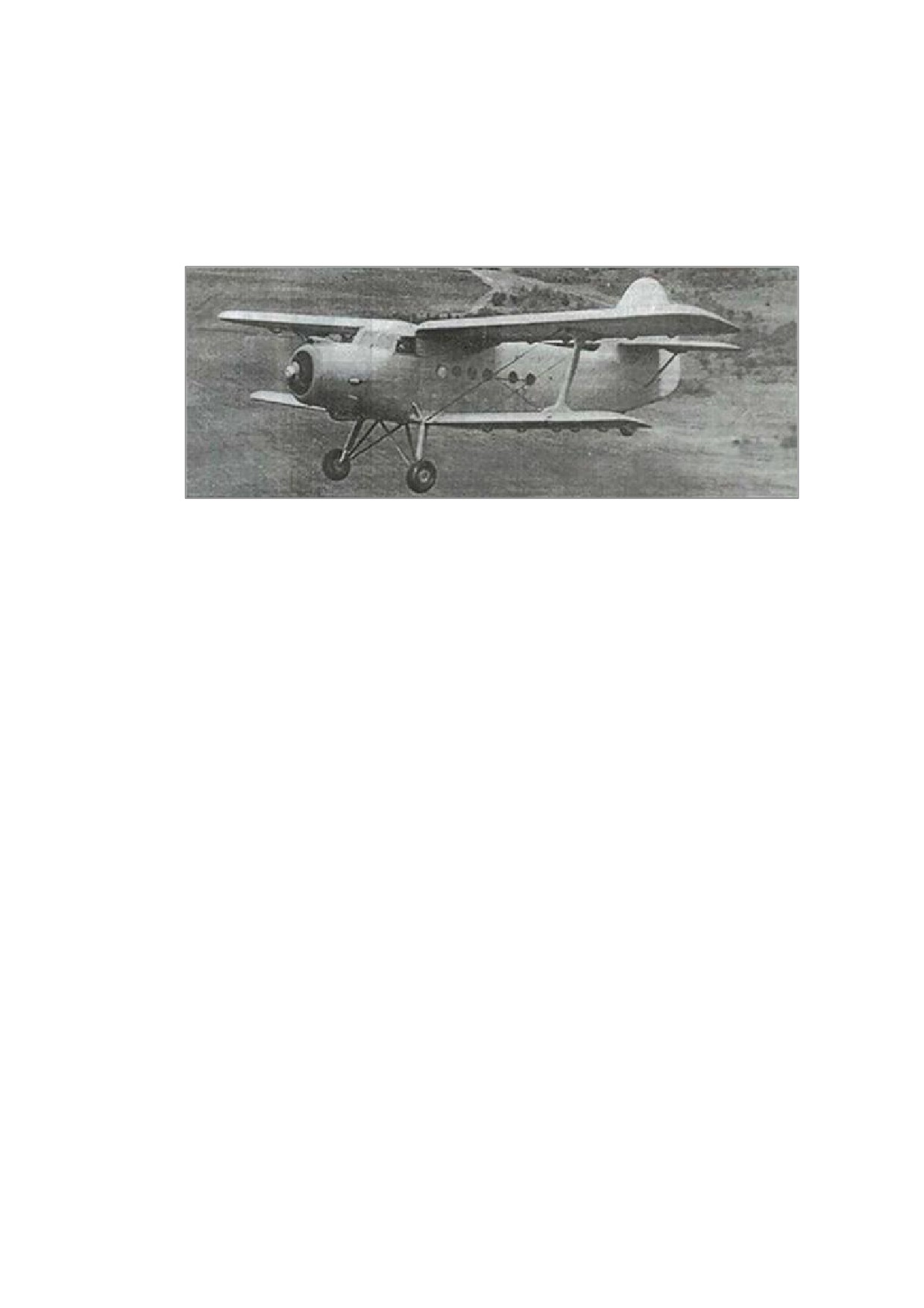
ntonov’s design was an all-metal biplane comprising an enclosed cockpit and a
cabin that could accommodate 12 seats. The first prototype, designated SKh-1, was
powered by a Shvetsov Ash-21 7-cylinder radial engine. The aircraft took its maiden flight
on August 31, 1947. The test pilot reportedly remarked after landing that the aircraft
performed flawlessly and that his only criticism was that the seat was not adjusted
Page 5 of 26
Antonov An-2 User Guide
properly for his height. The second iteration of the aircraft used a Shvetsov Ash-62 9-
cylinder radial engine, bringing the payload capability up to 4,720 pounds from 2,870
pounds. Designated the An-2, ntonov’s aircraft was ready for serial production, which
was slated to take place in Kiev, Ukraine.
In late 1952 the Soviet government halted plans for production of the An-2 at the
Kiev factory to focus on building fuselage components for the Ilyushin Il-28 bomber. Since
the order was signed by Stalin, there would be no appeal. Six months later, however, Stalin
died. An-2 production restarted in Kiev, and by 1960, 5,000 units had rolled off the
assembly line. Production was continued later in Dolgoprudniy, Russian SFSR. The majority
of An-2 production took place at Poland’s WSK factory in the city of Mielec͘ More than
13,000 units were produced by the time full production ended in 1991. Limited production
continued until 2001, with four aircraft produced for Vietnam. China has also produced
the airframe under license, which it calls the Shijiazhuang Y-5. While some sources have
claimed that East Germany produced the An-2, the country only refurbished some aircraft.
In all, more than 18,000 An-2s were manufactured between the Soviet Union, Poland, and
China.
Page 6 of 26

Antonov An-2 User Guide
THE AN-2’S OPER TION L HISTORY
The An-2 was quickly adopted throughout the
Soviet Union and other Eastern Bloc countries as soon as
it started rolling off the assembly line in Kiev. It was
initially used for agricultural purposes, notably for crop
dusting. The aircraft was also used in its early operational
days for mineral prospecting.
The spectrum of use of the An-2 broadened each year after its introduction. It
helped hunters by providing information on animal and bird habitat. It was used
extensively for aerial photography to aid hydrologic and other physical science research
work. It was used as a small airliner, transporting people, cargo, and mail. It was used to
monitor oil pipelines and electricity networks, and it was used to transport materials for
highway and other infrastructure projects.
Twenty-six countries have procured An-2s for their air forces and civil organizations.
Due to the aircraft’s versatility - notably its modifiability - excellent handling at slow
speeds, power, and forgivingness, it has seen adaptation over the decades for more than
40 specific applications. Some special applications and modifications have included:
Sampling air quality, water bombing forest fires, air ambulances, crop dusting, lightly
armed combat variants for the insertion of paratroopers, and civilian parachuting. The
most common variant is the An-2T, a 12-seat passenger version that today is very popular
among civilian parachute clubs.
Oleg Antonov stated that the aircraft itself would be its best advocate. He said: “If
they make at least 50 An-2s then a bright future will be ensured for it͘” He was correct in
his prediction, as evidenced by the more than 18,000 produced.
Why did the An-2 become so popular? What is so special about the aircraft?
When asked, Oleg ntonov noted: “I think it is due to its flight parameters first of
all: short take-off and landing distances, simplicity of piloting and operation. This machine
is undemanding to the airfields͘” He further explained that the n-2’s success and ubiquity
was due to its versatility and adaptability; that its form, power, ruggedness, and flight
profile throughout such a broad range of speeds and conditions make it uniquely qualified
to modify into a wide range of specialized aircraft.
Page 7 of 26

Antonov An-2 User Guide
From an overarching design standpoint, the success of the Antonov derives from
simplicity and reliability. This includes ensuring that all aerodynamic control surfaces are
actuated with sufficiently powerful systems. The resilient and reliable operation of the
aircraft is a function of the wing design. The An-2 incorporates automatic leading-edge
slats and flaperons that provide aircraft stability during high angle-of-attack (AoA)
maneuvers. The wing design is such that it is virtually impossible to stall the An-2 while
under power with flaps extended. The An-2 is so inherently aerodynamically stable that
even without any pilot control input, the aircraft, while powered, will recover to a
horizontal flight profile, even when placed into a flat spin.
A note from the original pilot's handbook reads: "If the engine quits in instrument
conditions or at night, the pilot should pull the control column full aft and keep the wings
level. The leading-edge slats will snap out at about 64 km/h (40 mph), and when the
airplane slows to a forward speed of about 40 km/h (25 mph), the airplane will sink at
about a parachute descent rate until the aircraft hits the ground."
The An-2 indeed has no stall speed quoted in the operating handbook. Pilots of the
An-2 say one can fly the aircraft in full control at an airspeed of just 30 miles per hour. The
An-2’s low stall speed makes it possible for the aircraft to “fly backwards,” relative to the
ground (granted it is flying into a headwind of more than about 31 or 32 miles per hour).
COMBAT SERVICE
Although it was designed originally to provide aerial support for agriculture and
forestry, the An-2’s incredible versatility soon caught the attention of military
practitioners. The An-2 has seen military use for a number of mission sets, including
logistical support (as a freighter), information operations (dropping leaflets), as an ISR
(intelligence, surveillance, and reconnaissance) data collections platform, as a light
bomber and surface attack aircraft (including maritime torpedo use), and recently as an
unmanned combat air vehicle in the role of loitering munition.
The first verifiable military use of the An-2 occurred during the Hungarian Revolution
of 1956, when the aircraft was used to drop informational leaflets and also for ISR
gathering.
An-2s were used in the war in Indochina. DRV (Democratic Republic of Vietnam) Air
Force An-2s ferried equipment, personnel, weapons, and ammunition to its allies in the
civil war in Laos.
Page 8 of 26

Antonov An-2 User Guide
During the Vietnam War, the An-2 was modified to carry torpedoes and used as a
naval interdiction platform. Its slow speed proved advantageous, as aircraft dispatched to
intercept An-2s could not engage them due to their slow flight. The STOL capability of the
An-2 proved particularly beneficial, as it could operate out of small, unimproved airfields
hacked into the jungle.
In Cambodia in 1970, government forces used the An-2 to carry supplies to troops
during operations against guerrillas. In 1979, An-2s were used in Cambodia by the Kmer
Rouge for both logistical support and as forward air controllers.
During the Croatian War of Independence in 1991, An-2s initially used as crop
dusters were converted to drop improvised bombs and as supply ships.
During the Second Nagorno-Karabakh War in 2020, the Azerbaijanis converted old
An-2s into loitering munitions by fitting them with video cameras, remote controls, and
high explosives, then flying them into enemy positions and detonating the explosives.
THE AN-2 TODAY
Since the collapse of the Soviet Union and the Eastern European communist states,
most airlines in these areas have been withdrawing their An-2s from service, as some of
these aircraft are now over 40 years old and the production dwindled. Private operators
are still using the An-2, as their stability, capaciousness, and slow-flying ability make them
very popular, notably for skydiving.
While their high noise levels, increasing maintenance costs, high fuel consumption,
and unsophisticated nature (the pre-flight checks alone take between 30 and 40 minutes)
make them obsolete for commercial service in Europe today, the large number of aircraft
available has lowered their resale value (each can be purchased for as little as $30,000).
They are ideal for the developing world, where their ability to carry large loads into short
airstrips makes them advantageous to airlines on a budget. Many ex-Aeroflot An-2s work
as regional airliners in Africa, Central and South America, Cuba, and Southeast Asia.
North Korea has a number of the aircraft using wooden propellers and canvas wings
(the Y-5 version that was license-built in China). This construction gives them a reduced
radar cross-section, and therefore a limited degree of "stealth." In a war they could
possibly be used to parachute or deliver special operations troops behind enemy lines for
sabotage operations.
Page 9 of 26

Antonov An-2 User Guide
The An-2's ability, looks, flying characteristics, and status as one of the world's
largest single-engine biplanes, has increased the demand for the An-2 in the United States
and Western Europe. The airframe is prized by collectors of classic aircraft, making them
an increasingly common sight at airshows. However, nearly all western nations
(the USA, Canada, the United Kingdom, France, etc.) prohibit the use of the An-2
commercially, despite its obvious potential as a bush plane and parachute aircraft. This is
because the aircraft has not been certified by the relevant national aviation authorities,
limiting its use.
The An-2 remains recognized as outstanding in its class and has many admirers
throughout the world. As of 2007, more than 4,000 An-2s remain in operation. Many have
been flying for more than 40 years and remain in excellent condition.
In
2012, the Ministry of Transport of the Russian Federation announced the
initiation of the An-2 Deep Modernization Program, which includes the replacement of
engines and other critical operational equipment.
Page 10 of 26

Antonov An-2 User Guide
AN-2 SPECIFICATIONS
The An-2 is a single-engine, short take-off and landing (STOL), utility biplane designed
in the Soviet Union for agricultural and forestry use. The design comprises an all-metal,
stressed-skin monocoque fuselage, an empennage consisting of metal framing and fabric
covering, and metal-framed, fabric-covered wings (with the upper wing longer than the
lower wing). The An-2 is renowned for its exceptional slow-speed and short-field
performance. This is due primarily to the wings of the aircraft, notably the full-length,
leading-edge slats and aileron-flap actuation system. The An-2 took its maiden flight on
August 31, 1947 and over 18,000 have been produced.
Dimensions
Length
12, 7 m (40 ft 8 in)
Height
5, 35 m (13 ft 2 in)
Wing span
18, 2 m (59 ft 8 in)
Wing area
71, 52 m (769.8 sq ft)
Engine
Shvetsov ASh-62 9-cylinder radial engine (which was a development of the Wright R-
1820 Cyclone) 1000 hp, displacement 30 liters.
Fuel
Total tank capacity: 317 US galls (1200 litters)
Air speeds
Max speed
258 km/h (160 mph)
Cruising speed
190 km/h (120 mph)
Stall speed
50 km/h (30 mph)
Performance
Range
845 km (525 miles)
Service ceiling 4500 m (14,750 ft)
Rate of climb
3, 5 m/sec (700 ft/min)
Take-off distance
170-490 m (560-1600 ft)
Landing distance
425 m (1400 ft)
Weight
Empty weight 3300 kg (7300 lbs)
Max take-off
5500 kg (12000 lbs
Page 11 of 26
Antonov An-2 User Guide
PANELS AND CONTROLS
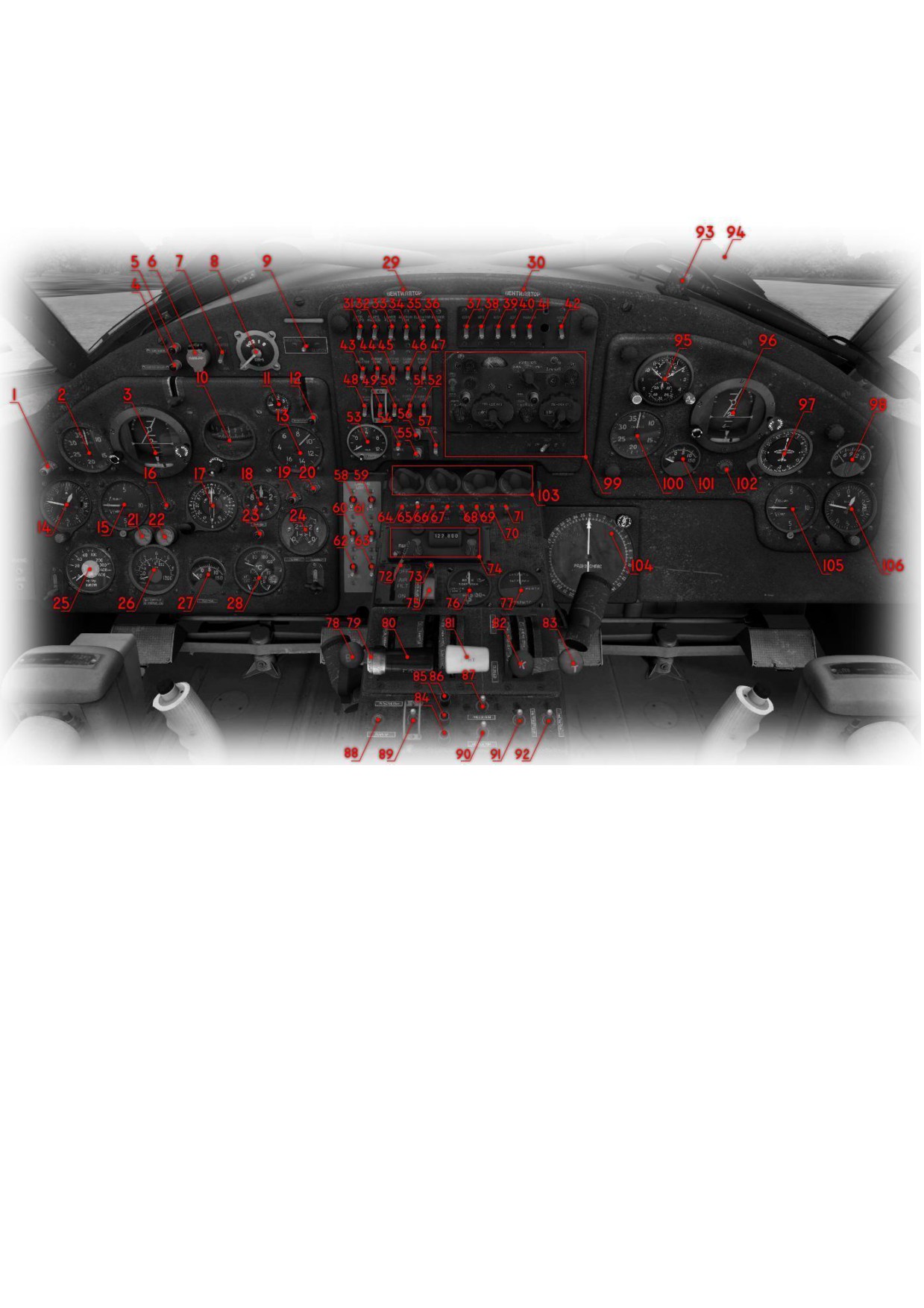
MAIN PANEL
1. Radio altimeter signal lamp
18. RPM indicator
2. Airspeed indicator
19. Chip detector signal lamp
3. Attitude indicator
20. Oil dilution signal lamp
4. Antifire system ready lamp
21. Left tank low fuel signal lamp
5. "Fire" signal lamp
22. Right tank low fuel signal lamp
6. Fire extinguisher button
23. Marker signal lamp
7. Starter circuit breaker
24. Cylinders heads temperature indicator
8. Magnetos knob
25. Radio altimeter indicator
9. Starter switch (Left click activates electric motor
26. Fuel meter indicator
to rotate flywheel. Right click - clutch flywheel
27. Carburetor temperature indicator
to engine)
28. Engine gauge (Fuel pressure, oil pressure and
10. Directional gyro
oil temperature indicators)
11. Ammeter
29. Cabin fresh air panel lever (Left)
12. Generator lamp
30. Cabin fresh air panel lever (Right)
13. Manifold pressure indicator
31. Up wing flaps circuit breaker
14. Altitude indicator
32. Flaps master circuit breaker
15. Vertical speed indicator
33. Low wing flaps circuit breaker
16. "Fast slave" button
34. Aileron trimmer circuit breaker
17. UGR compass
35. Elevator trimmer circuit breaker
Page 12 of 26

Antonov An-2 User Guide
36. Rudder trimmer circuit breaker
72. Air filter shutter lever
37. Comm radio circuit breaker
73. "Door open" signal lamp
38. GPS switch
74. COM radio
39. Intercom circuit breaker
75. Emergency flaps up switch
40. ADF circuit breaker
76. Flaps position indicator
41. Marker circuit breaker
77. Oil shutters position indicator
42. Radioaltimeter circuit breaker
78. "Altitude corrector" lever (Mixture)
43. Oil shutters circuit breaker
79. Flaps low button
44. Cowl flaps circuit breaker
80. Throttle lever
45. Antifire system circuit breaker
81. Propeller lever
46. Cabin light circuit breaker
82. Carburetor heat lever
47. Panel light circuit breaker
83. Fuel cut valve lever
48. Cockpit light circuit breaker
84. "Aileron trimmer in zero" signal lamp (+-2 deg.)
49. Pitot heat circuit breaker
85. "Elevator trimmer in zero" signal lamp (+-2 deg.)
50. UV lamps circuit breaker
86. "Rudder trimmer in zero" signal lamp (+-2 deg.)
51. Portable lamp circuit breaker (inoperable)
87. Rudder trimmer switch (left click - left, right click
52. Floor light circuit breaker (inoperable)
- right)
53. Ampervoltmeter
88. Rise flaps button
54. Power inverter switch (Left click - main. Right
89. Elevator trimmer switch (left click - low, right
click - aux)
click - up)
55. Aux power inverter signal lamp
90. Aileron trimmer switch (left click - left wing low,
56. Tail wheel lock signal lamp
right click - right wing low)
57. Tail wheel lock switch
91. Oil shutters switch
58. Left land light switch
92. Cowl flaps switch
59. Right land light switch
93. Lamp
60. Navigation lights switch
94. Window heat knob
61. Taxi light switch
95. Clock
62. Strobe lights switch
96. Attitude indicator
63. (inop) (Beacon light for airplane where it exist)
97. UGK-2 compass
64. Generator switch
98. Power inverter voltmeter
65. Battery switch
99. ADF control panel
66. Copilot's attitude indicator power switch
100. Airspeed indicator
67. Pilot's attitude indicator power switch
101. Outside temperature indicator
68. Fuel meters power switch
102. "Fast slave" button
69. Engine gauge power switch
103. UV lamps rheostats (inop)
70. Oil shutters and cowl flaps indicators power
104. ADF indicator
switch
105. Vertical speed indicator
71. Thermometers power switch
106.Altimeter indicator
Page 13 of 26
Antonov An-2 User Guide
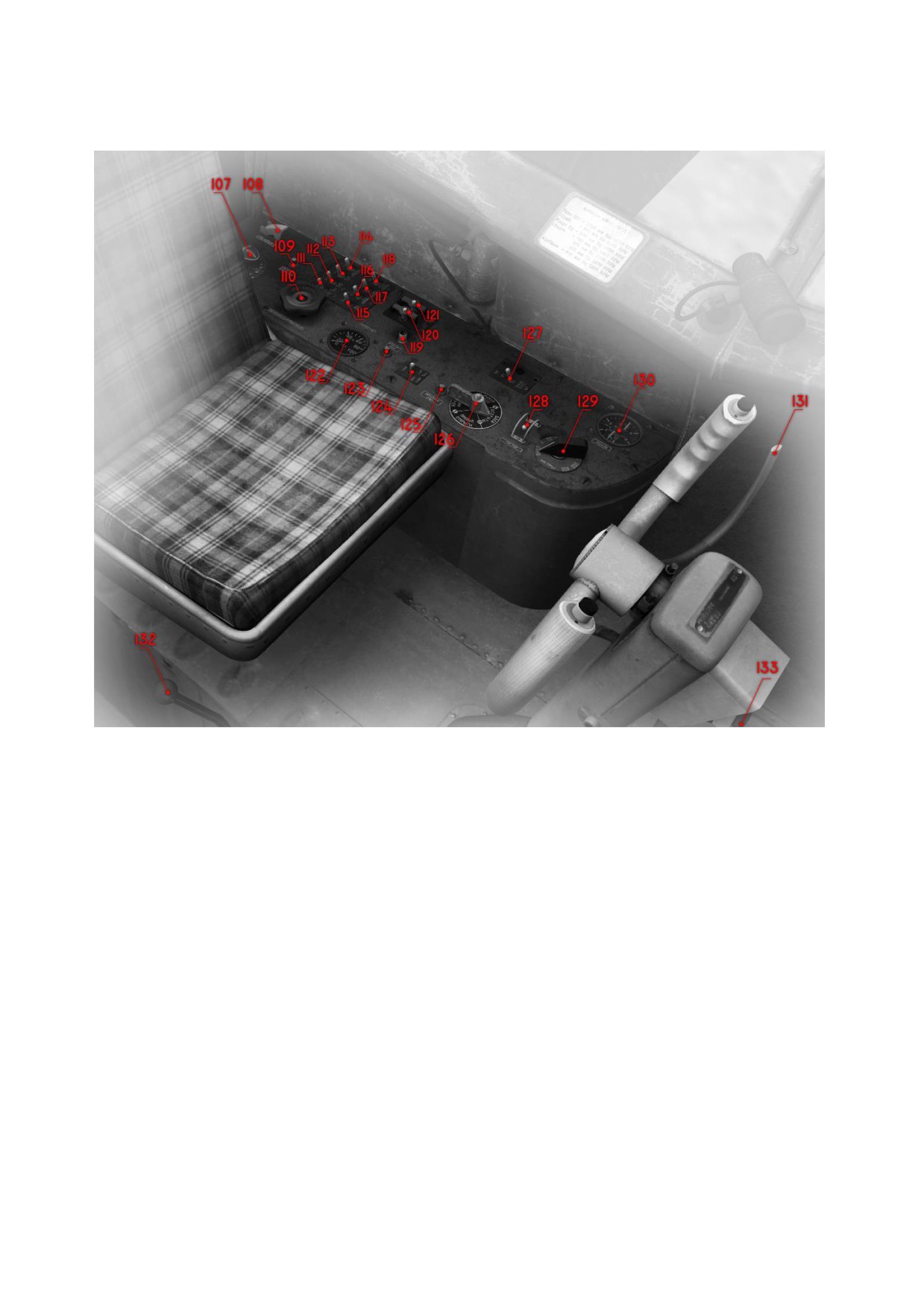
LEFT CONSOLE
107.
Engine primer lever
121.
Antifire system check switch
108.
Oil dilution system switch
122.
Air pressure indicator
109.
Low fuel sound signal switch
123.
Pitot heat check button
110.
Pneumo valve knob
124.
Fuel meter switch (left click - only left tank,
111.
Fuel low sound switch
right click - only right tank)
112.
Right wiper switch
125.
Chip detector lamp check button
113.
Left wiper switch
126.
Fuel selector
114.
Wipers circuit breaker
127.
Cockpit signal lamp switch
115.
Left fan switch
128.
Fuel pump switch
116.
Center window heat circuit breaker
129.
Radio altimeter knob
117.
Left window heat circuit breaker
130.
Wheels brakes air pressure indicator
118.
Window heat master switch
131.
Wheels brakes lever
119.
Pitot heat check lamp
132.
Manual fuel pump lever
120.
Antifire system check switch
133.
Parking brake knob
Page 14 of 26
Antonov An-2 User Guide
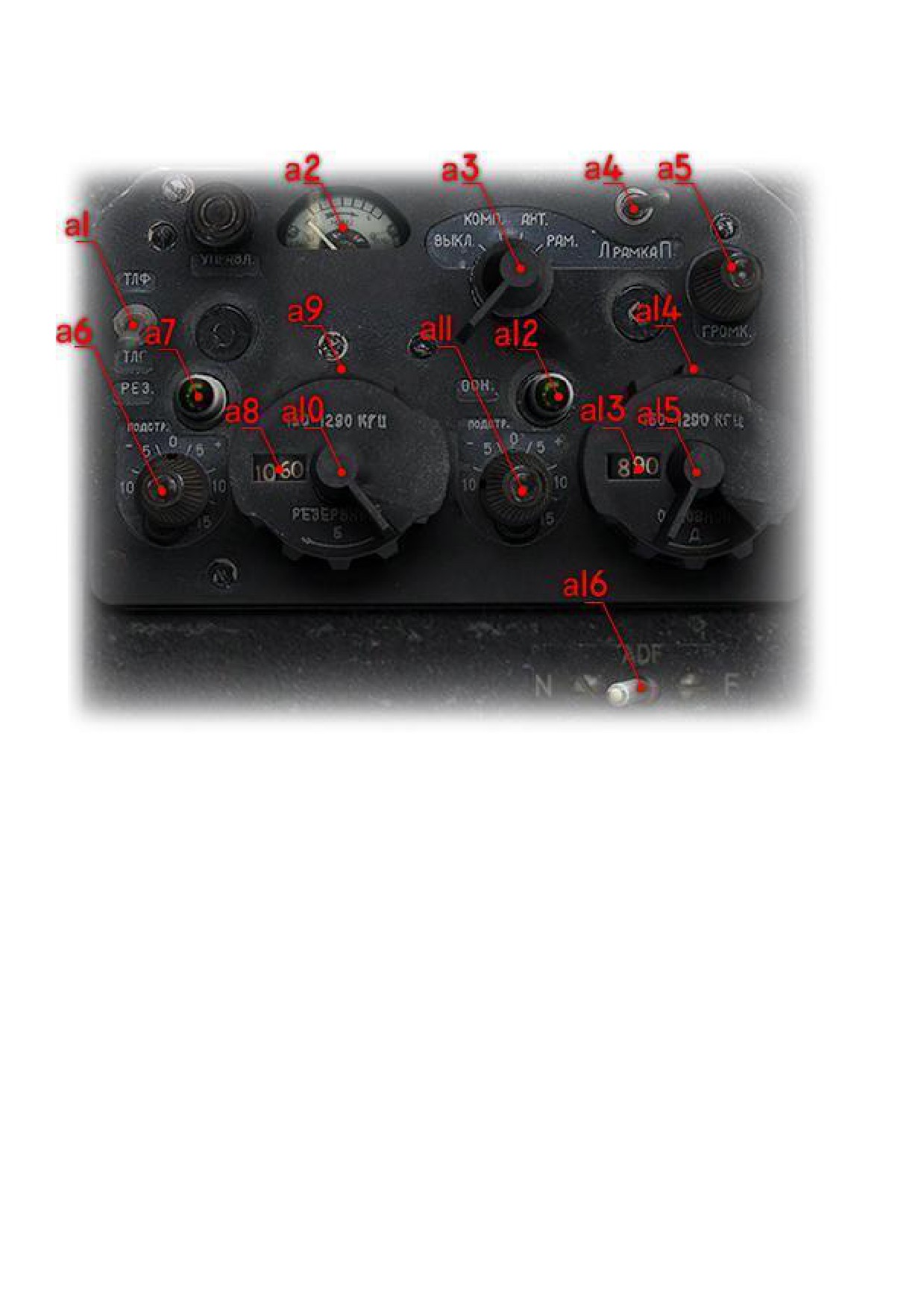
ADF CONTROL PANEL
a1. Telefone\Telegraf switch (inop)
a2. Level of signal indicator
a3. ADF mode knob
a4. Antenna switch (inop)
a5. Volume (inop)
a6͘ “Near” channel KHz knob
a7͘ “Near” channel indication lamp
a8͘ “Near” channel frequency indicator
a9͘ “Near” channel hundreds KHz knob
a10͘ “Near” channel tens KHz knob
a11͘ “Far” channel KHz knob
a12͘ “Far” channel indication lamp
a813 “Far” channel frequency indicator
a14͘ “Far” channel hundreds KHz knob
a15͘ “Far” channel tens KHz knob
a16͘ “Near” - “Far” channels switch
Page 15 of 26

Antonov An-2 User Guide
ENGINE CONTROLS
Throttle Control
The throttle is the outboard lever which is mechanically connected to the carburetor
by a flexible push-pull type cable. The full forward position of the throttle is OPEN and the
full aft position is CLOSED.
Standard shortcuts:
Cut Throttle
[F1]
Decrease Throttle
[F2 or Num Pad 3]
Increase Throttle
[F3 or Num Pad 9]
Full Throttle
[F4]
Mixture Control (Altitude Corrector)
The mixture lever enables the pilot to regulate the fuel-air mixture to the engine to
obtain efficient engine operation and maximum fuel economy at cruise. The RICH position
is full backward, full forward is IDLE CUT-OFF, and manual leaning is accomplished by
placing the lever between the RICH and IDLE CUT-OFF positions. Actually the An-2’s pilots
use altitude corrector very rare, on some airplanes it was even sealed in FULL RICH
position.
Standard shortcuts:
Set Mixture to Idle Cut-off
[CTRL+SHIFT+F1]
Lean Mixture
[CTRL+SHIFT+F2]
Enrich Mixture
[CTRL+SHIFT+F3]
Set Mixture to Rich
[CTRL+SHIFT+F4]
Magneto
The engine magneto switch controls the dual magneto system.
There are four switch positions, designated counterclockwise as
follows: BOTH, L, R and OFF. The engine is started and operated with
the switch in the BOTH position. The L and R positions are for
confirmation purposes only.
Page 16 of 26
Antonov An-2 User Guide
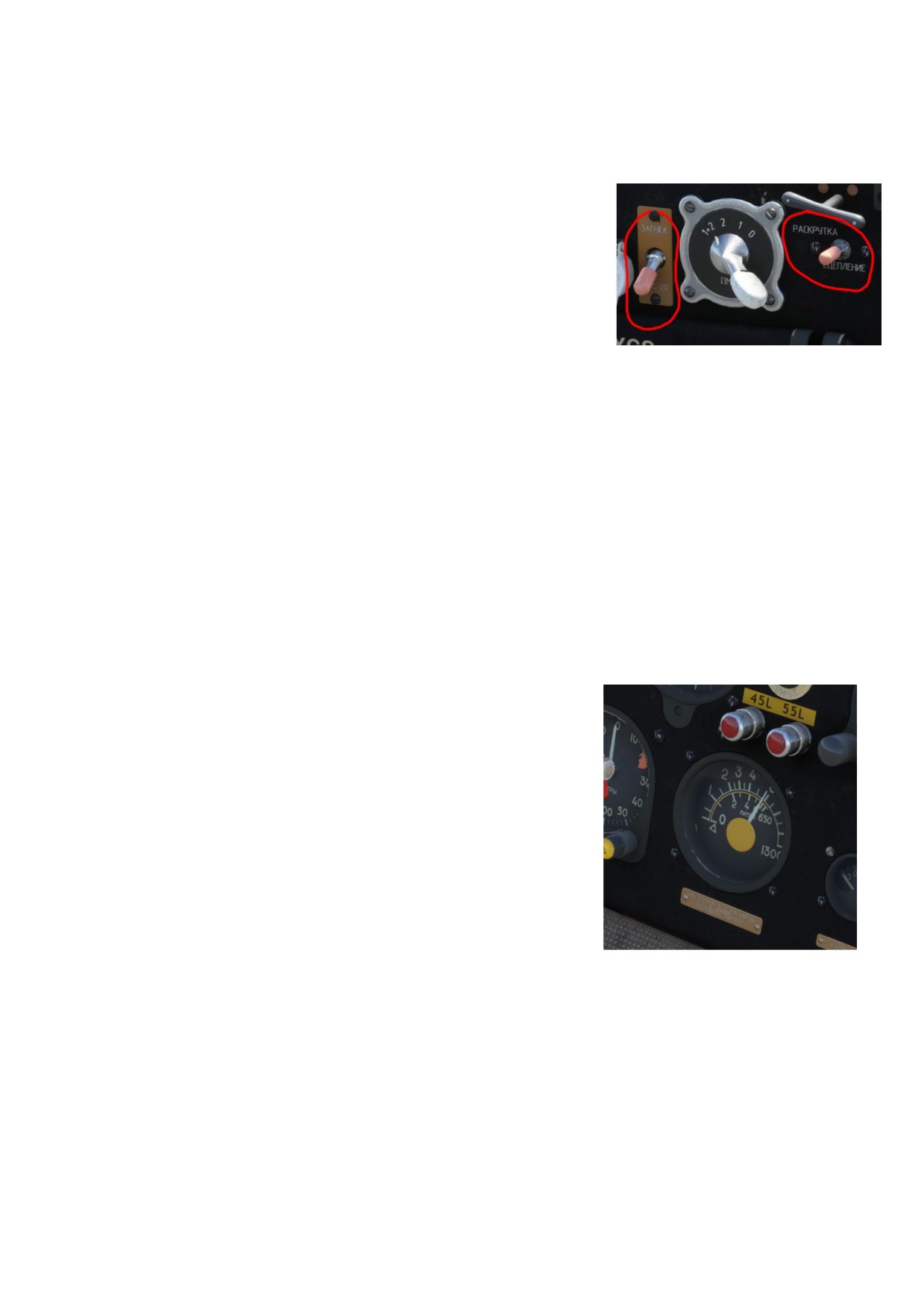
Starter
The starter circuit breaker (7) provides power to the
starter control switch (9). Starter switch has three positions:
left
(left click)
- provides power to electric motor which
rotates the flywheel; neutral
(right click from the left,
automatically from the right) - power off; right (right click
from neutral) - activates clutch which connects flywheel to
the engine’s crankshaft.
FUEL CONTROLS
Fuel Supply System
Fuel is supplied to the engine from two equally-sized fuel tanks located in the upper
wing. From these tanks, fuel flows through a fuel selector valve, a manual fuel pump, a
boost pump, a fuel strainer, and an engine-driven fuel pump to the carburetor.
Fuel Quantity Indicator
A direct reading, electrically actuated fuel quantity
indicator is mounted in the main pilot’s panel (26)͘ Indicator
shows whole, left tank or right tank fuel quantity. The mode
is chosen by a three-position switch (124). Additionally, the
aircraft has a low fuel signal lamp for each of the two tanks
to indicate when fuel level is less than 50 liters (21 and 22).
Note: To use fuel quantity indicator, the battery and
circuit breaker (68) must be ON.
Page 17 of 26
Antonov An-2 User Guide
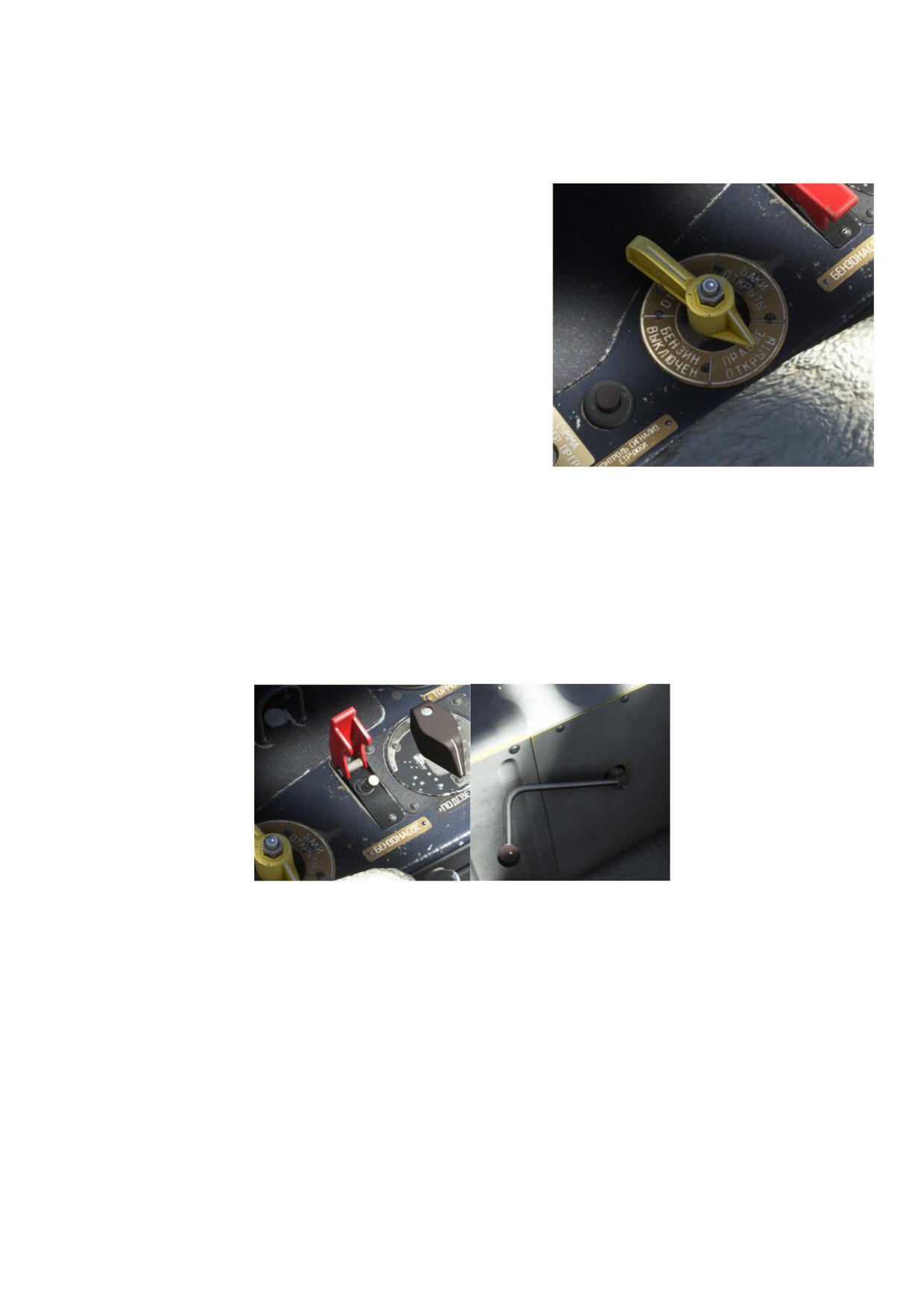
Fuel Selector Valve
A rotary type fuel-tank selector-valve handle is
incorporated in the fuel system. The fuel-tank
selector-valve handle, which controls the fuel selector
valve through mechanical linkage, has four positions:
LEFT TANK, RIGHT TANK, BOTH TANKS and FUEL OFF.
The RIGHT TANK, LEFT TANK and BOTH TANKS
positions allow fuel to flow from the appropriate
tank(s) to the engine. The FUEL OFF position seals
both tanks from the other components of the fuel
system and inhibits fuel from flowing beyond the
selector valve. The fuel selector rotates clockwise with
left click and anticlockwise with right click.
Fuel Boost Pumps
An-2 has two fuel pumps, manual and electric. The manual pump is operated by a
lever (132). The electric pump is controlled by an ON/OFF switch located on the right-
hand side of the instrument panel.
Page 18 of 26
Antonov An-2 User Guide
FLIGHT CONTROLS
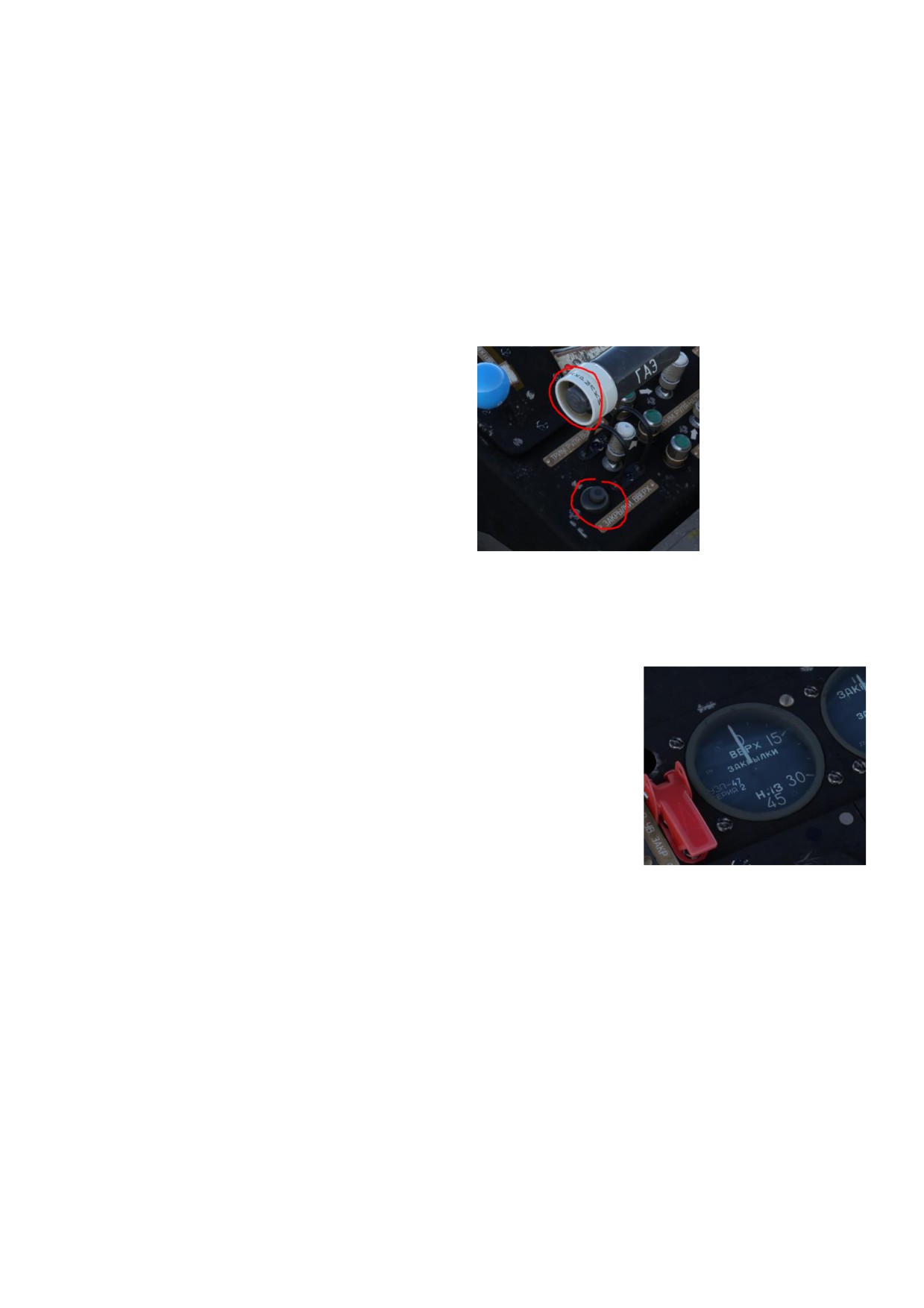
Wing Flaps
Wing-flap buttons (79 and 88) control the flaps. To lower the flaps, use button on the
throttle lever side (79). To raise the flaps, use button on the lower left corner of the
pedestal.
Note: to operate flaps motors, battery and circuit breakers 31-33 must be ON.
Standard Shortcuts:
Retract Flaps (fully)
[F5]
Retract Flaps (in increments)
[F6]
Extend Flaps (in increments)
[F7]
Extend Flaps (fully)
[F8]
Wing Flap Indicator
The position of the flaps can be determined by looking at
the flaps position indicator (76). There are indication marks at 0,
15, 30, 45 and flaps can be selected at these settings or any
setting in between.
Note: to use flaps position indicator battery and circuit
breaker 70 must be ON.
Page 19 of 26

Antonov An-2 User Guide
Trim Tabs
An-2 has electrical controlled trim tabs for all three control axes. Each trim motor is
connected to a three-position control tumbler (87, 89, 90). To indicate neutral tabs
positions the airplane has control lamp for each axe (84, 85, 86).
Note: to operate trim motors battery and circuit breakers 34-36 must be ON.
Standard Shortcuts:
Elevator Trim Down
[Num Pad 7]
Elevator Trim Up
[Num Pad 1]
Aileron Trim Left Wing Low
[Num Pad 4]
Aileron Trim Left Wing Up
[Num Pad 6]
Rudder Trim Left
[Num Pad 0]
Rudder Trim Right
[Num Pad Enter]
WINDOW HEAT CONTROL
Flying in cold weather conditions
can cause window freezing. To counter
the visual obscuration this causes, use
window heat (tumblers 116-118) and
cabin ventilation knobs
(on the floor
between pilots). Window icing depends
on the temperature difference between
aircraft interior and exterior. To control
temperature inside the cockpit you use
the thermometer directly behind left-
side pilot head. Check the outside
temperature or set it up manually.
Page 20 of 26

Antonov An-2 User Guide
CHECKLISTS AND PERFORMANCE
Antonov An-2
PRE-START PROCEDURES AND CHECKS
Control lock
REMOVED & STOWED
Parking brake
SET
Log book, flight doc. & legal forms
On board
All switches
OFF
Magneto switch
OFF
Windows
CLEAN
Propeller
CLEAN
Engine cowling latches
ALL CLOSED & LOCKED
Oil cooler
CLEAN
Dust filter
Check position
Tires condition & pressure (40 PSI)
CHECK
Left & right wings
no defects, no gasoline leaks
Pitot cover
REMOVED
Navigation & landing lights glasses
CLEAN
Side fuselage
no cracks, no deformations
INTERIOR CHECK - NIGHT FLIGHTS
Battery
ON
Interior/external lights
all ON - check for serviceability
BEFORE STARTING
Oil collector can
REMOVED & STOWED
Doorstep
REMOVED & STOWED
Emergency manhole
CLOSED & SECURED
Magneto
OFF
Flight controls
Freedom of movement
Air system charging valve
OPEN
Air pressure
CHECK > 30
Parking brake
SET
Brake pressure system
CHECK > 6
Bus voltage
24V
Battery switch
ON
Fuel tank meter switch
ON
Engine unit gages switch
ON
Flap position & oil shutters indicators switch
ON
Oil cooler shutters power switch
ON
Anti-fire system power switch
ON
Page 21 of 26

Antonov An-2 User Guide
Left & Right fuel gages
ON
Oil coolers shutters & cowl flaps
ON
Trim tabs
Neutral
Fuel selector valve
BOTH
Fire Extinguisher
CHECK
"Chip Monitoring" button
Press to test
STARTING ENGINE WHEN HOT
Propeller control
FORWARD (Low Pitch)
Mixture control
BACKWARD (Full Rich)
Fuel master valve
OPEN = FORWARD
Carburetor heater
OFF
Oil cooler shutter
CLOSED
Cowl flaps
CLOSED
Fuel pressure (with manual pump)
0.25
- 0.35
Primer pump to cylinders
6 injections
MAKE SURE PROP. AREA IS
CLEAR
Magneto switch
OFF
"Starting sequence" switch
ON
Starter
ON - Until 8 ON AMPMETER - Then
toggle the switch to interconnect engine shaft
Magneto switch
BOTH 1+2
AFTER START
Fuel pressure with manual pump
0.25
- 0.35
Throttle (when engine runs smoothly)
700 - 800 RPM
Check oil pressure
Normal > 3
"Starting sequence" switch
OFF
Generator
ON
A/C Converter
ON
Primer pump lever
LOCKED
BEFORE TAXI
Pax & cargo doors
CLOSED & LOCKED
All necessary switches
ON
Flaps upper & lower
Operative
Engine control lever positions
Correct
Indications of engine gages
Normal "All in the green"
Fuel quantity in each tank
CHECK
A/C Converter
Operative
Artificial horizon, course ind.
Page 22 of 26

Antonov An-2 User Guide
& gyro compass" switches
ON
Gyro instruments
SLAVED
Navigation instruments
CHECKED & SET
Air pressure in pneumatic system
> 40
Wheel chocks
CHECK & REMOVED
Tail wheel
UNLOCKED
TAXI
Lights
As required
If snow or OAT (< 0°) pitot heat
ON
keep mixture T° > 8° with carburetor heater
ON
All necessary switches
ON
Brakes
CHECK
In turns, gyro indications
CORRECT
BEFORE TAKE-OFF
Voltage & Load meter
CHECK
Navigation instruments & Com's
Confirm SET
Carburetor heater
OFF
Mixture
FULL RICH
Fuel selector valve
BOTH
Altimeters
SET
Gyro compass
SLAVED & SET TO RUNWAY HEADING
Set trim tabs:
Elevator
DOWN: If heavy for 10°; if not 3 - 5°
Rudder
RIGHT for 3°
Flaps
set for take-off (usually 15°)
Artificial horizon
CHECK normal indication
Engine gages
normal indications: "all in the green"
Cowl flaps & Oil cooler shutters
OPEN
Lights
AS REQUIRED
Take-off time
Recorded
Parking brake
Released
TAKE-OFF
1. Without flaps:
Engine parameters
9 / 2100
Speed up to
140 Km/h 75 Kts
1. With flaps (wind <20 Kts): reduces take off distance by 35%
If 15°: engine
9 / 2100
If 25°: engine
9 / 2100
Page 23 of 26

Antonov An-2 User Guide
If 30°: engine (max weight)
10.5 / 2200
Rotation speed
85 - 90 Km/h 48 Kts
Sped up to
120 Km/h 65 Kts
Flaps over 150 Ft
gradually drawn-in
Full drawing of flaps at
140 Km/h 75 Kts
CLIMB
Establish initially
9 / 2050 (9 / 2100 if urgent)
When altitude > 150 Ft
8.5 / 1850
Speed
140 - 150 Km/h
Oil T° < 70°
CHECK
CHT < 215°
CHECK
Lights
Considered
CRUISE
Oil T° 60° - 75°
CHECK
CHT: 120° - 215° (recommended: 150° - 215°)
CHECK
Oil Pressure 4 - 5
CHECK
Fuel Pressure 0.25 - 0.35
CHECK
Compressor pressure 45 - 50
CHECK
Voltages > 28.5 V & > 75 V
CHECK
Flaps
0°
DESCENT
Establish
5.2 / 1500 (= 180 Km/h 97 Kts)
Maximum speed for descent:
Quiet air
220 Km/h 119 Kts
Turbulent air
190 Km/h 102 Kts
Maintain
CHT > 120° & Oil T° > 50°
Carburetor heater if OAT < -15°
ON
Fuel selector
BOTH
Parking break
CONFIRM OFF & PRESSURE IN BRAKES "0"
Air pressure > 40
CHECK
Flaps
AS REQURED
FINAL CHECK
Throttle
< 5
Propeller
FULL PITCH
Speed
< 140 Km/h 75 Kts
Flaps
CHOOSE SETTING (usually 15°)
Landing lights
ON
Page 24 of 26

Antonov An-2 User Guide
Tail wheel locking
CONSIDERED
FINAL CHECK
Tail wheel
UNLOCKED
Landing lights
OFF
Taxi light
CONSIDERED
Pitot heat
OFF
Flaps
0°
Cowl flaps & Oil cooler shutters
OPEN
COOLING DOWN & SHUT DOWN
Avionics switches
OFF
Throttle
700 - 800 RPM
Cowl flaps & Oil cooler shutters
OPEN
Let CHT cool down
< 120°
Electrical switches & radios
OFF
For a few seconds: throttle
1700 RPM, then 800 RPM
Fuel master valve
CLOSED
Throttle
OFF
Cowl flaps & Oil cooler shutters if T° < 100
CLOSED
Air system charging valve
CLOSED
Controls & ailerons
LOCKED
Oil & Air system purges
DONE
EMERGENCY PROCEDURES: ENGINE FIRE
Fuel master valve
CLOSED
Fuel selector
CLOSED
Magnetos & Converter
OFF
Cowl flaps
CLOSED
"FIRE" Button
PRESSED
Page 25 of 26

Antonov An-2 User Guide
CONTACTS
If you have any questions, comments, suggestions, or need any additional information
concerning the Antonov An-2 add-on, please email: info@atsimulations.com
For further support, email: support@atsimulations.com
Website: https://www.atsimulations.com/
Facebook: https://www.facebook.com/ATSimulations/
Instagram: https://www.instagram.com/ATSimulations/
All rights reserved
Page 26 of 26