Fokker F.VII. Manual for Microsoft Flight Simulator

Table of Contents
PHOTOSENSITIVE SEIZURE WARNING
2
DISCLAIMER
2
INTRODUCTION
2
HISTORY
2
THE SOUTHERN CROSS
2
FRIENDSHIP
6
JOSEPHINE FORD
7
SPECIFICATIONS
8
AIRCRAFT OPERATION
9
VARIANTS
9
FLIGHTDECK DIAGRAMS
9
OPERATIONAL LIMITATIONS
28
STARTUP
30
TAXIING
30
TAKE OFF
30
CLIMB
31
CRUISE
31
DECENT
31
CIRCUIT APPROACH AND LANDING
31
CREDITS
33
QUICK REFERENCE CARDS
34
Fokker F.VII
1

Photosensitive seizure
warning
A very small percentage of people may experience a seizure when exposed to certain visual
images, including flashing lights or patterns that may appear in video games. Even people who
have no history of seizures or epilepsy may have an undiagnosed condition that can cause
these “photosensitive epileptic seizures” while playing video games.
Immediately stop playing and consult a doctor if you experience any symptoms.
These seizures may have a variety of symptoms, including lightheadedness, altered vision, eye
or face twitching, jerking, or shaking of arms or legs, disorientation, confusion, or momentary
loss of awareness. Seizures may also cause loss of consciousness or convulsions that can lead
to injury from falling down or striking nearby objects.
Parents should watch for or ask their children about the above symptoms. Children and
teenagers are more likely than adults to experience these seizures.
You may reduce risk of photosensitive epileptic seizures by taking the following precautions:
• Play in a well-lit room.
• Do not play if you are drowsy or fatigued.
If you or any of your relatives have a history of seizures or epilepsy, consult a doctor before
playing video games.
Disclaimer
This flight manual is for the sole purpose of flying the Fokker F.VII within Microsoft Flight
Simulator.
The content of this manual should not be relied upon in any way to fly real aircraft and Orbx take
no responsibility for actions arising from using the content in the real world.
Fokker F.VII
2

Introduction
Fokker F.VII
History
The F.VII was designed as a single-engine transport aircraft by Walter Rethel. Five examples of this model
were built for the Dutch airline KLM. One of these aircraft, registered H-NACC, was used in 1924 for the first
flight from the Netherlands to the Dutch East Indies. In 1925, while living in the US, Anthony Fokker heard of
the inaugural Ford Reliability Tour, which was proposed as a competition for transport aircraft. Fokker had the
company's head designer, Reinhold Platz, convert a single-engine F. VIIa airliner to a trimotor configuration,
powered by 200 hp Wright Whirlwind radial engines. The resulting aircraft was designated the Fokker F.
VIIa/3m. Following shipment to the US, it won the Ford Reliability Tour in late 1925. The Trimotor's structure
consisted of a fabric-covered steel-tube fuselage and a plywood-skinned wooden wing.
The Fokker F. VIIb/3m had a slightly increased wing area over the F. VIIa/3m, with power increased to 220 hp
per engine, while the F.10 was slightly enlarged, carrying 12 passengers in an enclosed cabin. The aircraft
became popularly known as the Fokker Trimotor.
“The Southern Cross”
The Southern Cross began life as the Detroiter, a polar exploration aircraft of the Detroit News-Wilkins Arctic
expedition. The aircraft had crashed in Alaska in 1926 and was recovered and repaired by the Australian
expedition leader, Hubert Wilkins. Wilkins, who had decided the Fokker was too large for his Arctic
explorations, met with Kingsford
Smith and Charles Ulm in San
Francisco and arranged to sell them
the aircraft, without engines or
instruments.
Having fitted the aircraft with
engines and other required parts,
Kingsford Smith made two attempts
at the world endurance record in an
attempt to raise funds and interest
for his trans-Pacific flight. However,
Fokker F.VII
3

after the New South Wales government withdrew its sponsorship of the flight, it looked as if the money would
run out and Kingsford Smith would have to sell The Southern Cross. The aircraft was bought by
American aviator and philanthropist Allan Hancock, who then loaned it back to Kingsford Smith and Ulm. The
three Wright Whirlwind engines were funded by Melbourne businessman Sidney Myer.
On 31 May 1928, the crew—Charles Kingsford Smith, Charles Ulm, and Americans Harry Lyon (navigator)
and James Warner (radio operator)—took off from Oakland, California, United States. The Southern
Cross stopped for rest and refuelling in Hawaii before setting off for Fiji. This leg of the journey
took 34+1⁄2 hours of flight across open seas before gliding past the Grand Pacific Hotel in Suva, where a large
and enthusiastic crowd saw the first aircraft to land in Fiji touch down at Albert Park. She then landed at Eagle
Farm Airport in Brisbane, Queensland, Australia, on 9 June, where a crowd of 25,000 people were waiting to
greet her on its arrival at the airport.
The aircraft was in constant radio communication with ships and shore during the flight using four transmitters
and three receivers powered by a ram air turbine attached to the fuselage below the cockpit. The first paid
commercial messages were sent and received during the flight and a new world record distance for radio was
set with a short-wave reception at Bloemfontein, South Africa, the long way around the world at 12,800 miles
(20,600 km). Direct short-wave aircraft-to-shore communications were maintained with the Pacific Coast until
the flight was four hours out of Honolulu which had been monitoring the flight from two hours after departure
with a similar reception overlap on the Honolulu to Suva leg.
Success on this flight
influenced Admiral
Byrd to equip his three
Antarctic Expedition
aircraft with similar
equipment.
Shortly before
Kingsford Smith's
death in 1935, he sold
The Southern Cross to
the Commonwealth of
Australia, for display in
a museum. The aircraft
was brought out of
retirement briefly in
1945 for the filming of
the movie Smithy. She
was refurbished in
1985 under the supervision of Jim Schofield, a senior aviation civil servant and air crash investigator.
The Southern Cross is now preserved in a special glass hangar memorial on Airport Drive, near the
international terminal at Brisbane Airport.
Fokker F.VII
4

A full-sized flying reproduction of The Southern Cross was built in South Australia between 1980 and 1987
and is the largest known reproduction aircraft in the world. Sergeant Anthony Lohrey of the Royal Australian
Air Force, Aircraft Research and Development Unit (ARDU) oversaw its construction.
On 25 May 2002 at Parafield South Australia she lost a main wheel on take-off. The replica was landed on the
one good wheel and the tailskid with the pilot keeping the damaged undercarriage off the ground by keeping
the wing high in the air. When the aircraft stopped the wing came down and snapped off ~3 m of the wing tip.
After considerable negotiation the Historical Aircraft Restoration Society (HARS) acquired the aircraft from the
SA Government in 2010, and the aircraft was transported to HARS facility at Illawarra Regional Airport, Albion
Park, New South Wales. The replica aircraft is being restored to full airworthy status by HARS volunteers and
recently ran taxi-out and back tests at the airfield facility.
We thank the HARS volunteers for assisting us with the production of The Southern Cross for Microsoft Flight
Simulator.
Fokker F.VII
5

“Friendship”
Though Friendship was equipped with aluminium pontoons for water takeoffs and landings, it was otherwise
the same type as Southern Cross.
She was the fourth aircraft to be produced in the series and her first flight was on February 16 1928.
On June 17/18 1928 she carried out a trans-Atlantic flight with Amelia Earheart as a passenger who would be
the first woman to cross the Atlantic Ocean. She was accompanied by pilot Wilmer Lower Stultz and
mechanic Louis Edward Gordon.
They departed from Trepassey Harbor, Newfoundland, and arrived at Burry Port (near Llanelli), Wales, United
Kingdom on the southwest coast of Wales, 20 hours, 40 minutes later.
Fokker F.VII
6

“Josephine Ford”
Josephine Ford is the first Fokker F.VIIa/3m monoplane. It was built by Anton H.G. Fokker’s N.V. Koninklijke
Nederlandse Vliegtuigenfabriek Fokker at Veere, Netherlands in 1925, and made its first flight at Schipol, 4 September
1925
The Josephine Ford was purchased for the Byrd Arctic Expedition by Edsel Ford and named Josephine Ford in honor of
his 3-year-old daughter, Josephine Clay Ford.
On May 9, 1926 with Chief Bennett as the expedition’s pilot and Lieutenant Commander Richard Byrd navigating they
departed Spitzbergen in the Svalbard Archipelago, Norway, on a round-trip flight to the North Pole. They flew
approximately 840 miles (1,350 kilometers) to the Pole and returned the same day. The total duration of the flight was 15
hours, 44 minutes.
For this accomplishment, Lieutenant Commander Byrd was promoted to Commander, and Chief Bennett to Warrant
Officer. Both aviators were awarded the Medal of Honor by President Coolidge.
The discovery in 1996 of a diary that Byrd had kept of his famous flight seems to suggest that he and Bennett may have
turned back 150 miles short of the pole because of an oil leak in the aircraft. The diary also contained erased (but still
legible) sextant readings that sharply differ with a later typewritten official report on June 22nd to the National Geographic
Society.
To this day, Richard Byrd’s expedition to the North Pole is still a disputed achievement.
Fokker F.VII
7
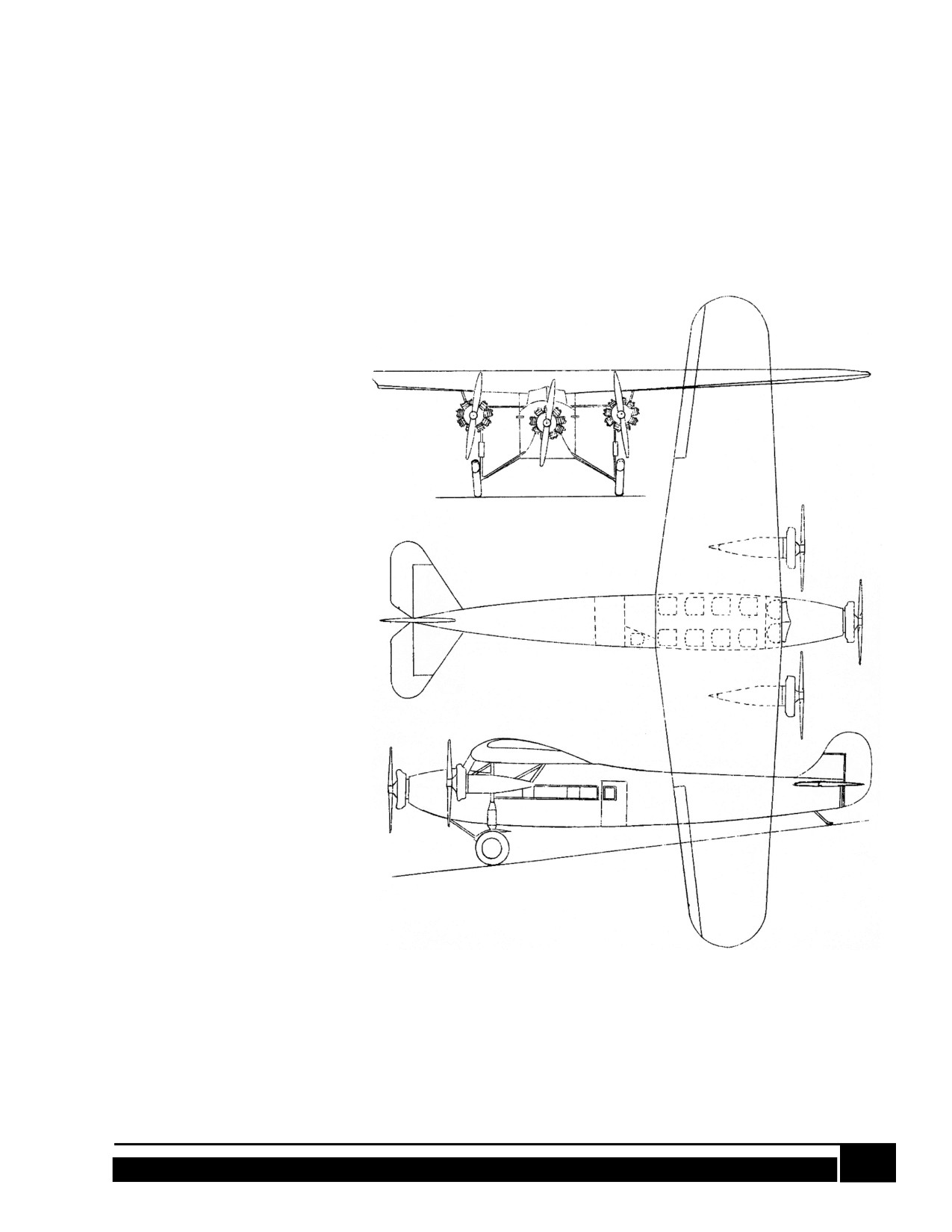
Specifications F.VII/3m
• CREW: 2
• CAPACITY: 8 PASSENGERS
• LENGTH: 14,5M
• WINGSPAN: 21,71M
• EMPTY WEIGHT: 3,100KG
(6,834LB)
• GROSS WEIGHT: 5,300KG
(11,684 LB)
• POWERPLANT: 3 X WRIGHT J-5
WHIRLWIND, 9 CYLINDERS AND
300HP EACH
PERFORMANCE
• MAXIMUM SPEED: 109KN
(210KM/H)
• CRUISE SPEED: 96KN
(178KM/H)
• RANGE: 650NM (1,200KM)
• SERVICE CEILING: 14,400FT
(4,400M)
Fokker F.VII
8
Aircraft Operation
Variants
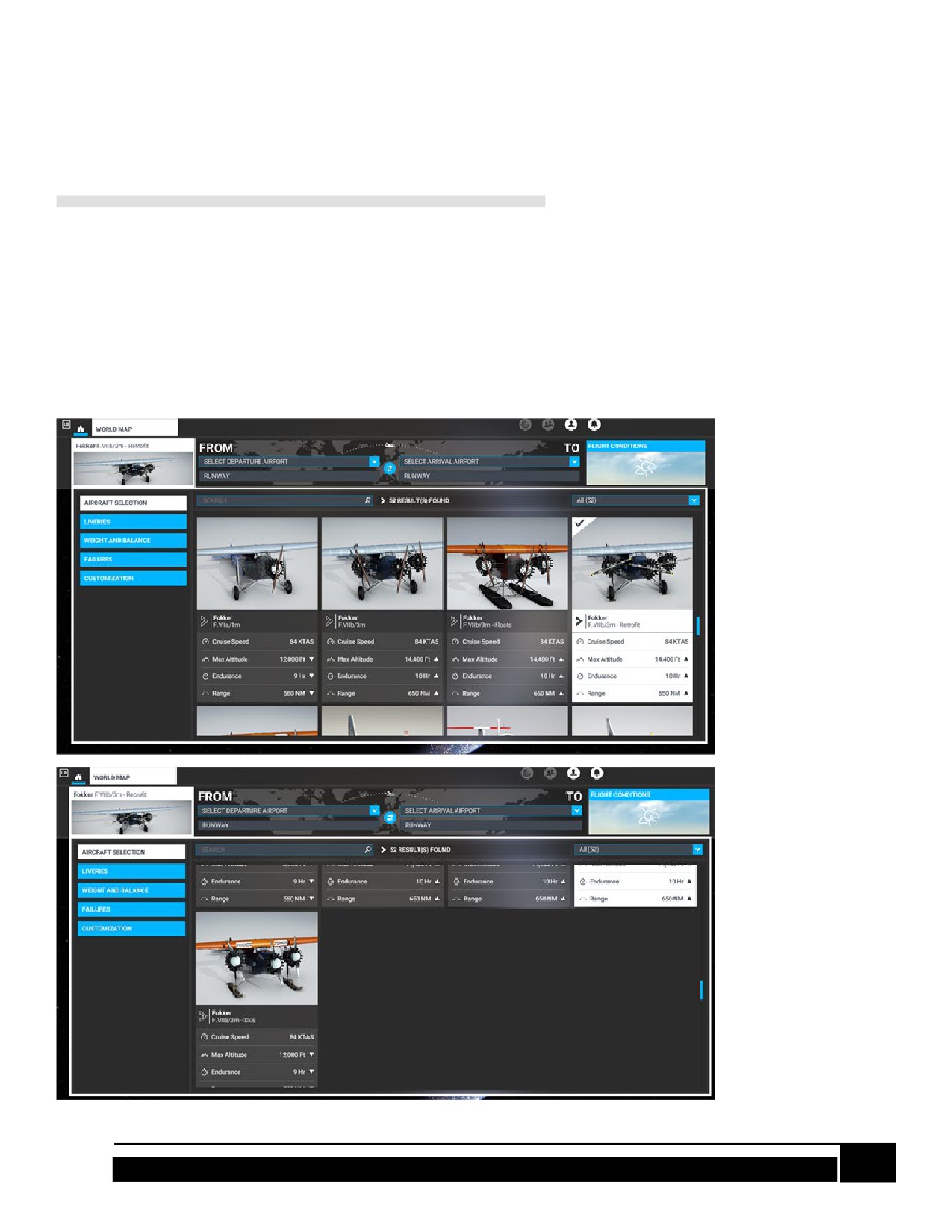
There are 5 main variants within the package; the F.VIIa/1m single engine transport, the F.VIIb/3m “Southern Cross” with
original cockpit, the F.VIIb/3m - Floats “Friendship”, the F.VIIb/3m - Retrofit which contains the “Southern Cross” and
transport variants with modern day cockpit and the F.VIIa/3m - Skis “Josephine Ford”.
Go to World Map, Aircraft Selection and look for the Fokker variants listed.
Fokker F.VII
9
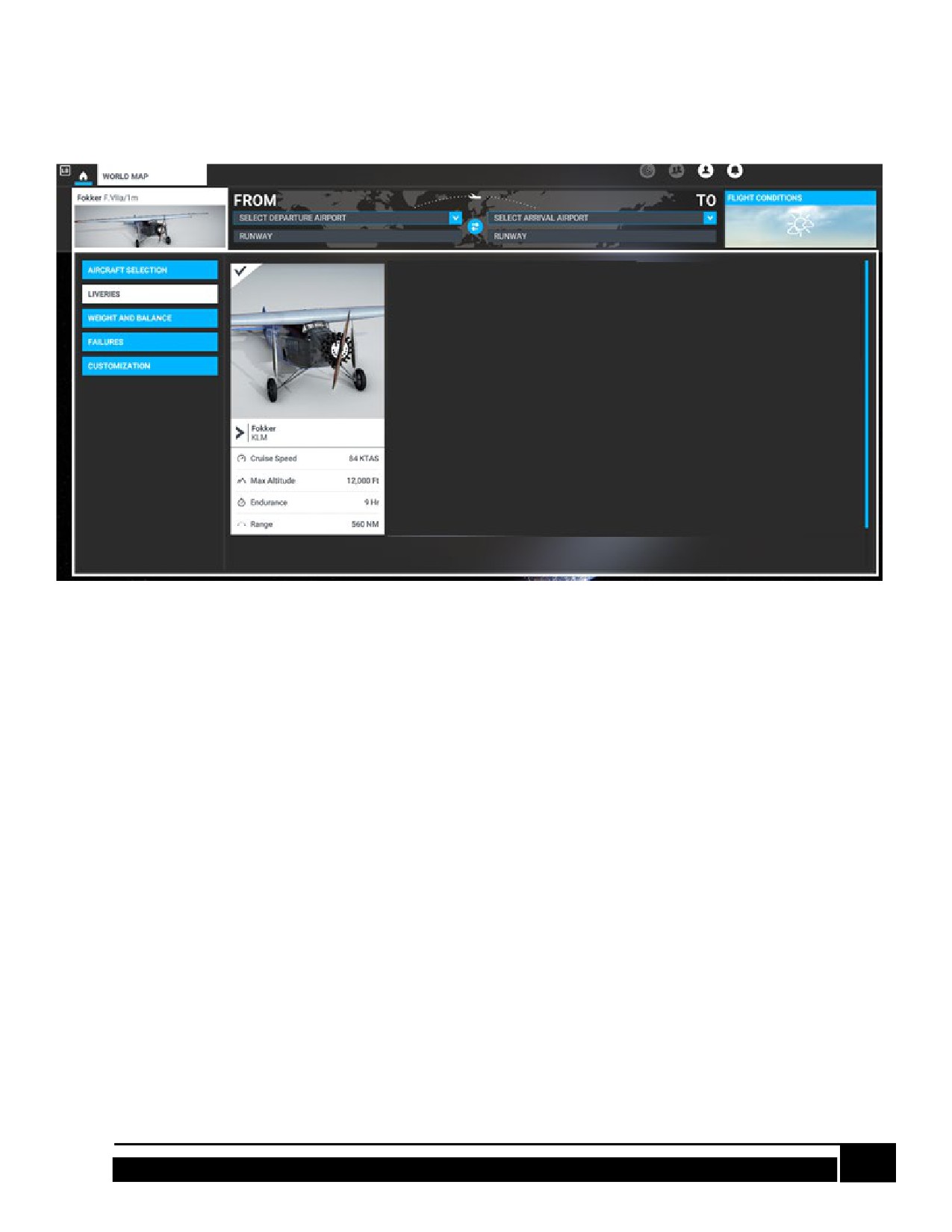
Once you have selected your aircraft, open the Liveries tab and you will see the different liveries associated
with each aircraft.
Fokker F.VII
10
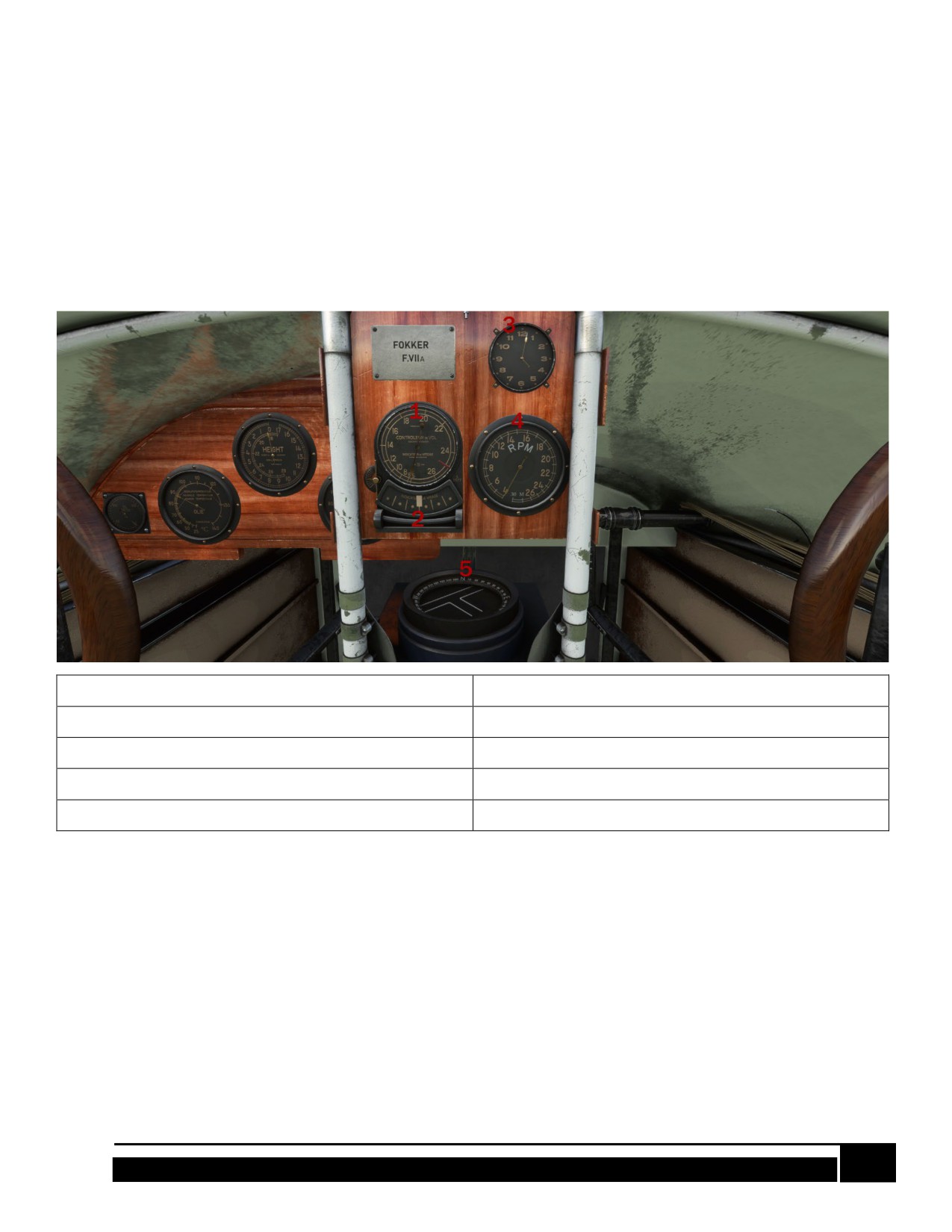
Flightdeck
F.VIIa/1m
Centre Instruments
1
Air Speed (KMPH)
2
Turn Indicator
3
Chronometer
4
RPM
5
Magnetic Compass
Fokker F.VII
11
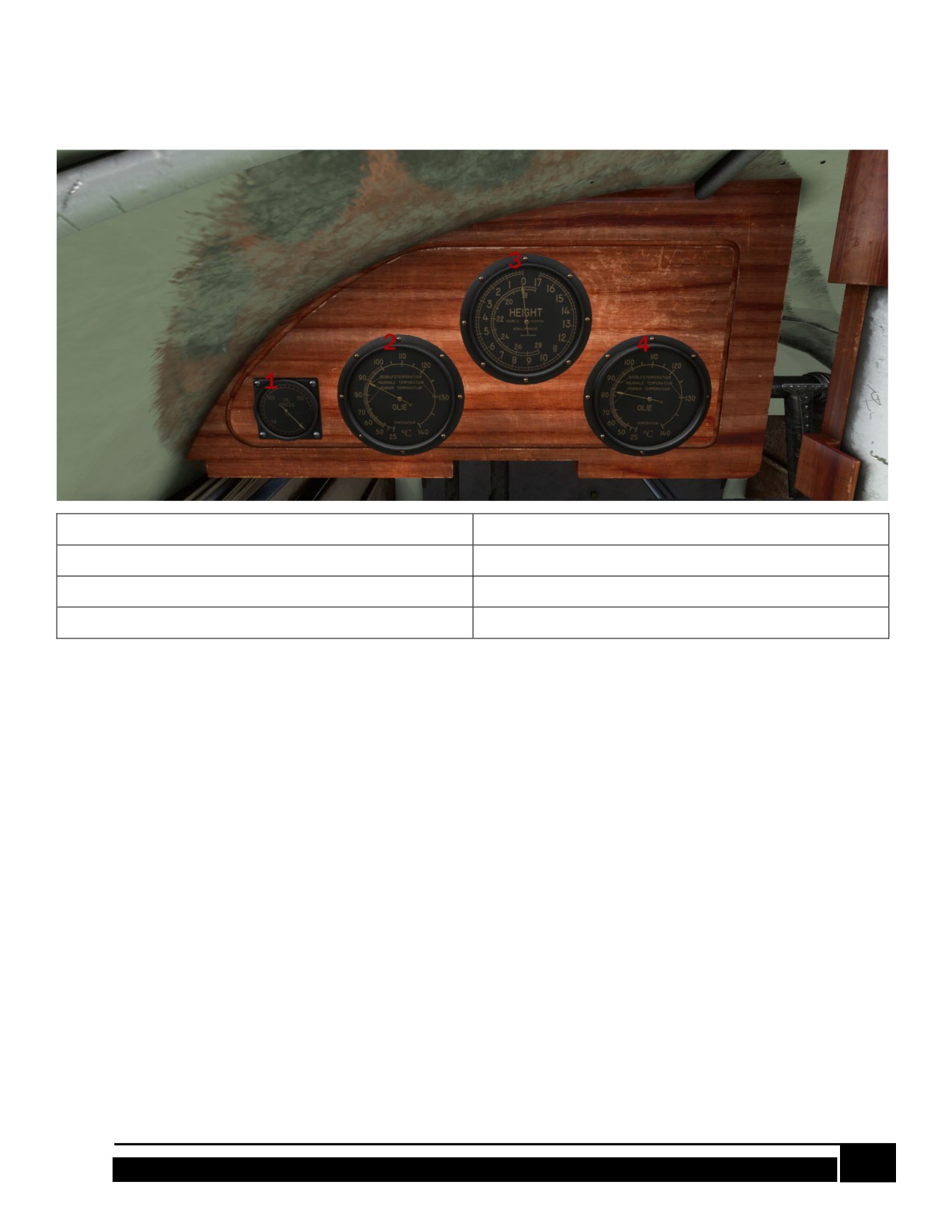
Left Instruments
1
Oil Pressure
2
Oil Temperature (after through the engine)
3
Altitude Indicator (in Thousands of feet)
4
Oil Temperature (supply)
Fokker F.VII
12
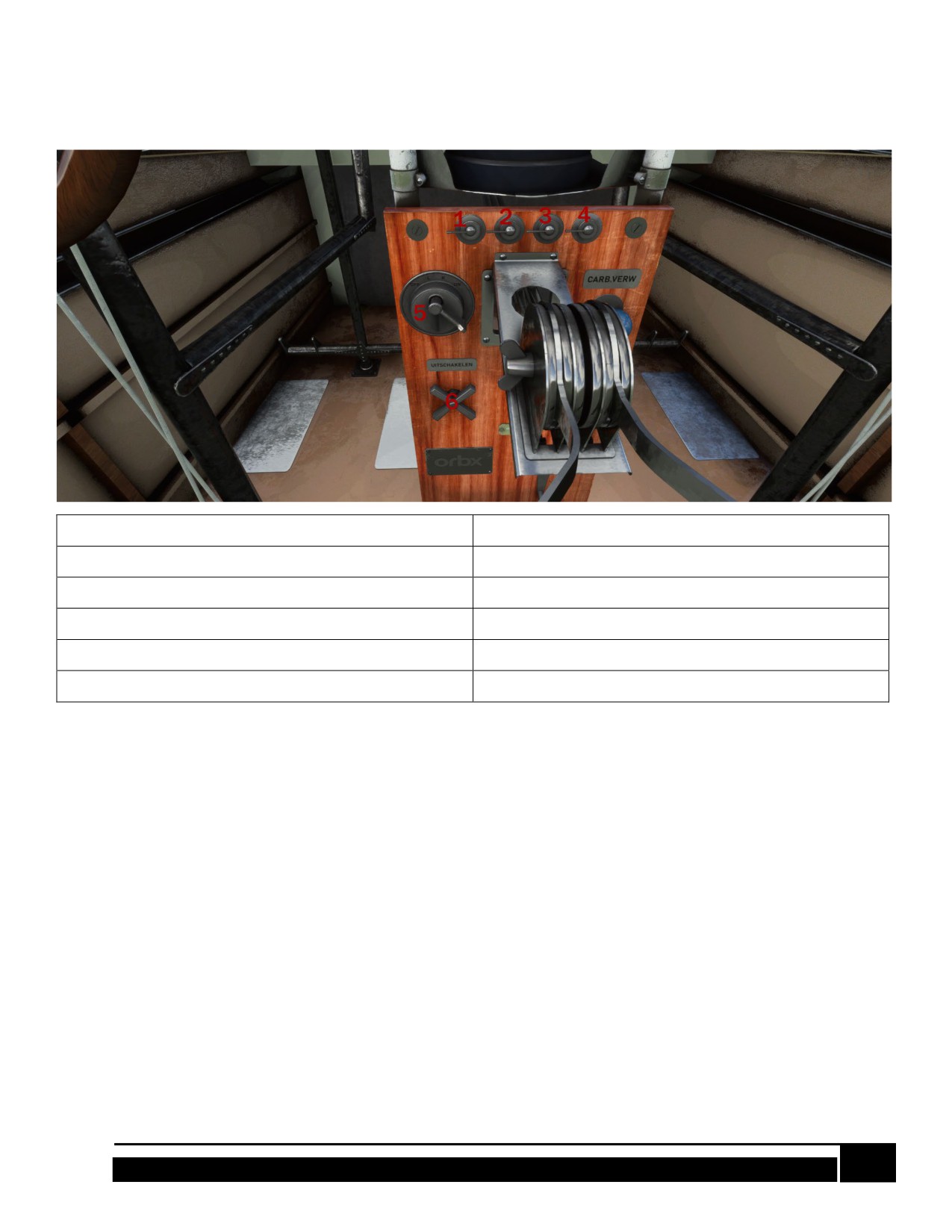
Centre Console - Left Side
1
Battery
2
Engine Master
3
Primer
4
Fuel Pump
5
Magneto
6
Fuel Valve
Fokker F.VII
13
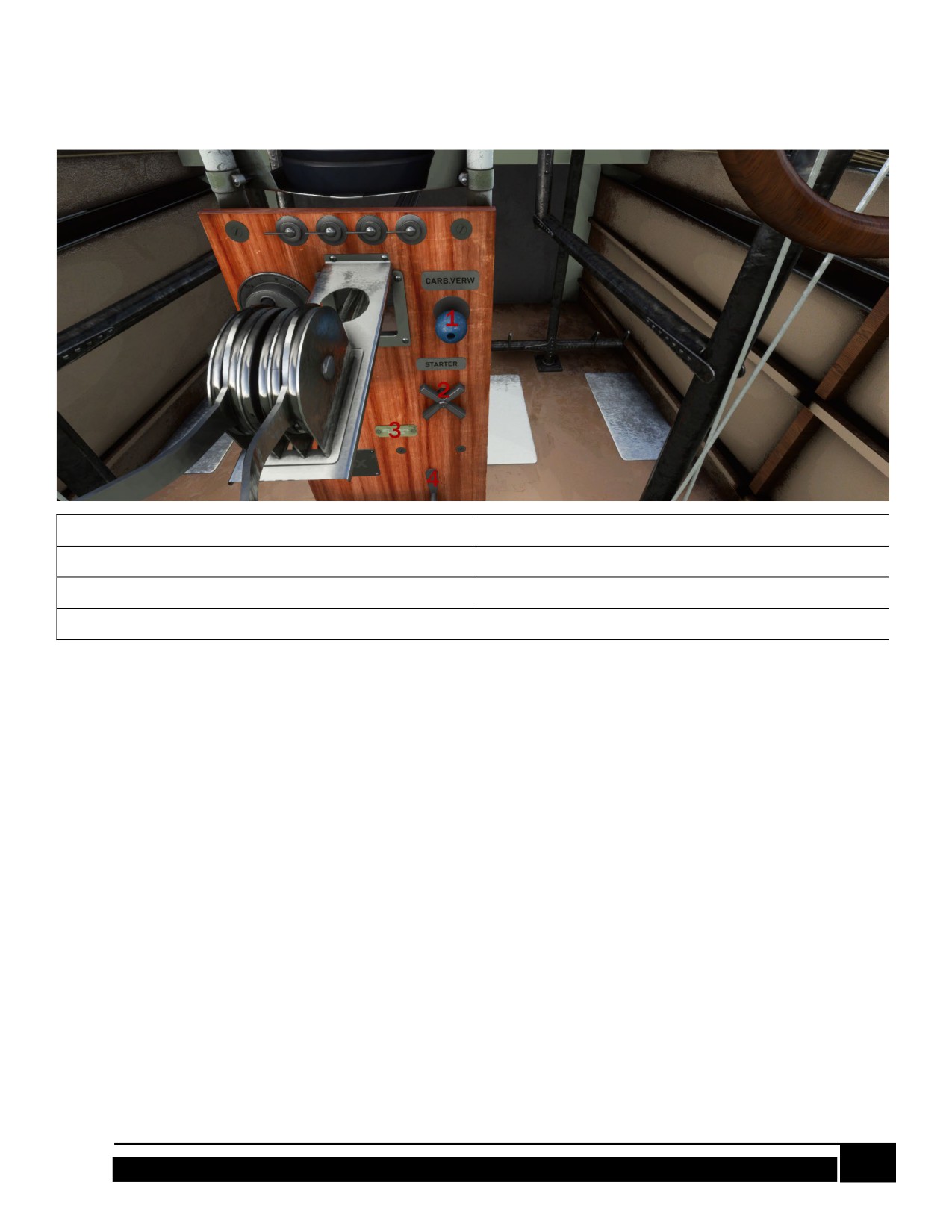
Centre Console - Right Side
1
Carb Heat
2
Engine Starter
3
Place Chocks (Parking Brake)
4
Inop
Fokker F.VII
14
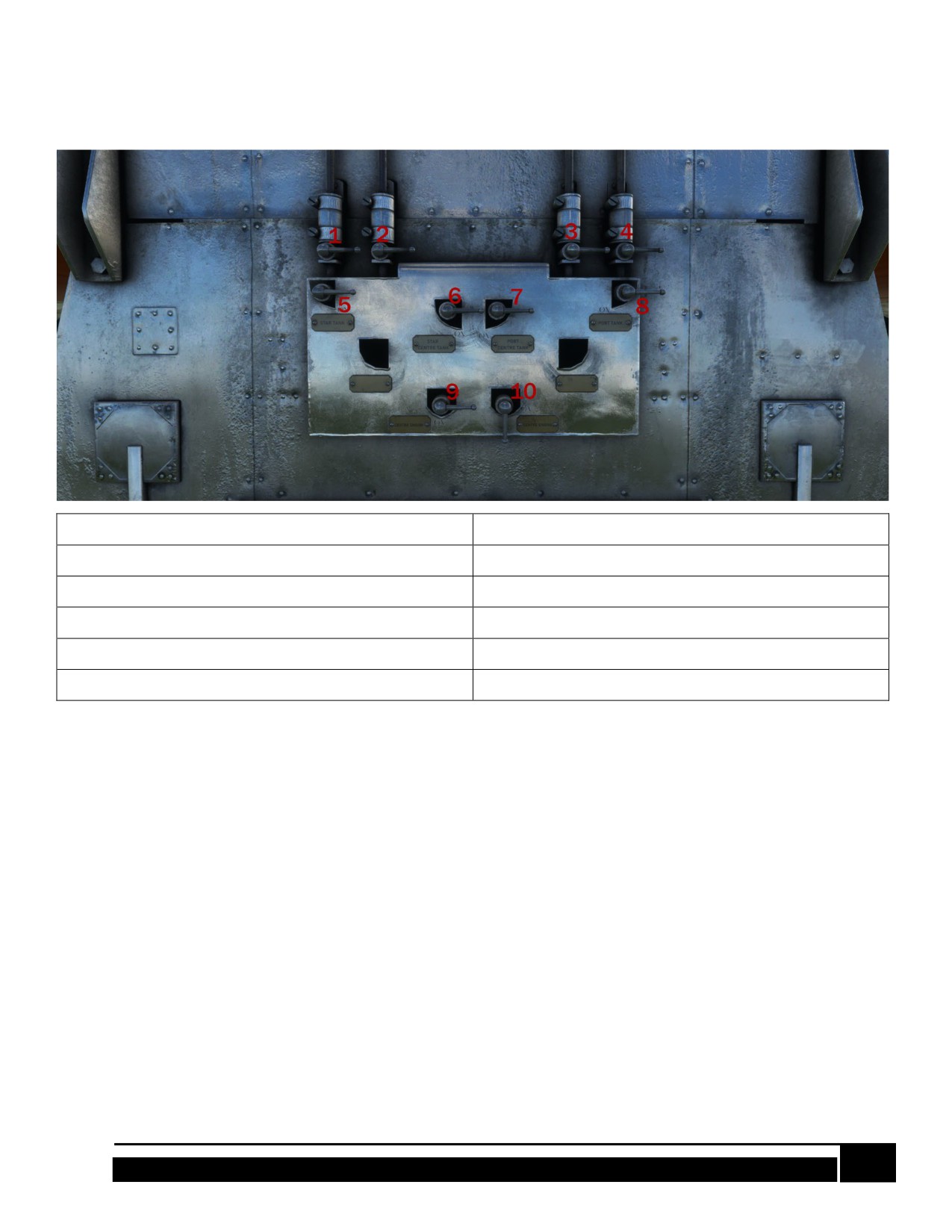
Rear Wall Fuel Panel
1 & 2
Starboard Tank Fuel Valves
3 & 4
Port Tank Fuel Valves
5
Starboard Tank Fuel Pump
6 & 7
Centre Tanks Fuel Pump
8
Port Tank Fuel Pump
9 & 10
Centre Engine Fuel Flow
Fokker F.VII
15
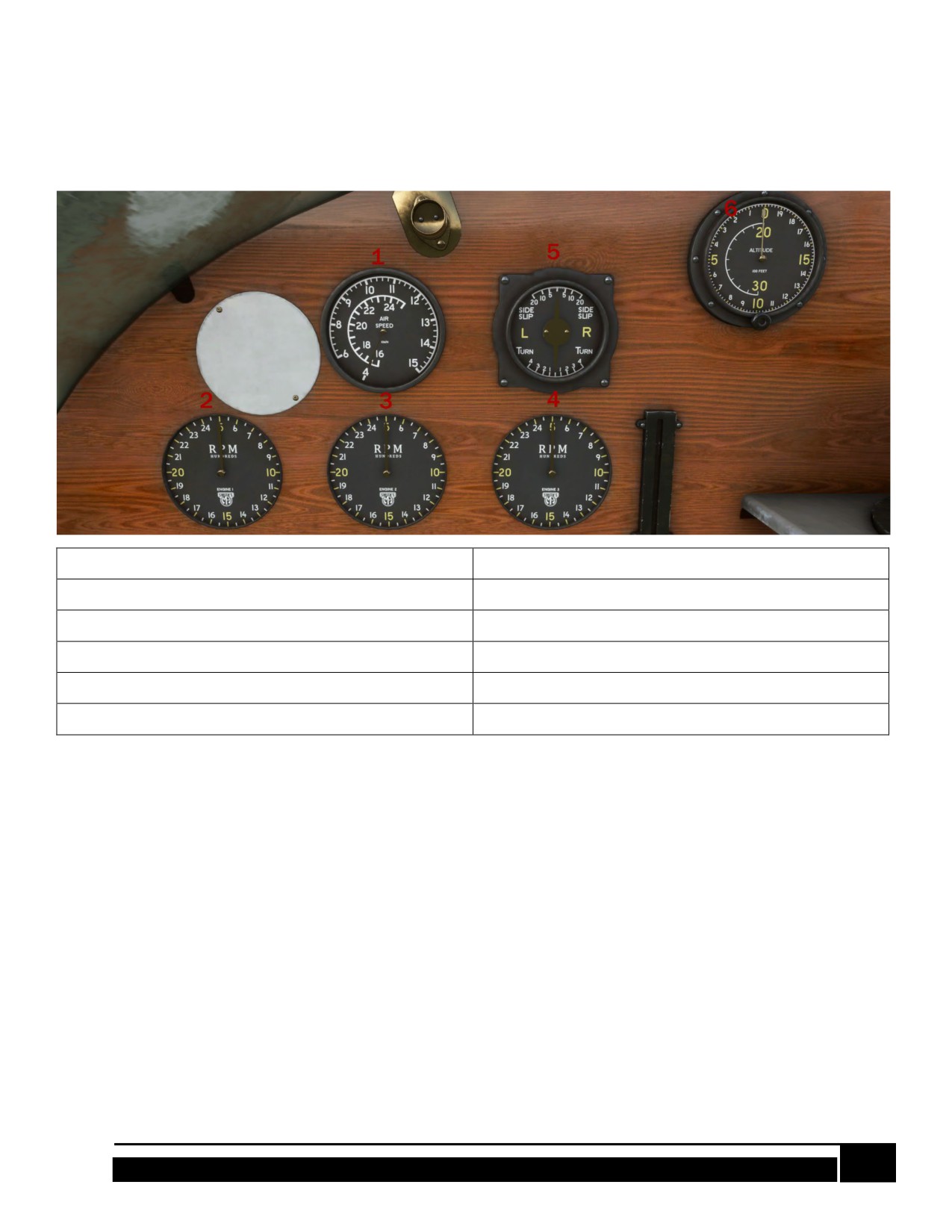
F.VIIb/3m Southern Cross / Friendship / Josephine Ford (Original Cockpit)
Left Instruments
1
Air Speed (KMPH)
2
Port Engine RPM
3
Centre Engine RPM
4
Starboard Engine RPM
5
Turn and Slip Indicator
6
Altitude Indicator (in Thousands of feet)
Fokker F.VII
16
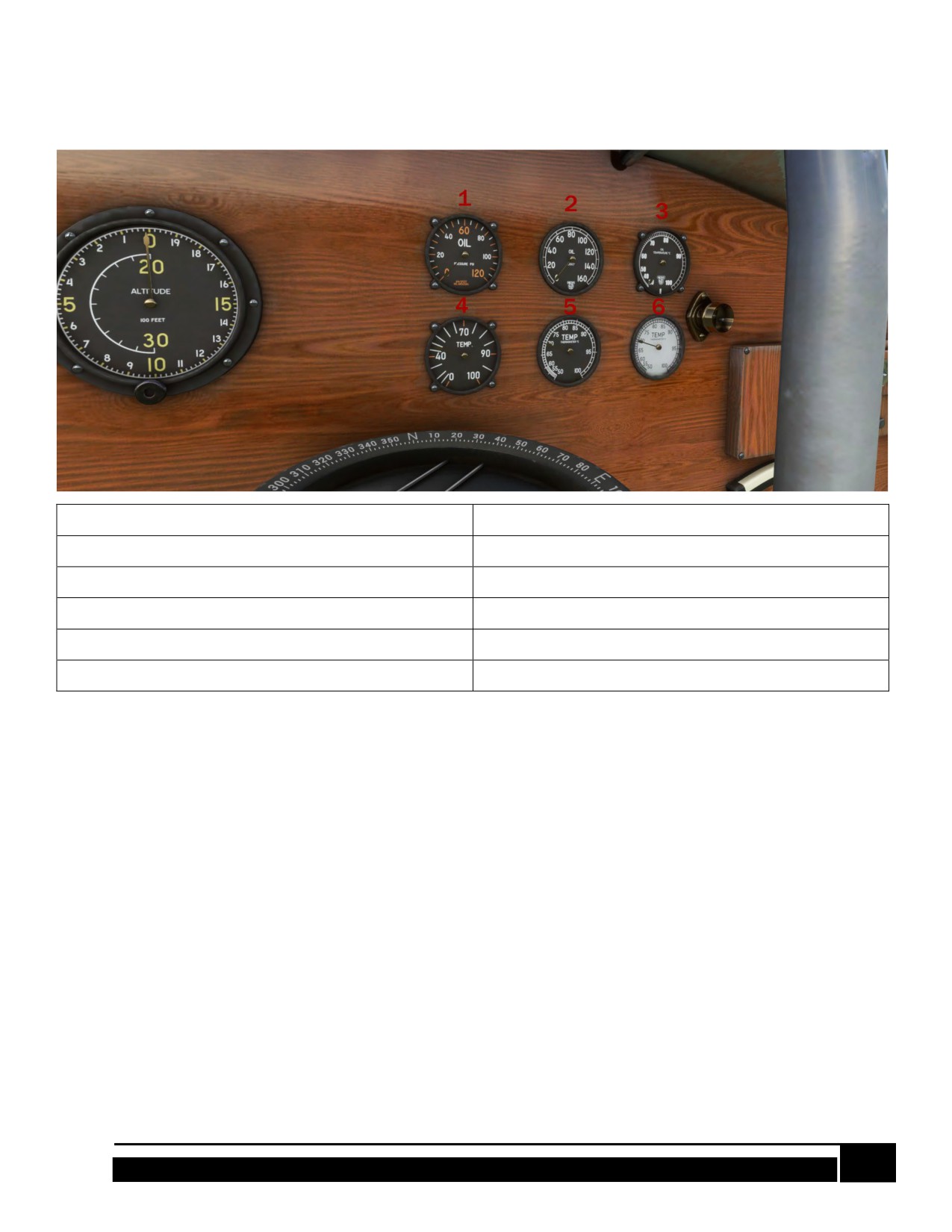
Right Instruments
1
Port Engine Oil Pressure (PSI)
2
Centre Engine Oil Pressure (PSI)
3
Starboard Engine Oil Pressure (PSI)
4
Port Engine Temperature (degrees C)
5
Centre Engine Temperature (degrees C)
6
Starboard Engine Temperature (degrees C)
Fokker F.VII
17
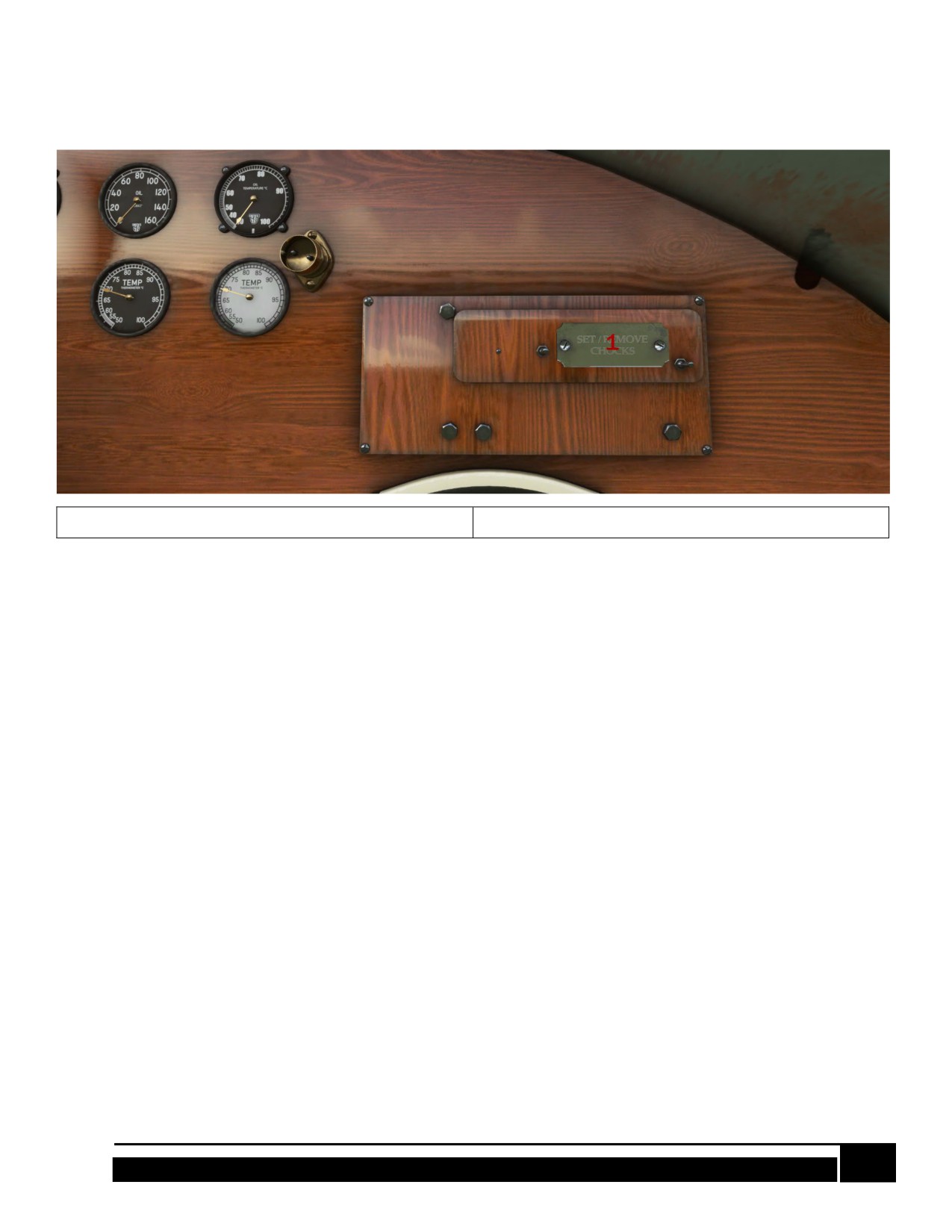
Right Panel
1
Set / Remove Chocks (Parking Brake)
Fokker F.VII
18
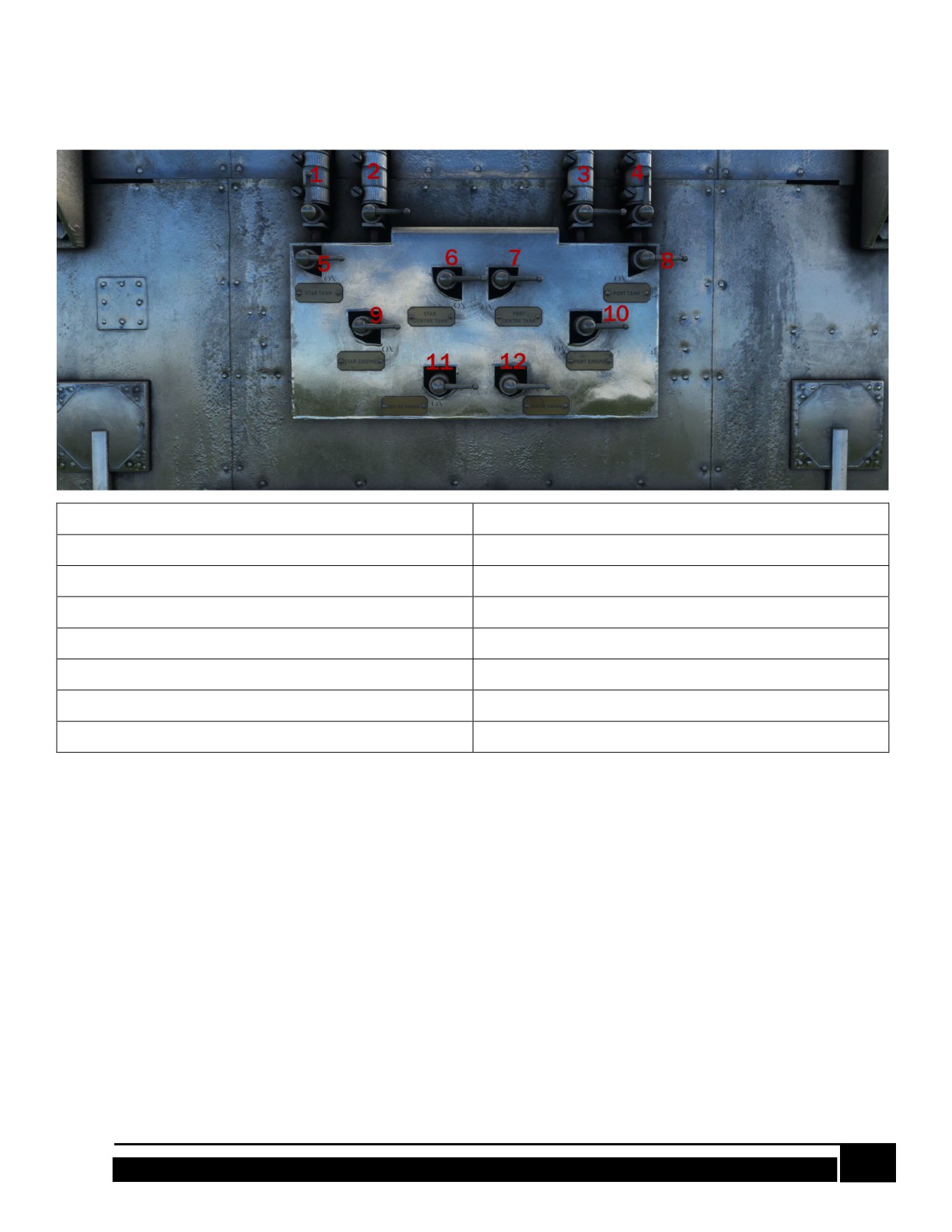
Rear Wall Fuel Panel
1 & 2
Starboard Tank Fuel Valves
3 & 4
Port Tank Fuel Valves
5
Starboard Tank Fuel Pump
6 & 7
Centre Tanks Fuel Pump
8
Port Tank Fuel Pump
9
Starboard Engine Starter
10
Port Engine Starter
11 & 12
Centre Engine Starter
Fokker F.VII
19
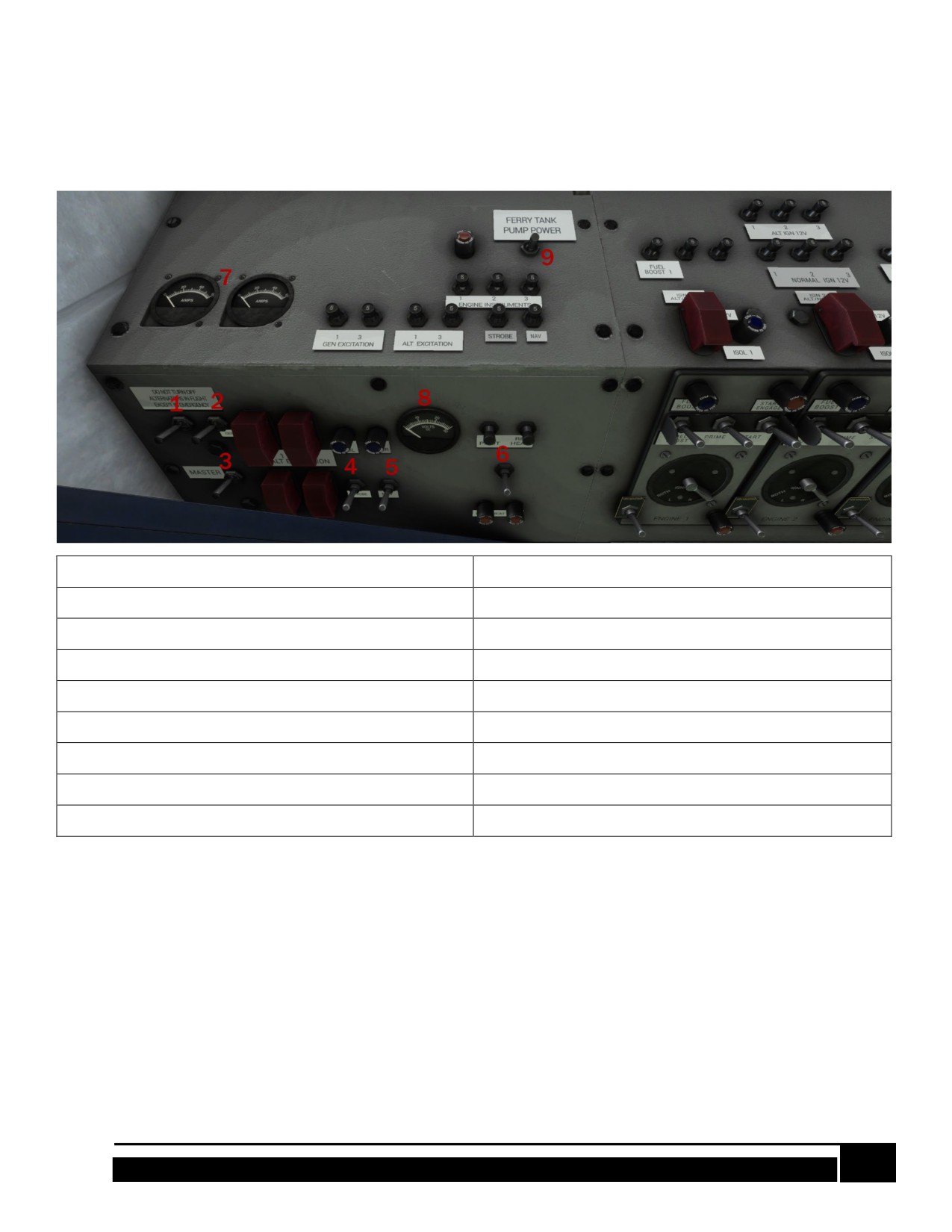
F.VIIb/3m Southern Cross & Transport Retrofit - Modern Cockpit
Left Overhead Panel
1
Alternator 1
2
Alternator 2
3
Battery
4
Strobe (Beacon) Light
5
Nav Light
6
Pitot Heat
7
Ammeter 1 & 2
8
Voltmeter
9
Inop
Fokker F.VII
20
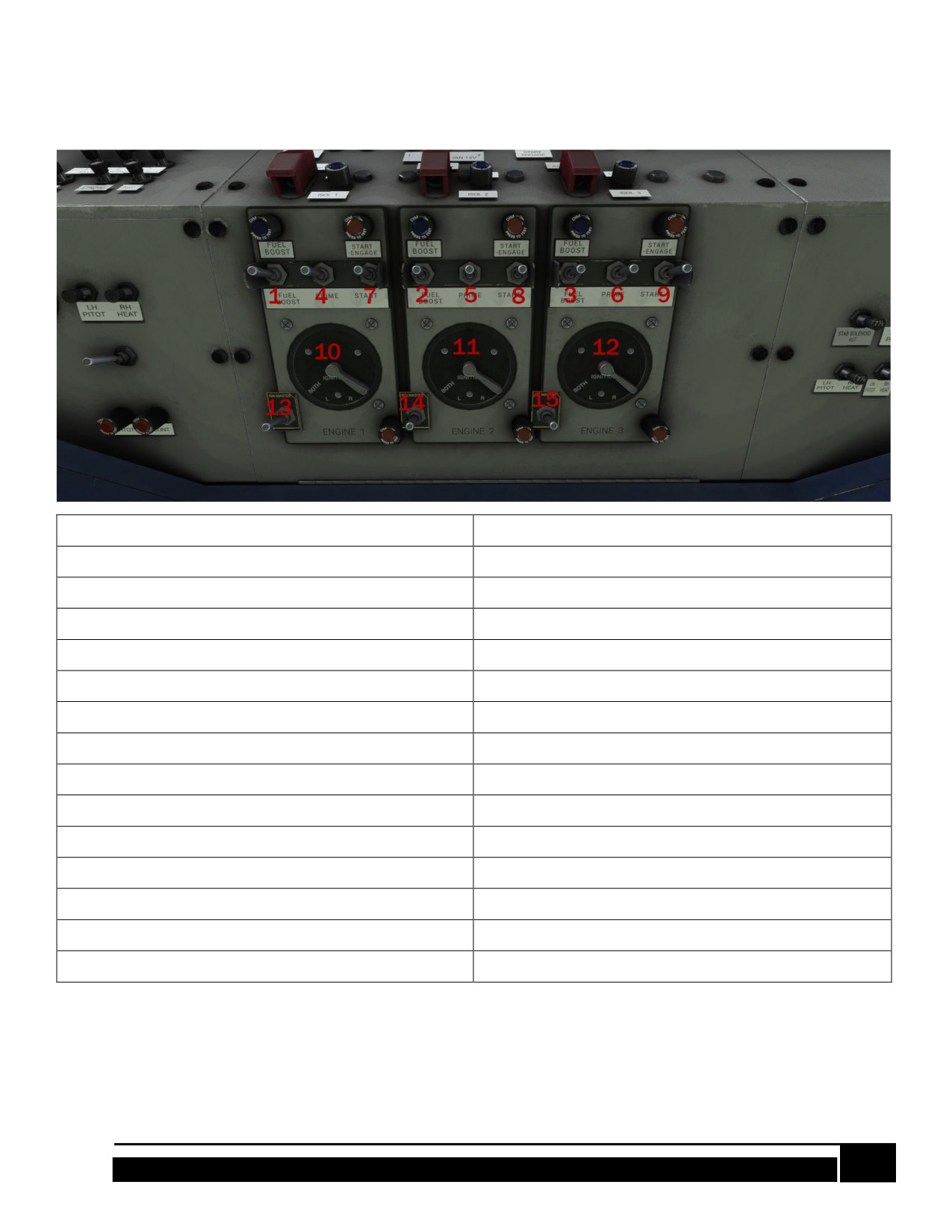
Centre Overhead Panel
1
Port Engine Fuel Pump
2
Centre Engine Fuel Pump
3
Starboard Engine Fuel Pump
4
Port Engine Prime
5
Centre Engine Prime
6
Starboard Engine Prime
7
Port Engine Starter
8
Centre Engine Starter
9
Starboard Engine Starter
10
Port Mag Switch
11
Centre Mag Switch
12
Starboard Mag Switch
13
Port Engine Master
14
Centre Engine Master
15
Starboard Engine Master
Fokker F.VII
21
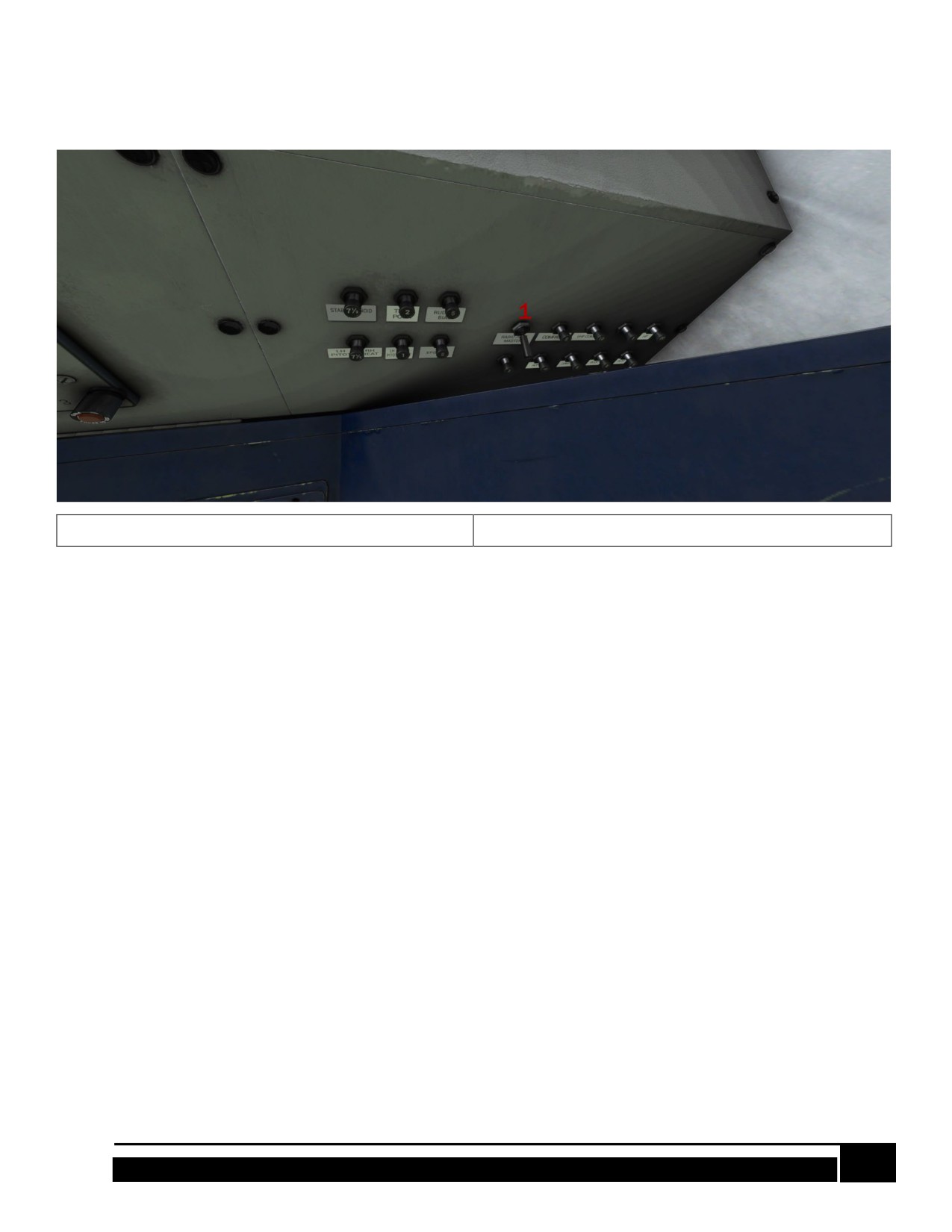
Centre Overhead Panel
1
Radio / Inst Master (Avionics Switch)
Fokker F.VII
22
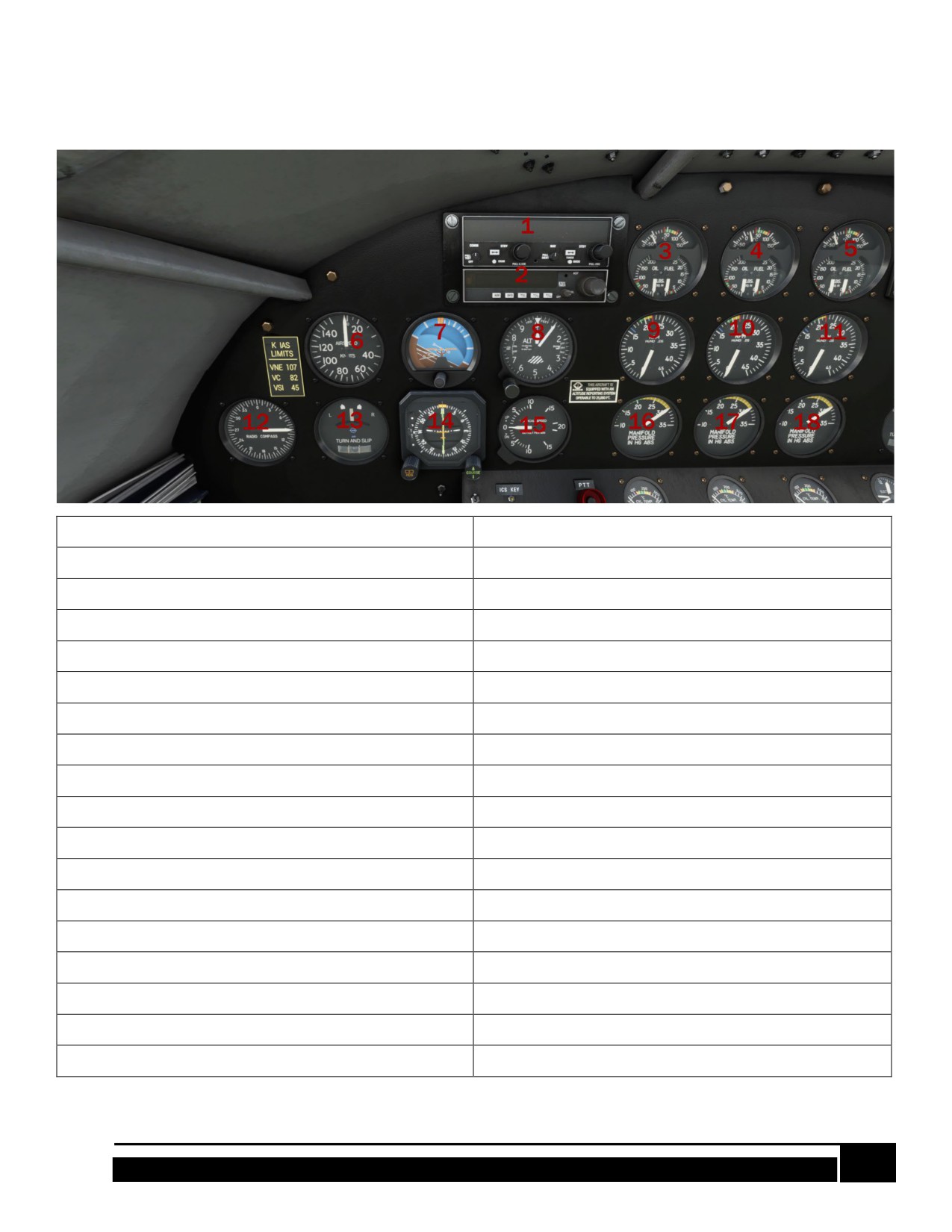
Left Instrument Panel
1
AS155 COM/NAV
2
AS87 ADF
3
Port Engine Pressures and Temperatures
4
Centre Engine Pressures and Temperatures
5
Starboard Engine Pressures and Temperatures
6
Airspeed
7
Attitude Indicator
8
Altimeter
9
Port Engine RPM
10
Centre Engine RPM
11
Starboard Engine RPM
12
Radio Compass
13
Turn and Slip Indicator
14
Horizontal Situation Indicator
15
Vertical Speed Indicator
16
Port Engine Manifold Pressure
17
Centre Engine Manifold Pressure
18
Starboard Engine Manifold Pressure
Fokker F.VII
23
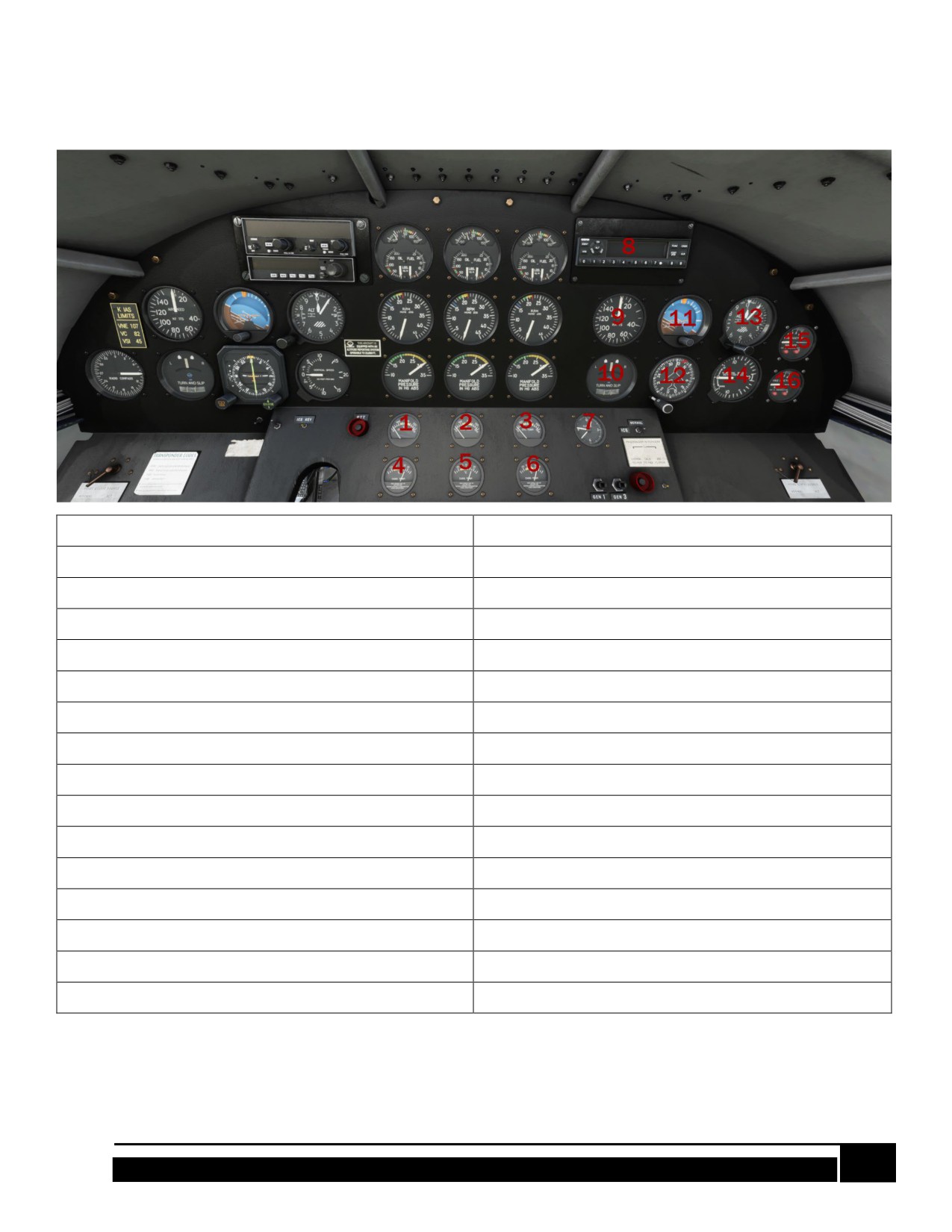
Centre Instrument Panel
1
Port Engine Cylinder Temperature
2
Centre Engine Cylinder Temperature
3
Starboard Engine Cylinder Temperature
4
Port Carburettor Temperature
5
Centre Carburettor Temperature
6
Starboard Carburettor Temperature
7
Chronometer
8
AS330 Transponder
9
Airspeed
10
Turn and Slip Indicator
11
Attitude Indicator
12
Directional Gyro Indicator
13
Altitude
14
Vertical Speed Indicator
15
Gyro Suction
16
Gyro Suction
Fokker F.VII
24
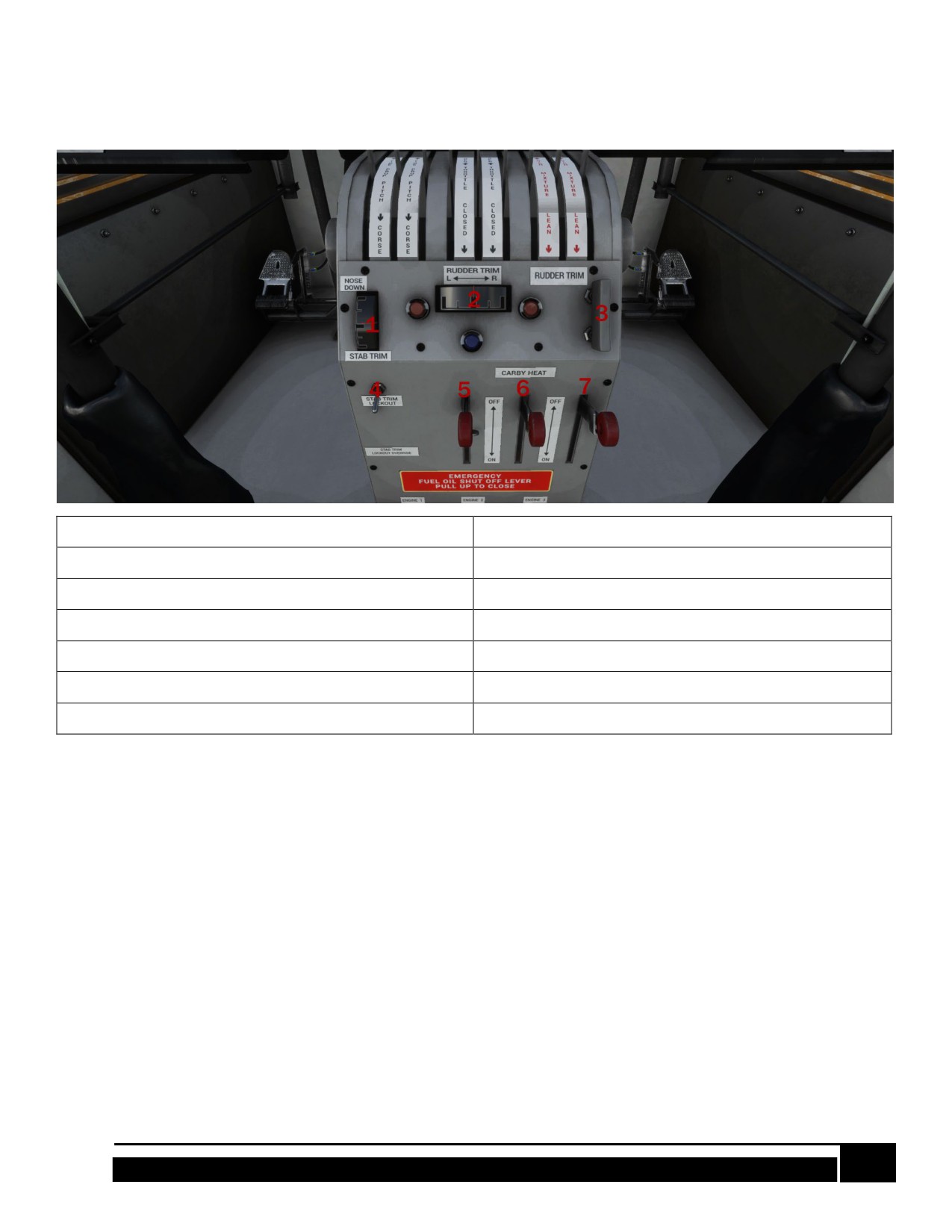
Centre Upper Console
1
Elevator Trim Indicator
2
Rudder Trim Indicator
3
Rudder Trim Switch
4
Inop
5
Port Engine Carby Heat
6
Centre Engine Carby Heat
7
Starboard Engine Carby Heat
Fokker F.VII
25
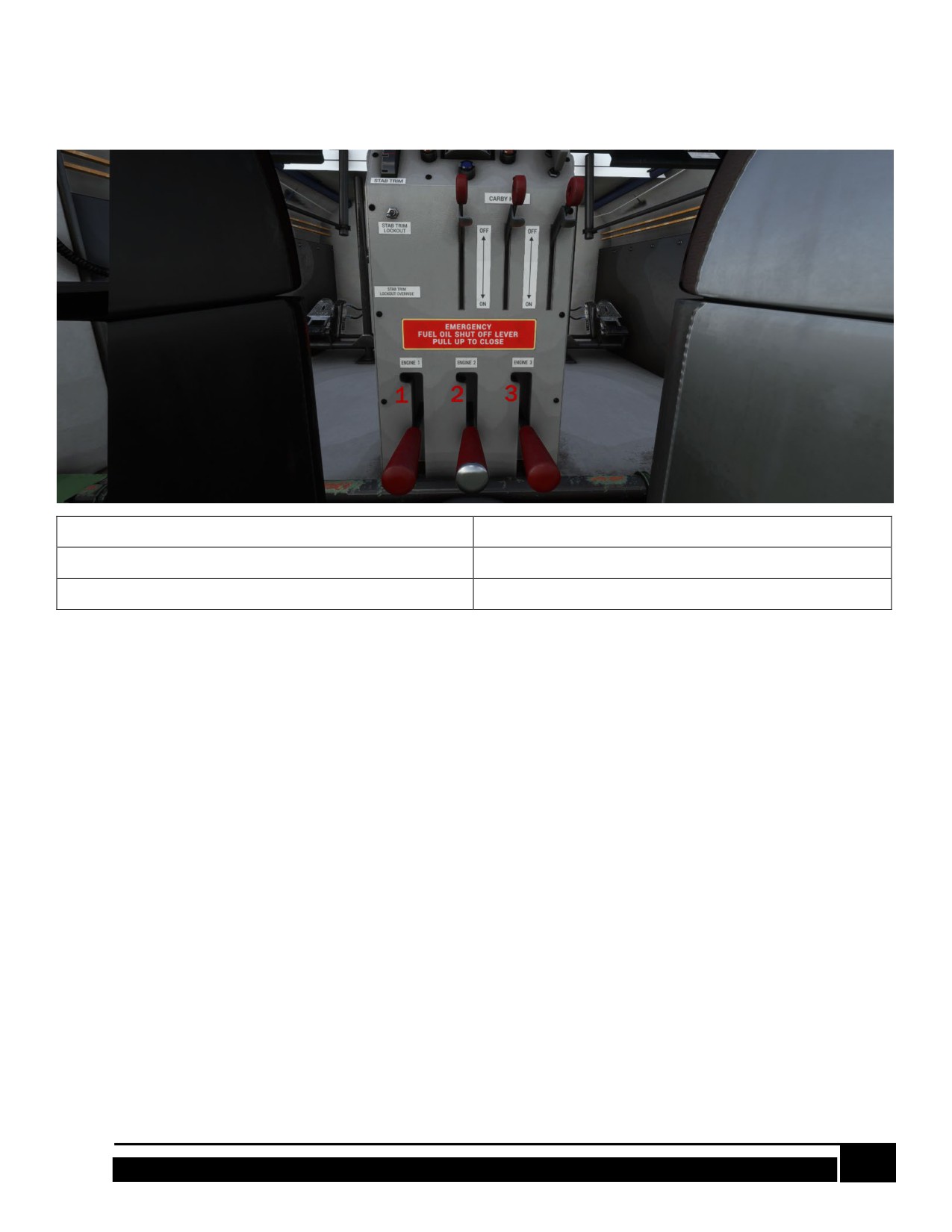
Centre Lower Console
1
Port Engine Fuel Cutoff Lever
2
Centre Engine Fuel Cutoff Lever
3
Starboard Engine Fuel Cutoff Lever
Fokker F.VII
26
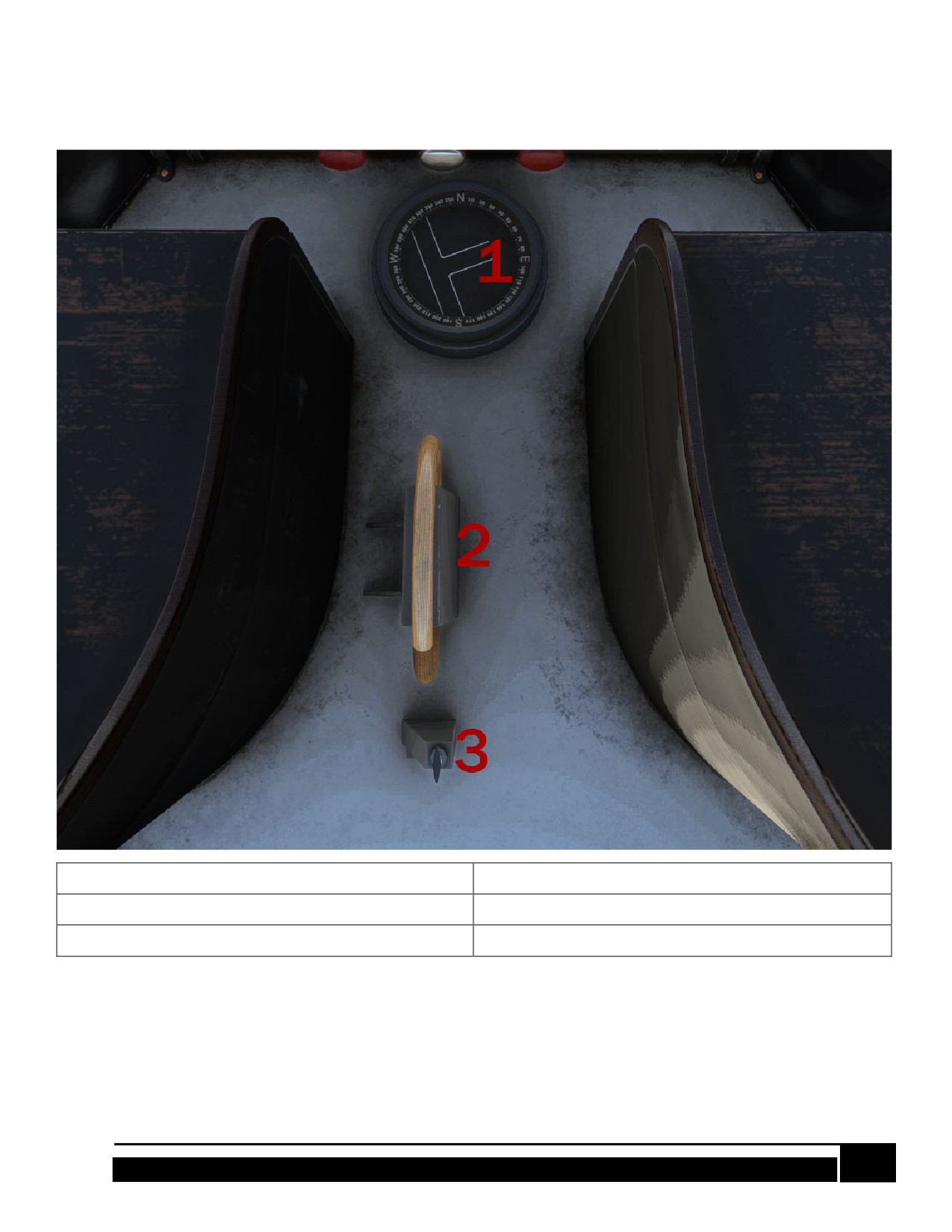
Floor
1
Magnetic Compass
2
Elevator Trim
3
Inop
Fokker F.VII
27

Operational limitations
F.VIIa/1M
WEIGHT LIMITATIONS
Maximum Take-off Weight
3,500kg
CENTRE OF GRAVITY LIMITATIONS
FORWARD LIMIT
400 mm aft of datum
REAR LIMIT
600 mm aft of datum
The datum is the centre line of the wing front spar.
SPEED LIMITATIONS
STALL SPEED
(VS)
61 Kmph
MAXIMUM SPEED
(VNE)
231 Kmph
MANOEVRE SPEED
(VNO)
185 Kmph
MINIMUM AIR CONTROL SPEED
(Vmca)
65 Kpmh
F.VIIb/3M
WEIGHT LIMITATIONS
Maximum Take-off Weight
5,300 kg
CENTRE OF GRAVITY LIMITATIONS
FORWARD LIMIT
400 mm aft of datum
REAR LIMIT
600 mm aft of datum
The datum is the centre line of the wing front spar.
SPEED LIMITATIONS
STALL SPEED
(VS)
81 Kmph
MAXIMUM SPEED
(VNE)
246 Kmph
MANOEVRE SPEED
(VNO)
213 Kmph
MINIMUM AIR CONTROL SPEED
(Vmca)
98 Kmph
Fokker F.VII
28

F.VIIb/3M Retrofit
WEIGHT LIMITATIONS
Maximum Take-off Weight
5,700 kg
CENTRE OF GRAVITY LIMITATIONS
FORWARD LIMIT
400 mm aft of datum
REAR LIMIT
600 mm aft of datum
The datum is the centre line of the wing front spar.
SPEED LIMITATIONS
STALL SPEED
(VS)
44 Kts
MAXIMUM SPEED
(VNE)
109 Kts
MANOEVRE SPEED
(VNO)
84 Kts
MINIMUM AIR CONTROL SPEED
(Vmca)
35 Kts
Fokker F.VII
29

Start-Up
The aircraft can be started up using the in-game Checklists or by using the Quick Reference
Cards below.
Alternatively you can quick-start the aircraft by pressing Ctrl+E on the keyboard.
Taxiing
The F.VIIa/1m and F.VIIb/3m Southern Cross Original have a tail skid, no toe brakes and limited
maneuverability whilst taxing. It is therefore recommended to start at the end of a long grass
runway.
The F.VIIb Modern Retrofit planes have toe brakes and a free castoring tail wheel.
To enable the free castoring wheel it is required to push the control yoke fully forward during taxi
procedures.
Take off
After the run up and appropriate Pre-Take-off checks, briefing has been completed and the ATC
clearance obtained line up the aircraft on the center line of the runway as near to the end of the
usable length as possible.
With the left hand holding the yoke hard back, open the throttles smoothly
and continuously to the full forward position for maximum power, approx. 28” HG 2200 RPM.
After 25 knots / 46 kmph the yoke is pushed forward to lift the tail so that the aircraft is in a level
or slightly nose down attitude with the rudder in the slipstream.
At 55 knots /102 kmph the Captain will remove their right hand from the throttles to the yoke and
rotate the aircraft to lift off.
Gently adjust attitude to allow the speed to build up to the climb speed of 70kts / 130 kpmh,
when power can be reduced to climb power.
Fokker F.VII
30

Climb
Normal climb speed is 70 kts / 130 kmph indicated air speed (IAS).
Turn onto course should not be initiated below 500 feet. Turns must be carefully coordinated
with rudder leading into the turn because of the severe aileron drag. Turbulence will affect air
speed but maintain a constant attitude rather than chasing air speed.
Cruise
On reaching the assigned altitude, level out and allow the speed to increase to the cruise speed
(approx. 80 kts / 148 kmph IAS) before setting up the appropriate power setting -
21.5” HG or less and RPM between 2000 and 1850 RPM.
Decent
Descent from the cruise altitude should be planned 300 - 500 feet per minute to arrive in the
circuit area at 1500 feet above aerodrome level (or as per local aerodrome requirements).
This continuous straight-in descent may not always be possible due to terrain clearance and/or
ATC.
Power not less than minimum RPM should normally be set. Keep a check on cylinder head
temperatures (CHT’s) particularly in cold weather. An increase in power or slower speed will
reduce cooling but upset the planned descent profile.
Circuit Approach and Landing
Approaching the circuit, the Approach checks should be called. At non-controlled airfields, due
to possible light aircraft operation, it is required that all aircraft will join the circuit, for the landing
direction in use, at some point before the downwind turn onto the base leg, at 1000 feet above
the aerodrome altitude.
On down-wind leg, complete pre-landing checks. The turn onto base leg is commenced when
the engine rear support strut passes the threshold of the runway. Reduce power to 12-15” HG.
The pitch controls can then be moved fully forward to Full Increase. The RPM will be about
1500 RPM and maintain speed at 70kts / 130kmph. The turn onto final should be at 500 feet
and on lining up on the runway complete the final checks and aim to cross the threshold at 60 -
65k / 111 - 120kpmh IAS.
Fokker F.VII
31

Without flaps, the approach is relatively flat and the aircraft is put on to the runway with a slight
flare coordinated with power being reduced to idle in a “wheeler” type landing. After the wheels
are on the ground hold the aircraft in a level or slightly nose down attitude. Do not apply brakes
until the speed has fallen below 45k / 83 kmph IAS when slight braking can be employed to hold
the aircraft in the level attitude. Below 30k / 55 kmph IAS the tail can be lowered gently to the
runway. If the brakes are applied too early, when the wing is taking most of the weight, the tires
could be badly scuffed and the plane could pitch forward causing a prop-strike on the ground. If
the tail is lowered quickly or at too high a speed the wing will regain lift and the aircraft could
become airborne again.
Fokker F.VII
32

Credits
This aircraft has been lovingly created by a multi-cultured international team of experts,
enthusiast and friends.
We hope you enjoy it!
Art Director: Marcus Nyberg
Project Management: Ellise Christopher
Art Team:
Sebastian Darrell
Rob Brindley
Smit Parmer
Aaron Grieve McGuirk
Karl Høybye
Nawfal Benbennasser
Russ White
Flight Model and Systems Model:
Daniel Dunn
Mitchell Williamson
Sounds by Dynamedion with assistance from Sam Packer at Orbx
We would also like to thank our tireless QA and Testing team across the Globe.
Fokker F.VII
33

Pre-Flight Inspection
Doors
Closed and locked
Control Yoke
Fully Aft
Chocks (Parking Brake)
Set
Throttle
Advance until 2500RPM
Battery Switch
Off
Magneto
Set to Right
Fuel Valve
Closed
RPM Indicator
Check for decrease in RPM <90
Mixture
Lean
Magneto
Set to Both
Magneto
Off
RPM Indicator
Check stabilised
Fuel Pump
Off
Magneto
Set to Left
Engine Master
Off
RPM Indicator
Check for decrease in RPM <90
Magneto
Set to Both
Before Starting Engine
RPM Indicator
Check stabilised
Throttle
Idle
Chocks (Parking Brake)
Set
Control Yoke
Centre
Doors
Closed and locked
Engine temperatures
Check within limits
Battery Switch
On
Flight Controls
Free and Correct Movement
Normal Take Off & Climb
Starting Engine
Flight Controls
Free and Correct Movement
Chocks (Parking Brake)
Remove (Release)
Magneto
Both
Throttle
Advance
Mixture
Rich
Manifold Pressure
24 InHG
Fuel Valve
Open
RPM
2050
Fuel pump
On
Rotation
Greater than 112 KMPH
Throttle
Open ½ inch
Carb Heat
As Required
Engine Master
On
Propeller area
Clear
Cruise
Primer
Hold for 20 seconds on a cold day
Engine Starter
On
Flight instruments
Check
Engine gauges
Check within limits
Fuel pump
Off
Manifold Pressure
21.5 InHG
Engine Run Up
RPM
Between 1850 and 2000
Carb Heat
As Required
Chocks (Parking Brake)
Set
Fokker F.VIIa - Quick Reference Cards

Descent
Fuel pump
On
Throttle
As required
VNE
250 KMPH
Normal Landing & Roll Out
Fuel pump
On
Threshold
120 KMPH
Touchdown
Greater than 111 KMPH
Control Yoke
Aft less than 60 KMPH
Throttles
Idle
Tail Skid
Contact with the ground to allow for slowing and stopping
After Landing & Shutdown
Chocks (Parking Brake)
Set once come to a full stop
Throttle
Run the engine up to 1400RPM for 20 seconds
Throttle
Idle
Mixture
Lean
Magneto
Off
Engine Master
Off
Fuel Pump
Off
Fuel Valve
Closed
Battery Switch
Off
Fokker F.VIIa - Quick Reference Cards

Pre-Flight Inspection
Propeller area
Clear
Centre Engine Starter (Back Wall)
On
Chocks (Parking Brake)
Set
Engine gauges
Check within limits
Fuel Valves
On the Back Wall, All Closed
Throttles
Idle
> Engine 1 Start - Port
Magnetos
Off
Magneto 1 (Port)
Both
Before Starting Engine
Throttle
Open ½ inch
Propeller area
Clear
Chocks (Parking Brake)
Set
Port Engine Starter (Back Wall)
On
Doors
Closed and locked
Engine gauges
Check within limits
Flight Controls
Free and Correct Movement
Engine Run Up
Fuel Panel (Back Wall)
Chocks (Parking Brake)
Set
Starboard Tank
On
Doors
Closed and locked
Port Tank
On
Control Yoke
Fully Aft
Star / Port Centre Tank
On
Engine 3 Throttle
Advance until 2500RPM
Magneto 3
Set to Right
Starting Engines
RPM Indicator
Check for decrease in RPM <90
Magneto 3
Set to Both
> Engine 3 Start - Starboard
RPM Indicator
Check stabilised
Magneto 3
Set to Left
Magneto 3 (Starboard)
Both
RPM Indicator
Check for decrease in RPM <90
Throttle
Open ½ inch
Magneto 3
Set to Both
Propeller area
Clear
RPM Indicator
Check stabilised
Star Engine Starter (Back Wall)
On
Throttle
Idle
Engine gauges
Check within limits
Control Yoke
Centre
Engine temperatures
Check within limits
> Engine 2 Start - Centre
Repeat Procedure for Engine 2 (Centre) and Engine 1 (Port)
Magneto 2 (Centre)
Both
Throttle
Open ½ inch
Fokker F.VIIb Southern Cross / Josephine Ford / Friendship - Quick Reference Cards

Normal Take Off & Climb
Port, Centre, Starboard Fuel Valves
Off
Flight Controls
Free and Correct Movement
Chocks (Parking Brake)
Remove (Release)
Throttles
Advance
RPM
2050
Rotation
Greater than 112 KMPH
Cruise
Flight instruments
Check
RPM
Between 1850 and 2000
Descent
Throttle
As required
VNE
250 KMPH
Normal Landing & Roll Out
Threshold
120 KMPH
Touchdown
Greater than 111 KMPH
Control Yoke
Aft less than 60 KMPH
Throttles
Idle
Tail Skid
Contact with the ground to allow for slowing and stopping
After Landing & Shutdown
Chocks (Parking Brake)
Set once come to a full stop
Throttle
Run the engine ups to 1400RPM for 20 seconds
Throttles
Idle
Magnetos 1, 2, 3
Off
Fokker F.VIIb Southern Cross / Josephine Ford / Friendship - Quick Reference Cards

Pre-Flight Inspection
Starting Engines
Parking Brake
Set
> Engine 3 Start - Starboard
Battery
Off
Alternators
Both Off
Engine 3 Master Switch
On
Strobe Light Switch (Beacon)
Off
Engine 3 Magneto (Starboard)
Both
Nav Light
Off
Engine 3 Fuel Boost Pump
On
Pitot Heat
Off
Engine 3 Prime
Approx. 20 seconds on a cold day
Magnetos
All Off
Engine 3 Throttle
Open ½ inch
Fuel Boost Pumps
All Off
Engine 3 Mixture
Rich
Engine Master Switches
All Off
Engine 3 Prop Pitch Lever
Fully Forward
Radio / Inst Master
Off
Propeller area
Clear
Throttles
All Idle
Engine 3 Start
On
Mixture
All Lean
Engine 3 Gauges
Check within limits
Prop Pitch Levers
All Aft
Throttle 3
Idle
Fuel Valves
All Closed
Carby Heat
All Off
> Engine 2 Start - Centre
Engine 2 Master Switch
On
Before Starting Engine
Engine 2 Magneto (Centre)
Both
Parking Brake
Set
Engine 2 Fuel Boost Pump
On
Doors
Closed and locked
Engine 2 Prime
Approx. 20 seconds on a cold day
Flight Controls
Free and Correct Movement
Engine 2 Throttle
Open ½ inch
Battery
On
Engine 2 Mixture
Rich
Alternators
Both On
Engine 2 Prop Pitch Lever
Fully Forward
Strobe Light Switch (Beacon)
On
Propeller area
Clear
Fuel Valves
All Open
Engine 2 Start
On
Carby Heat
All Off
Engine 2 Gauges
Check within limits
Throttles
All Idle
Throttle 2
Idle
Mixture
All Lean
Prop Pitch Levers
All Aft
Fokker F.VIIb Modern Cockpit - Quick Reference Cards

> Engine 1 Start - Port
Parking Brake
Set
Engine 1 Master Switch
On
Doors
Closed and locked
Engine 1 Magneto (Port)
Both
Control Yoke
Fully Aft
Engine 1 Fuel Boost Pump
On
Engine 3 Throttle
Advance until 2500RPM
Engine 1 Prime
Approx. 20 seconds on a cold day
Magneto 3
Set to Right
Engine 1 Throttle
Open ½ inch
RPM Indicator
Check for decrease in RPM <90
Engine 1 Mixture
Rich
Magneto 3
Set to Both
Engine 1 Prop Pitch Lever
Fully Forward
RPM Indicator
Check stabilised
Propeller area
Clear
Magneto 3
Set to Left
Engine 1 Start
On
RPM Indicator
Check for decrease in RPM <90
Engine 1 Gauges
Check within limits
Magneto 3
Set to Both
Throttle 1
Idle
RPM Indicator
Check stabilised
Prop 3 Lever Cycling
Fully Aft
After Engine Start
Oil Pressure Gauge
Check for Pressure Decrease
RPM Gauge
Check for RPM Decrease
Alternators
Check Both On
Prop 3 Lever
Fully Forward
Radio / Inst Master
On
Throttle
Idle
Transponder
On
Control Yoke
Centre
Radios
On
Engine temperatures
Check within limits
Taxiing
Repeat Procedure for Engine 2 (Centre) and Engine 1 (Port)
Parking Brake
Off
Normal Take Off & Climb
Control Yoke
Fully Aft
Throttles
Advance 10%
Radios
Set
Toe Brake
Check After Movement
Transponder
Set
Control Yoke
Fully Forward During Taxi
Nav Light
On
Throttles
As Required
Pitot Heat
On
Flight Controls
Free and Correct Movement
Engine Run Up
Position Aircraft
Into Wind
Fokker F.VIIb Modern Cockpit - Quick Reference Cards

Control Yoke
Centred
Threshold
60 KIAS
Rudder Trim
Half Right
Aim for 3 point landing
Tail Low Attitude
Elevator Trim
Set as Required
Touchdown
55 KIAS
Parking Brake
Release
Stall Speed (VS1)
45 KIAS
Throttles
Advance
Throttles
Idle
RPM
2050
Control Yoke
Fully Aft less than 32 KIAS
Rotation
Greater than 60 KIAS
Tail Wheel
Contact with the ground
Toe Brakes
Gentle Pressure Applied
Climb
Taxiing Back
Manifold Pressure
24 InHG
RPM
2050
Parking Brake
Off
Carby Heat
As Required
Control Yoke
Fully Forward During Taxi
Throttles
As Required
Cruise
Fuel Boost Pumps
Off
Nav Lights
Off
Flight instruments
Check
Pitot Heat
Off
Manifold Pressure
21.5 InHG or Less
Carby Heat
Off
RPM
Between 1850 and 2000
Fuel Boost Pumps
Off
After Landing & Shutdown
Carby Heat
As Required
Parking Brake
Set once come to a full stop
Descent & Approach
Throttle
Run the engine up to 1400RPM for 20 seconds
Throttles
Idle
Fuel Boost Pumps
On
Magnetos 1, 2, 3
Off
Throttle
As required
Mixtures 1,2,3
Lean
Prop Levers
Fully Forward
Prop Levers 1,2,3
Fully Aft
Approach Speed
70 KIAS
Radio / Inst Master
Off
Trims
Set as Required
Engine Master Switches
All Off
Carby Heat
As Required
Strobe Light Switch (Beacon)
Off
Alternators
Both Off
Normal Landing & Roll Out
Battery
Off
Fokker F.VIIb Modern Cockpit - Quick Reference Cards