New Holland F106.6 / F106.6A / F156.6 / F156.6A. SERVICE MANUAL (2007)
SERVICE
SERVICE MANUAL
MANUAL
F106.6 / F106.6A / F156.6 / F156.6A
Grader
F106.6 / F106.6A
F156.6 / F156.6A
Grader
Print No.
87726937A
Print No. 87726937A
TO THE READER
mechanical assembly:
This repair manual is intended for professional
• technical
description
and information
repair technicians. It contains important
regarding the operation of essential systems
information, needed for carrying out specialised
and equipment;
repair work.
• information about performance tests on the
Please read carefully through the repair manual,
machine;
and also the operating instructions, before
• troubleshooting and information for identifying
undertaking any repair work.
faults on the machine;
Use the repair manual, but also use the operating
• technical information necessary for repair
instructions and parts catalogue for reference
operations on the machine, the equipment
and guidance, even if you are already familiar with
necessary for carrying out repairs, information
the technology used in graders.
about maintenance standards, procedures for
The repair manual will allow the experienced
removal/installation and for disassembly/
construction machine mechanic to carry out the
assembly.
necessary repair work correctly.
You can use the list of contents to find the necessary
information easily.
The illustrations are partially simplified to make
USE
them more easily understood.
The repair manual describes the machine model in
Although it may result in apparent differences with
the form it was originally delivered. It does not
your particular grader model, this is intended to
describe any implements and modifications that
make the information clearer.
maybe added later.
The repair manual contains the following
information:
REPAIR
• Safety instructions
Carry out the required repair operations as soon as
possible. Doing so will reduce repair costs and
• Technical data and special tools
increase the availability of your grader.
• Function description
In all repair operations, always follow the
• Performance test
instructions in the workshop manual and the
• Troubleshooting and fault correction
operating instructions. Customer Service will be
pleased to carry out for you any extensive
• Repair instructions
operations not described in the workshop manual.
The Safety Instructions section describes the
Always use only original replacement parts.
recommended procedures for preventing the risk of
injuries to the operator and the personnel
responsible for maintaining and working on the
FURTHER REFERENCE MATERIAL
machine.
In addition to the present manual, please also refer
The Specifications section contains service data,
to the following documentation:
conversion tables and lists of special tools and
• Operating instructions
maintenance materials required. The other sections
contain the following information for each
• Parts catalogue
Edition 12/2007
87726937A
1
SAFETY INSTRUCTIONS
0
SPECIFICATIONS
1
ENGINE
2
TRANSMISSION
3
REAR AXLE
4
FRONT AXLE
5
EQUIPMENT
6
HYDRAULIC SYSTEM
7
BRAKE SYSTEM
8
STEERING SYSTEM
9
ELECTRICAL SYSTEM
10
CAB AND OPERATING PLATFORM
11
Edition 12/2007
87726937A
1
PARAGRAPH 0
LIST OF CONTENTS
1
BASIC SAFETY INFORMATION
0-3
1.1
Warning notes and symbols
0-3
1.2
Correct use
0-3
1.3
Organizational procedures
0-4
1.4
Personnel selection and qualifications - basic responsibilities
0-5
1.5
Safety information for specific phases of operation
0-6
1.6
Special operations when using the machine, servicing and fault repair work as part
of working procedure, waste disposal
0-7
1.7
Notes on special types of hazard
0-9
1.7.1
Electrical energy
0-9
1.7.2
Gas, dust, vapour, smoke
0-9
1.7.3
Hydraulic, pneumatic system
0-9
1.7.4
Noise
0-9
1.7.5
Oil, grease and other chemical substances
0-9
1.8
Transport, towing and restarting
0-10
2
WARNING AND INSTRUCTION PLATES
0-12
2.1
Left side of vehicle
0-12
2.2
Right side of vehicle
0-14
3
OPERATION
0-17
3.1
General Remarks
0-17
3.2
Fuelling
0-19
3.3
Fuelling system (optional)
0-20
3.4
Driving
0-21
3.5
Towing /recovery
0-23
3.5.1
Towing devices
0-23
3.5.2
Transport
0-23
3.5.3
Crane loading
0-23
3.6
Everyday operation
0-24
3.7
Using the grader
0-24
3.8
Working equipment
0-25
3.9
SECURING THE MACHINE
0-26
4
INSPECTION AND MAINTENANCE
0-27
4.1
General information
0-27
4.2
Fuel system
0-31
4.3
Electrical system
0-32
4.4
Power shift transmission
0-33
4.5
Hydraulic system
0-33
4.6
Brakes
0-34
4.7
Wheels and tyres
0-35
4.8
Air conditioning system (optional)
0-37
4.9
Repair
0-38
5
PROTECTING ELECTRONIC UNITS WHEN WELDING
0-40
5.1
Disconnect the connectors of the electronic equipment
0-40
5.1.1
Transmission control ‘EST37A’ (XA1) and front wheel drive control ‘FWD’ (XA8.1)
0-40
5.1.2
AIC connections
0-41
Edition 12/2007
87726937A
0 - 1
5.1.3
Engine control
0-41
5.1.4
Cab connectors
0-41
5.1.5
Alternator connector
0-42
6
VACUUM PUMP
0-43
6.1
General information
0-43
6.2
Package content
0-43
6.3
Vacuum pump connection
0-43
0 - 2
87726937A
Edition 12/2007
1
BASIC SAFETY INFORMATION
1.1
Warning notes and symbols
The Grader can also be used in conjunction with
other operating equipment for special applications.
The following symbols are used in the operating
The Technical Data provide clear information on this
instructions to indicate particularly important
subject.
information:
CAUTION: Safety rules and procedures, designed
Proper use of the machine also means following the
to protect the driver and others from mortal dangers
operating instructions and applying the inspection
or injuries, and to prevent serious damage to
and maintenance conditions.
property.
Using the grader for any other purpose, for example:
NOTE: Notes and precautions to avoid damage to
• transporting personnel,
machinery and property.
• as a working platform,
• towing or carrying loads without attaching the
1.2
Correct use
proper working attachments, is considered
This machine is constructed according to the
improper use.
recognized mechanical safety regulations, and
Improper use of the machine can pose mortal
using state-of-the-art technology. Nevertheless,
danger to operating personnel or other persons, or
when in operation, situations can occur that present
may result in physical injuries, or may cause
serious or mortal dangers to the operator and third
damage to property.
parties, or which could cause damage to the
machine and other property.
The manufacturer, supplier will not be liable for any
The machine should be used only if it is in proper
damage resulting from improper use. In this case,
operating condition, and only by operators who are
the user alone will be responsible.
aware of the dangers, know the safety procedures,
and have read the operating instructions!
Noise emission data as stated in statutory order 3
The important notes are placed at the start of this
pursuant to the mechanical safety law of 18/01/1991
section. Immediately repair any faults (or have them
or EC machinery guideline 89/392/EWG.
repaired) if these could have a prejudicial effect on
safety.
Using the earth-moving equipment properly, with
ISO 7096 standard driver seats, will ensure that the
This Grader is principally designed for:
measured vibration frequencies
(measured as
• Creating a double course
described in ISO 2631 Part
1) meet the
• Clearing top soils
requirements regarding protection from whole-body
vibrations.
• Scarifying old road surfaces and hard ground
• Cutting embankments
• Clearing ice and snow
• Placing, spreading, mixing, and compressing
materials.
Edition 12/2007
87726937A
0 - 3
1.3
Organizational procedures
Check that all safety information and warning
notices at or on the machine remain fully and clearly
Keep the operating instructions stored at the
legible.
location where the machine is used, and in a place
where they can be easily accessed, for example in
If there are any changes that affect safety or the
the holder provided!
operating behaviour of the machine, stop the
machine immediately and inform the person or
In addition to the operating instructions, follow and
department responsible.
draw attention to the general legal regulations and
other obligatory requirements regarding accident
Modifications, conversions or retrofits that might
prevention and environmental protection!
affect safety must not be made to the machine
without the approval of the supplier! This also
These requirements may, for example, concern the
applies to the installation or re-adjustment of safety
handling of dangerous goods, the making
devices and valves, or welding work on
available / wearing of personal protective
load-bearing parts.
equipment or highway code regulations.
Replacement parts must meet the technical
Supplement the operating instructions with
requirements stated by the manufacturer. This can
additional instructions, including supervisory and
be ensured by always using original replacement
reporting duties, in order to take account of specific
parts.
operating conditions, for example, Particular work
plans, working processes or personnel.
Replace hydraulic hoses at the proper times or at
the stated intervals, even if no defects affecting
Before starting work, personnel appointed to carry
safety are visible!
out work on the machine must have read the
operating instructions, and particularly the Safety
For the periodic checks / inspections, keep to the
Information section. It will be too late to do this when
specified intervals or the times specified in the
the actual work has begun. This especially applies
operating instructions.
to personnel employed occasionally, for example,
for setting up or maintaining the machine.
When maintenance work is being carried out, fire
extinguishers and their operating instructions must
You must at least check occasionally that personnel
be displayed at a suitable place!
can demonstrate safety and risk awareness when
working!
Pay attention to fire detection and firefighting
devices.
Loose or long hair must be tied up, and personnel
must not wear loose clothing or jewellery, including
rings. These are a potential risk, for example, if they
are caught up or pulled in by machinery.
Where necessary, or when specified by the
regulations, personal protective equipment must be
worn!
Pay attention to the safety information and warning
notices on the machine!
0 - 4
87726937A
Edition 12/2007
1.4
Personnel selection and
Work on the machine’s electrical equipment should
only be carried out by a qualified electrician, or a
qualifications - basic
trained technician under the supervision and
responsibilities
guidance of a qualified electrician, in accordance
Only trained and reliable personnel should be
with the electrical regulations.
allowed to work on or with the machine. Apply the
minimum age required by law.
Work on the chassis, an the brake and steering
systems should only be carried out by personnel
Only use personnel who have been suitably trained
trained for this purpose!
or instructed, and clearly set out the responsibilities
assigned for operating, setting up, maintenance,
Only personnel with the necessary skills and
and repair!
experience should be allowed to work on the
hydraulic systems.
Ensure that only the personnel appointed for the
task concerned is allowed to work on or with the
machine!
Define the responsibilities of the driver
(also in
relation to highway code regulations) and authorize
him/her to reject third-party instructions that would
lead to a breach of safety regulations.
Personnel being trained, instructed or briefed, or
persons undergoing general training, must only be
allowed to work on or with the machine if they are
given constant supervision by an experienced
person!
Edition 12/2007
87726937A
0 - 5
1.5
Safety information for specific
Before starting work / driving, check whether the
brake, steering, lighting and signalling systems are
phases of operation
operational.
Normal operation
Refrain from any working methods that might be
Before moving off, always check that attachments
prejudicial to safety!
are secured to prevent accidents!
Before starting work, familiarize yourself with the
If using public roads, streets, or other areas, follow
particular working environment at the location
the regulations in the highway code and, if
concerned. Working environment includes, for
necessary, make the machine road-worthy as
example, obstacles in the working/traffic area,
required by the highway code before doing so.
load-bearing capacity of the ground, and safety
barriers necessary at the worksite relative to public
In conditions of poor visibility or when dark, always
traffic areas.
switch on the vehicle lights!
Take steps to ensure that the machine is only
Passengers should only sit in the passenger seats
operated when in a safe and operative condition!
provided for this purpose.
Only operate the machine if all safety devices and
When passing through underpasses, bridges,
safety-related systems, for example, removable
tunnels, under overhead lines, etc., always check
safeguards, emergency shut-off devices, noise
that there is sufficient headroom!
insulation, extractor systems, are present and in
operative condition.
Always keep at a sufficient distance from the edges
of trenches and embankments.
The machine must be inspected at least once in
each shift for visible damage and defects!
Any changes that occur
(including changes in
Do not use any working methods that might
operational behaviour) must be reported
endanger the stability of the machine!
immediately to the department or person
responsible! If necessary, stop the machine
Do not drive with overhead attachments positioned
immediately and secure it.
in a transverse direction; always drive with
attachments and loads lowered and near the
If there is a malfunction, stop the machine
ground, especially when driving uphill/downhill!
immediately and secure it! Faults must be repaired
immediately!
When on a gradient, always adapt vehicle speed to
the particular conditions! Always change to the
Start the machine only from the driver’s position.
lowered position in advance of the gradient, never
while driving on it!
Follow the operating instructions, during
the
switch-on/switch-off procedures.
Before leaving the driver’s seat, always immobilise
the machine to prevent it moving off accidentally,
and to prevent access by unauthorized persons.
Before starting up the machine, ensure that no one
Switch off the engine!
will be put at risk by when the machine is started!
0 - 6
87726937A
Edition 12/2007
REPAIR INSTRUCTIONS
F106.6 / F106.6A
SAFETY INSTRUCTIONS
F156.6 / F156.6A
1.6
Special operations when using
For assembly work carried out above body height,
use the appropriate safety hoists and work platforms
the machine, servicing and fault
provided for this purpose.
repair work as part of working
Do not use machine parts as hoists!
procedure, waste disposal
Apply the intervals specified in the operating
instructions for adjustment, maintenance, and
inspection tasks, and pay attention to
the
replacement data for parts and components. These
tasks should only be carried out by qualified
personnel!
Inform the operating personnel before starting
special or repair operations! Appoint supervisors.
When carrying out any tasks related to the
operating, retrofitting or adjusting of the machine
and its safety devices, and to maintenance,
inspection
or
repair
work,
follow
the
switch-on/switch-off procedures described in the
operating instructions and the notes concerning
repair operations.
Whenever required, seal off the repair area, leaving
plenty of room!
If the machine is switched off completely for
maintenance and repair work, it must be secured to
prevent it being switched on accidentally:
• Take out the key and
• attach a warning sign.
Only carry out maintenance and repair work when
the machine is parked on a level, sufficiently
load-bearing surface and secured to prevent it
moving off or collapsing!
When being replaced, individual components and
major assemblies should be carefully fastened and
secured to the lifting gear. Only use suitable and
correctly functioning lifting gear, and load-handling
equipment with sufficient carrying capacity. Do not
stand or work under suspended loads!
Only appoint experienced persons to attach loads
and instruct crane drivers! The instructor must stand
where they are visible to the operator, or be in
contact with him by voice communications.
Edition 12/2007
87726937A
0 - 7
REPAIR INSTRUCTIONS
F106.6 / F106.6A
SAFETY INSTRUCTIONS
F156.6 / F156.6A
For maintenance work at greater heights, wear
fall-protection!
Keep all handles, steps, guard rails, landings,
platforms and ladders clear of dirt, snow and ice!
At the start of maintenance/repair work, clean any
oil, fuel, or operating fluids from the machine, and
particularly from screw connections or other
connections. Do not use aggressive cleaning
agents! Use fibre-free cleaning cloths!
If cleaning the machine using water or a steam jet
(high-pressure cleaner) or other cleaning
equipment, seal off or cover all openings where
water/steam/cleaning agents should not be allowed
to enter for safety or functional reasons. Electric
motors and switching cabinets are particularly at
risk.
When carrying out cleaning work, ensure that heat
sensors connected to fire detection and
extinguishing systems cannot come into contact
with hot cleaning fluids. These might trigger the fire
extinguishing system.
After cleaning, remove all covers and sealing plugs
completely!
After cleaning all fuel, engine oil, brake fluid, and
hydraulic fluid pipes, examine them for leaks, loose
connections, chafe marks and damage! Repair any
defects immediately!
When carrying out maintenance and repair work,
always tighten any loose screw connections.
If safety devices have to be removed for setting-up,
maintenance and repair work, these should be
replaced immediately and inspected when the
maintenance/repair work is completed.
Dispose of operating fluids, auxiliary products and
replacement parts safely, and without damage to the
environment!
0 - 8
87726937A
Edition 12/2007
REPAIR INSTRUCTIONS
F106.6 / F106.6A
SAFETY INSTRUCTIONS
F156.6 / F156.6A
1.7
Notes on special types of
1.7.3
Hydraulic, pneumatic system
hazard
Regularly inspect all pipes, hoses, and screw
connections for leaks and visible damage. Repair
1.7.1
Electrical energy
any damage immediately! Spurting oil can cause
burns and other injuries.
Use only original fuses with the correct current
rating! Switch the machine off immediately if there
are faults in the electrical system.
Before starting repair work, any system blocks and
pressure lines (hydraulic, compressed air) that are
to be opened up must first be depressurized as
Keep the machine at a sufficient distance from
indicated in the descriptions of the assemblies.
overhead power lines. If working close to overhead
power lines, keep the equipment away from the
lines. Danger of death!
Hydraulic and compressed air lines must be
Find out the what the required safety clearances
correctly laid and assembled. Do not get the
are.
connections mixed up!
If contact is made with high-voltage lines:
Valves, and the length and quality of hoses must
meet the requirements.
• Do not leave the machine.
• Drive the machine out of the danger area.
1.7.4
Noise
• Warn persons on the ground not to come
Noise insulation devices must be in the protection
near, or to touch the machine.
position during operation.
• Have the voltage switched off.
• Only leave the machine when the
Wear the prescribed personal ear protection!
contacted/damaged power line has been
safely de-energized.
1.7.5
Oil, grease and other chemical
The machine’s electrical equipment should be
substances
regularly inspected. Faults such as loose
If handling oil, grease or other chemical substances,
connections or braised cables must be corrected
follow the safety instructions for the product
immediately.
concerned!
Be careful when handling operating fluids and
1.7.2
Gas, dust, vapour, smoke
auxiliary materials (risk of burns and scalds).
Only operate combustion engines and fuel-driven
heaters in well-ventilated areas!
If using the equipment in an enclosed space, ensure
there is sufficient ventilation before starting.
Follow the local regulations applying at the worksite.
Only carry out welding, firing, or grinding work on
the machine if this has been explicitly approved
- risk of fire and explosions!
Before carrying out welding, firing or grinding work,
clean away dust and combustible materials from the
machine and its surroundings, and provide
adequate ventilation (risk of explosion)!
Edition 12/2007
87726937A
0 - 9
REPAIR INSTRUCTIONS
F106.6 / F106.6A
SAFETY INSTRUCTIONS
F156.6 / F156.6A
1.8
Transport, towing and
Only use suitable means of transport and lifting
gear, with sufficient load-carrying capacity.
restarting
Towing, loading and transporting should be carried
When restarting, follow only the procedure
out only as described in the operating instructions!
described in the operating instructions.
If towing, use the specified transport position, and
keep to the permitted speed and distance!
0 - 10
87726937A
Edition 12/2007
REPAIR INSTRUCTIONS
F106.6 / F106.6A
SAFETY INSTRUCTIONS
F156.6 / F156.6A
NOTES:
Edition 12/2007
87726937A
0 - 11
REPAIR INSTRUCTIONS
F106.6 / F106.6A
SAFETY INSTRUCTIONS
F156.6 / F156.6A
2
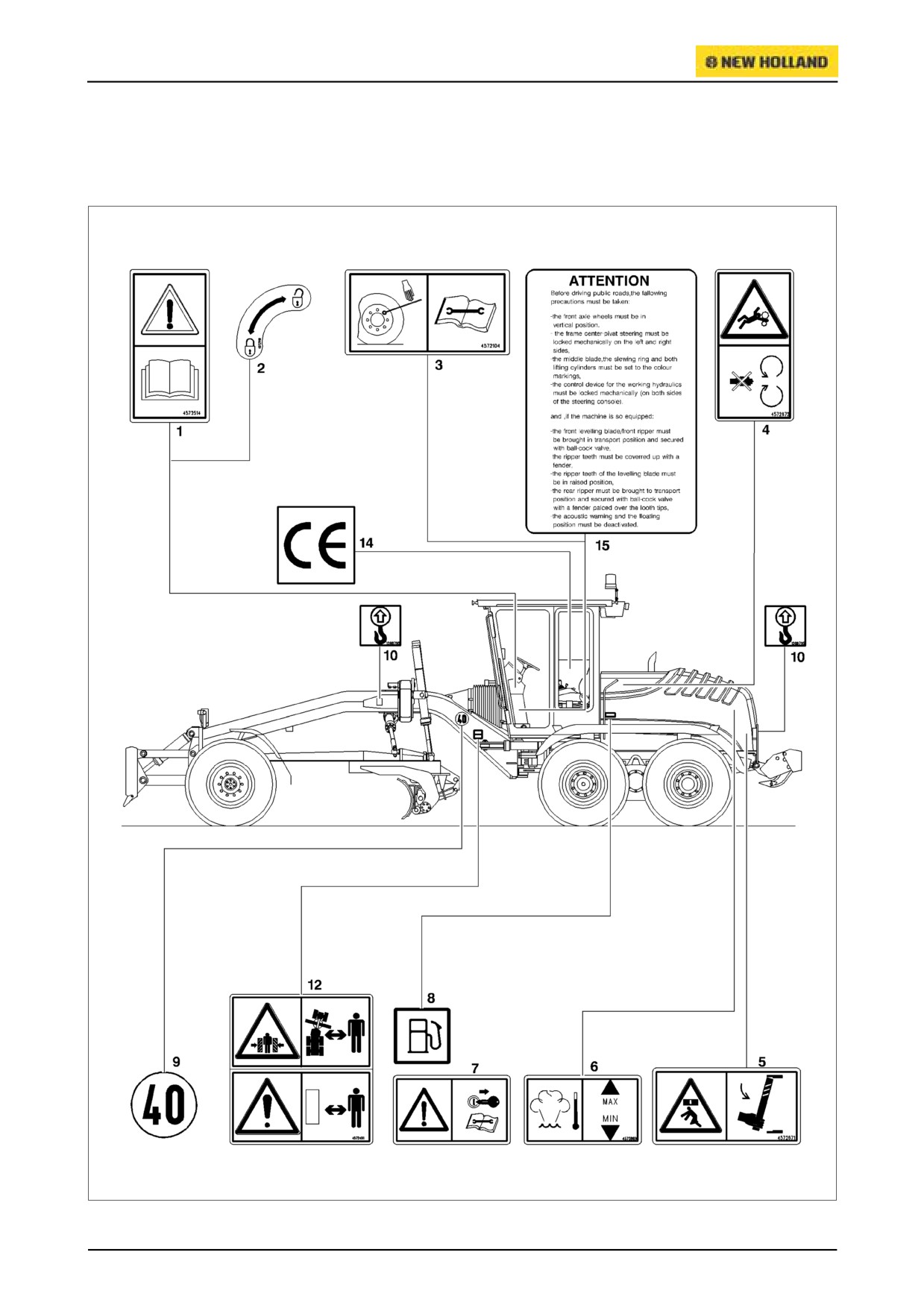
WARNING AND INSTRUCTION PLATES
2.1
Left side of vehicle
GT3_00_001
0 - 12
87726937A
Edition 12/2007
REPAIR INSTRUCTIONS
F106.6 / F106.6A
SAFETY INSTRUCTIONS
F156.6 / F156.6A
CAUTION: Read the warning signs and instruction plates on the machine.
Keep these signs and plates clean and legible.
Replace these plates immediately if they are no longer legible.
New warning signs and instruction plates can be obtained from the spare parts department. When ordering,
part numbers can be found on the replacement parts lists for the machine.
Legend for left side
1.
Do not start up the machine before you have read and understood the operating instructions.
2.
At this point, the equipment can be secured against accidental start-up.
3.
Inspect wheel nuts regularly - see the operating instructions.
4.
Risk of injury from hot or rotating parts in the engine compartment. Only open the engine compartment
cover when the engine has stopped.
7.
Risk of injury due to unauthorized starting of the machine. Before working on the machine, switch off the
engine and remove the key.
9.
This plate indicates the maximum speed permitted on public roads.
10. Lashing ropes or chains must be attached here if the machine is to be transported.
11. Risk of injury due to hot or pressurized hydraulic fluid. Follow the operating instructions.
12. Risk of injury by crushing. Do not start up the machine if anyone is near the articulated joint.
Risk of injury by crushing. Do not start up the machine if anyone is standing between the machine and
an adjoining barrier.
14. The CE symbol certifies that this machine has been constructed according to the European regulations
on mechanical safety. LWA indicates the level of noise emissions in dBA, as stated in EC standard
2007/14/EG).
15. Driving on public roads. This plate indicates the steps to be taken before driving on public roads.
Edition 12/2007
87726937A
0 - 13
REPAIR INSTRUCTIONS
F106.6 / F106.6A
SAFETY INSTRUCTIONS
F156.6 / F156.6A
2.2
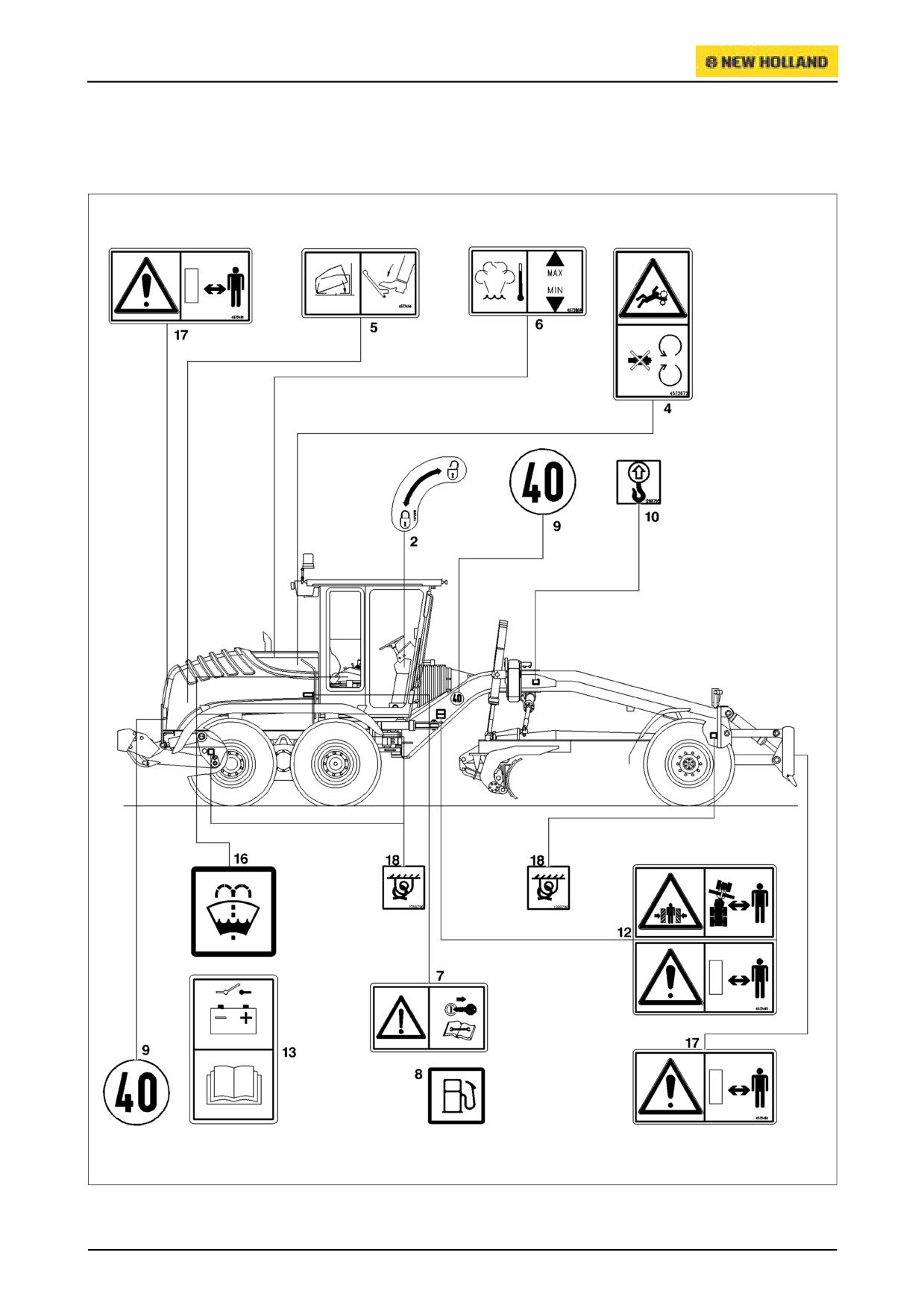
Right side of vehicle
GT3_00_002
0 - 14
87726937A
Edition 12/2007
REPAIR INSTRUCTIONS
F106.6 / F106.6A
SAFETY INSTRUCTIONS
F156.6 / F156.6A
CAUTION: Read the warning signs and instruction plates on the machine.
Keep these signs and plates clean and legible.
Replace them immediately if they are no longer legible.
New warning and instruction plates can be obtained from the spare parts department. When ordering, part
numbers can be found on the replacement parts lists for the machine.
Legend for left side
2.
At this point, the equipment can be protected from accidental start-up.
4.
Risk of injury from hot or rotating parts in the engine compartment. Only open the engine compartment
cover when the engine has stopped.
5.
Risk of injury if engine hood falls shut. Close the engine hood by releasing the safety rod with the foot.
Read the operating instructions before carrying out repair / maintenance work.
6.
Risk of injury from hot coolant. Only take off the radiator cap once the radiator has cooled down.
Coolant level marking.
7.
Risk of injury due to unauthorized starting of the machine. Before working on the machine, switch off the
engine and remove the key.
8.
Fuel tank, fill with diesel fuel here.
9.
This plate indicates the maximum speed permitted on public roads.
10. Lashing ropes or chains must be attached here if the machine is to be transported.
12. Risk of injury by crushing. Do not start up the machine if anyone is near the articulated joint.
Risk of injury by crushing. Do not start up the machine if anyone is standing between the machine and
an adjoining barrier.
13. Alternator, regulator and electronic assemblies may be damaged if the battery is disconnected while the
engine is running. Therefore, switch off the engine before disconnecting and removing the battery.
16. Windscreen washer system. Water can be added here for the windscreen washer system.
17. Risk of injury by crushing. Do not start up the machine if anyone is standing between the machine and
an adjoining barrier.
Edition 12/2007
87726937A
0 - 15
REPAIR INSTRUCTIONS
F106.6 / F106.6A
SAFETY INSTRUCTIONS
F156.6 / F156.6A
NOTES:
0 - 16
87726937A
Edition 12/2007
REPAIR INSTRUCTIONS
F106.6 / F106.6A
SAFETY INSTRUCTIONS
F156.6 / F156.6A
3
OPERATION
3.1
General Remarks
OPERATING CONDITION OF THE MACHINE
Only operate the machine if in a reliable operating
Do not operate the machine until you have read and
condition, and only as required by the regulations.
understood the operating instructions.
Always follow the safety instructions.
Pay particular attention to:
Always carry out inspections and maintenance work
punctually (or have them carried out).
the ‘Basic Safety Information’ and all the warning
signs and instruction plates attached to
the
Only operate the machine with the attachments and
machine.
component combinations approved by the
manufacturer. See the Technical Data for clear
Before starting the machine, familiarize yourself with
information on this subject.
the locations, functions and operating directions of
the controls. Operate the controls only from the
Only attach and work with different equipment or
driver’s seat.
component combinations if the manufacturer has
checked and approved the planned type of
Keep the operating instructions stored permanently
assembly.
at the machine.
Before starting work / driving, check whether the
brake, steering, lighting and signalling systems are
OPERATING PERSONNEL
operational.
Operating personnel must be experienced in
working with and operating this or similar machines.
Poor visibility can lead to accidents. Clean the
windows, and the lenses on lamps, before operating
The required skills can be acquired through a
the machine.
course of instruction lasting a few days, which could
be provided by a service technician, or by attending
Check whether all warning signs and instruction
a driver training course.
plates on the machine are present, and that they are
clearly legible.
PERSONAL PROTECTIVE EQUIPMENT AND
GETTING IN AND OUT
WORK CLOTHES
Face towards the machine when getting in or out.
Wear a hard hat and protective shoes with non-slip
soles. Smooth soles can slip on steps and pedals,
Use only the steps, platforms and handles provided
thus causing injuries or operator errors.
when getting in or out.
Wear close-fitting work clothes when operating the
Keep steps, platforms and handles in a condition
machine. Loose or wide items of clothing can cause
where they provide a secure grip. Clean them
the control lever to be operated accidentally.
immediately if they become soiled with oil, grease,
soil, mud, snow, ice, or other matter.
SEAT BELT
On machines with seat belts for operating
DANGER AREA
personnel:
The danger area is that area around the machine
Check the seat belt attached to the driver’s seat.
where anyone might come within the range of
Replace immediately if damaged, or after an
movement of the machine, its working equipment
accident. Put the seat belt on before starting work.
and attachments, swinging loads, falling loads, or
downward moving tools.
Edition 12/2007
87726937A
0 - 17
REPAIR INSTRUCTIONS
F106.6 / F106.6A
SAFETY INSTRUCTIONS
F156.6 / F156.6A
PERSONS IN THE DANGER AREA
Warn bystanders with a horn signal before starting
the machine.
Check that no one is standing within the danger
area around the machine. Stop working until all
persons have moved out of the danger area.
MARSHALLER
The marshaller must stand outside the danger area.
You should have the marshaller assist you:
• if you are unable to see the entire danger area
around the machine,
• when reversing,
• when manoeuvring.
Use only signs that will be understood both by you and
the marshaller, or use a communication device (for
example radio telephone / camera). The marshaller
will not be able to understand unaided speech
because of the operating noise from the machine.
Remain in constant contact with the marshaller.
Stop the machine immediately, if your lose contact
with the marshaller.
SECURING THE MACHINE
Secure the machine as described in the section
‘Securing the machine’, before:
• attaching/removing working equipment,
• switching the machine off after everyday
operations,
• carrying out maintenance or repair work.
0 - 18
87726937A
Edition 12/2007
REPAIR INSTRUCTIONS
F106.6 / F106.6A
SAFETY INSTRUCTIONS
F156.6 / F156.6A
3.2
Fuelling
FUELLING FROM CANS
If the machine is mostly or regularly fuelled from
RISK OF EXPLOSION
cans or drums, there is a greater risk that dirt
Fuel and fuel vapour are easily ignited and can
particles and water will penetrate into the fuel
explode into flame. Therefore, avoid causing sparks
system.
and do not use naked flames such as lighters or
matches for illumination.
In this case:
• always pour in the fuel through a fine-mesh
strainer
POSSIBLE RISKS TO HEALTH
• only use siphon pipes along with a fine filter
Diesel fuel and fuel vapour can be injurious to
health. Fuel should not be swallowed. Also, avoid
• drain the fuel filter more often than indicated
prolonged contact with the skin. Do not inhale fuel
in the maintenance plan
vapour. Wear protective gloves or use a barrier
• drain the water and sediment from the fuel
cream. Do not eat, drink or smoke while fuelling.
tank more often
• replace all fuel filters at shorter intervals.
AVOIDING DAMAGE TO THE ENVIRONMENT
Avoid allowing fuel to overflow. Do not allow fuel to
CAUTION: NEVER FILL WITH BIODIESEL
penetrate into the soil, as this is dangerous for the
environment.
Biodiesel can damage the engine and injection
system.
Spilled fuel should be soaked up immediately with a
cleaning cloth or binding agent, then disposed of in
Use only diesel fuel produced from mineral oil,
an environmentally responsible way.
which meets EN 590 standard. For more
information, contact your dealer’s service
Fuel accidents should be reported immediately to
department.
the licensee or his agent.
SECURING THE MACHINE
When fuelling, secure the machine to prevent
unauthorized start-up:
Park the machine on level ground with sufficient
load-carrying capacity, lower the working equipment
to the ground, switch off fuel-driven auxiliary heaters
and air conditioning systems, switch off the engine,
apply the hand brake, take the key out of the key
switch for the electrical system.
Fuelling always takes place on the ground, with the
operator in standing position.
FUELLING
Read and apply the ‘Fuelling safety instructions’
before filling up with fuel.
Edition 12/2007
87726937A
0 - 19
REPAIR INSTRUCTIONS
F106.6 / F106.6A
SAFETY INSTRUCTIONS
F156.6 / F156.6A
3.3
Fuelling system (optional)
RISK OF EXPLOSION!
Do not smoke, and keep away from naked flames.
Fuel and fuel vapour are inflammable; Danger of
fire.
Switch off fuel-driven auxiliary heaters and air
conditioning systems.
PROTECTING HEALTH AND THE ENVIRONMENT
Fuel can be harmful to the skin, so wear protective
gloves or use a barrier cream.
Do not spill fuel or allow it to penetrate the soil - this
would endanger the environment. Spilled fuel
should be soaked up immediately with a cleaning
cloth or binding agent, then disposed of in an
environmentally responsible way.
Report accidents with fuel immediately to the
machine licensee, or his agent.
SECURING THE MACHINE
When fuelling, secure the machine to prevent
unauthorized start-up:
• Lower working equipment to the ground
• Switch off the engine
• Take the key out of the electrical system key
switch.
INCREASED RISK OF CONTAMINATION
If the machine is mostly or regularly fuelled from
tanks or drums, there is an increased risk of
contamination of the fuel system.
In this case, the fuel prefilter must be drained and
cleaned more often than indicated in
the
maintenance plan.
The fuel filter must also be replaced at shorter
intervals.
0 - 20
87726937A
Edition 12/2007
REPAIR INSTRUCTIONS
F106.6 / F106.6A
SAFETY INSTRUCTIONS
F156.6 / F156.6A
3.4
Driving
DRIVING OVER LONGER DISTANCES
The share should not extend into the steering area
BEFORE MOVING OFF
of the front wheels, or of the steering linkage.
Before operating the machine, clean your work
shoes to remove clinging soil, mud, snow, ice,
The central warning lamp should not flash when the
grease and oil. These could cause the shoes to slip
driver enters, otherwise determine the cause and
on the steps or pedals, thus causing unwanted
switch off.
movements.
If driving on public roads:
Before moving off, adjust the driver’s seat, steering
• Keep to the conditions of the general
column and mirror, and fasten your seat belt.
operating licence.
Do not carry passengers on the machine.
• Close the driver cab doors.
• Take along a first-aid box, hazard warning
Before moving off, warn any bystanders with the
triangle and warning lamp.
signal horn.
• Check the content of the first-aid box. Replace
items that have been used, or which have
become unusable.
NO TOWING
With the engine running, check:
This machine is not suitable for towing trailers or
• that the steering wheel moves easily, by
other vehicles; Doing so would cause damage to
turning it briefly to the left and right, and that
axles and gears. The tow coupling is intended only
the steering gear responds.
for towing or recovering the machine from hazard
areas, or for lashing onto transport vehicles; see
• Drive a short distance and operate the brake
‘Towing/recovery’.
to check that the service brake is working
effectively.
Never allow the machine to roll with the gear lever in
DRIVING WITH HANGING LOADS
the ‘N’ position, for example when driving downhill.
Ensure that the wheels provide sufficient ground
If driving with the door open, this should be engaged
adhesion; only this will ensure braking/steering
in the end position.
effectiveness. Do not drive with hanging loads
Before moving off, bring the machine up to
positioned cross-wise; Do not attempt a U-turn with
operating temperature as described in the
such loads. Do not attempt to position such loads
‘Operating instructions - warming up’.
using the articulated joint.
Only then should the engine be placed under full
load.
REVERSING
When reversing, the view of the danger area is
reduced. Therefore, obtain assistance from an
experienced marshaller. Agree on the meaning of
signals with the marshaller, to ensure that the
signals from the marshaller are correctly
understood.
PARKING THE MACHINE
Machines parked on slopes can move off by
themselves.
Therefore, always park the machine on an even,
horizontal surface, lower the working equipment
and its support to the ground.
Edition 12/2007
87726937A
0 - 21
REPAIR INSTRUCTIONS
F106.6 / F106.6A
SAFETY INSTRUCTIONS
F156.6 / F156.6A
SEAT BELT
Fasten your seat belt before every trip.
Do not pass the seat belt over rigid or breakable
objects, for example a bunch of keys or spectacles.
This could result in bodily injuries.
The seat belt must always lie firmly against the body
and should not catch on anything.
The belt buckle guide should not be obstructed (for
example, with papers), otherwise the buckle tongue
will not engage.
Seat belts that are damaged, or which were
stressed during an accident and have therefore
been stretched, must be replaced.
ADJUSTING THE STEERING COLUMN
Do not adjust the steering column while driving.
Your attention will be distracted
- RISK OF
ACCIDENT!
Before adjusting the steering column:
• Stop the machine
• Gear lever in neutral position
• Apply the hand brake
0 - 22
87726937A
Edition 12/2007
REPAIR INSTRUCTIONS
F106.6 / F106.6A
SAFETY INSTRUCTIONS
F156.6 / F156.6A
3.5
Towing /recovery
3.5.2
Transport
Only load up and transport the machine if all the
Tow the machine with the tow bar or tow rope only.
requirements of the safety regulations are met.
The tow bar / tow rope should not be damaged.
Arrange the loading and transport with a company
It must be designed so that the calculated load at
that is experienced in the transport of abnormal
rupture is three times the tractive force of the towing
loads.
machine.
Responsibility for the loading and transport is borne
The towing vehicle must have sufficient tractive
by the transport company or their authorised
force. Drive slowly and carefully.
representative.
To reduce the risk of slipping, clean the drive-on
No one should be standing near the tow bar/rope.
ramps and loading area on the transport vehicle,
Only tow the machine if the brakes and steering are
and the wheels of the machine, to remove oil,
functional and the machine cannot be transported
grease, soil, mud, snow, ice and other matter.
any other way.
Use anchoring equipment with sufficient
If these are not functional, only tow the machine as
load-holding capacity (for the weight specifications
far as is necessary to recover the machine from
of the machine, see the ‘Technical Data’ section).
danger areas.
After recovery, the machine must be secured to
3.5.3
Crane loading
prevent it rolling, and prevent unauthorized start-up.
If loading with a crane, lock the articulated joint.
Before transporting over long distances, either
repair the machine or load it onto a transport
vehicle.
Towing speed should not go above 10 km/h.
Tow the machine out of the danger area only,
otherwise tow it on a low-bed trailer.
Towing any further can cause damage to the
transmission.
3.5.1
Towing devices
The towing devices should not be used for towing
trailers.
Edition 12/2007
87726937A
0 - 23
REPAIR INSTRUCTIONS
F106.6 / F106.6A
SAFETY INSTRUCTIONS
F156.6 / F156.6A
3.6
Everyday operation
3.7
Using the grader
Read carefully through the sections ‘Basic safety
Due to the versatility of the grader and the diversity
instructions’ and ‘Operation - General information’
of the materials, there are many possible
and follow the instructions given.
applications and working methods. We therefore
recommend having the driver instructed by the
Before starting work, examine the worksite for
manufacturer.
embedded gas and water pipes, and electrical
Read and pay attention to: ‘Operating instructions -
power lines. Damaging these lines can cause a
Warming up’.
life-threatening situation!
Do not exceed the machine’s permitted
Before operating the machine, clean your work
transverse/longitudinal tilt angle. Doing so will
shoes to remove clinging soil, mud, snow, ice,
reduce or interrupt the engine lubrication.
grease and oil.
These could cause the shoes to slip on the steps or
The permitted tilt angles of the machine are:
pedals, thus causing unwanted movements.
• Transverse tilt:
Left / right 35° 35°
If driving with the door open, engage the door in the
end position.
• Longitudinal tilt:
Downward / upward 35° 35°
Warn bystanders with a horn signal before starting
work.
If the engine temperature, oil pressure or alternator
warning lamps come on, lower the working
Do not drive with hanging loads positioned
equipment immediately and switch the engine off.
cross-wise.
Do not attempt a U-turn with such loads. Do not
attempt to position such loads using the articulated
joint.
Stop working if anyone is standing within the danger
area around the machine. Start working only when
all persons have moved out of the danger area.
Always operate and use the machine in such a way
that it remains stable.
Ditches and trenches can collapse. Keep at a safe
distance.
0 - 24
87726937A
Edition 12/2007
REPAIR INSTRUCTIONS
F106.6 / F106.6A
SAFETY INSTRUCTIONS
F156.6 / F156.6A
3.8
Working equipment
SECURING THE WORKING EQUIPMENT
Lower the working equipment to the ground, so that
PERSONNEL
it will not move when mechanical or hydraulic
The assembly operations should be carried out only
connections are loosened.
by operating or maintenance personnel who
possess the required skills.
If the machine has to be jacked up, secure the front
axle with wedges to prevent swinging.
If the personnel lack the necessary skills, they
should be carefully guided by experienced
If working near the articulation, lock the joint.
personnel.
Remove all locking and securing devices when the
work is complete.
They must have read and understood the operating
instructions,
particularly
the
‘Basic safety
If work tools or tool parts are to be attached or
information’ section.
removed, or adjusted while in position, they should
be secured with suspension/propping equipment to
During the assembly operations, only experienced
prevent unintentional movement, slipping or falling.
personnel must be allowed to start the machine in
order to make adjustments to the working tool.
SECURING THE MACHINE
Operator errors with the machine or the working
Only carry out work on the working equipment if the
equipment can result in life-threatening situations.
machine has been secured as described in the
section ‘Securing the machine’.
PERSONAL PROTECTIVE EQUIPMENT AND
WORK CLOTHES
CHOOSING THE WORKING EQUIPMENT
Wear close-fitting work clothes when working with
The machine can be equipped with a variety of
the machine. Loose or wide items of clothing can
working equipment. The components of the working
become caught in machine parts, and thus cause
equipment are made up of hydraulic cylinders and
injuries.
connecting parts. Various component combinations
are possible in order to adapt the working
Wear a hard hat, protective shoes and gloves.
equipment optimally to the type of application.
Only use equipment and component combinations
TOOLS AND ACCESSORIES
with the machine, if these have been expressly
Tools, lifting gear, lifting accessories, support frames
approved by the manufacturer for this machine.
and other equipment must be in a reliable working
condition.
Equipment supplied by other manufacturers, to
which EC machines guideline 89/392 EWG applies,
When driving in or removing fastening bolts, metal
should only be attached and operated if they carry:
splinters may fly off and cause injury. Therefore, use
a brass or copper drift for driving in or removing
• the manufacturer’s statement of conformity,
bolts, and wear safety glasses.
• the statement of compatibility.
Use only the steps, platforms and handles provided
when getting in or out.
Keep steps, platforms and handles in a condition
where they provide a secure grip. Clean them
immediately if they become soiled with oil, grease,
soil, mud, snow, ice, or other matter.
Edition 12/2007
87726937A
0 - 25
REPAIR INSTRUCTIONS
F106.6 / F106.6A
SAFETY INSTRUCTIONS
F156.6 / F156.6A
3.9
SECURING THE MACHINE
RISK OF INJURY
The machine should not be started by unauthorized
persons.
It should therefore be protected.
Secure the machine as described below:
• Before any maintenance or repair work on the
machine.
• Whenever attaching or changing the working
equipment.
• Park the machine on level ground with
sufficient load-carrying capacity.
• Lower the working equipment to the ground.
• Apply the hand brake.
NOTE: Do not stop the engine when under full
load, but let it run for about three to five minutes to
allow temperature balancing.
• Switch off the engine.
• Take the key out of the electrical system key
switch.
• Depressurize the hydraulic system.
• Lock the articulated joint.
• Secure open engine hoods.
• Secure the machine with chocks to prevent it
rolling.
• Switch off the battery main switch and remove
the control lever.
• Before working on the electrical system,
disconnect the batteries.
• Before carrying out welding operations on the
machine, read the section ‘Repair - Welding
work’.
0 - 26
87726937A
Edition 12/2007
REPAIR INSTRUCTIONS
F106.6 / F106.6A
SAFETY INSTRUCTIONS
F156.6 / F156.6A
4
INSPECTION AND MAINTENANCE
4.1
General information
If working equipment or tool parts are to be attached
or removed, or adjusted while in position, they
Repair manual
should be secured with suspension/propping
Before starting work, personnel appointed to carry
equipment to prevent unintentional movement,
out work on the machine must have read and
slipping or falling.
understood the repair manual.
Pay particular attention to:
SECURING THE MACHINE
‘Basic Safety Information’ and all the warning signs
Only carry out work on the working equipment if the
and instruction plates attached to the machine.
machine has been secured as described in the
section ‘Securing the machine’.
The repair manual contains all the technical
information necessary for carrying out maintenance
GETTING IN AND OUT
and repair work on the machine. Work on the
machine should only be carried out by personnel
Use only the steps, platforms and handles provided
trained for this purpose!
when getting in or out.
Keep steps, platforms and handles in a condition
INSPECTION AND MAINTENANCE PERSONNEL
where they provide a secure grip. Clean them
The inspecting and maintenance personnel must
immediately if they become soiled with oil, grease,
have experience in the inspection and maintenance
soil, mud, snow, ice, or other matter.
of these or similar machines.
Face towards the machine when getting in or out.
The required skills can be acquired through a
course of instruction lasting a few days, which could
be provided by a service technician, or by attending
CHECK THE CONDITION OF TOOLS
a driver training course.
Only work with fully functional and reliable tools.
Choose only tools that are suitable for the task.
PERSONAL PROTECTIVE EQUIPMENT AND
WORK CLOTHES
Ill-fitting wrenches, for example, may slip off and
Wear close-fitting work clothes when working with
cause injury.
the machine. Loose or wide items of clothing can
become caught in machine parts, and thus cause
injuries.
CLEANING OPERATIONS
Before starting work, clean up any assemblies
Wear a hard hat, protective shoes and gloves, and
located in the work area.
ear protection if there is loud noise.
The choice of cleaning agent will depend on the type
of material in the parts to be cleaned.
SECURING THE WORKING EQUIPMENT
Lower the working equipment to the ground, so that
Example: Do not use solvents or steam jets to clean
it will not move when mechanical or hydraulic
electrical or rubber components.
connections are loosened.
If working near the articulation, lock the joint.
Remove all locking and securing devices when the
work is complete. If the machine has to be jacked
up, secure the front axle with wedges to prevent
swinging.
Edition 12/2007
87726937A
0 - 27
REPAIR INSTRUCTIONS
F106.6 / F106.6A
SAFETY INSTRUCTIONS
F156.6 / F156.6A
Use only fibre-free cleaning cloths to clean the
Stand out of the direction of the oil spray.
hydraulic system or the engine.
Avoid contact with the skin. Wear gloves and
Cleaning agents and solvents can give off highly
close-fitting work clothes.
inflammable or noxious vapours.
Only use such products in areas that are well
Old oils can be injurious to health if they come into
ventilated - do not inhale the vapour, and do not
contact with the skin. If this occurs, wash the skin
smoke.
thoroughly with warm soapy water and apply a
Do not allow cleaning agents and solvents to come
protective cream. Do not use fuels or solvents to
into contact with the skin. Wear solvent-resistant
clean the skin.
gloves.
Follow the instructions on the product packaging.
If you have accidentally swallowed oil, do not induce
vomiting, but seek medial assistance immediately.
HANDLING COMBUSTIBLE FLUIDS
When handling combustible fluids:
VISIBLE OIL LEAKS
If there is a visible oil leak, repair the leak
• do not smoke,
immediately.
• no open lights or naked flames.
Leaking oil is a danger to the environment!
Fuel and other operating fluids often have low
flashpoints and are easily ignited.
Use an oil binding agent to absorb any spilled oil.
Gather up the binding agent and dispose of
Do not use water to extinguish burning fluids. Use
separately from other waste.
the following:
• powder extinguisher,
RELEASE RESIDUAL PRESSURE IN THE
• carbon dioxide or
HYDRAULIC SYSTEM
• foam extinguishing equipment.
Hydraulic systems should only be opened after they
have been depressurized. Even when the machine
When it comes into contact with burning fluids,
is parked on a horizontal surface, the working
water will vaporise abruptly and cause burning oil to
equipment lowered to the ground, and the drive
spray over a large area.
motor switched off, a considerable amount of
residual pressure can remain in some parts of the
hydraulic system, for example, primary pressure
Water will cause short-circuiting in the electrical
due to the final hydraulic movements before the
system, thus possibly creating additional dangers.
machine stops.
Notify the fire department.
Residual pressure is only released gradually. If work
on the hydraulic system is required immediately
FASTENINGS AND FIXING ELEMENTS
after switching off, release the residual pressure as
Check fastenings and fixing elements, for example,
described in the section ‘Hydraulic system’.
bolts, nuts, washers, before re-using.
Replace damaged parts.
HANDLING OILS AND LUBRICANTS
Risk of burns due to the uncontrolled release of hot
lubricants or hydraulic fluid.
If burns occur, chill immediately with running water,
then apply a dry bandage.
0 - 28
87726937A
Edition 12/2007
REPAIR INSTRUCTIONS
F106.6 / F106.6A
SAFETY INSTRUCTIONS
F156.6 / F156.6A
SCREW CONNECTIONS, PIPES, HYDRAULIC
ENGINE EXHAUST
HOSES
Exhaust gases are harmful to health - do not inhale.
Repair any leaks in the pipe system immediately.
If working in enclosed spaces an exhaust gases are
A fine spray of hydraulic fluid at high pressure can
present, use an extractor to evacuate the gases and
penetrate the skin.
keep the room well ventilated.
Do not try to locate leaks with the fingers, but use a
piece of cardboard and wear protective goggles.
HANDLING BATTERIES
Batteries give off explosive gases.
If fluid has penetrated the skin, seek medical
assistance immediately.
Do not bring open lights or naked flames near
batteries, and do not smoke.
Do not repair damaged pipes, but replace them with
new ones.
Remove the batteries, if welding or grinding work is
to be carried out nearby. Take the batteries to a safe
distance.
Replace hydraulic hoses immediately if there is
visible damage or seepage.
Battery acid is poisonous and corrosive.
Only re-tighten leaking screw plugs after
depressurizing.
Avoid contact with the skin, mouth, eyes and
clothing. Do not spill battery acid, and do not inhale
acid vapour.
Leaking oil is a danger to the environment!
When handling batteries, wear acid-resistant
DISPOSE OF ENVIRONMENTALLY
gloves, close-fitting clothes and protective goggles.
Oil, grease, brake fluid, cleaning agents, solvents
and parts containing oil, for example, filters,
If acid comes into contact with the skin, wash
cleaning cloths, replaced parts and unusable
thoroughly with water and seek medical assistance.
machine parts should be disposed of separately
from each other, with respect for the environment.
If acid spray gets into the eyes, rinse thoroughly with
running water and call an eye specialist
Do not include these materials with normal
immediately, or go to a hospital A&E department.
household waste.
Do not place tools on the battery. This can cause a
Put them into the containers provided for this
short circuit, which would ruin the battery and could
purpose.
cause injury.
Even
bio-degradable
‘environment-friendly’
Do not wear metal necklaces, bracelets or watch
hydraulic fluid must be disposed of separately, like
straps when working on the battery. Metal parts can
any other oil.
cause a short circuit and possible burn injuries.
Do not allow oils and oily waste to penetrate the soil
Dispose of old batteries separately from other
or water courses, as this would endanger the
waste, and with respect for the environment.
environment!
SEALING SURFACES
Clean the sealing surfaces before assembling.
Edition 12/2007
87726937A
0 - 29
REPAIR INSTRUCTIONS
F106.6 / F106.6A
SAFETY INSTRUCTIONS
F156.6 / F156.6A
BEFORE WORKING ON THE ELECTRICAL
AFTER MAINTENANCE
SYSTEM
To prevent corrosion damage, coat all bare metal
Before working on the electrical system, when there
machine parts with a film of grease.
is a possibility of tools, spare parts, etc. touching
electric wires and contacts, disconnect the battery:
When the work is completed, re-attach all safety
• disconnect the negative terminal first, then the
devices.
positive.
When work is complete:
Only start the drive motor when no one is working on
the machine.
• connect the positive terminal first, then the
negative.
Carry out a function test on the machine.
Read and pay attention to the ‘Electrical system’
section.
CHOOSING OILS / LUBRICANTS
Only use the recommended grades, select
viscosities according to temperature level.
FILTERS
Replace all filter elements and cartridges at the
specified intervals.
All filters are carefully selected to suit the equipment
concerned. Trouble-free operation and long service
life for the engine and hydraulic assemblies can only
be ensured by using original replacement parts.
SEALS
When removing components, pay attention to their
seals.
Before installing, check the seals and replace them
even if only slightly damaged.
Check that they are correctly seated when
assembling.
CHECK OIL LEVEL / OIL CHANGE
Place the machine horizontally. Change the oil when
the machine is warm. Warm oil flows better and
carries particles in suspension better (oil carbon and
abrasion particles).
GREASE LUBRICATION
Clean the lubricating nipples, then lubricate as
indicated in the lubrication plan.
0 - 30
87726937A
Edition 12/2007
REPAIR INSTRUCTIONS
F106.6 / F106.6A
SAFETY INSTRUCTIONS
F156.6 / F156.6A
4.2
Fuel system
FUELLING FROM CANS
If the machine is mostly or regularly fuelled from
RISK OF EXPLOSION DUE TO FUEL VAPOUR
cans or drums, there is a greater risk that dirt
Fuel vapour is highly inflammable and can burst into
particles and water will penetrate into the fuel
flame. Therefore, avoid causing sparks and do not
system.
use naked flames such as lighters or matches for
In this case:
illumination.
•
always pour in the fuel through a fine-mesh
strainer,
If you have to work on the fuel system:
•
drain the fuel filter more often than indicated
• switch off the engine and auxiliary heater,
in the maintenance plan,
• secure the machine,
•
drain the water and sediment from the fuel
• avoid using naked flames,
tank at shorter intervals,
• do not eat, drink or smoke.
•
replace all fuel filters at shorter intervals.
POSSIBLE RISKS TO HEALTH
Diesel fuel and drained water / fuel mixtures can be
injurious to health. These fluids are harmful if
swallowed.
Also, avoid prolonged contact with the skin.
Do not inhale fuel vapour. Wear protective gloves or
use a barrier cream.
AVOIDING DAMAGE TO THE ENVIRONMENT
Collect overflowing fuel in a container and dispose
of it without causing damage to the environment.
Dispose of fuel filters and fuel-soaked cleaning
cloths separately from other waste.
NOTE: NEVER FILL WITH BIODIESEL!
Biodiesel can damage the engine and injection
system.
Use only diesel fuel produced from mineral oil,
which meets EN 590 standard.
For more information, contact your dealer’s service
department.
Edition 12/2007
87726937A
0 - 31
REPAIR INSTRUCTIONS
F106.6 / F106.6A
SAFETY INSTRUCTIONS
F156.6 / F156.6A
4.3
Electrical system
ALTERNATOR
Never disconnect the electrical connections at the
Risk of injury from battery acid and gases.
alternator, regulator or battery while the engine is
running.
Wear protective goggles, work gloves and
close-fitting work clothes.
This will damage the alternator and regulator.
BEFORE WORKING ON THE ELECTRICAL
When connecting the batteries, do not mix up the
SYSTEM
cables (check the polarities).
Switch off the engine.
Use only measuring instruments for carrying out
Turn the electrical system key switch to the 0 and
voltage tests and continuity checks.
take out the key.
Do not use test lamps.
Turn the battery main switch to the OFF position and
remove the control lever.
Do not ‘short to ground’.
Disconnect the control units and control console
The resulting short circuit will cause damage to the
from the on-board electrical system.
alternator and regulator.
Before working on the electrical system, when there
When the engine is started, the alternator is
is a possibility of tools, spare parts, etc. touching
actuated
(pre-excited) by an electronic circuit.
electric wires and contacts, disconnect the batteries.
This ensures that the alternator is able to deliver
• Disconnect the negative terminal first, then
power.
the positive.
This circuit is part of the main electronic system in
When work is complete:
the control console.
• connect the positive terminal first, then the
negative.
A LED (charge indicator) on the control console
indicates whether the alternator is functioning
Read and apply the
‘Operating instructions-
correctly. This LED must light up when the key
Alternator, control units and control console’.
switch is turned to the On position; it should go off
once the engine is running.
Read and pay attention to the section ‘Inspection
and maintenance - General information’.
If this is not the case, then there is a fault in the
alternator electrical circuit or in the control console.
Use only measuring instruments for carrying out
voltage tests and continuity checks. Do not use test
To prevent further damage, the cause of the fault
lamps.
must be found and resolved as quickly as possible.
Do not ‘short to ground’.
Contact your dealer’s service department.
The resulting short circuit will cause damage to the
alternator or to the electronics.
0 - 32
87726937A
Edition 12/2007