New Holland F156.6 / F156.6A GRADER. Workshop Manual
F156.6
F156.6A
GRADER
Workshop Manual
Print No. 604.13.572 English
III - 2005
THIS ALERT SYMBOL SIGNALS IMPORTANT MESSAGES INVOLVING YOUR SAFETY.
Read and heed carefully the safety instructions listed and follow the precautions recommended to
avoid potential risks and to safeguard your health and your safety.
You will find this symbol in the text of this Manual referred to the following key words:
WARNING - Cautions directed to avoid improper repair interventions involving potential consequences
for the safety of the personnel performing the repairs.
DANGER - These warnings qualify specifically potential dangers for the safety of the operator or other
persons directly or indirectly involved.
IMPORTANT NOTICE
All maintenance and repair interventions explained in this Manual must be performed exclusively by the
Service Organisation of the Manufacturer, observing strictly the instructions explained using, whenever
necessary, the recommended specific tools.
Whoever performs the operations reported without following exactly the precautions is responsible on his own,
for the damages that may result.
Neither the Factory nor any Organisations in its Distribution Network, including but not limited to national,
regional or local distributors, are responsible for any liability arising from any damage resulting from defects
caused by parts and/or components not approved by the Factory for use in maintaining and/or repairing prod-
ucts manufactured or merchandised by the Factory.
In any case, no warranty of any kind is made or shall be imposed with respect to products manufactured or
merchandised by the Factory, when failures are caused by the use of parts and/or components not approved
by the Factory.
AVOID ACCIDENTS
Most accidents, whether they occur in industry, on the
farm, at home or on the road, are caused by the fail-
ure of some individuals to follow simple and funda-
mental safety rules and precautions. For this reason
MOST ACCIDENTS CAN BE PREVENTED by recog-
nising the real cause and doing something aboiut it
before the accident occurs.
Regardless of the care used in the design and con-
struction of any type of equipment, there are many
conditions that cannot be completely safeguarded
against without interfering in the reasonable accessi-
bility and efficient operation.
A carefull operator is the best insurance against an
accident. The complete observance of one simple
rule would prevent many serious accidents.
The rule is simple: never attempt to clean, lubricate or
maintain a machine while it is in motion.
WARNING
Prior to engaging in any maintenance, adjustment
or repair operation on machines having hydrauli-
cally, mechanically, and/or cable controlled equip-
ment (such as shovels, loaders, dozers, excavators
etc.) be certain the equipment is lowered to the
ground.
If it is necessary to have the equipment partially or
fully raised to gain access to certain items, be sure
the equipment is suitably supported by means
other than the devices used for controlling the
equipment.
SUMMARY
SAFETY INSTRUCTIONS
SECTION 0
TECHNICAL DATA
SECTION 1
ENGINE
SECTION 2
TRANSMISSION
SECTION 3
REAR AXLE
SECTION 4
FRONT AXLE
SECTION 5
ATTACHMENT
SECTION 6
HYDRAULIC SYSTEM
SECTION 7
BRAKE SYSTEM
SECTION 8
STEERING SYSTEM
SECTION 9
ELECTRICAL SYSTEM
SECTION 10
OPERATOR’S CAB
SECTION 11
F156.6 / F156.6A
INTRODUCTION
IN - 1
FOR THE READER
- information for carrying out the performance tests
on the machine;
This Workshop Manual is written for the Repair-
- troubleshooting, information concerning the rec-
Technician. It provides important information on
ognition and correction of failures on the machine,
how to perform skilful repairs.
- technical information necessary for carrying out
We recommend to consult the Workshop Manual
the Service and Repair operations on the Machine,
and also the Motor-Grader Operation and Mainte-
the equipment necessary for the maintenance op-
nance Instruction Manual before initiating any repair-
erations, the information concerning the Stand-
work operation. Utilize the Workshop Manual as
ards to be applied in the Maintenance operations,
well as the Operation and Maintenance Instruc-
the Procedures for the Removal and Installation
tion Manual and the Parts Catalog as a prompt-
operations as well as for Disassembly and As-
book and adviser, even if the Motor-Grader tech-
sembly operations.
nique is become familiar.
By means of the Workshop Manual the expert tech-
By means of the index contents a desired information
nician will be able to carry out a skilful repair-work
can be easily achieved.
operation.
For a better understanding the illustration of the part
will be displayed.
Therefore differences in arrangement of the Grader
USE
are possible, whenever the latter involves the uni-
vocal capability of the information.
The Workshop Manual refers to the initial Machine
configuration. Structural changes or rebuilding oper-
ations are not described in this Handbook.
REPAIR OPERATIONS
In this Workshop Manual the following information
can be found:
Carry out the necessary repair works as soon as pos-
- Safety Instructions;
sible. This procedure will avoid the maintenance
- Technical Data and Special Tools;
costs while increasing the availability of your Motor-
Grader.
- Functional Description;
Pay always attention during all works to the Work-
- Performance Testing;
shop Manual warnings and cautions and to the Op-
- Troubleshooting and Failure Correction;
eration and Maintenance Instruction Manual.
- Repair Instructions.
The Service Assistance will gladly carry out for you
the works not described in the Workshop Manual.
In the Section Safety Instructions the recom-
Always utilize the Original Spare Parts only.
mended procedures are described, so that through
the relevant compliance with, a risk of accident for
the User and for the personnel responsible of the
FURTHER INFORMATION MATERIAL
maintenance operations on the machine can be
avoided.
Please notice the supplementary information con-
sulting the following Handbooks:
In the Section Technical Data the Service Data, the
- Operation and Maintenance Instruction
change tables and lists of the needed Special Tools
Manual;
and Maintenance materials are indicated.
- Parts Catalog.
In other Sections, for each mechanical group, when
available can be found:
- a functional description with information con-
cerning the operation of the essential devices and
equipments;
Carefully read personal and machine SAFETY INSTRUCTIONS (at the beginning of this manual)
SECTION 0
SAFETY INSTRUCTIONS
INDEX
SUBJECT
PAGE
FUNDAMENTAL SAFETY INSTRUCTIONS
0-1
Warnings and symbols
0-1
Designated use
0-1
Organizational measures
0-2
Selection and qualification of personnel
Basic responsibilities
0-3
Safety instructions governing specific operational phases
0-4
Special work in conjunction with use of the machine
Maintenance and repairs during operation
Disposal of parts and consumables
0-5
Warning of special dangers
0-6
Transporting and towing
Recommissioning
0-7
WARNING AND INSTRUCTION SIGNS
0-8
Left side
0-9
Right side
0-11
OPERATION
0-13
General instructions
0-13
Refuelling
0-15
Refuelling system (Option)
0-16
Driving
0-17
Machine recovery / towing
0-19
Tow rod coupling
0-19
Transport
0-19
Crane loading
0-19
Working operation
0-20
Grader deployment
0-20
Working equipment
0-21
Securing the machine
0-22
INSPECTION AND SERVICING
0-23
General instructions
0-23
Fuel system
0-27
Electrical system
0-28
Powershift transmission
0-29
Hydraulic system
0-29
Brakes
0-30
Tyres and wheels
0-31
Air conditioner (Option)
0-33
Repair work
0-34
F156.6 / F156.6A
SAFETY INSTRUCTIONS
0 - 1
FUNDAMENTAL SAFETY INSTRUCTIONS
WARNINGS AND SYMBOLS
The grader can also be used with other working
equipment for special purposes. The technical data
The following signs are used in the manual to desig-
offer clear instructions in this respect.
nate instructions of particular importance:
Designated use includes following the operating in-
structions and fullfilling the inspection and mainte-
Precautionary rules and measures
nance conditions.
designed to protect the machine op-
erator and other persons from life-
threatening danger or injuries and to
Using the machine for purposes
prevent extensive damage.
other than or extending beyond
those stated above, e.g.:
Information and precautionary
- for the transportation of persons;
measures designed to prevent
- as a working platform;
damage to the machine or other
- for pulling or transporting loads
property.
without the working equipment
being approved for such purposes
is considered contrary to the desig-
DESIGNATED USE
nated use.
Improper use may involve a lifeth-
The machine has been built with state of the art tech-
reatening risk for operators or other
nology and in accordance with the officially recog-
personnel or may cause injury or ex-
nised safety regulations. Nevertheless, its use may
tensive damage.
constitute a risk to life and limb for the operator or
third parties, or cause damage to the the machine
The manufacturer/supplier cannot be held liable for
and other property.
any damage arising out of improper use. The risk
involved in improper use lies entirely with the user.
The machine must be used only in technically perfect
condition in accordance with its designated use and
Noise emission specification in accordance with the
the instructions set out in the operating manual, and
3rd Ordinance of the Machine Safety Act (18/01/
only by safety-conscious persons who are fully aware
1991) and EC Machine Directive, 89/392/EEC.
of the risks involved in operating the machine. Im-
portant notices are to be found at the beginning of
If the earth-moving mchine is operated in accordance
the chapters. Functional disorders should be rectified
with its designated use, the installation of driver’s
immediately, especially those which could affect
seats complying with ISO 7096 ensures that the con-
safety conditions.
sidered vibration accelerations azw (measured as
per ISO 2631, Part 1) fulfil the requirements of pro-
The grader is intended mainly for:
tecting the driver against wholebody vibration.
- Creating fine-graded surfaces;
- Clearing away top soil;
- Tearing up old road surfaces and hard ground;
- Cutting slopes;
- Clearing away ice and snow;
- Gathering, spreading, mixing and compacting ma-
terials.
Carefully read personal and machine SAFETY INSTRUCTIONS (at the beginning of this manual)
0 - 2
SAFETY INSTRUCTIONS
F156.6 / F156.6A
ORGANIZATIONAL MEASURES
The operating instructions must always be at hand
Observe all safety instructions and warnings at-
at the place of use of the machine, e.g. by stowing
tached to the machine.
them in the tool compartment or tool-box provided
for such purpose.
See to it that safety instructions and warnings at-
tached to the machine are always complete and per-
In addition to the operating instructions, observe and
fectly legible.
instruct the user in all other generally applicable legal
and other mandatory regulations relevant to accident
In the event of safety-relevant modifications or
prevention and environmental protection.
changes in the behaviour of the machine during op-
eration, stop the machine immediately and report the
These compulsory regulations may also deal with the
malfunction to the competent authority/person.
handling of hazardous substances, issuing and/or
wearing of personal protective equipment or traffic
Never make any modifications, additions or conver-
regulations.
sions which might affect safety without the supplier’s
approval. This also applies to the installation and ad-
The operating instructions must be supplemented by
justment of safety devices and valves as well as to
instructions covering the duties involved in super-
welding work on load-bearing elements.
vising and notifying special organizational features,
such as job organization, working sequences or the
Spare parts must comply with the technical require-
personnel entrusted with the work.
ments specified by the manufacturer. Spare parts
from original equipment manufacturers can be relied
Personnel entrusted with work on the machine must
upon to do so.
have read the operating instructions and in particular
the chapter on safety before beginning work.
Replace hydraulic hoses within stipulated and appro-
Reading the instructions after work has begun is too
priate intervals, even if no safety-relevant defects
late. This applies especially to persons working only
have been detected.
occasionally on the machine, e.g. during setting up
or maintenance.
Adhere to prescribed intervals or those specified in
the operating instructions for routine checks and in-
Check - at least from time to time - whether the per-
spections.
sonnel is carrying out the work in compliance with
the operating instructions and paying attention to
For the execution of maintenance work, tools and
risks and safety factors.
workshop equipment adapted to the task on hand
are absolutely indispensable.
For reasons of security, long hair must be tied back
or otherwise secured, garments must be close-fitting
The personnel must be familiar with the location and
and no jewellery, such as rings, may be worn. Injury
operation of fire extinguishers.
may result from being caught up in the machinery or
from rings catching on moving parts.
Observe all fire-warning and fire-fighting procedures.
Use protective equipment wherever required by the
circumstances or by law.
Carefully read personal and machine SAFETY INSTRUCTIONS (at the beginning of this manual)
F156.6 / F156.6A
SAFETY INSTRUCTIONS
0 - 3
SELECTION AND QUALIFICATION OF
PERSONNEL
BASIC RESPONSIBILITIES
Any work on and with the machine must be executed
Work on the electrical system and equipment of the
by reliable personnel only. Statutory minimum age
machine must be carried out only by a skilled elec-
limits must be observed.
trician or by instructed persons under the supervision
and guidance of a skilled electrician and in accord-
Employ only trained or instructed staff and set out
ance with electrical engineering rules and regula-
clearly the individual responsibilities of the personnel
tions.
for operation, set-up, maintenance and repair.
Work on chassis, brake and steering systems must
Make sure that only authorized personnel works on
be performed by skilled personnel only, which has
or with the machine.
been specially trained for such work.
Define the machine operator’s responsibilities - also
Work on the hydraulic system must be carried out
with regard to observing traffic regulations - giving
only by personnel with special knowledge and expe-
the operator the authority to refuse instructions by
rience of hydraulic equipment.
third parties that are contrary to safety.
Do not allow persons to be trained or instructed or
persons taking part in a general training course to
work on or with the machine without being perma-
nently supervised by an experienced person.
Carefully read personal and machine SAFETY INSTRUCTIONS (at the beginning of this manual)
0 - 4
SAFETY INSTRUCTIONS
F156.6 / F156.6A
SAFETY INSTRUCTIONS GOVERNING
SPECIFIC OPERATIONAL PHASES
Standard operation
Avoid any operational mode that might be prejudicial
Before starting work or travelling with the machine,
to safety.
check that the braking, steering, signalling and
lighting systems are fully functional.
Before beginning work, familiarize yourself with the
surroundings and circumstances of the site, such as
Before setting the machine in motion always check
obstacles in the working and travelling area, the soil
that the accessories have been safely stowed away.
bearing capacity and any barriers separating the con-
struction site from public roads.
When travelling on public roads, ways and places
always observe the valid traffic regulations and, if
Take the necessary precautions to ensure that the
necessary, make sure beforehand that the machine
machine is used only when in a safe and reliable
is in a condition compatible with these regulations.
state.
In conditions of poor visibility and after dark always
switch on the lighting system.
Operate the machine only if all protective and safety-
oriented devices, such as removable safety devices,
Persons accompanying the driver must be seated on
emergency shut-off equipment, soundproofing ele-
the passenger seats provided for this purpose.
ments and exhausters, are in place and fully func-
tional.
When crossing underpasses, bridges and tunnels or
when passing under overhead lines always make
Check the machine at least once per working shift
sure that there is sufficient clearance.
for obvious damage and defects. Report any
changes (incl. changes in the machine’s working be-
Always keep at a distance from the edges of building
haviour) to the competent organization/person im-
pits and slopes.
mediately. If necessary, stop the machine
immediately and lock it.
Avoid any operation that might be a risk to machine
stability.
In the event of malfunctions, stop the machine im-
mediately and lock it. Have any defects rectified im-
Never travel across slopes; always keep the working
mediately.
equipment and the load close to the ground, espe-
cially when travelling downhill.
Start the machine from the driver’s seat only.
On sloping terrain always adapt your travelling speed
During start-up and shut-down procedures always
to the prevailing ground conditions. Never change to
watch the indicators in accordance with the operating
a lower gear on a slope but always before reaching it.
instructions.
Before leaving the driver’s seat always secure the
Before setting the machine in motion, make sure that
machine against inadvertent movement and unau-
nobody is at risk.
thorized use. Stop the engine.
Carefully read personal and machine SAFETY INSTRUCTIONS (at the beginning of this manual)
F156.6 / F156.6A
SAFETY INSTRUCTIONS
0 - 5
SPECIAL WORK IN CONJUNCTION
WITH USE OF THE MACHINE
MAINTENANCE AND REPAIRS
DURING OPERATION
DISPOSAL OF PARTS AND CONSUMABLES
Observe the adjusting, maintenance and inspection
Wear a safety harness when carrying out mainte-
activities and intervals set out in the operating in-
nance work at greater heights.
structions, including information on the replacement
of parts and equipment. These activities may be ex-
Keep all handles, steps, handrails, platforms, land-
ecuted by skilled personnel only.
ings and ladders free from dirt, snow and ice.
Brief operating personnel before beginning special
Clean the machine, especially connections and
operations and maintenance work, and appoint a
threaded unions, of any traces of oil, fuel or preserv-
person to supervise the activities.
atives before carrying out maintenance/repair. Never
use aggressive detergents. Use lintfree cleaning
In any work concerning the operation, conversion or
rags.
adjustment of the machine and its safety-oriented de-
vices or any work related to maintenance, inspection
Before cleaning the machine with water, steam jet
and repair, always observe the start-up and shut-
(high-pressure cleaning) or detergents, cover or tape
down procedures set out in the operating instructions
up all openings which - for safety and functional rea-
and the information on maintenance work.
sons - must be protected against water, steam or
detergent penetration. Special care must be taken
Ensure that the maintenance area is adequately se-
with electric motors and switchgear cabinets.
cured.
Ensure during cleaning of the machine that the tem-
If the machine is completely shut down for mainte-
perature sensors of the fire-warning and firefighting
nance and repair work, it must be secured against
systems do not come into contact with hot cleaning
inadvertent starting by:
agents as this might activate the fire-fighting system.
- removing the ignition key;
After cleaning, remove all covers and tapes applied
- attaching a warning sign.
for that purpose.
Carry out maintenance and repair work only if the
After cleaning, examine all fuel, lubricant, and hy-
machine is positioned on stable and level ground and
draulic fluid lines for leaks, loose connections, chafe
has been secured against inadvertent movement
marks and damage. Any defects found must be rec-
and buckling.
tified without delay.
To avoid the risk of accidents, individual parts and
Always tighten any screwed connections that have
large assemblies being moved for replacement pur-
been loosened during maintenance and repair.
poses should be carefully attached to lifting tackle
and secured. Use only suitable and technically per-
Any safety devices removed for set-up, maintenance
fect lifting gear and suspension systems with ade-
or repair purposes must be refitted and checked im-
quate lifting capacity. Never work or stand under
mediately upon completion of the maintenance and
suspended loads.
repair work.
The fastening of loads and the instructing of crane
Ensure that all consumables and replaced parts are
operators should be entrusted to experienced per-
disposed of safely and with minimum environmental
sons only. The marshaller giving the instructions
impact.
must be within sight or sound of the operator.
For carrying out overhead assembly work always use
specially designed or otherwise safety-oriented lad-
ders and working platforms. Never use machine
parts as a climbing aid.
Carefully read personal and machine SAFETY INSTRUCTIONS (at the beginning of this manual)
0 - 6
SAFETY INSTRUCTIONS
F156.6 / F156.6A
WARNING OF SPECIAL DANGERS
Electric energy
Hydraulic and pneumatic equipment
Use only original fuses with the specified current
Check all lines, hoses and screwed connections reg-
rating. Switch off the machine immediately if trouble
ularly for leaks and obvious damage. Repair damage
occurs in the electrical system.
immediately. Splashed oil may cause injury and fire.
When working with the machine, maintain a safe dis-
Depressurize all system sections and pressure pipes
tance from overhead electric lines. If work is to be
(hydraulic system, compressed-air system) to be re-
carried out close to overhead lines, the working
moved in accordance with the specific instructions
equipment must be kept well away from them. Cau-
for the unit concerned before carrying out any repair
tion, danger! Check out the prescribed safety dis-
work.
tances.
Hydraulic and compressed-air lines must be laid and
If your machine comes into contact with a live wire:
fitted properly. Ensure that no connections are inter-
- do not leave the machine;
changed. The fittings, lengths and quality of the
hoses must comply with the technical requirements.
- drive the machine out of the hazard zone;
- warn others against approaching and touching the
Noise
machine;
- have the live wire de-energized;
During operation, all sound baffles of the machine
- do not leave the machine until the damaged line
must be closed.
has been safely de-energized.
Always wear the prescribed ear protectors.
The electrical equipment of machines is to be in-
spected and checked at regular intervals.
Oil, grease and other chemical substances
Defects such as loose connections or scorched ca-
bles must be rectified immediately.
When handling oil, grease and other chemical sub-
stances, observe the product-related safety regula-
Gas, dust, steam and smoke
tions.
Operate internal combustion engines and fueloper-
Be careful when handling hot consumables (risk of
ated heating systems only on adequately ventilated
burning or scalding).
premises. Before starting the machine on enclosed
premises, make sure that there is sufficient ventila-
tion.
Observe the regulations in force at the respective
site.
Carry out welding, flame-cutting and grinding work
on the machine only if this has been expressly au-
thorized, as there may be a risk of explosion and fire.
Before carrying out welding, flame-cutting and
grinding operations, clean the machine and its sur-
roundings from dust and other inflammable sub-
stances and make sure that the premises are
adequately ventilated (risk of explosion).
Carefully read personal and machine SAFETY INSTRUCTIONS (at the beginning of this manual)
F156.6 / F156.6A
SAFETY INSTRUCTIONS
0 - 7
TRANSPORTING AND TOWING
RECOMMISSIONING
The machine must be towed, loaded and transported
Use only appropriate means of transport and lifting
only in accordance with the operating instructions.
gear of adequate capacity.
For towing the machine observe the prescribed
The recommissioning procedure must be strictly in
transport position, admissible speed and itinerary.
accordance with the operating instructions.
Carefully read personal and machine SAFETY INSTRUCTIONS (at the beginning of this manual)
0 - 8
SAFETY INSTRUCTIONS
F156.6 / F156.6A
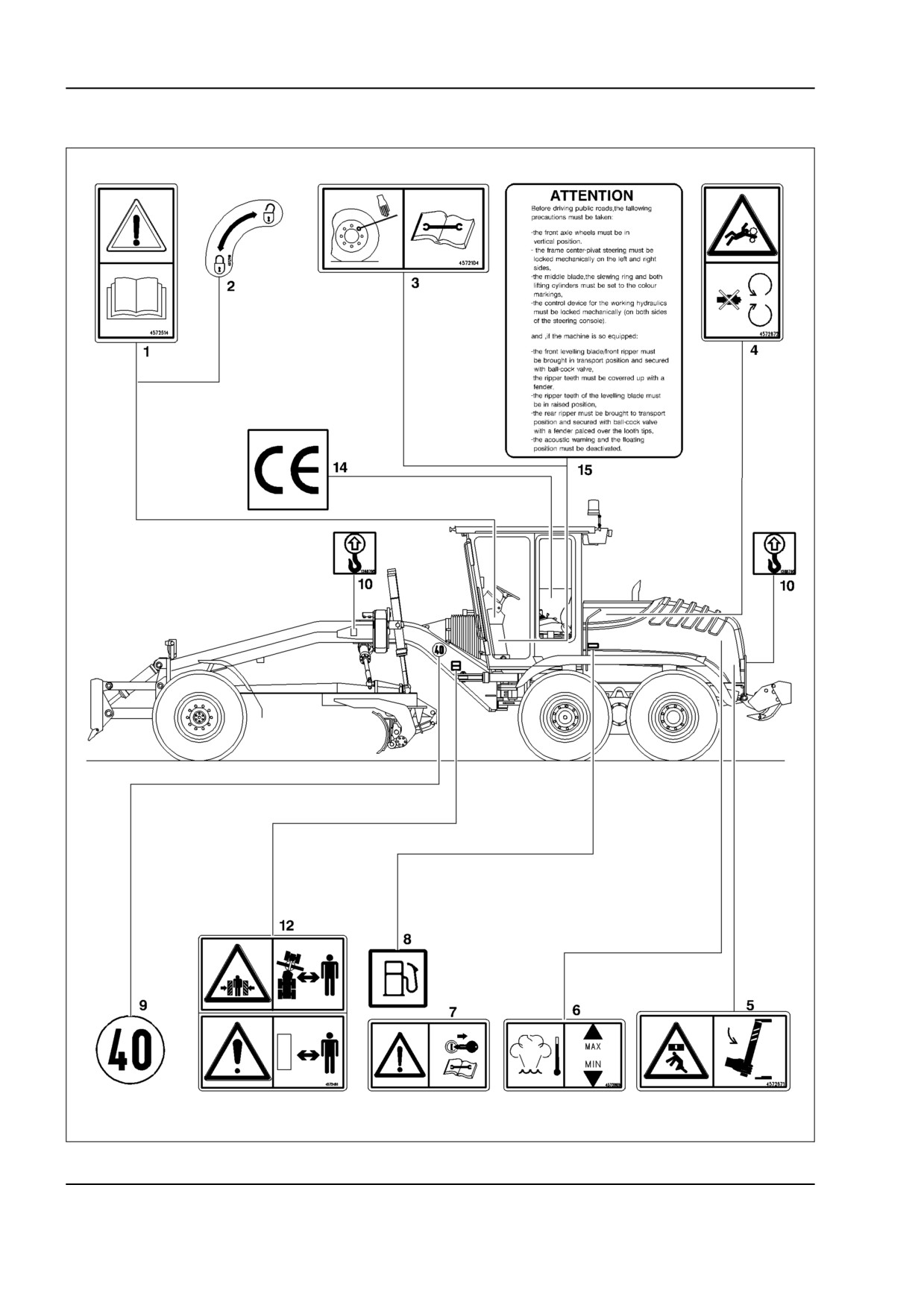
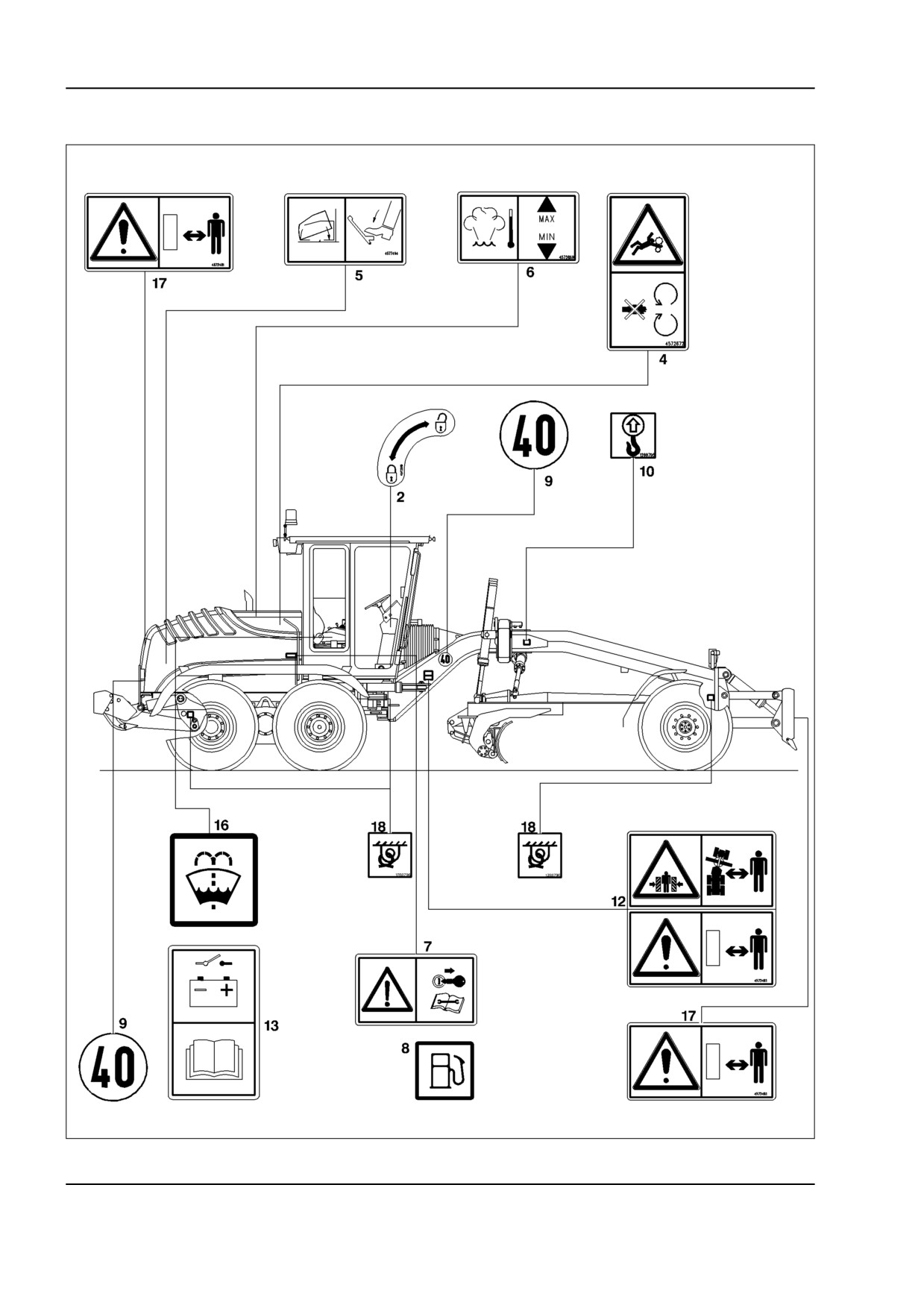
WARNING AND INSTRUCTION SIGNS
OKs1-00-001
Carefully read personal and machine SAFETY INSTRUCTIONS (at the beginning of this manual)
F156.6 / F156.6A
SAFETY INSTRUCTIONS
0 - 9
Always observe the warning and in-
struction signs attached to the ma-
chine.
Keep signs clean and legible.
Replace signs immediately if they
have become illegible.
New warning and instruction signs
can be ordered from the Spare-Parts
Service. The Part nos. required for
orders can be found in the Parts
Catalog of your machine.
LEFT SIDE
1.
The machine must not be started up unless the Op-
9.
This sign indicates the admissible maximum speed
eration and Maintenance Instructions Manual have
for driving on public roads
been read and understood
10.
Fixing points for fastening chains and ropes for ma-
2.
The equipment can be secured at this point against
chine transport
inadvertent activation
12.
Risk of injury through crushing. Never start up the
3.
Check wheel nuts at regular intervals; see Operation
machine without ensuring that nobody is standing
and Maintenance Instructions Manual
within the range of the center-pivot joint
4.
Risk of injury through hot or rotating components
Risk of injury through crushing. Never start up the
in the engine compartment. Never open engine hood
machine without ensuring that nobody is standing in
until engine is stationary
the area between the machine and a nearby obstacle
5.
Risk of injury through engine hood slamming
14.
The CE sign indicates that this machine has been
closed.
built in conformity with the European prescriptions
Open engine hood until the safety rod engages in
for the safety of machines. LWA is the level of noise
the lock position.
emissions specified in dBA (in acc. with standard
Read Operation and Maintenance Instructions
2001/14/EC)
Manual before carrying out any repair / servicing
15.
Driving on public roads. This sign specifies
work
measure to be taken before driving on public roads.
6.
Risk of injury through hot coolant. Open cap on ra-
diator only after the radiator has cooled down -
Coolant level indicators
7.
Risk of injury by unauthorized starting of the ma-
chine. Before undertaking any work on the machine
shut off the engine and withdraw the key
8.
Fuel tank, fill in diesel only
Carefully read personal and machine SAFETY INSTRUCTIONS (at the beginning of this manual)
0 - 10
SAFETY INSTRUCTIONS
F156.6 / F156.6A
OKs1-00-002
Carefully read personal and machine SAFETY INSTRUCTIONS (at the beginning of this manual)
F156.6 / F156.6A
SAFETY INSTRUCTIONS
0 - 11
Always observe the warning and in-
struction signs attached to the ma-
chine.
Keep signs clean and legible.
Replace signs immediately if they
have become illegible.
New warning and instruction signs
can be ordered from the Spare-Parts
Service. The Part nos. required for
orders can be found in the Parts
Catalog of your machine.
RIGHT SIDE
2.
The equipment can be secured at this point against
12.
Risk of injury through crushing. Never start up th
inadvertent activation
machine without ensuring that nobody is standing
4.
Risk of injury through hot or rotating components
within the range of the center-pivot joint
in the engine compartment. Never open engine hood
Risk of injury through crushing. Never start up the
until engine is stationary
machine without ensuring that nobody is standing in
5.
Risk of injury through engine hood slamming
the area between the machine and a nearby obstacle
closed. Close engine hood by disengaging the safety
13.
Damage to the alternator, regulator and electronic
bar with your foot. Read Operation and Maintenance
modules may result from the battery being discon-
Instructions Manual before carrying out any repair /
nected while the engine is running. Always stop the
servicing work
engine before disconnecting and removing batteries
6.
Risk of injury through hot coolant. Open cap on ra-
16.
Screen washer. Filler opening of screen-washer res-
diator only after the radiator has cooled down -
ervoir. Top up with water
Coolant level indicators
17.
Risk of injury through crushing. Never start up the
7.
Risk of injury by unauthorized starting of the ma-
machine without ensuring that nobody is standing in
chine. Before undertaking any work on the machine
the area between the machine and a nearby ob-
shut off the engine and withdraw the key
stacle.
8.
Fuel tank, fill in diesel only
18.
Fixing points for fastening chains and ropes for ma-
9.
This sign indicates the admissible maximum speed
chine transport
for driving on public roads
10. Fixing points for fastening chains and ropes for ma-
chine transport
Carefully read personal and machine SAFETY INSTRUCTIONS (at the beginning of this manual)
F156.6 / F156.6A
SAFETY INSTRUCTIONS
0 - 13
OPERATION
GENERAL INSTRUCTIONS
Never operate the machine before
SAFETY BELT
having read and understood the op-
For machines with a safety belt for
erating instructions.
operating personnel:
Pay special attention to:
Check safety belt attached to driver’s
seat. In the event of damage or after
"Fundamental Safety Instructions"
an accident, have it replaced imme-
and all warnings and safety instruc-
diately.
tions attached to the machine.
Apply safety belt before starting
Familiarize yourself with the layout,
work.
the functioning and the activating de-
vices of the control elements prior to
starting up the machine.
STATE OF THE MACHINE
Activate the control elements from
Operate the machine only in a safe
the driver’s seat only.
state and only in accordance with its
designated use. Always observe the
Keep the operating instructions with
safety instructions.
the machine at all times.
Always have inspection and mainte-
nance work carried out on schedule.
OPERATING PERSONNEL
The operating personnel must be
Operate the machine only with the
fully informed of the operation and
equipment and component combina-
application of this or comparable ma-
tions approved by the Manufacturer.
chines.
Clearcut data are given in the tech-
nical specifications.
The necessary know-how can be ac-
quired in several days’ instruction,
Never install and commission other
e.g. by a CNH mechanic or by at-
equipment and component combina-
tending a CNH operators’ training
tions without the Manufacturer
course.
having first inspected and approved
the project.
PERSONAL PROTECTIVE WEAR
Before starting work or travelling
AND WORKING CLOTHING
with the machine, check that the
Wear a safety helmet and working
braking, steering, signalling and
footwear with non-slip soles.
lighting systems are fully functional.
Smooth soles may slip from steps
and pedals, resulting in injury or in-
Poor visibility may result in acci-
correct operation.
dents. Always clean the windows
and the glass covers of all lights be-
Wear closely fitting working clothing
fore starting up the machine.
when operating the machine.
Loose, wide garments may result in
Check that all warnings and safety in-
the control lever being inadvertently
structions attached to the machine
activated.
are present and legible.
Carefully read personal and machine SAFETY INSTRUCTIONS (at the beginning of this manual)
0 - 14
SAFETY INSTRUCTIONS
F156.6 / F156.6A
ENTERING AND LEAVING
MARSHALLERS
THE MACHINE
The marshall must keep outside the
Use only the steps, platforms and
hazard zone.
handrails provided when entering
and leaving the machine.
Have a marshall to assist you:
- when you have no clear overview
Always keep steps, platforms, han-
over the hazard zone of the ma-
dles and handrails in a non-slip, safe
chine;
state and remove any oil, grease,
- when reversing;
soil, clay, snow, ice and other foreign
- when shunting.
matter immediately.
Use only those communication sig-
Always face the machine when en-
nals which you and the marshall un-
tering and leaving.
derstand, or use aids for
communication (e.g. walkie-talkie /
camera).
HAZARD RANGE
Calls cannot be understood by the
The hazard range is that zone around
marshaller because of the noise
the machine in which persons are
made by the machine during opera-
within reach of falling loads or falling
tion.
attachments due to operational
movements by the machine, to its
Keep in constant contact with the
equipment and attachments or to
marshaller.
swinging loads.
Stop the machine immediately if you
lose contact with the marshaller.
PERSONS WITHIN THE HAZARD
ZONE
Always use the horn to warn persons
SECURING THE MACHINE
in the immediate vicinity of the ma-
Secure the machine as described in
chine before starting up the machine.
the chapter "Securing the Machine"
before:
Ensure that no one sets foot in the
- mounting or dismantling the at-
hazard zone of the machine. Interrupt
tachment;
work until such persons have left the
- parking the machine after daily op-
hazard zone.
eration;
- carrying out any servicing or repair
work.
Carefully read personal and machine SAFETY INSTRUCTIONS (at the beginning of this manual)
F156.6 / F156.6A
SAFETY INSTRUCTIONS
0 - 15
REFUELLING
EXPLOSION HAZARD
FILLING IN FUEL
Fuels and fuel vapours are highly
Read and observe "Refuelling -
flammable and likely to explode.
safety instructions" before filling in
Therefore, avoid the formation of
fuel.
sparks and do not use open flames
such as lighters or matches for illu-
mination purposes.
REFUELLING FROM CANS
If the machine is filled up frequently
or regularly with fuel from cans or
POSSIBLE HEALTH HAZARD
drums, there is an increased risk of
Diesel fuel and the fuel vapours are
dirt particles and water getting into
a health hazard.
the fuel system.
Fuels must not be swallowed.
Avoid prolonged contact with the
In this case:
skin.
- always fill in fuel through a
Do not inhale the fumes.
finemeshed strainer;
Wear protective gloves or use a bar-
- use only microfilter-equipped suc-
rier cream.
tion hoses;
Do not eat, drink or smoke during re-
- dewater the fuel filter more often
fuelling.
than specified in the servicing plan;
- drain water and deposits from the
tank bottom at shorter intervals;
AVOID ENVIRONMENT POLLUTION
- replace all fuel filters at shorter in-
Avoid spilling fuel. Do not let fuel get
tervals.
into the ground, it pollutes the envi-
ronment.
Soak up any overflowing fuel imme-
NEVER FILL IN "BIO-DIESEL"
diately with cleaning rags or binding
The injection system and the engine
agents and discard without polluting
are at risk of being damaged if "Bio-
the environment.
diesel" is used.
Report fuel accidents immediately to
Fill up the machine only with diesel
the owner of the machine or to his
fuel made from mineral oils acc. to
representative.
the EN 590 standard.
For more information please contact
your dealer service.
SECURING THE MACHINE
Secure the machine against unau-
thorized starting during refuelling:
- park the machine on level and firm
ground;
- lower the working equipment to the
ground;
- switch off any fuel-operated auxil-
iary heaters and air conditioners;
- shut off the engine;
- apply the parking brake;
- withdraw the key from the keys-
witch of the electrical system.
Refuelling must always be per-
formed from the ground.
Carefully read personal and machine SAFETY INSTRUCTIONS (at the beginning of this manual)
0 - 16
SAFETY INSTRUCTIONS
F156.6 / F156.6A
REFUELLING SYSTEM (Option)
RISK OF EXPLOSION
Do not smoke and do not use naked
flames. Fuels and fuel vapours are
flammable. Risk of fire.
Switch off fuel-operated auxiliary
heating systems and air condi-
tioners.
HEALTH AND ENVIRONMENT
PROTECTION
Fuel may damage the skin. Wear pro-
tective gloves or use a barrier cream.
Do not spill fuel. Do not let fuel seep
into the ground. Fuel pollutes the en-
vironment.
Soak up any overflowing fuel imme-
diately with cloths or binding agents.
Then discard without polluting the
environment.
Report any accidents involving fuels
immediately to the owner of the ma-
chine or his authorized representa-
tive.
SECURING THE MACHINE
Secure the machine against unau-
thorized starting during refuelling:
- Lower the working equipment to
the ground
- Shut off the engine
- Withdraw the key from the elec-
trical system key-switch.
INCREASED RISK
OF CONTAMINATION
If the machine is refilled frequently
or regularly with fuel from cans or
barrels, there is an increased risk of
contamination for the fuel system.
In this case, the fuel prefilter must be
drained and cleaned more often than
specified in the servicing plans.
The fuel filter must be replaced at
shorter intervals.
Carefully read personal and machine SAFETY INSTRUCTIONS (at the beginning of this manual)
F156.6 / F156.6A
SAFETY INSTRUCTIONS
0 - 17
DRIVING
BEFORE SETTING OFF
PARKING THE MACHINE
Clean off any earth, mud, snow, ice,
Machines parked on sloping terrain
grease and oil adhering to your
may start moving inadvertently.
working footwear before operating
Park the machine therefore on a level
the machine. There is otherwise a
surface and lower the working equip-
risk of slipping off the pedals and in-
ment to the ground.
itiating inadvertent movements.
DRIVING LONG DISTANCES
Adjust the driver’s seat, steering
The blade must not interfere with the
column and mirrors and fasten the
steering range of the front wheels or
safety belt before setting off.
with the steering linkage.
Do not let other persons accompany
Do not start the machine when the
you on the machine.
central warning lamp is flashing; lo-
cate the cause of the fault before-
Warn anyone in the vicinity with the
hand and rectify.
horn before setting off.
When driving on public roads:
- Observe the requirements of the
machine’s general operating
DO NOT TOW TRAILERS
permit.
The machine is not suited for towing
- Close the cab door.
trailers or other vehicles. Risk of
- The first-aid kit, the warning tri-
damage to gearboxes and axles.
angle and the warning lamp must
The tow-bar coupling is provided
be on board.
only for towing or recovering the ma-
chine out of hazard areas or for fas-
- Check that the contents of the first-
tening of the machine on transport
aid kit is complete, replacing
vehicles; see also "Machine re-
missing or old parts.
covery / towing".
Check when the engine is running:
- When making short left / right turns
the steering wheel must move
DRIVING ON SLOPES
easily and the steering must react.
Make sure the wheels have sufficient
- After driving a short distance, the
grip; only then are the machine’s full
braking effect of the service brake
steering and braking capabilities
must be tested.
available.
Do not drive across slopes.
Never idle the machine with the gear
Never turn on slopes.
lever in neutral position, e.g. when
Never steer with the pivot steering on
driving downhill.
slopes.
When driving with the door open, it
must be locked in its limit position.
REVERSING
During reversing operations, your
Bring the machine to operating tem-
view of the hazard zone is restricted.
perature as described in the "Opera-
Therefore, seek the assistance of ex-
tion and Maintenance Istruction
perienced marshallers. Instruct the
Manual - Warming up the machine"
marshaller in order to ensure that
before setting off.
you understand his signals cor-
rectly.
Never demand full performance from
the engine unless the machine is at
operating temperature.
Carefully read personal and machine SAFETY INSTRUCTIONS (at the beginning of this manual)
0 - 18
SAFETY INSTRUCTIONS
F156.6 / F156.6A
SEAT BELT
Always belt up before driving.
Never run belt over rigid or fragile ob-
jects such as bunches of keys or
spectacles. This may result in injury.
The belt must always be flat and firm
against the body and must not be
jammed.
The buckle opening must not be
locked, e. g. with paper, as the buckle
can then not engage.
Damaged seat belts and those
stretched in an accident must be re-
placed.
ADJUSTING THE STEERING
COLUMN
Do not adjust the steering column
while driving. Concentrate on the
road to avoid accidents.
Before adjusting the steering
column:
- Stop the machine;
- Set the gearshift lever to neutral po-
sition;
- Apply the parking brake.
Carefully read personal and machine SAFETY INSTRUCTIONS (at the beginning of this manual)
F156.6 / F156.6A
SAFETY INSTRUCTIONS
0 - 19
MACHINE RECOVERY / TOWING
TRANSPORT
Tow the machine with a tow-rod or
The machine may be loaded and
towing cable only.
transported only if all safety regula-
tions are complied with.
The tow rod or cable must be undam-
aged.
Entrust loading and transporting of
They must be dimensioned in such a
the machine to a company experi-
way that the calculated breaking load
enced in the transport of heavy
is equal to three times the tractive
equipment.
power of the towing machine.
The responsibility for loading and
The towing vehicle must have ade-
transporting lies with the transport
quate tractive power. Drive slowly
company or their representative.
and carefully.
Remove oil, grease, soil, mud, snow,
All persons must keep clear of the
ice and other materials from the ma-
tow rod or cable.
chine’s wheels and from ramps and
Tow only if the brakes and steering
loading platforms of the transport ve-
of the machine are functioning prop-
hicle to minimize slipping.
erly and if the machine cannot be
transported in another way.
Use only tying equipment of suffi-
cient strength (the weights of the ma-
Tow defective machines only as far
chine are set out in the Section
as is needed to recover the machine
“Technical Data”).
from hazard zones.
After being recovered, the machine
CRANE LOADING
must be secured against inadvertent
movement and unauthorized
starting.
Block the pivot joint if the machine is
to be lifted by a crane for loading.
Repair the machine before trans-
porting it over longer distances, or
load it onto a transport vehicle.
The towing speed must not exceed
10 km/h. Tow the machine only out
of the hazard zone or transport it on
a low loader.
Excessive trailing may damage the
transmission.
TOW ROD COUPLING
The tow rod couplings must not be
used to tow trailers.
Carefully read personal and machine SAFETY INSTRUCTIONS (at the beginning of this manual)
0 - 20
SAFETY INSTRUCTIONS
F156.6 / F156.6A
WORKING OPERATION
GRADER DEPLOYMENT
The versatility of the graders and the wide range of
Read the chapters "Fundamental
materials handled allow many different applications
safety instructions" and "Operation
and working methods.
- General instructions" carefully and
observe the instructions given in
We therefore recommend initial operator instruction
these sections.
by the Manufacturer.
Inspect the site for underground gas,
power and water lines before starting
Read and observe: "Operation and
work. Any damage to such lines is a
Maintenance Instruction Manual -
life-threatening risk.
Warming up the machine".
Clean off any earth, mud, snow, ice,
Never exceed the admissible trans-
grease and oil adhering to your
verse and longitudinal inclination of
working footwear before operating
the machine. This affects or inter-
the machine. There is otherwise a
rupts the engine lubrication.
risk of slipping off the pedals and in-
itiating inadvertent movements.
The admissible engine inclinations
are:
When driving with the door open, it
must be locked in its limit position.
Transverse: left
/
right
35°
35°
Sound the hooter to warn persons in
the immediate vicinity of the machine
Longitudinal: deep
/
high
before starting work.
35°
35°
Never drive across slopes.
Lower the working equipment imme-
diately and shut off the engine if the
Never turn on slopes.
warning lights for engine tempera-
ture, engine oil pressure or alternator
Never steer with the pivot steering on
light up.
slopes.
Stop work if anyone is in the hazard
range of the machine. Continue
working only after such persons
have left the hazard range.
Always use and operate the machine
in such a way as to guarantee its sta-
bility.
Trenches and building pits may cave
in. Keep well clear of them.
Carefully read personal and machine SAFETY INSTRUCTIONS (at the beginning of this manual)
F156.6 / F156.6A
SAFETY INSTRUCTIONS
0 - 21
WORKING EQUIPMENT
PERSONNEL
TOOLS AND AUXILIARIES
Assembly work may be performed
Tools, lifting equipment, slings,
only by operating or repair personnel
chocks and other equipment must be
possessing the necessary know-
in safe operating and working condi-
how.
tion.
In the case of insufficient knowhow,
Metal splinters can cause injury
meticulous instruction must be
when accessory bolts are being
given by experienced personnel, e.g.
driven in and out. Therefore, a brass
by the Manufacturer.
or copper mandrel should be used
and protective goggles must be
The personnel must have read and
worn.
understood the operating instruc-
tions, especially the chapter "Funda-
When entering and leaving the cab,
mental safety instructions".
use only the intended steps, plat-
forms and handrails.
These people only may operate the
machine during installation, in order
Keep steps, platforms and handles in
to make corrections to the working
safe condition for footholds and
equipment.
handholds. Remove any oil, grease,
Misuse or improper operation of the
earth, clay, snow, ice other sub-
machine or its working equipment
stances immediately.
can be highly dangerous.
SECURING WORKING EQUIPMENT
PERSONAL PROTECTIVE
Set all working equipment down on
EQUIPMENT AND WORKING
the ground, so that no movements
CLOTHES
can occur if mechanical or hydraulic
Wear closely fitting working clothes
connections become detached.
when working on the machine.
Loose, wide working clothes can
When working in jointed areas lock
catch in machine parts and cause in-
the pivot joints. Remove the locks
jury.
when work is finished.
Wear a safety helmet, protective
Secure any equipment or compo-
working boots and gloves.
nents which are to be attached or de-
tached or whose position is to be
altered, with hoists or suitable
slinging/supporting devices to pre-
vent them from moving, slipping or
falling.
Carefully read personal and machine SAFETY INSTRUCTIONS (at the beginning of this manual)
0 - 22
SAFETY INSTRUCTIONS
F156.6 / F156.6A
SECURING THE MACHINE
SECURING THE MACHINE
Work on the working equipment
RISK OF INJURY
should only be carried out if the ma-
The machine must not be started by
chine has been secured as described
unauthorised persons.
in the chapter "Securing the ma-
Therefore, secure the machine.
chine".
Secure the machine as described below:
SELECTING THE WORKING
•
Before carrying out any servicing or repair work
EQUIPMENT
on the machine.
The machine can be fitted with a va-
•
Before fitting or changing the working equipment.
riety of working equipment. The
•
Park the machine on level, firm ground.
working equipment components are
•
Set working equipment down on the ground.
assembled with hydraulic cylinders
•
Apply parking brake.
and connectors. The components
can be combined in a variety of ways
so that the working equipment can
Never shut off the engine out of full
be best adapted to the specific task.
load, but continue running for ca.
three minutes at idling speed to cool
Operate the machine only with equip-
down.
ment and component combinations
approved by the Manufacturer for
•
Turn off engine.
this machine.
•
Remove key from the key switch in the electrical
Install and commission equipment
system.
and component combinations only
•
Depressurize the hydraulic system.
after the Manufacturer has checked
•
Lock the pivot joint.
the proposal and given its approval
•
Secure open hood.
in writing.
•
Secure the machine from rolling away by placing
chocks under the wheels.
Attachments from other manufac-
•
Switch off battery main switch and remove
turers subject to the EC Machine Di-
switching lever.
rective 89/392 EEC may be mounted
and put into operation only if:
•
Disconnect batteries before work on the electrical
system or before welding work.
- the manufacturer’s declaration of
conformity,
•
When doing welding jobs on the machine, observe
"Repair work - Welding operations”.
- the declaration of compatibility
from CNH are at hand.
Carefully read personal and machine SAFETY INSTRUCTIONS (at the beginning of this manual)
F156.6 / F156.6A
SAFETY INSTRUCTIONS
0 - 23
INSPECTION AND SERVICING
GENERAL INSTRUCTIONS
WORKSHOP MANUAL
SECURING WORKING EQUIPMENT
No inspection and servicing work
Stand working equipment on the
must be carried out until the Service
ground in such a way that no move-
Manual has been read and under-
ments can be made if mechanical or
stood.
hydraulic connections become de-
tached.
Pay special attention to the:
When working in jointed areas, block
off the joints. Remove the blocks on
"Fundamental Safety Instructions"
finishing work.
and all warnings and safety instruc-
tions attached to the machine.
If the machine has to be jacked up,
the front axle must first be wedged
The Workshop Manual contains the
in place to prevent it from moving.
necessary information in order to
Secure any equipment or component
perform all repair and maintenance
which is to be mounted or disman-
jobs.
tled, or whose position is to be
However working on the machine
changed, with hoists or appropriate
must be carried out only by special-
slinging/supporting devices to pre-
ised personnel specially trained for
vent them from moving, slipping or
this activity.
falling inadvertently.
INSPECTION AND SERVICING
SECURING THE MACHINE
PERSONNEL
Carry out servicing work only if the
Inspection and servicing personnel
machine is secured as described in
must have the necessary knowhow
the chapter "Securing the Machine".
on the inspection and servicing of
this or comparable machines.
CLIMBING ONTO AND OFF
The necessary know-how can be ac-
THE MACHINE
quired in several days’ instruction,
Use only the steps, platforms and
e.g. by a CNH mechanic or by at-
handrails provided when climbing
tending a CNH training course.
onto or off the machine.
Always keep steps, platforms, han-
dles and handrails in a non-slip, safe
PERSONAL PROTECTIVE
state and remove any oil, grease,
EQUIPMENT
soil, clay, snow, ice and other foreign
AND WORKING CLOTHING
matter immediately.
Wear closely fitting working clothing
when working on the machine.
Always face the machine when
Loose, wide garments may catch on
climbing on and off.
machine parts and result in injury.
Wear a safety helmet, safety foot-
wear, gloves and, in the event of high
CHECK STATE OF TOOLS
noise levels, ear protectors.
Use only fully functional, reliable
tools.
Select the right tool for the job.
Wrenches of the wrong size, for ex-
ample, may slip and cause injury.
Carefully read personal and machine SAFETY INSTRUCTIONS (at the beginning of this manual)
0 - 24
SAFETY INSTRUCTIONS
F156.6 / F156.6A
CLEANING JOBS
FASTENING AND SECURING
Clean the units within the working
ELEMENTS
range before starting work.
Check fastening and securing ele-
Select the cleaning agent according
ments, e.g. bolts, nuts, washers, be-
to the material constituting the parts
fore using them again.
to be cleaned.
Replace any damaged parts.
Example: Never clean rubber or elec-
trical parts with solvents or steam
jets.
HANDLING OILS AND GREASES
Use lint-free cleaning rags when
Hot lubricant or hydraulic oil
working on the hydraulic system or
emerging uncontrolled from the
the engine.
system may result in severe burns.
Cleaning agents and solvents may
give off harmful, readily flammable
Cool any burns immediately with
vapours.
running water and apply a dry
Never work with such agents except
dressing.
on well ventilated premises; never in-
hale the vapours and never smoke.
Never set foot within reach of the
Prevent solvents and cleaning
emerging oil jet.
agents from coming into contact with
the skin.
Avoid contact with the skin. Wear
Wear solvent-resistant gloves.
gloves and firm protective clothing.
Observe the instructions on the
packaging.
Used oil may be harmful to the skin.
Clean soiled skin thoroughly with
HANDLING FLAMMABLE LIQUIDS
warm soapy water and apply a barrier
When handling flammable liquids:
cream. Never use fuels or solvents
- never smoke;
for cleaning the skin.
- keep away from unshielded light
If you have swallowed any oil, avoid
sources and naked flames.
vomiting but consult a doctor or a
Fuel and other consumables often
hospital immediately.
have low flash points and are readily
ignited.
Never attempt to extinguish burning
VISIBLE LOSS OF OIL
liquids with water. Use:
Have any visible leakage repaired im-
- dry powder,
mediately.
- carbon dioxide or
- foam extinguishers.
Escaping oil is an environmental
hazard.
Water used for extinguishing
purposes would vapourize
Soak up any oil that has escaped with
instantaneously on contact with
a binding agent. Sweep up binding
burning substances and spread
agent and dispose of it separately
burning oil, for example, over a wide
from other waste.
area. Water generates short circuits
in the electrical system, possibly
producing new hazards.
Notify the fire brigade.
Carefully read personal and machine SAFETY INSTRUCTIONS (at the beginning of this manual)
F156.6 / F156.6A
SAFETY INSTRUCTIONS
0 - 25
RELIEVING RESIDUAL PRESSURE
ENVIRONMENTALLY COMPATIBLE
IN THE HYDRAULIC SYSTEM
DISPOSAL
Only unpressurized hydraulic sys-
Oils, greases, brake fluids, cleaning
tems may be opened. Even when a
agents, solvents and oily compo-
machine is parked on a horizontal
nents, e.g. filters, cleaning rags, re-
surface with its attachments sup-
placed wear parts and unserviceable
ported on the ground and its driving
machine parts, must be disposed of
motor switched off, there may still be
separately in the interests of environ-
substantial residual pressure in
mental protection.
parts of the hydraulic system, e.g.
primary pressure from the last hy-
Never dispose of such substances
draulic movements prior to stopping
with standard household refuse.
the machine.
Empty substances into the con-
Residual pressure is reduced only
tainers provided for this purpose.
gradually. If an intervention into the
hydraulic system is to be undertaken
Even biodegradable, "environmen-
immediately after stopping, depres-
tally friendly" hydraulic oil has to be
surize the system as described in the
disposed of separately like any other
Section “Hydraulic System".
oil.
Never allow oils and oily waste to get
SCREWED CONNECTIONS, PIPING,
into the soil or into water: environ-
HYDRAULIC HOSES
mental hazard!
Repair any leakages in the piping and
hose system immediately.
SEALING FACES
A fine, highly pressurized jet of hy-
Clean sealing faces prior to as-
draulic oil can penetrate the skin.
sembly.
Never search for leakages with the
fingers, but use a piece of cardboard
EXHAUST GASES
and always wear goggles.
Exhaust gases are a health hazard:
never inhale them.
If oil has penetrated into the skin,
consult a doctor immediately.
When working on enclosed
premises, draw off exhaust gases
Never repair damaged piping; always
with a suction plant and ventilate the
replace it.
premises well.
Replace hydraulic hoses immedi-
ately on detecting any damage or
moist areas.
Tighten leaking screw plugs only
when the system is depressurized.
Escaping oil is an environmental
hazard.
Carefully read personal and machine SAFETY INSTRUCTIONS (at the beginning of this manual)
0 - 26
SAFETY INSTRUCTIONS
F156.6 / F156.6A
HANDLING BATTERIES
SELECTING OILS AND GREASES
Batteries give off explosive gases.
Use the recommended qualities only,
matching viscosities with the tem-
Never handle batteries close to
perature level.
naked flames and unshielded light
sources, never smoke.
Remove batteries if welding or
FILTERS
grinding is to be done at close quar-
Replace all filter elements or filter
ters and store them in a safe place.
cartridges within the specified pe-
Battery acid is toxic and corrosive.
riods.
Avoid any contact with the skin,
All filters are coordinated carefully
mouth, eyes and clothing. Avoid
with the equipment. Original Parts
spilling battery acid or inhaling the
must be used to ensure smooth run-
vapours.
ning and a long service life of the en-
gine and the hydraulic units.
Wear solvent-resistant gloves, firm
protective clothing and goggles
when handling batteries.
SEALING ELEMENTS
If acid splashes onto the skin, rinse
When dismantling parts, pay atten-
off thoroughly with water, then seek
tion to sealing elements.
medical advice at a medical practice
Check sealing elements prior to in-
or hospital.
stallation and replace any that are
If the eyes are splashed with acid,
even slightly damaged.
rinse thoroughly with running water,
then seek medical advice immedi-
When assembling, ensure a perfect
ately at an opthalmological practice
fit.
or a hospital.
Never wear metal necklaces, brace-
OIL-LEVEL CHECK
lets or watch-straps when working
AND OIL CHANGE
on the battery. The metal parts may
Position the machine horizontally.
induce a short circuit, resulting in
burns.
Change the oil when the machine is
at operating temperature.
Dispose of used batteries separately
Warm oil flows better and carries
from other waste in the interests of
suspended particles (carbon or
environmental protection.
abraded matter) better.
PRIOR TO WORK
LUBRICATING
ON THE ELECTRICAL SYSTEM
Clean the lubricating nipple, then lu-
Prior to any work on the electrical
bricate as scheduled.
system involving tools, spares etc.
coming into contact with electric ca-
bles or contacts, disconnect the bat-
tery.
AFTER SERVICING
To prevent corrosion, coat all bright
Disconnect first the negative pole,
metal parts with a grease film.
then the positive pole.
On completing work, reinstall all pro-
After work:
tective devices.
Connect first the positive pole, then
the negative pole.
Never start up the drive motor while
Read and observe the chapter "Elec-
work is being done on the machine.
trical system".
Carry out a performance test with the
machine.
Carefully read personal and machine SAFETY INSTRUCTIONS (at the beginning of this manual)
F156.6 / F156.6A
SAFETY INSTRUCTIONS
0 - 27
FUEL SYSTEM
EXPLOSION HAZARD DUE
NEVER FILL IN "BIO-DIESEL"
TO VAPOURS
The injection system and the engine
Fuel vapours are easily flammable
are at risk of being damaged if "Bio-
and likely to explode. Therefore,
diesel" is used.
avoid the formation of sparks and do
not use open flames such as lighters
Fill up the machine only with diesel
or matches for illumination pur-
fuel made from mineral oils acc. to
poses.
the EN 590 standard.
When you have to work on the fuel
For more information please contact
system:
your Dealer service.
- shut off the engine and the auxiliary
heating;
REFUELLING FROM CANS
- secure the machine;
If the machine is filled up frequently
- avoid open flames;
or regularly with fuel from cans or
- do not eat, drink or smoke.
drums, there is an increased risk of
dirt particles and water getting into
the fuel system.
POSSIBLE HEALTH HAZARD
Diesel fuel and the water / fuel mix-
In this case:
ture drained off are a health hazard.
- always fill in fuel through a
These liquids must not be swal-
finemeshed strainer;
lowed.
- dewater the fuel filter more often
Avoid prolonged contact with the
than specified in the servicing plan;
skin.
- drain water and deposits from the
Do not inhale the fumes.
tank bottom at shorter intervals;
Wear protective gloves or use a bar-
- replace all fuel filters at shorter in-
rier cream.
tervals.
AVOID ENVIRONMENT POLLUTION
Collect escaping fuel and discard
without polluting.
Fuel filter cartridges and fuelstained
cleaning rags must be disposed of
separately from other waste.
Carefully read personal and machine SAFETY INSTRUCTIONS (at the beginning of this manual)
0 - 28
SAFETY INSTRUCTIONS
F156.6 / F156.6A
ELECTRICAL SYSTEM
Risk of injury from battery acid and
ALTERNATOR
gases.
Never disconnect electrical connec-
tions on the alternator, regulator and
Wear goggles, protective gloves and
battery when the engine is running.
strong working clothes.
This would damage the alternator
and regulator.
PRIOR TO WORKING ON THE ELEC-
TRICAL SYSTEM
When connecting the batteries,
Shut off the engine.
never interchange the cables (pay at-
Set ’Electrical System’ key switch to
tention to polarity).
0 and withdraw key.
Voltage and continuity tests must be
Set battery main switch to OFF and
done with a meter only.
withdraw switching lever.
Disconnect control elements and
Never use a test lamp.
control console from machine cir-
cuit.
Never check by touching ground
with a bare wire.
Prior to working on the electrical
system where tools, spare parts, etc.
The resulting short circuit damages
may come into contact with electrical
the alternator and the regulator.
cables or contacts, turn off the bat-
tery main switch or disconnect the
When starting up the engine, the al-
battery.
ternator is controlled (pre-excited)
Disconnect the negative pole first,
by an electronic circuit. This ensures
then the positive pole.
that the alternator can discharge
power.
After work:
Reconnect the positive pole first,
The circuit is an integral part of the
then the negative pole.
central electronic system in the con-
sole.
Read and observe "Operating In-
structions - Alternator, control ele-
A LED in the console (load control)
ments and control console".
shows that the alternator is func-
Read and observe "Inspection and
tioning correctly. This LED must light
servicing - General instructions".
up when the key-switch is switched
on and go out when the engine is run-
Always use a meter for voltage and
ning.
continuity testing.
If this is not the case, there is a fault
Do not use any test lamp.
in the alternator circuit or in the con-
sole.
Do not "tap against ground".
This will cause a short circuit with
To prevent further damage, the
consequent damage to the generator
cause of the fault must be located
or to the PCS electronic system.
and rectified as quickly as possible.
Consult your local Dealer.
Carefully read personal and machine SAFETY INSTRUCTIONS (at the beginning of this manual)
F156.6 / F156.6A
SAFETY INSTRUCTIONS
0 - 29
POWERSHIFT TRANSMISSION
HYDRAULIC SYSTEM
Read and observe: "Inspection and
RISK OF INJURY
servicing - General instructions".
from hydraulic oil under high pres-
sure.
As the torque converter of the pow-
ershift transmission may be emptied
from hydraulic fluid or hot parts of
into the transmission while the en-
the engine.
gine is stationary, the oil level must
be checked while the engine is run-
Before working on the hydraulic
ning.
system, make sure the system has
been depressurized and that any re-
It is vital therefore to respect the
sidual pressure has also been re-
safety instructions set out in the fol-
leased (see the section "Hydraulic
lowing sections.
system").
Shut off the engine and let the ma-
chine cool down.
Secure the machine as described in
the chapter "Securing the machine".
Avoid skin contact with hydraulic
oils. Skin contact with hydraulic oils
is a health hazard.
Wear gloves and firm working
clothing.
Read and observe: "Inspection and
servicing - General instructions".
Carefully read personal and machine SAFETY INSTRUCTIONS (at the beginning of this manual)
0 - 30
SAFETY INSTRUCTIONS
F156.6 / F156.6A
BRAKES
PERSONAL
ACCUMULATORS
Do not carry out inspection and
Accumulators are installed in the hy-
maintenance work on brakes unless
draulic system. These accumulators
you are qualified for working on
contain nitrogen under high initial
brake systems.
pressure.
If in doubt, have the work performed
Even when the hydraulic pressure in
by our after-sales service.
the system is reduced, the nitrogen
remains in the accumulator.
Read and observe the instructions in
the section: "Inspection and serv-
The accumulators are completely
icing - General instructions".
safe in operation. If incorrectly han-
dled, however, there is a risk of ex-
plosion.
SECURING THE MACHINE
So:
Inspection and maintenance work on
- Never handle accumulator me-
brakes should only be carried out if
chanically, never weld or solder it.
the machine has been secured as de-
- Testing and servicing work must be
scribed in the section "Securing the
carried out by experts only.
machine".
- Prior to any testing and servicing
work, depressurize the hydraulic
part of the system.
HEALTH PRECAUTIONS
- To dismantle the accumulator, al-
Do not inhale abraded particles from
ways wear goggles and working
brake linings. Wear a breathing
gloves.
mask.
- Fill accumulator with nitrogen only,
never with compressed air or ox-
ygen.
- Report any defects or damage to
the machine owner without delay.
- Prior to recommissioning, an in-
spection by a specialist or expert is
essential if the accumulator was
damaged or if the admissible oper-
ating temperature or operating
pressure was exceeded.
Never remove or paint over warning
and information plates, rating plates
or type identification markings. Re-
place illegible or damaged plates im-
mediately.
Carefully read personal and machine SAFETY INSTRUCTIONS (at the beginning of this manual)
F156.6 / F156.6A
SAFETY INSTRUCTIONS
0 - 31
TYRES AND WHEELS
RISK OF INJURY
TYRE PRESSURE
Heat-induced combustion of gas in-
Bursting tyres and parts splintering
side the tyre may lead to explosions
away from the rims or from the tyre
in air-inflated tyres.
itself may cause severe injury.
This heat may be due, for instance,
The following instructions must
to frequent use of the brakes or to
therefore be strictly observed:
welding work carried out on the ma-
-
Before inflating the tyre, check the
chine. A heat-induced tyre explosion
tyres, rims and rim parts for
is more violent than that occuring
damage, penetrated foreign ob-
during normal bursting of tyres.
jects and proper fitting.
Such an explosion can eject parts of
-
Have all damage detected repaired
the tyre and the rim over several hun-
by a qualified workshop.
dreds of meters. Exploding and/or
-
Check the tyre inflation pressure
bursting tyres and ejected parts of
only when the tyres are cold. After
tyres and rims may cause severe or
warming up, the pressures indi-
sometimes even fatal injuries.
cated are higher than ususal.
-
Use a tyre inflator with a long filling
Therefore:
hose, snap-on valve and pressure
-
If a tyre is suspected to be too hot,
gauge.
secure the machine and wait some
-
Use only compressed ambient air
distance away until the tyre has
for inflating the tyres. Never use
cooled down.
flammable gases: risk of explosion.
-
Before inflating the tyre, check the
tyre itself, the rims and rim compo-
-
Keep away from the tyre during in-
nents for damage, penetrated for-
flation and always stand besides
eign objects and perfect fit.
the tyre tread.
-
Have detected faults always recti-
-
Watch the tyre and the gauge of the
fied immediately by specialized
filling gear permanently during in-
workshops.
flation and never exceed the spec-
-
If you are in doubt about the safe
ified tyre pressures.
condition of the tyre, the rims or rim
-
Place a safety cage around disman-
components, do nothing yourself
tled wheels.
but have the complete wheel re-
-
When pumping up, make sure all
moved by a special workshop.
persons are well clear of the tyre.
Changing of tyres, rims or rim com-
ponents requires special tools and
Always inflate the tyres to the pre-
procedures and must therefore al-
scribed pressure:
ways be carried out by a workshop
- Excessive pressures result in poor
with special equipment for this kind
off-road handling properties and
of work.
tyres may burst;
-
Never carry out works on rims and
tyres unless you are qualified to do
- Insufficient tyre pressures lead to
so.
increased tyre wear and to inade-
quate stability of the machine.
WHEEL-NUTS
Always tighten the wheel-nuts with a
torque wrench. Recheck with a
torque wrench for tightness after
several hours of operation.
Carefully read personal and machine SAFETY INSTRUCTIONS (at the beginning of this manual)
0 - 32
SAFETY INSTRUCTIONS
F156.6 / F156.6A
DRIVING ON ROADS
When driving on the road check that
the tyres have the prescribed min-
imum tread and the correct air pres-
sure.
Always make sure that both axles are
equipped with tyres of the same size
and same degree of wear.
Tyres with different diameters may
cause damage to the differentials.
To avoid excessive tyre wear:
- inflate to the correct air pressure;
- do not start or brake abruptly;
- take corners slowly.
Clean the tyres and the gaps between
the tyres before driving on public
roads. This helps to avoid putting
other road users at risk from soiled
traffic lanes or from lumps of soil or
stones ejected from the wheels.
Carefully read personal and machine SAFETY INSTRUCTIONS (at the beginning of this manual)